
Life, 1893-11-16 · page 12 of 14
Life — November 16, 1893 — page 12: what you’re looking at
What you’re looking at
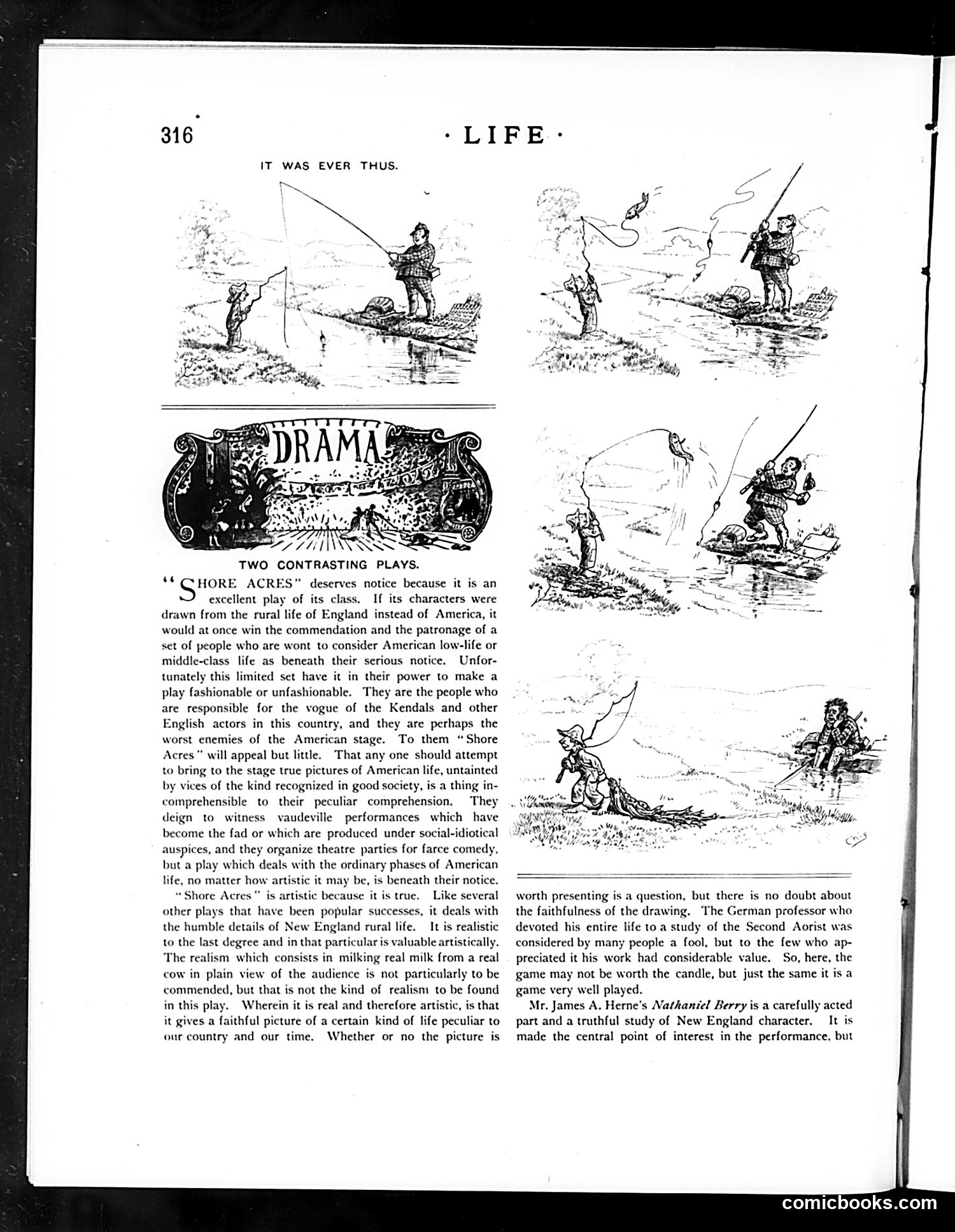
This page critiques American theater snobbery through two contrasting plays. The sketches at top show fishing scenes, illustrating the caption "It Was Ever Thus"—suggesting timeless class distinctions. The text defends "Shore Acres," a realistic play about New England rural life, against cultural elitism. Life argues that wealthy American audiences dismissively prefer English actors and artificial farce comedy over honest depictions of American working-class life. These tastemakers consider American "low-life" beneath serious notice. The review praises "Shore Acres" precisely *because* it's artistically true and realistic—not because the subject matter is inherently important (comparing it to a German scholar studying obscure grammar). The criticism targets the cultural gatekeepers who control what becomes "fashionable" on American stages, arguing their prejudice against American subject matter damages American theater itself.
📄 Transcribed text from this page (OCR, searchable)
Machine-transcribed from the original scan — historical spelling and the odd misread are preserved.
IT WAS EVER THUS. TWO CONTRASTING PLAYS. ** CHORE ACRES” deserves notice because it is an excellent play of its class. If its characters were drawn from the rural life of England instead of America, it would at once win the commendation and the patronage of a set of people who are wont to consider American low-life or middle-class life as beneath their serious notice. Unfor- tunately this limited set have it in their power to make a play fashionable or unfashionable. They are the people who are responsible for the vogue of the Kendals and other English actors in this country, and they are perhaps the worst enemies of the American stage. To them “Shore Acres" will appeal but little. That any one should attempt to bring to the stage true pictures of American life, untainted by vices of the kind recognized in good society, is a thing in- comprehensible to their peculiar comprehension. They deign to witness vaudeville performances which have become the fad or which are produced under social-idiotical auspices, and they organize theatre parties for farce comedy, but a play which deals with the ordinary phases of American life, no matter how artistic it may be, is beneath their notice. “Shore Acres” is artistic because it is true. Like several other plays that have been popular succe: it deals with the humble details of New England rural life. It is realistic to the last degree and in that particular is valuable artistically, The realism which consists in milking real milk from a real cow in plain view of the audience is not particularly to be commended, but that is not the kind of realism to be found in this play. Wherein it is real and therefore artistic, is that it gives a faithful picture of a certain kind of life peculiar to our country and our time. Whether or no the picture is worth presenting is a question, but there is no doubt about the faithfulness of the drawing. The German professor who devoted his entire life toa study of the Second Aorist was considered by many people a fool, but to the few who ap- preciated it his work had considerable value. So, here, the game may not be worth the candle, but just the same it is a game very well played. Mr. James A. Herne’s Nathaniel Berry is a carefully acted part and a truthful study of New England character. It is made the central point of interest in the performance, but comicbooks.com