
A complete issue · 18 pages · 1893
Life — August 3, 1893
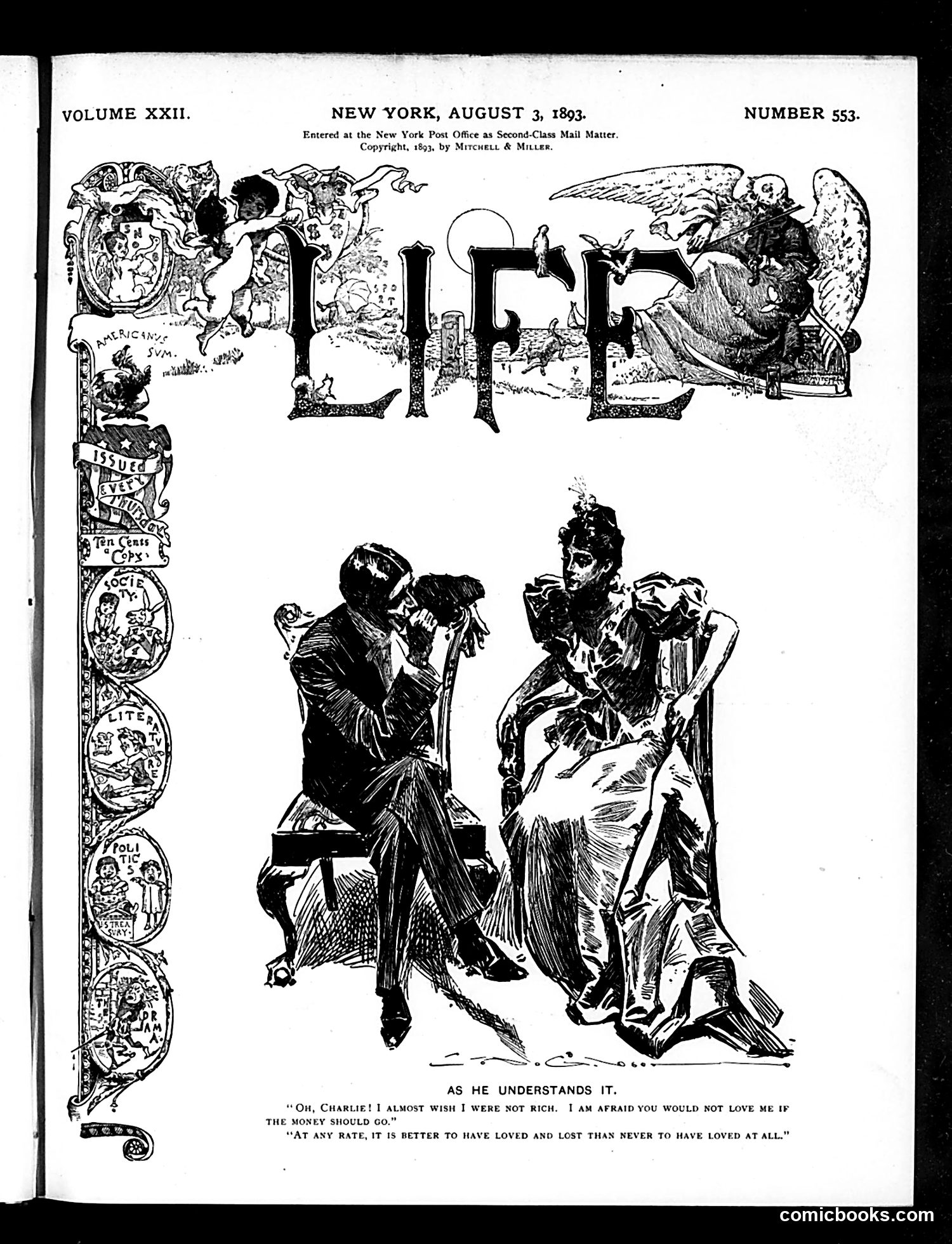
This page features a romantic dialogue between two figures—a man and woman in intimate conversation. The caption reveals the central tension: the man expresses fear that a woman won't love him without wealth, while she counters that experiencing love and loss is preferable to never loving at all. The cartoon satirizes anxieties about **marriage and money** in the Gilded Age, when economic status heavily influenced matrimonial prospects. The woman's philosophical response challenges the materialism of the era, suggesting that genuine emotional connection transcends financial considerations. The elaborate decorative border featuring classical figures and medallions is typical of Life's artistic presentation during this period. The specific identities of these figures remain unclear from the image alone.
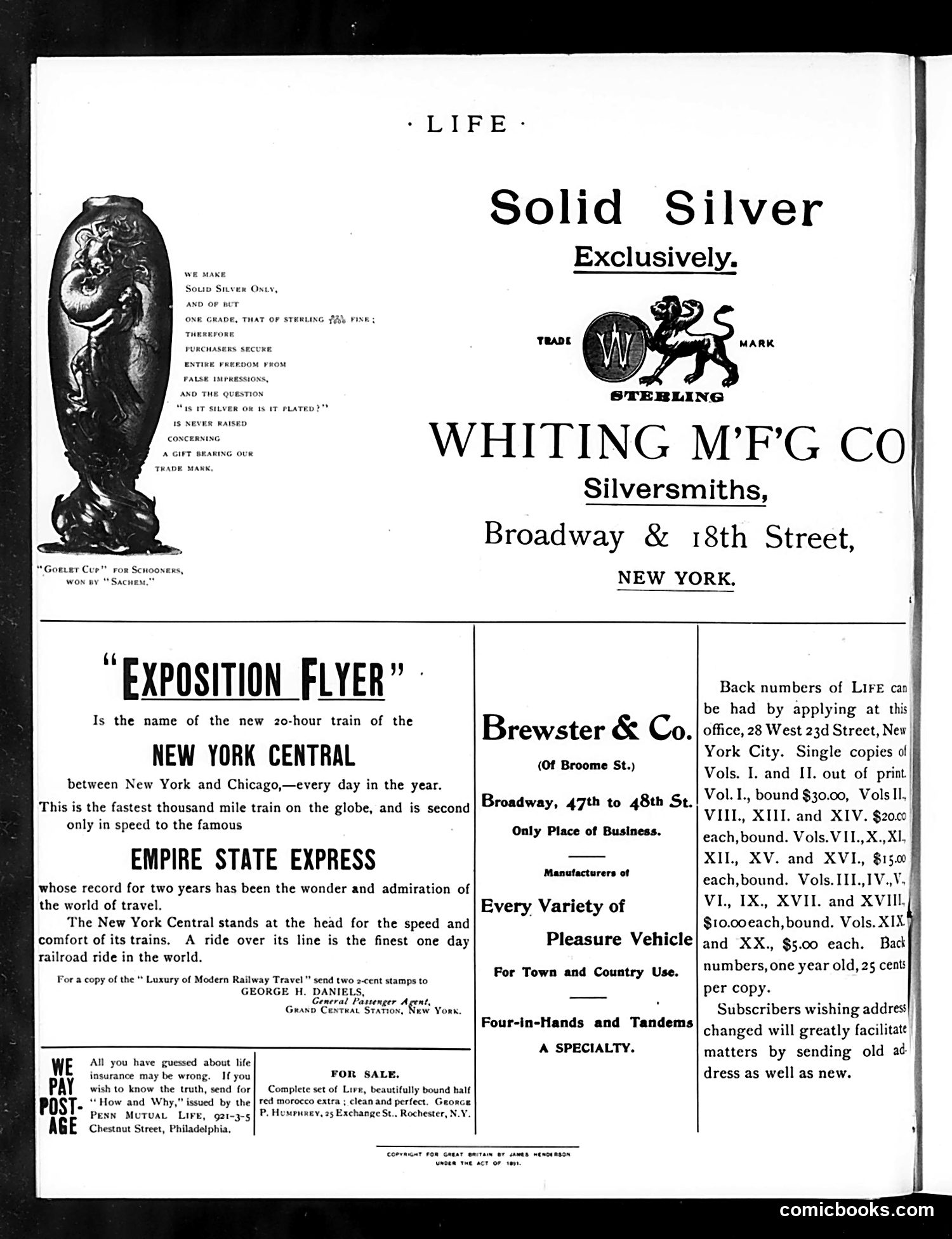
This page is primarily **advertising**, not political satire or cartoons. The main content features an advertisement for **Whiting Manufacturing Company**, a New York silversmith located at Broadway & 18th Street. They emphasize making "Solid Silver Exclusively" and showcase a decorative silver vessel called the "Goblet Cup" (won by "Sachen," likely a competition winner). The text stresses quality assurance: their sterling silver cannot be confused with plated goods, addressing consumer concerns about authenticity—an important selling point for expensive silverware. The page also contains advertisements for the New York Central Railroad's "Exposition Flyer" train service and Brewster & Co., a manufacturer of pleasure carriages and vehicles. No political commentary or satirical cartoons appear on this page.
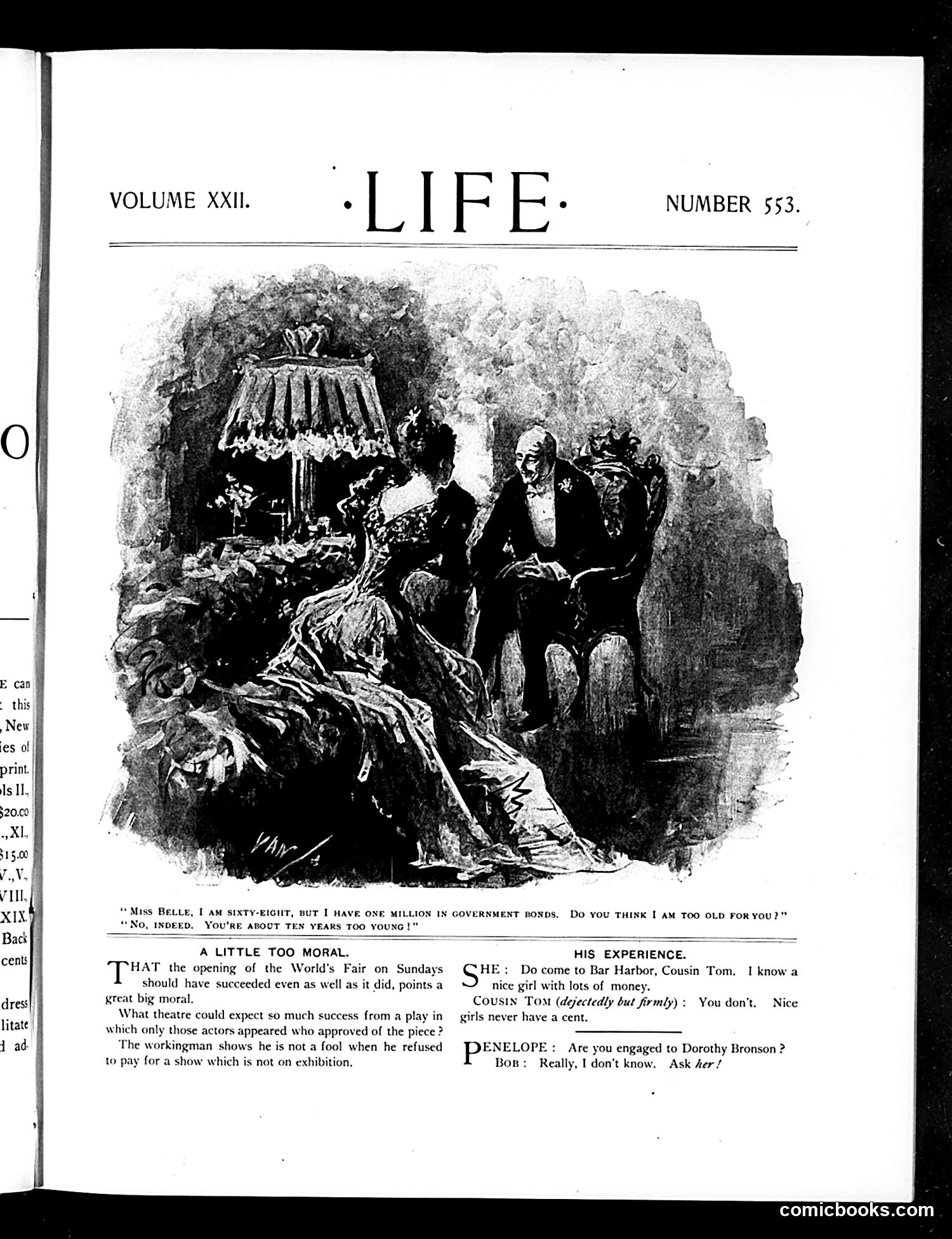
This page contains two brief satirical pieces. The main illustration depicts a social scene where a wealthy woman claims to have "one million in government bonds" while dismissing a suitor as "about ten years too young." **"A Little Too Moral"** critiques theatrical morality—specifically that a play's success shouldn't depend on having "approved" actors, and that workingmen show good judgment by refusing to pay for non-exhibition shows. **"His Experience"** is a brief comedic exchange about a girl with money but no sense, contrasting her wealth with her lack of common sense. The satire targets wealth, social pretension, and gender dynamics of the era. The exact historical context remains unclear without additional publication details.
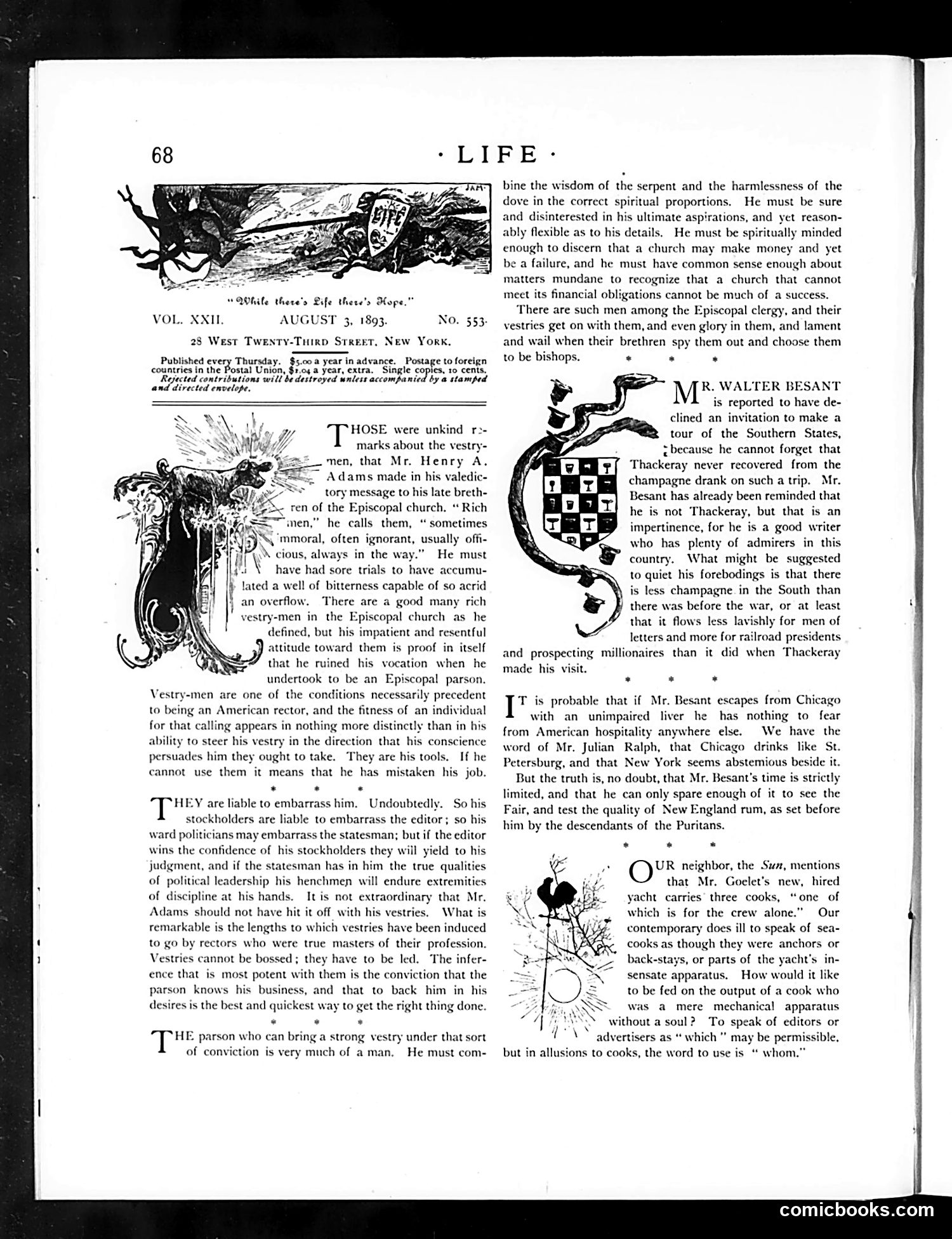
This page contains **editorial commentary on Episcopal Church governance**, not political cartoons. The main article criticizes "vestry-men" (parish administrators) in the Episcopal Church, arguing they often lack the temperament and wisdom needed for leadership roles. The text discusses how vestrymen can embarrass church rectors and damage parish finances through poor judgment. The author argues that while vestrymen are "tools" necessary for church function, they require strong leadership and should defer to the rector's expertise. The decorative illustrations are period ornaments rather than satirical cartoons—typical of 1890s magazine design. The content reflects internal debates within American Protestant denominations about ecclesiastical authority and lay governance during this era.
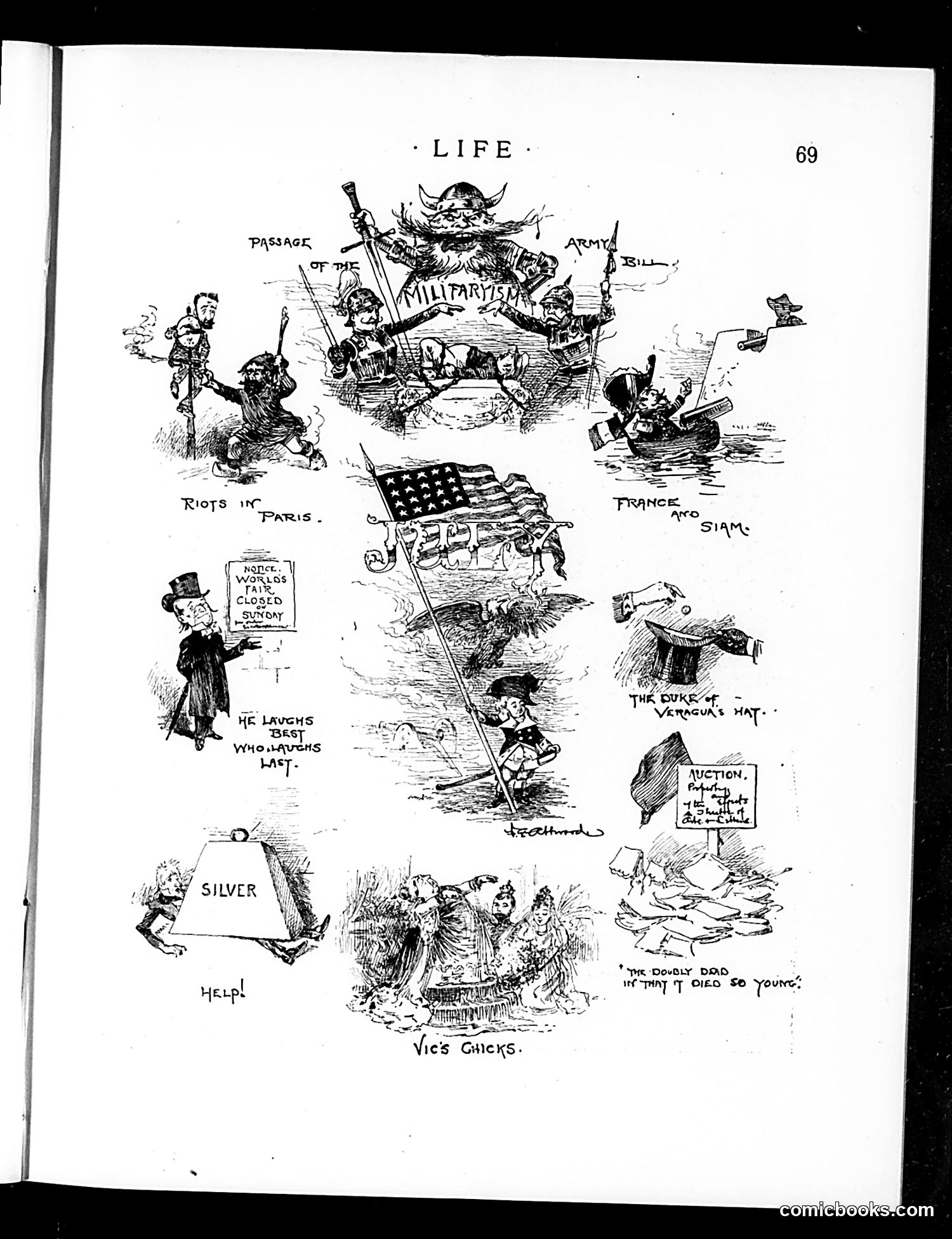
This satirical page presents multiple vignettes criticizing American foreign policy and domestic issues, likely from the early 20th century. Central is a map of the United States supporting an "Army of Militarism," labeled with global interventions: "Passage of the Philippines," "France," "Siam," and "Army Bill." Surrounding scenes mock specific situations: "Riots in Paris," "France and Siam" (colonial conflicts), and "The Duke of Connaught's Hat" (unclear reference). A figure labeled "He laughs best who laughs last" holds a notice about "World's Fair Closed Due to Outbreak." The "Silver" figure crying "Help!" and "Vics Chicks" at bottom, plus an "Auction" scene, suggest economic anxieties. Overall, the cartoon critiques American military expansion abroad while domestic problems fester at home.
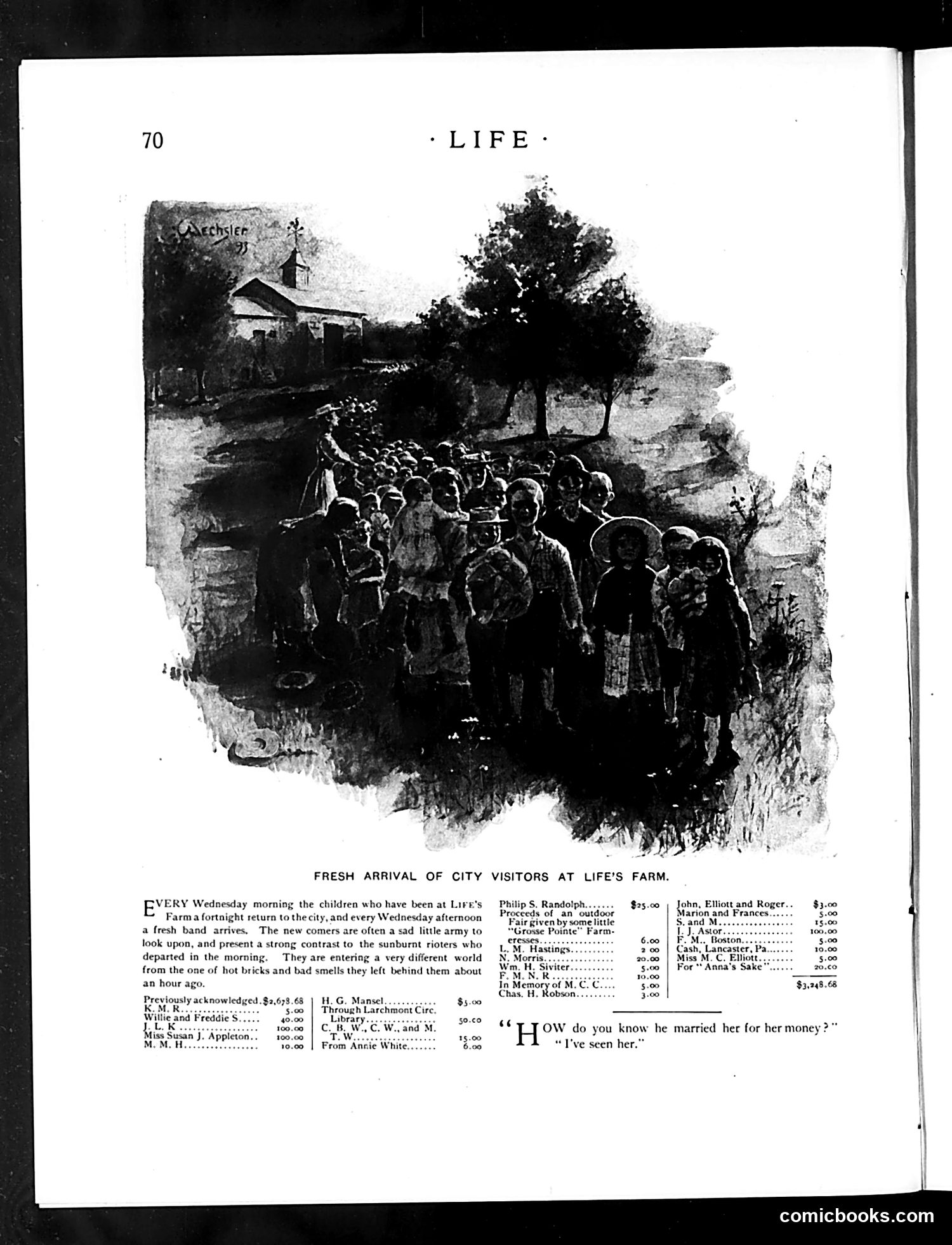
This page from *Life* magazine features an illustration titled "Fresh Arrival of City Visitors at Life's Farm" depicting a large group of urban visitors arriving at a rural farm property. The image shows well-dressed city people, including children and adults in hats and formal clothing, gathering near a church and farmstead. The satirical point appears to be social commentary on the contrast between urban and rural life—specifically, the incongruity of city dwellers (unfamiliar with farm work) visiting or attempting agricultural life. The gathered crowd's formal attire and their apparent unfamiliarity with their surroundings suggests humor at their expense. Below is a list of financial contributors to *Life's Farm*, apparently a real property or project. The page concludes with a brief joke about marriage and money, unrelated to the main illustration.
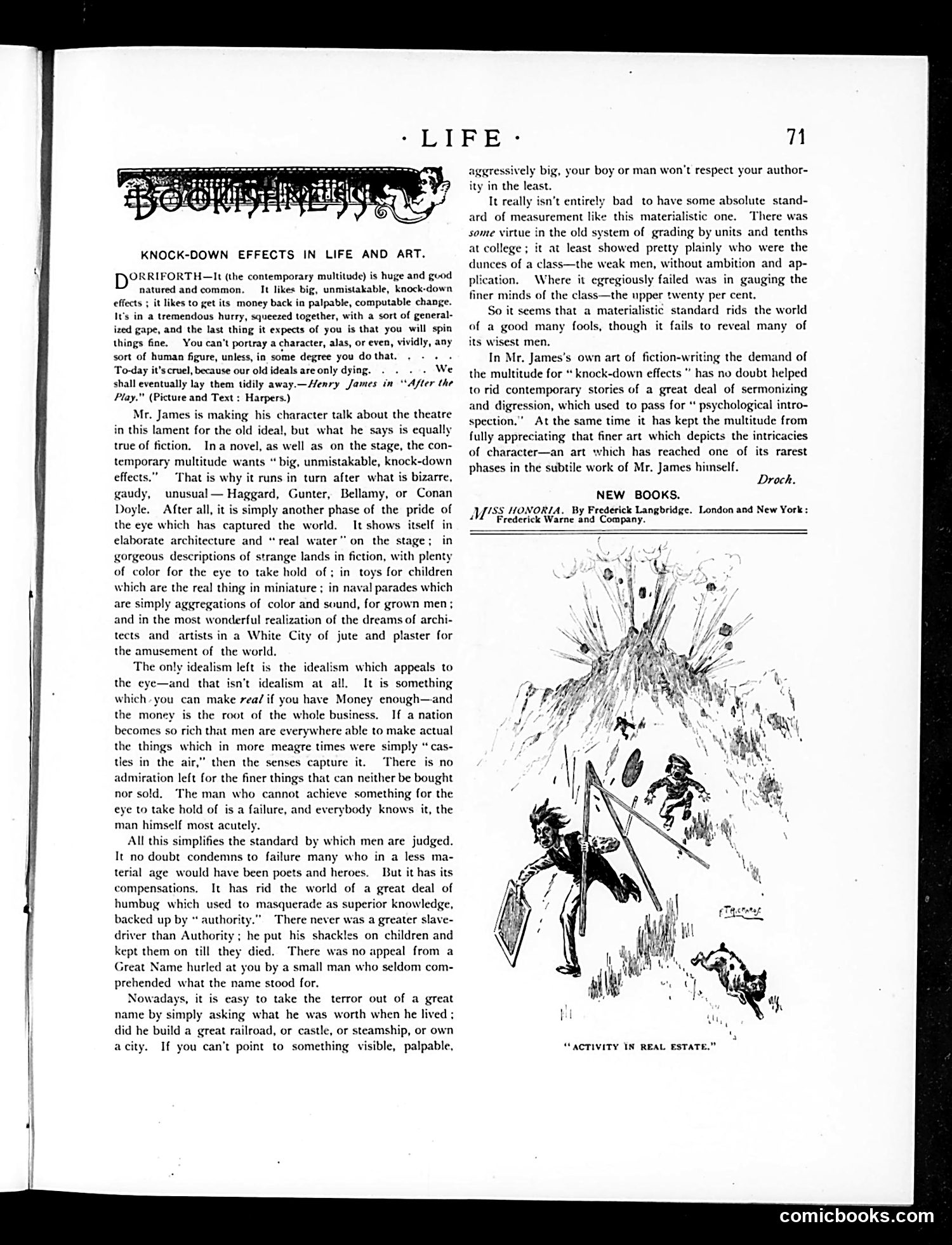
The cartoon illustrates the text's discussion of theatrical "knock-down effects"—exaggerated, sensational staging techniques used in contemporary theater to impress audiences. The sketch depicts what appears to be a chaotic real estate or construction scene, with figures climbing or falling on a steep hillside or cliff face. The caption "ACTIVITY IN REAL ESTATE" is ironic—rather than showing legitimate property development, it shows comic mayhem and dangerous climbing. This satirizes how both theater and contemporary society (apparently during a real estate boom) prioritize spectacular visual effects and dramatic action over substance. The cartoon mocks this preference for sensationalism as a substitute for genuine accomplishment or value, tying into the page's broader critique of materialism and shallow standards of judgment in modern life.
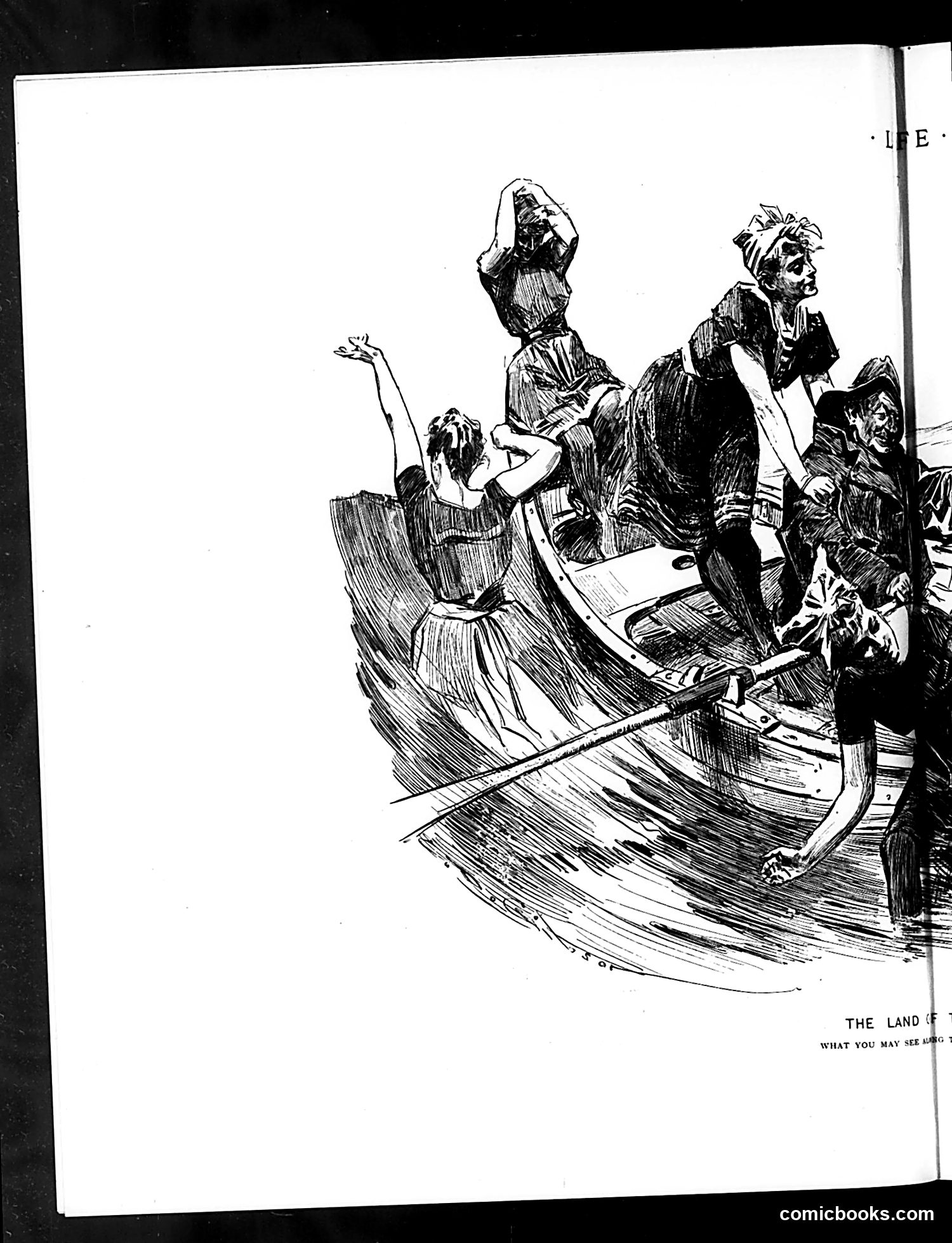
This satirical illustration depicts a boat scene titled "THE LAND OF [text cuts off]" with the subtitle "WHAT YOU MAY SEE UPOR [text cuts off]." The drawing shows four figures in a small boat, rendered in Life magazine's characteristic caricature style. The composition appears to satirize a specific social or political scenario involving leisure travel, likely critiquing either wealthy tourists, immigration, or societal class dynamics of the era. The detailed cross-hatching and expressive figure work are typical of early 20th-century American satirical illustration. However, **without the complete caption text, I cannot definitively identify the specific figures, historical event, or satirical point being made.** The partial text prevents certain interpretation of the cartoon's actual subject and intended message for modern readers.
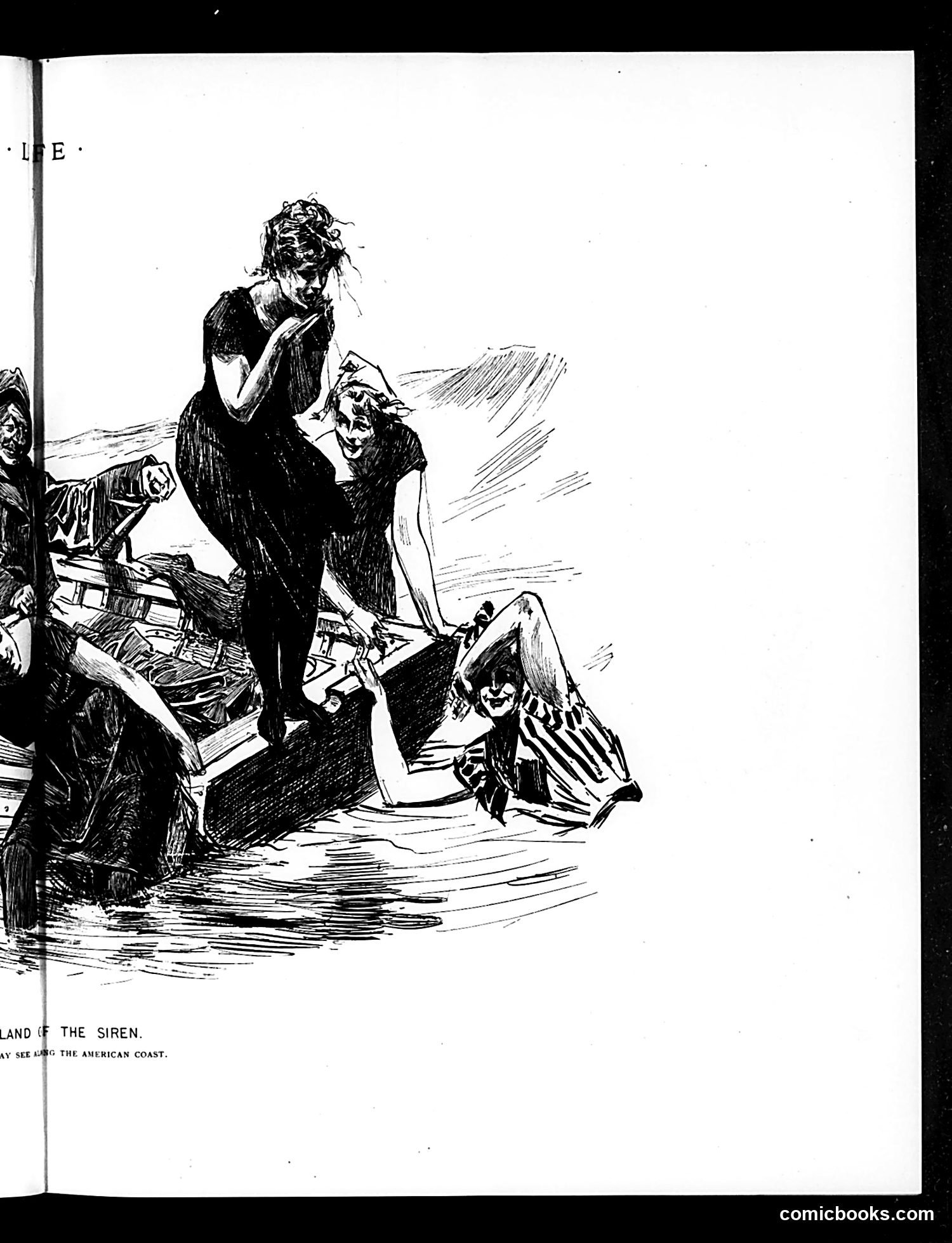
This satirical illustration depicts a classical "siren" myth scenario adapted to contemporary commentary. The image shows a standing woman in dark clothing addressing or gesturing toward seated figures below, with water suggested by horizontal lines at the bottom. The title "Land of the Siren" references the legendary Greek sirens—mythological women whose enchanting songs lured sailors to their doom. In Life magazine's satirical tradition, this appears to use the siren myth as metaphor for female seduction or deception as a social/political danger. The specific political or social target remains unclear from the visible text alone ("American Coast" is referenced), but the composition suggests commentary on women's influence or power during this era—likely engaging contemporary debates about gender roles, morality, or women's changing social position.
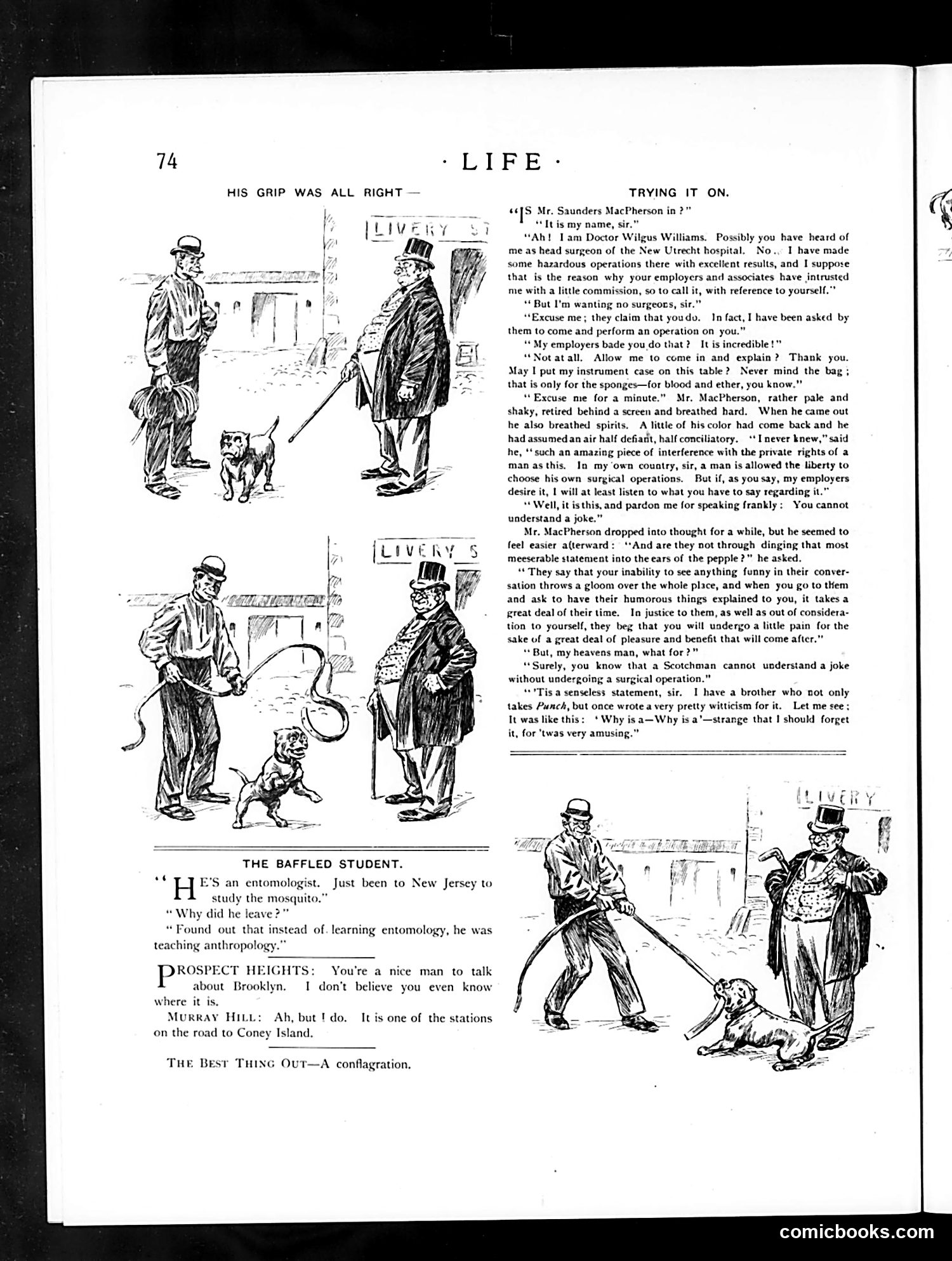
This page contains three separate satirical pieces. The main cartoon shows a well-dressed man (identified as "Mr Saunders MacPherson") encountering Doctor Wilgus Williams, head surgeon of New Utrecht Hospital. MacPherson seeks to explain why he's performing unauthorized surgical operations despite employer prohibitions. The humor centers on MacPherson's audacious attempt to justify his private surgical practice—he literally demonstrates his "grip" (surgical skill) is sound, as if this validates ignoring professional boundaries and employer rules. Below are shorter jokes: "The Baffled Student" mocks someone who confused entomology (insect study) with anthropology, and "The Best Thing Out" puns on a contagion/infection. The satire targets professional pretension and rule-breaking justified by personal competence.
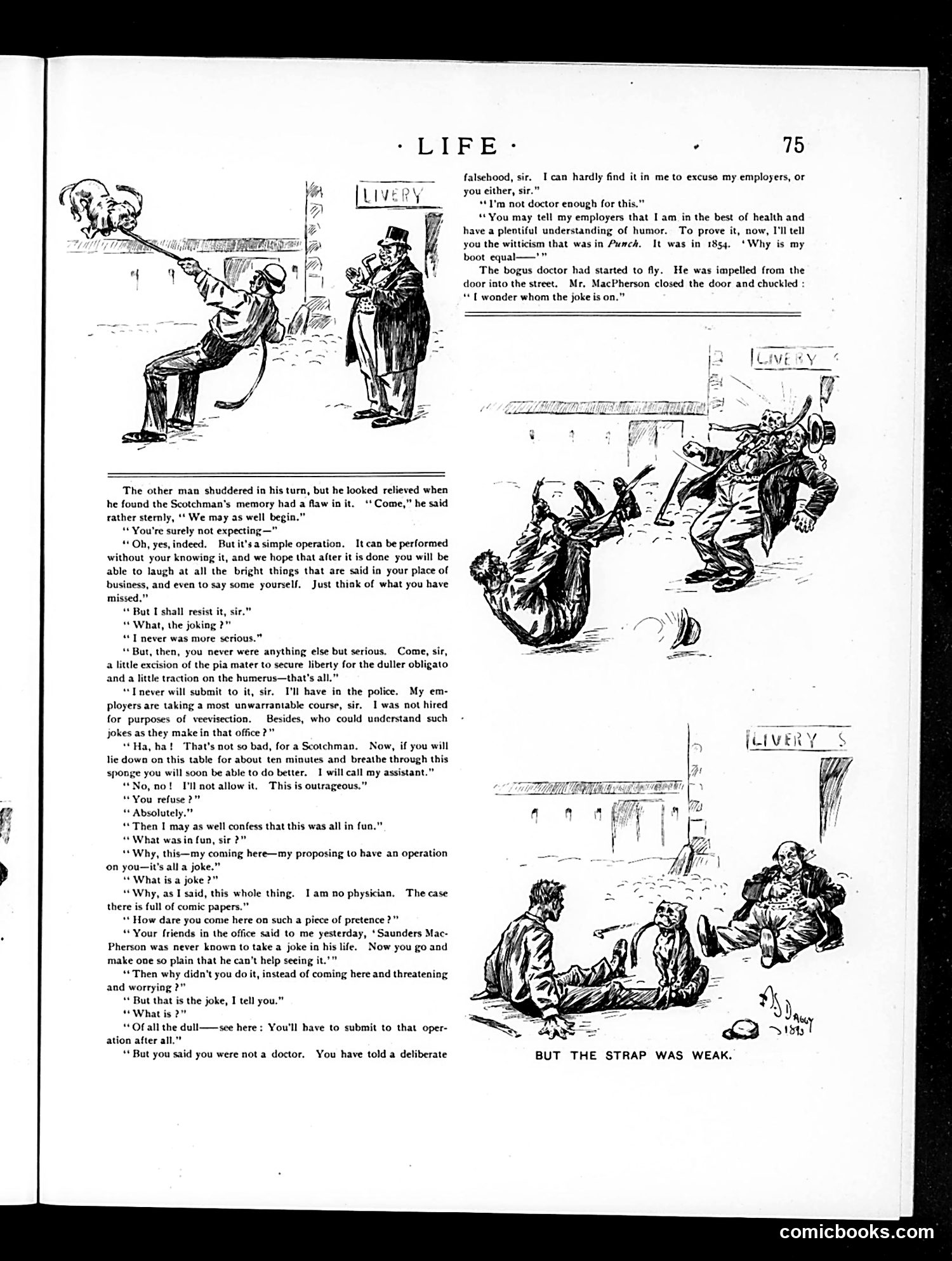
This page satirizes medical ethics and quackery. The main dialogue concerns a Scotsman being pressured into undergoing an unnecessary surgical operation by a charlatan posing as a doctor. The humor derives from the victim's resistance—he correctly recognizes he's being defrauded and won't submit to the procedure. The accompanying illustration captioned "BUT THE STRAP WAS WEAK" shows a patient on what appears to be an operating table strapped down, with the strap failing—a visual punchline about the incompetence of the fake medical practitioner. The satire targets fraudulent doctors who performed unnecessary procedures on unsuspecting patients, a common 19th-century concern. The Scotsman's skepticism and refusal represent common sense against professional deception.
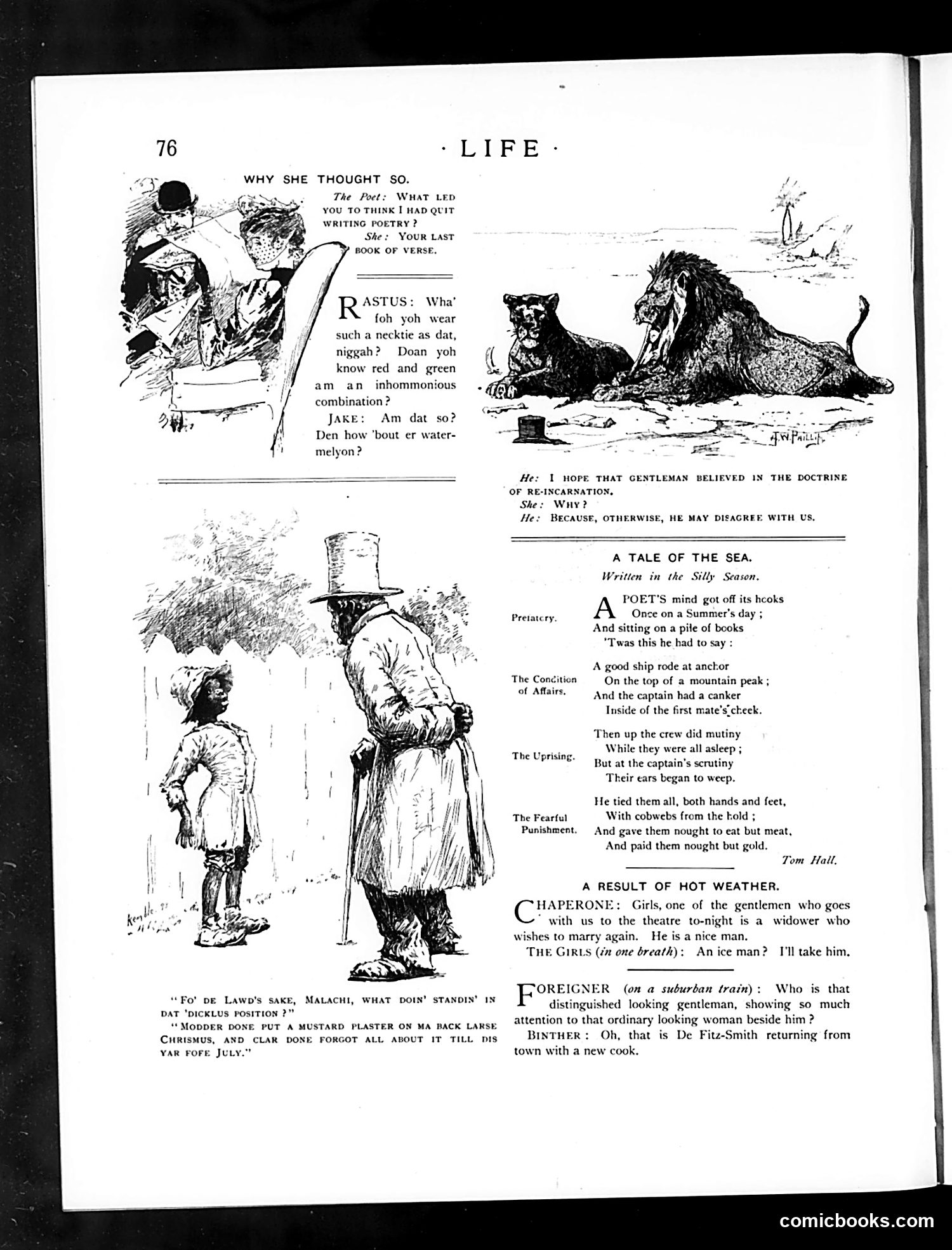
This page contains several satirical humor pieces typical of early 20th-century Life magazine: **"Why She Thought So"**: A brief joke mocking a poet—his girlfriend assumes he quit writing because his last book was so bad. **"Rastus & Jake dialogue**: Uses racist dialect humor (common to the era) where Jake defends wearing a red-and-green necktie by sarcastically comparing it to watermelon colors, turning the insult back on Rastus's criticism. **"A Tale of the Sea"**: Absurdist poetry parody set during "silly season" (summer, when news was slow), featuring nonsensical nautical imagery—ships on mountaintops, punishments with cobwebs and gold. **"Result of Hot Weather"**: Young women eagerly pursue a widower simply because he's available, satirizing both female desperation and shallow courtship. **"Foreigner on train"**: A joke implying a gentleman's attentiveness to an "ordinary looking woman" is noteworthy only because she's his new cook, not a romantic interest. The page exemplifies period humor: wordplay, ethnic stereotypes, absurdism, and gentle social observation about courtship and propriety.
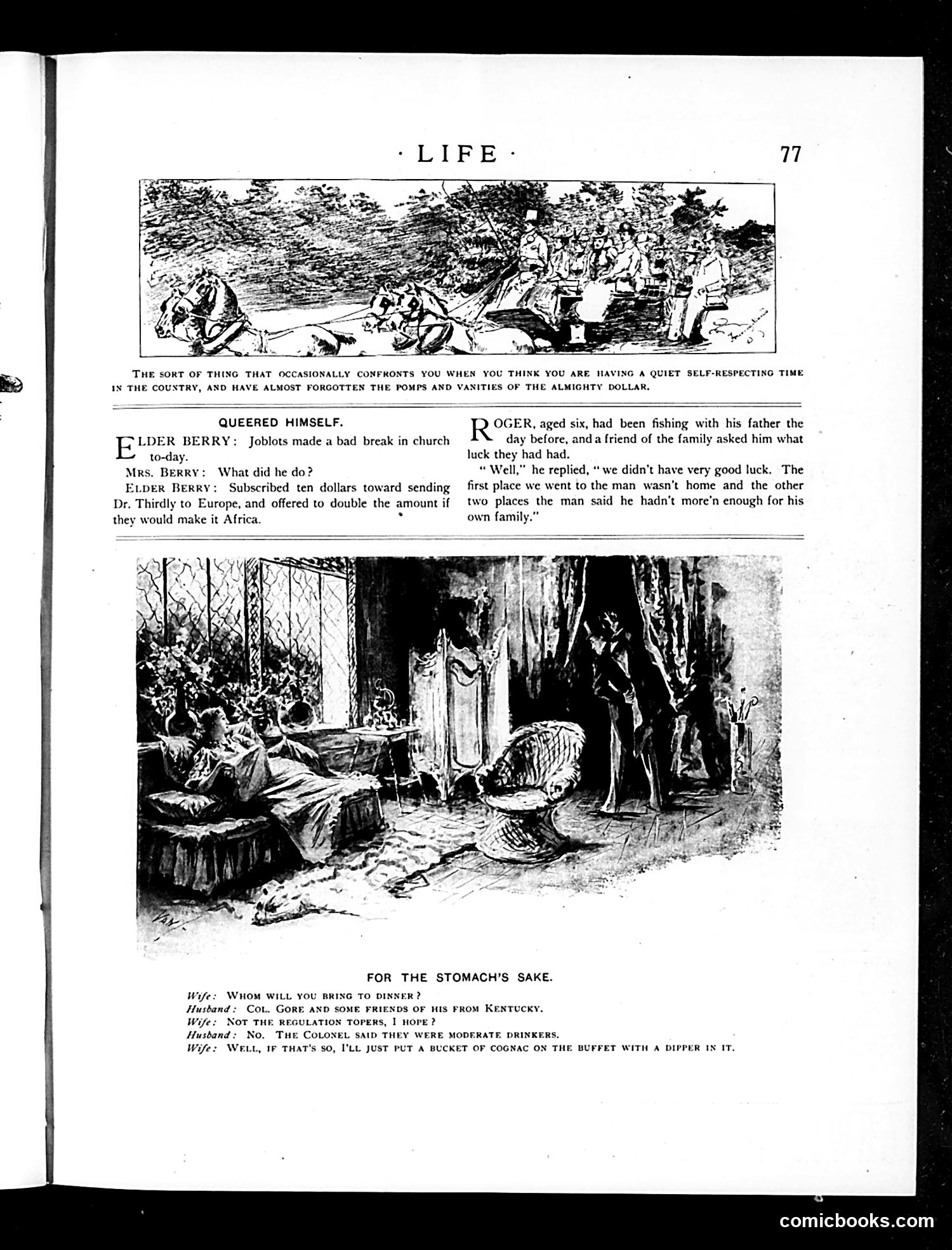
This page contains two separate satirical pieces mocking hypocrisy and social pretense: **"Queered Himself"** ridicules Elder Berry's charitable posturing. He publicly subscribes $10 toward sending Dr. Thirdly to Europe, then offers to *double* the amount if they send him to Africa instead—revealing his desire to get rid of the man. The humor lies in his transparent self-interest masked as generosity. **"For the Stomach's Sake"** satirizes the contradiction between claimed temperance and actual behavior. The husband insists his Kentucky guests (Col. Gore and friends) are "moderate drinkers," yet the wife's response—placing a bucket of cognac with a dipper on the buffet—suggests these men are notorious heavy drinkers. The satirical implication is that "moderate drinkers" is a transparent lie, and the wife knows it. Both pieces critique how people use polite social rhetoric to conceal ungracious or dishonest intentions.
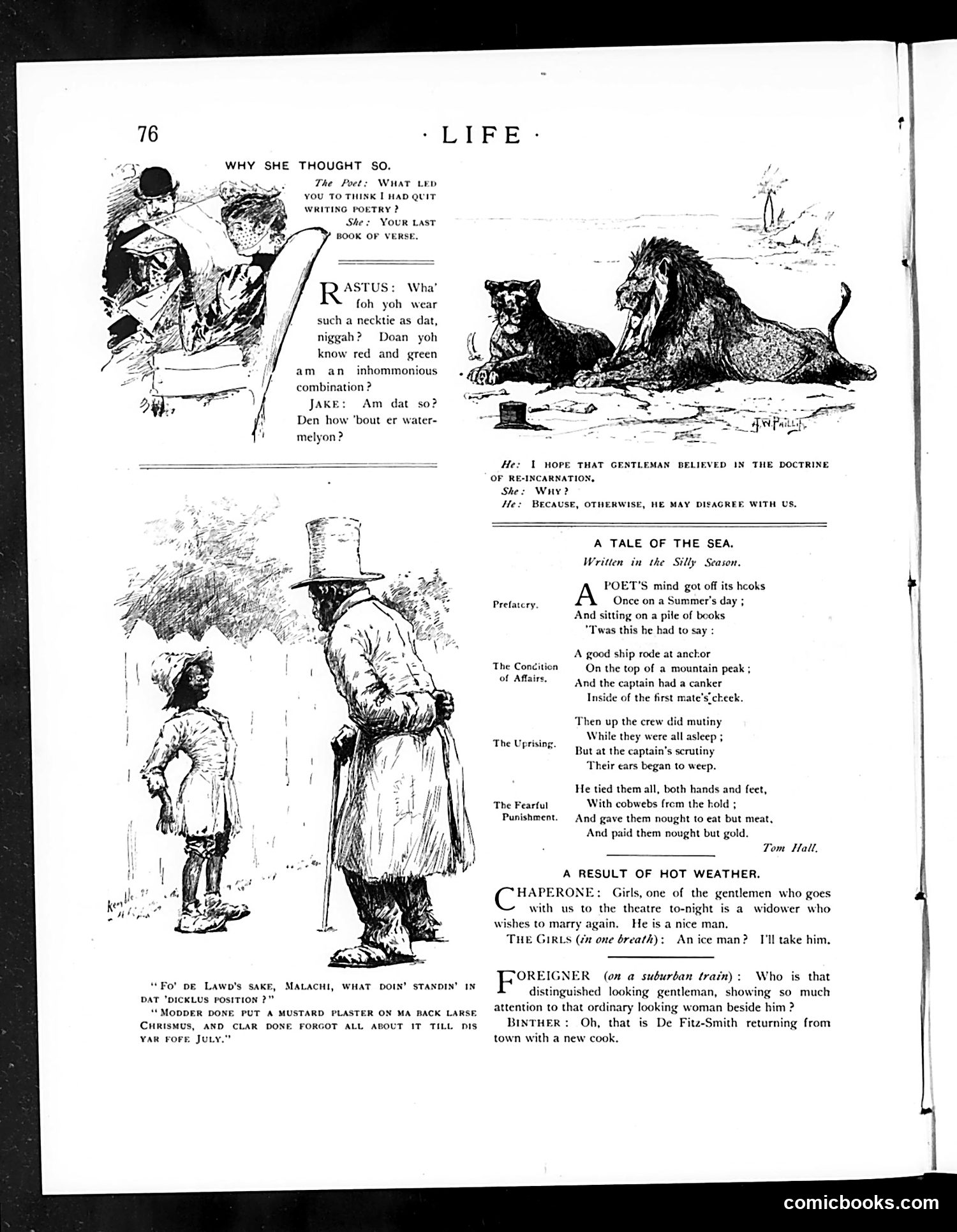
This page contains multiple satirical pieces typical of 1890s-1900s American humor: **"Why She Thought So"** (top): A joke about a poet's failed career—his wife assumes he quit writing because his last poetry collection was so bad, it discouraged him. **Racist Dialect Humor** (left): Two separate vignettes using offensive "blackface" dialect stereotypes common to the era. Characters debate fashion choices and reference watermelon and mustard plasters in exaggerated vernacular—typical of period entertainment that relied on racial caricature. **"A Tale of the Sea"** (right): Absurdist parody poetry mocking overly sentimental Victorian verse through nonsensical imagery (a ship on a mountain, ears that weep, cobweb restraints). **"A Result of Hot Weather"** (bottom): Social satire on class pretension—wealthy women mistake an iceman for a gentleman suitor; a man's new cook is so plain she's mistaken for his romantic interest, satirizing both male vanity and women's superficiality. The page reflects period attitudes: crude racial humor was considered mainstream entertainment, while genteel society received mockery for snobbery and hypocrisy.
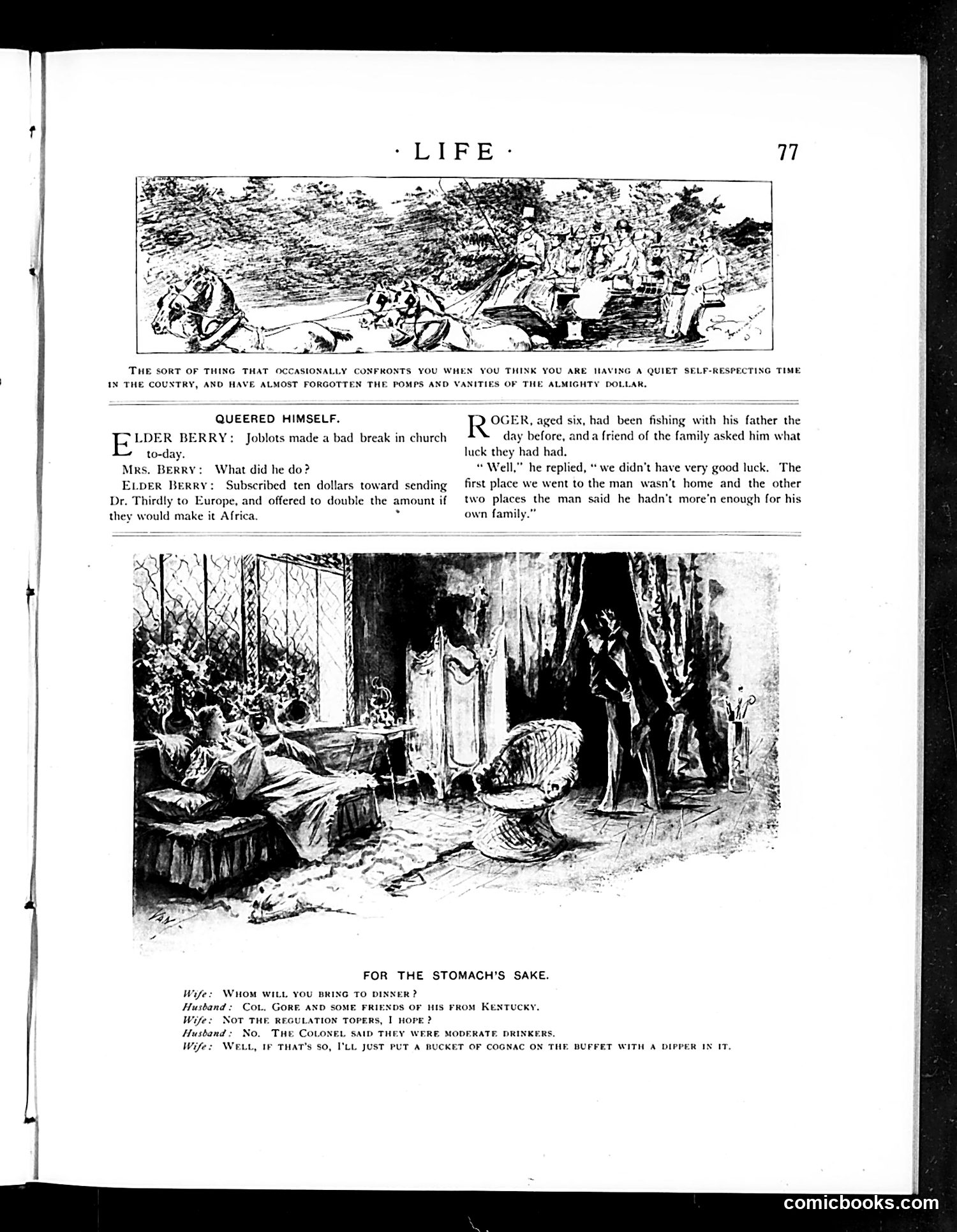
This page contains three separate satirical sketches mocking wealthy Americans' relationship with money and social respectability: **"Queered Himself"**: Elder Berry donates $10 to send Dr. Thirdly to Europe, then offers to *double* the amount if they'll send him to Africa instead—a crude joke implying Africa is worse/less desirable, revealing his true feelings despite charitable posturing. **Roger's fishing story**: A child innocently exposes the hypocrisy of the wealthy poor. When asked about fishing luck, he reveals they visited three homes where the owners refused to share—not because they were away, but because they "didn't have enough for [their] own family," exposing their actual poverty beneath pretenses. **"For the Stomach's Sake"**: A husband promises "moderate drinkers" as dinner guests, but his wife sarcastically responds by putting "a bucket of cognac on the buffet with a dipper in it"—mocking both his lie and the guests' likely excessive drinking. The page's theme: wealthy Americans' attempts at respectability are undermined by their greed and dishonesty.
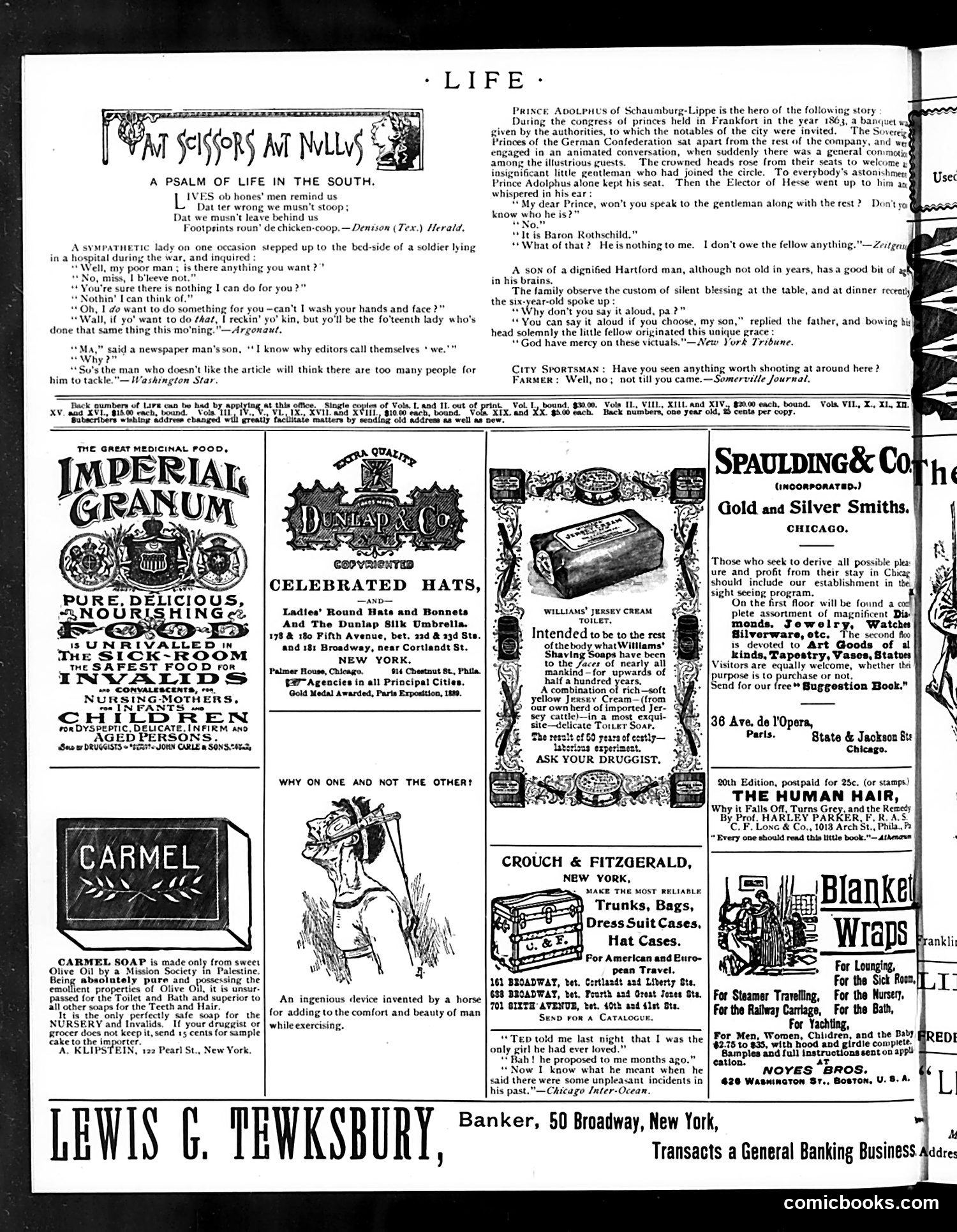
This page features satirical humor and period advertisements typical of Life magazine. The main cartoons and stories are: **"A Psalm of Life in the South"**: Employs stereotypical dialect humor featuring an African American speaker cautioning against moral failings—specifically stealing chickens. This reflects the era's problematic racial caricature comedy. **The Prince Adolphus anecdote**: Satirizes aristocratic pretension. A minor German prince refuses to acknowledge Baron Rothschild (the famous banker) merely because he owes him nothing, exposing how titled nobility valued status over courtesy or practical sense. **The Hartford boy's grace**: Gentle humor about a child's literal-minded innocence; after being permitted to say grace aloud, he creates an irreverent prayer about "victuals." **The city sportsman joke**: A setup-punchline revealing class conflict—the farmer insults the urban visitor by suggesting *he* is the only thing worth shooting. The page is otherwise dominated by period advertisements for patent medicines, luggage, soap, and banking services—typical of Life's revenue model.
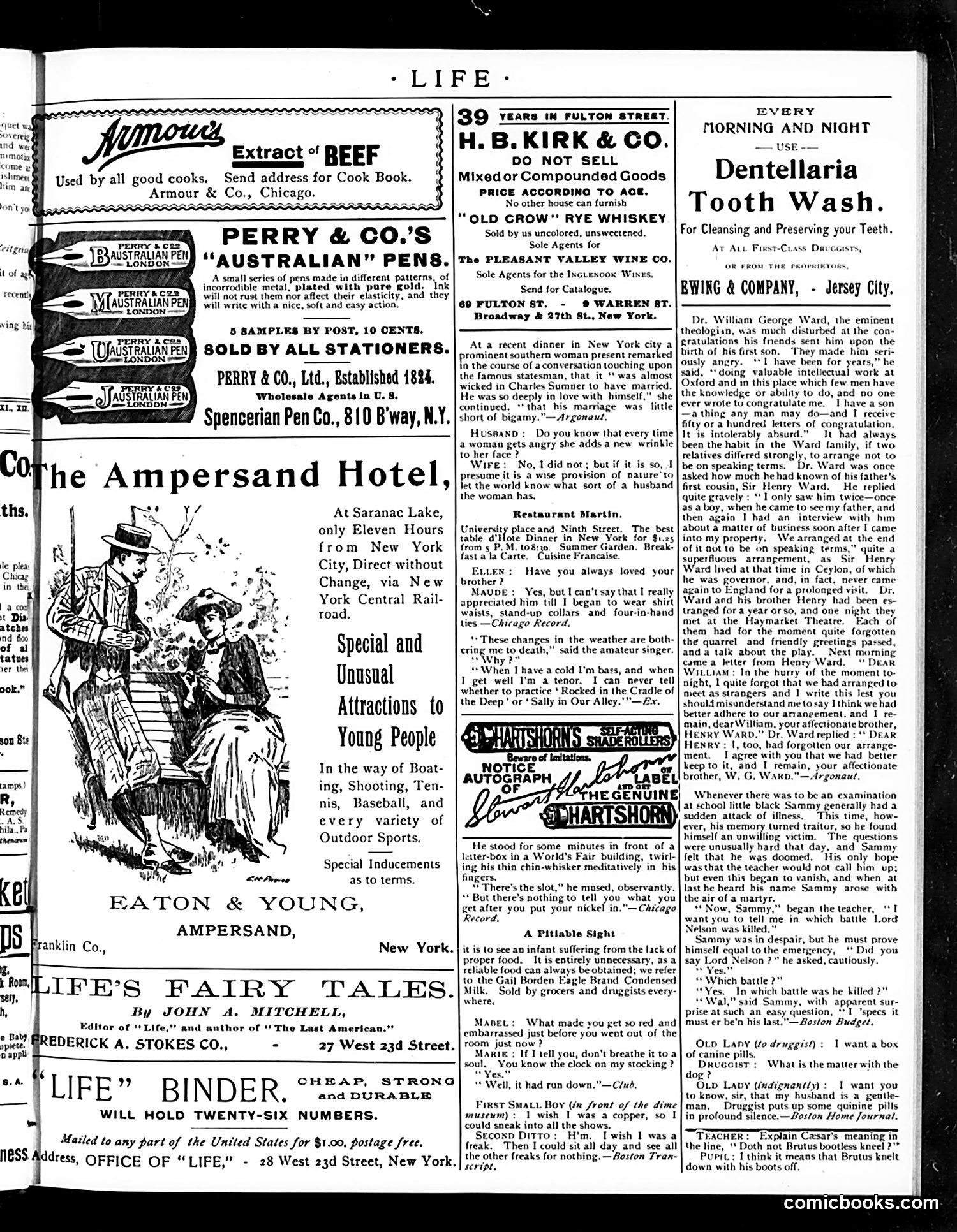
This page is primarily **advertisements and short humorous anecdotes** rather than political cartoons. The main visual element is an illustration for the Ampersand Hotel advertising recreational activities. The text content consists of: **Short comic exchanges** satirizing everyday domestic life and social situations—husbands and wives, siblings, amateur singers dealing with weather affecting their voice range. These are gentle, observational humor typical of early 20th-century magazines. **Notable joke**: A southern woman's quip that Charles Sumner (a prominent 19th-century statesman) marrying was "bigamy" because "he was so deeply in love with himself"—a character assassination disguised as wit. The rest is commercial advertising for pens, hotels, whiskey, wine, and condensed milk. There's no evident political satire or caricature on this particular page—it represents Life magazine's mixed model of advertising revenue supporting light entertainment and humor pieces aimed at educated urban readers.
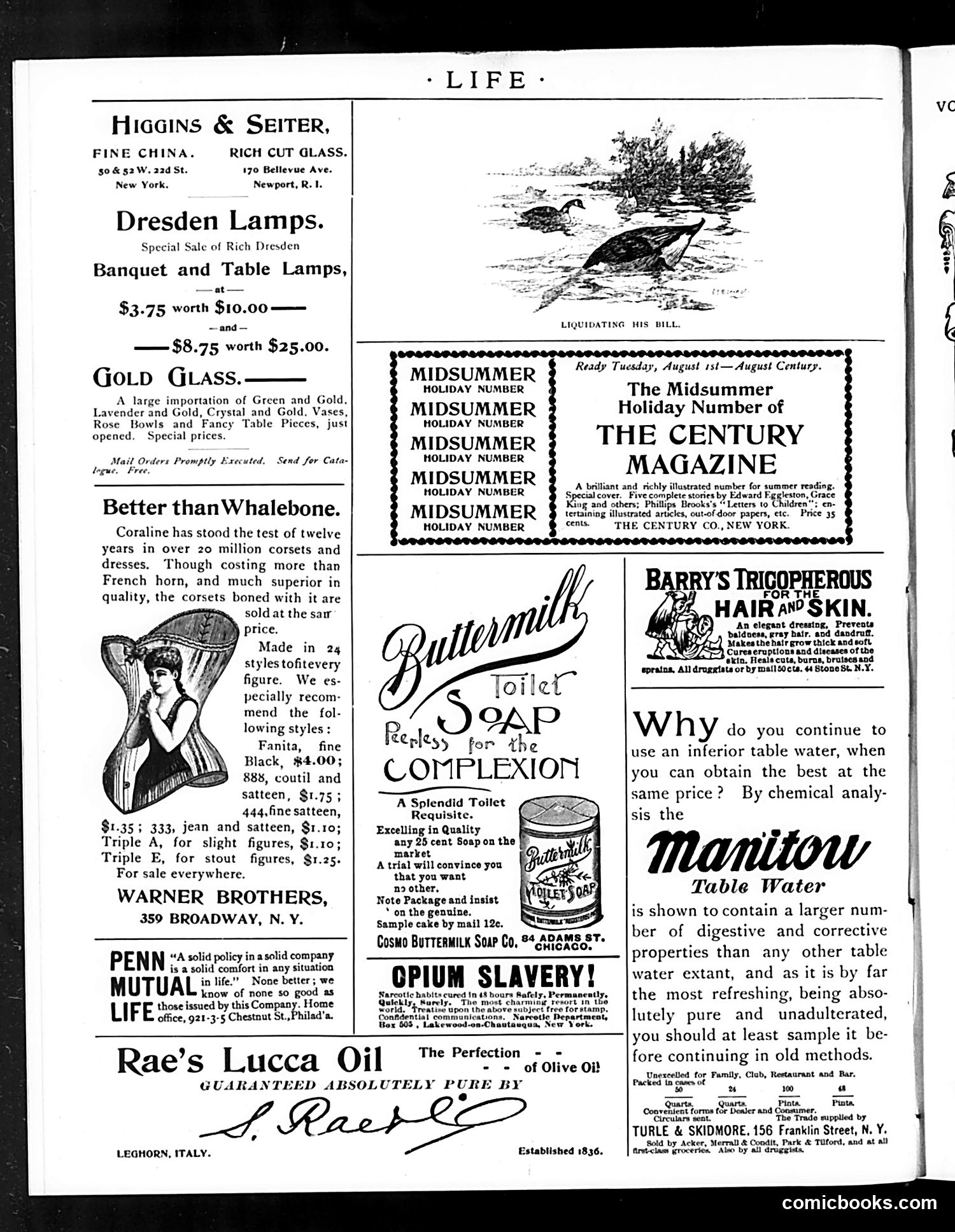
This is primarily an **advertising page** from Life magazine's midsummer holiday issue (August 1st-Century). There is one small illustration titled "Liquidating His Bill" showing a duck in water, likely a visual pun on "bill" (the duck's beak versus financial debt). The page consists almost entirely of period advertisements for luxury goods and patent medicines typical of early 20th-century America: fine china and glassware, corsets (Coraline brand), The Century Magazine subscription, toilet soaps, hair tonics, table water, and notably, an opium addiction cure service ("Opium Slavery! Narcotic habits cured in 48 hours"). The advertisements reflect the purchasing interests and health concerns of affluent readers. The opium cure ad is historically significant—it reveals widespread narcotic addiction was openly advertised as treatable, unlike modern approaches. There is **no political satire or social commentary** on this page; it functions as commercial space.