
Life, 1893-08-03 · page 7 of 18
Life — August 3, 1893 — page 7: what you’re looking at
What you’re looking at
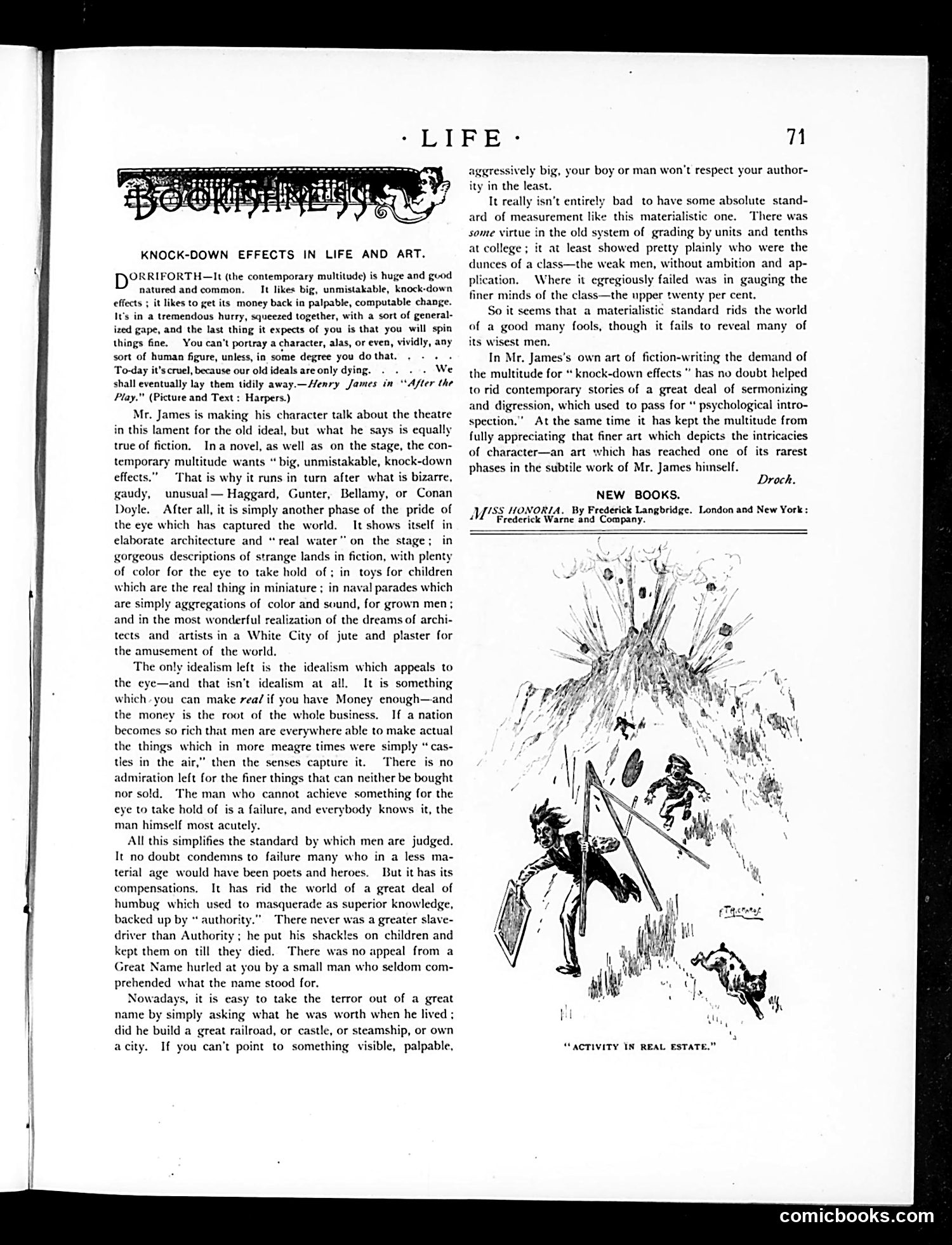
The cartoon illustrates the text's discussion of theatrical "knock-down effects"—exaggerated, sensational staging techniques used in contemporary theater to impress audiences. The sketch depicts what appears to be a chaotic real estate or construction scene, with figures climbing or falling on a steep hillside or cliff face. The caption "ACTIVITY IN REAL ESTATE" is ironic—rather than showing legitimate property development, it shows comic mayhem and dangerous climbing. This satirizes how both theater and contemporary society (apparently during a real estate boom) prioritize spectacular visual effects and dramatic action over substance. The cartoon mocks this preference for sensationalism as a substitute for genuine accomplishment or value, tying into the page's broader critique of materialism and shallow standards of judgment in modern life.
📄 Transcribed text from this page (OCR, searchable)
Machine-transcribed from the original scan — historical spelling and the odd misread are preserved.
- LIFE: 71 KNOCK-DOWN EFFECTS IN LIFE AND ART. ORRIFORTH—It (the contemporary multitude) is huge and guod natured and common. It likes big, unmistakable, knock-down effects ; it likes to get its money back in palpable, computable change. It's in a tremendous hurry, squeezed together, with a sort of general- ized gape, and the last thing it expects of you is that you will spin things fine. You can't portray a character, alas, or even, vividly, any sort of human figure, unless, in some degree you dothat. . - . « To-day it’s cruel, because our old ideals are only dying. . . . . We shall eventually lay them tidily away.—Henry James in “After the Play.” (Picture and Text : Harpers.) Mr. James is making his character talk about the theatre in this lament for the old ideal, but what he says is equally true of fiction. Ina novel, as well as on the stage, the con- temporary multitude wants “ big, unmistakable, knock-down effect: That is why it runs in turn after what is bizarre, gaudy, unusual — Haggard, Gunter, Bellamy, or Conan Doyle, After all, it is simply another phase of the pride of the eye which has captured the world. It shows itself in elaborate architecture and “real water” on the stage; in gorgeous descriptions of strange lands in fiction, with plenty of color for the eye to take hold of; in toys for children which are the real thing in miniature ; in naval parades which are simply aggregations of color and sound, for grown men ; and in the most wonderful realization of the dreams of archi- tects and artists in a White City of jute and plaster for the amusement of the world. The only idealism left is the idealism which appeals to the eye—and that isn’t idealism at all. It is something which. you can make rea/ if you have Money enough—and the money is the root of the whole business. If a nation becomes so rich that men are everywhere able to make actual the things which in more meagre times were simply “ cas- tles in the air,” then the senses capture it. There is no admiration left for the finer things that can neither be bought nor sold. The man who cannot achieve something for the eye to take hold of is a failure, and everybody knows it, the man himself most acutely. All this simplifies the standard by which men are judged. It no doubt condemns to failure many who in a less ma- terial age would have been poets and heroes. But it has its compensations. It has rid the world of a great deal of humbug which used to masquerade as superior knowledge, backed up by “ authority." There never was a greater slave- driver than Authority ; he put his shackles on children and kept them on till they died. There was no appeal from a Great Name hurled at you by a small man who seldom com- prehended what the name stood for. Nowadays, it is easy to take the terror out of a great name by simply asking what he was worth when he lived ; did he build a great railroad, or castle, or steamship, or own acity. If you can’t point to something visible, palpable, aggressively big, your boy or man won't respect your author- ity in the least. It really isn’t entirely bad to have some absolute stand- ard of measurement like this materialistic one. There was some virtue in the old system of grading by units and tenths at college ; it at least showed pretty plainly who were the dunces of a class—the weak men, without ambition and ap- plication. Where it egregiously failed was in gauging the finer minds of the class—the upper twenty per cent, So it seems that a materialistic standard rids the world of a good many fools, though it fails to reveal many of its wisest men. In Mr. James's own art of fiction-writing the demand of the multitude for “ knock-down effects " has no doubt helped to rid contemporary stories of a great deal of sermonizing and digression, which used to pass for “ psychological intro- spection.” At the same time it has kept the multitude from fully appreciating that finer art which depicts the intricacies of character—an art which has reached one of its rarest phases in the subtile work of Mr. James hitnself. Droch. NEW BOOKS. Y/SS HONORTA. By Frederic Langbridge. London and New York: +10" Frederick Warne and Company. “ACTIVITY IN REAL ESTATE.” comicbooks.com