
Life, 1893-08-03 · page 4 of 18
Life — August 3, 1893 — page 4: what you’re looking at
What you’re looking at
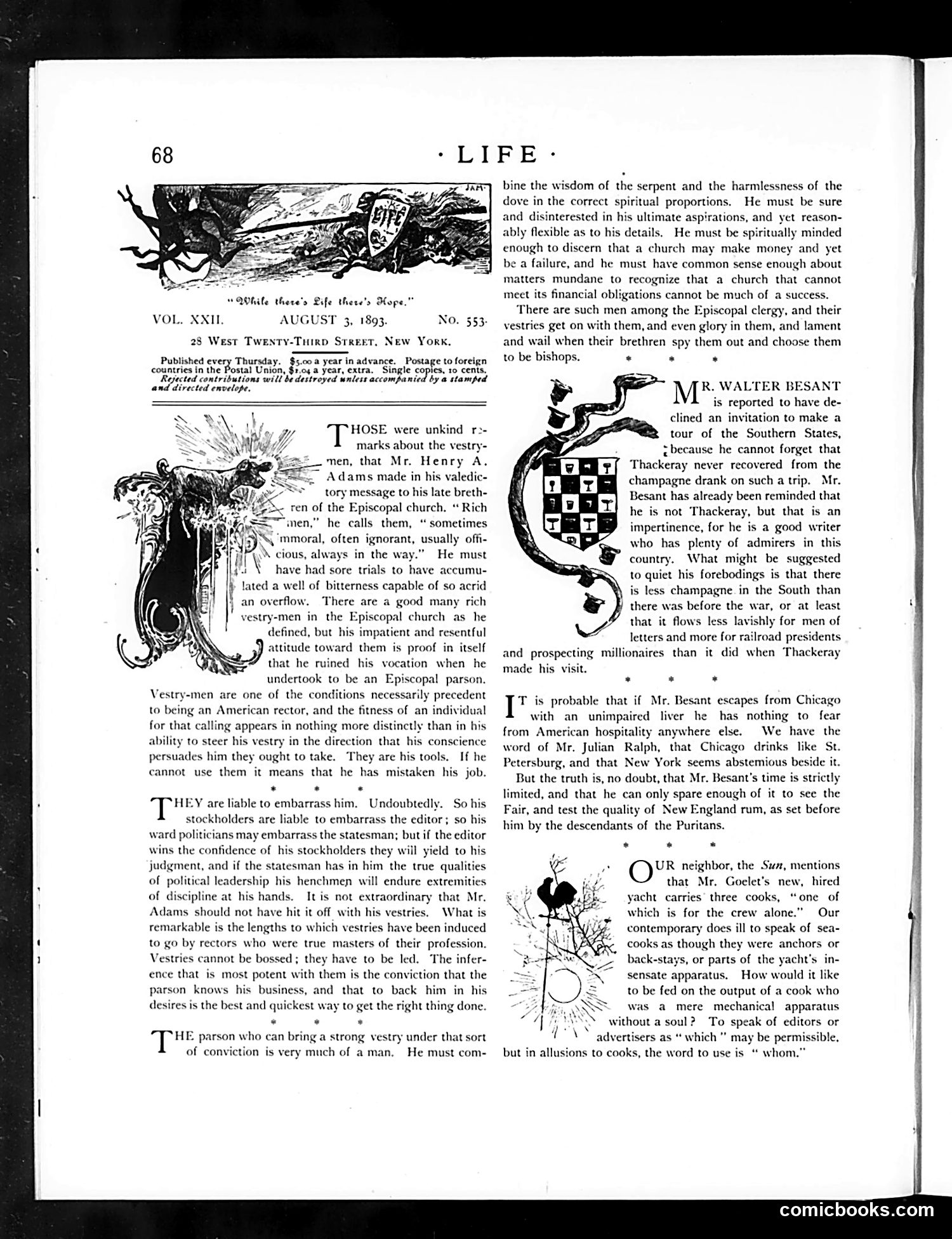
This page contains **editorial commentary on Episcopal Church governance**, not political cartoons. The main article criticizes "vestry-men" (parish administrators) in the Episcopal Church, arguing they often lack the temperament and wisdom needed for leadership roles. The text discusses how vestrymen can embarrass church rectors and damage parish finances through poor judgment. The author argues that while vestrymen are "tools" necessary for church function, they require strong leadership and should defer to the rector's expertise. The decorative illustrations are period ornaments rather than satirical cartoons—typical of 1890s magazine design. The content reflects internal debates within American Protestant denominations about ecclesiastical authority and lay governance during this era.
📄 Transcribed text from this page (OCR, searchable)
Machine-transcribed from the original scan — historical spelling and the odd misread are preserved.
* LIFE: “While there's Life there's Hope.” VOL. XXII. AUGUST 3, 1893. 23 West Twenty-Tuirp Street, New York. No. Published every Thursday. $5.00. year in advance. Postage to foreign countries in the Postal Union, $1.04 a year, extra. Single copies, 10 cents, Rejected contributions will be destroyed unless accompanied by a stamped and directed envelope, HOSE were unkind r: marks about the vestry- men, that Mr. Henry A. Adams made in his valedic- tory message to his late breth- n of the Episcopal church, * Rich men,” he calls them, “ sometimes S\\'mmoral, often ignorant, usually offi- \ cious, always in the way.” He must have had sore trials to have accumu- lated a well of bitterness capable of so acrid an overflow. There are a good many rich vestry-men in the Episcopal church as he defined, but his impatient and resentful attitude toward them is proof in itself that he ruined his vocation when he undertook to be an Episcopal parson. Vestry-men are one of the conditions necessarily precedent to being an American rector, and the fitness of an individual for that calling appears in nothing more distinctly than in his ability to steer his vestry in the direction that his conscience persuades him they ought to take. They are his tools. If he cannot use them it means that he has mistaken his job. * . * HEY are liable to embarrass him. Undoubtedly. So his stockholders are liable to embarrass the editor; so his ward poli ns may embarrass the statesman; but if the editor wins the confidence of his stockholders they will yield to his judgment, and if the statesman has in him the true qualities of political leadership his henchmen will endure extremities of discipline at his hands. It is not extraordinary that Mr. Adams should not have hit it off with his vestries. What is remarkable is the lengths to which vestries have been induced to go by rectors who were true masters of their profession. ‘annot be bossed; they have to be led. The infer- ence that is most potent with them is the conviction that the parson knows his business, and that to back him in his desires is the best and quickest way to get the right thing done. * * . HE parson who can bring a strong vestry under that sort of conviction is very much of a man. He must com- Vestries bine the wisdom of the serpent and the harmlessness of the dove in the correct spiritual proportions. He must be sure and disinterested in his ultimate aspirations, and yet reason- ably flexible as to his details. He must be spiritually minded enough to discern that a church may make money and yet be a failure, and he must have common sense enough about matters mundane to recognize that a church that cannot meet its financial obligations cannot be much of a success here are such men among the Episcopal clergy, and their vestries get on with them, and even glory in them, and lament and wail when their brethren spy them out and choose them to be bishops. * . * R. WALTER BES is reported to have de- clined an invitation to make a tour of the Southern States, gbecause he cannot forget that Thackeray never recovered from the champagne drank on such a trip. Mr. Besant has already been reminded that he is not Thackeray, but that is an impertinence, for he is a good writer who has plenty of admirers in this country. What might be suggested to quiet his forebodings is that there is less champagne in the South than there was before the war, or at least that it flows less lavishly for men of letters and more for railroad presidents and prospecting millionaires than it did when Thackeray made his visit. * * * T is probable that if Mr. Besant escapes from Chicago with an unimpaired liver he has nothing to fear from American hospitality anywhere else. We have the word of Mr. Julian Ralph, that Chicago drinks like St. Petersburg, and that New York seems abstemious beside it. But the truth is, no doubt, that Mr. Besant’s time is strictly limited, and that he can only spare enough of it to see the Fair, and test the quality of New England rum, as set before him by the descendants of the Puritans. * * * UR neighbor, the Suz, mentions that Mr. Goelet’s new, hired yacht carries three cooks, “one of which is for the crew alone.” Our contemporary does ill to speak of sea- cooks as though they were anchors or back-stays, or parts of the yacht sensate apparatus. How would it like to be fed on the output of a cook who was a mere mechanical apparatus without a soul? To speak of editors or advertisers as “ which " may be permissible, but in allusions to cooks, the word to use is “ whom.” comicbooks.com