
A complete issue · 17 pages · 1893
Life — June 29, 1893
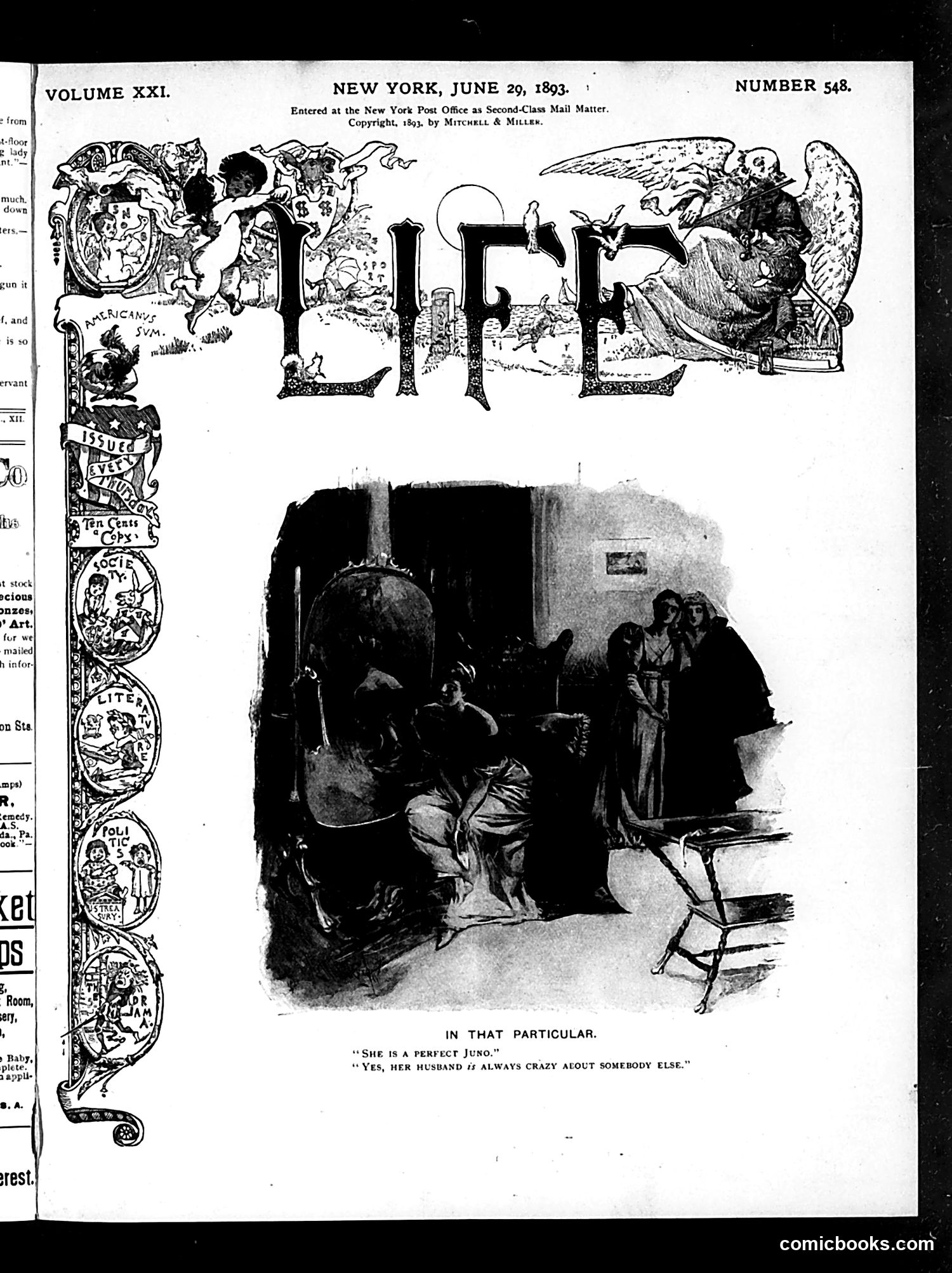
This page features the magazine's title "LIFE" with decorative illustrations. The lower half contains a sketch titled "IN THAT PARTICULAR" with dialogue: "She is a perfect Juno." "Yes, her husband is always crazy about somebody else." The cartoon satirizes marital infidelity. The setup presents a woman being complimented as a "perfect Juno" (the Roman goddess, implying beauty and majesty), but the punchline reveals her husband's chronic unfaithfulness—he's "always crazy about somebody else." The humor derives from the irony: despite the wife's exceptional qualities, her husband remains a serial philanderer. This reflects 1890s social commentary on male behavior and marriage dynamics, depicting infidelity as a common masculine vice regardless of a wife's virtues.
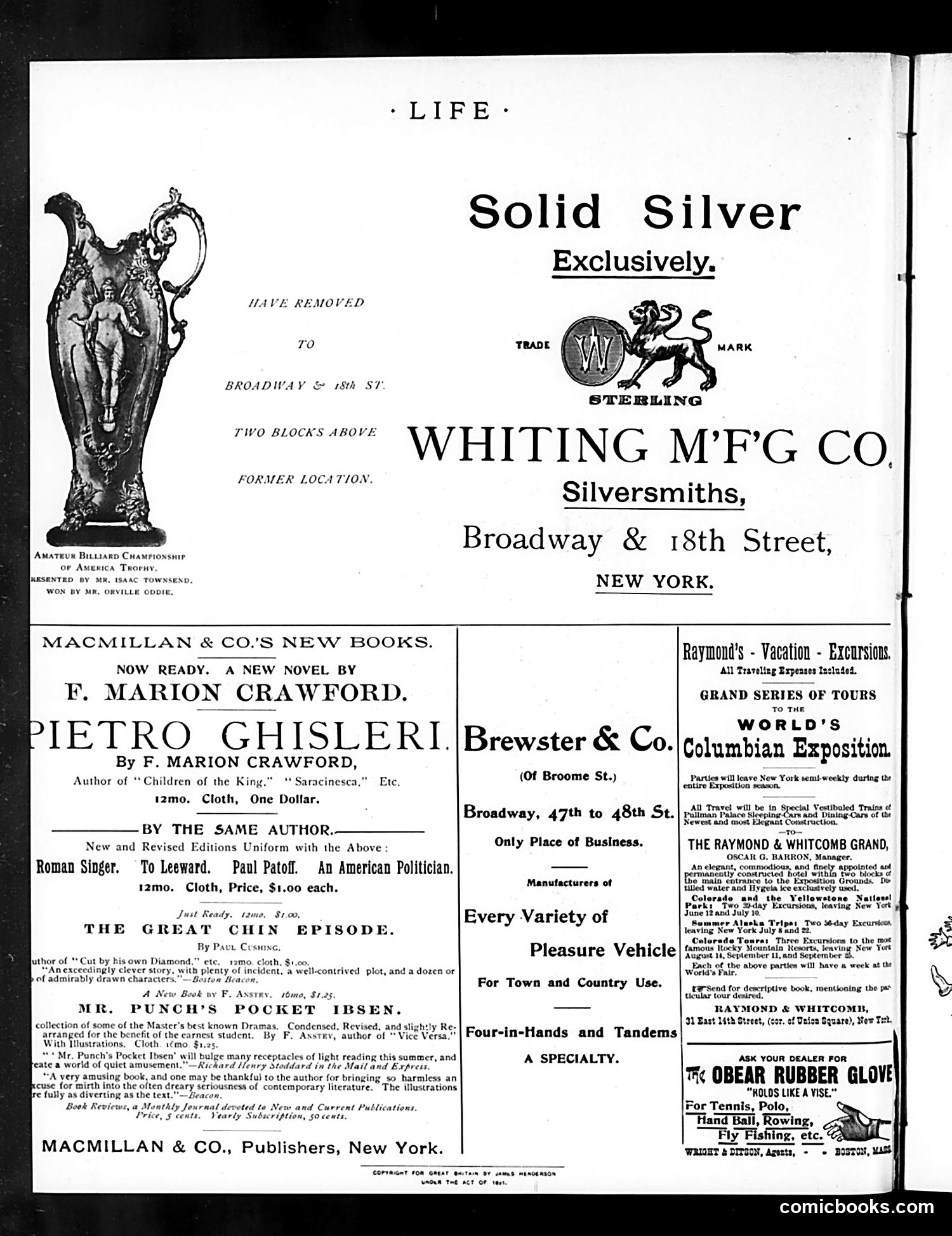
This page is primarily **advertising**, not satirical content. The main feature is a full-page advertisement for **Whiting Manufacturing Company**, silversmiths located at Broadway & 18th Street in New York City. They emphasize "Solid Silver Exclusively" with a Sterling mark. The left side shows an ornate silver pitcher labeled as the "Amateur Billiard Championship of America Trophy, presented by Mr. Isaac Townsend, won by Mr. Orville Codie"—demonstrating the company's craftsmanship in creating prestigious awards. The remainder of the page contains book advertisements from MacMillan & Co. and notices for Brewster & Co. (vehicle manufacturers) and Raymond's Vacation Excursions. There is no political cartoon or satire visible on this page.
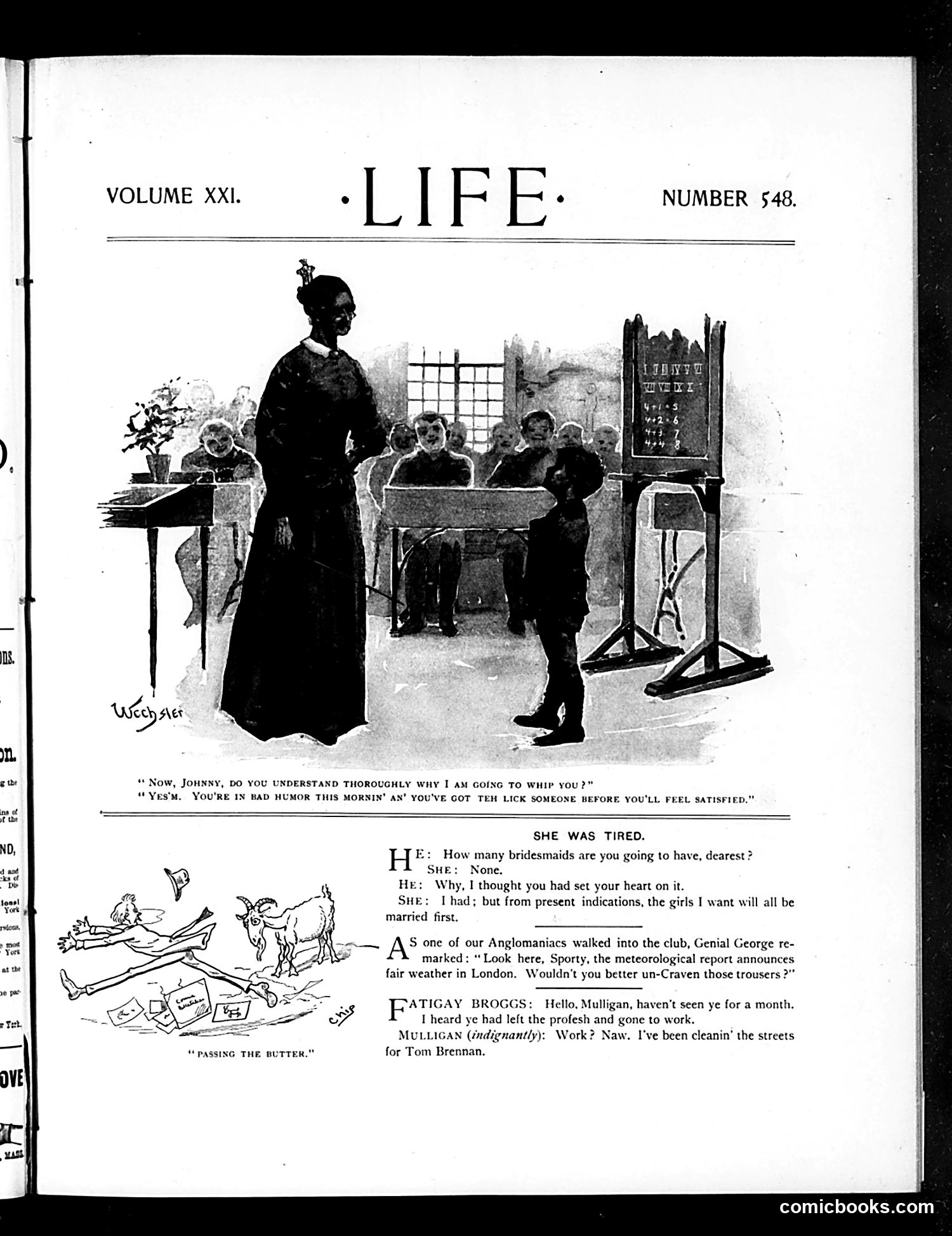
The top cartoon titled "Now, Johnny, do you understand thoroughly why I am going to whip you?" depicts a classroom scene where a teacher prepares to corporeally punish a student. The joke plays on educational discipline: the teacher promises the child will "feel satisfied" after receiving a beating, satirizing harsh Victorian-era schooling practices. Below, "She Was Tired" presents a dialogue between a couple discussing bridesmaids. The humor centers on the bride-to-be's exhaustion—she initially wanted bridesmaids but now expects her unmarried friends will marry first, leaving her with none. This mocks the social pressure and complications surrounding wedding planning and female social hierarchies of the era. The lower cartoon "Passing the Butter" features animals (unclear which), likely offering gentle domestic humor.
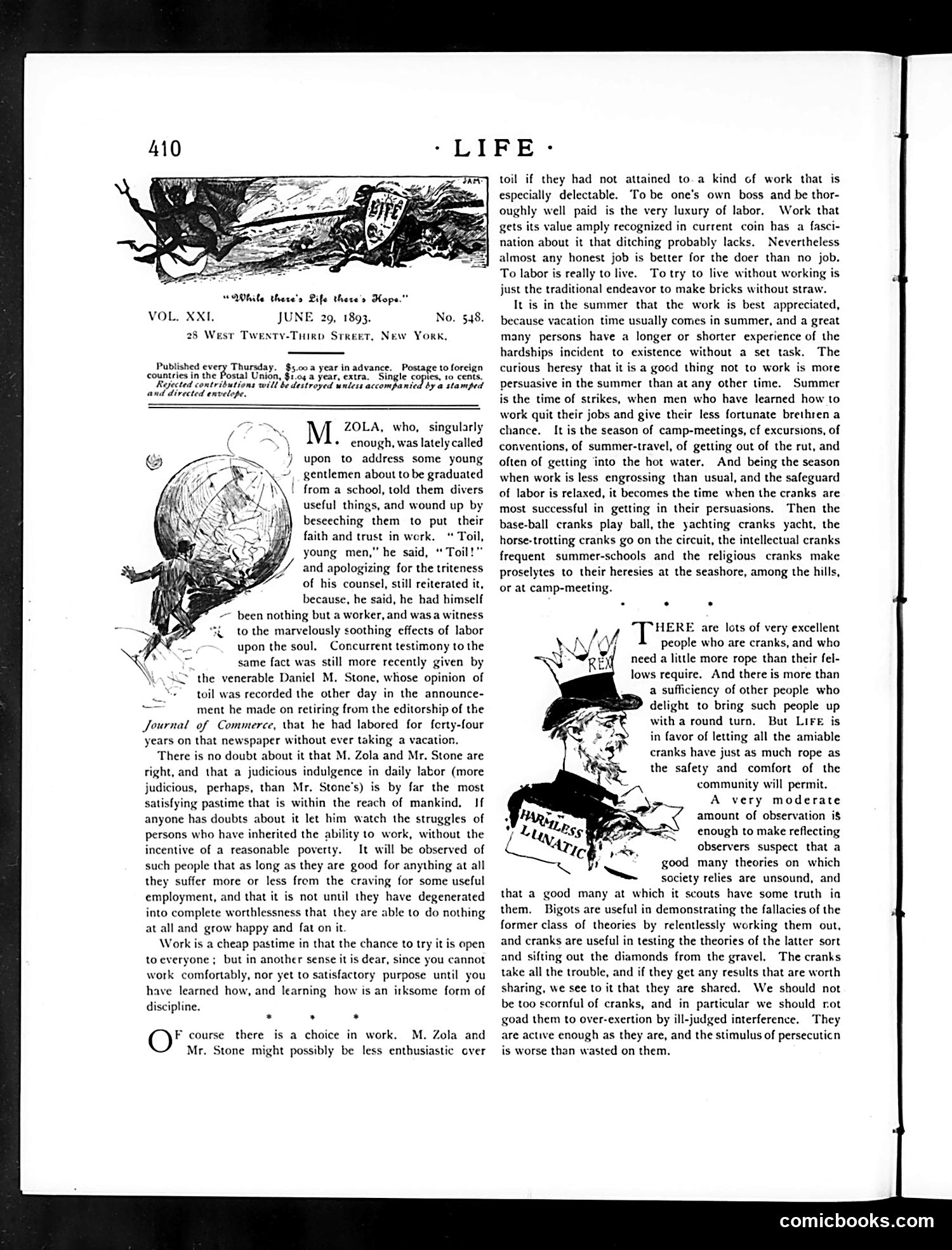
This page contains editorial commentary on labor and work, not political cartoons. The text discusses M. Zola and Daniel M. Stone's views on labor, arguing that honest work—even difficult labor—is dignified and preferable to idleness. The two illustrated figures appear to be generic character types rather than specific caricatures: the first shows a working man, and the second depicts a figure labeled "Harmless Lunatic," likely representing eccentric individuals or "cranks" who the author suggests society should tolerate moderately. The article advocates for allowing workers reasonable leisure time and distinguishes between productive "cranks" (useful agitators testing social theories) and those who are merely bothersome. The piece reflects 1890s attitudes about labor, social reform, and tolerance for unconventional thinkers.
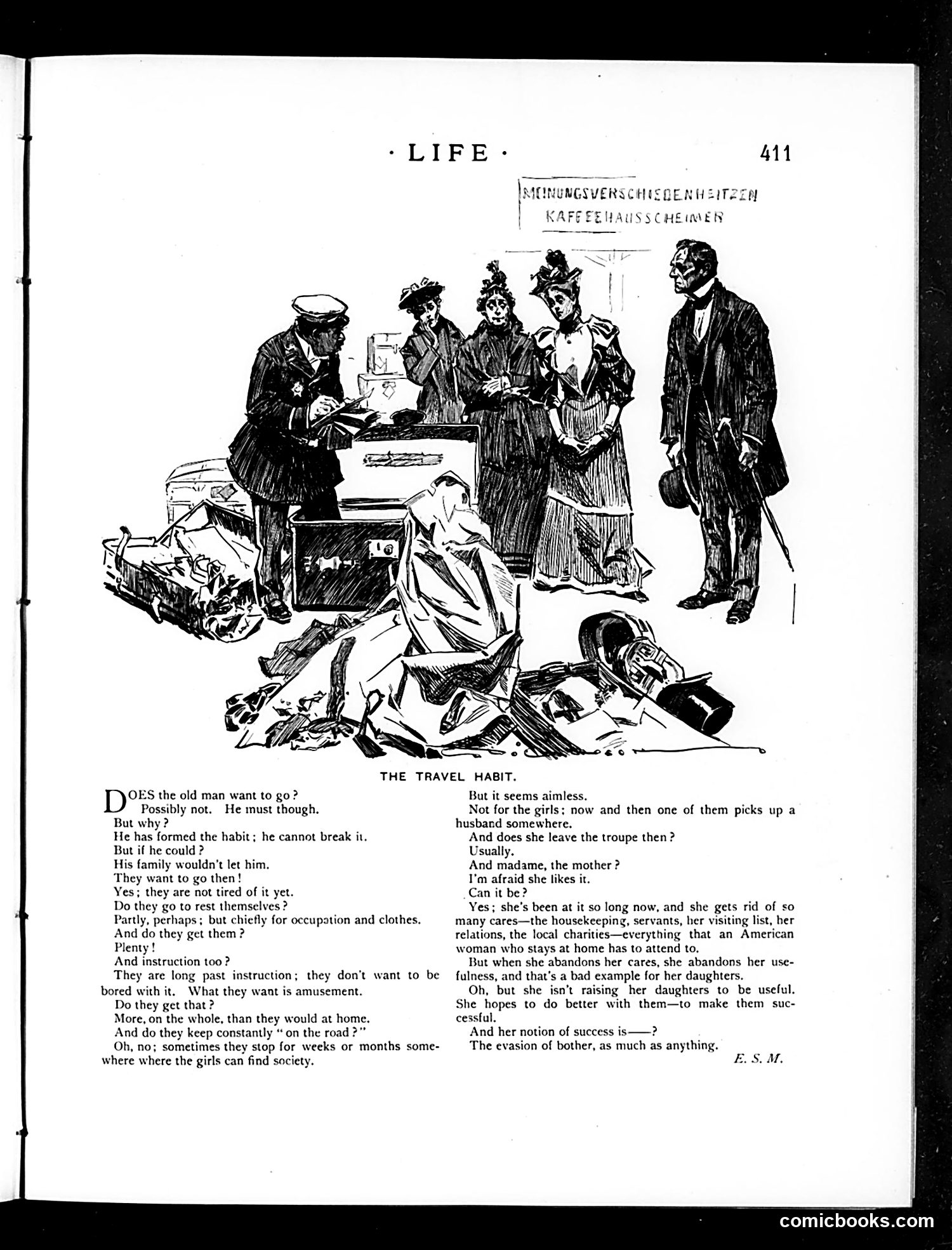
This satirical piece critiques the popular trend of wealthy American families—particularly women—traveling constantly rather than maintaining stable homes. The illustration shows a chaotic domestic scene where a family's belongings are scattered, suggesting perpetual displacement. The accompanying dialogue explores the irony: while parents claim to travel for educational and recreational purposes, the real motivation appears to be escaping domestic responsibilities. The text sarcastically notes that traveling mothers abandon household management, servants, and child-rearing duties under the guise of "success," while actually seeking "evasion of bother." The cartoon mocks both the pretense of cultured travel and the abdication of traditional maternal responsibilities that this lifestyle represents—a concern reflecting early 20th-century anxieties about changing gender roles and family structure.
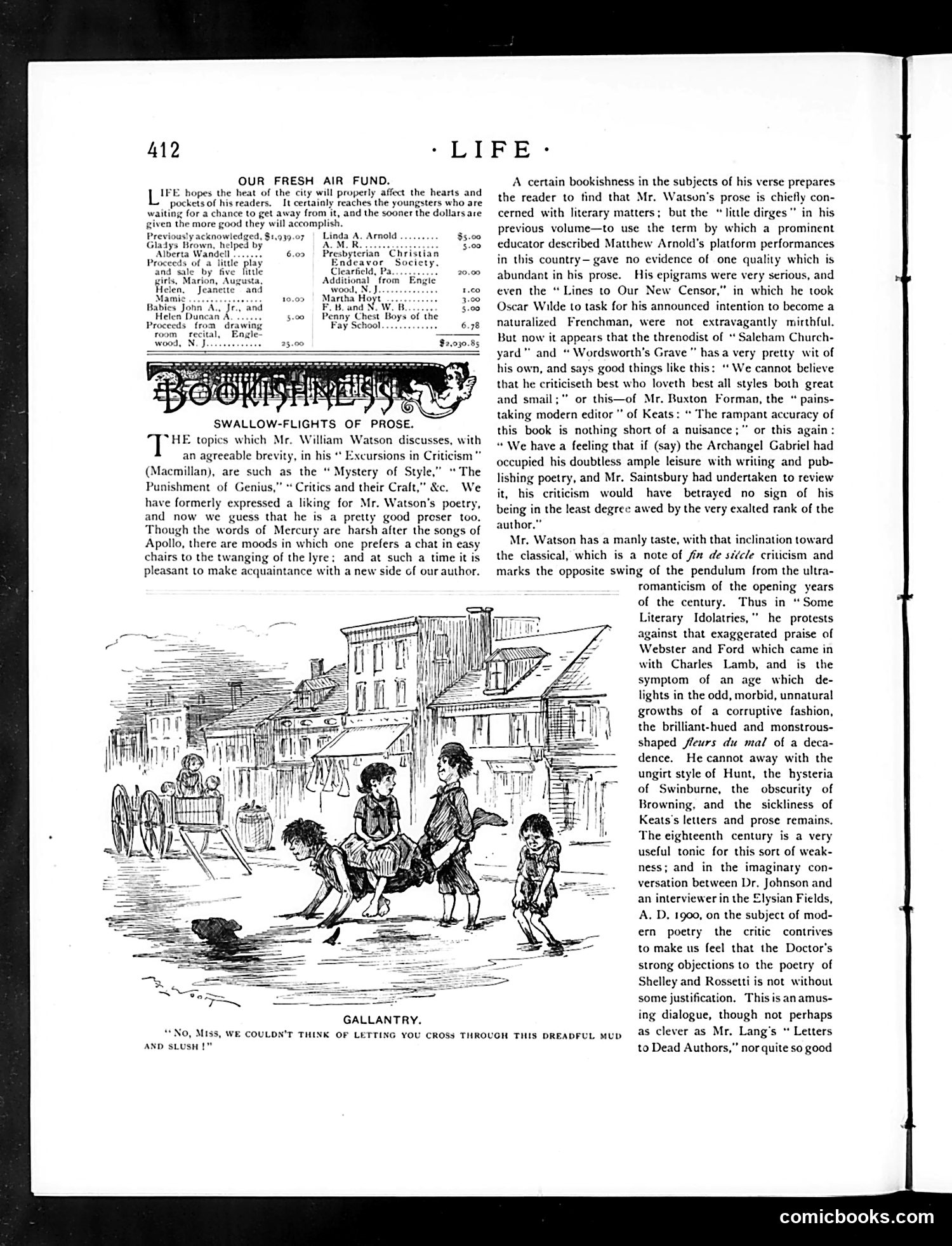
This page contains a literary review section titled "Swallow-Flights of Prose," discussing Mr. William Watson's essays and prose style. The accompanying illustration labeled "Gallantry" depicts a Victorian-era street scene with children and adults in muddy conditions, with the caption: "No, Miss, we couldn't think of letting you cross through this dreadful mud and slush!" The cartoon satirizes exaggerated Victorian gentility and courtship manners—the absurd lengths men would go to demonstrate chivalry toward women, even in impractical situations. The muddy street provides ironic contrast to the gentleman's fastidious concern for the lady's comfort, poking fun at the era's rigid social conventions and performative politeness.
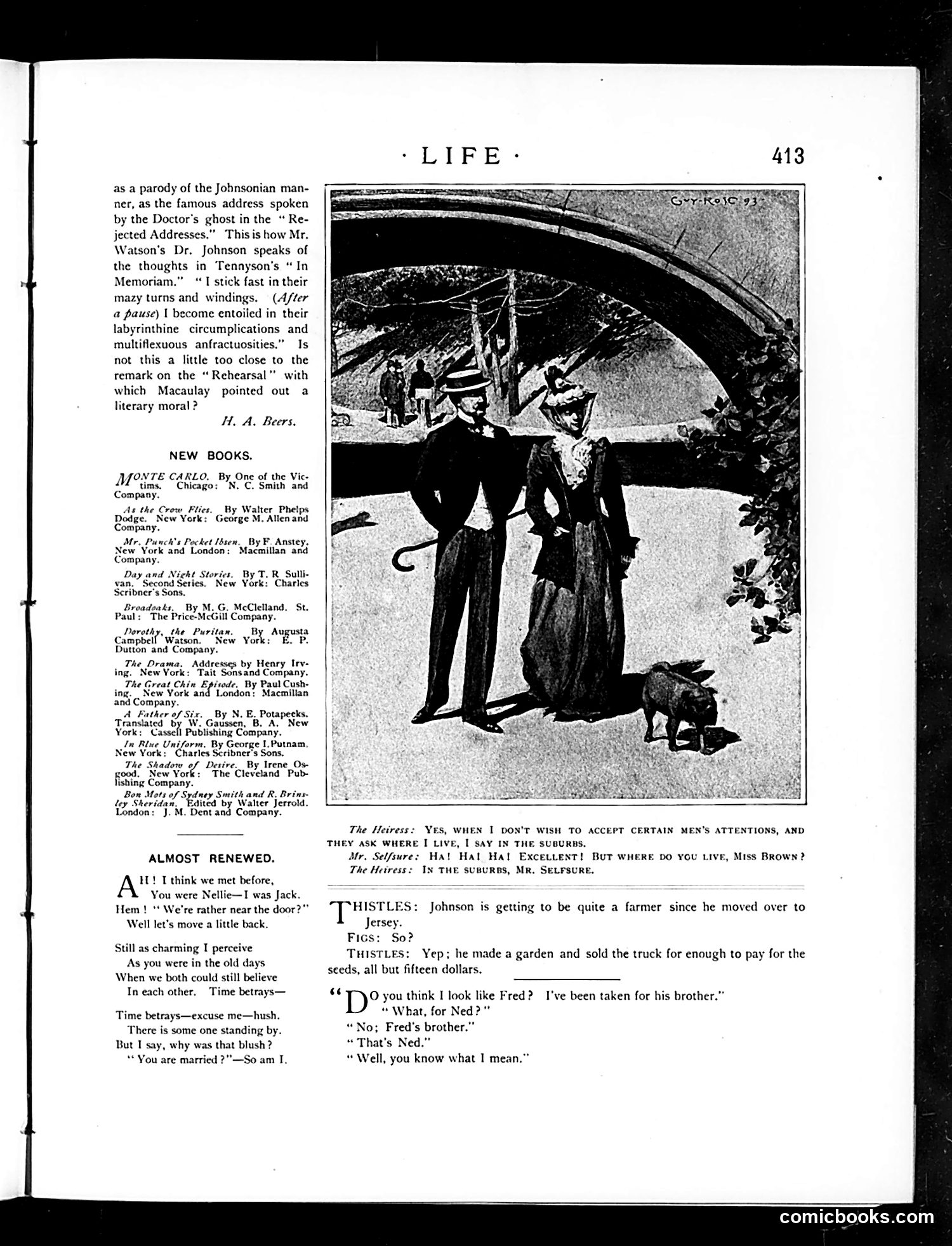
This page contains a satirical cartoon dialogue titled "Almost Renewed" depicting two figures encountering each other. The accompanying text suggests a reunion scenario between former acquaintances ("You were Nellie—I was Jack"). The main cartoon shows what appears to be a social encounter, with dialogue centered on mistaken identity and marital status, ending with a suggestive punchline about marriage. Below that, a separate comic titled "Thistles" involves characters Johnson, Figs, and others discussing Johnson becoming a farmer in Jersey and his garden/truck sale. The page also lists "New Books" with various contemporary publications. Without additional historical context, the specific satirical targets remain unclear, though the humor centers on social awkwardness, mistaken identity, and the domestic/rural life comedies typical of early 20th-century Life magazine satire.
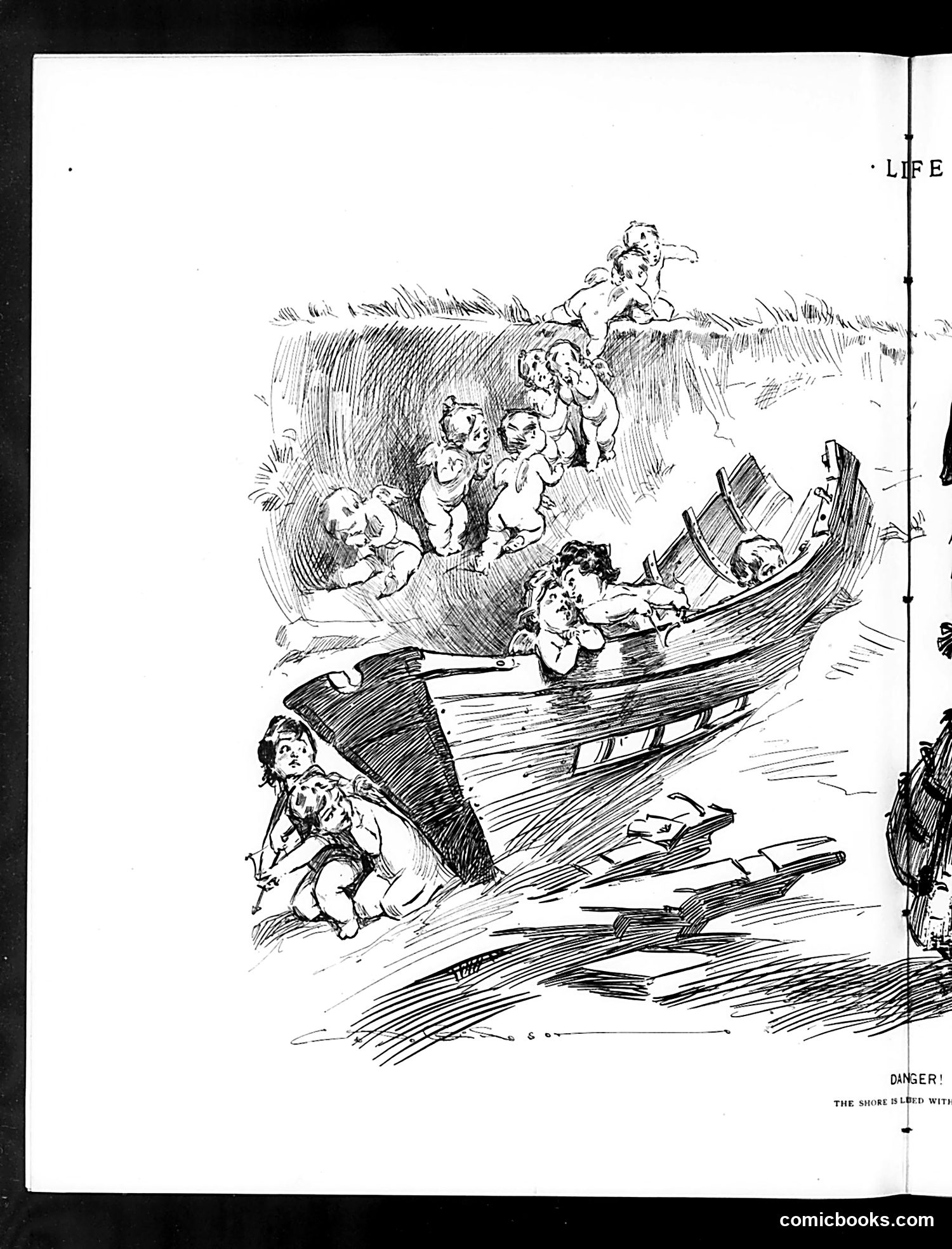
This appears to be a satirical cartoon from *Life* magazine depicting cherubs or putti (baby-like figures) in a boat on shore. The visible text reads "DANGER!" and "THE SHORE IS RED WITH..." (text cuts off). The cartoon likely references a contemporary political or social crisis involving bloodshed or violence. The cherubs—traditionally symbols of innocence—are portrayed in a dangerous situation, suggesting commentary on how innocents are threatened by the referenced danger. Without the complete caption and publication date, I cannot definitively identify which specific event this references. It could relate to labor violence, war, or social unrest from the early 20th century when *Life* was actively publishing political satire. The artist uses the juxtaposition of innocent figures against danger to create social commentary.
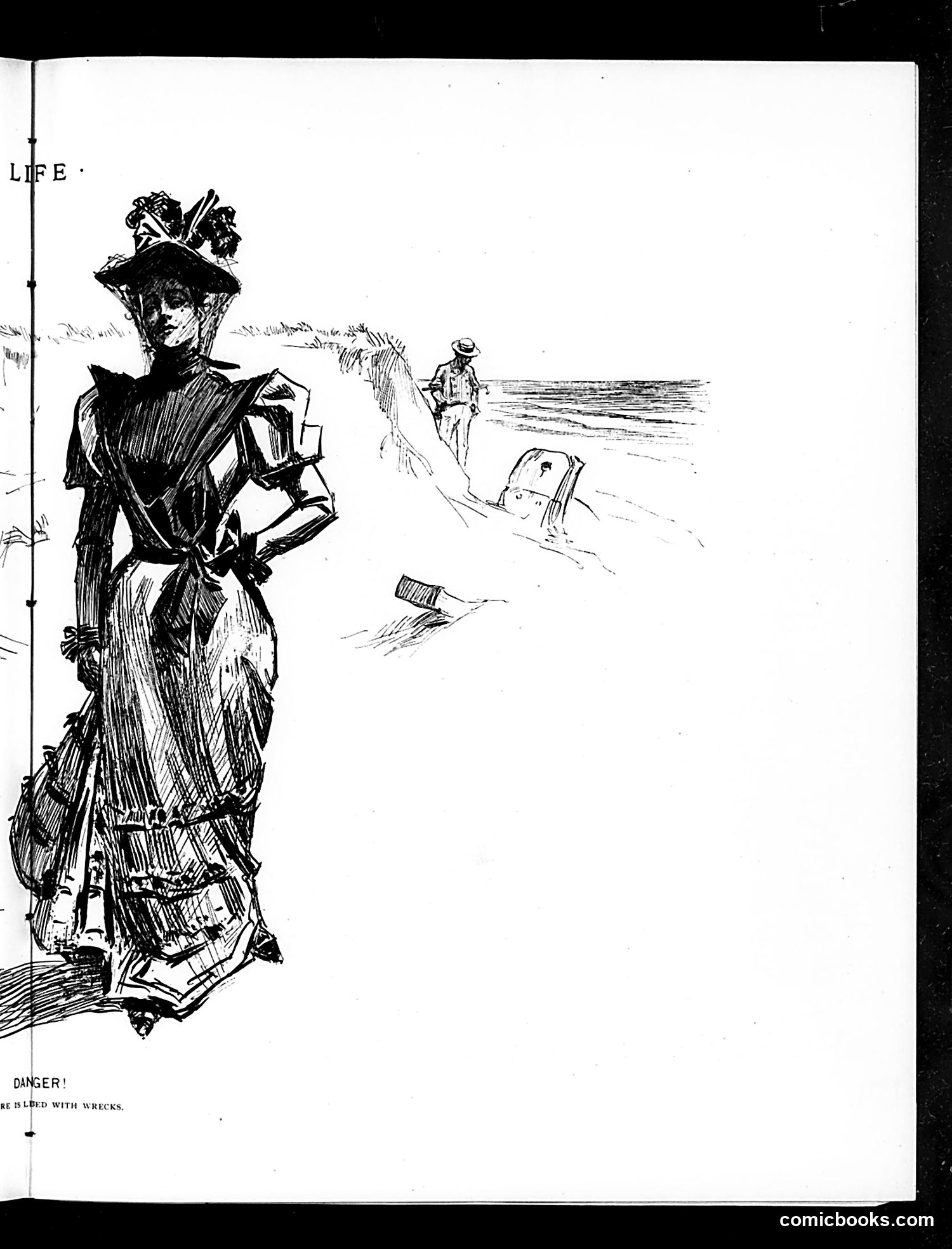
This page from *Life* magazine presents a single satirical illustration titled "Danger!" with the subtitle "Be Rid with Wrecks." The image depicts a fashionably dressed woman in elegant Edwardian-era clothing on the left, observing a seaside scene on the right where a man appears to be drowning or in distress in the water, with another figure standing nearby on the shore. The satire appears to target the dangers of reckless behavior at beaches or seaside resorts—specifically cautioning against swimming in unsafe conditions or near shipwrecks. The contrast between the woman's refined appearance and the perilous scene suggests commentary on Victorian-era leisure activities and their actual hazards, likely warning readers (particularly women) about the risks of fashionable seaside outings.
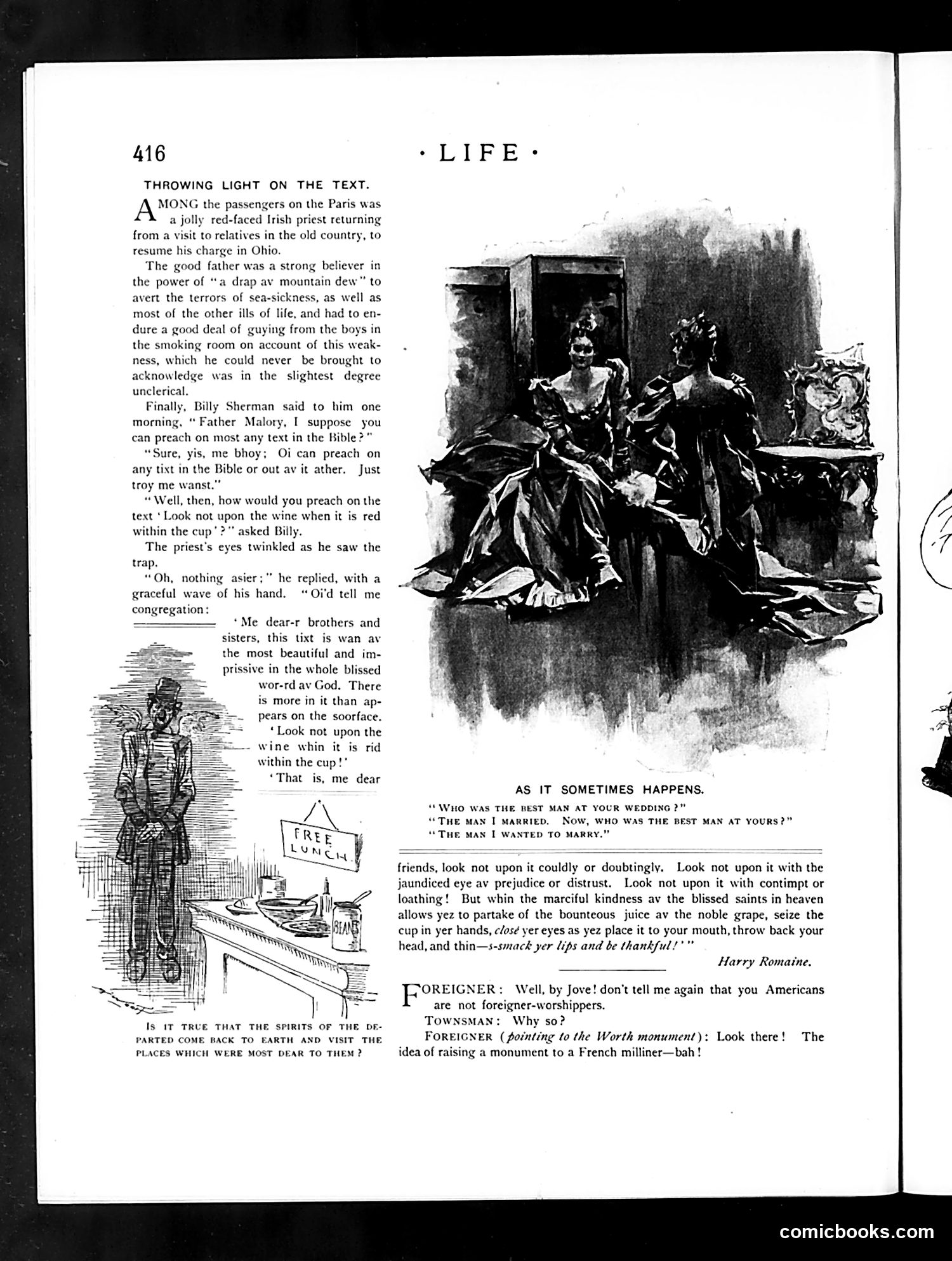
This page from *Life* magazine contains a humorous anecdote about an Irish priest named Father Malory who returns from Ireland to Ohio. Billy Sherman asks the priest which Bible verse he'll preach on, suggesting one about wine. The priest catches the trap—recognizing that Sherman is testing whether he'll drink—and instead delivers a lengthy quote counseling moderation and kindness regarding alcohol consumption. The accompanying sketch depicts a man labeled "First Lunch," suggesting the cartoon satirizes working-class dining habits or early-day drinking culture. The lower section includes a brief dialogue mocking foreigners' perceptions of Americans, with a foreigner sarcastically commenting on a French milliner's monument, poking fun at both American and foreign attitudes toward each other.
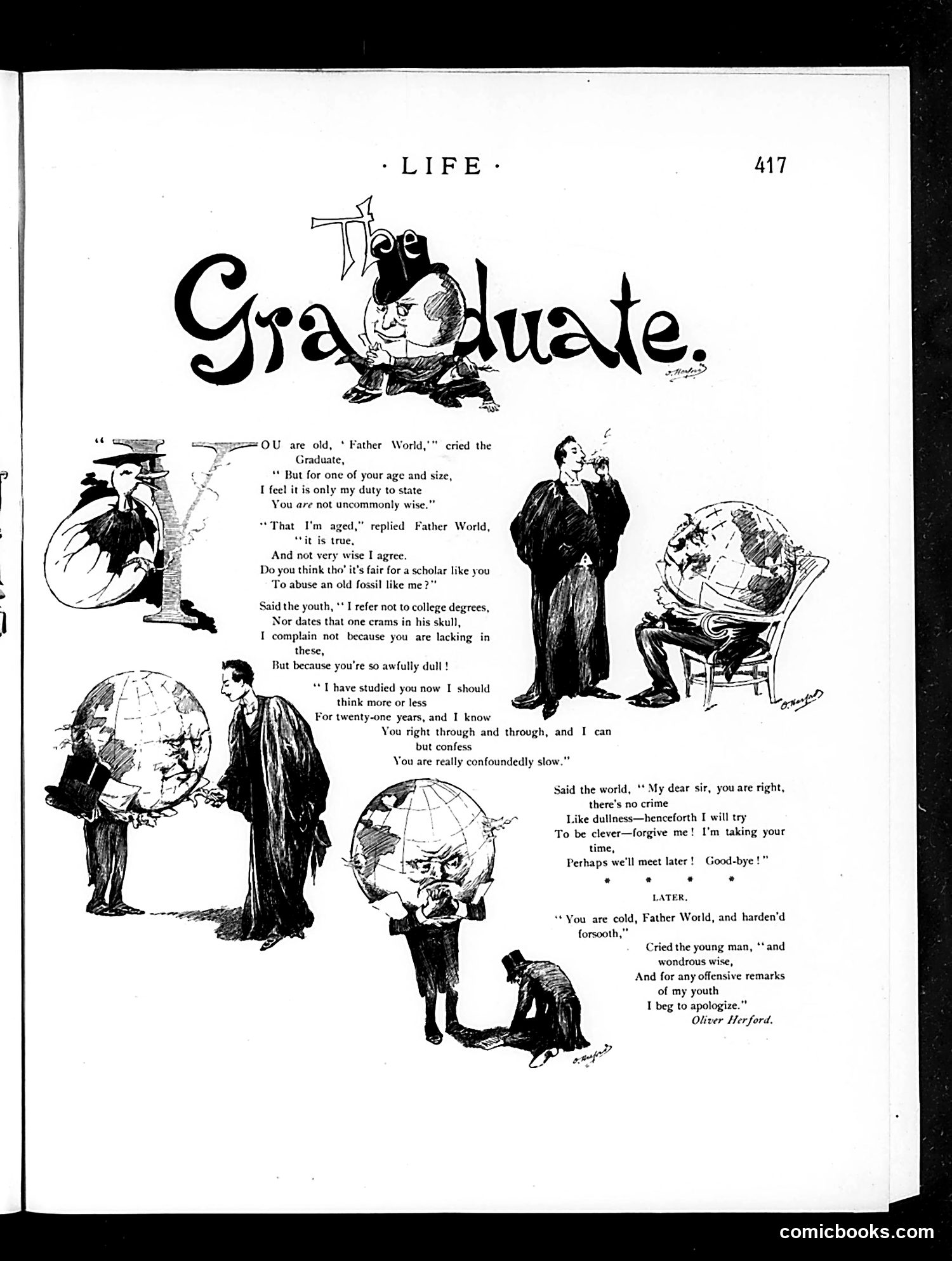
This page satirizes the tension between academic education and practical worldly experience. "Father World" (personified as an old, wizened figure) confronts a young Graduate, arguing that book learning doesn't prepare one for life's realities. The Graduate defensively claims scholarly credentials matter, but Father World dismissively calls him "confoundedly slow" and "awfully dull." The accompanying illustrations show the Graduate encountering various globes and maps—visual symbols of the world's complexity—while appearing small and helpless beside them. The satire mocks overeducated but naive young men entering society, suggesting that academic degrees and intellectual knowledge prove useless against practical experience. The poem's conclusion has the humbled Graduate apologizing for his youthful arrogance.
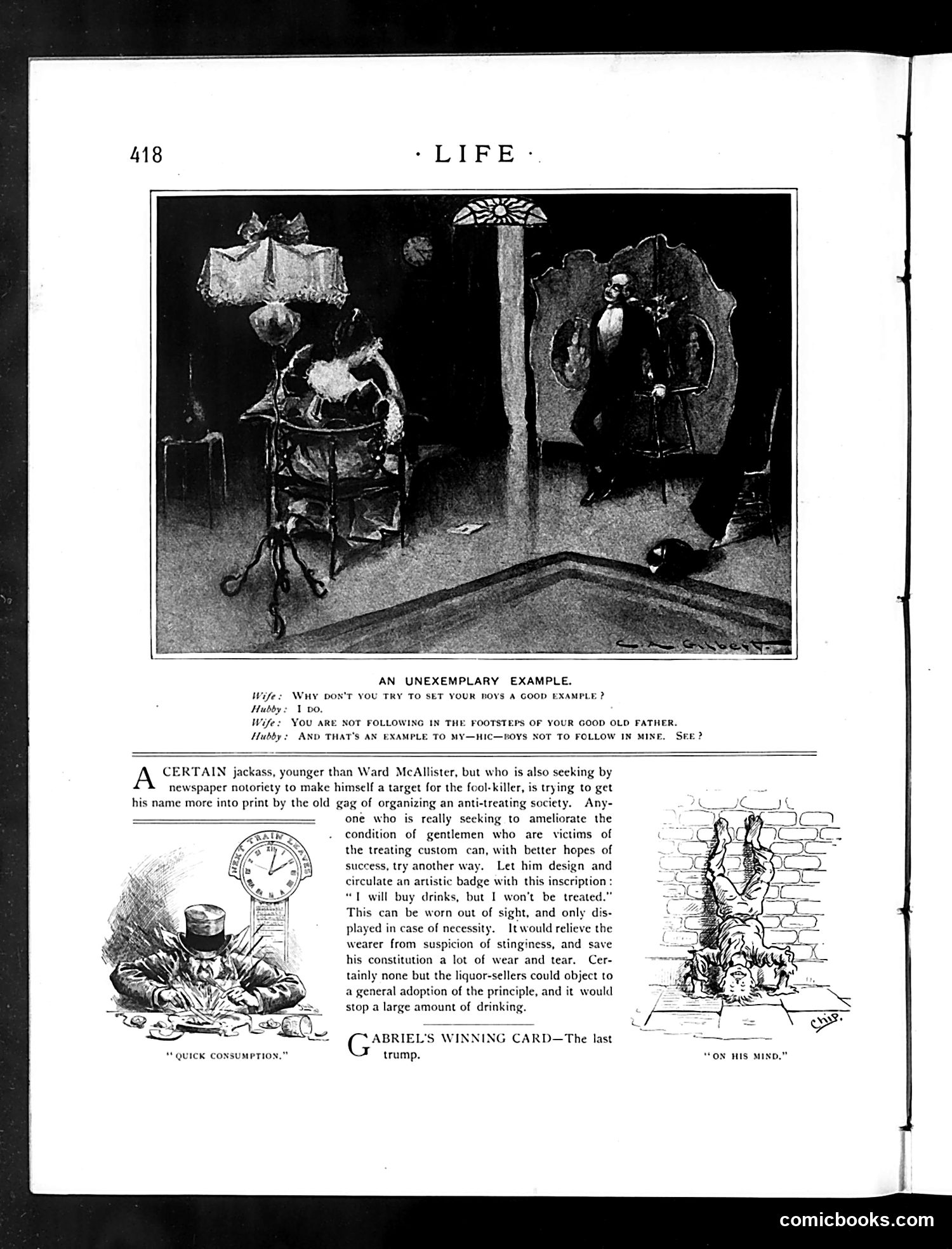
The top cartoon depicts a drunk husband (marked "HIC"—hiccupping) lecturing his sons about following their grandfather's example while clearly intoxicated himself. The satire mocks his hypocrisy: he's teaching them *not* to follow his behavior by being a terrible example of it. The accompanying text critiques an unnamed "jackass" (possibly a real public figure seeking notoriety) who founded an "anti-treating society"—organizations that discouraged the social custom of buying drinks for others. The author sardonically suggests an alternative: a discreet badge reading "I will buy drinks, but I won't be treated," which would resolve the social awkwardness around paying for rounds while reducing overall alcohol consumption. The three accompanying illustrations ("Quick Consumption," "Gabriel's Winning Card," "On His Mind") appear to reinforce the theme of drinking as an inescapable, defining preoccupation of the era's gentlemen. The piece satirizes both excessive drinking culture and the ineffectual reform movements attempting to address it.
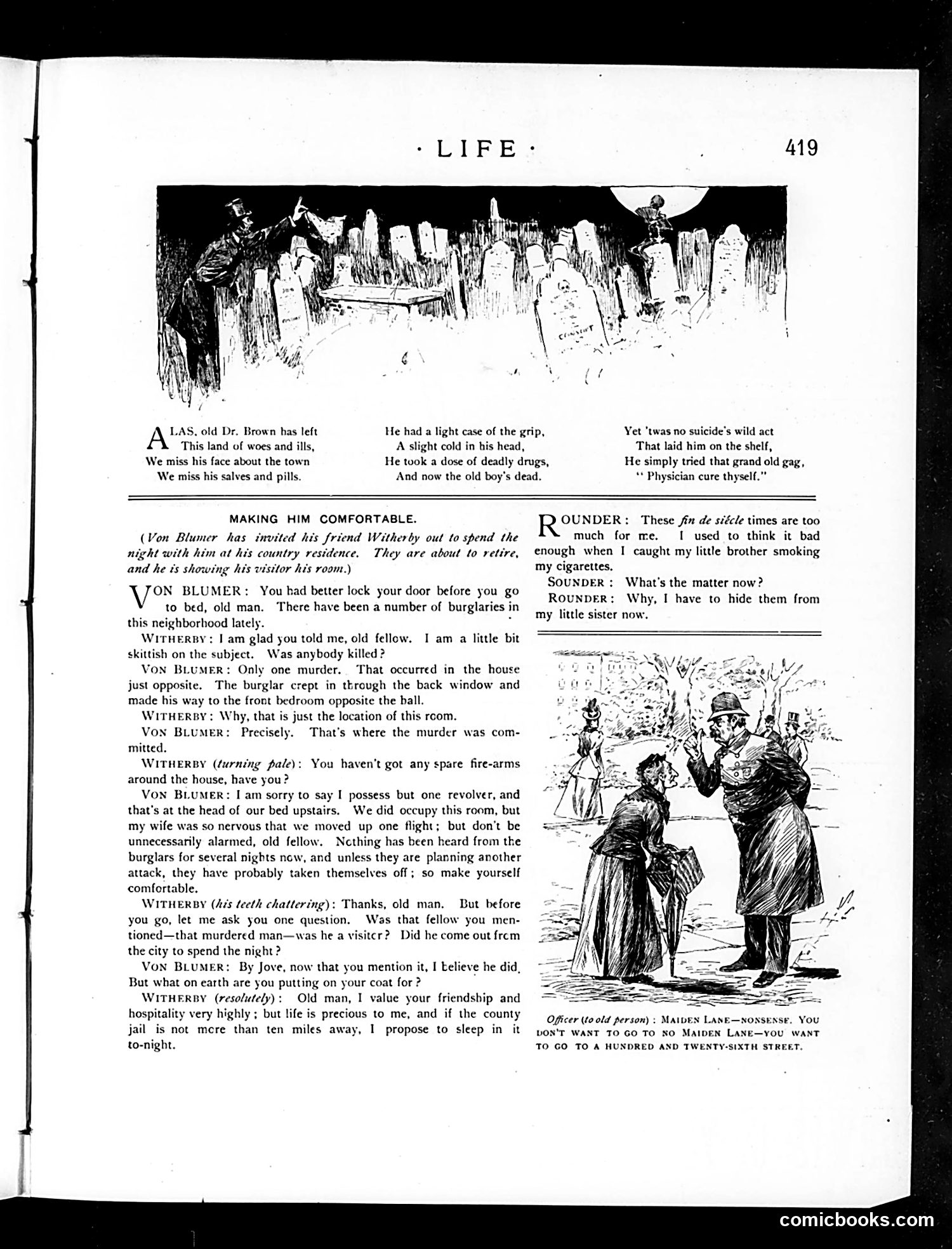
**Top Section - "Dr. Brown" Poem:** A brief, darkly comic verse mocking a deceased doctor who ironically dies from medical treatment ("a dose of deadly drugs"). The joke plays on the proverb "Physician, heal thyself"—the doctor couldn't cure his own ailment, dying from the very medicine he would prescribe to others. **Main Section - "Making Him Comfortable":** A dialogue comedy where Von Blumer invites guest Witherby to stay overnight but cheerfully reveals the guest bedroom is in the exact location where a recent murder occurred during a burglary. Von Blumer casually mentions the previous visitor-guest was the murder victim, then offers only one revolver (upstairs in *his* bedroom) for protection. Witherby, increasingly terrified, abandons politeness and resolves to spend the night in jail instead—finding prison safer than his host's "comfortable" guest room. The humor satirizes false hospitality and the absurd dangers of accepting invitations to dangerous locales.
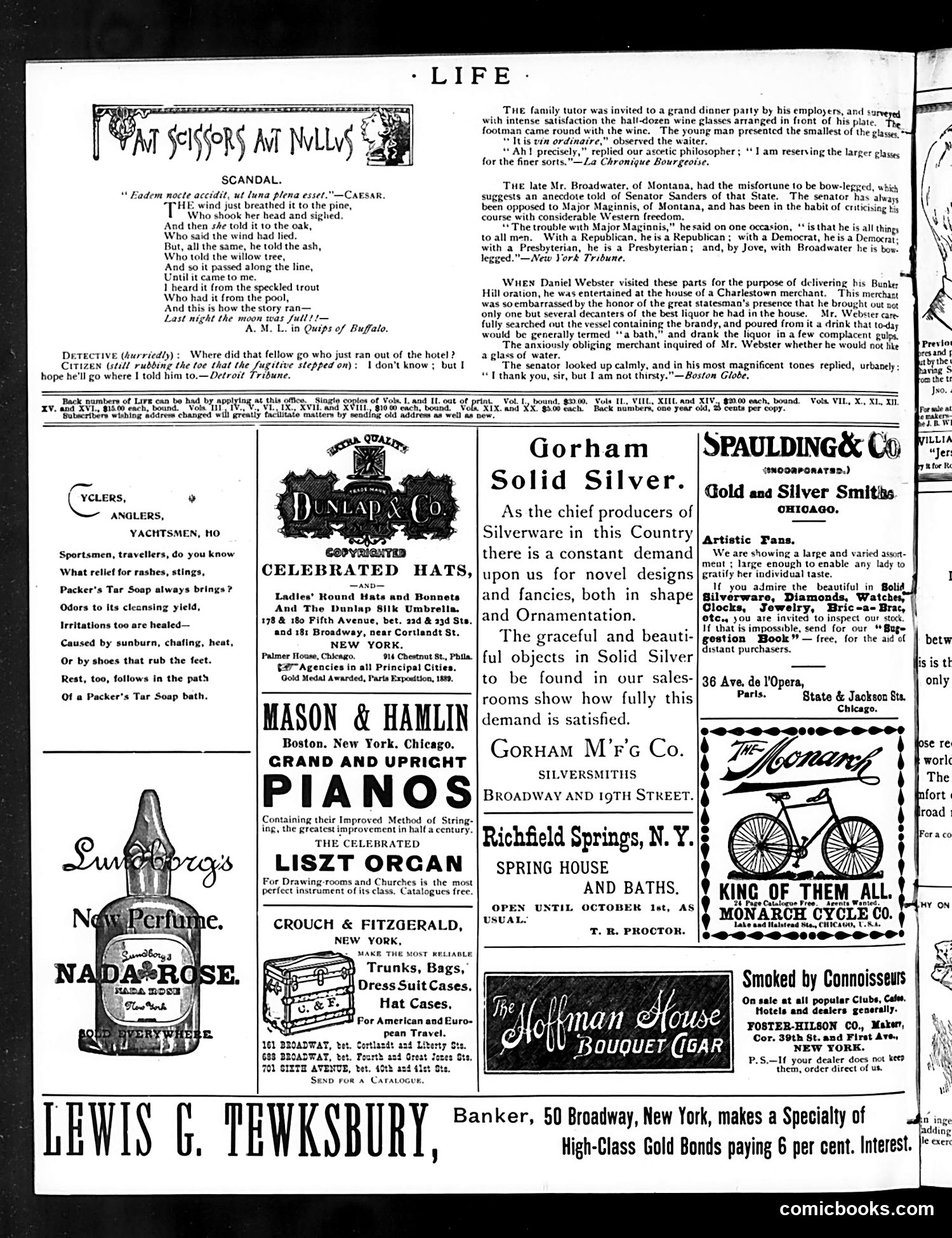
This page is primarily **advertising and miscellaneous content** rather than political cartoons. The main items are: **"Scandal" Section**: A series of brief anecdotes and jokes about social situations, including stories about a tutor at a dinner party choosing small wine glasses, Senator Sanders of Montana mocking Major Maginnis's political inconsistency (humorously comparing him to being "bow-legged" with different constituencies), and Daniel Webster famously declining water after drinking brandy. **The One Cartoon**: A small detective/citizen exchange making a visual pun about someone's toe being stepped on by a fleeing suspect. **Advertisements**: The bulk of the page features ads for hats (Dunlap & Co.), pianos (Mason & Hamlin), perfume (Nadaose), trunks and luggage (Crouch & Fitzgerald), silverware (Gorham), bicycles (Monarch), cigars (Hoffman House), and financial services (Lewis G. Tewksbury bonds). The "scandal" anecdotes are gentle, upper-class humor focused on social etiquette rather than political satire.
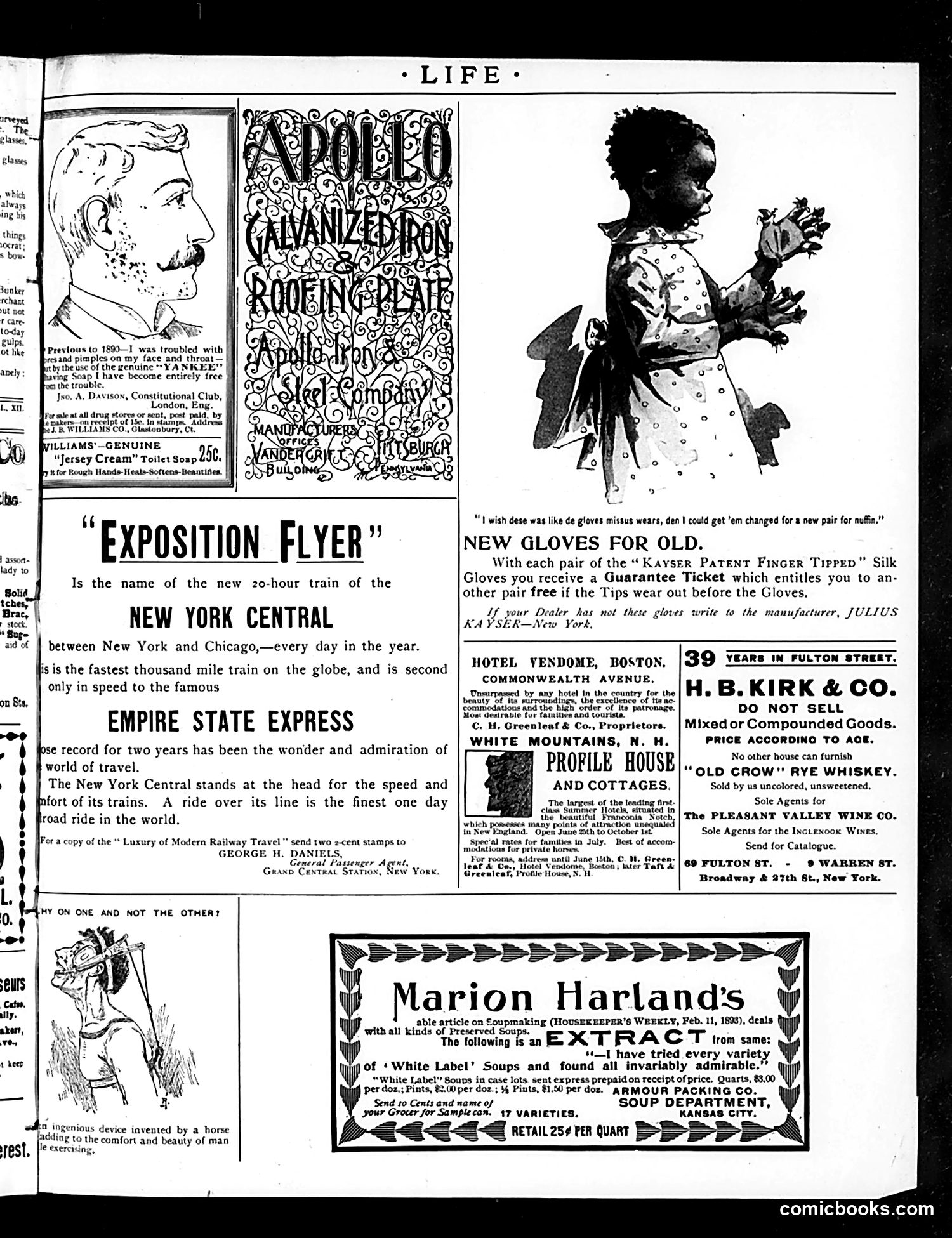
This is primarily an **advertising page** from Life magazine, not a political cartoon. The layout features multiple product advertisements typical of late 19th-century magazines. The most notable visual element is a **caricature of a Black child** in the "New Gloves for Old" advertisement (top right), depicted in a stereotypical manner common to the era. The accompanying caption uses **dialect speech** ("dese," "missus," "nuffia") to create humor—the child wishes their worn gloves could be exchanged like the advertised Kayser brand. This reflects the **casual racial stereotyping** prevalent in period advertising, where Black figures were often caricatured for comedic effect in product promotions. The rest of the page advertises: - New York Central trains - Hotels and resorts - Whiskey and wine - Soup products (featuring a Marion Harland endorsement) - Toiletries and other goods The page demonstrates how mainstream publications of this era normalized racial caricature as entertainment alongside ordinary commercial messaging.
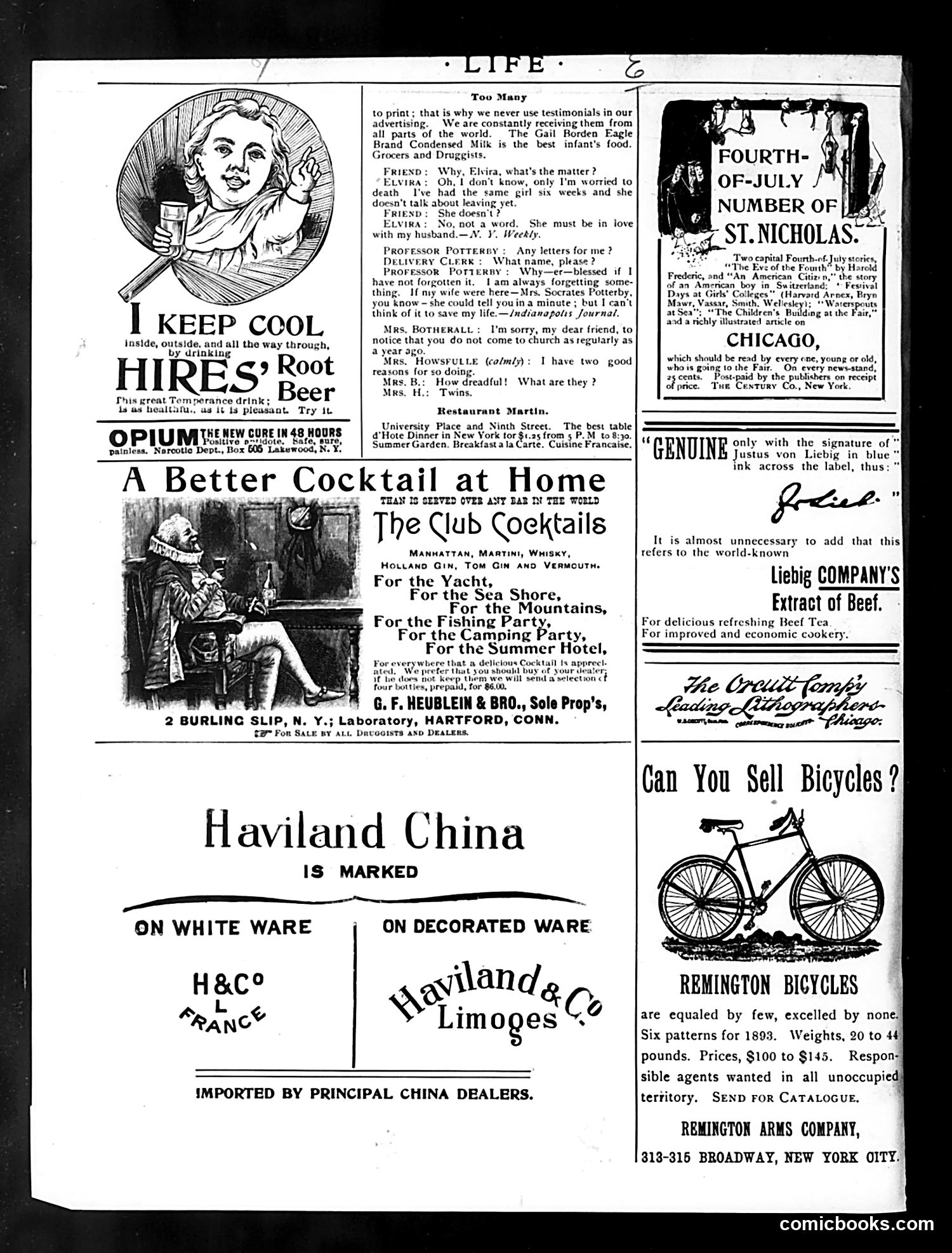
This page is primarily **advertisements and humor columns**, not political cartoons. The content reflects turn-of-the-century American consumer culture and domestic comedy: ## Main Humor Pieces: The text includes three brief satirical anecdotes about marriage and relationships—a woman worried her maid is too content (implying she's infatuated with the husband), a professor who can't remember his own name, and a woman with twins explaining her absence from church. These are genteel domestic jokes typical of *Life*'s satirical humor aimed at middle-class readers. ## Advertisements: The page showcases period products: Hires Root Beer (a "temperance drink"), cocktail recipes, condensed milk, china, bicycles, and beef extract. Notable is the emphasis on branded goods and mail-order consumer culture emerging in the 1890s. The "Fourth-of-July Number of St. Nicholas" ad references the holiday magazine issue, indicating this is a summer edition of *Life*. **No significant political satire is present on this page.**

I can see this is a very dark page from what appears to be a historical publication, with minimal visible content. The OCR text provides only "comicbooks.com" and formatting markers, which suggests this is either a blank or nearly blank page, possibly a back cover, divider, or advertisement space. The left margin shows partial text fragments including words like "this," "DY'S," and "S?" but these are too incomplete to identify any specific cartoon, article, or advertisement with certainty. Without clearer visible content or legible text, I cannot reliably identify figures, political references, or satirical intent. This appears to be either a scanning issue or genuinely an unmarked/blank page from the publication.