
Life, 1893-06-29 · page 4 of 17
Life — June 29, 1893 — page 4: what you’re looking at
What you’re looking at
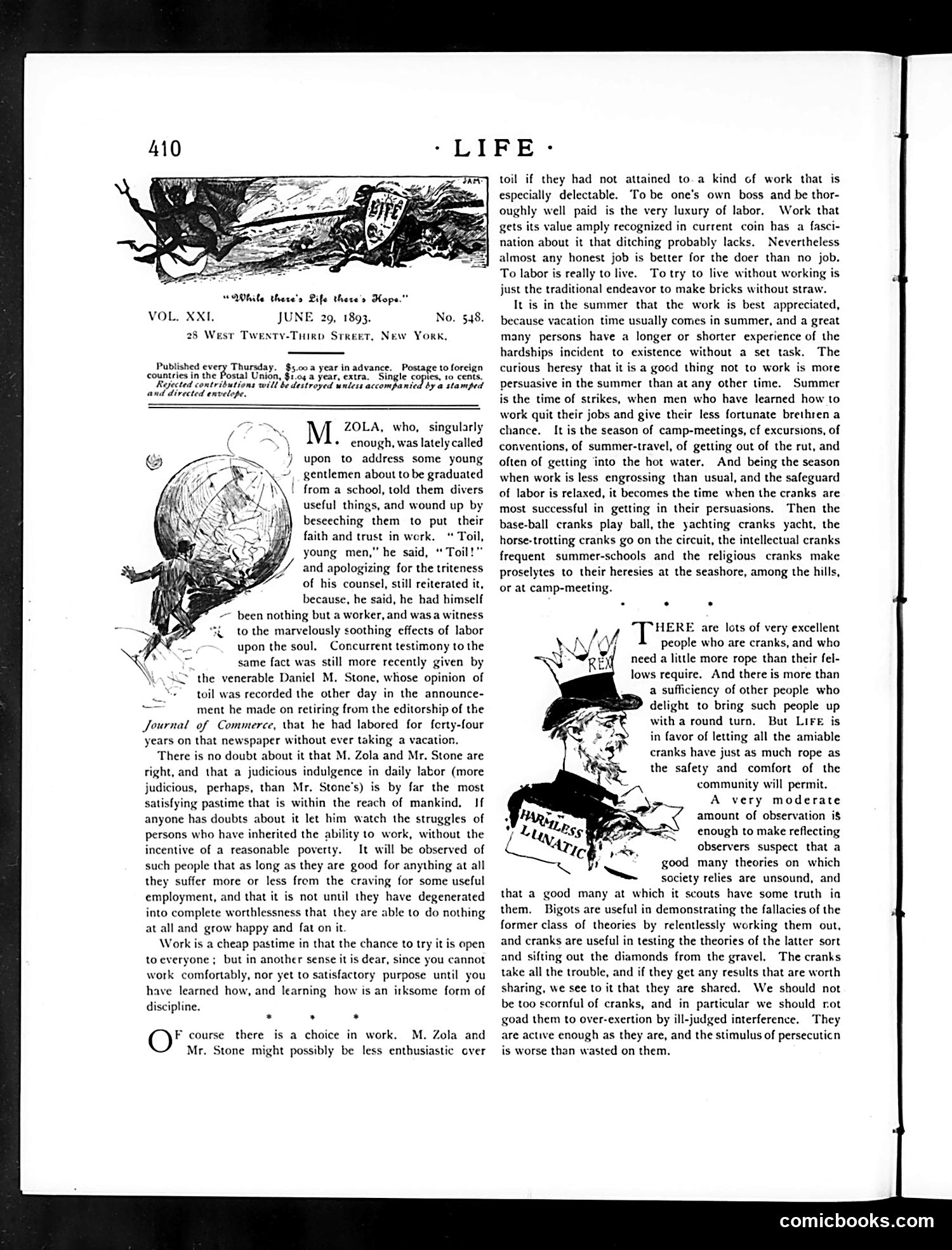
This page contains editorial commentary on labor and work, not political cartoons. The text discusses M. Zola and Daniel M. Stone's views on labor, arguing that honest work—even difficult labor—is dignified and preferable to idleness. The two illustrated figures appear to be generic character types rather than specific caricatures: the first shows a working man, and the second depicts a figure labeled "Harmless Lunatic," likely representing eccentric individuals or "cranks" who the author suggests society should tolerate moderately. The article advocates for allowing workers reasonable leisure time and distinguishes between productive "cranks" (useful agitators testing social theories) and those who are merely bothersome. The piece reflects 1890s attitudes about labor, social reform, and tolerance for unconventional thinkers.
📄 Transcribed text from this page (OCR, searchable)
Machine-transcribed from the original scan — historical spelling and the odd misread are preserved.
- LIFE: “While there's Life there's Hope.” XXI. JUNE 29, 1893. No. 548. 28 West Twenty-Tiirp Srreet, New York, Published every Thursday. $5.00. a year in advance. Postage to foreign countries in the Postal Union, $1.0 a year, extra. Single copies, 10 cents. Rejected contributions will be destroyed unless accompanied by a stamped and directed envelope. ” anes = ZOLA, who, singularly * enough, was lately called upon to address some young gentlemen about to be graduated from a school, told them divers useful things, and wound up by beseeching them to put their faith and trust in werk. “ Toil, young men," he said, “ Toil!" and apologizing for the triteness of his counsel, still reiterated it, because, he said, he had himself been nothing but a worker, and was a witness “3 to the marvelously soothing effects of labor upon the soul, Concurrent testimony to the same fact was still more recently given by the venerable Daniel M. Stone, whose opinion of toil was recorded the other day in the announce- ment he made on retiring from the editorship of the Journal of Commerce, \hat he had labored for forty-four years on that newspaper without ever taking a vacation. There is no doubt about it that M. Zola and Mr. Stone are right, and that a judicious indulgence in daily labor (more judicious, perhaps, than Mr. Stone's) is by far the most satisfying pastime that is within the reach of mankind. If anyone has doubts about it let him watch the struggles of persons who have inherited the ability to work, without the incentive of a reasonable poverty. It will be observed of such people that as long as they are good for anything at all they suffer more or less from the craving for some useful employment, and that it is not until they have degenerated into complete worthlessness that they are able to do nothing at all and grow happy and fat on it Work is a cheap pastime in that the chance to try itis open to everyone ; but in another sense it is dear, since you cannot work comfortably, nor yet to satisfactory purpose until you have learned how, and learning how is an irksome form of discipline. O° * . * course there is a choice in work. M. Zola and Mr. Stone might possibly be less enthusiastic over toil if they had not attained to.a kind of work that is especially delectable. ‘To be one’s own boss and be thor- oughly well paid is the very luxury of labor. Work that gets its value amply recognized in current coin has a fasci- nation about it that ditching probably lacks. Nevertheless almost any honest job is better for the doer than no job. To labor is really to live. To try to live without working is just the traditional endeavor to make bricks without straw. It is in the summer that the work is best appreciated, because vacation time usually comes in summer, and a great many persons have a longer or shorter experience of the hardships incident to existence without a set task. The curious heresy that it is a good thing not to work is more persuasive in the summer than at any other time. Summer is the time of strikes, when men who have learned how to work quit their jobs and give their less fortunate brethren a chance. It is the season of camp-meetings, cf excursions, of conventions, of summer-travel, of getting out of the rut, and often of getting into the hot water. And being the season when work is less engrossing than usual, and the safeguard of labor is relaxed, it becomes the time when the cranks are most successful in getting in their persuasions. Then the base-ball cranks play ball, the yachting cranks yacht, the horse-trotting cranks go on the circuit, the intellectual cranks frequent summer-schools and the religious cranks make proselytes to their heresies at the seashore, among the hills, or at camp-meeting. HERE are lots of very excellent people who are cranks, and who need a little more rope than their fel- lows require. And there is more than a sufficiency of other people who delight to bring such people up with a round turn, But LIFE is in favor of letting all the amiable cranks have just as much rope as the safety and comfort of the community will permit. A very moderate amount of observation i$ enough to make reflecting observers suspect that a many theories on which society relies are unsound, and that a good many at which it scouts have some truth ia them. Bigots are useful in demonstrating the fallacies of the former class of theories by relentlessly working them out, and cranks are useful in testing the theories of the latter sort and sifting out the diamonds from the gravel. The cranks take all the trouble, and if they get any results that are worth sharing, we see to it that they are shared. We should not be too scornful of cranks, and in particular we should rot goad them to over-exertion by ill-judged interference, They are active enough as they are, and the stimulus of persecuticn is worse than wasted on them. comicbooks.com