
Life, 1893-06-29 · page 6 of 17
Life — June 29, 1893 — page 6: what you’re looking at
What you’re looking at
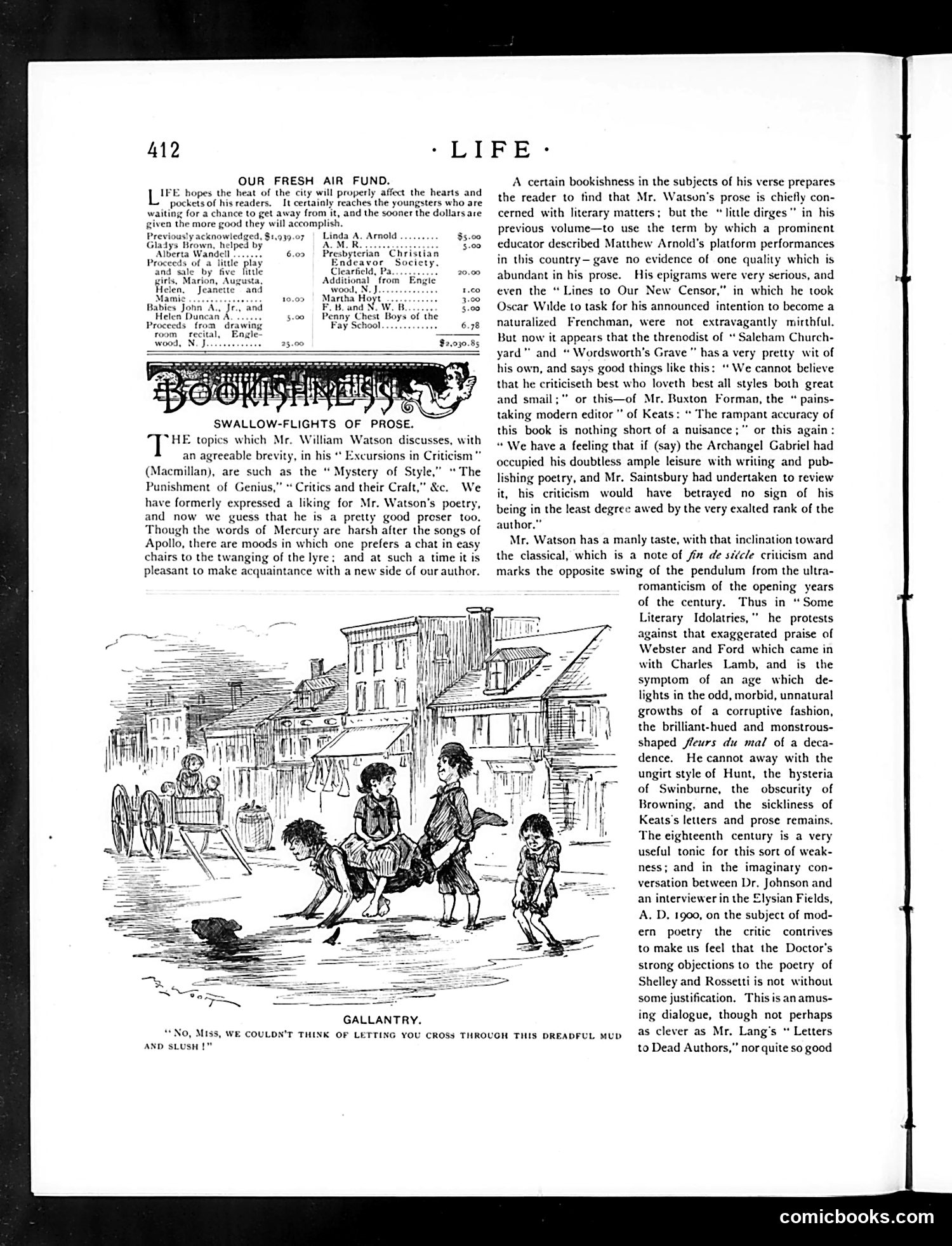
This page contains a literary review section titled "Swallow-Flights of Prose," discussing Mr. William Watson's essays and prose style. The accompanying illustration labeled "Gallantry" depicts a Victorian-era street scene with children and adults in muddy conditions, with the caption: "No, Miss, we couldn't think of letting you cross through this dreadful mud and slush!" The cartoon satirizes exaggerated Victorian gentility and courtship manners—the absurd lengths men would go to demonstrate chivalry toward women, even in impractical situations. The muddy street provides ironic contrast to the gentleman's fastidious concern for the lady's comfort, poking fun at the era's rigid social conventions and performative politeness.
📄 Transcribed text from this page (OCR, searchable)
Machine-transcribed from the original scan — historical spelling and the odd misread are preserved.
412 OUR FRESH AIR FUND. IFE hopes the heat of the city will properly affect the hearts and pockets of his readers. It certainly reaches the youngsters who are waiting for a chance to get away from it, and the sooner the dollars are given the more good they will accomplish. Previously acknowledged, $1,939.07 Linda A. Arnold Gladys Brown, helped b ALM: R. occsees: I Ww. ell Presbyterian Christi. Endeavor Socicty. me field, Pa. * little play five little Cle A Babies Jona A., Je. Helen Duncan A Proceeds from drawing room recital, Engle- wood, N. J... WB. Penny Chest Boys of the “ay School. SWALLOW-FLIGHTS OF PROSE. “Pe topics which Mr. William Watson discusses, with an agreeable brevity, in hi: =xcursions in Criticism” (Macmillan), are such as the “ Mystery of § Punishment of Genius,” “ Critics and their Craft have formerly expressed a liking for Mr. Watson's poetry, nd now we guess that he is a pretty good preser too, Though the words of Mercury are harsh after the songs of Apollo, there are moods in which one prefers a chat in easy chairs to the twanging of the lyre; and at such a time it is pleasant to make acquaintance with a new side of our author. yle,” “ The &e. We ‘LIFE: A certain bookishness in the subjects of his verse prepares the reader to tind that Mr. Watson's prose is chiefly con- cerned with literary matters; but the “little dirges” in his previous volume—to use the term by which a prominent educator described Matthew Arnold's platform performances in this country— gave no evidence of one quality which is abundant in his prose. His epigrams were very serious, and even the “Lines to Our New Censor,” in which he took Oscar Wilde to task for his announced intention to become a naturalized Frenchman, were not extravagantly mirthful. But now it appears that the threnodist of * Saleham Church- yard" and “ Wordsworth’s Grave” has a very pretty wit of his own, and says good things like this: “ We cannot believe that he criticiseth best who loveth best all styles both great and smail;" or this—of Mr. Buxton Forman, the “ pains- taking modern editor " of Keats: * The rampant accuracy of this book is nothing short of a nuisance ;" or this again: “ We have a feeling that if (say) the Archangel Gabriel had occupied his doubtless ample leisure with writing and pub- lishing poetry, and Mr. Saintsbury had undertaken to review it, his criticism would have betrayed no sign of his being in the least degree awed by the very exalted rank of the author.” Mr. Watson has a manly taste, with that inclination toward the classical, which is a note of fin de siécle criticism and marks the opposite swing of the pendulum from the ultra- romanticism of the opening years of the century. Thus in “ Some Literary Idolatries,"’ he protests against that exaggerated praise of Webster and Ford which came in with Charles Lamb, and is the symptom of an age which de- lights in the odd, morbid, unnatural growths of a corruptive fashion, the brilliant-hued and monstrous- shaped fleurs du mal of a deca- dence. He cannot away with the ungirt style of Hunt, the hysteria of Swinburne, the obscurity of Browning, and the sickliness of Keats's letters and prose remains. The eighteenth century is a very useful tonic for this sort of weak- ness; and in the imaginary con- versation between Dr. Johnson and an interviewer in the Elysian Fields, A. D. 1900, on the subject of mod- ern poetry the critic contrives to make us feel that the Doctor's strong objections to the poetry of Shelley and Rossetti is not without some justification. This isan amus- ing dialogue, though not perhaps as clever as Mr. Lang’s “ Letters to Dead Authors,” nor quite so good comicbooks.com