
Life, 1893-06-29 · page 5 of 17
Life — June 29, 1893 — page 5: what you’re looking at
What you’re looking at
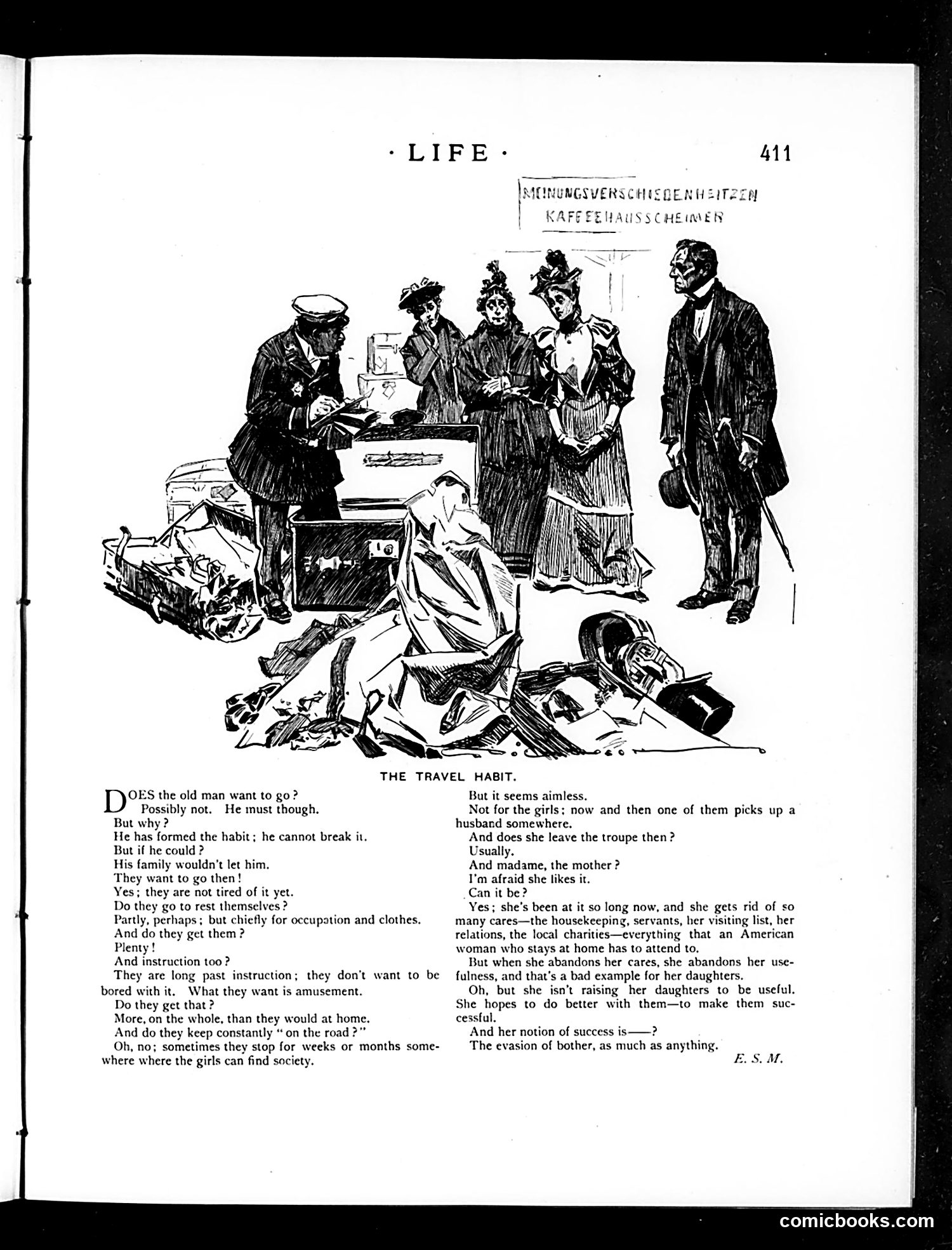
This satirical piece critiques the popular trend of wealthy American families—particularly women—traveling constantly rather than maintaining stable homes. The illustration shows a chaotic domestic scene where a family's belongings are scattered, suggesting perpetual displacement. The accompanying dialogue explores the irony: while parents claim to travel for educational and recreational purposes, the real motivation appears to be escaping domestic responsibilities. The text sarcastically notes that traveling mothers abandon household management, servants, and child-rearing duties under the guise of "success," while actually seeking "evasion of bother." The cartoon mocks both the pretense of cultured travel and the abdication of traditional maternal responsibilities that this lifestyle represents—a concern reflecting early 20th-century anxieties about changing gender roles and family structure.
📄 Transcribed text from this page (OCR, searchable)
Machine-transcribed from the original scan — historical spelling and the odd misread are preserved.
- LIFE: 4A IMCNUNGSVERS CHISDERHEITZZM THE TRAVEL HABIT. OES the old man want to go? Possibly not. He must though. But why ? He has formed the habit; he cannot break it. But if he could ? His family wouldn't let him. They want to go then! Yes; they are not tired of it yet. Do they go to rest themselves ? Partly, perhaps; but chiefly for occupation and clothes. And do they get them ? Plenty ! And instruction too ? They are long past instruction; they don’t want to be bored with it. What they want is amusement. Do they get that ? More, on the whole, than they would at home. And do they keep constantly “on the road ?” Oh, no; sometimes they stop for weeks or months some- where where the girls can find society. But it seems aimless. Not for the girls; now and then one of them picks up a husband somewhere. And does she leave the troupe then ? Usually. And madame, the mother ? I'm afraid she likes it. Can it be? Yes; she’s been at it so long now, and she gets rid of so many cares—the housekeeping, servants, her visiting list, her relations, the local charities—everything that an American woman who stays at home has to attend to, But when she abandons her cares, she abandons her use- fulness, and that’s a bad example for her daughters. Oh, but she isn’t raising her daughters to be useful. She hopes to do better with them—to make them suc- cessful. And her notion of success is ——? The evasion of bother, as much as anything. ELS. M. comicbooks.com