
A complete issue · 18 pages · 1893
Life — May 18, 1893
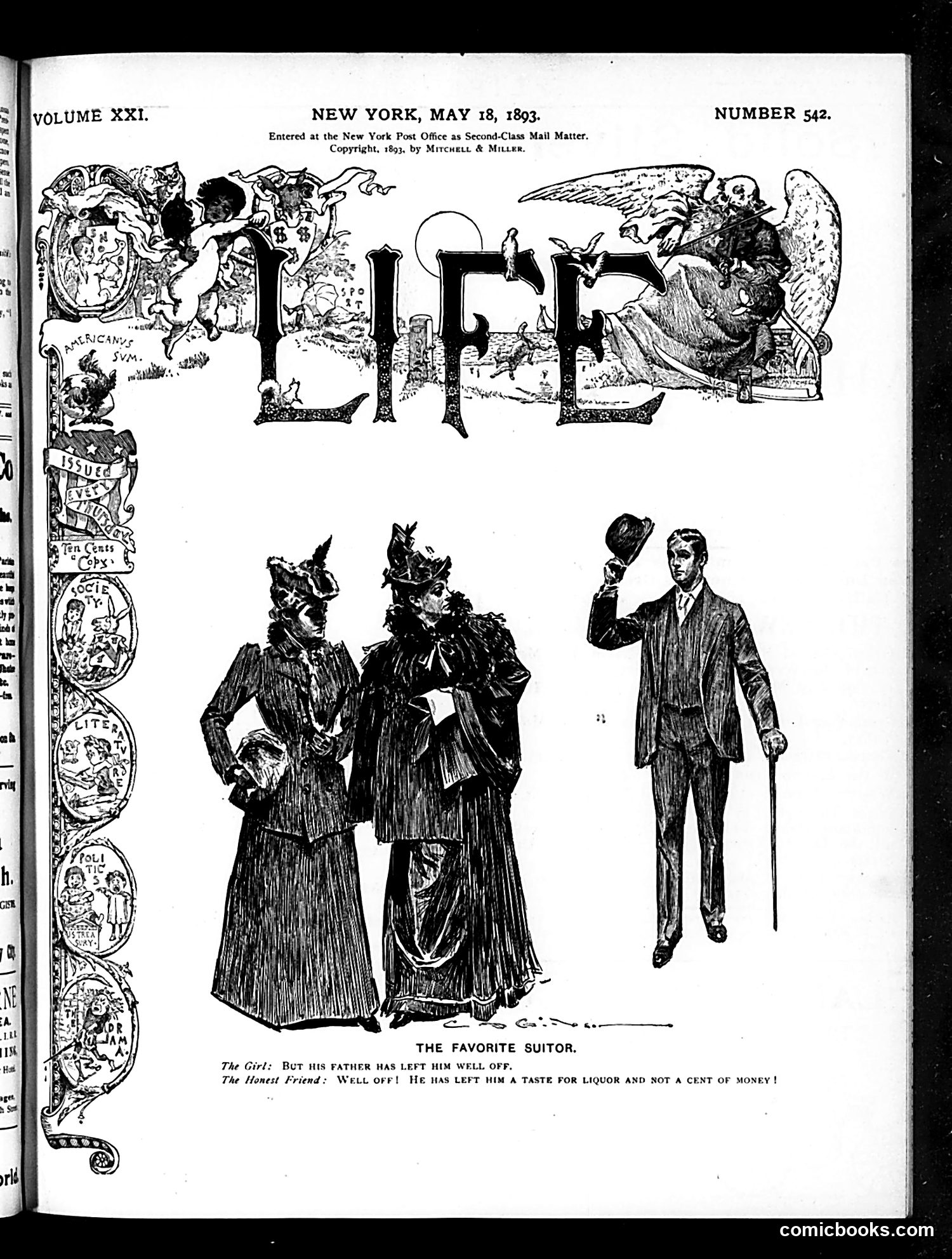
This cartoon satirizes a romantic triangle involving class and money. The illustration shows two women and a man in late-Victorian dress. According to the dialogue: - **The Girl** tells her father: "But his father has left him well off" - **The Honest Friend** responds: "Well off! He has left him a taste for liquor and not a cent of money!" The satire mocks the daughter's naïve assumption that the suitor is wealthy based on his appearance and family background. The "honest friend" exposes the truth: the man's father left him only bad habits (alcoholism) and debt, not an actual fortune. This critiques both romantic illusions about gentlemen suitors and the financial precariousness beneath Victorian gentility—a timely concern during the 1893 economic depression.
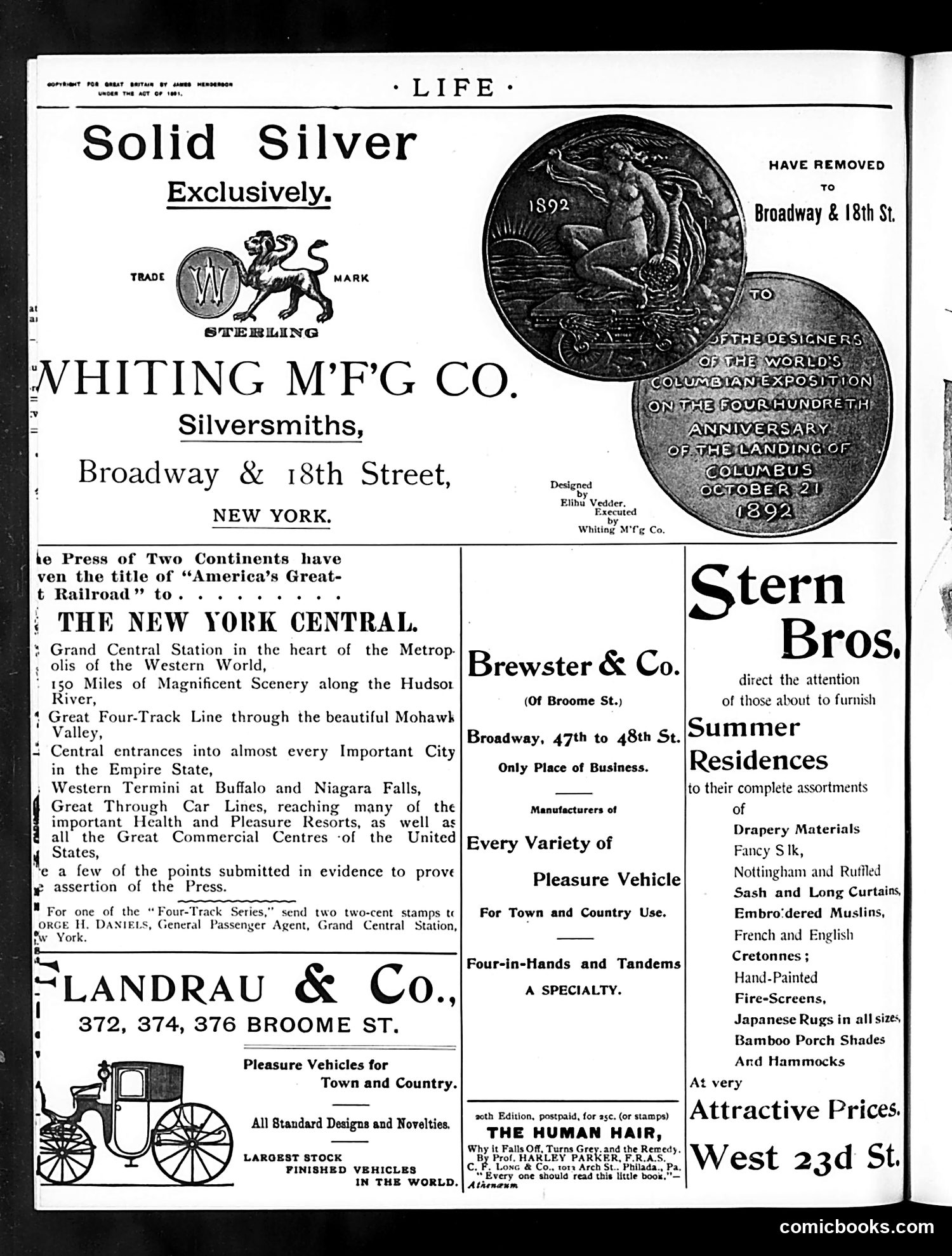
This page is **primarily advertising**, not satirical content. It contains commercial advertisements from 1892 (based on the commemorative medal shown) for luxury goods and services: Whiting Manufacturing Company's sterling silver, the New York Central Railroad, pleasure vehicles from Landrau & Co., Brewster & Co.'s carriages, and Stern Bros.' home furnishings. The only non-commercial content is a small medallion depicting the 400th anniversary of Columbus's landing (October 21, 1892), which was a major historical commemoration that year. The page reflects the commercial interests and consumer goods available to wealthy New Yorkers in the 1890s. There is no political satire or social commentary evident on this particular page.
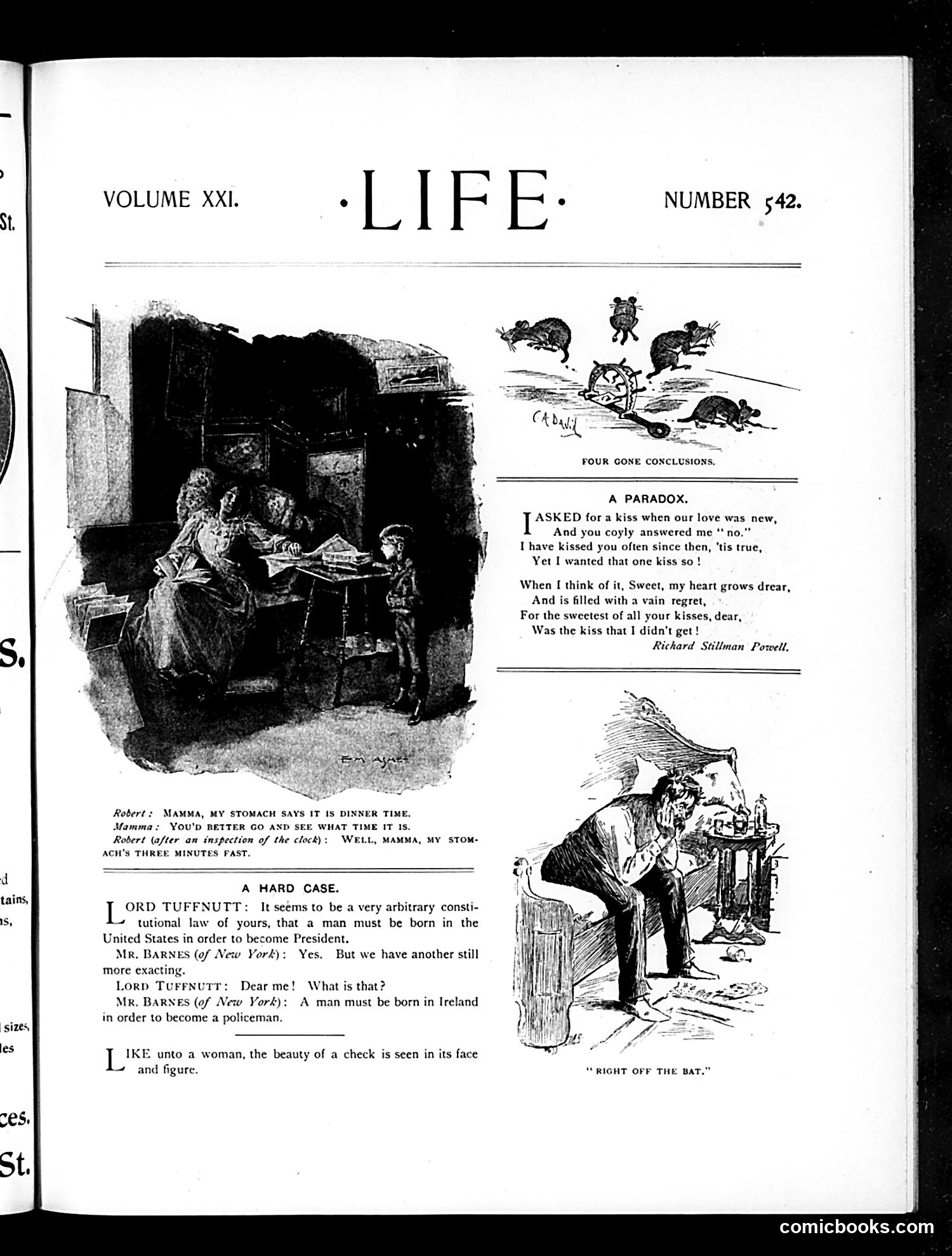
This page contains three separate humor pieces typical of Life's satirical content: 1. **"A Hard Case"**: A dialogue between Lord Tuffnutt and Mr. Barnes (of New York) mocking American vs. Irish constitutional requirements. The joke plays on stereotypes about Irish immigration and naturalization laws—suggesting absurdly that Ireland requires being born there to become a policeman, while America has different (apparently easier) standards. 2. **"A Paradox"**: A poem by Richard Stillman Powell about romantic regret—the speaker wanted a specific kiss years ago but was rejected, yet has received many kisses since. It's sentimental rather than political. 3. **"Right Off the Bat"**: An illustration (unclear what specific satire it represents without additional context). The page uses domestic comedy and light social observation rather than sharp political commentary.
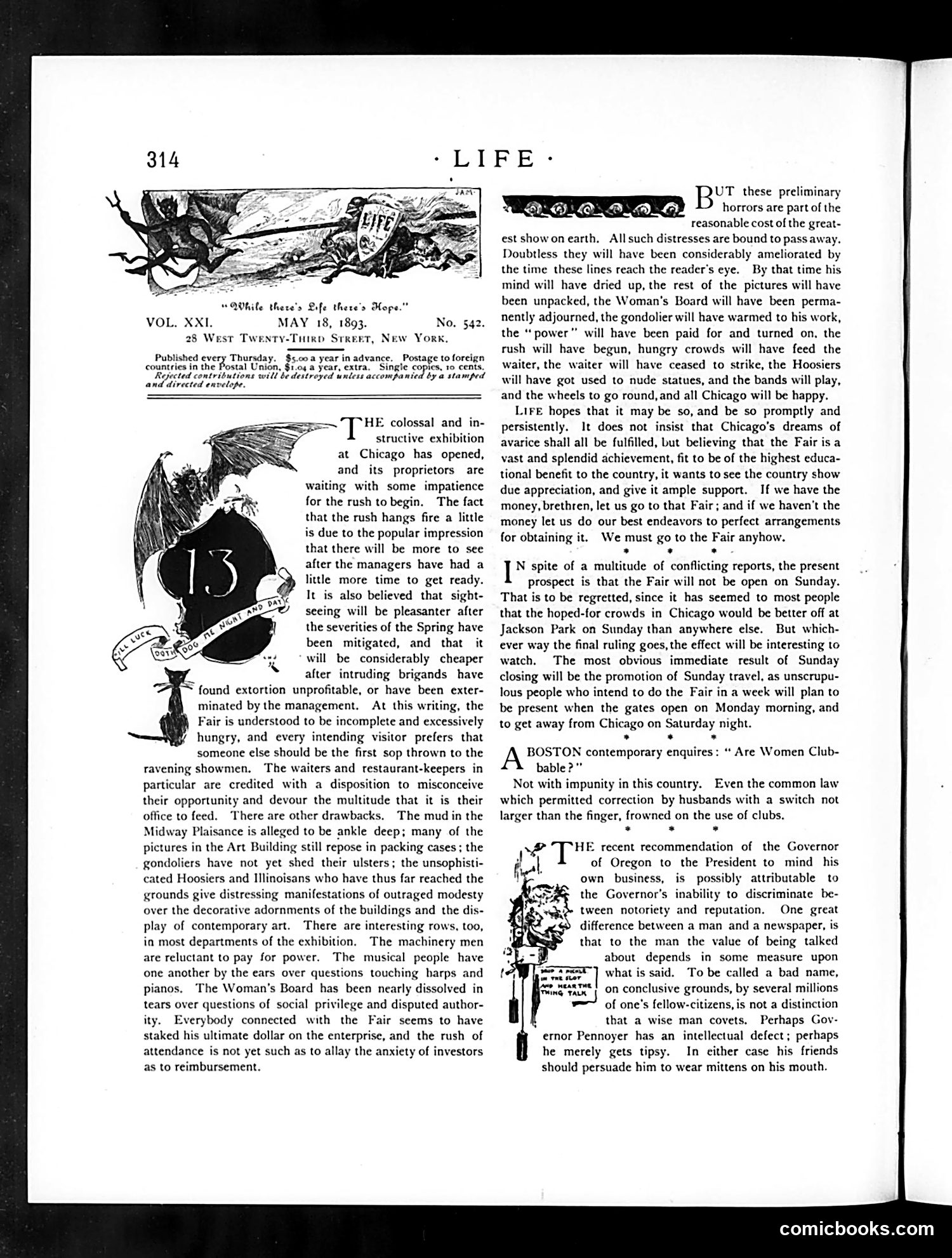
This page discusses the 1893 World's Columbian Exposition in Chicago. The main cartoon depicts figure "13" (likely representing bad luck or delay) as a winged demon or gremlin, symbolizing obstacles hampering the Fair's opening. The text expresses frustration that the Fair—a major educational and economic event—faces numerous operational problems: labor strikes, incomplete construction, unpaid workers, and managerial disputes. The article criticizes various parties responsible for delays while urging Americans to support the Fair anyway, as it represents national achievement. The secondary articles address contemporaneous controversies: women's clubs' societal influence and Oregon Governor Pennoyer's disputed business practices. The tone mixes satire with earnest advocacy for the Fair's success.
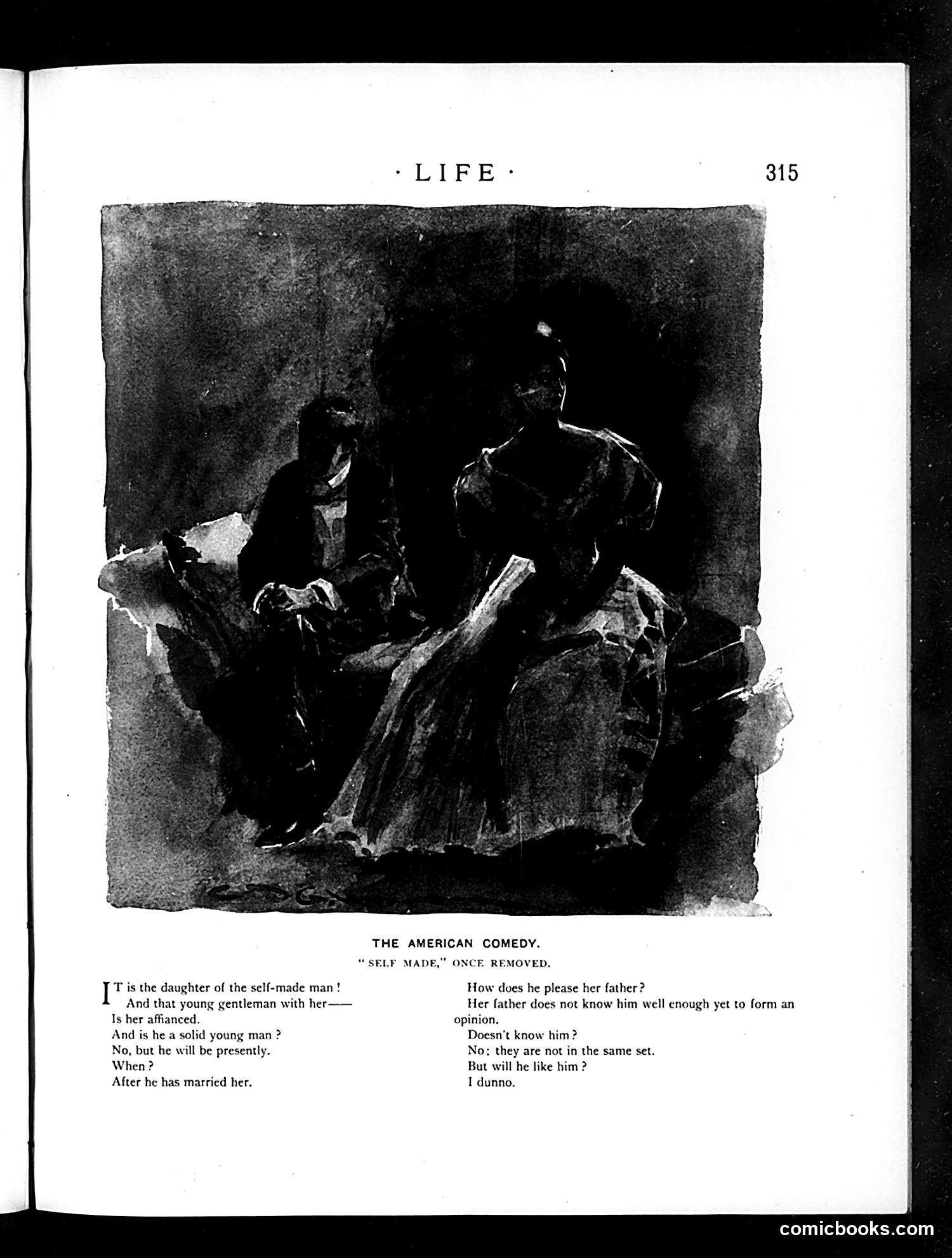
This satirical piece mocks class anxieties in Gilded Age America. The dialogue concerns a self-made man's daughter who is engaged to marry. The humor centers on social pretension: the father, though successful and wealthy ("self-made"), apparently lacks the social standing or education to meet his future son-in-law's family expectations. The joke's bite lies in exposing that American wealth alone doesn't guarantee social acceptance. Despite the daughter's advantageous marriage prospects, her father's humble origins ("self-made") remain a liability in upper-class circles. The title "Once Removed" suggests he's excluded from his daughter's new social sphere—satirizing how rigid class stratification persisted in supposedly democratic America, even among the newly wealthy.
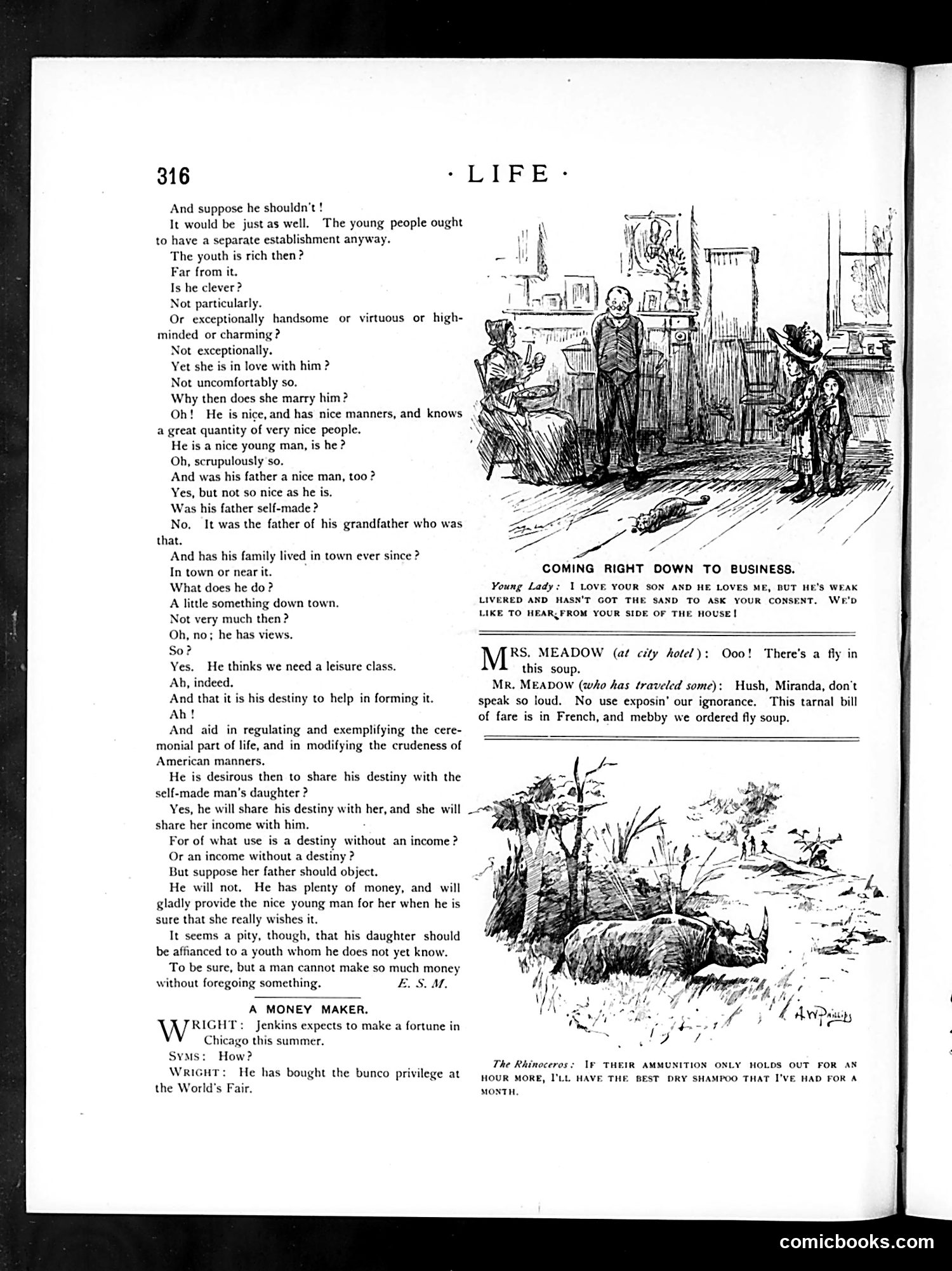
This page contains two satirical pieces about marriage and class mobility in turn-of-the-century America. The main dialogue critiques a wealthy man's son marrying a self-made man's daughter despite lacking exceptional qualities—he's merely "nice" with good manners. The satire questions whether such unions based on social standing rather than merit or love represent progress, particularly whether the daughter should "be affianced to a youth whom he does not yet know." The lower cartoon "Coming Right Down to Business" depicts a wealthy couple (the Meadows) at a city hotel, with the husband dismissively explaining French menu items to his wife, suggesting nouveau riche pretension masking ignorance. Both pieces mock American class anxieties and the contradictions between democratic ideals and aristocratic aspirations in Gilded Age society.
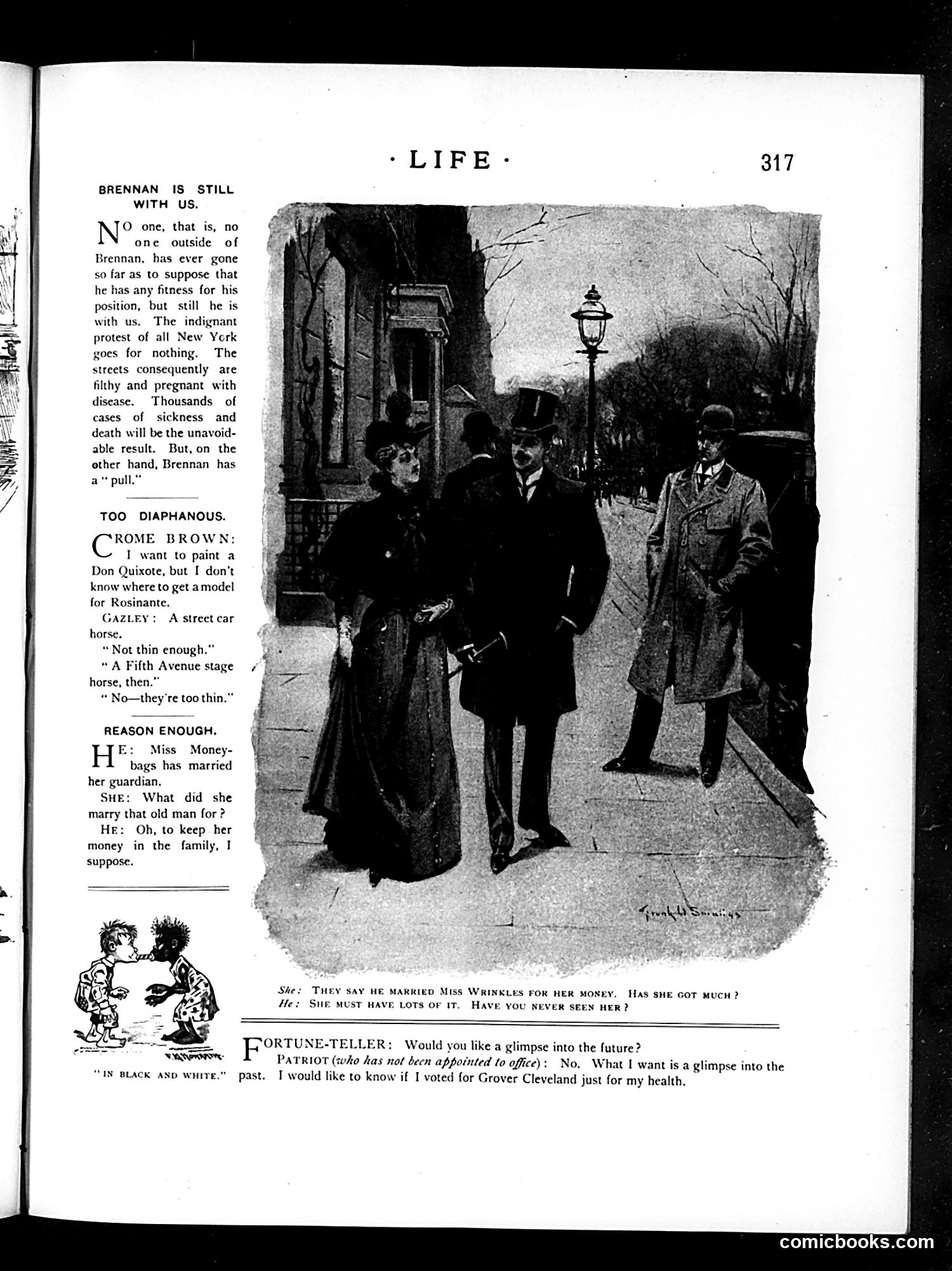
This page contains several brief satirical jokes about contemporary social issues: **"Brennan Is Still With Us"** criticizes the persistence of disease in New York City streets despite William O'Brien Brennan's (likely a political figure's) ineffective efforts. **"Too Diaphanous"** jokes about artistic models for Don Quixote and Rosinante, with Crome Brown and Gazley debating unsuitable horses. **"Reason Enough"** mocks a wealthy woman (Miss Moneybags) who married her guardian merely to keep family money intact—a critique of mercenary marriages among the wealthy. **"In Black and White"** (cartoon illustration) appears to be a children's joke. The **fortune-teller exchange** satirizes political anxiety, with a Patriot more concerned about voting for Grover Cleveland's health implications than actual fortune-telling.
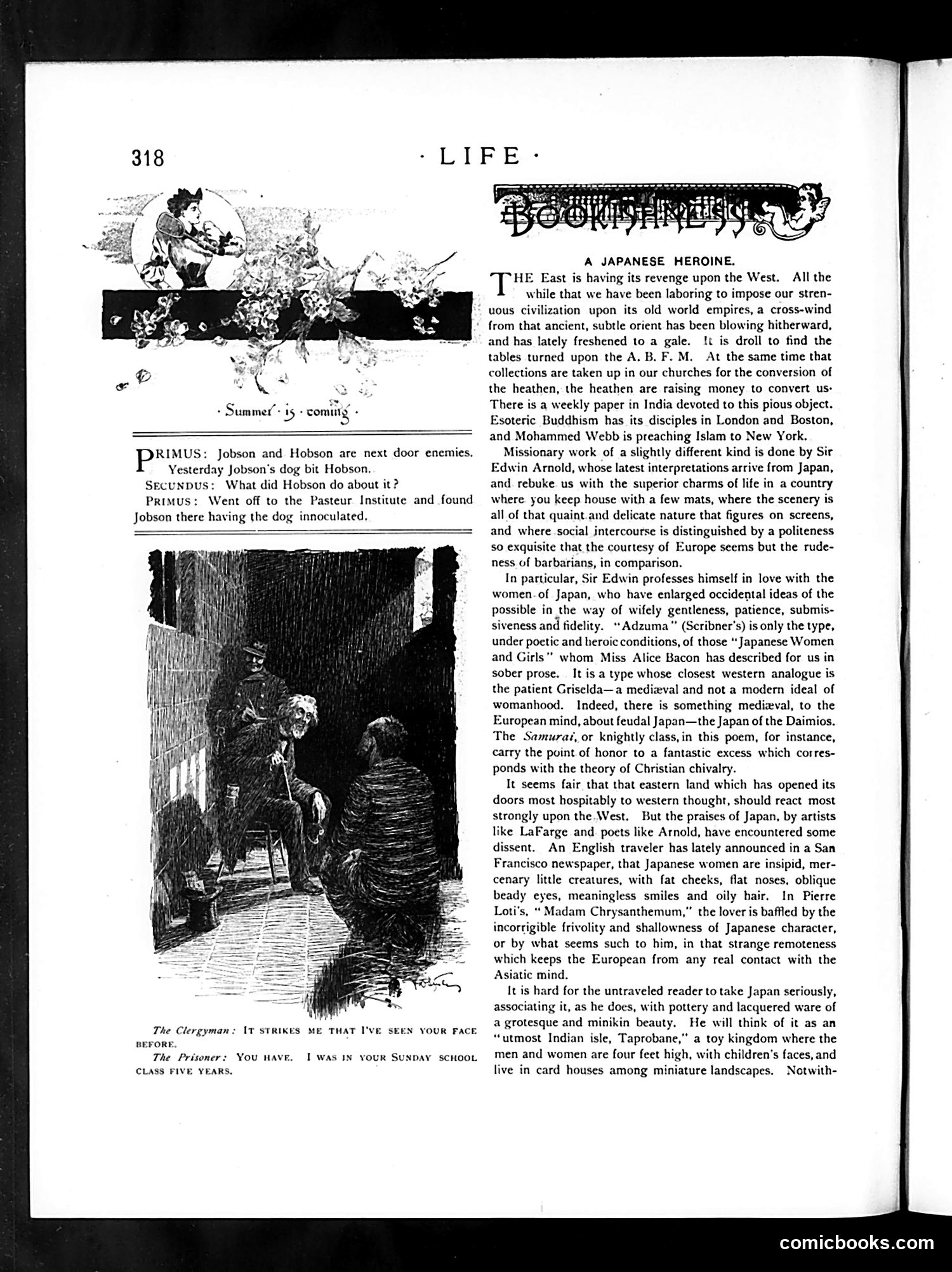
This page contains a theatrical dialogue excerpt and an accompanying illustration. The text discusses "A Japanese Heroine" and references Sir Edwin Arnold's work depicting Japanese women and culture. The dialogue shows a **Clergyman** and **Prisoner** in conversation—the prisoner claims to recognize the clergyman from five years prior at Sunday school. This appears to be social commentary on redemption and moral reformation through religious education. The illustration depicts two figures in what seems to be a prison or institutional setting, visually reinforcing the dialogue's themes of crime, punishment, and spiritual reclamation. The broader article critiques Western romanticization of Japan, dismissing stereotypical European portrayals of Japanese aesthetics and character as superficial.
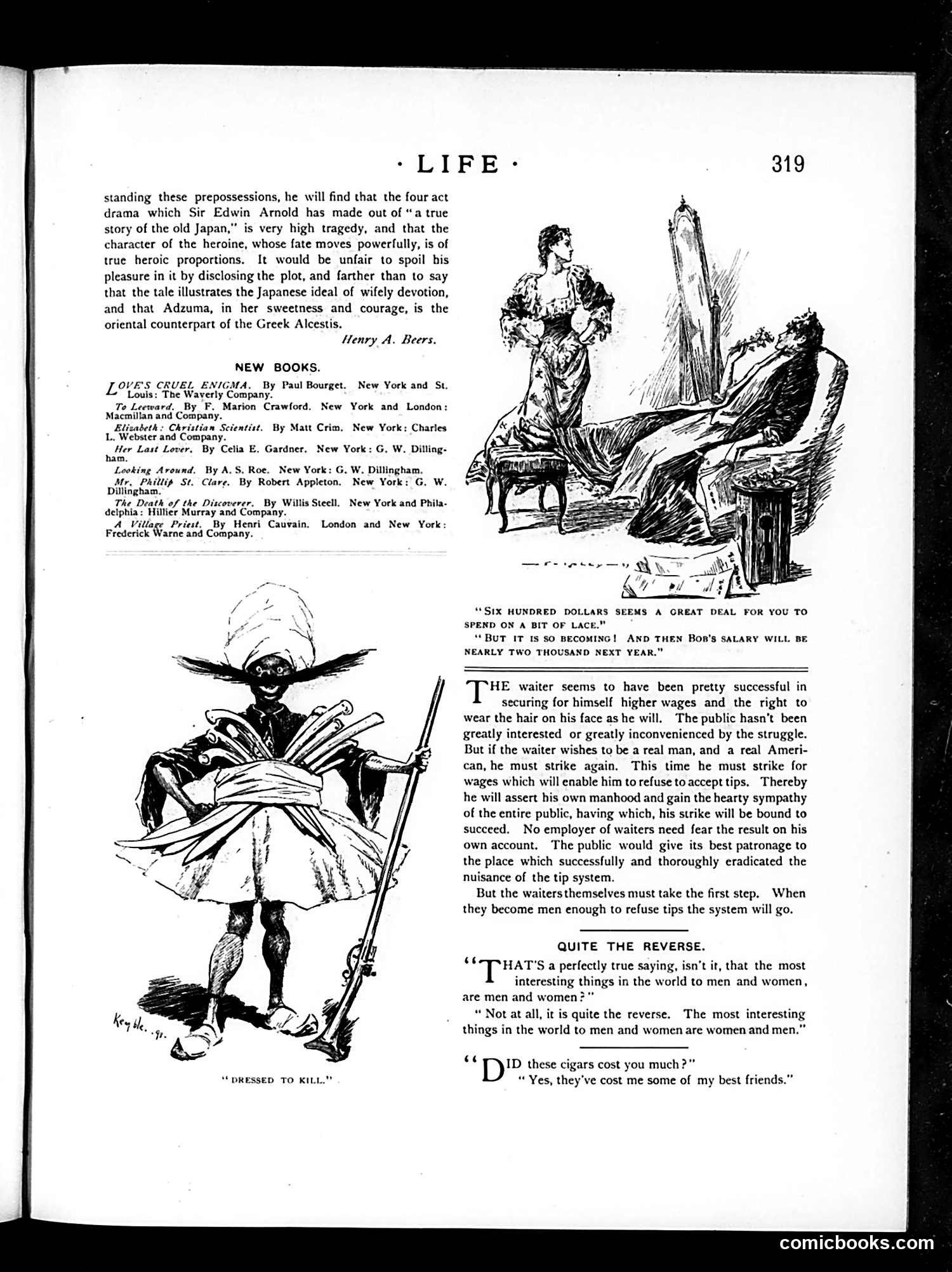
This page contains literary reviews and social commentary rather than political cartoons. The main illustrations are satirical drawings accompanying discussion of labor relations. The prominent "Dressed to Kill" illustration depicts a skeletal figure in fancy dress with weapons—likely representing death or destructive consequences of labor conflict. The upper illustration shows a conversation between two figures about wages and lace—satirizing workplace negotiations and consumer aspirations. The text discusses waiters' labor organizing efforts to secure higher wages and eliminate the tipping system. The satire suggests that while workers seek dignity and fair pay, there's tension between individual advancement and collective action. The closing dialogue joke ("cost me some of my best friends") mocks how wealth differences create social friction—a theme relevant to early 20th-century class tensions in America.
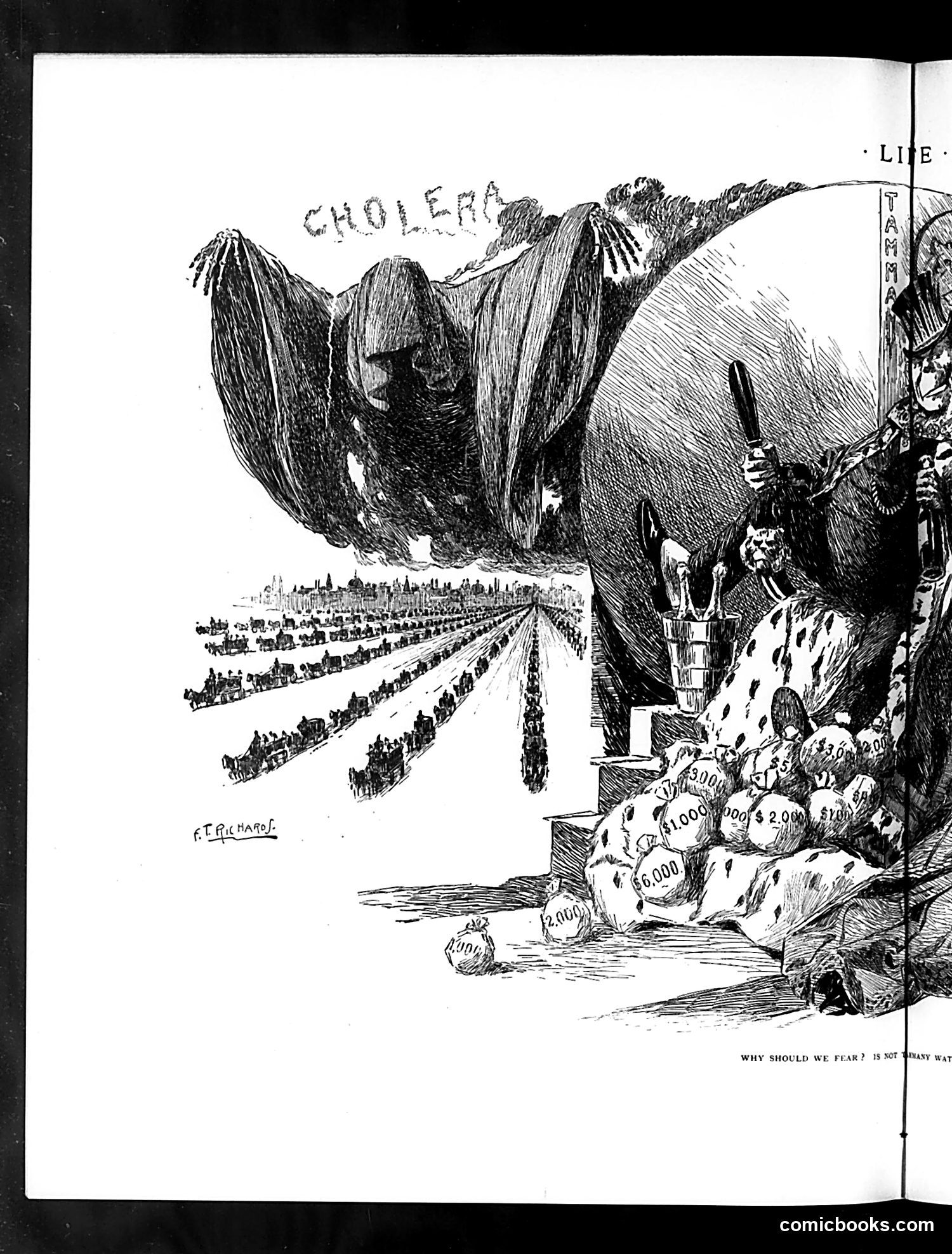
This political cartoon depicts **Cholera** as a grim reaper figure with dark, skeletal wings looming over a densely packed city and approaching masses of people (shown as dots representing crowds or soldiers). On the right, armed military or government figures stand guard near large spheres labeled with dollar amounts ($1,000, $2,000, $6,000), suggesting **wealth or resources** being protected or hoarded. The caption "WHY SHOULD WE FEAR?" appears at the bottom, indicating ironic commentary—likely satirizing government complacency or the wealthy's false sense of security regarding a cholera epidemic. The cartoon criticizes how those with money or power believed themselves protected from disease that threatened common people, mocking the notion that wealth could shield one from a contagious epidemic affecting entire populations.
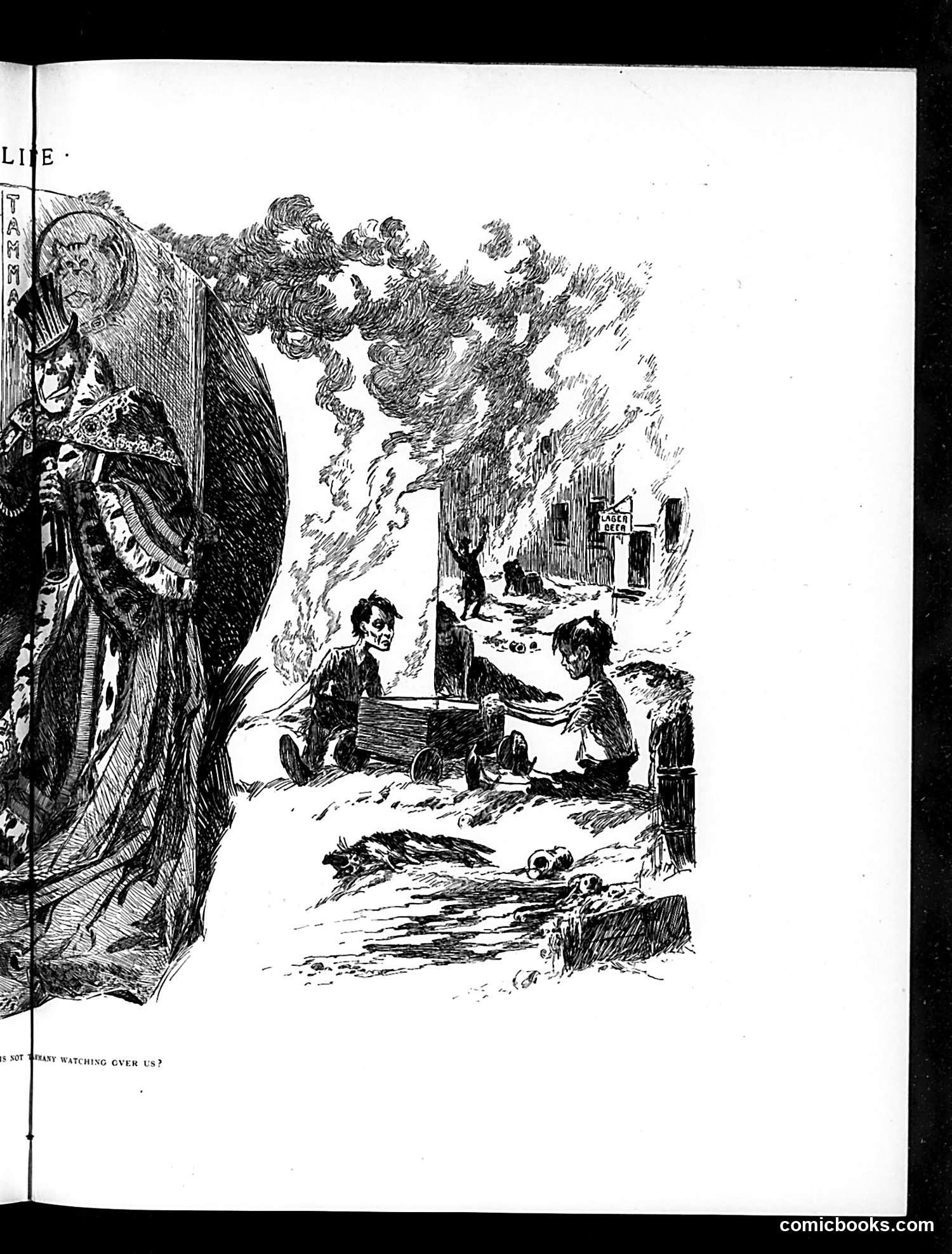
This is a satirical illustration from *Life* magazine showing a stark contrast between wealth and poverty. On the left stands an ornately dressed figure of Death or a skeletal personification, draped in elaborate royal robes and regalia, holding what appears to be a scythe or staff. On the right, children play in a squalid, impoverished setting with ramshackle buildings and a wasteland landscape. The caption reads: "IS NOT MANY WATCHING OVER US?" The cartoon likely critiques how Death—personified as a grotesque, richly-adorned figure—presides over the poor and vulnerable, particularly children. It suggests indifference from authorities ("many watching over us") to preventable deaths from poverty and poor living conditions. The satire condemns either governmental neglect or the wealthy's complicity in childhood mortality among the impoverished.
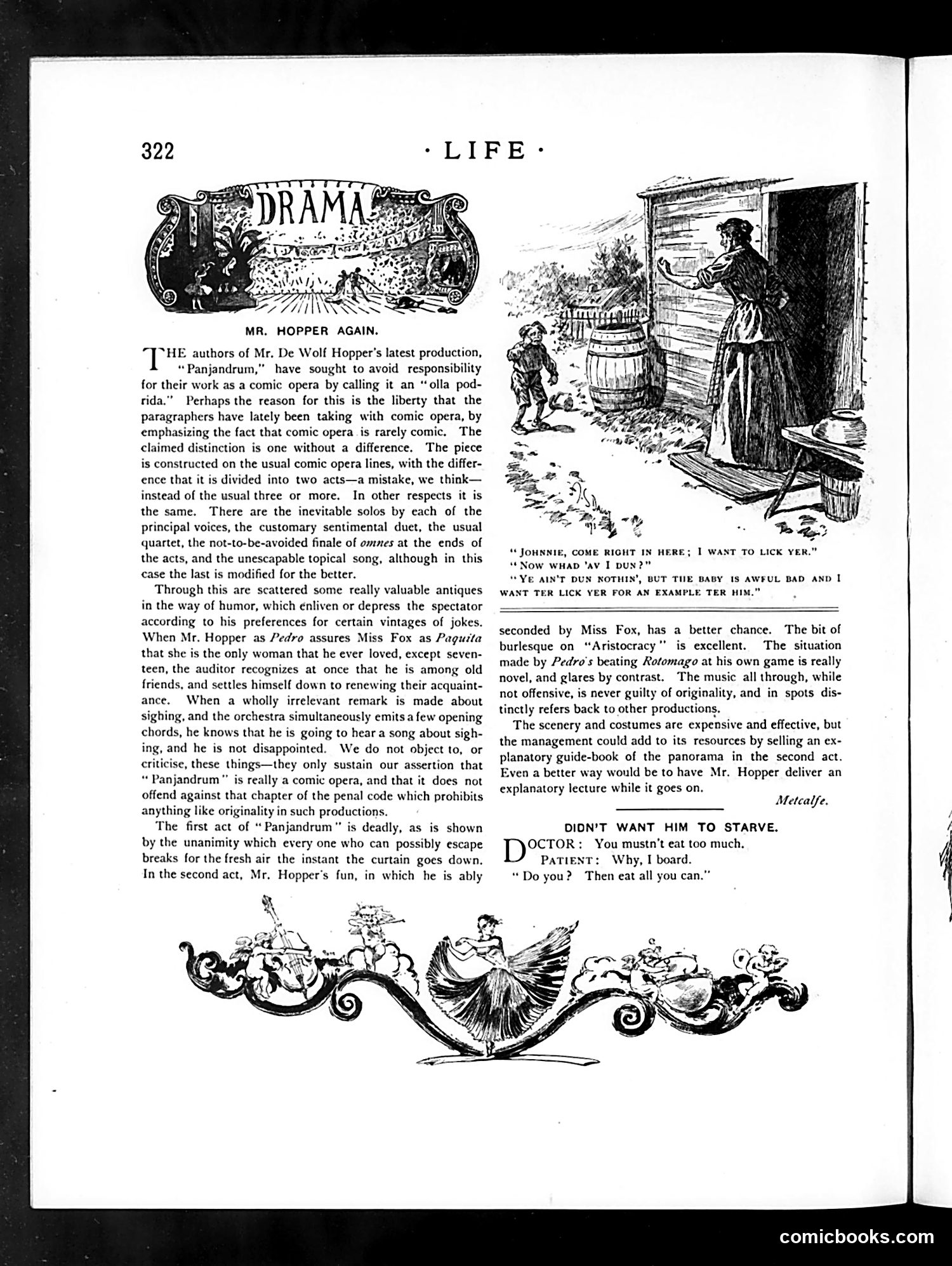
This page contains a theater review of De Wolf Hopper's comic opera "Panjandrum" and two unrelated comic panels. **The Review**: The critic (Metcalfe) argues the production is a standard, uninspired comic opera disguised by calling it an "olla podrida" (Spanish miscellaneous mixture). He mocks its formulaic structure—predictable solos, sentimental duets, topical songs—and notes the first act is so tedious audiences flee at intermission. However, Hopper's comedic performance and a burlesque bit on "Aristocracy" redeem the second act. The criticism is that the show lacks originality while claiming to avoid being a typical comic opera. **The Comics**: Two unrelated gag strips appear below: 1. A rural/dialect humor strip about a parent threatening to beat a child as punishment 2. A doctor-patient joke about eating: the doctor says "don't eat too much," the patient responds he boards (pays for meals), so the doctor advises "eat all you can"—both strips reflect early 20th-century humor conventions now considered dated.
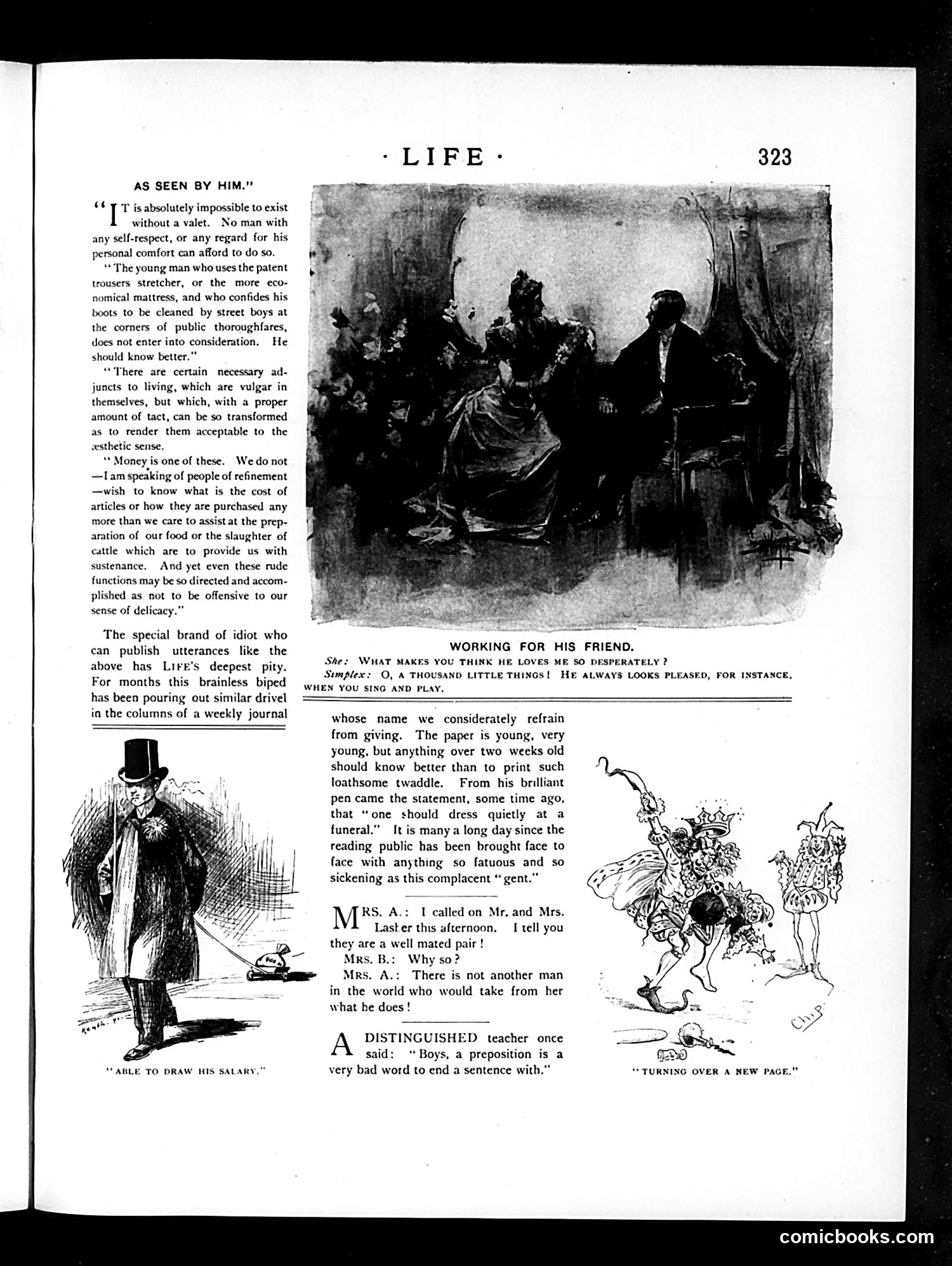
This page satirizes upper-class affectation and shallow values. The main text mocks a pompous advice columnist (unnamed but clearly contemptible to *Life*'s editors) who insists a gentleman *must* employ a valet to maintain respectability. The satire targets the pretentious logic that certain "vulgar" necessities of life—earning money, eating, bodily functions—should be hidden behind a veneer of refinement to remain aesthetically acceptable to the wealthy. The cartoon "Working for His Friend" jokes about a woman's obliviousness: she attributes a man's devoted attention to her singing and playing, unaware he's merely being polite. The dialogue jokes about marital mismatches and the cynical observation that only this particular man would tolerate her company. The bottom sketch about ending sentences with prepositions is a standard grammar joke, somewhat disconnected from the page's main satirical thrust. The cartoon "Able to Draw His Salary" appears to depict a man's financial precarity.
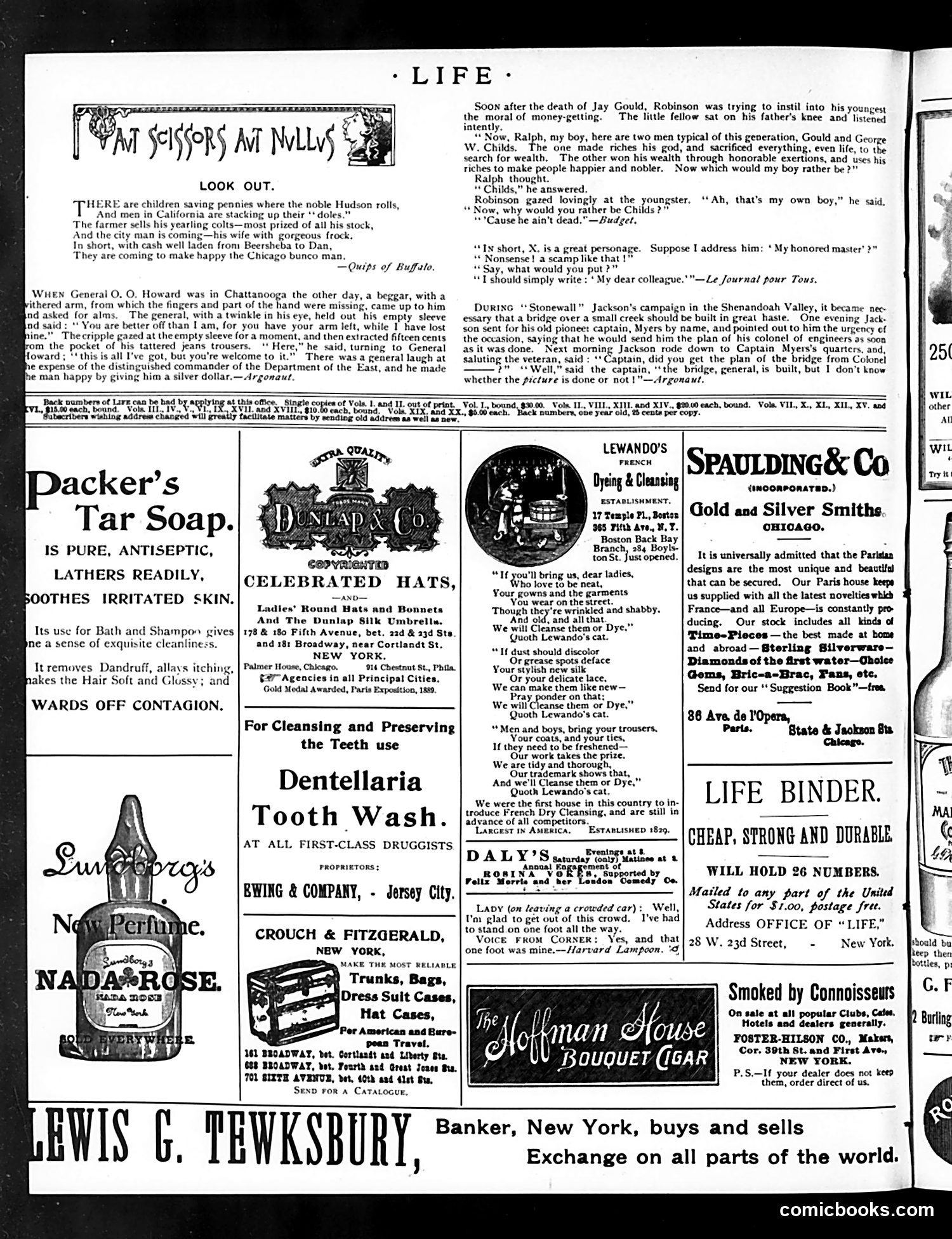
This page is primarily a collection of brief anecdotes and advertisements with no political cartoons. The content consists of several humorous stories published in *Life* magazine: **Main content:** Satirical commentary through short jokes. One describes General O.O. Howard (likely the famous Civil War general) and a beggar; another depicts a father (Robinson) discussing wealth-building with his son, who pragmatically prefers the living (non-deceased) role model. A third details Confederate General "Stonewall" Jackson and a captain who builds a bridge before receiving the architectural plan. **Context for modern readers:** The humor relies on ironic reversals—the general giving away his empty sleeve, the boy's blunt reasoning about mortality over morality, and the captain's practical action preceding theoretical plans. These reflect late 19th-century attitudes about practical solutions, military efficiency, and moral instruction. **The rest** is advertising for soaps, hats, tooth wash, and banking services typical of the period.
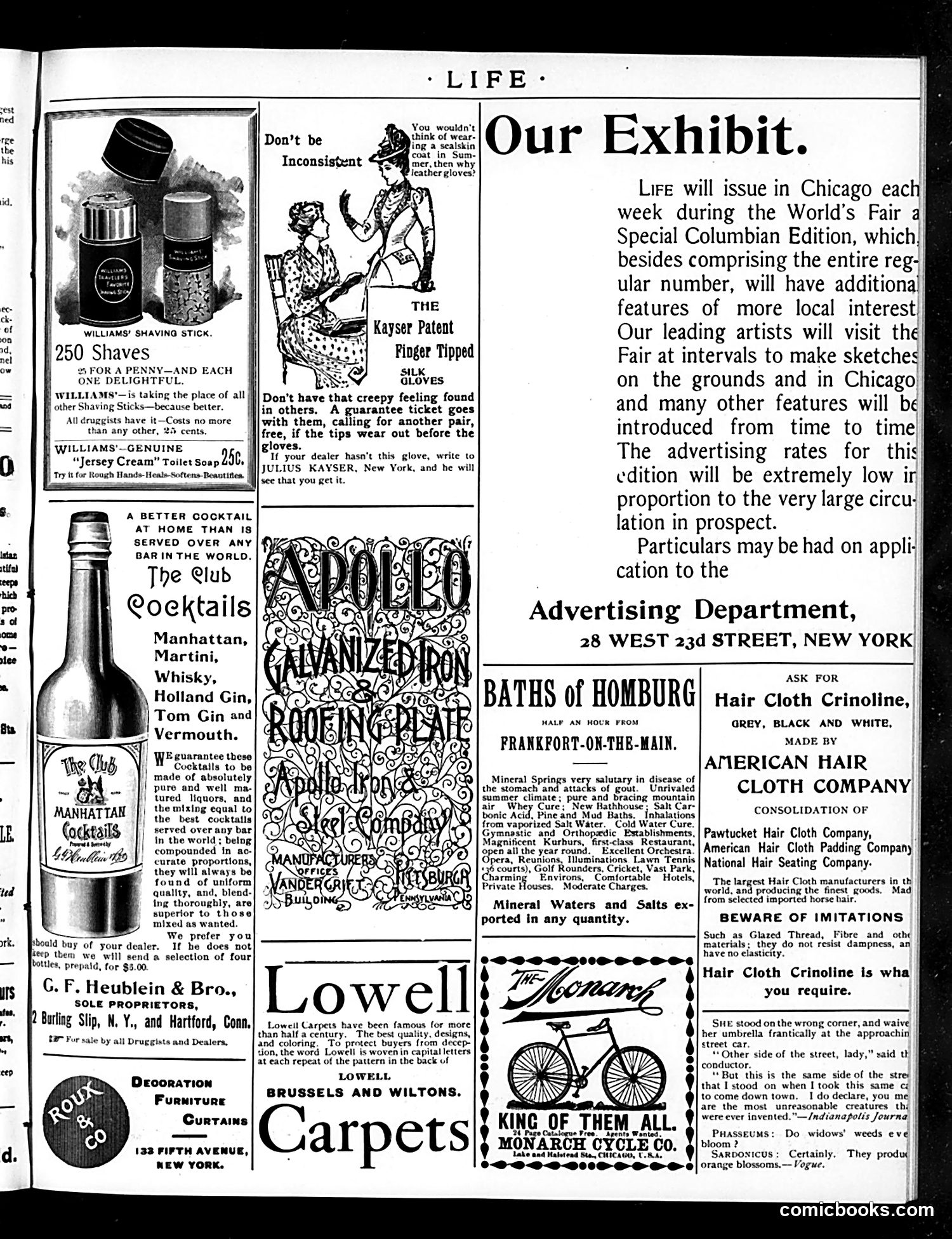
This is primarily an **advertising page** from Life magazine, likely from the 1890s World's Columbian Exposition era (referenced in "Our Exhibit"). The page contains no political cartoons or satirical commentary. The main content announces Life's special Chicago edition during the World's Fair, offering low advertising rates to capitalize on expected high circulation. The page features period product advertisements including: - Williams' shaving sticks and Jersey Cream soap - Kayser gloves (with a small comic illustration of a woman asking why one wouldn't wear sealskin in summer) - Club cocktail mixes - Lowell carpets - Baths of Homburg (German spa) - Hair cloth crinoline (fabric) - Monarch bicycles The only visual humor is the minor glove advertisement showing a woman's rhetorical question about seasonal clothing choices. Otherwise, this is straightforward commercial advertising with product claims and company contact information.
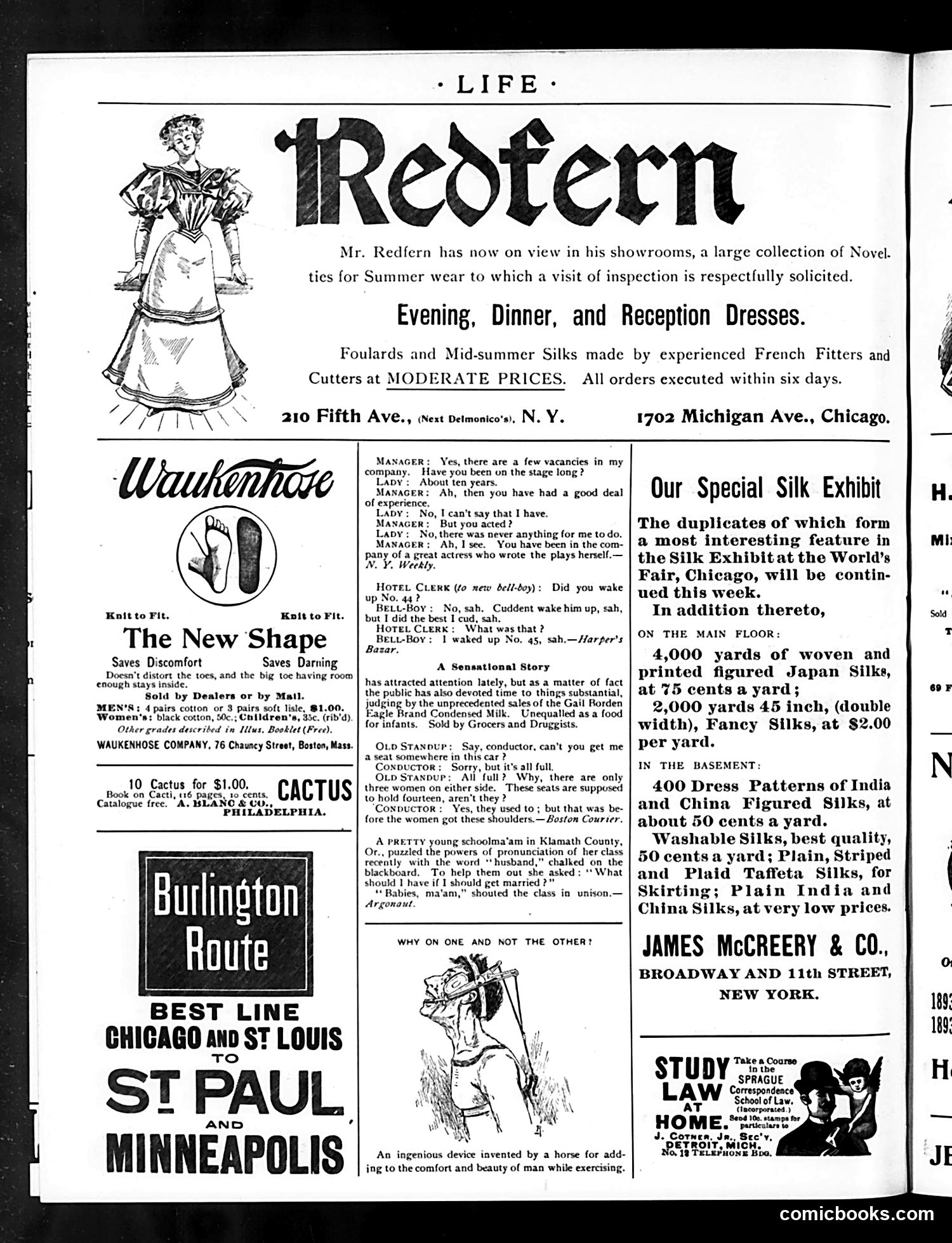
This is primarily an **advertising page** from Life magazine, with several small humorous anecdotes interspersed. The main advertisements feature fashion (Redfern dresses), hosiery (Waukenhose), and silk goods promoted for the World's Fair in Chicago. The Burlington Route railroad ad promotes travel to the Midwest. The humor pieces are brief workplace and social comedies typical of the era: - A stage actress admits she had no actual acting experience despite ten years in theater - A hotel bellboy, unable to wake guest #44, instead wakes #45 - A conductor dismisses complaints about crowded seating by blaming women's large shoulder wear - A schoolteacher's pronunciation lesson backfires when students answer her marriage question with "Babies!" - The final cartoon shows a horse wearing some kind of decorative device—the caption suggests it's a humorous "invention" for human comfort while riding The humor relies on wordplay, misunderstandings, and gentle workplace absurdities rather than political satire. The page reflects early 1900s consumer culture and social attitudes.
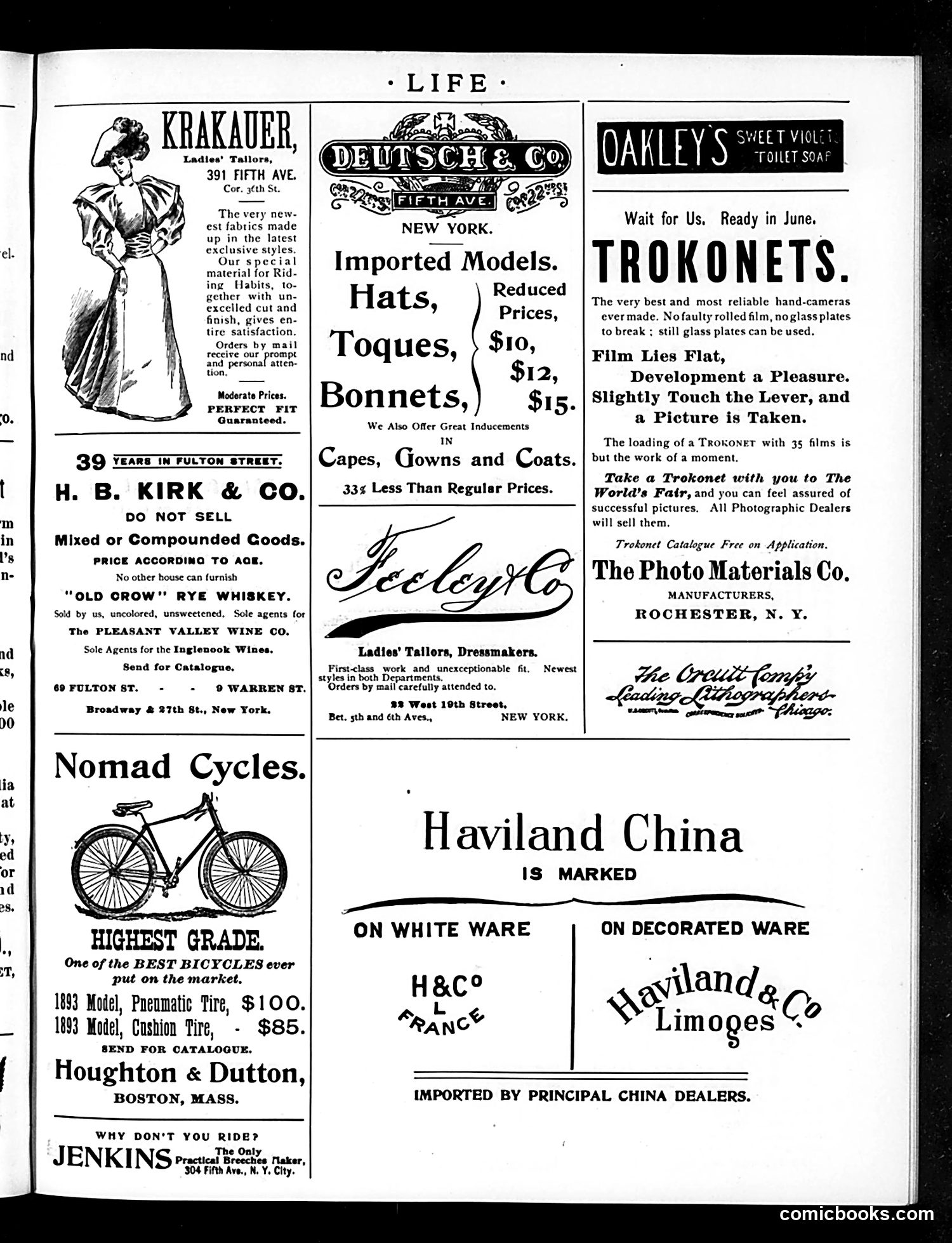
This is primarily an **advertising page**, not a satirical cartoon. It showcases late 1890s consumer goods and services targeting middle-to-upper-class readers. Notable ads include: - **Ladies' fashion**: Krakauer tailors offering imported hats, bonnets, and riding habits - **Bicycles**: Nomad Cycles marketed as "one of the BEST BICYCLES ever put on the market" ($100 pneumatic tire model)—bicycles were a major trend of the 1890s - **Photography**: Trokonets hand-cameras, promoting film photography as convenient for the upcoming World's Fair - **Porcelain**: Haviland China from France, marked for identification - **Whiskey and wine**: H.B. Kirk & Co. emphasizing "Old Crow" rye whiskey sold pure and uncolored The page reflects the era's consumer culture, technological innovation (cameras, bicycles), and appreciation for imported European luxury goods. It's a window into 1890s American consumer aspirations rather than political satire.
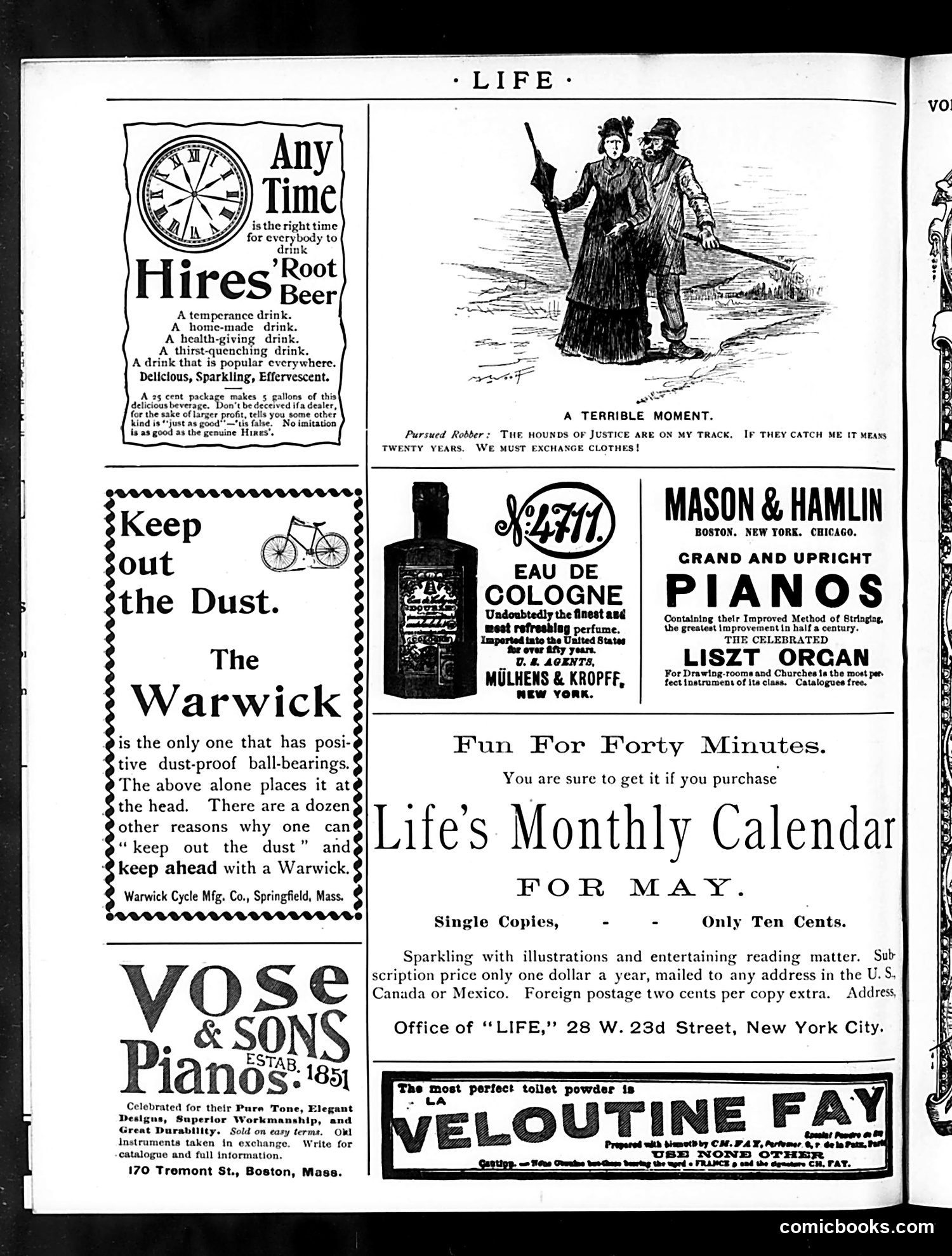
This page is primarily **advertising** for various consumer products (pianos, cosmetics, bicycles, beverages), typical of early 20th-century magazine layouts. The one notable cartoon, titled "A Terrible Moment," depicts a **pursued robber and an apparent accomplice exchanging clothes** to evade capture. The robber states the "hounds of justice are on my track"—a reference to police pursuit. The satire appears to mock the naïve criminal logic that simply swapping garments could fool law enforcement, presenting a darkly comedic take on criminal desperation. The cartoon's humor relies on the absurdity of the escape plan rather than political commentary. It likely satirizes either actual crime stories of the era or the melodramatic "criminal on the run" narratives popular in contemporary theater and literature—poking fun at both criminals and sensationalized popular entertainment. The Hires Root Beer advertisement emphasizes its status as a "temperance drink," reflecting the Prohibition-era context when non-alcoholic alternatives were heavily marketed as moral choices.