
Life, 1893-05-18 · page 6 of 18
Life — May 18, 1893 — page 6: what you’re looking at
What you’re looking at
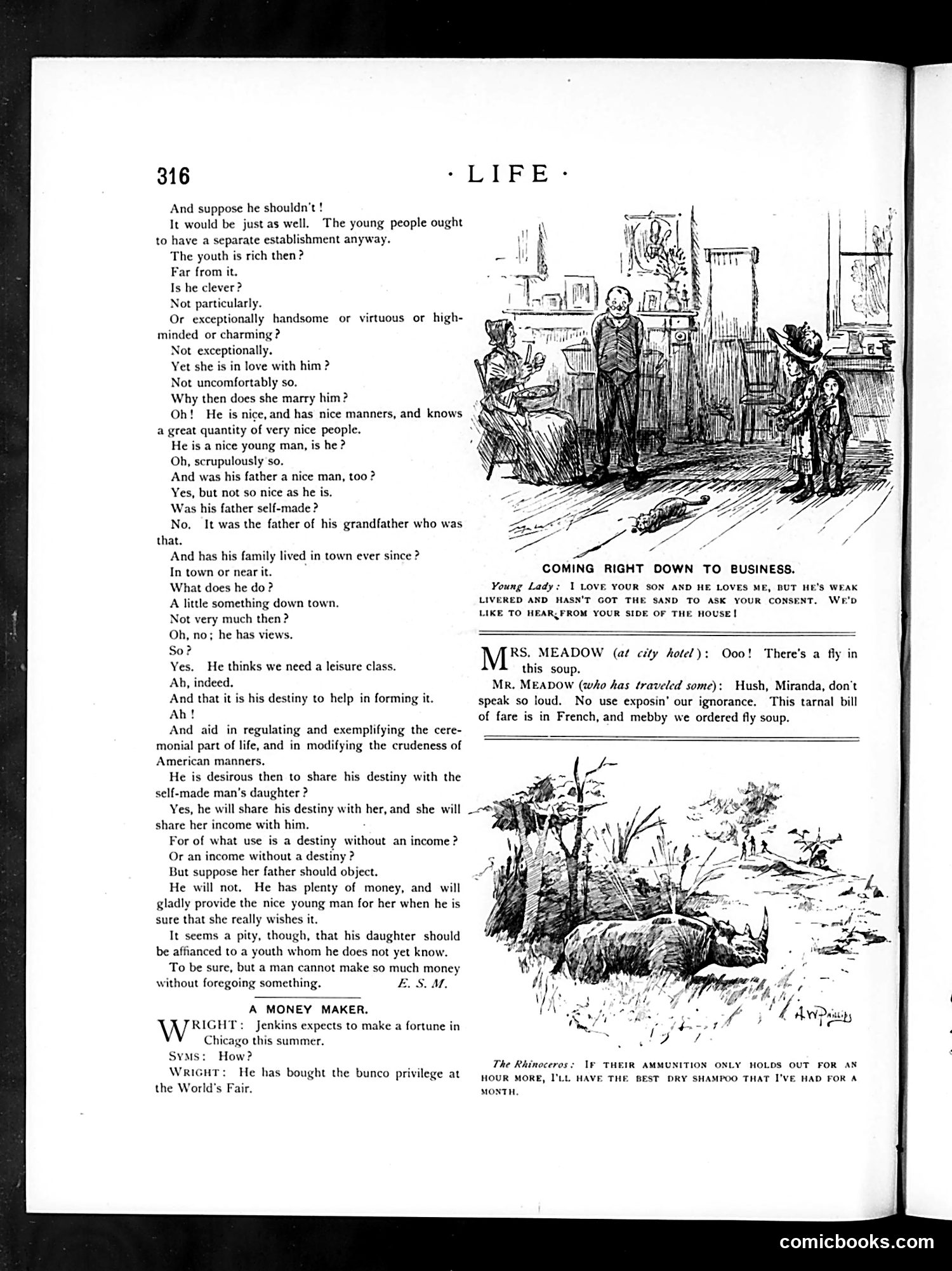
This page contains two satirical pieces about marriage and class mobility in turn-of-the-century America. The main dialogue critiques a wealthy man's son marrying a self-made man's daughter despite lacking exceptional qualities—he's merely "nice" with good manners. The satire questions whether such unions based on social standing rather than merit or love represent progress, particularly whether the daughter should "be affianced to a youth whom he does not yet know." The lower cartoon "Coming Right Down to Business" depicts a wealthy couple (the Meadows) at a city hotel, with the husband dismissively explaining French menu items to his wife, suggesting nouveau riche pretension masking ignorance. Both pieces mock American class anxieties and the contradictions between democratic ideals and aristocratic aspirations in Gilded Age society.
📄 Transcribed text from this page (OCR, searchable)
Machine-transcribed from the original scan — historical spelling and the odd misread are preserved.
316 And suppose he shouldn't ! It would be just as well. The young people ought to have a separate establishment anyway. The youth is rich then ? Far from it. Is he clever? Not particularly. Or exceptionally handsome or virtuous or high- minded or charming ? Not exceptionally. Yet she is in love with him ? Not uncomfortably so. Why then does she marry him? Oh! a great quantity of very nice people. He is a nice young man, is he ? Oh, scrupulously so. And was his father a nice man, too ? Yes, but not so nice as he is. Was his father self-made ? No. It was the father of his grandfather who was that. And has his family lived in town ever since ? In town or near it. What does he do? A little something down town. Not very much then? Oh, no; he has views. So? Yes. He thinks we need a leisure class. Ab, indeed. And that it is his destiny to help in forming it. Ah! And aid in regulating and exemplifying the cere- monial part of life, and in modifying the crudeness of American manners. He is desirous then to share his destiny with the self-made man’s daughter ? Yes, he will share his destiny with her, and she will — share her income with him. For of what use is a destiny without an income ? Or an income without a destiny ? But suppose her father should object. He will not. He has plenty of money, and will gladly provide the nice young man for her when he is sure that she really wishes it. It seems a pity, though, that his daughter should be affianced to a youth whom he does not yet know. To be sure, but a man cannot make so much money without foregoing somethin; ELS. M. A MONEY MAKER. RIGHT: Jenkins expects to make a fortune in Chicago this summer. Syms: How? WRIGHT: He has bought the bunco privilege at the World’s Fair. He is nice, and has nice manners, and knows | * LIFE - COMING RIGHT DOWN TO BUSINESS. Young Lady: LIVERED AND HASN'T GOT THE SAND TO ASK YOUR CONSENT. LIKE TO HEAR, FROM YOUR SIDE OF THE HOUSE! I LOVE YOUR SON AND HE LOVES ME, BUT HE'S WEAK We'o RS. MEADOW (at city hotel): this soup. MR. MEADOW (who has traveled some): Hush, Miranda, don’t speak loud. No use exposin’ our ignorance. This tarnal bill of fare is in French, and mebby we ordered fly soup. Ooo! There's a fly in The Rhinoceros: \f THEIR AMMUNITION ONLY HOLDS OUT FOR AN HOUR MORE, I'LL HAVE THE BEST DRY SHAMPOO THAT I'VE HAD FOR A MONTH, comicbooks.com