
Life, 1893-05-18 · page 12 of 18
Life — May 18, 1893 — page 12: what you’re looking at
What you’re looking at
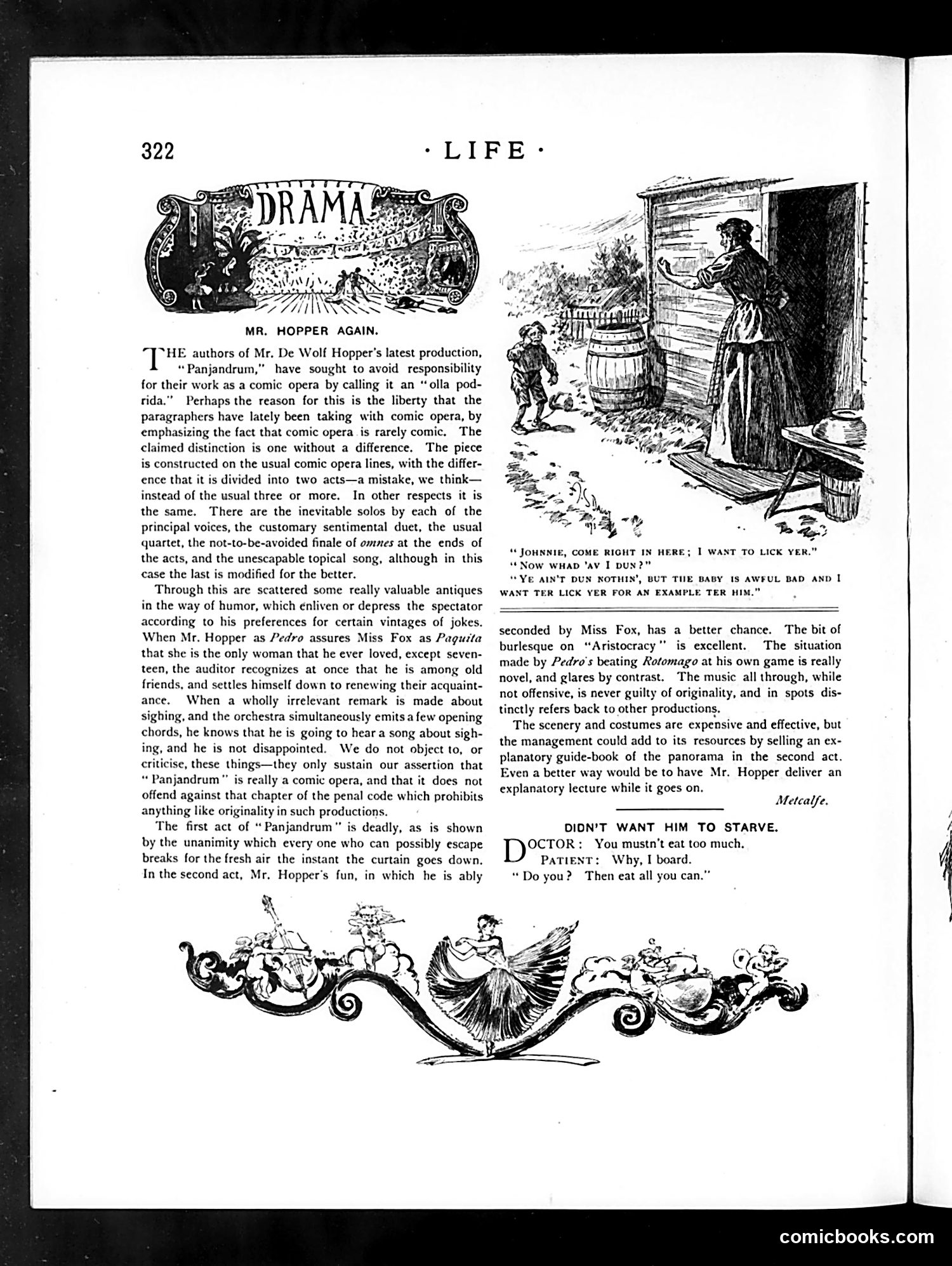
This page contains a theater review of De Wolf Hopper's comic opera "Panjandrum" and two unrelated comic panels. **The Review**: The critic (Metcalfe) argues the production is a standard, uninspired comic opera disguised by calling it an "olla podrida" (Spanish miscellaneous mixture). He mocks its formulaic structure—predictable solos, sentimental duets, topical songs—and notes the first act is so tedious audiences flee at intermission. However, Hopper's comedic performance and a burlesque bit on "Aristocracy" redeem the second act. The criticism is that the show lacks originality while claiming to avoid being a typical comic opera. **The Comics**: Two unrelated gag strips appear below: 1. A rural/dialect humor strip about a parent threatening to beat a child as punishment 2. A doctor-patient joke about eating: the doctor says "don't eat too much," the patient responds he boards (pays for meals), so the doctor advises "eat all you can"—both strips reflect early 20th-century humor conventions now considered dated.
📄 Transcribed text from this page (OCR, searchable)
Machine-transcribed from the original scan — historical spelling and the odd misread are preserved.
MR. HOPPER AGAIN. Te authors of Mr. De Wolf Hopper’s latest production, “Panjandrum,” have sought to avoid responsibility for their work as a comic opera by calling it an “olla pod- rida.” Perhaps the reason for this is the liberty that the paragraphers have lately been taking with comic opera, by emphasizing the fact that comic opera is rarely comic, The claimed distinction is one without a difference. The piece is constructed on the usual comic opera lines, with the differ- ence that it is divided into two acts—a mistake, we think— instead of the usual three or more. In other respects it is the same. There are the inevitable solos by each of the principal voices, the customary sentimental duet, the usual quartet, the not-to-be-avoided finale of omnes at the ends of the acts, and the unescapable topical song, although in this case the last is modified for the better. Through this are scattered some really valuable antiques in the way of humor, which enliven or depress the spectator according to his preferences for certain vintages of jokes. When Mr. Hopper as Pedro assures Miss Fox as Pagurta that she is the only woman that he ever loved, except seven- teen, the auditor recognizes at once that he is among old friends, and settles himself down to renewing their acquaint- ance. When a wholly irrelevant remark is made about sighing, and the orchestra simultaneously emits a few opening chords, he knows that he is going to hear a song about sigh- ing, and he is not disappointed. We do not object to, or criticise, these things—they only sustain our assertion that “ Panjandrum” is really a comic opera, and that it does not offend against that chapter of the penal code which prohibits anything like originality in such productions. The first act of “Panjandrum” is deadly, as is shown by the unanimity which every one who can possibly escape breaks for the fresh air the instant the curtain goes down. In the second act, Mr. Hopper’s fun, in which he is ably % \ “ JOUNNIE, COME RIGHT IN HERE; 1 WANT TO LICK YER.” **Now wHap ‘av I pun?" “YE AIN'T DUN NOTHIN’, BUT TUE BABY IS AWFUL BAD AND I WANT TER LICK YER FOR AN EXAMPLE TER HIM.” seconded by Miss Fox, has a better chance. The bit of burlesque on ‘“Aristocracy’’ is excellent. The situation made by Pedro's beating Rotomago at his own game is really novel, and glares by contrast. The music all through, while not offensive, is never guilty of originality, and in spots dis- tinctly refers back to other productions. The scenery and costumes are expensive and effective, but the management could add to its resources by selling an ex- planatory guide-book of the panorama in the second act. Even a better way would be to have Mr. Hopper deliver an explanatory lecture while it goes on. Metcalfe. DION’T WANT HIM TO STARVE, OCTOR: You mustn't eat too much. PATIENT: Why, I board. “Do you? Then eat all you can.” comicbooks.com