
Life, 1893-05-18 · page 8 of 18
Life — May 18, 1893 — page 8: what you’re looking at
What you’re looking at
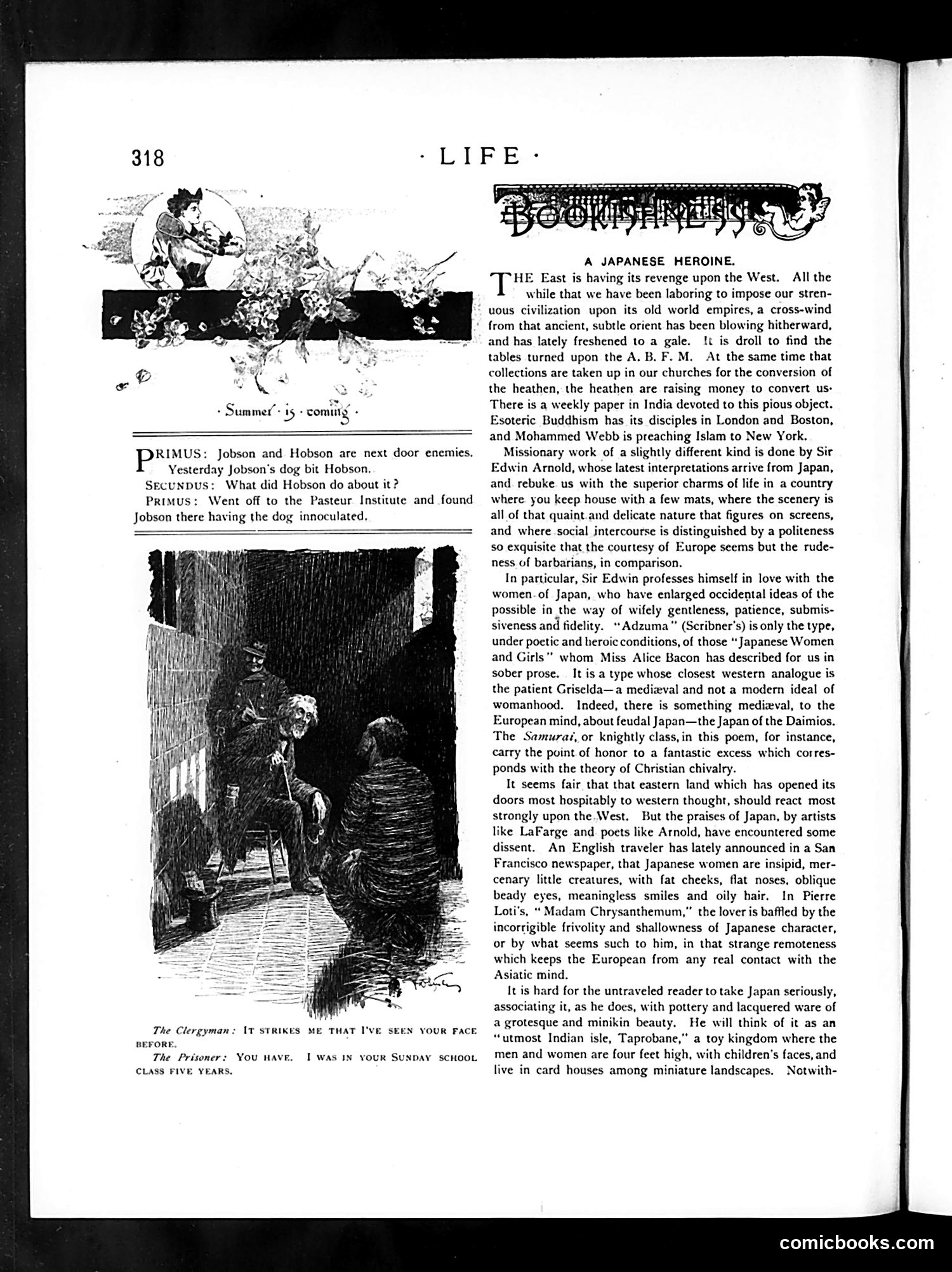
This page contains a theatrical dialogue excerpt and an accompanying illustration. The text discusses "A Japanese Heroine" and references Sir Edwin Arnold's work depicting Japanese women and culture. The dialogue shows a **Clergyman** and **Prisoner** in conversation—the prisoner claims to recognize the clergyman from five years prior at Sunday school. This appears to be social commentary on redemption and moral reformation through religious education. The illustration depicts two figures in what seems to be a prison or institutional setting, visually reinforcing the dialogue's themes of crime, punishment, and spiritual reclamation. The broader article critiques Western romanticization of Japan, dismissing stereotypical European portrayals of Japanese aesthetics and character as superficial.
📄 Transcribed text from this page (OCR, searchable)
Machine-transcribed from the original scan — historical spelling and the odd misread are preserved.
+ Summer’ i - cominty « RIMUS: Jobson and Hobson are next door enemies. Yesterday Jobson’s dog bit Hobson, SEcuNDUS: What did Hobson do about it? Primus: Went off to the Pasteur Institute and found Jobson there having the dog innoculated, bi The Clergyman: It STRIKES ME THAT I'VE SEEN YOUR FACE BEFORE The Prisoner: CLASS FIVE YEARS. You wave. I was in vouR SUNDAY SCHOOL A JAPANESE HEROINE. HE East is having its revenge upon the West. All the while that we have been laboring to impose our stren- uous civilization upon its old world empires, a cross-wind from that ancient, subtle orient has been blowing hitherward, and has lately freshened to a gale. {¢ is droll to find the tables turned upon the A. B. F. M. At the same time that collections are taken up in our churches for the conversion of the heathen, the heathen are raising money to convert us: There is a weekly paper in India devoted to this pious object. Esoteric Buddhism has its disciples in London and Boston, and Mohammed Webb is preaching Islam to New York. Missionary work of a slightly different kind is done by Sir Edwin Arnold, whose latest interpretations arrive from Japan, and. rebuke us with the superior charms of life in a country where you keep house with a few mats, where the scenery is all of that quaint.and delicate nature that figures on screens, and where social intercourse is distinguished by a politeness so exquisite that the courtesy of Europe seems but the rude- ness of barbarians, in comparison. In particular, Sir Edwin professes himself in love with the women.of Japan, who have enlarged occidental ideas of the possible in the way of wifely gentleness, patience, submis- siveness and fidelity. *Adzuma" (Scribner's) is only the type, under poetic and heroic conditions, of those “Japanese Women and Girls” whom Miss Alice Bacon has described for us in sober prose. It is a type whose closest western analogue is the patient Griselda—a medieval and not a modern ideal of womanhood. Indeed, there is something medizval, to the European mind, about feudal Japan—the Japan of the Daimios. The Samuraé, or knightly class,in this poem, for instance, carry the point of honor to a fantastic excess which corres- ponds with the theory of Christian chivalry. It seems fair that that eastern land which has opened its doors most hospitably to western thought, should react most strongly upon the West. But the praises of Japan, by artists like LaFarge and. poets like Arnold, have encountered some dissent. An English traveler has lately announced in a San Francisco newspaper, that Japanese women are insipid, mer- cenary little creatures, with fat cheeks, flat noses, oblique beady eyes, meaningless smiles and oily hair. In Pierre Loti Madam Chrysanthemum,” the lover is baffled by the incorrigible frivolity and shallowness of Japanese character, or by what seems such to him, in that strange remoteness which keeps the European from any real contact with the Asiatic mind. It is hard for the untraveled reader to take Japan seriously, associating it, as he does, with pottery and lacquered ware of a grotesque and minikin beauty. He will think of it as an “utmost Indian isle, Taprobane,” a toy kingdom where the men and women are four feet high, with children’s faces, and live in card houses among miniature landscapes. Notwith- comicbooks.com