
A complete issue · 14 pages · 1893
Life — May 11, 1893
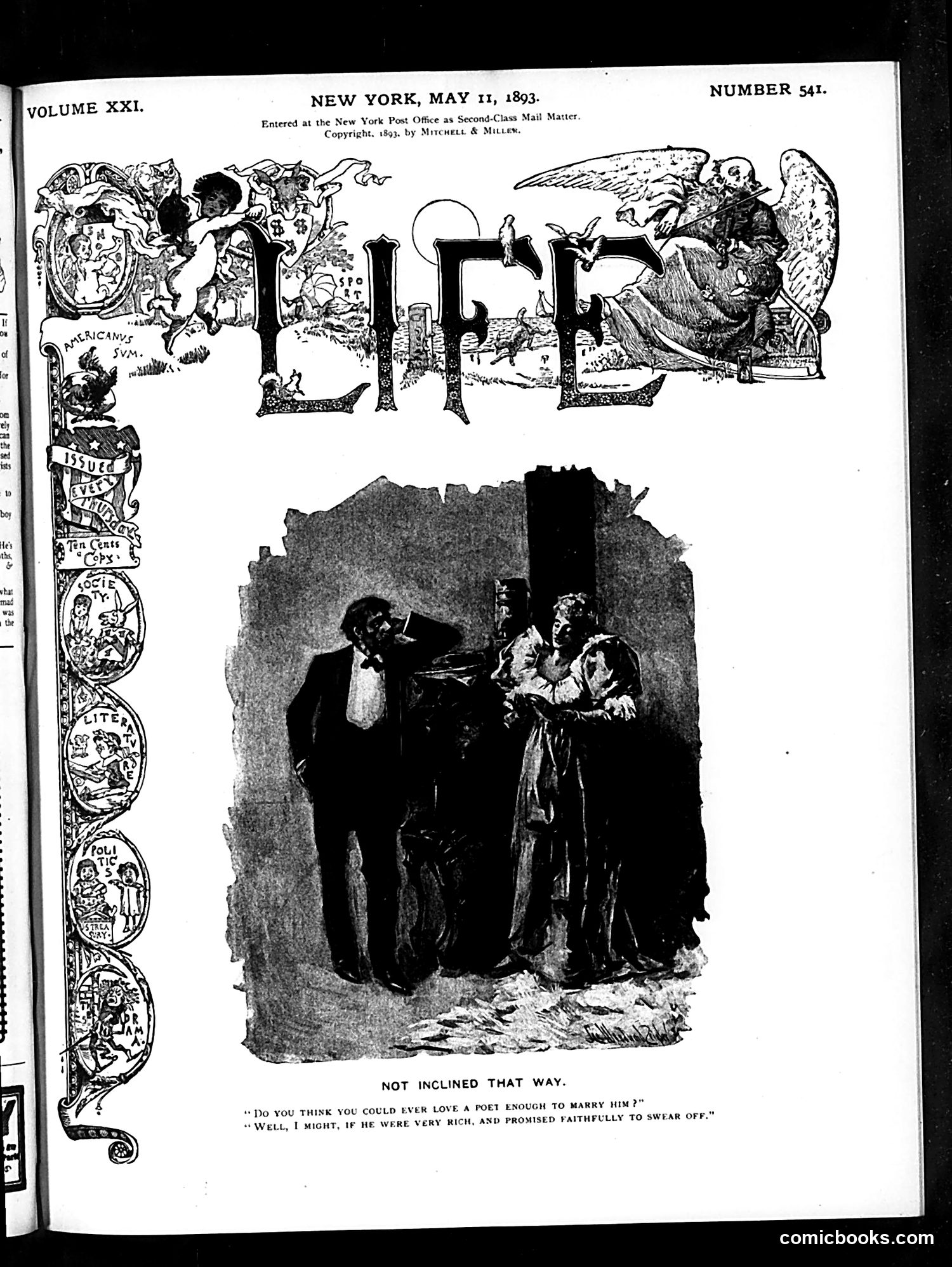
This page features a satirical cartoon titled "Not Included That Way," depicting what appears to be a marriage negotiation or proposal scene. The dialogue reads: "Do you think you could ever love a poet enough to marry him?" with the response: "Well, I might, if he were very rich, and promised faithfully to swear off." The satire targets the common Victorian-era practice of women marrying for financial security rather than romantic love. The joke mocks both the idealistic poet (presumably poor) and the materialistic woman who would only consider marriage to a wealthy suitor willing to abandon bohemian affectations. This reflects 1890s anxieties about marriage, class, and the romanticization of artistic life versus practical economic reality.
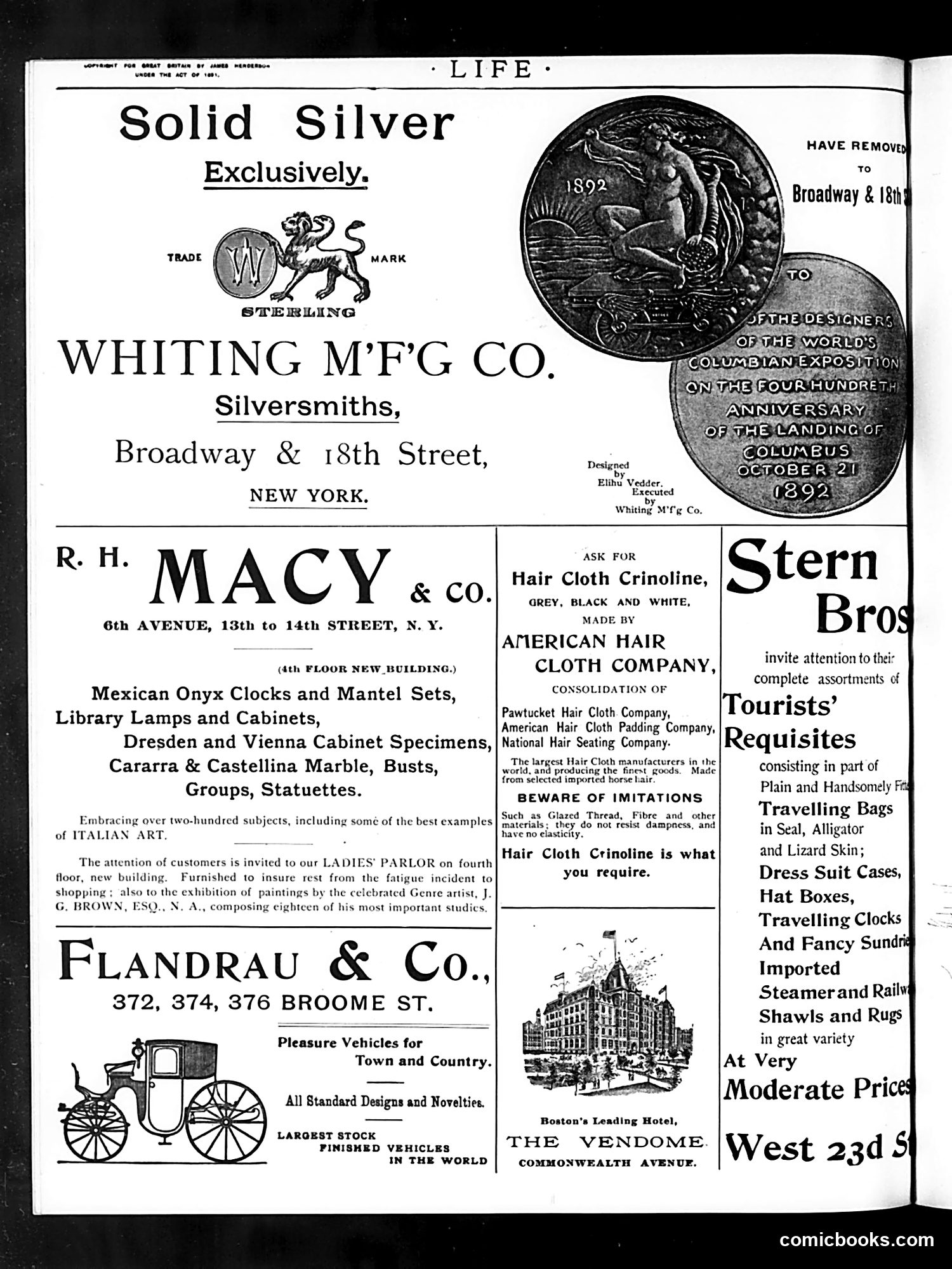
This page is **primarily advertisements** with no political cartoon or satire visible. The content consists of commercial notices from 1892 era New York businesses: - Whiting Manufacturing Company (sterling silver goods) - R.H. Macy & Co. (decorative items and furniture) - American Hair Cloth Company (warns against imitations) - Stern Bros. (travel accessories) - Flandrau & Co. (carriages and pleasure vehicles) - The Vendome hotel (Boston) The only illustrative elements are **product images and decorative engravings** — a commemorative medallion from Columbus's 1892 landing anniversary, a carriage design, and a hotel building. There is no discernible political commentary or satirical intent on this page. It functions as a standard magazine advertising section.
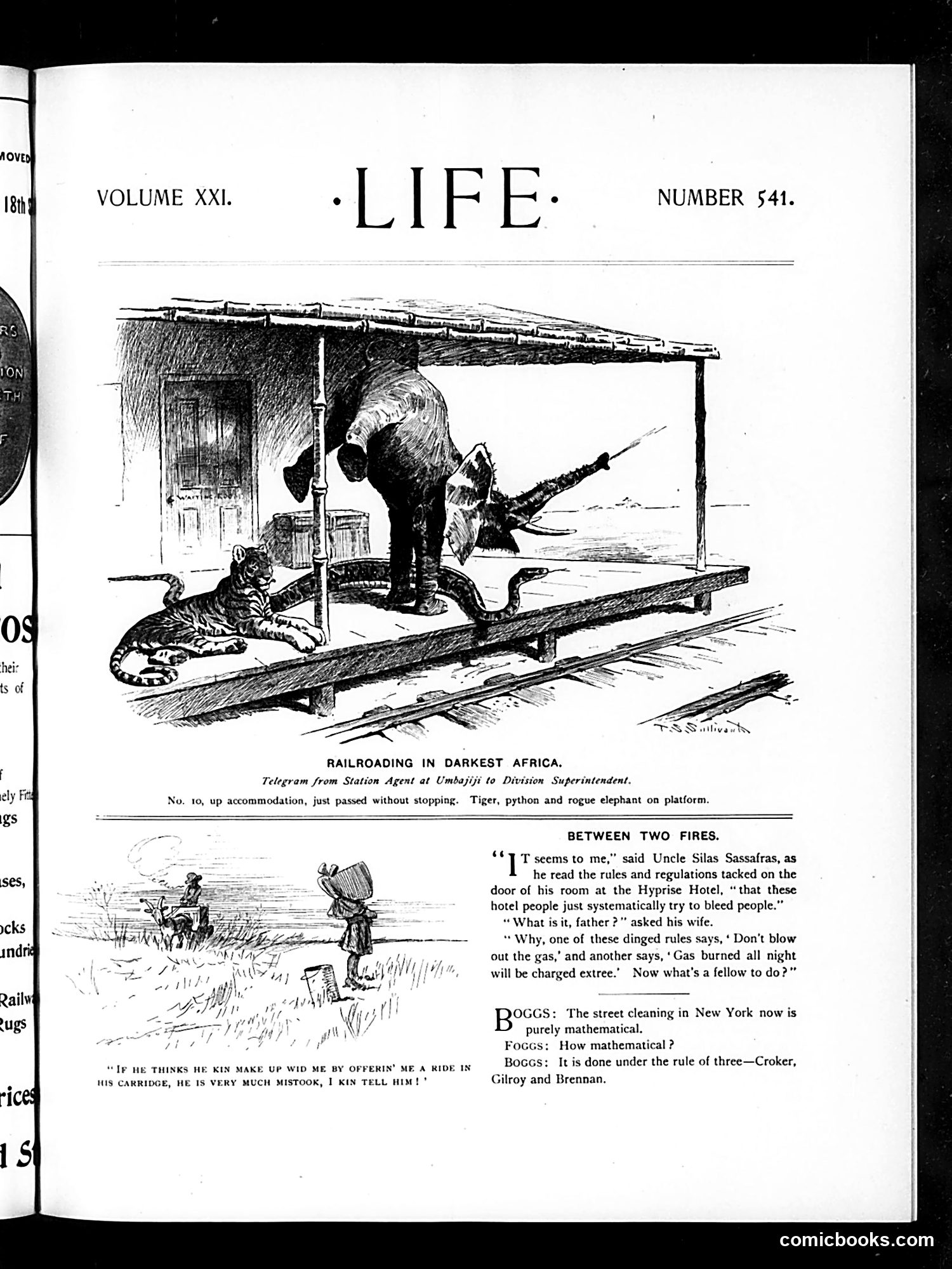
**Top Cartoon - "Railroading in Darkest Africa":** This is satirical commentary on colonial-era African railways. The absurdist humor depicts dangerous animals (tiger, python, elephant) sharing a railroad platform with human passengers—an impossible scenario mocking both the hazards of early African rail infrastructure and perhaps the colonial enterprise's chaotic management. The caption's mock-serious "telegram from Station Agent" tone amplifies the satire. **Bottom Section - "Between Two Fires":** A domestic humor piece about hotel rules. Uncle Silas Sassafras complains that the Hypesite Hotel's posted regulations are deliberately designed to extract money from guests through violations (gas charges, cleaning fees). The brief dialogue satirizes predatory hotel business practices common to the era.
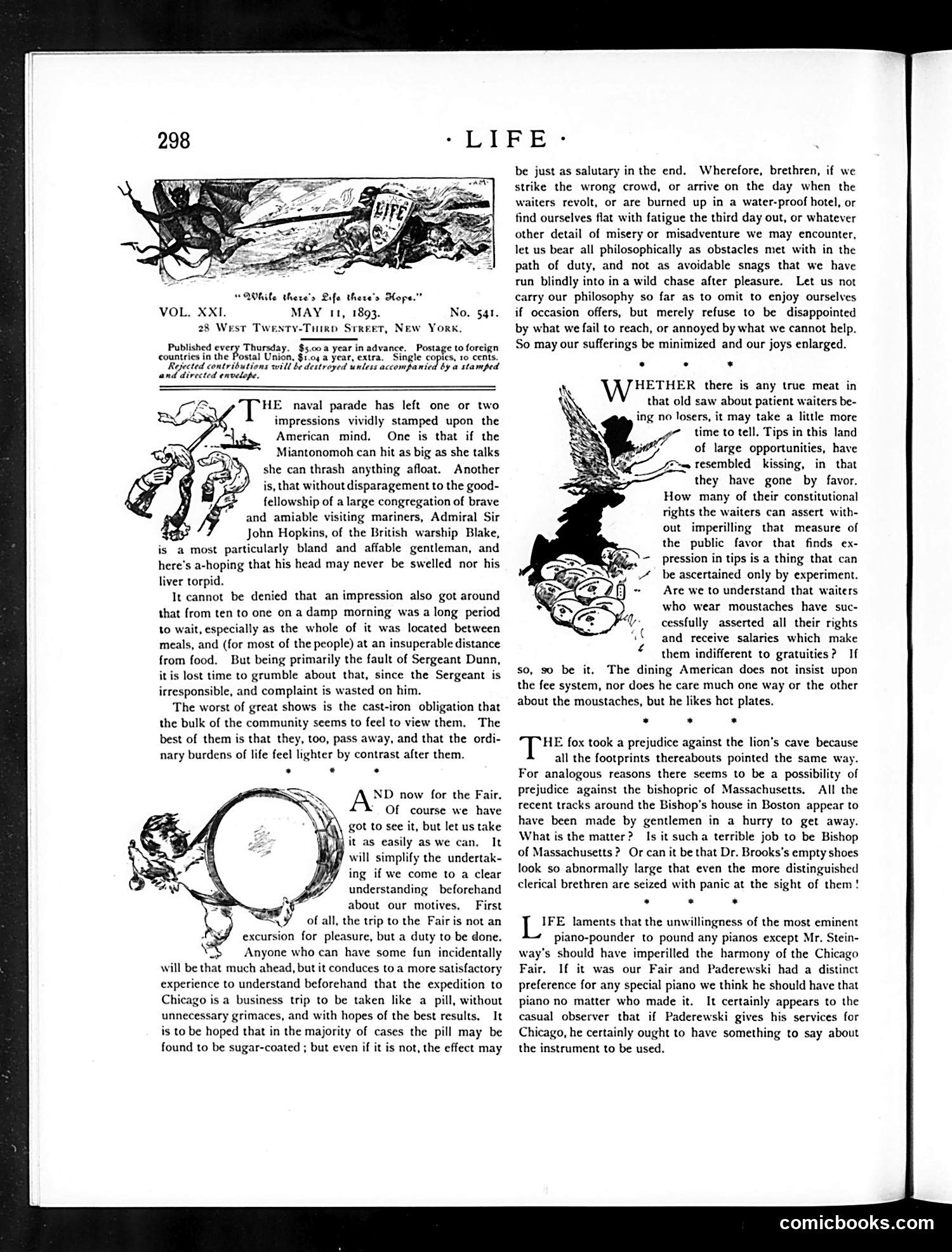
This page contains editorial commentary rather than political cartoons. The text discusses: 1. **Naval parade impressions**: References Admiral Sir John Hopkins of the British warship Blake visiting America, noting the good fellowship between navies. 2. **Waiter tips debate**: Satirizes the American tipping system, questioning whether waiters who wear mustaches have "successfully asserted all their rights" by receiving tips instead of salaries. The humor lies in mocking the arbitrary nature of gratuities. 3. **Bishop Brooks controversy**: Appears to reference prejudice against Massachusetts Bishop Phillips Brooks, with cryptic mentions of "empty shoes" and gentlemen in Boston acting suspiciously. 4. **Paderewski piano performance**: Critiques the unwillingness of prominent pianists to perform at the Chicago World's Fair, suggesting this harmed the event's prestige. The page reflects 1890s social anxieties about labor practices, class, and cultural institutions.
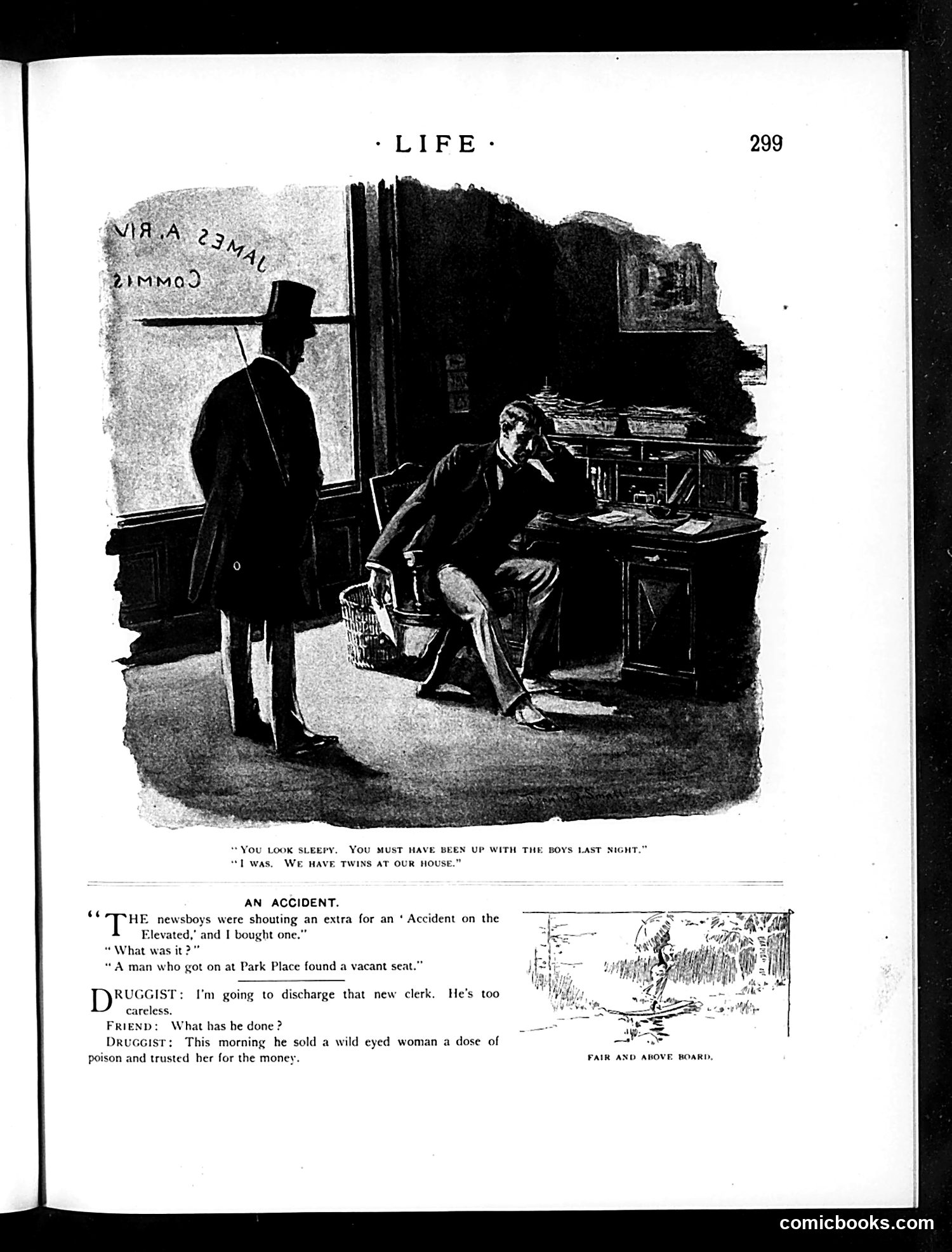
This page contains two separate humorous pieces from *Life* magazine: **Top cartoon:** A domestic scene where a man in formal dress confronts a sleepy boy at a desk. The caption reveals the joke: the father accuses the boy of being out "with the boys last night," but the boy claims he was studying. The father then reveals he has "twins at our house"—suggesting the boy has been neglectful or irresponsible, leaving the father to deal with domestic chaos. **Bottom section ("An Accident"):** A brief comedic dialogue between a druggist and friend about a careless clerk. The clerk sold poison to "a wild eyed woman" and trusted her for payment—a darkly humorous commentary on negligent pharmacy practices of the era. The small illustration labeled "Fair and Above Board" likely provides visual commentary on proper (versus improper) conduct. Both pieces satirize carelessness and irresponsibility in everyday life.
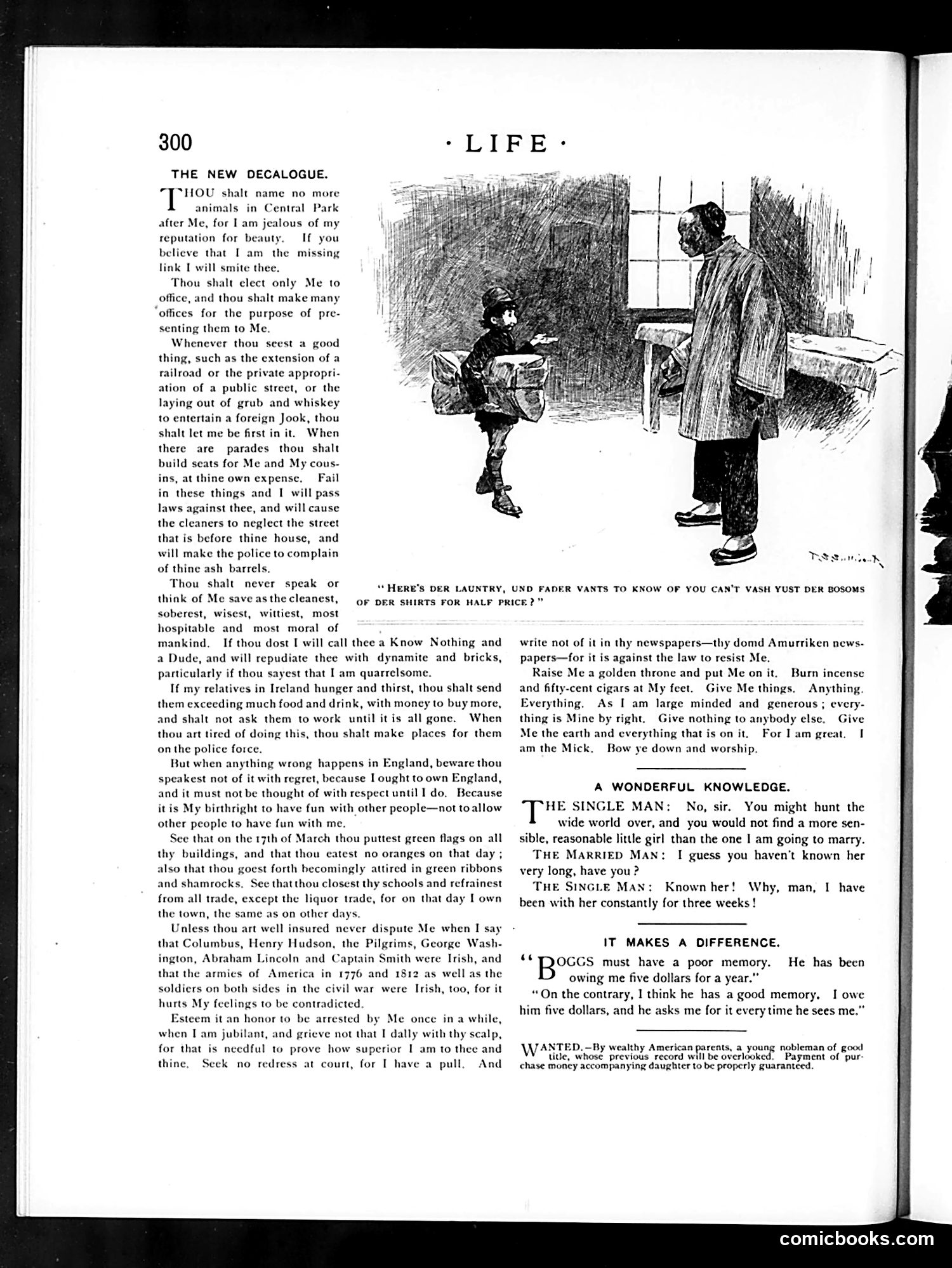
The main cartoon depicts a laundry transaction. A poorly dressed boy presents laundry to a stern man, asking in German-accented English if he can "vash just der bosoms of der shirts for half price." The humor targets German immigrants' linguistic peculiarities and assumed frugality during a period of significant German immigration to America. The accompanying text sections—"A Wonderful Knowledge" and "It Makes a Difference"—are brief humorous anecdotes about courtship and debt, unrelated to the cartoon. Below is a "Wanted" advertisement for wealthy American parents seeking a young nobleman as a suitor for their daughter, satirizing the era's transatlantic marriages where American heiresses wed European nobility for social status. The page reflects turn-of-the-century American attitudes toward immigration and class aspiration.
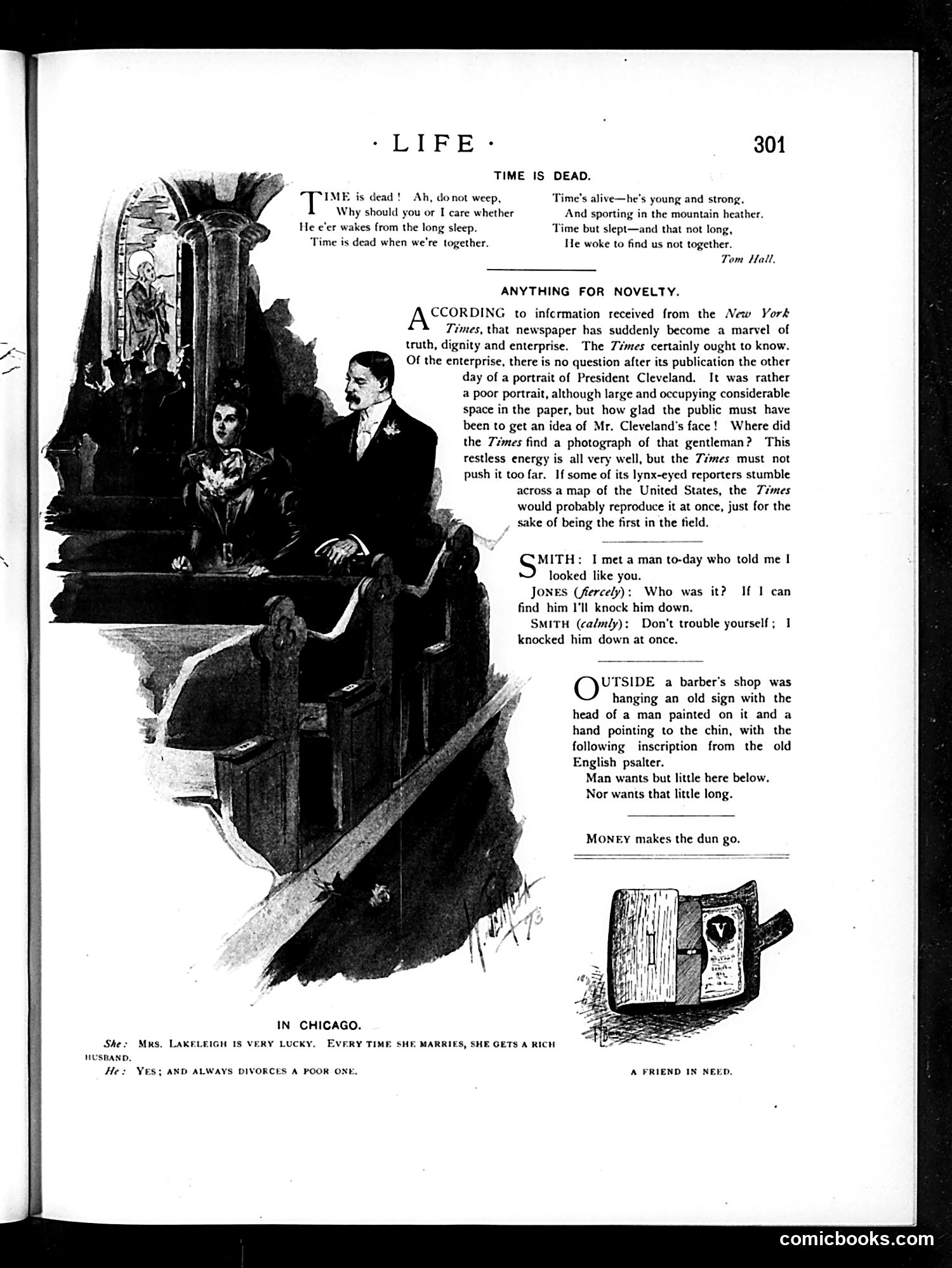
The main cartoon depicts two figures in what appears to be a courtroom or formal setting beneath a large clock. The accompanying dialogue and "IN CHICAGO" caption suggest this satirizes marital discord and divorce proceedings—a common Life magazine subject. The text below jokes about "Mrs. Lakleigh" who "gets a rich husband" each time she marries but "always divorces a poor one"—mocking wealthy women who serially marry for money then discard husbands of lesser means. The other items on the page are brief humorous anecdotes: one about mistaken identity ("I looked like you"), another about a barber shop sign quoting an old English psalm about mortality and money. The overall theme appears to be satirizing American social pretension, materialism, and the divorce culture among the wealthy.
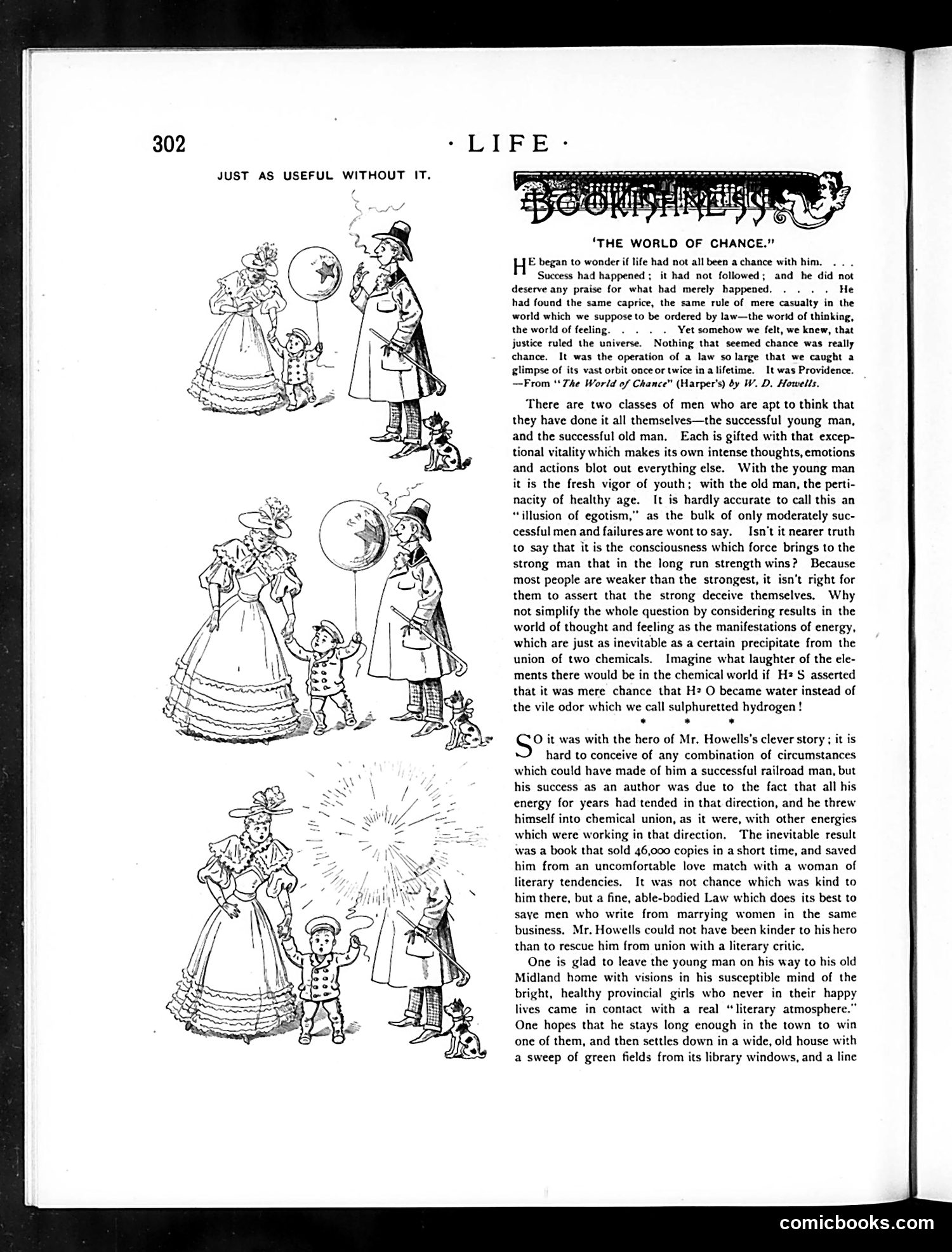
This page contains three cartoon panels illustrating the essay "The World of Chance" (attributed to H.D. Henault). The cartoons are not political satire but rather visual humor supporting the article's philosophical argument about luck and determinism. The sketches show a man presenting a globe to a woman and children in different scenarios—the globe appears to represent chance or fate. The recurring imagery (the globe, the gentleman's top hat, the family group) creates comedic repetition as the composition shifts. The accompanying essay argues that success isn't purely self-made but involves chance and circumstance. It references Mr. Howell's "clever story" about a young railroad man whose literary success saved him from an unfortunate marriage—suggesting that seeming coincidences are actually inevitable confluences of energy and circumstance, not random luck.
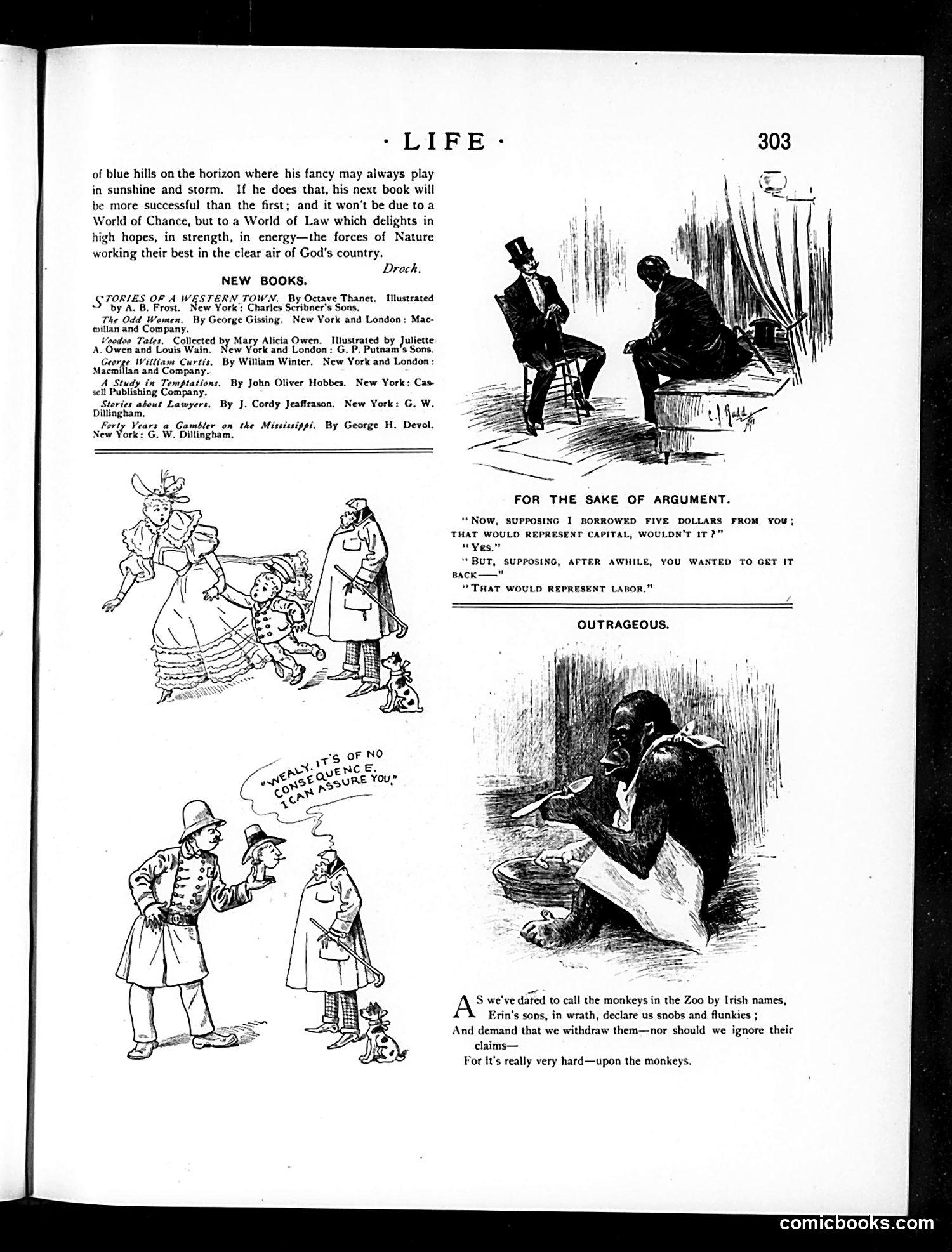
This page contains three distinct cartoons satirizing different subjects: 1. **"For the Sake of Argument"** discusses capital versus labor—a debate about whether borrowed money represents capital or labor when repaid, reflecting labor/economic tensions of the era. 2. **"Outrageous"** features a caricatured figure (appears to be a racist depiction of an African American) at a zoo, accompanying text about "calling the monkeys in the Zoo by Irish names" and declaring them "snobs and flunkies." This satirizes both anti-Irish and racist attitudes, apparently mocking those who make such offensive comparisons. 3. A third cartoon shows figures in conversation with the phrase "Certainly it's of no consequence, I can assure you," likely commenting on social pretension or dishonesty. The "New Books" section lists contemporary publications including works by Octave Thanet and George Gissing.
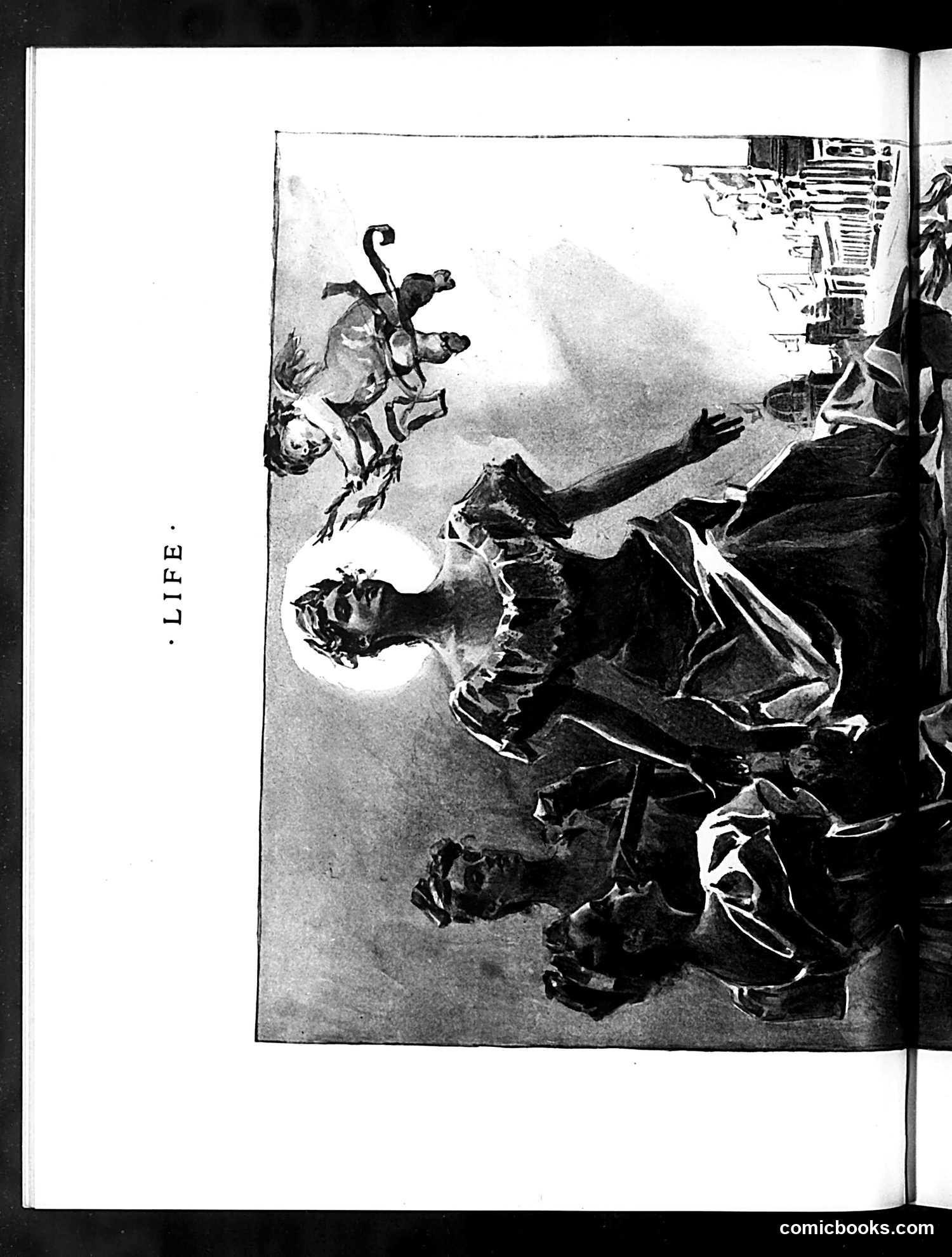
This page from *Life* magazine shows a satirical illustration titled "LIFE" depicting a woman in an elegant dress reclining and gesturing expressively toward figures in the background. The composition appears to be social satire, likely commenting on leisure, entertainment, or social dynamics of the era. The woman's relaxed pose and theatrical gesture suggest commentary on upper-class or bohemian lifestyles. The figures in the background and the ornate setting indicate this may critique wealth, vanity, or the entertainment world. However, without visible text identifying specific individuals or events, I cannot definitively name the figures being caricatured or pinpoint the exact social/political reference. The artistic style and composition suggest early-to-mid 20th century American satire, but the specific satirical point remains unclear from the image alone.
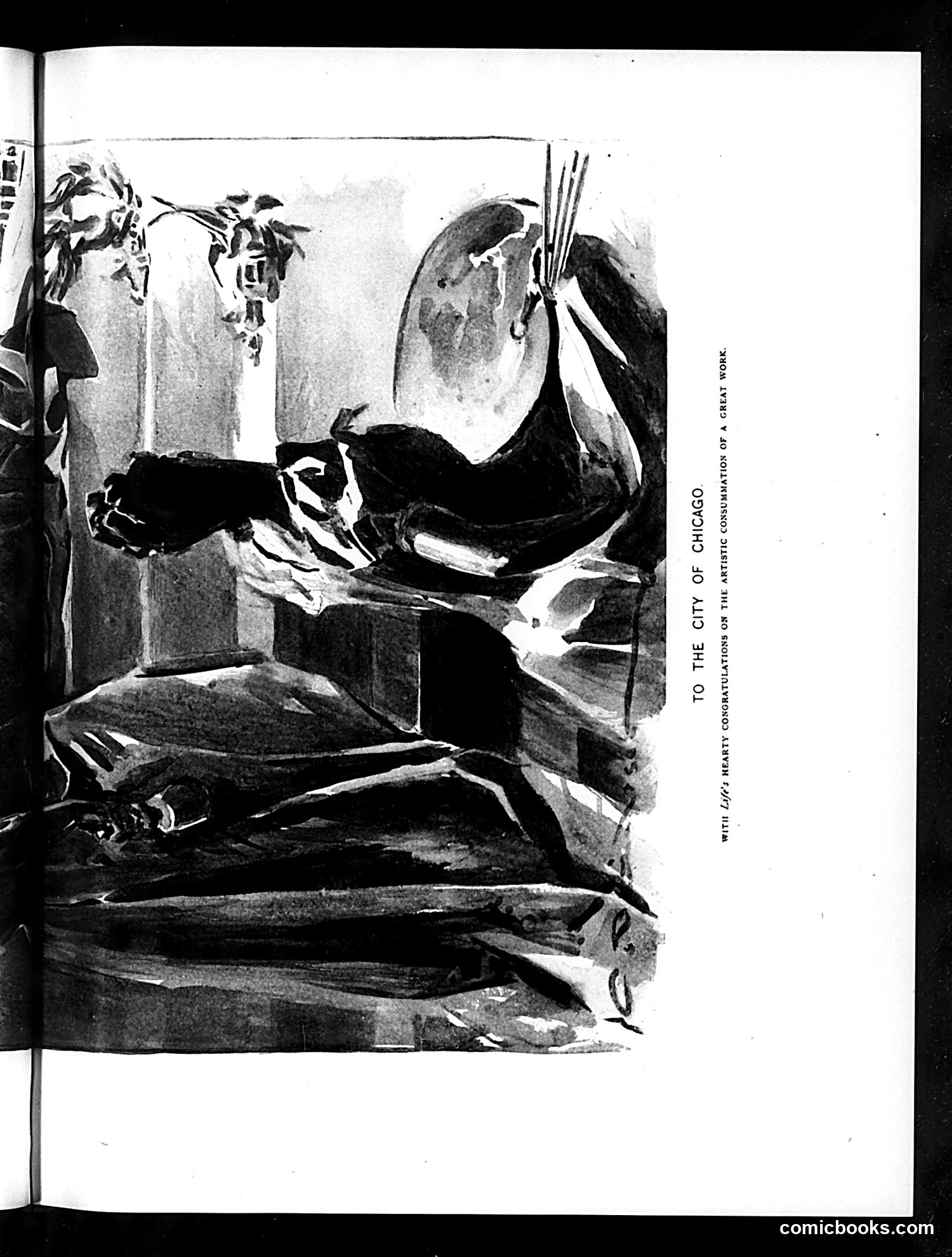
This appears to be a satirical illustration titled "To the City of Chicago" with a hearty contribution to a literary work. The black and white artwork depicts a figure reclining dramatically in an interior setting, surrounded by potted plants and architectural elements. The composition suggests commentary on Chicago's cultural aspirations or pretensions during the period when *Life* magazine was publishing satirical content. Without additional context from the magazine's date or surrounding articles, I cannot identify the specific political figure or cultural reference with certainty. The theatrical pose and domestic interior setting suggest the satire may concern Chicago's intellectual or artistic ambitions, but the precise target and point of the joke remain unclear from the image alone.
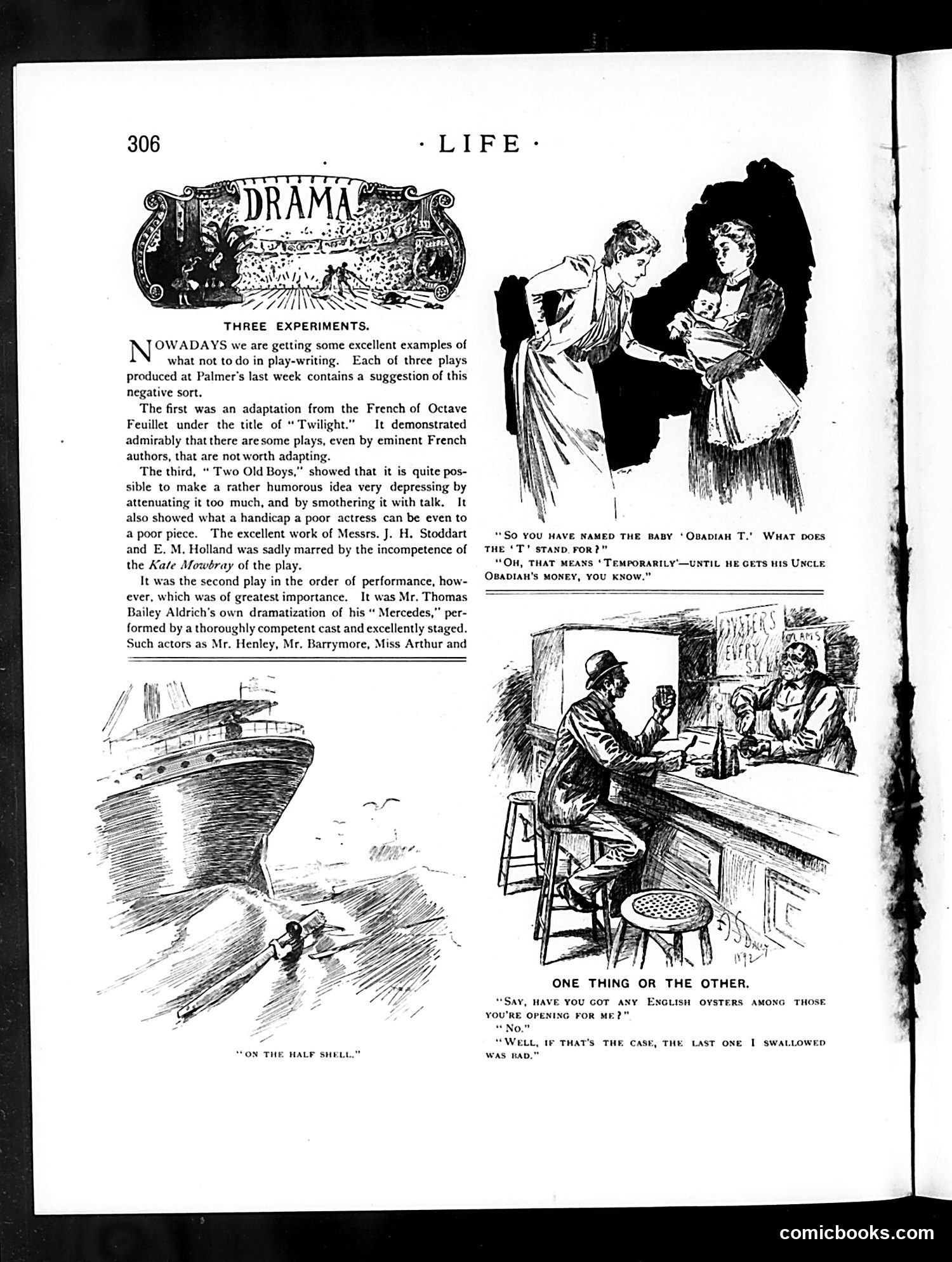
This *Life* magazine page reviews three theatrical productions at Palmer's Theater, critiquing their artistic merit. The text dismisses adaptations of French plays as generally not worth staging, and criticizes "Two Old Boys" for being tediously verbose and poorly acted. The two cartoon jokes below are unrelated to the drama review: 1. **"On the Half Shell"**: A satirical jab at social climbing. Parents name their baby "Obadiah T." temporarily—the "T" stands for "Temporarily"—planning to rename him after inheriting his wealthy Uncle Obadiah's money. This mocks mercenary naming practices among the poor or aspirational classes. 2. **"One Thing or the Other"**: A pub/bar joke about oysters. A customer complains about getting sick from an oyster, demanding to know if it was English. The bartender jokes that if it wasn't English, the last oyster he swallowed was the bad one—implying casual indifference to food quality or dishonest sourcing. Both cartoons use mild social satire typical of *Life*'s satirical humor.
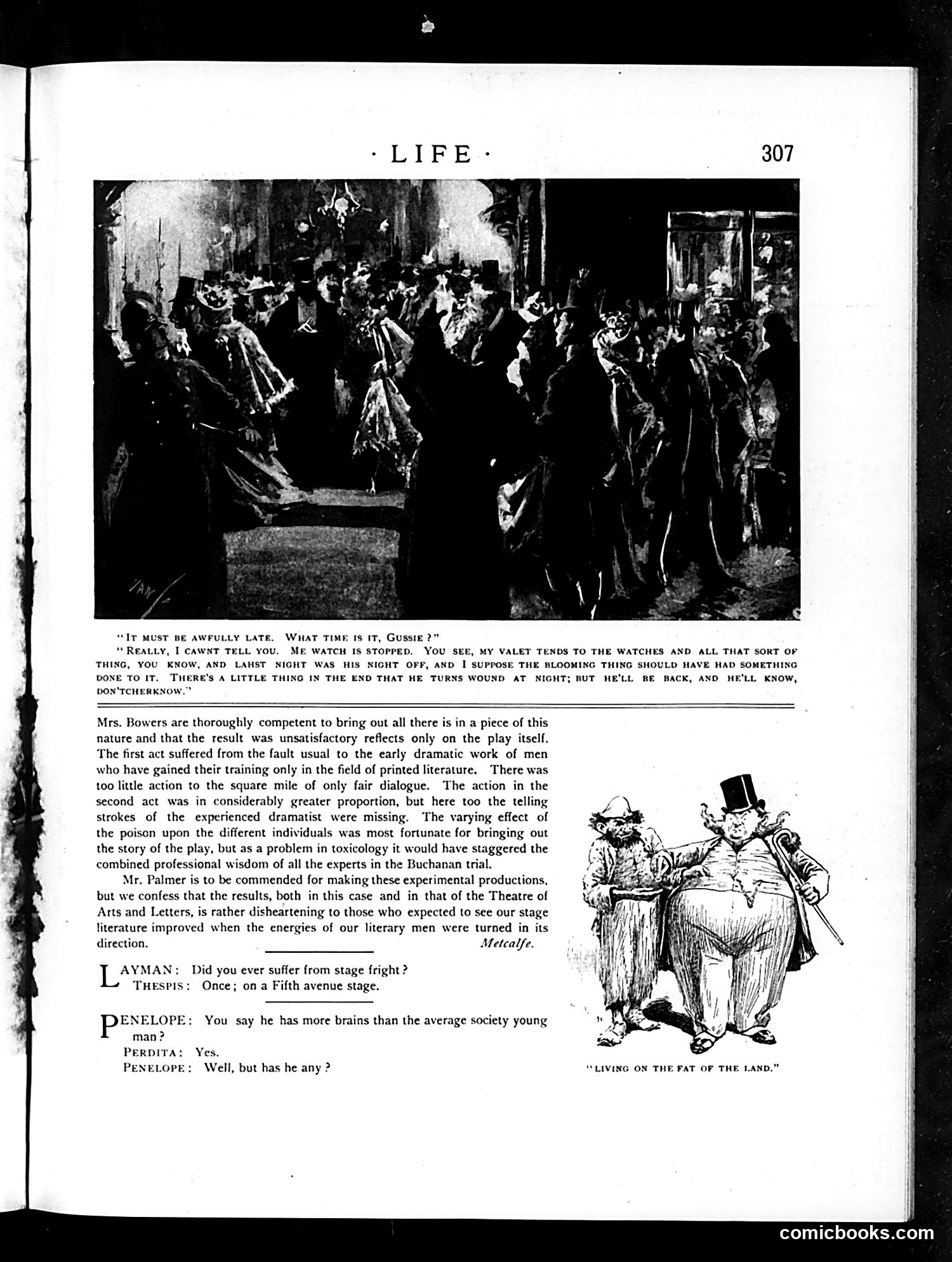
**Top photograph/scene:** Shows an elegant social gathering, likely a theatrical production or society event from the early 1900s. **Main cartoon (bottom right):** Titled "Living on the Fat of the Land," depicts two rotund, well-dressed men in top hats. The satire targets wealthy idleness—these figures represent affluent gentlemen of leisure who depend entirely on servants and inherited wealth to manage even basic tasks. **The dialogue above the photo:** A character named "Gussie" exemplifies this parasitic wealth. He cannot tell time because his watch stopped, and rather than wind it himself, he explains his valet handles all such matters—and it's the valet's night off. The satire mocks his complete helplessness and entitlement: he literally cannot perform the simplest self-care without hired help. **The lower dialogue** continues this theme, questioning whether a wealthy young man has "any" brains at all, suggesting that inherited privilege produces mental vacancy. The page criticizes early 1900s aristocratic excess and dependence.
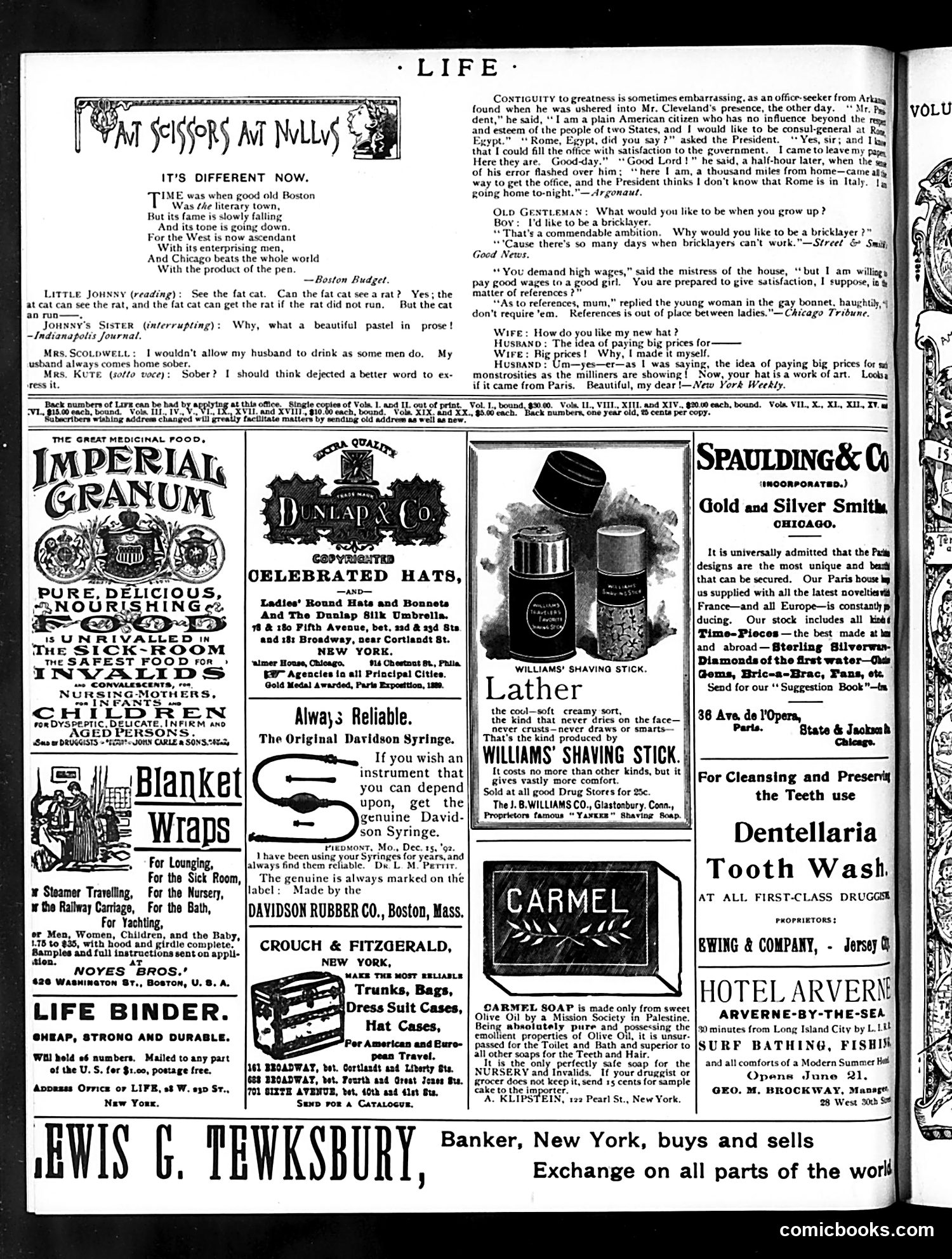
This page contains several brief humorous sketches satirizing American social life and manners, likely from the 1880s-90s based on references to President Cleveland. **Key satires:** 1. **Regional literary rivalry**: The opening poem mocks Boston's declining literary prestige versus the rising West and Chicago—reflecting late-19th-century anxieties about American cultural centers shifting westward. 2. **The office-seeker anecdote**: An Arkansas man embarrasses himself before President Cleveland by proposing a consulship at "Rome, Egypt" (confusing Rome, Italy with Egypt), then realizes his error after leaving. This ridicules provincial ignorance and desperate political patronage-seeking. 3. **Class and domestic humor**: Several brief jokes target servant-employer relations, wives' spending on hats, and marital dynamics—standard Victorian domestic comedy targeting both working-class presumption and middle-class pretension. 4. **Women's independence**: The servant girl who rejects providing references "between ladies" suggests emerging tensions over female workplace dignity. The page is primarily advertising below these sketches.