
Life, 1893-05-11 · page 13 of 14
Life — May 11, 1893 — page 13: what you’re looking at
What you’re looking at
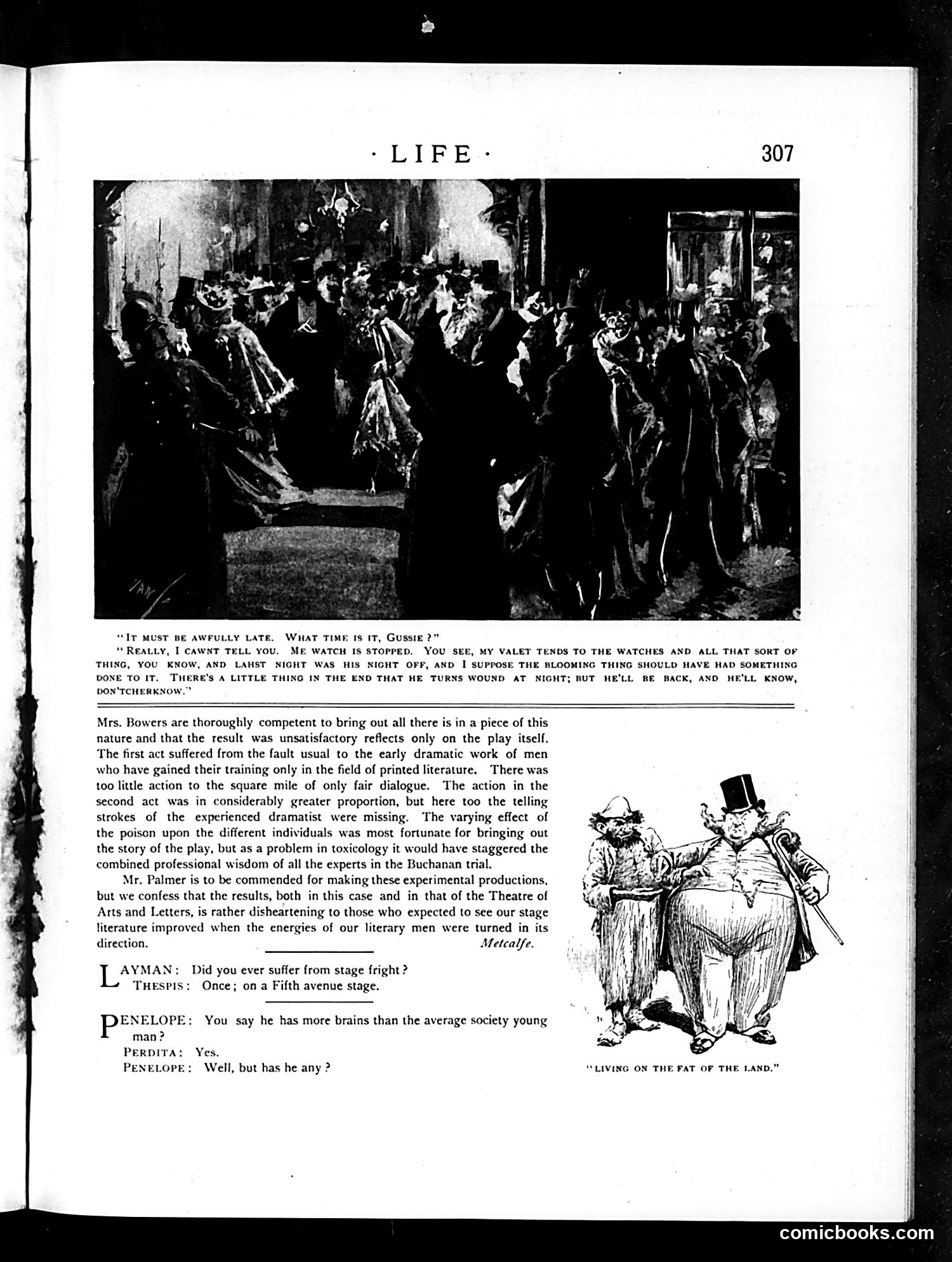
**Top photograph/scene:** Shows an elegant social gathering, likely a theatrical production or society event from the early 1900s. **Main cartoon (bottom right):** Titled "Living on the Fat of the Land," depicts two rotund, well-dressed men in top hats. The satire targets wealthy idleness—these figures represent affluent gentlemen of leisure who depend entirely on servants and inherited wealth to manage even basic tasks. **The dialogue above the photo:** A character named "Gussie" exemplifies this parasitic wealth. He cannot tell time because his watch stopped, and rather than wind it himself, he explains his valet handles all such matters—and it's the valet's night off. The satire mocks his complete helplessness and entitlement: he literally cannot perform the simplest self-care without hired help. **The lower dialogue** continues this theme, questioning whether a wealthy young man has "any" brains at all, suggesting that inherited privilege produces mental vacancy. The page criticizes early 1900s aristocratic excess and dependence.
📄 Transcribed text from this page (OCR, searchable)
Machine-transcribed from the original scan — historical spelling and the odd misread are preserved.
“Tt MUST BE AWFULLY LATE. WuHaT TIME Is IT, Gussie?” “Reatty, I cAwNT . YOU. ME WATCH IS STOPPED. YOU SEE, MY VALET TENDS TO THE WATCHES AND ALL THAT SORT OF THING, YOU KNOW, AND LAHST NIGHT WAS HIS NIGHT OFF, AND I SUPPOSE THE BLOOMING THING SHOULD HAVE HAD SOMETHING DONE TO IT, THERE'S A LITTLE THING IN THE END THAT HE TURNS WOUND AT NIGHT; BUT HE'LL BE BACK, AND HE'LL KNOW, DON'TCHERKNOW.” Mrs. Bowers are thoroughly competent to bring out all there is in a piece of this nature and that the result was unsatisfactory reflects only on the play itself. The first act suffered from the fault usual to the early dramatic work of men who have gained their training only in the field of printed literature. There was too little action to the square mile of only fair dialogue. The action in the second act was in considerably greater proportion, but here too the telling strokes of the experienced dramatist were missing. The varying effect of the poison upon the different individuals was most fortunate for bringing out the story of the play, but as a problem in toxicology it would have staggered the combined professional wisdom of all the experts in the Buchanan trial. Mr. Palmer is to be commended for making these experimental productions, but we confess that the results, both in this case and in that of the Theatre of Arts and Letters, is rather disheartening to those who expected to see our stage literature improved when the energies of our literary men were turned in its direction. Metcalfe. AYMAN: Did you ever suffer from stage fright ? THEsPIS: Once; ona Fifth avenue stage. ENELOPE: You say he has more brains than the average society young man? PERDITA: Yes. PENELOPE: Well, but has he any ? “LIVING ON THE FAT OF THE LAND.” comicbooks.com