
Life, 1893-05-11 · page 8 of 14
Life — May 11, 1893 — page 8: what you’re looking at
What you’re looking at
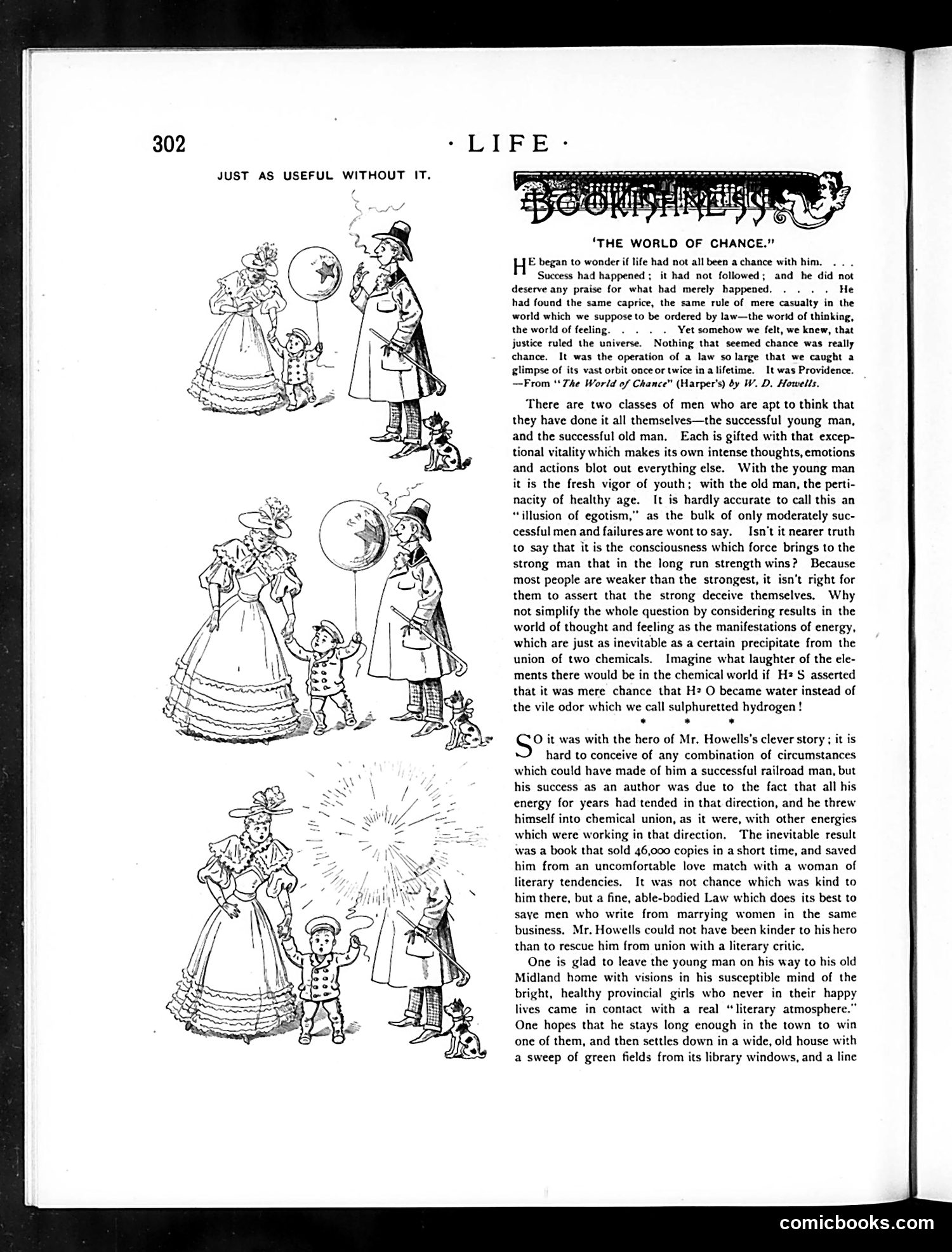
This page contains three cartoon panels illustrating the essay "The World of Chance" (attributed to H.D. Henault). The cartoons are not political satire but rather visual humor supporting the article's philosophical argument about luck and determinism. The sketches show a man presenting a globe to a woman and children in different scenarios—the globe appears to represent chance or fate. The recurring imagery (the globe, the gentleman's top hat, the family group) creates comedic repetition as the composition shifts. The accompanying essay argues that success isn't purely self-made but involves chance and circumstance. It references Mr. Howell's "clever story" about a young railroad man whose literary success saved him from an unfortunate marriage—suggesting that seeming coincidences are actually inevitable confluences of energy and circumstance, not random luck.
📄 Transcribed text from this page (OCR, searchable)
Machine-transcribed from the original scan — historical spelling and the odd misread are preserved.
‘THE WORLD OF CHANCE.” HE besan to wonder if life had not all been a chance with him... . Success had happened ; it had not followed; and he did not deserve any praise for what had merely happened. . . . . He had found the same caprice, the same rule of mere casualty in the world which we suppose to be ordered by law—the world of thinking, the world of feeling. . . . . Yet somehow we felt, we knew, that justice ruled the universe. Nothing that seemed chance was really chance. It was the operation of a law so large that we caught a glimpse of its vast orbit once or twice in a lifetime. It was Providence. —From ‘The World of Chance" (Harper's) by W. D. Howells. There are two classes of men who are apt to think that they have done it all themselves—the successful young man, and the successful old man. Each is gifted with that excep- tional vitality which makes its own intense thoughts, emotions and actions blot out everything else. With the young man it is the fresh vigor of youth; with the old man, the perti- nacity of healthy age. It is hardly accurate to call this an “illusion of egotism,” as the bulk of only moderately suc- cessful men and failuresare wontto say, Isn't it nearer truth to say that it is the consciousness which force brings to the strong man that in the long run strength wins? Because most people are weaker than the strongest, it isn’t right for them to assert that the strong deceive themselves. Why not simplify the whole question by considering results in the world of thought and feeling as the manifestations of energy, which are just as inevitable as a certain precipitate from the union of two chemicals. Imagine what laughter of the ele- ments there would be in the chemical world if HS asserted that it was mere chance that H? O became water instead of the vile odor which we call sulphuretted hydrogen ! . . * O it was with the hero of Mr. Howells’s clever story ; it is hard to conceive of any combination of circumstances which could have made of him a successful railroad man, but his success as an author was due to the fact that all his energy for years had tended in that direction, and he threw himself into chemical union, as it were, with other energies which were working in that direction, The inevitable result was a book that sold 46,000 copies in a short time, and saved him from an uncomfortable love match with a woman of literary tendencies. It was not chance which was kind to him there, but a fine, able-bodied Law which does its best to saye men who write from marrying women in the same business. Mr. Howells could not have been kinder to his hero than to rescue him from union with a literary critic. One is glad to leave the young man on his way to his old Midland home with visions in his susceptible mind of the bright, healthy provincial girls who never in their happy lives came in contact with a real “literary atmosphere.” One hopes that he stays long enough in the town to win one of them, and then settles down in a wide, old house with a sweep of green fields from its library windows, and a line comicbooks.com