
A complete issue · 20 pages · 1893
Life — April 27, 1893
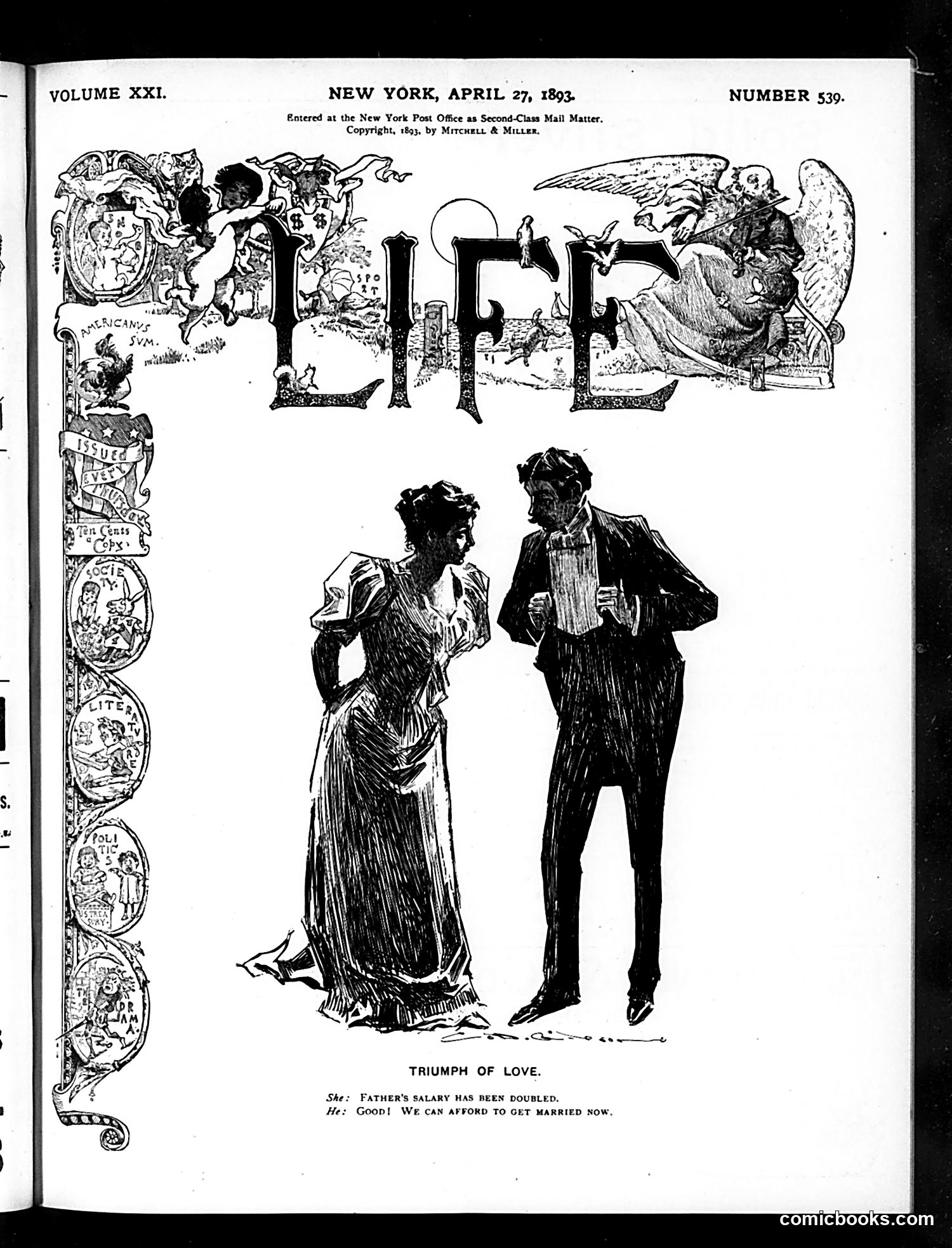
This single-panel cartoon illustrates a romantic scenario titled "Triumph of Love." A well-dressed man in formal evening wear presents himself to a woman in an elegant gown. The dialogue reveals the satire: **She:** "Father's salary has been doubled." **He:** "Good! We can afford to get married now." The joke mocks mercenary attitudes toward marriage among the middle and upper classes. Rather than love being the primary motivation for matrimony, the cartoon suggests that financial security—specifically the woman's father's income—is the decisive factor. The man's sudden enthusiasm for marriage only after learning of improved finances satirizes how economic practicality, not romantic sentiment, drives marriage decisions in 1890s society.
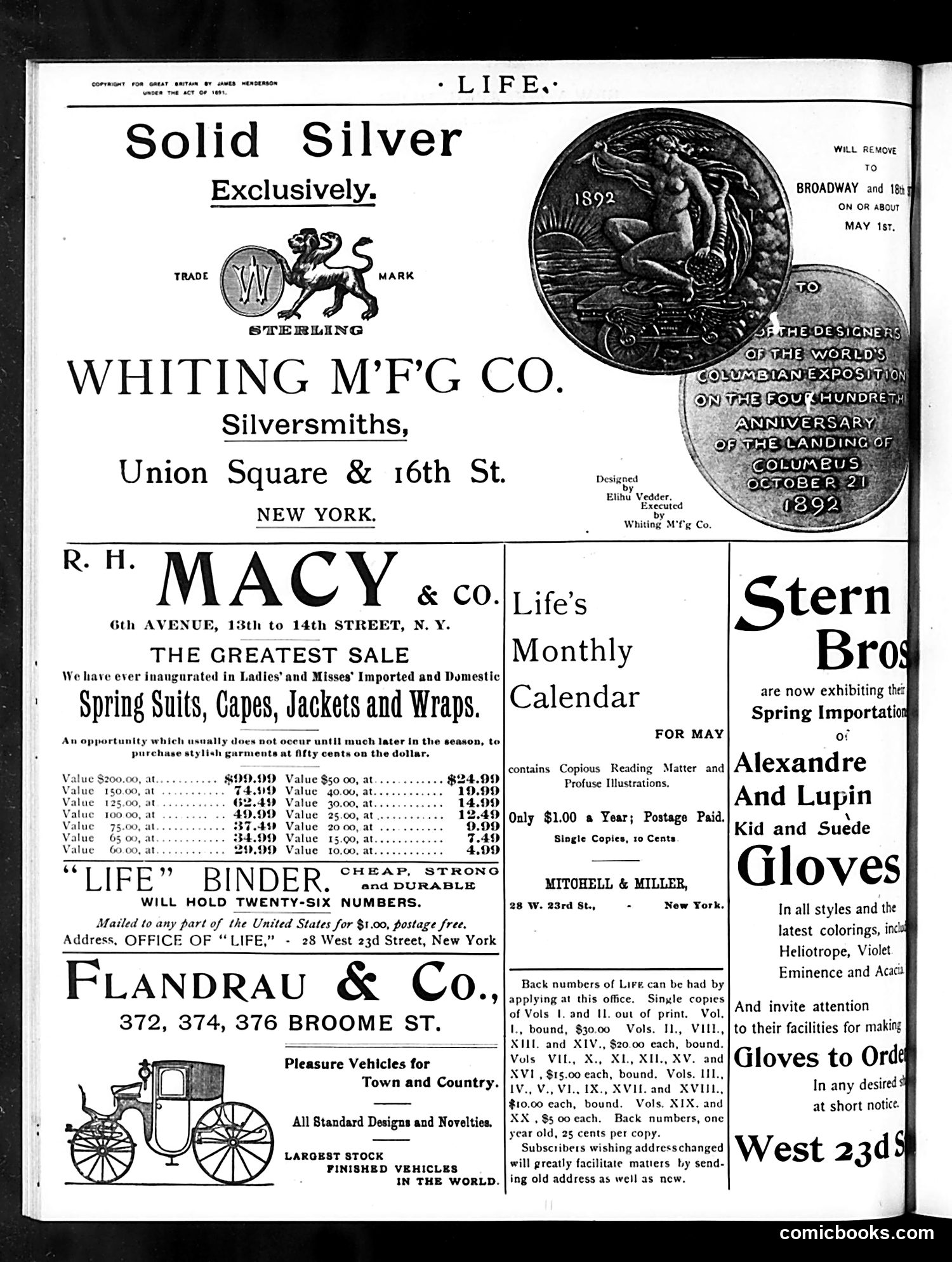
This page is predominantly **advertising** rather than editorial content or political cartoons. The advertisements are for: - Whiting M'F'G Co. (solid silver goods) - R.H. Macy & Co. (spring clothing sale) - Stern Bros. (gloves) - Life Magazine's own products (binder, calendar) - Flandrau & Co. (pleasure vehicles/carriages) - Mitchell & Miller The only image with potential historical reference is a commemorative medal shown at top right, dated 1892, marking the "four-hundredth anniversary of the landing of Columbus, October 21" — referring to the 1492 Columbus arrival and the 1892 World's Columbian Exposition in Chicago. The page contains no political cartoons or satirical commentary to analyze.
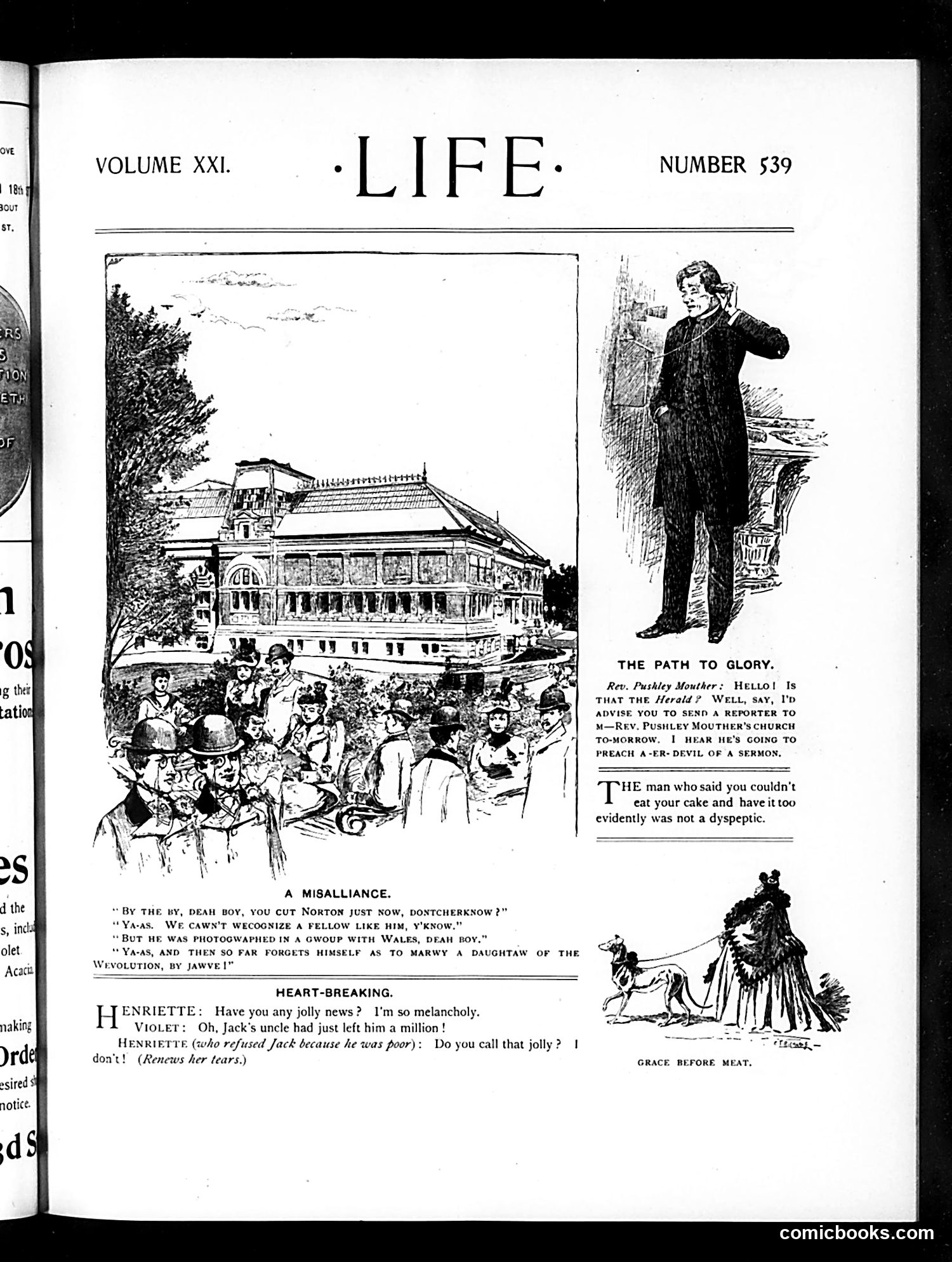
This page contains three satirical pieces: **"The Path to Glory"** depicts a clergyman (Reverend Punkley Moultre) apparently planning to deliver sensational sermons, with the caption suggesting hypocrisy—using dramatic preaching for personal advancement rather than spiritual purpose. **"A Misalliance"** is a brief dialogue mocking social pretension, referencing someone's association with Wales and the "Weyolution" (likely a misspelling or pun), suggesting ridicule of affected upper-class connections. **"Heart-Breaking"** shows a woman (Henriette) distraught over her suitor Jack's uncle refusing him money, with the joke hinging on her calling this situation "jolly"—satirizing the emotional melodrama of wealthy families' financial disputes. The page exemplifies Life's satirical humor targeting clerical hypocrisy, class pretension, and romantic sentimentality among the wealthy.
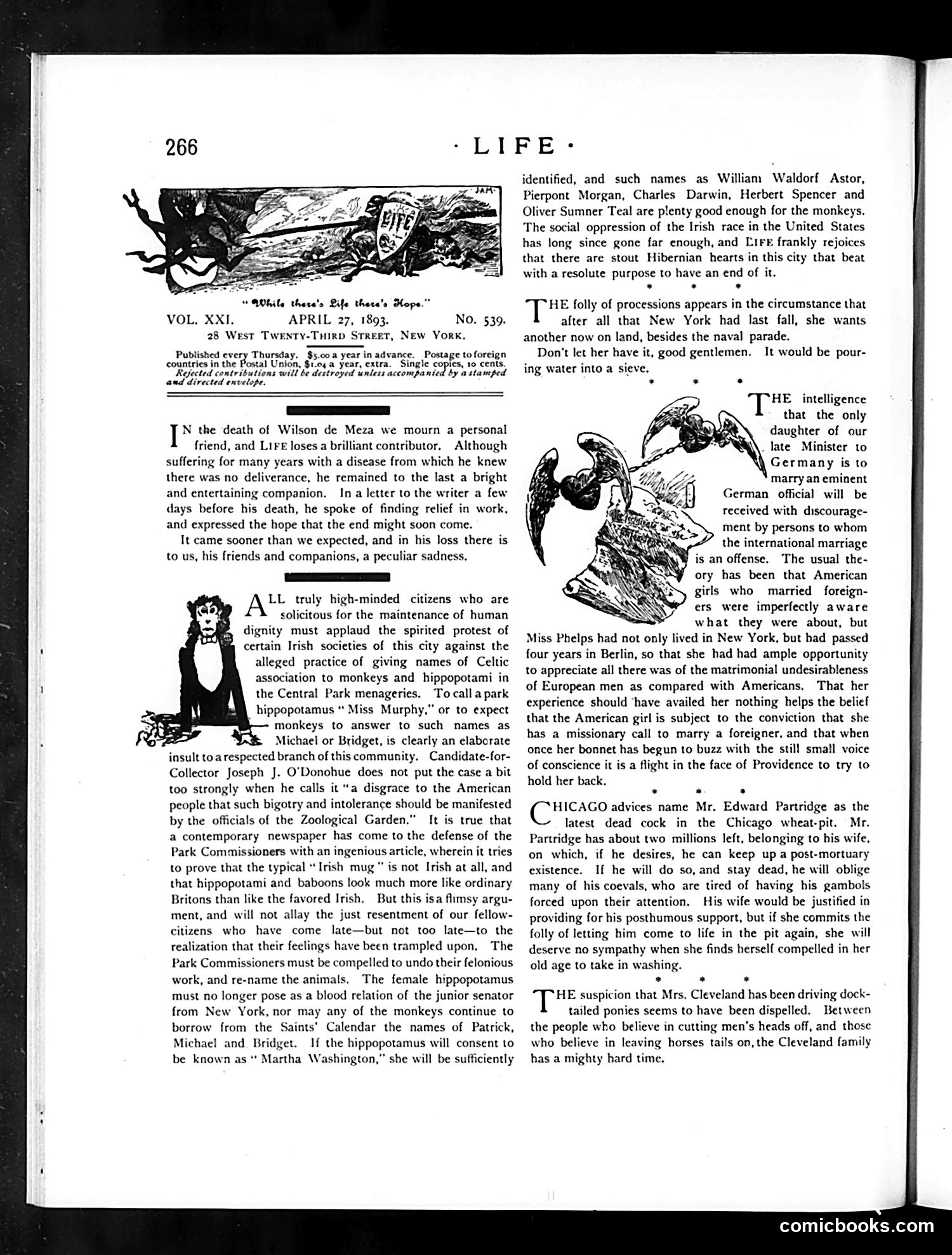
The page contains editorial commentary rather than political cartoons. The main illustrated element shows a caricatured female hippopotamus wearing a bonnet, likely referencing the famous "Miss Murphy" hippopotamus at the Central Park Zoo. The text satirizes Irish-American civic groups protesting the zoo's naming of animals after Irish names (Patrick, Michael, Bridget). The editors mock this protest as absurd—arguing that using Irish names for animals insults no one, and that the protesters' complaints about "Celtic association with monkeys and hippopotami" reveal their own prejudices rather than genuine offense. The piece also discusses Miss Phelps, daughter of Germany's late minister, marrying an American—considered scandalous by some Germans.
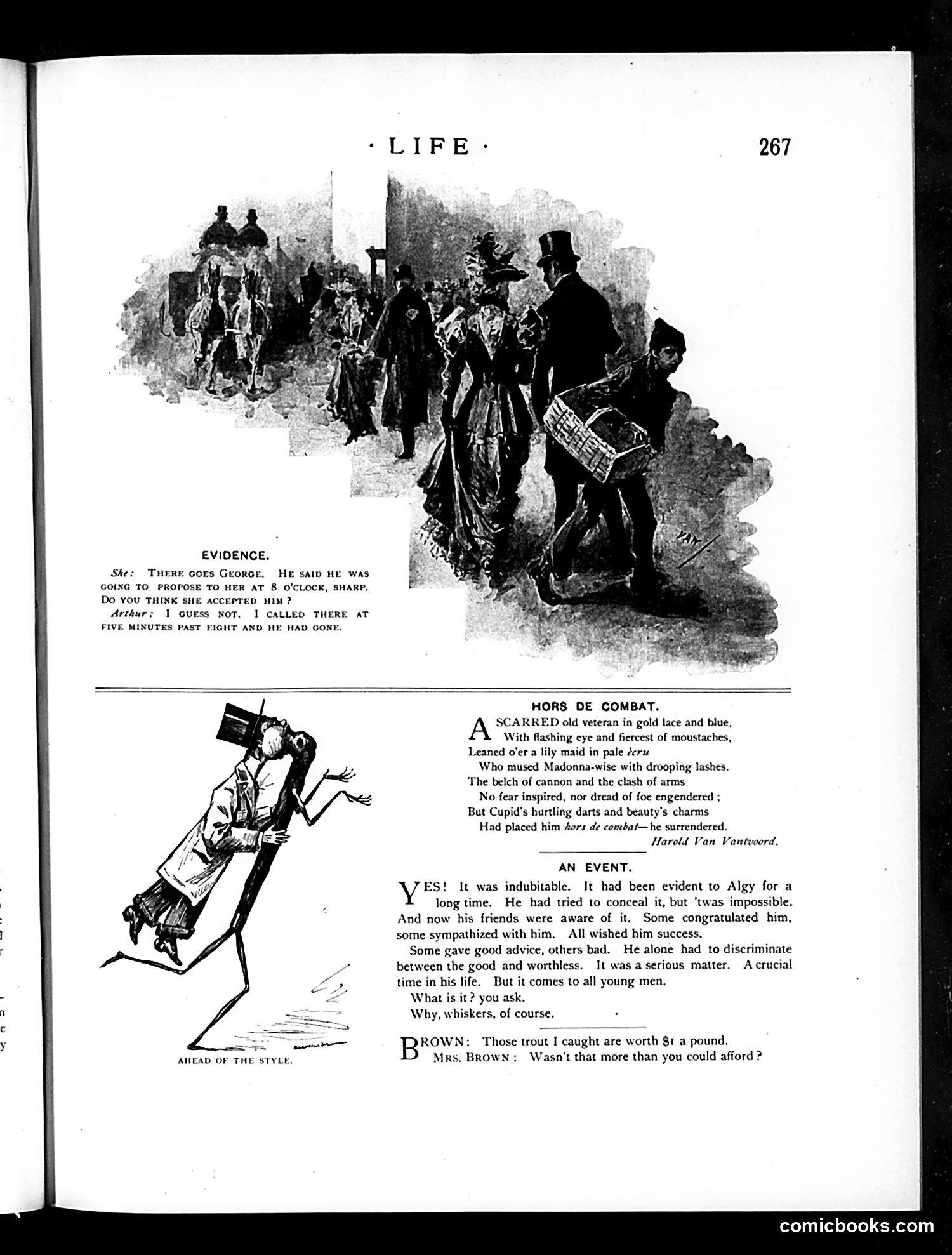
The page contains three distinct elements: 1. **"Evidence" dialogue**: A conversation between "She" and "Arthur" about George's failed marriage proposal at 8 o'clock, with Arthur claiming he saw George five minutes past eight—implying the proposal was rejected almost immediately. 2. **"Hors de Combat" poem**: A literary piece by Harold Van Vosseord celebrating a scarred military veteran in gold lace, contrasting his battlefield courage with romantic vulnerability to a woman's charms. 3. **"An Event" and "Ahead of the Style" sections**: Comic commentary on a young man's romantic crisis, presented as universally relatable ("it comes to all young men"). The humor centers on male anxiety about courtship and whiskers as a romantic concern. 4. **"Brown" dialogue**: A brief comedic exchange about trout fishing prices. The overall tone is light satire on romance, masculinity, and courtship customs of the era.
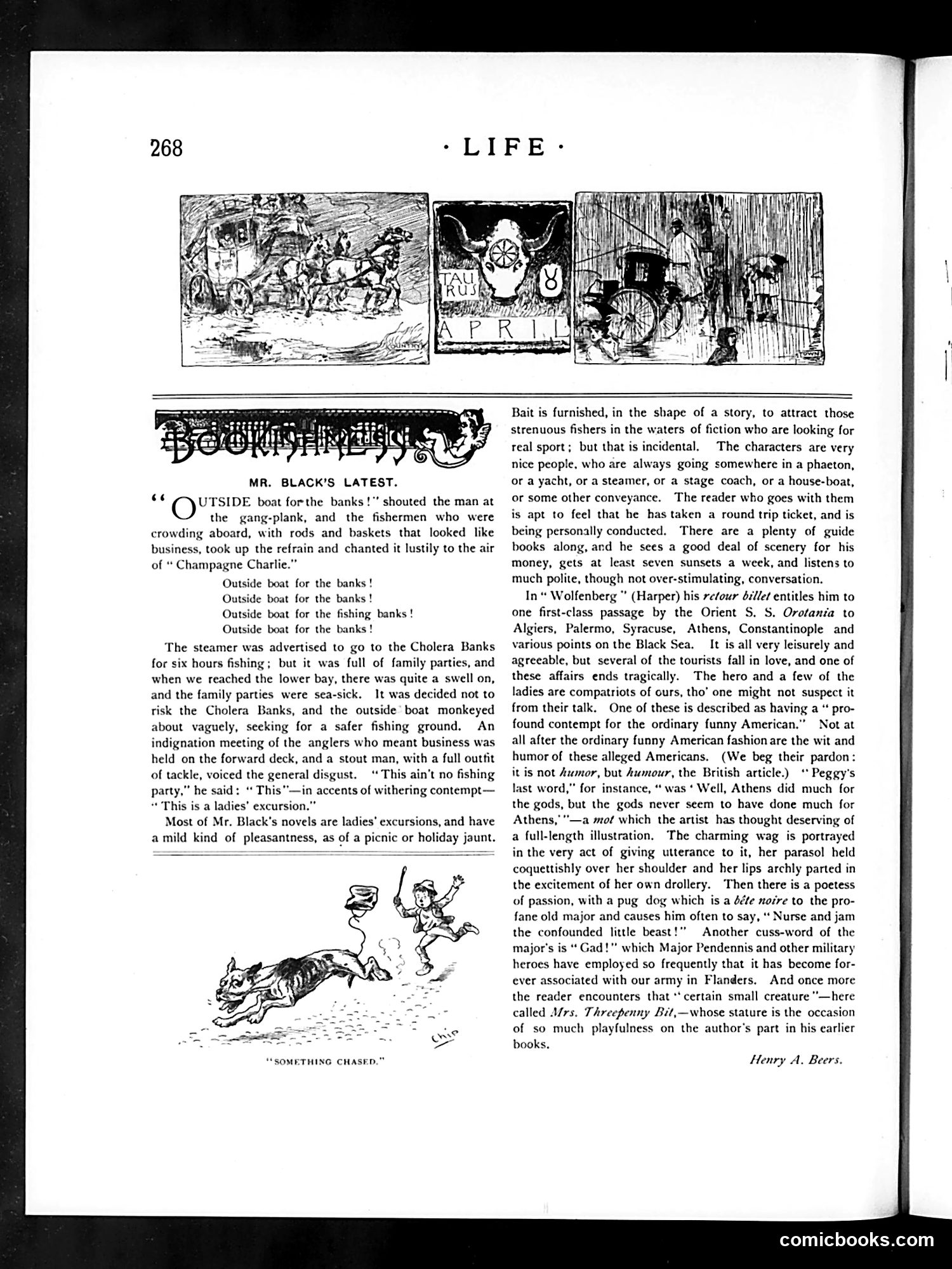
This page reviews Mr. Black's novels, which the critic Henry A. Beers describes as pleasant, leisurely fiction featuring genteel characters on various conveyances—yachts, steamers, and coaches. The review is largely complimentary, praising the work's gentle humor and agreeable tone. However, Beers critiques Black's portrayal of American characters as witty and humorous in ways that feel inauthentic—calling them "alleged Americans." He notes the humor is affected rather than genuine. The review also mocks a character named "Mrs. Threepenny Bid," suggesting Black's female characters lack depth. The small illustration at bottom shows figures chasing what appears to be a dog or animal, likely referencing a scene from one of Black's works discussed in the text.
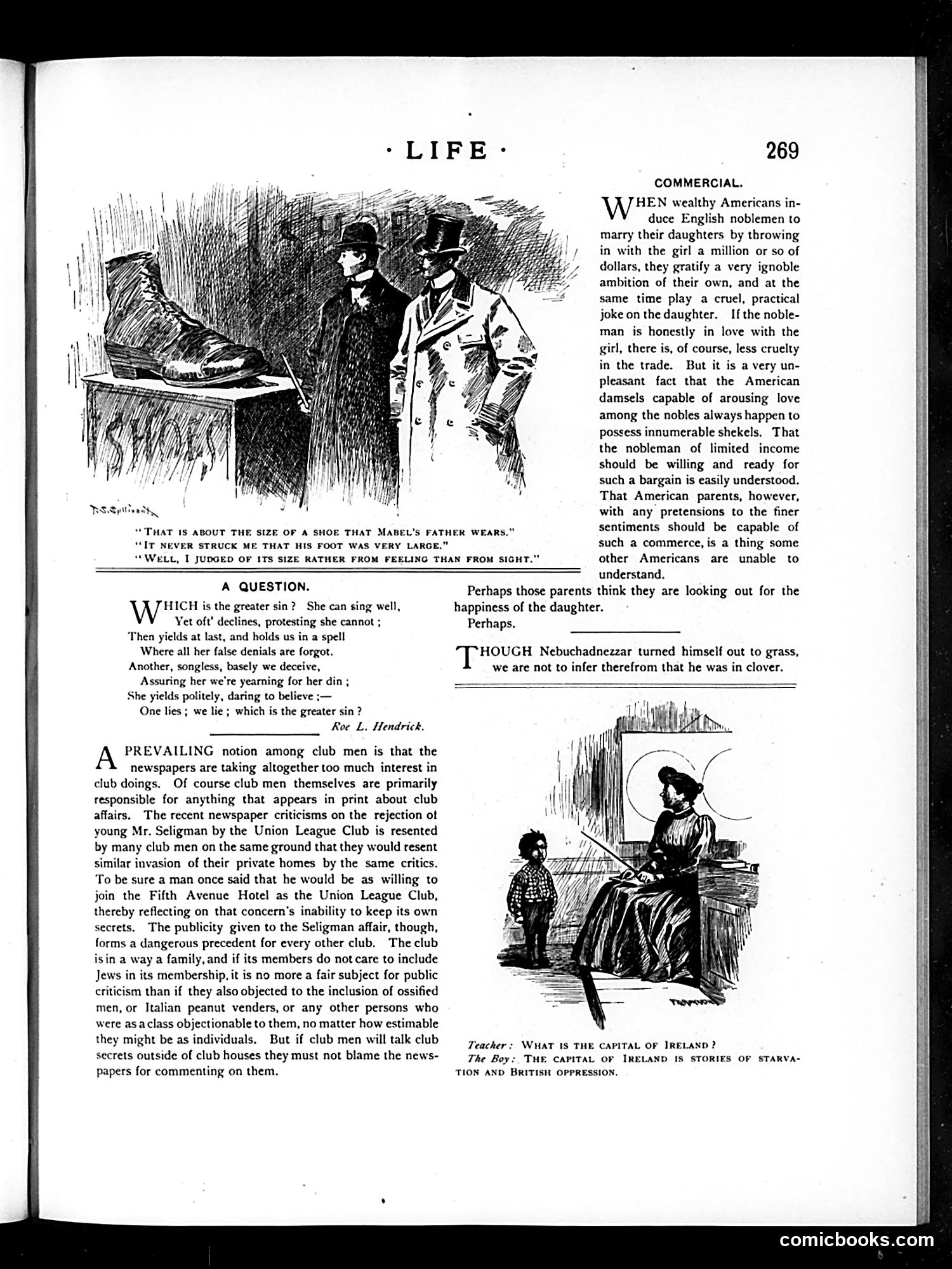
**Top Cartoon:** A satirical commentary on wealthy American fathers arranging marriages between their daughters and English noblemen. The caption jokes about shoe size—the father wears a very large shoe, implying his wealth/importance. The humor targets the "cruel, practical joke" of American heiresses marrying impoverished European aristocrats for titles while the noblemen gain money. The text explicitly criticizes this practice as unpleasant and mercenary, suggesting American parents lack "finer sentiments" by participating in such commerce. **Bottom Section:** Contains an unrelated poem ("A Question") about female agency, and a discussion of newspaper coverage of exclusive clubs' discriminatory membership practices, touching on anti-Semitism and class prejudice.
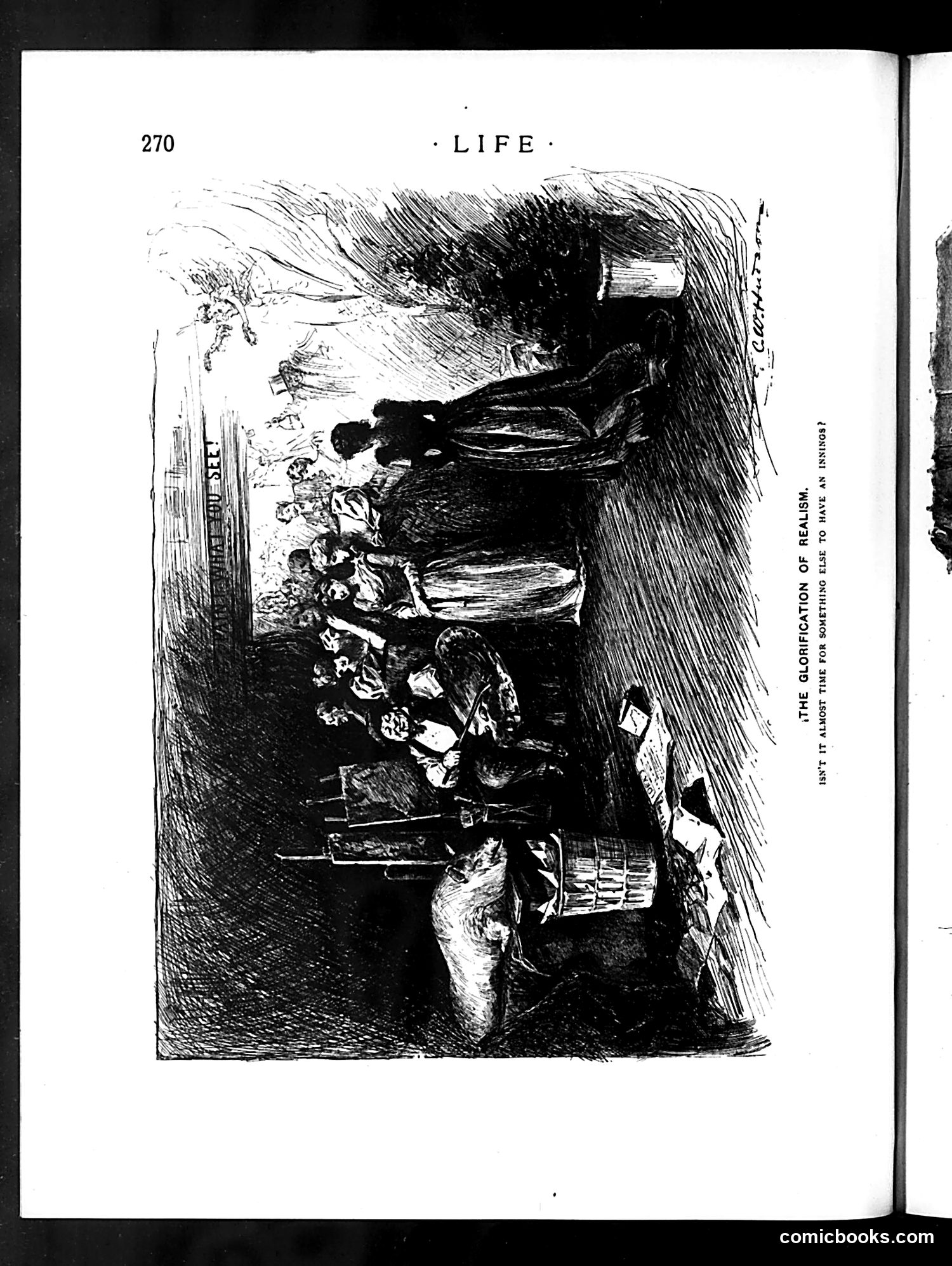
This appears to be a satirical sketch from Life magazine showing an interior scene. The caption reads: "The glorification of realism—isn't it almost the for something else to make an honest?" The cartoon depicts what seems to be a cluttered, unglamorous domestic interior with figures and various objects scattered about. The satire targets the artistic movement of "realism" in late 19th/early 20th century art and literature—which emphasized depicting ordinary, sometimes ungainly subjects rather than idealized scenes. The joke appears to be that while realists claimed to celebrate honest depiction of everyday life, the results were often aesthetically unpleasant or messy. The caption's incomplete sentence suggests irony: pursuing "realism" so thoroughly makes one question whether something else (beauty? idealization?) might actually be preferable. The cluttered scene exemplifies this tension between artistic principle and visual appeal.
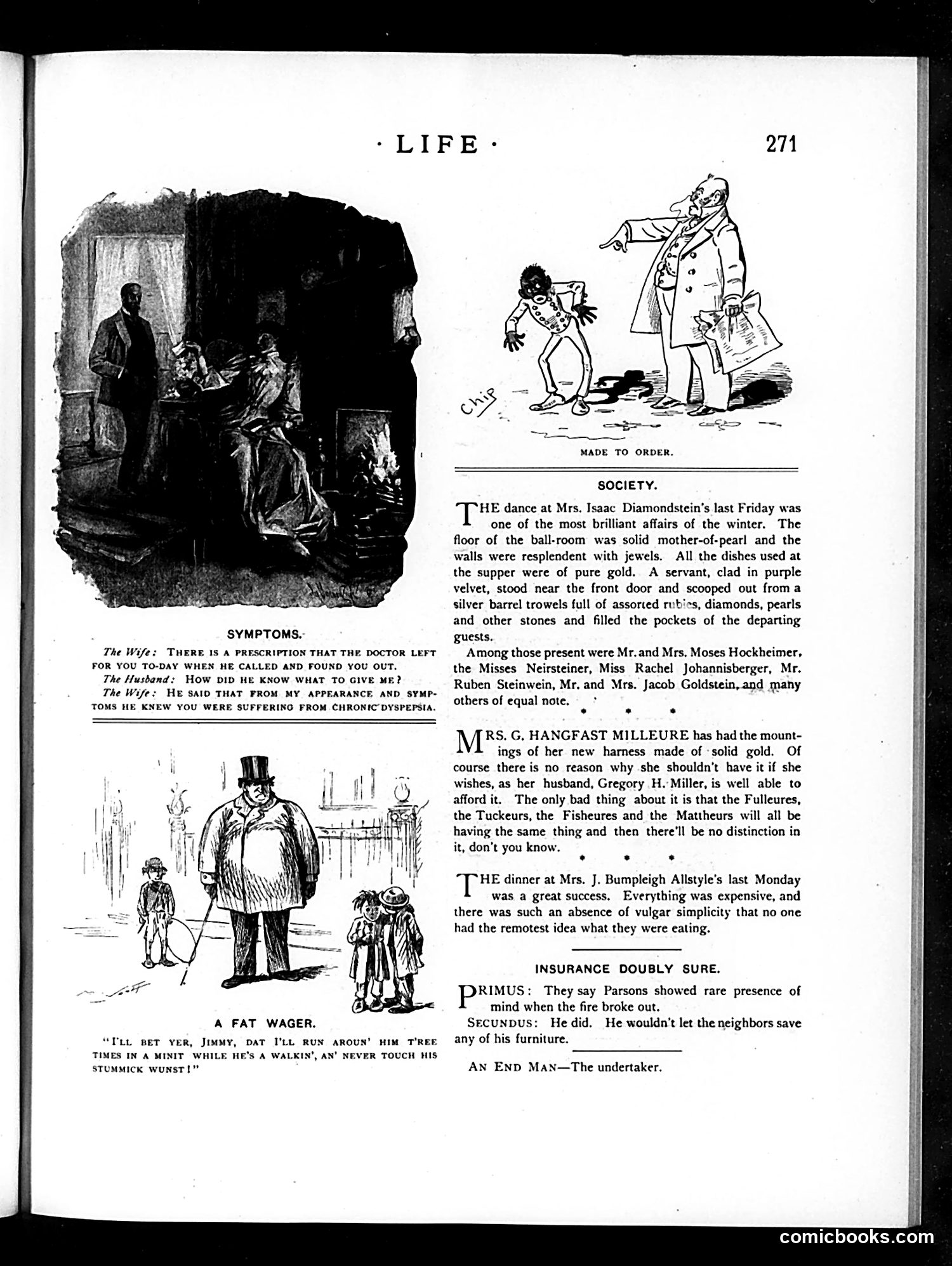
This page contains three satirical sections: **"Symptoms"** depicts a doctor's visit, mocking medical practitioners who diagnose patients based on appearance rather than actual examination—a common critique of early-20th-century medicine. **"A Fat Wager"** shows a portly man with children, illustrating the joke that an overweight person claims he could run around trees without touching his "stumbling wurst" (sausage)—crude body-shaming humor typical of the era. **"Society"** section gossips about wealthy social events, including Mrs. Diamondstein's lavish ball and Mrs. Hangfast Miller's expensive jewelry, satirizing the conspicuous consumption and materialistic pretensions of the upper class. The cartoons mock both incompetent professionals and the vanity of the wealthy.
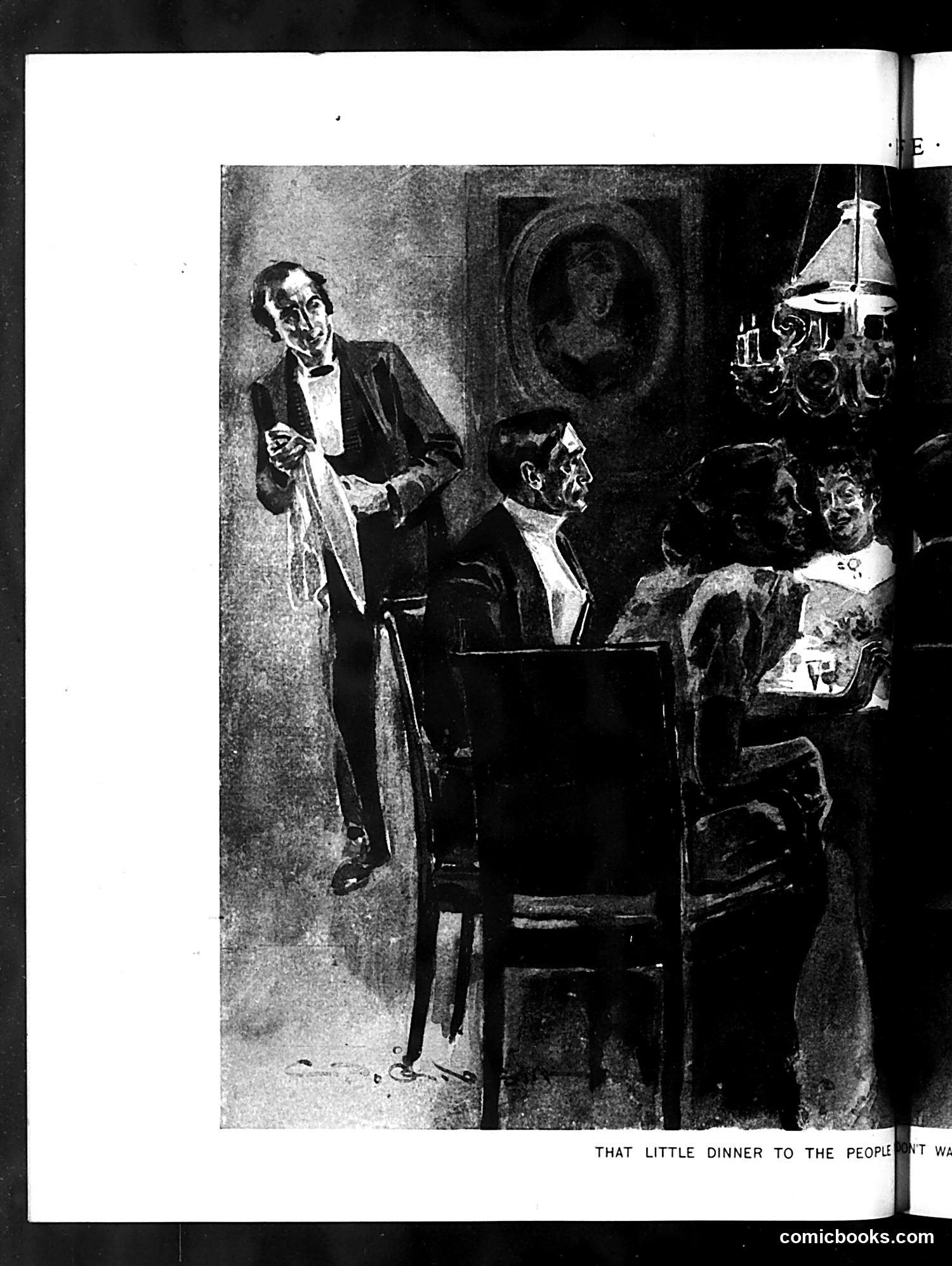
This appears to be a political cartoon from Life magazine satirizing a formal dinner scene. The visible caption reads "THAT LITTLE DINNER TO THE PEOPLE WON'T..." (text cuts off). The image shows formally dressed men at what appears to be an elegant dinner, with a portrait hanging on the wall and a chandelier above. One figure stands prominently on the left in an exaggerated pose, while others are seated. Without the complete caption or date, I cannot definitively identify the specific political figures or event being referenced. The cartoon likely satirizes either a politician's claim to support "the people" while dining luxuriously, or perhaps mocks a specific public figure's dinner party or social event. The contrast between formal elegance and the caption's reference to "the people" suggests commentary on hypocrisy or class divide, but the precise target remains unclear from the visible text alone.
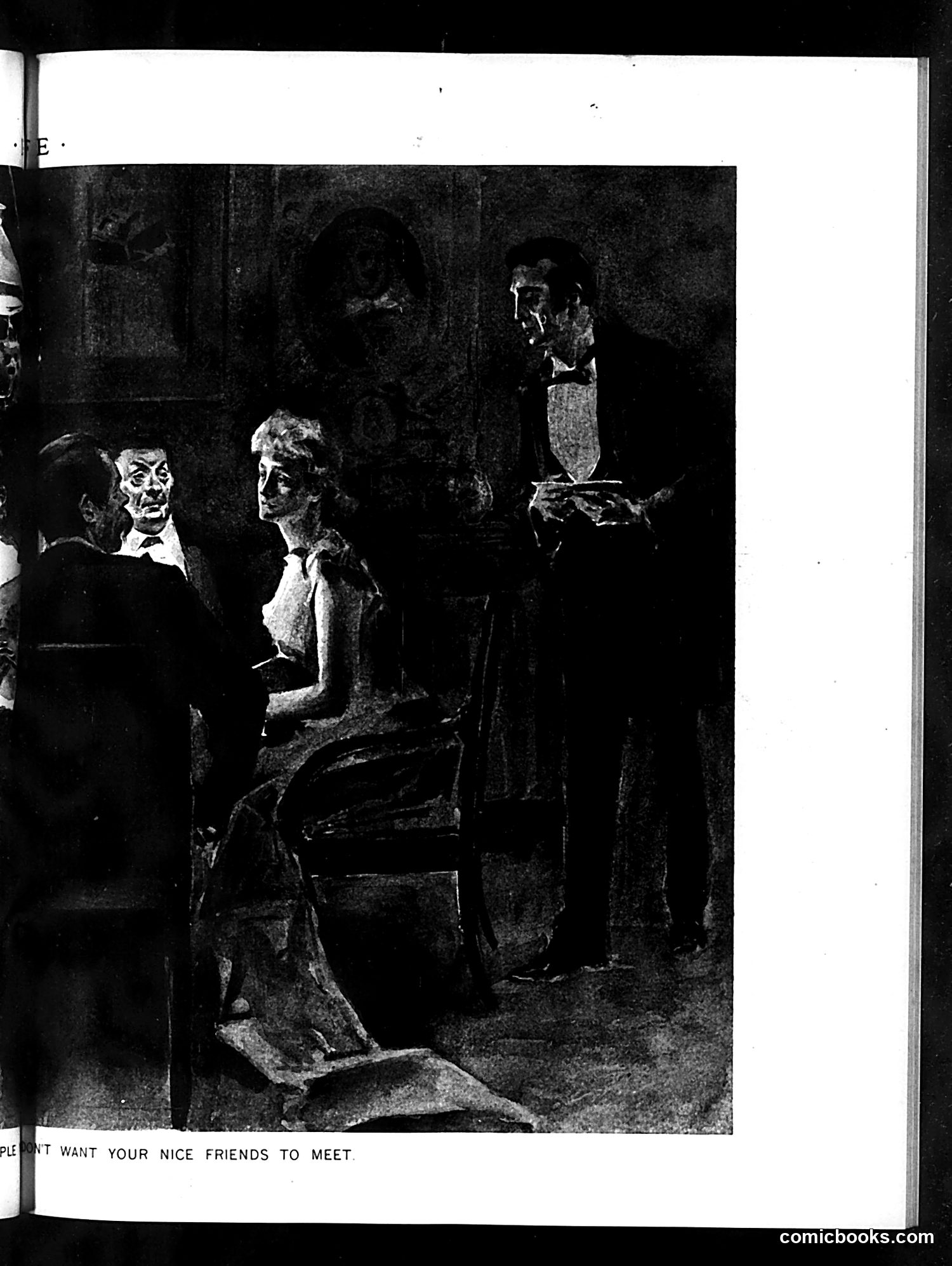
This appears to be a satirical cartoon from Life magazine with the caption "I DON'T WANT YOUR NICE FRIENDS TO MEET." The image depicts a darkly comedic social scene: a well-dressed woman is introduced to what appear to be grotesque or demonic figures in formal attire. The contrast between her refined appearance and the unsettling nature of her companions creates the cartoon's humor. The satire likely critiques social climbing or embarrassing associations—the joke being that someone is ashamed to introduce respectable acquaintances to certain companions, despite those companions being dressed formally. Without additional context or visible artist attribution, the specific social commentary or identities of the caricatured figures remain unclear, though the piece suggests commentary on class pretension or questionable social connections.
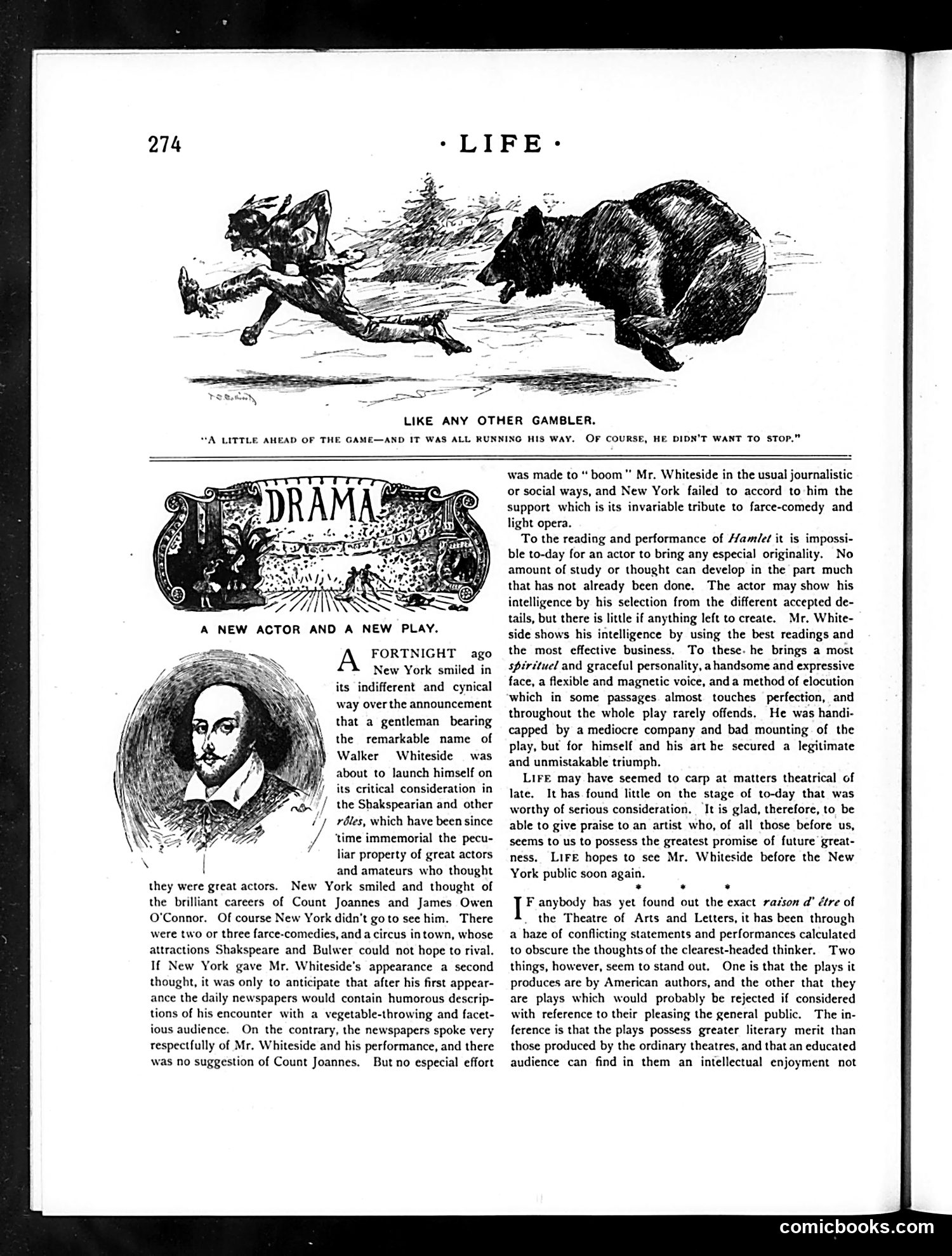
The top cartoon shows a man fleeing from a bear, captioned "Like Any Other Gambler." It's a metaphor for risk-taking: the man is "ahead of the game" but won't stop—like a gambler on a winning streak who keeps betting, eventually losing everything. The bear represents inevitable consequences. The article below discusses actor Walker Whiteside's New York debut performing Shakespeare's *Hamlet*. Life praises his performance as genuinely excellent—showing intelligence, grace, and vocal skill—despite poor company support and modest promotion. The satire is genteel: Life notes that New York typically ignores serious theatrical art in favor of farce and circuses, yet surprisingly treated Whiteside respectfully. The piece critiques both public taste and journalistic hype, while genuinely commending an actor who succeeded through talent rather than sensational marketing or critical novelty.
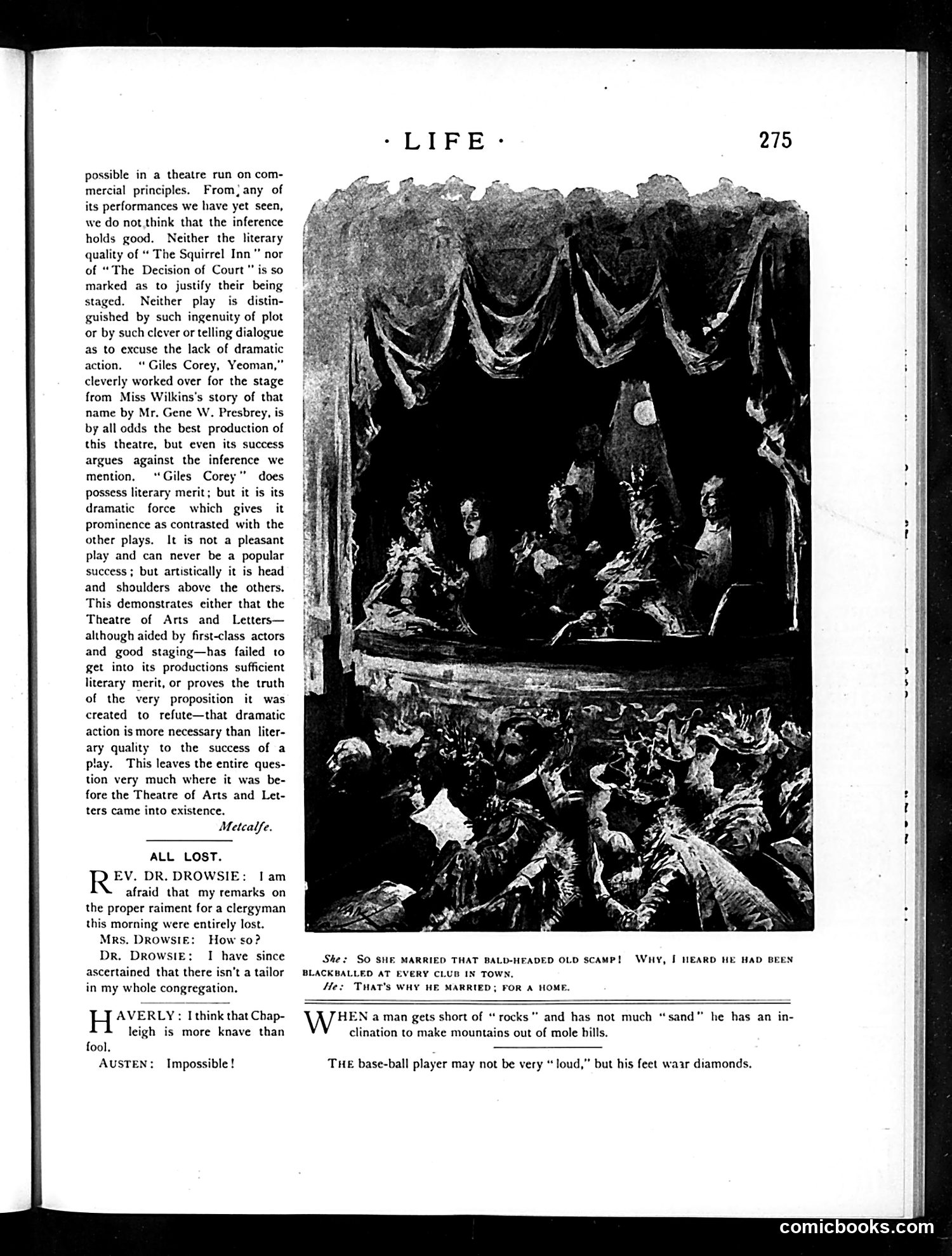
This page contains theatrical criticism and satirical humor pieces typical of Life's format. **Main Content:** A theater review critiquing the Theatre of Arts and Letters. The critic argues that despite being designed to prove literary quality matters more than dramatic action, the theater's own success with "Giles Corey, Yeoman"—praised for its *dramatic force* rather than literary merit—actually proves the opposite point. The paradox undercuts the theater's founding philosophy. **The Jokes:** Several brief comedic pieces play on wordplay and social observation: - A minister laments his sermon on clerical dress was wasted because his congregation has no tailors - A quip about a bald man marrying for "a home" (implying he was rejected by clubs) - Aphorisms about making "mountains out of mole hills" and baseball players' "feet wear diamonds" (puns on wealth/"rocks" and "sand") The cartoon (top) appears to depict a theatrical scene, supporting the drama discussion.
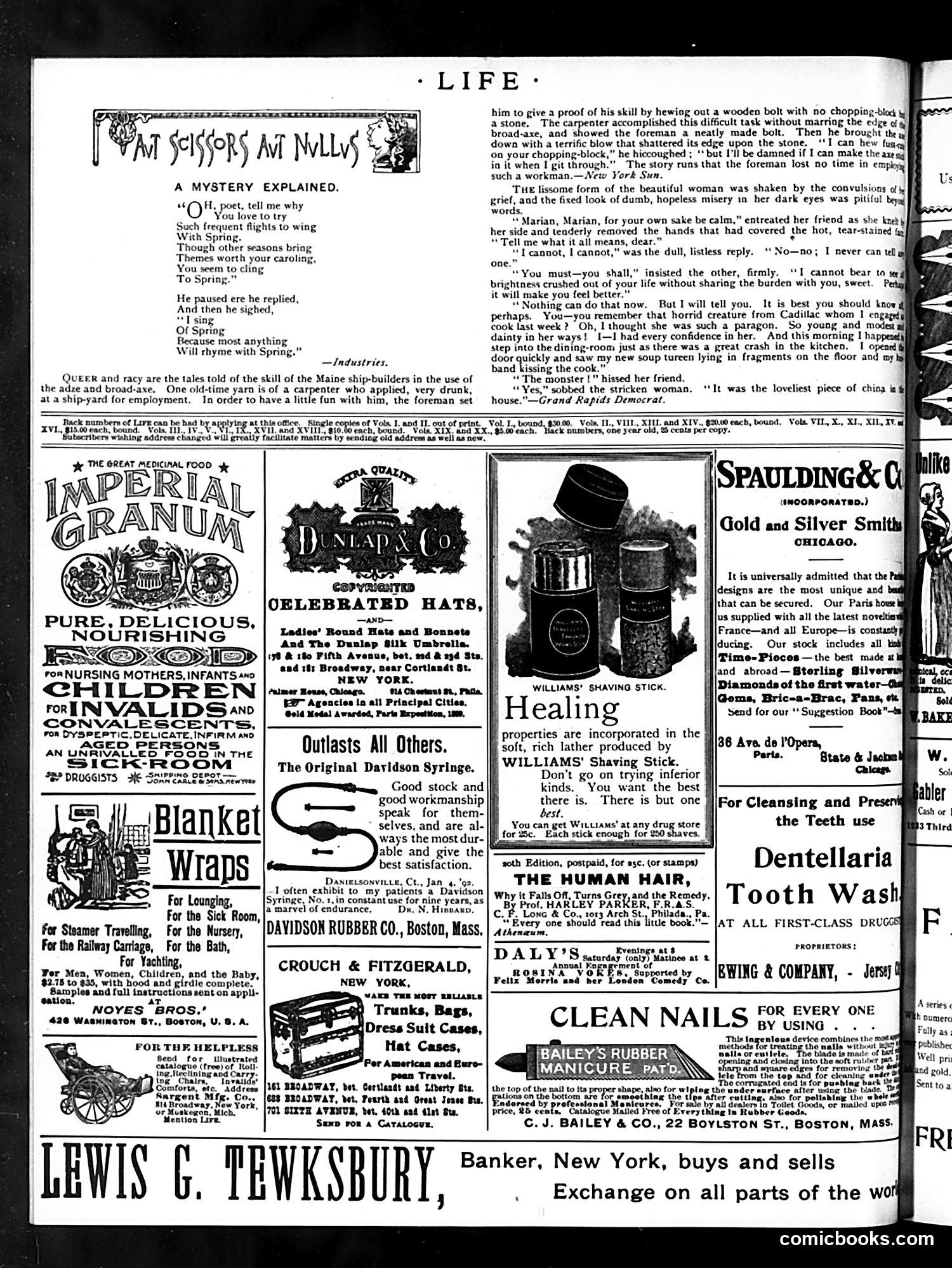
This is primarily a **magazine page filled with period advertisements**, with a small amount of editorial content at the top. **The Editorial Content:** The page opens with "A Mystery Explained," a light verse joke about why poets repeatedly write about spring—the punchline is that "spring" rhymes with almost everything, making it easy filler for poets lacking inspiration. Below that is a tall tale from Maine about a drunk carpenter's exceptional skill with an adze (woodworking tool), valued enough that the foreman overlooks his inebriation. The remainder consists of a sentimental domestic drama about a woman devastated to find her cook kissing her husband—played for emotional effect rather than humor. **The Advertisements:** These occupy most of the page and promote period products: Imperial Granum (medicinal food), blanket wraps, rubber goods, dental products, shaving sticks, and hat makers. They're typical of late-19th-century magazine advertising, emphasizing medicinal and domestic goods. This is **not a political cartoon page**—it's a standard magazine layout mixing light fiction with commercial advertising.
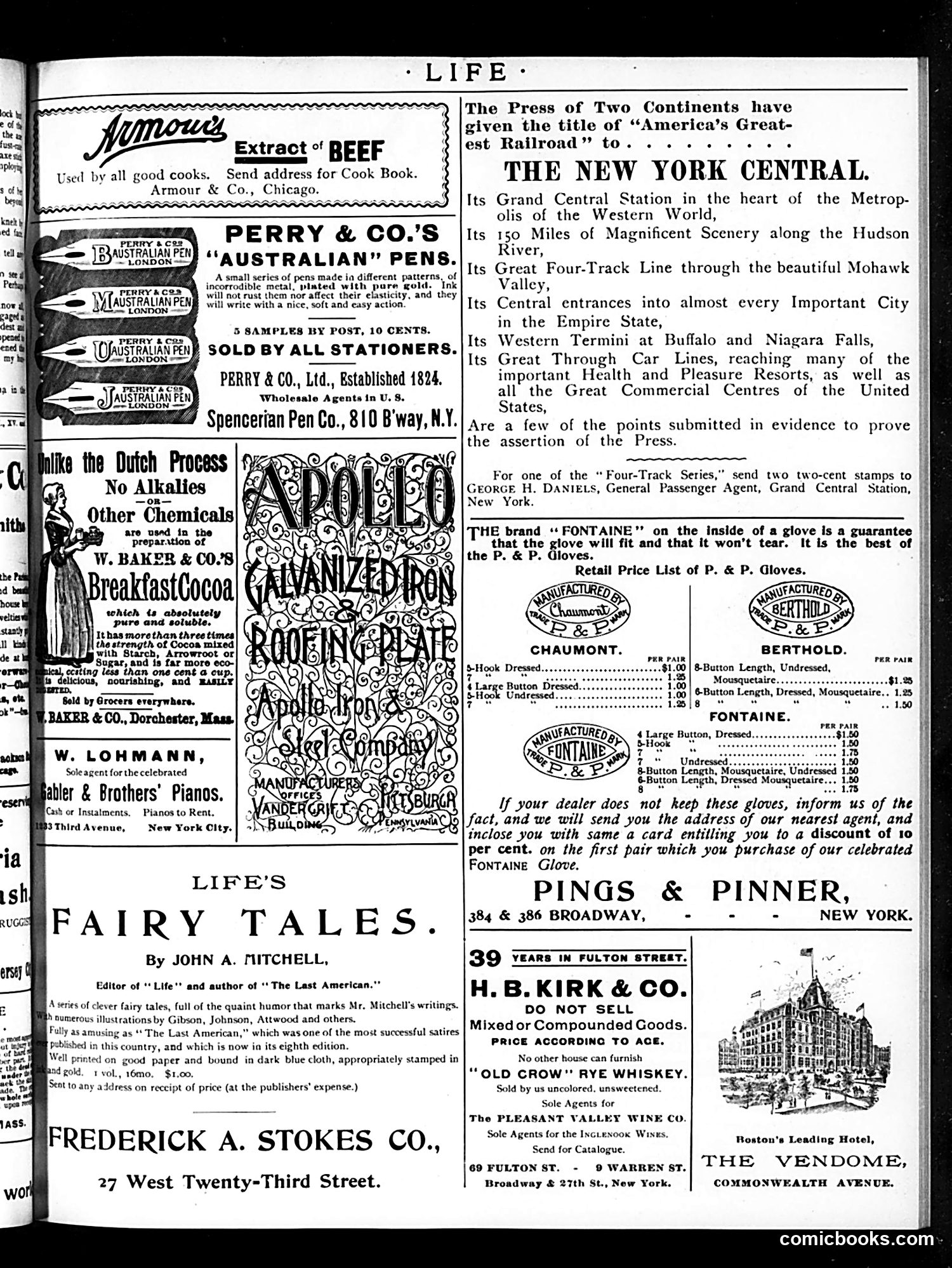
This page is primarily **advertisements and book promotions** rather than satirical cartoons. The main content includes: **Key Features:** - A decorative Art Nouveau advertisement for "Apollinaris" mineral water (center) — ornate lettering typical of the era - Book promotion for John A. Mitchell's *Fairy Tales*, emphasizing its humor and illustrations - Multiple product ads: pens, cocoa, pianos, gloves, whiskey, wine, and the New York Central Railroad **Notable Advertisement:** The New York Central Railroad ad claims the press has dubbed it "America's Greatest Railroad," listing amenities like Hudson River scenery and connections to health resorts — typical Gilded Age corporate promotion. **What moderns might miss:** The ornate Art Nouveau design, the prominence of mail-order book sales, and the specific brand names (Perry pens, Baker's cocoa, "Old Crow" whiskey) reflect late-19th/early-20th century consumer culture and advertising aesthetics quite different from today. There are no identifiable political cartoons or satirical commentary on this particular page.
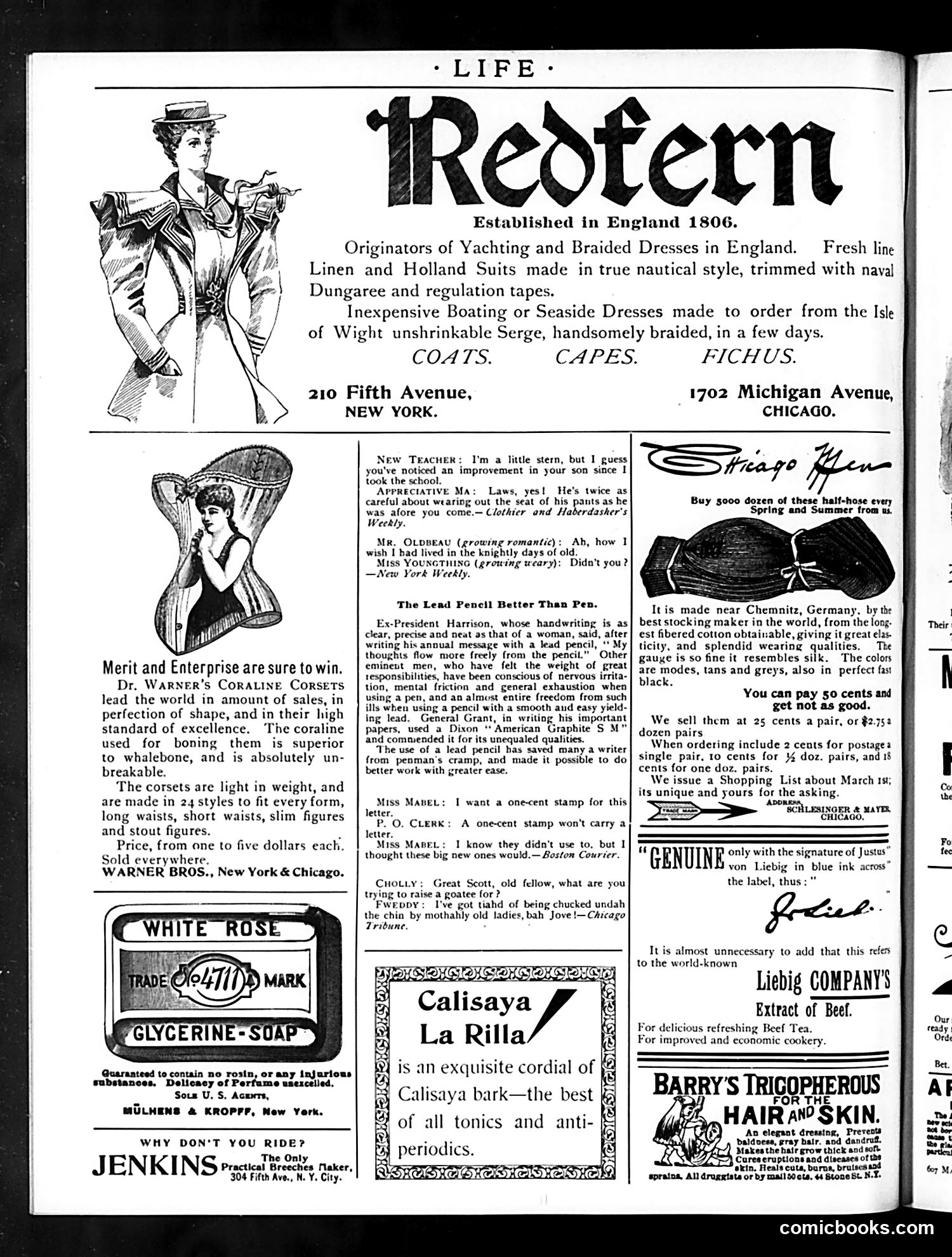
This page is primarily **advertising**, with brief humorous snippets interspersed. The main content includes: **Advertisements:** - Redfern clothing (established 1806) advertises yachting and boating dresses - Warner Bros. Coraline Corsets emphasizes superior boning material - White Rose Glycerin Soap and other patent medicines - Liebig's Extract of Beef and other tonics **Humor sections** contain period jokes about: - A schoolteacher earning parental approval by making a boy careful with his pants - An old romantic man reminiscing about "knightly days" - Ex-President Harrison preferring lead pencils to pens for writing - A woman wanting a one-cent stamp for a letter (postal humor) **The satire is gentle**, targeting contemporary fashions, Victorian courtship, and everyday etiquette rather than serious politics. The page reflects early 1900s concerns: women's fashion, proper comportment, and consumer goods marketed as solutions to life's small problems.
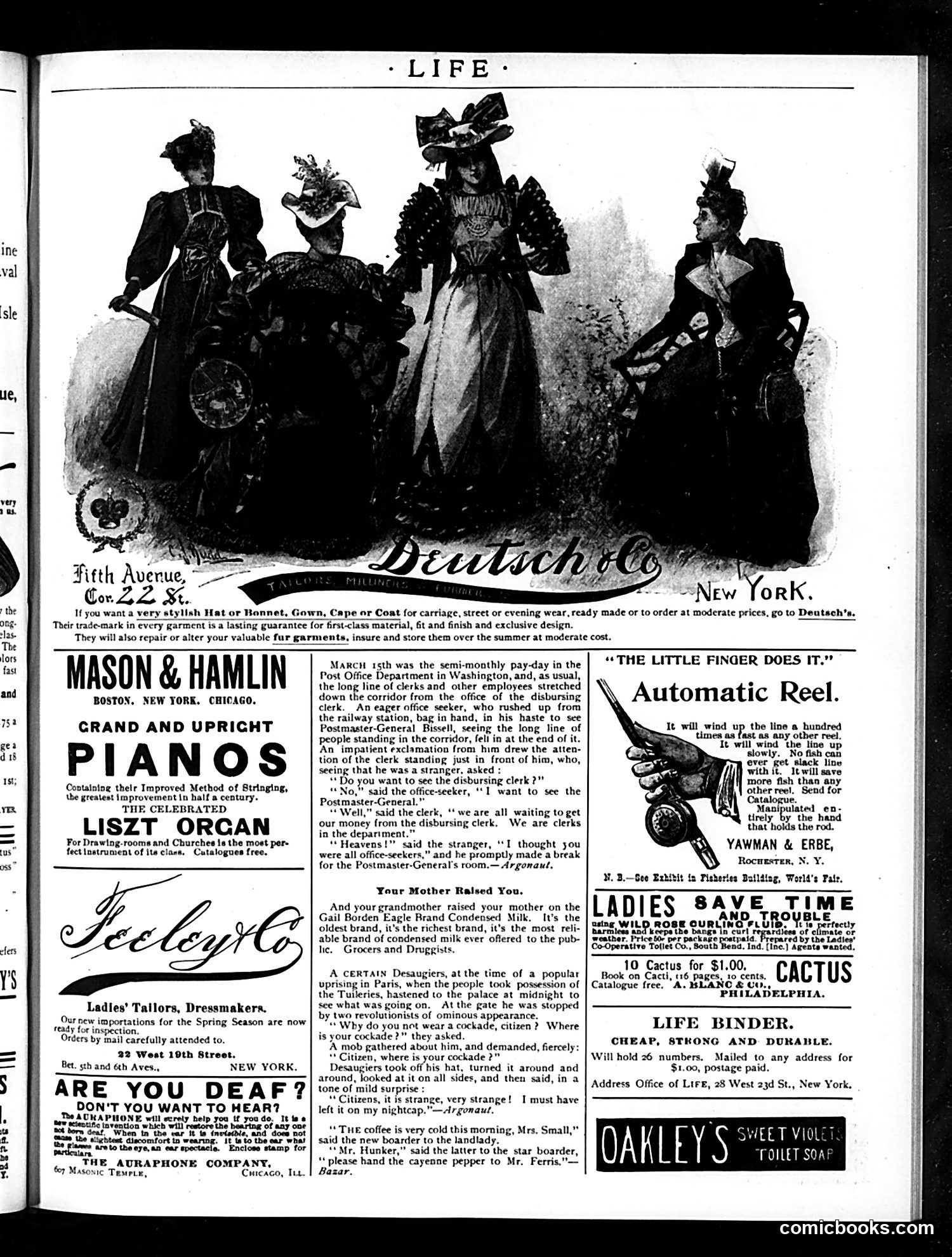
This is primarily an **advertising page** with some brief humorous anecdotes. The top features a Deutsche & Co. fashion advertisement showing four elaborately dressed women in Victorian-era clothing, promoting their Fifth Avenue millinery and garment services. The page contains several **short jokes** typical of Life magazine's satirical humor: 1. A story about an office-seeker mistaking Post Office Department clerks (waiting for payday) for job applicants—satirizing the common perception that government workers were primarily political appointees seeking positions. 2. A French revolutionary anecdote about Desaugiers claiming he left his cockade (symbol of allegiance) on his nightcap—mocking revolutionary zealotry through absurdist humor. 3. A boarding house joke about cold coffee, playing on social awkwardness between lodgers. The remainder consists of period advertisements for pianos, organs, hearing aids, condensed milk, fishing reels, and other merchandise typical of 1890s publications. The page reflects Life's mix of satirical commentary on contemporary politics and employment culture alongside commercial content.
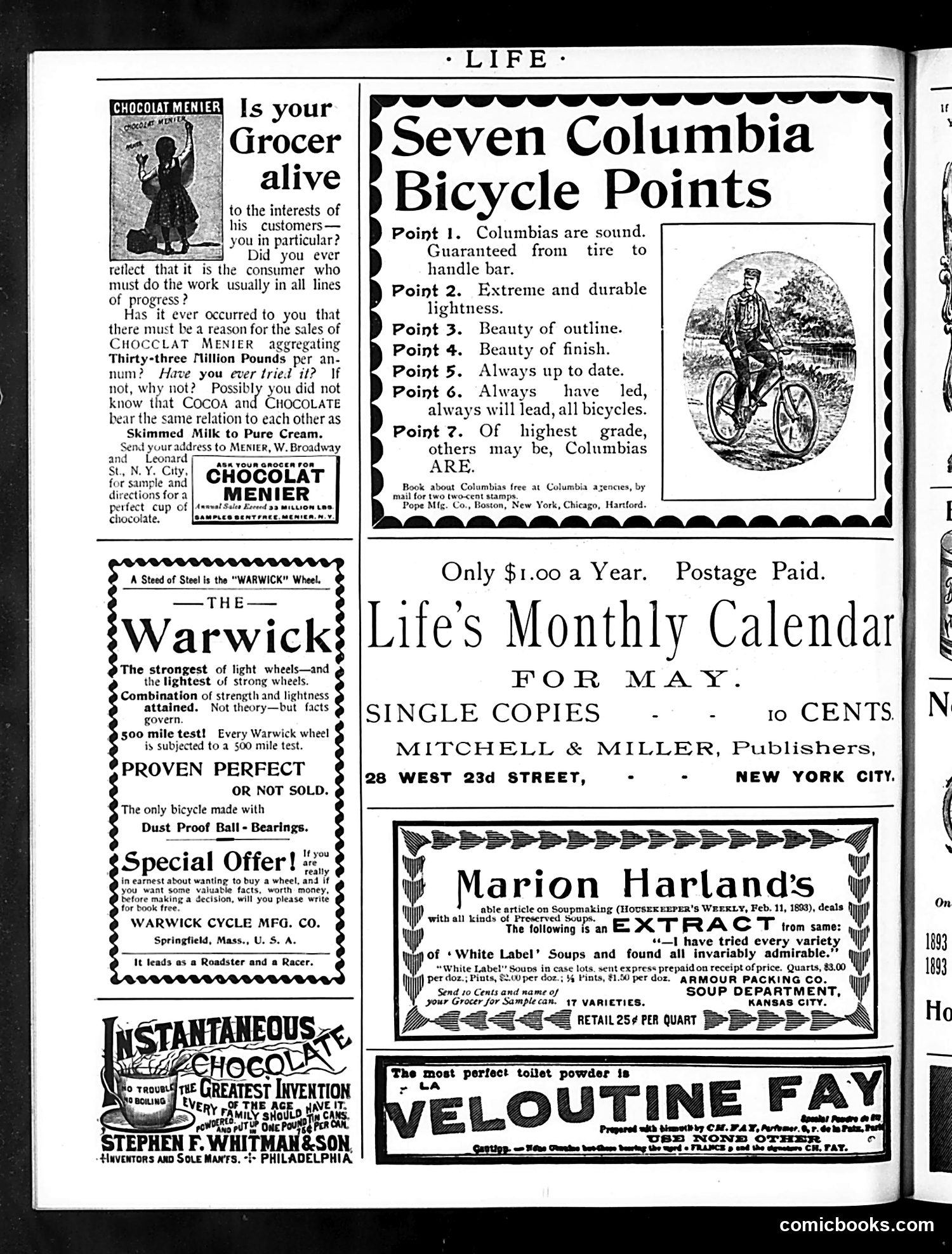
This is primarily an **advertising page**, not a satirical cartoon. It contains six product advertisements from the 1890s, reflecting the era's bicycle craze and consumer goods marketing. **Key advertisements:** - **Chocolat Menier** appeals to consumer consciousness, suggesting grocers should stock this brand - **Columbia, Warwick, and other bicycles** dominate the page, emphasizing durability, lightness, and superiority—reflecting intense late-Victorian bicycle competition - **Marion Harland's soup** and **Veloutine Fay powder** target domestic consumers **Historical context:** This page captures the bicycle boom of the 1890s, when bicycles were luxury goods requiring substantial marketing investment. The ads use emerging consumer psychology—appealing to status, progress, and competitive advantage. The repeated emphasis on bicycles being "proven," "perfect," and market leaders reflects fierce commercial rivalry in an expanding consumer economy. Most notably, these ads treat readers as active consumers whose purchasing decisions matter—a relatively modern marketing concept for this period.
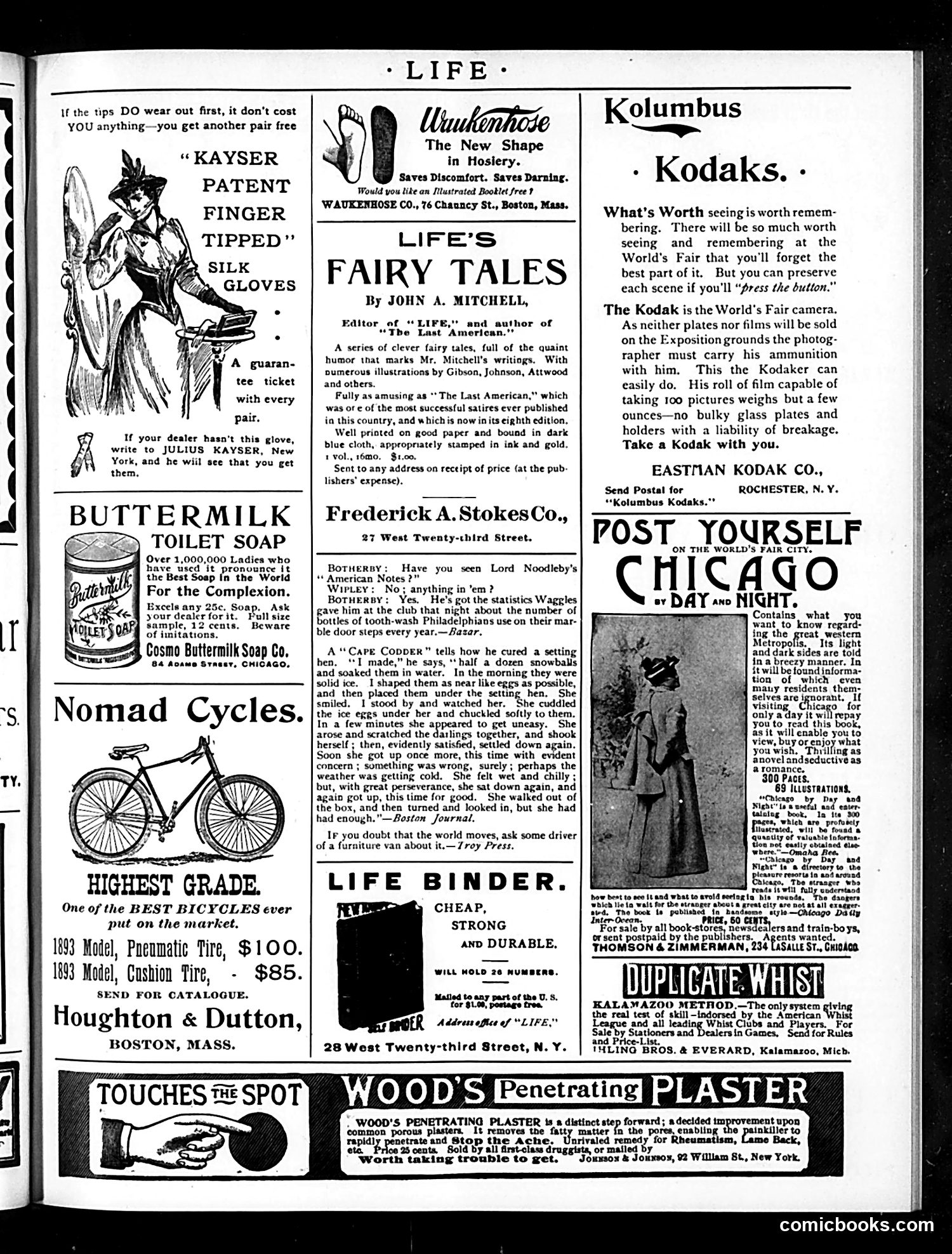
This is primarily an **advertising page** from Life magazine, circa 1893 (referenced by the World's Columbian Exposition/"World's Fair" mentions). Rather than political cartoons, the page features commercial advertisements and some light editorial content. **Notable content:** - **"Life's Fairy Tales"** by John A. Mitchell (Life's editor) advertises a published collection of satirical fairy tales, described as amusing social satire similar to his earlier work "The Last American." - **Product advertisements** dominate: gloves, hosiery, bicycles, soap, and notably **Kodak cameras**—the Kodak ad cleverly markets cameras for World's Fair photography, emphasizing portability over glass plates. - **Humorous anecdotes** appear mid-page, including a "Cape Codder" tale about tricking a hen with ice balls—period folk humor. - The page reflects **1890s consumer culture** and emerging technologies like photography and bicycles marketed to middle-class readers. No significant political satire is evident; this is commercial content aimed at Life's affluent readership.
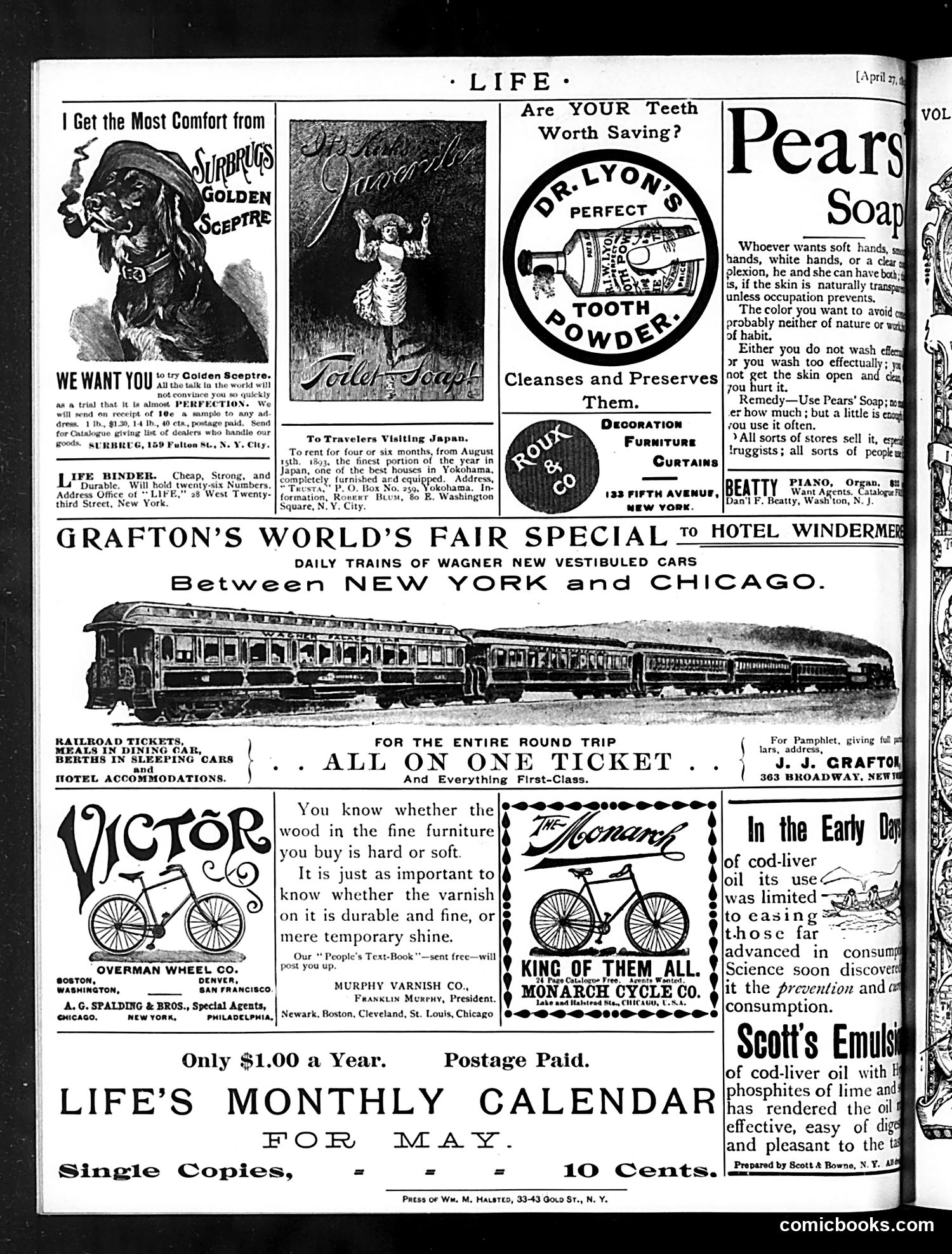
This page is primarily **advertising**, not satirical content. It's from *Life* magazine's back pages showcasing commercial products of the 1890s. Notable ads include: - **Surbrugs Golden Sceptre** dog product (comfort/care) - **Dr. Lyons Tooth Powder** (dental hygiene) - **Pears' Soap** (complexion care, emphasizing pale skin as desirable—a period beauty standard) - **Grafton's World's Fair Special** railroad service between New York and Chicago (likely promoting the 1893 World's Columbian Exposition in Chicago) - **Victor** and **Monarch** bicycles (the bicycle craze was at its peak in the 1890s) - **Murphy Varnish** and furniture products The page reflects late-Victorian consumer culture: concern with genteel appearance, new transportation technology, and modern goods marketed to middle-class readers. There is no discernible political satire here—it's a straightforward advertising section typical of magazines from this era.