
Life, 1893-04-27 · page 4 of 20
Life — April 27, 1893 — page 4: what you’re looking at
What you’re looking at
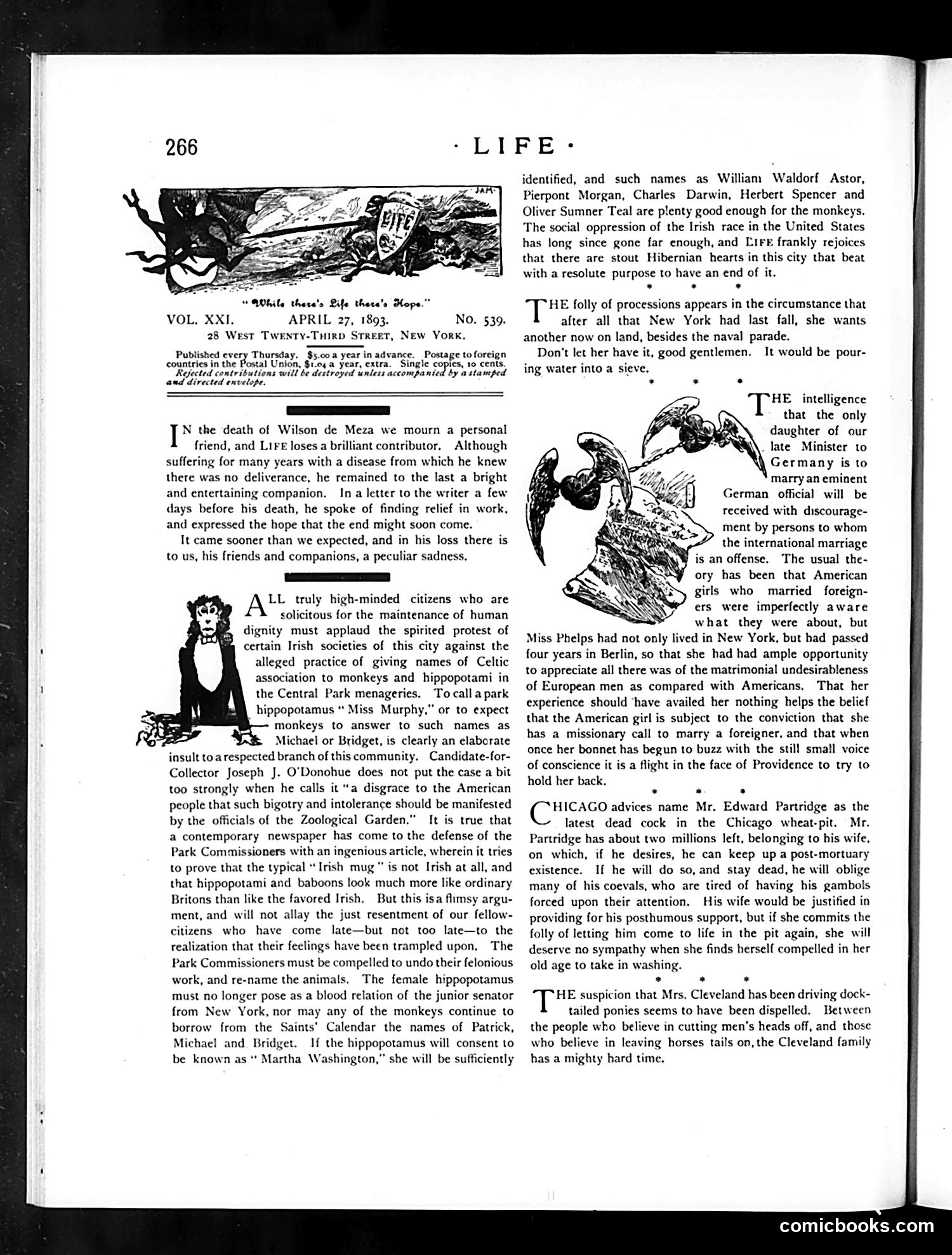
The page contains editorial commentary rather than political cartoons. The main illustrated element shows a caricatured female hippopotamus wearing a bonnet, likely referencing the famous "Miss Murphy" hippopotamus at the Central Park Zoo. The text satirizes Irish-American civic groups protesting the zoo's naming of animals after Irish names (Patrick, Michael, Bridget). The editors mock this protest as absurd—arguing that using Irish names for animals insults no one, and that the protesters' complaints about "Celtic association with monkeys and hippopotami" reveal their own prejudices rather than genuine offense. The piece also discusses Miss Phelps, daughter of Germany's late minister, marrying an American—considered scandalous by some Germans.
📄 Transcribed text from this page (OCR, searchable)
Machine-transcribed from the original scan — historical spelling and the odd misread are preserved.
- LIFE: “While there's Life there’s Hope.” VOL. XXI. APRIL 27, 1893. No. 539. 28 West Twenty-Tuirp Street, New York. Published every Thursday. $5.coa year in advance. Postage to foreign countries in the Postal Union, $1.04 a year, extra. Single copies, 10 cents. Rejected contributions will be destroyed tuntess accompanied by a stamped and directed envelope. N the death of Wilson de Meza we mourn a personal friend, and LiFe loses a brilliant contributor. Although suffering for many years with a disease from which he knew there was no deliverance, he remained to the last a bright and entertaining companion. In a letter to the writer a few days before his death, he spoke of finding relief in work, and expressed the hope that the end might soon come. It came sooner than we expected, and in his loss there is to us, his friends and companions, a peculiar sadness. LL truly high-minded citizens who are solicitous for the maintenance of human dignity must applaud the spirited protest of certain Irish societies of this city against the alleged practice of giving names of Celtic association to monkeys and hippopotami in the Central Park menageries. To calla park hippopotamus “ Miss Murphy,” or to expect monkeys to answer to such names as “& = Michael or Bridget, is clearly an elaborate insult toa respected branch of this community. Candidate-for- Collector Joseph J. O'Donohue does not put the case a bit too strongly when he calls it “a disgrace to the American people that such bigotry and intolerance should be manifested by the officials of the Zoological Garden.” It is true that a contemporary newspaper has come to the defense of the Park Commissioners with an ingenious article, wherein it tries to prove that the typical “Irish mug" is not Irish at all, and that hippopotami and baboons look much more like ordinary Britons than like the favored Irish. But this isa flimsy argu- ment, and will not allay the just resentment of our fellow- citizens who have come late—but not too late—to the realization that their feelings have been trampled upon, The Park Commissioners must be compelled to undo their felonious work, and re-name the animals. The female hippopotamus must no longer pose as a blood relation of the junior senator from New York, nor may any of the monkeys continue to borrow from the Saints’ Calendar the names of Patrick, Michael and. Bridget. If the hippopotamus will consent to be known as ** Martha Washington,” she will be sufficiently identified, and such names as William Waldorf Astor, Pierpont Morgan, Charles Darwin, Herbert Spencer and Oliver Sumner Teal are plenty good enough for the monkeys. The social oppression of the Irish race in the United States has long since gone far enough, and LiFe frankly rejoices that there are stout Hibernian hearts in this city that beat with a resolute purpose to have an end of it. . . . HE folly of processions appears in the circumstance that after all that New York had last fall, she wants another now on land, besides the naval parade. Don't let her have it, good gentlemen. It would be pour- ing water into a sieve. . HE intelligence that the only daughter of our . late Minister to \\ Germany is to ‘ marry an eminent German official will be received with discourage- ment by persons to whom the international marriage H is an offense. The usual the- ory has been that American girls who married foreign- ers were imperfectly aware what they were about, but Miss Phelps had not only lived in New York, but had passed four years in Berlin, so that she had had ample opportunity to appreciate all there was of the matrimonial undesirableness of European men as compared with Americans. That her experience should ‘have availed her nothing helps the belief that the American girl is subject to the conviction that she has a missionary call to marry a foreigner, and that when once her bonnet has begun to buzz with the still small voice of conscience it is a flight in the face of Providence to try to hold her back. . . . HICAGO advices name Mr. Edward Partridge as the latest. dead cock in the Chicago wheat-pit. Mr. Partridge has about two millions left, belonging to his wife, on which, if he desires, he can keep up a post-mortuary existence. If he will do so, and stay dead, he will oblige many of his coevals, who are tired of having his gambols forced upon their attention. His wife would be justified in providing for his posthumous support, but if she commits the folly of letting him come to life in the pit again, she will deserve no sympathy when she finds herself compelled in her old age to take in washing. . . * HE suspicion that Mrs. Cleveland has been driving dock- tailed ponies seems to have been dispelled. Between the people who believe in cutting men’s heads off, and those who believe in leaving horses tails on, the Cleveland family has a mighty hard time. comicbooks.com