
Life, 1893-04-27 · page 12 of 20
Life — April 27, 1893 — page 12: what you’re looking at
What you’re looking at
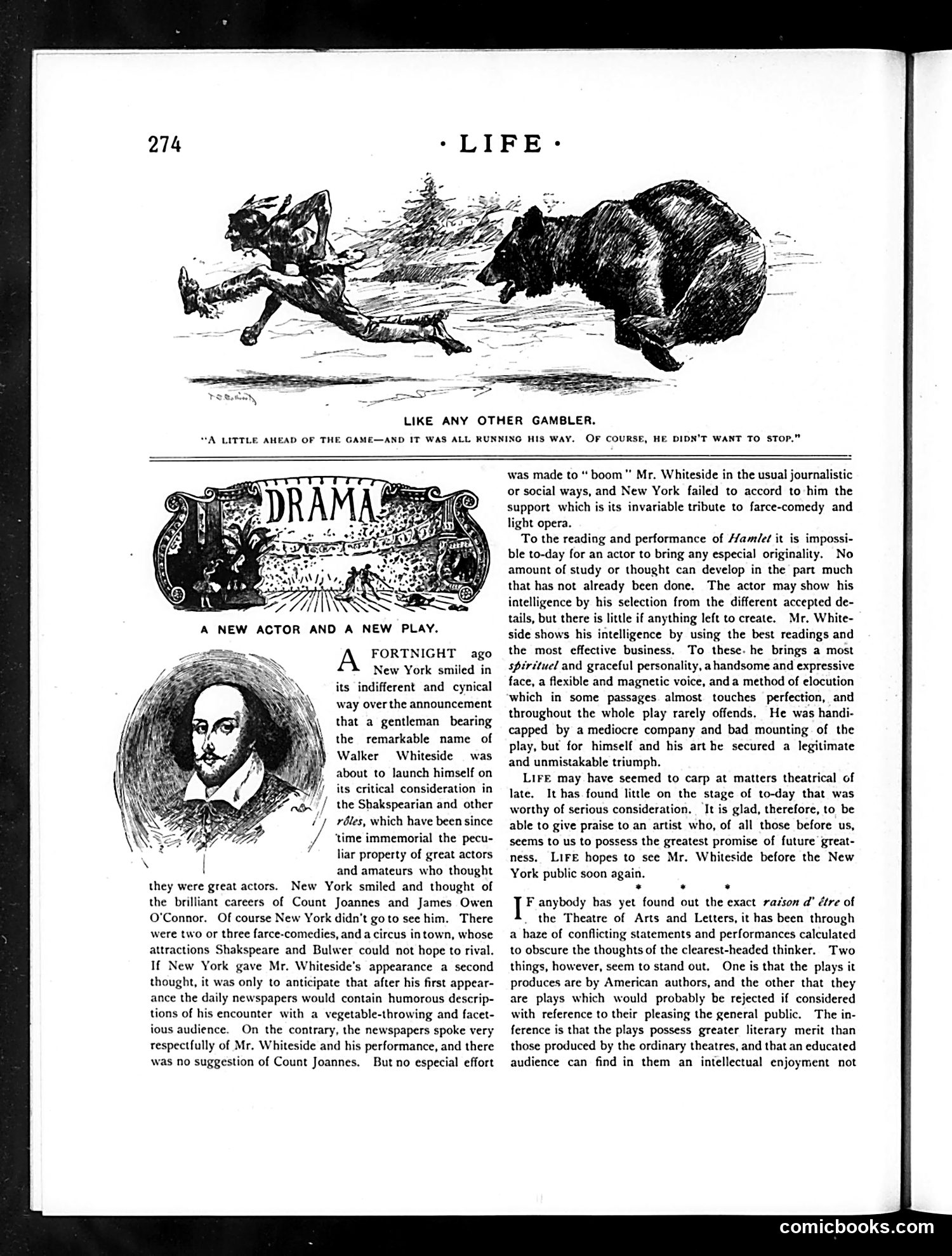
The top cartoon shows a man fleeing from a bear, captioned "Like Any Other Gambler." It's a metaphor for risk-taking: the man is "ahead of the game" but won't stop—like a gambler on a winning streak who keeps betting, eventually losing everything. The bear represents inevitable consequences. The article below discusses actor Walker Whiteside's New York debut performing Shakespeare's *Hamlet*. Life praises his performance as genuinely excellent—showing intelligence, grace, and vocal skill—despite poor company support and modest promotion. The satire is genteel: Life notes that New York typically ignores serious theatrical art in favor of farce and circuses, yet surprisingly treated Whiteside respectfully. The piece critiques both public taste and journalistic hype, while genuinely commending an actor who succeeded through talent rather than sensational marketing or critical novelty.
📄 Transcribed text from this page (OCR, searchable)
Machine-transcribed from the original scan — historical spelling and the odd misread are preserved.
LIKE ANY OTHER GAMBLER. “A LITTLE AHEAD OF THE GAME—AND IT WAS ALL RUNNING HIS WAY. OF COURSE, HE DIDN'T WANT To STOP.” A NEW ACTOR AND A NEW PLAY. FORTNIGHT ago New York smiled in its indifferent and cynical way over the announcement that a gentleman bearing the remarkable name of Walker Whiteside was about to launch himself on its critical consideration in the Shakspearian and other réles, which have been since ‘time immemorial the pecu- liar property of great actors and amateurs who thought they were great actors. New York smiled and thought of the brilliant careers of Count Joannes and James Owen O'Connor. Of course New York didn’t goto see him. There were two or three farce-comedies, and a circus in town, whose attractions Shakspeare and Bulwer could not hope to rival. If New York gave Mr. Whiteside’s appearance a second thought, it was only to anticipate that after his first appear- ance the daily newspapers would contain humorous descrip- tions of his encounter with a vegetable-throwing and facet- ious audience. On the contrary, the newspapers spoke very respectfully of Mr. Whiteside and his performance, and there was no suggestion of Count Joannes. But no especial effort was made to “ boom" Mr. Whiteside in the usual journalistic or social ways, and New York failed to accord to him the support which is its invariable tribute to farce-comedy and light opera. To the reading and performance of Hamlet it is impossi- ble to-day for an actor to bring any especial originality. No amount of study or thought can develop in the part much that has not already been done. The actor may show his intelligence by his selection from the different accepted de- tails, but there is little if anything left to create. Mr. White- side shows his intelligence by using the best readings and the most effective business. To these. he brings a most Spirituel and graceful personality, a handsome and expressive face, a flexible and magnetic voice, anda method of elocution which in some passages almost touches perfection, and throughout the whole play rarely offends. He was handi- capped by a mediocre company and bad mounting of the play, but for himself and his art he secured a legitimate and unmistakable triumph. LIFE may have seemed to carp at matters theatrical of late. It has found little on the stage of to-day that was worthy of serious consideration. It is glad, therefore, to be able to give praise to an artist who, of all those before us, seems to us to possess the greatest promise of future great- ness. LiFE hopes to see Mr. Whiteside before the New York public soon again. . . . IF anybody has yet found out the exact razson a’ étre of . the Theatre of Arts and Letters, it has been through a haze of conflicting statements and performances calculated to obscure the thoughts of the clearest-headed thinker. Two things, however, seem to stand out. One is that the plays it produces are by American authors, and the other that they are plays which would probably be rejected if considered with reference to their pleasing the general public. The in- ference is that the plays possess greater literary merit than those produced by the ordinary theatres, and that an educated audience can find in them an intellectual enjoyment not comicbooks.com