
Life, 1893-04-27 · page 6 of 20
Life — April 27, 1893 — page 6: what you’re looking at
What you’re looking at
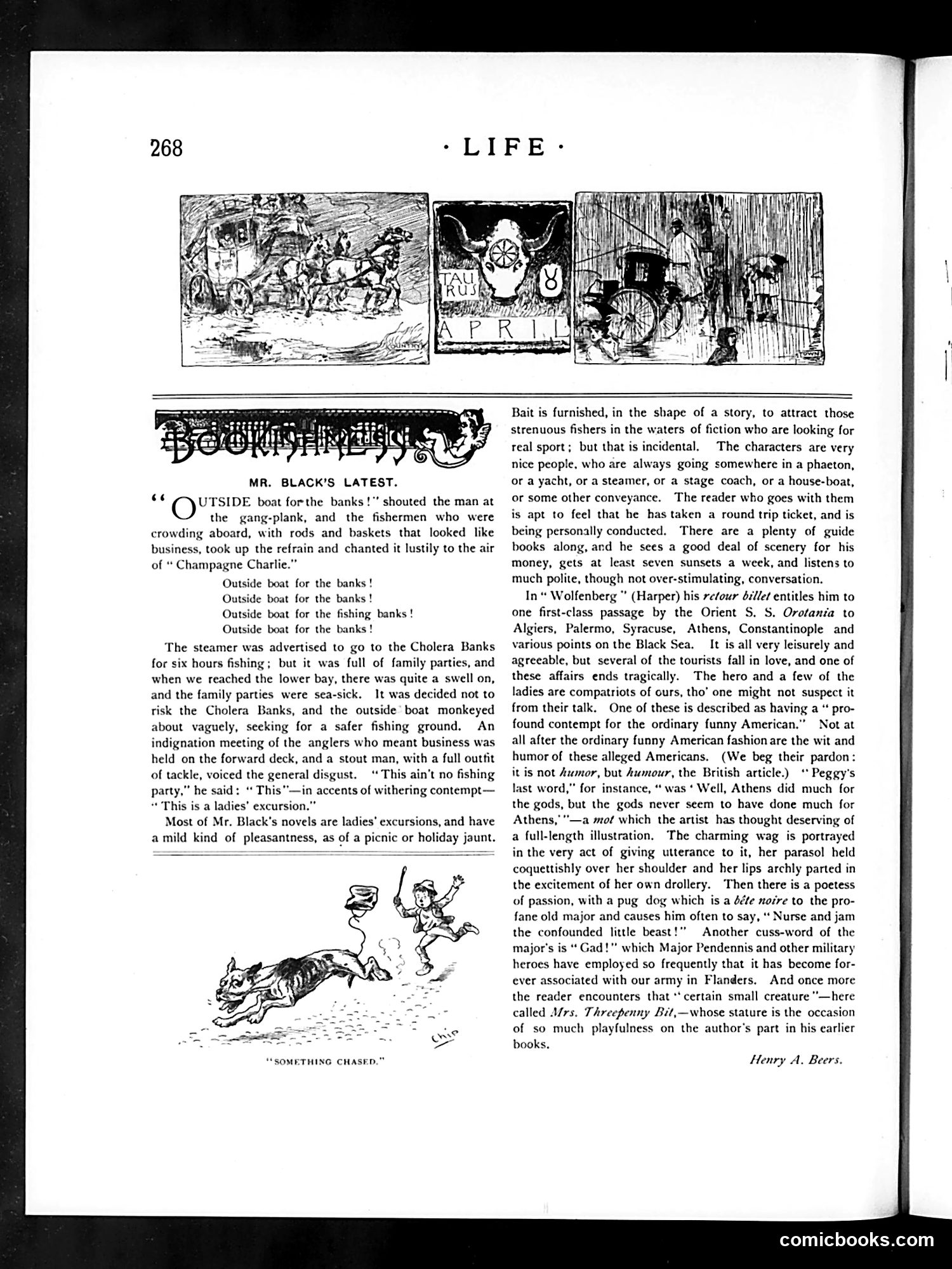
This page reviews Mr. Black's novels, which the critic Henry A. Beers describes as pleasant, leisurely fiction featuring genteel characters on various conveyances—yachts, steamers, and coaches. The review is largely complimentary, praising the work's gentle humor and agreeable tone. However, Beers critiques Black's portrayal of American characters as witty and humorous in ways that feel inauthentic—calling them "alleged Americans." He notes the humor is affected rather than genuine. The review also mocks a character named "Mrs. Threepenny Bid," suggesting Black's female characters lack depth. The small illustration at bottom shows figures chasing what appears to be a dog or animal, likely referencing a scene from one of Black's works discussed in the text.
📄 Transcribed text from this page (OCR, searchable)
Machine-transcribed from the original scan — historical spelling and the odd misread are preserved.
MR. BLACK’S LATEST. UTSIDE boat forthe banks!" shouted the man at the gang-plank, and the fishermen who were crowding aboard, with rods and baskets that looked like s, took up the refrain and chanted it lustily to the air “a busin of * Champagne Charlie.” Outside boat for the banks! Outside boat for the banks ! Outside boat for the fishing banks! Outside boat for the banks ! The steamer was advertised to go to the Cholera Banks for six hours fishing; but it was full of family parties, and when we reached the lower bay, there was quite a swell on, and the family parties were sea-sick. It was decided not to risk the Cholera Banks, and the outside boat monkeyed about vaguely, seeking for a safer fishing ground. An indignation meeting of the anglers who meant business was held on the forward deck, and a stout man, with a full outfit of tackle, voiced the general disgust.‘ This ain't no fishing party,” he said: “ This"—in accents of withering contempt— “ This is a ladies’ excursion.” Most of Mr. Black's novels are ladies’ excursions, and have a mild kind of pleasantness, as of a picnic or holiday jaunt. “SOMETHING CHASED.” Bait is furnished, in the shape of a story, to attract those strenuous fishers in the waters of fiction who are looking for real sport; but that is incidental, The characters are very nice people, who are always going somewhere in a phaeton, or a yacht, or a steamer, or a stage coach, or a house-boat, or some other conveyance. The reader who goes with them is apt to feel that he has taken a round trip ticket, and is being personally conducted. There are a plenty of guide books along, and he sees a good deal of scenery for his money, gets at least seven sunsets a week, and listens to much polite, though not over-stimulating, conversation. In “ Wolfenberg ” (Harper) his refour drllet entitles him to one first-class passage by the Orient S. S. Orotanta to Algiers, Palermo, Syracuse, Athens, Constantinople and various points on the Black Sea. It is all very leisurely and agreeable, but several of the tourists fall in love, and one of these affairs ends tragically. The hero and a few of the ladies are compatriots of ours, tho’ one might not suspect it from their talk. One of these is described as having a ‘‘ pro- found contempt for the ordinary funny American.” Not at all after the ordinary funny American fashion are the wit and humor of these alleged Americans. (We beg their pardon: it is not Aumor, but humour, the British article.) “ Peggy's last word,” for instance, “ was * Well, Athens did much for the gods, but the gods never seem to have done much for Athens,’ ""—a mot which the artist has thought deserving of a full-length illustration. The charming wag is portrayed in the very act of giving utterance to it, her parasol held coquettishly over her shoulder and her lips archly parted in the excitement of her own drollery. ‘Then there is a poetess of passion, with a pug dog which is a défe nozre to the pro- fane old major and causes him often to say, ‘* Nurse and jam the confounded little beast!” Another cuss-word of the major's is * Gad!" which Major Pendennis and other military heroes have employed so frequently that it has become for- ever associated with our army in Flanders. And once more the reader encounters that ‘certain small creature “—here called A/rs. Threepenny Bit,—whose stature is the occasion of so much playfulness on the author's part in his earlier books. Henry A. Beers. comicbooks.com