
A complete issue · 28 pages · 1893
Life — March 30, 1893
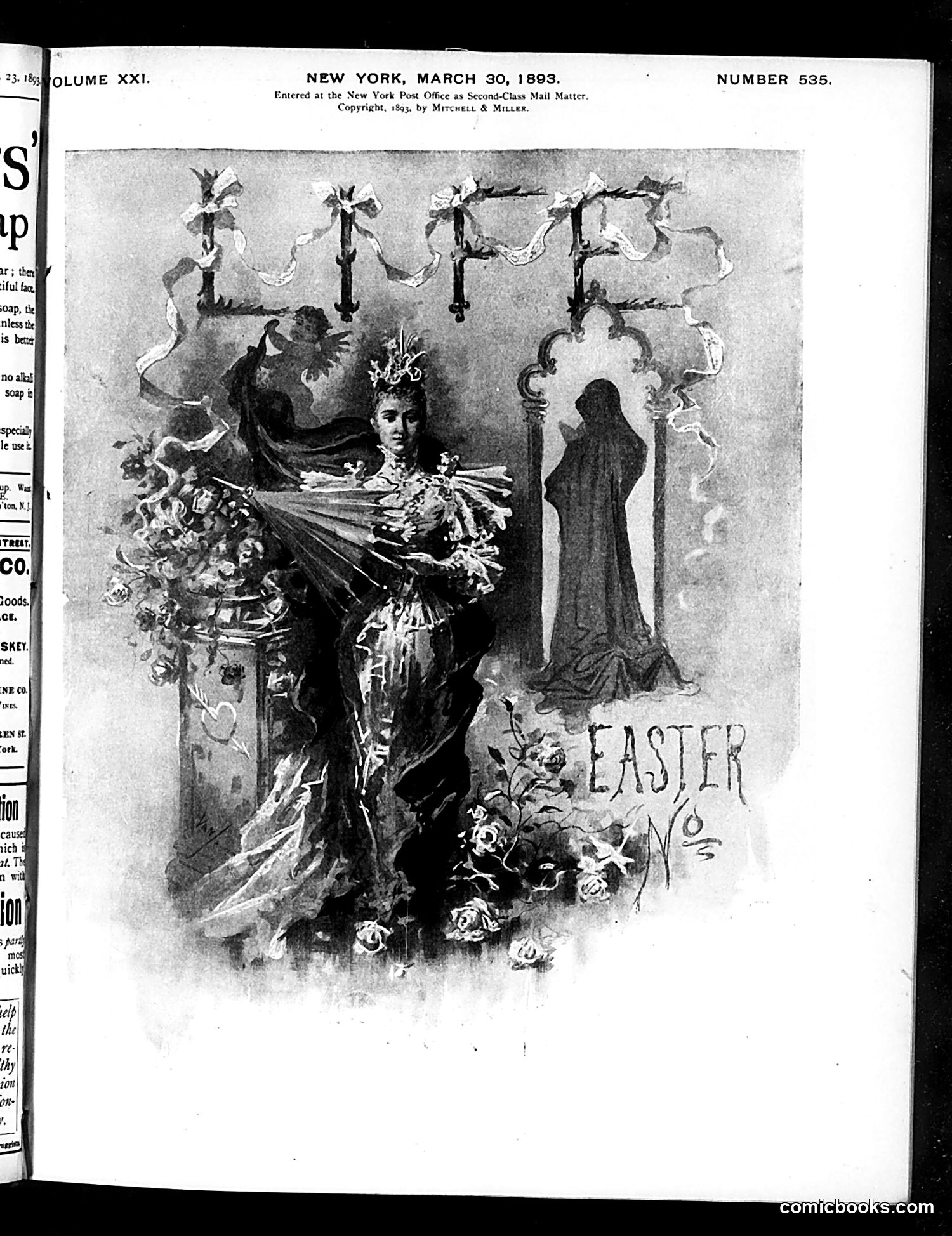
This is an Easter-themed illustration for *Life* magazine's Number 535. The central figure appears to be a fashionably dressed woman in elaborate period costume with a large feathered cape, wearing a crown or ornate headdress. She's positioned among decorative elements including flowers at the base. The word "EASTER" is visible in the lower right, identifying this as holiday-themed content. A cloaked figure appears on the right side of the composition. The elaborate theatrical styling and the presence of what seems to be a skeletal or death-like figure suggest this may be satirizing Easter fashions, social pretension, or the contrast between holiday celebration and mortality—common satirical targets in *Life* magazine of this era. However, without additional context or clearer identification of specific figures, the precise satirical point remains somewhat unclear.
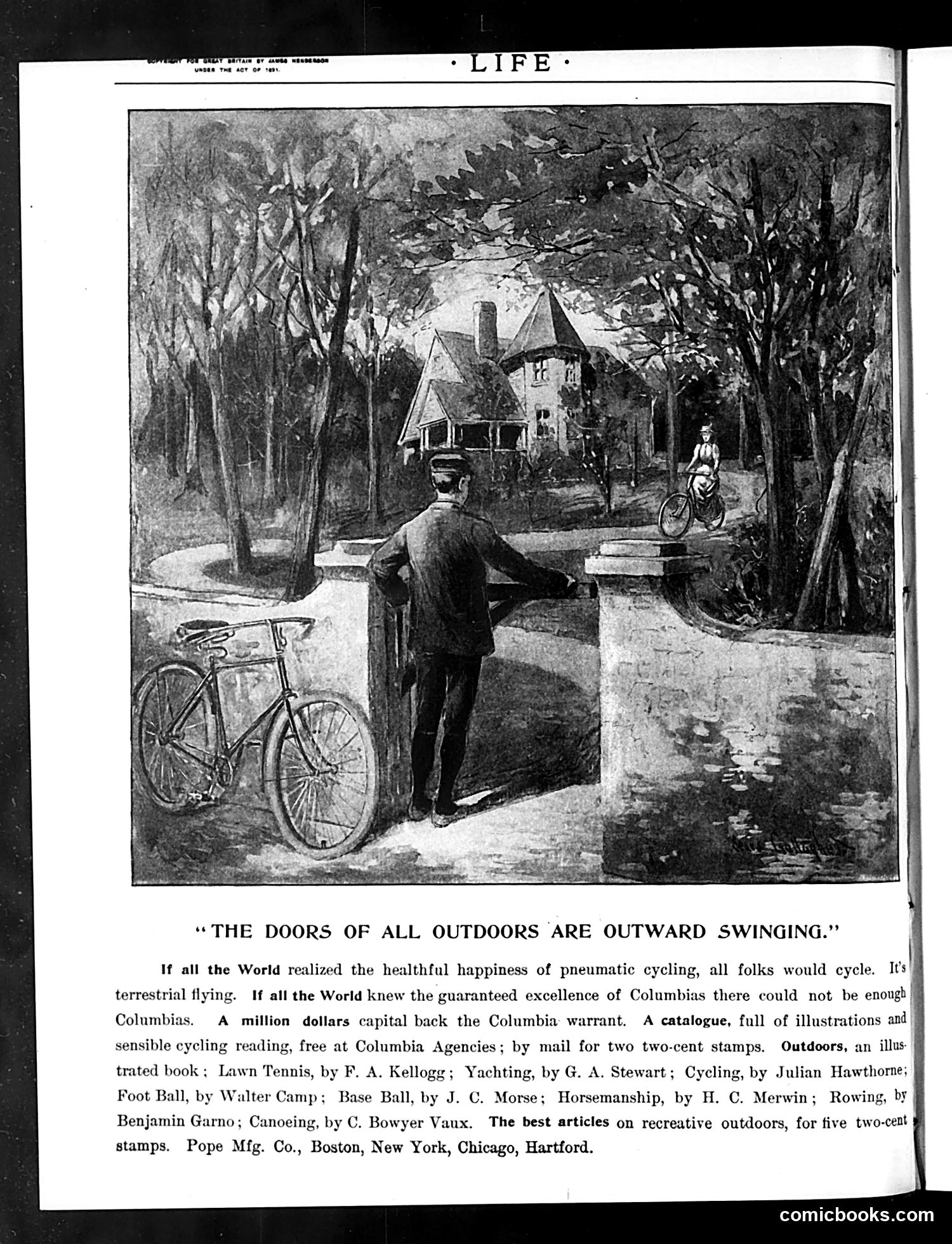
This page is primarily **advertising, not political satire**. The main image illustrates Columbia bicycles with the caption "The Doors of All Outdoors Are Outward Swinging." The illustration depicts two cyclists enjoying a scenic tree-lined path past a Victorian house—promoting bicycling as healthy outdoor recreation. A well-dressed man with a bicycle stands in the foreground, contemplating the path ahead. The text below is a commercial promoting Columbia bicycles, claiming they offer "healthful happiness" and guaranteed excellence. It advertises a free catalogue and several outdoor recreation books available through Pope Mfg. Co. (Columbia's manufacturer). This reflects the late 19th-century bicycle craze, when cycling was marketed as both fashionable leisure and health-promoting activity. The "outward swinging doors" metaphor simply means bicycles open up outdoor opportunities.
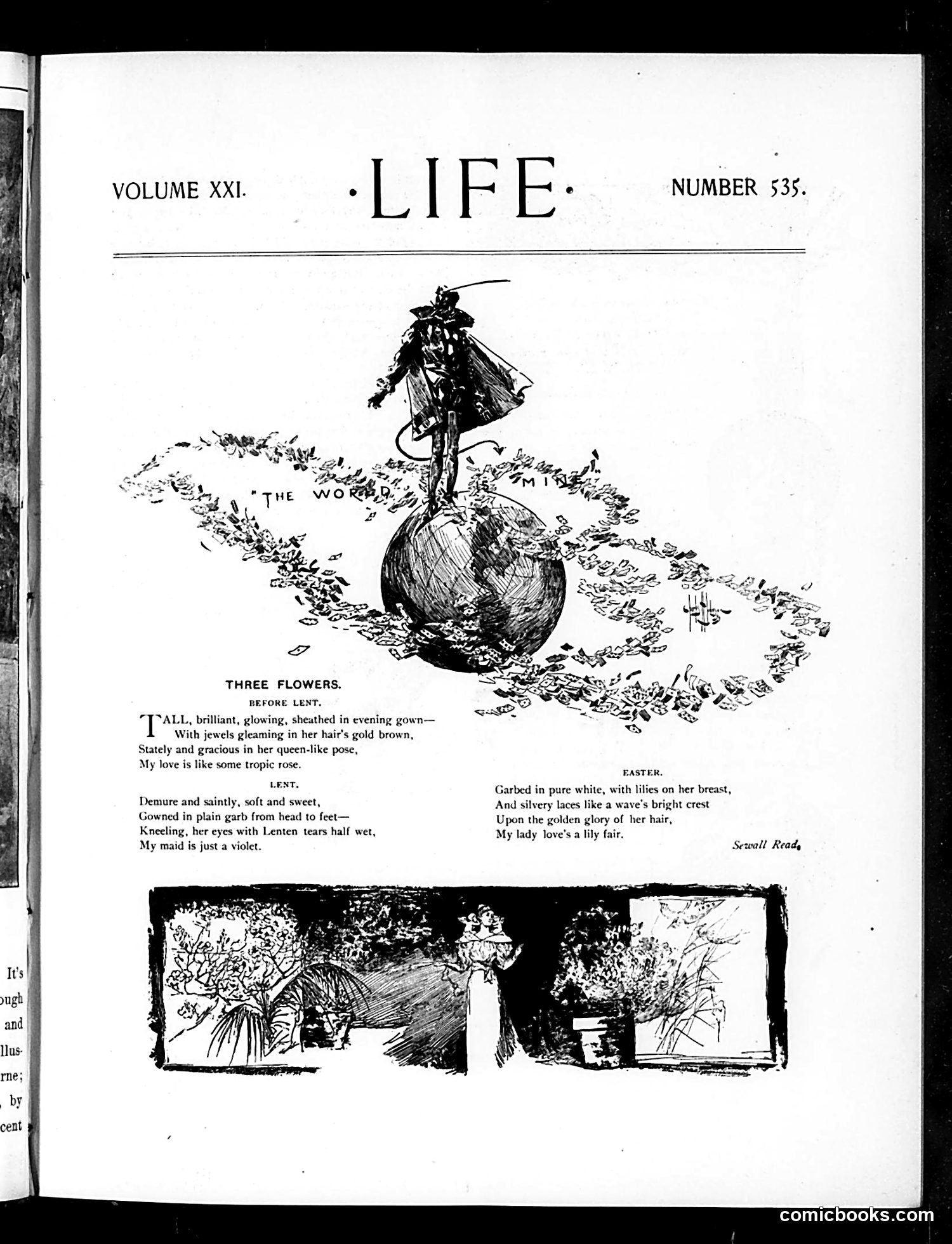
This page features a satirical poem titled "Three Flowers" with three sections (Before Lent, Lent, and Easter), each describing a woman using flower metaphors. The central illustration shows a figure standing atop a globe, sword raised, surrounded by scattered flowers and text reading "THE WORLD." The satire appears to mock the superficiality of female vanity and appearance across different occasions—the showy "tropic rose" before Lent, the plain "violet" during the austere Lenten season, and the Easter display of white lilies and lace. The figure dominating the world suggests women's influence or ambition. The accompanying sketches below depict romantic or social scenes, reinforcing themes of courtship and feminine presentation. The poem's author is credited as "Sewell Roades."
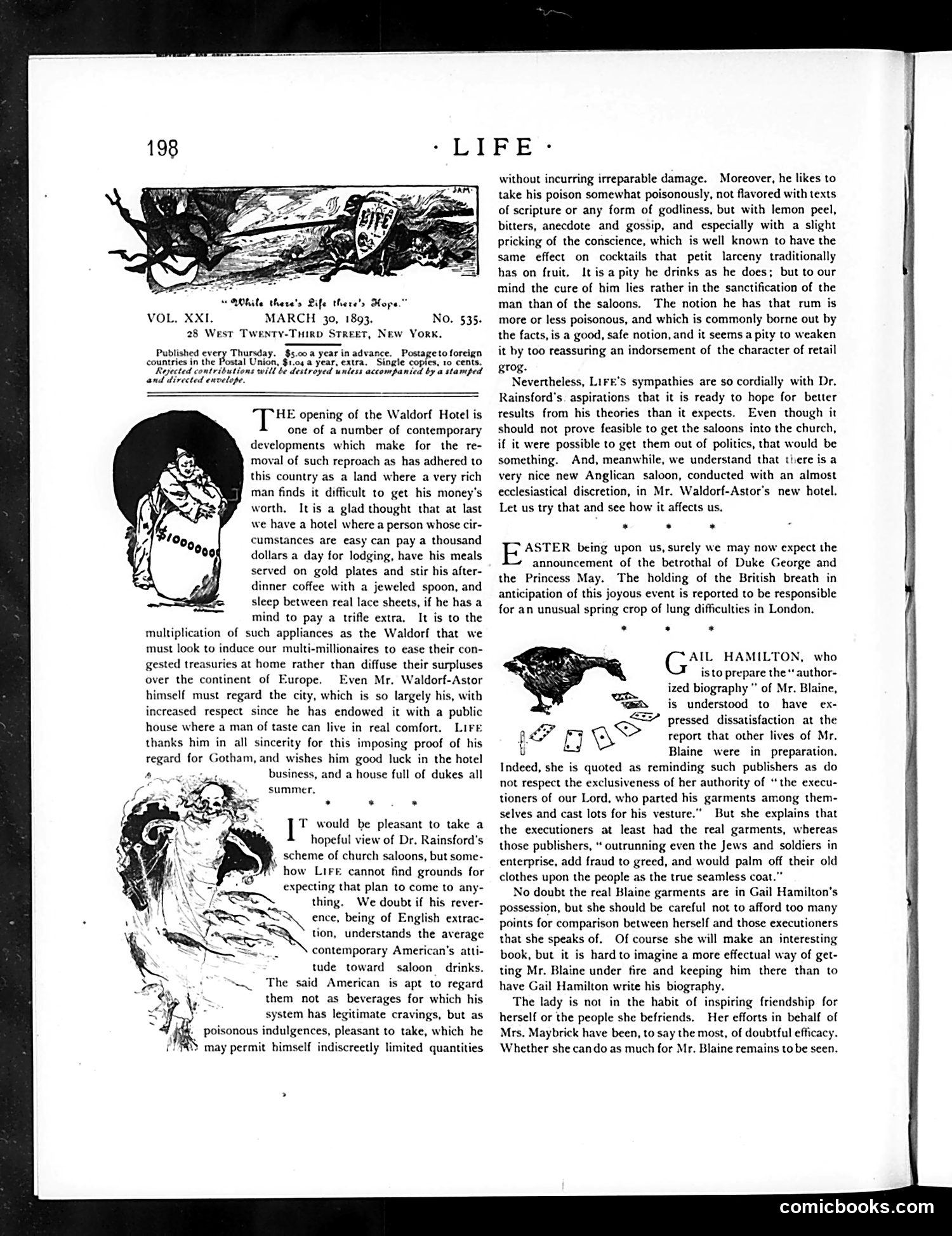
This page contains editorial commentary rather than political cartoons. The main illustration shows a wealthy man laden with jewelry and ornaments—representing the nouveau riche opening the Waldorf Hotel, a luxury establishment for millionaires. The satire mocks the ease with which wealthy Americans can accumulate excessive luxury. Below, a sketch appears to illustrate Dr. Rainsford's proposal for church saloons—establishments serving alcohol within religious settings. Life expresses skepticism about this scheme, doubting it would succeed in converting saloon-goers while questioning whether churches should operate such ventures. The page also discusses Gail Hamilton's biography of Mr. Blaine and debates about its accuracy and the executors' handling of his estate papers.
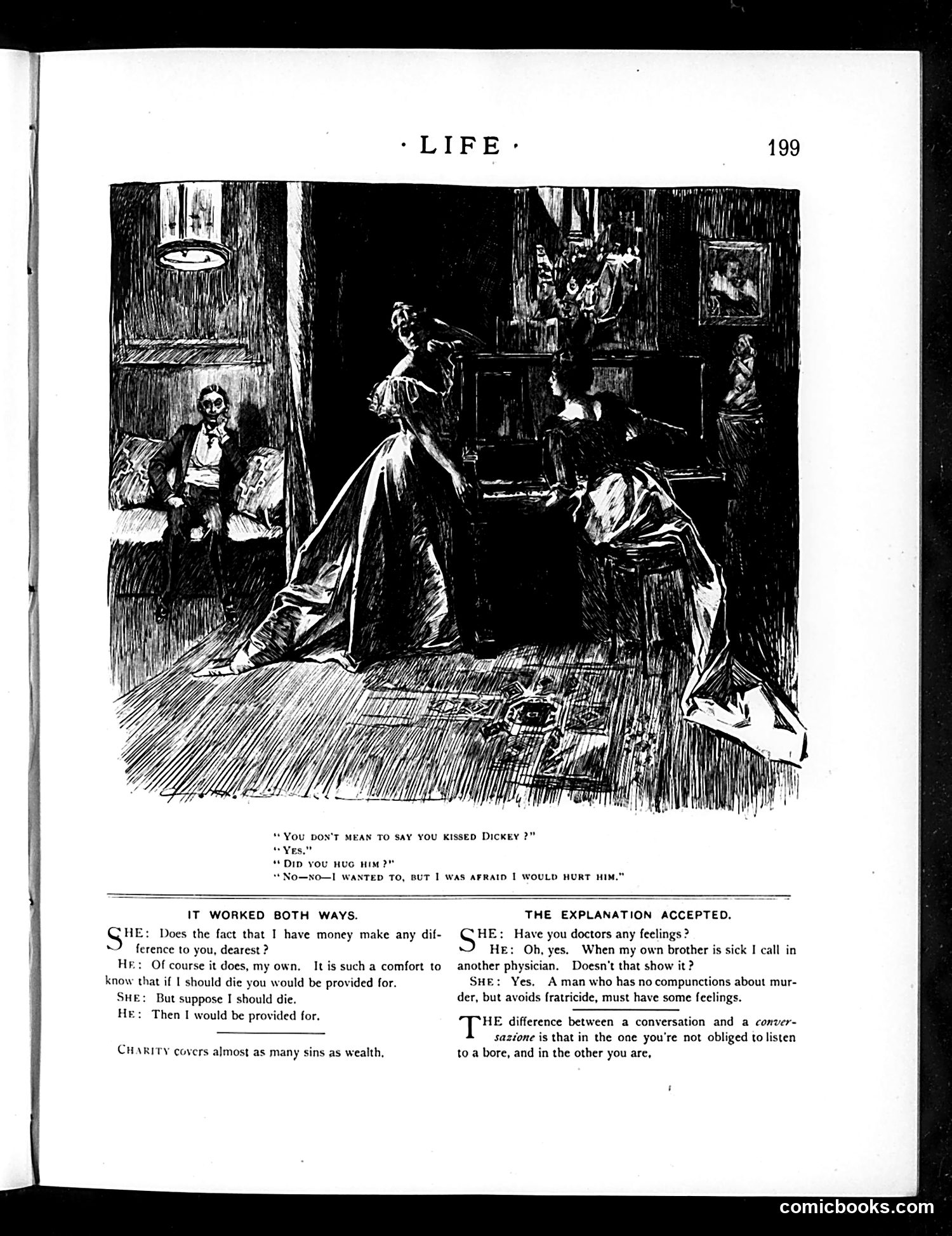
This page contains three separate humorous pieces about relationships and social conventions. The top illustration depicts a domestic scene where a woman addresses a man about kissing someone named Dickey. The dialogue explores marital anxieties—she worries about financial security if he dies, while he reassures her of provision. The humor comes from the awkward juxtaposition of romantic concern with practical mortality planning. Below are two brief satirical observations: "It Worked Both Ways" mocks how financial security influences marriage decisions, and "The Explanation Accepted" uses a doctor's visit to comment on emotional detachment in relationships—suggesting that avoiding "compunctions about murder" requires emotional distance, a dark joke about marital tolerance. The satire targets Victorian-era attitudes toward marriage as economic arrangement rather than romantic partnership.
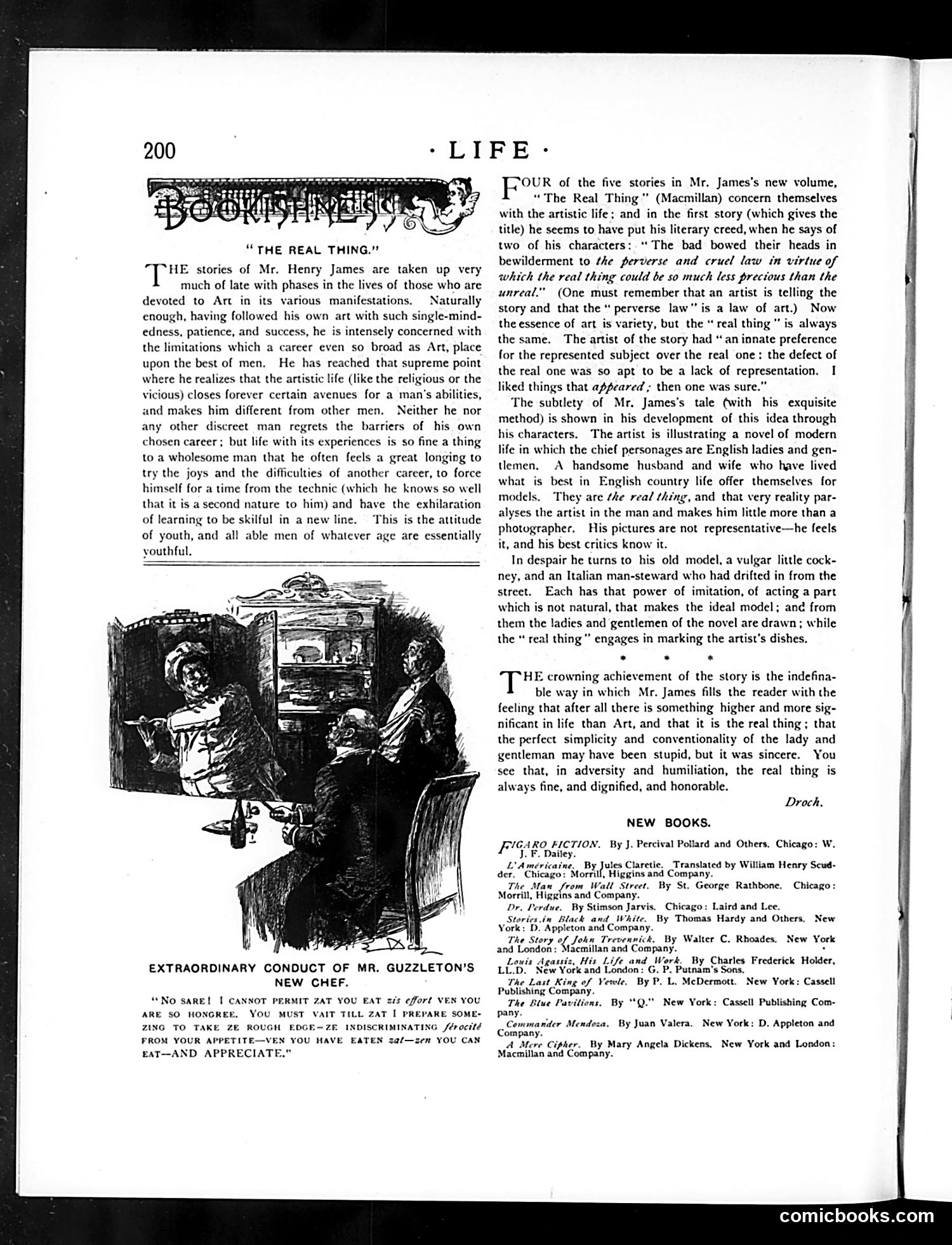
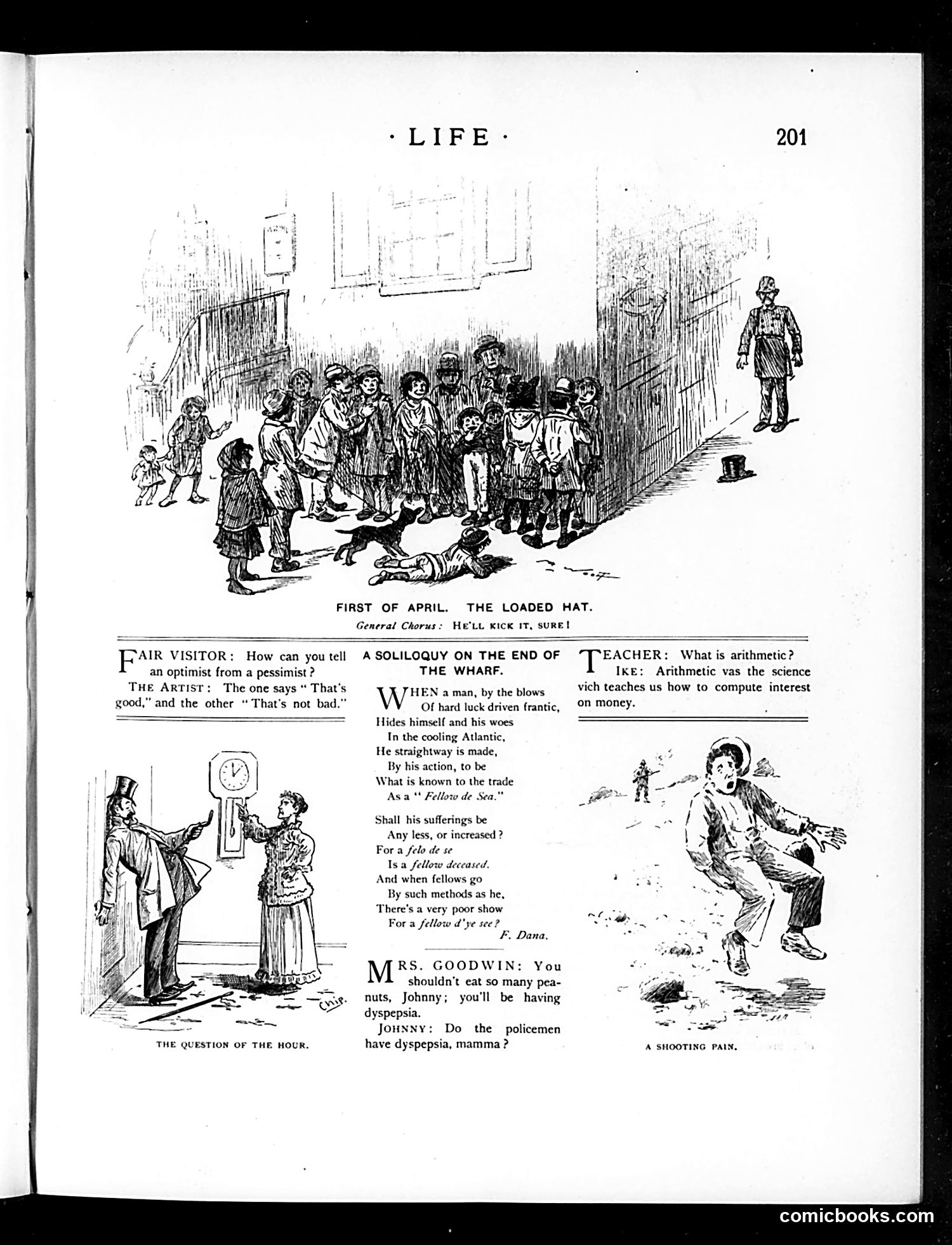
This page contains several satirical sketches targeting social conventions and class pretensions: **"First of April: The Loaded Hat"** depicts children discovering an April Fool's prank—a hat rigged to kick when picked up, reflecting turn-of-the-century pranks. **"The Question of the Hour"** shows a well-dressed man explaining optimism versus pessimism to a woman, likely satirizing popular philosophical debates of the era. **"A Soliloquy on the End of the Wharf"** is a poem about maritime misfortune, mocking romantic verse conventions. **"A Shooting Pain"** humorously illustrates a child's physical mishap. The **Teacher/Ike exchange** mocks pretentious definitions—the teacher's abstract explanation of "arithmetic" contrasts with Ike's practical understanding (computing interest on money), satirizing academic pomposity versus common sense.
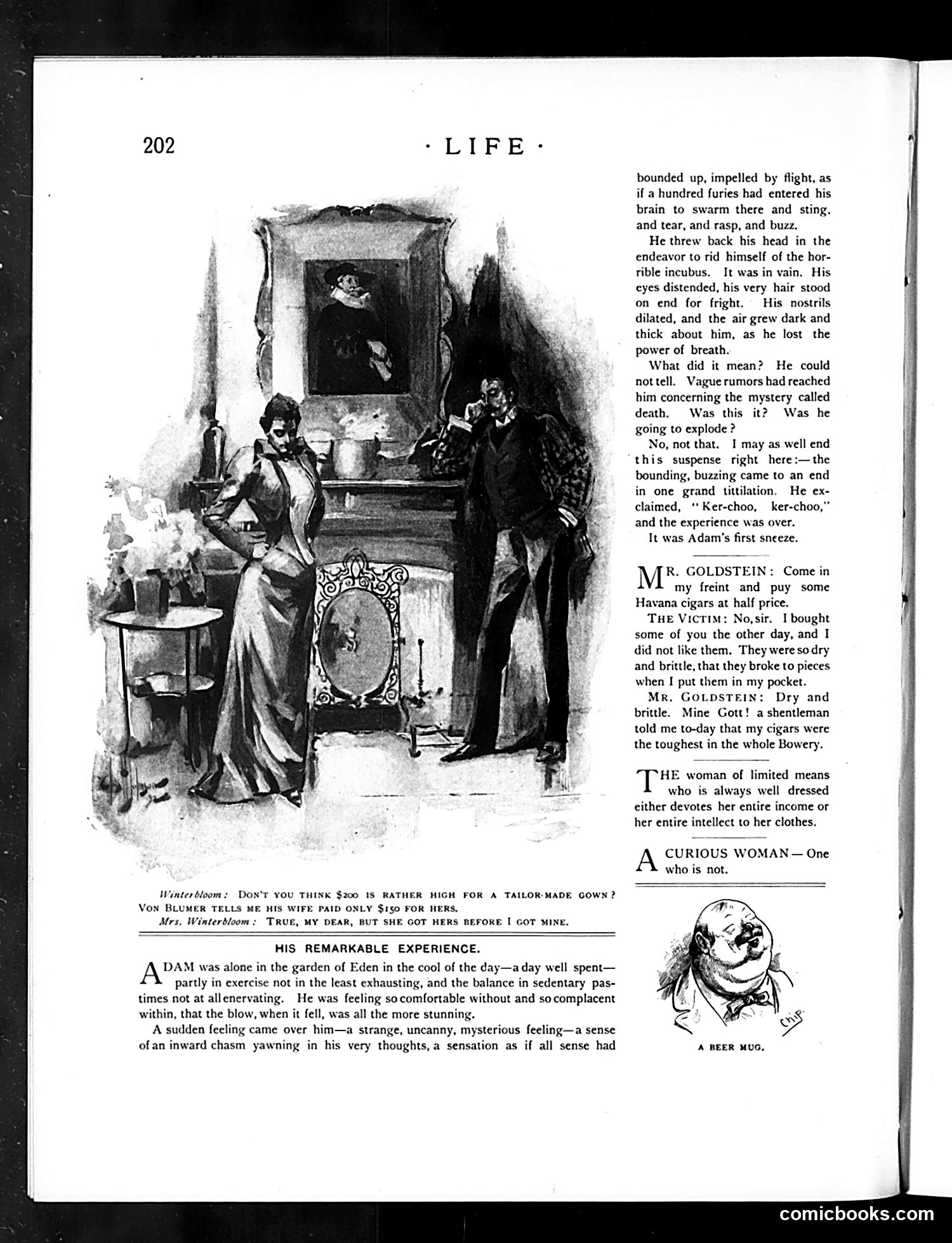
This page contains a satirical dialogue between **Mr. Goldstein** (a cigar merchant) and a customer identified as "The Victim." The joke satirizes consumer deception: the victim complains that cigars he bought from Goldstein were so poor quality they broke in his pocket. Goldstein dismissively responds that a gentleman told him his cigars were "the toughest in the whole lowery [sic]"—a deliberate misunderstanding playing on "lowery" (lower-class neighborhood) versus quality assurance. Below is an unrelated section titled "His Remarkable Experience" about Adam in Eden, appearing to be literary content rather than satire. The cartoon mocks both dishonest merchant practices and the verbal sleight-of-hand used to defend them, typical of early 20th-century American humor targeting urban commerce and ethnic stereotypes.
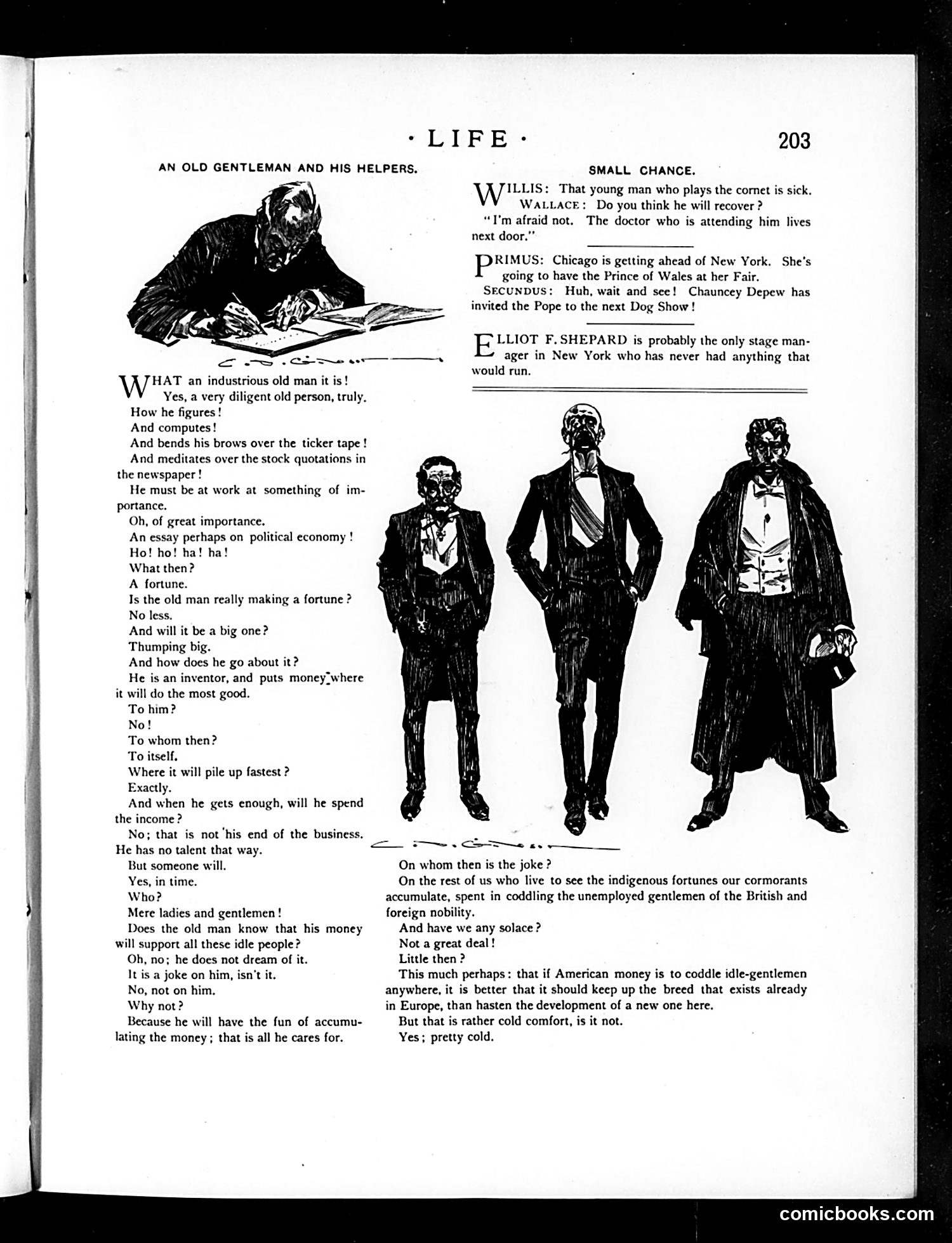
This page contains two distinct satirical pieces: **"An Old Gentleman and His Helpers"** (left): A dialogue mocking a wealthy elderly man who obsessively tracks finances—studying ticker tape, stock quotations, and newspaper reports. The satire suggests his money will eventually support "idle gentlemen" (unemployed aristocrats) in Europe rather than benefit anyone purposefully. The joke critiques both his obsessive moneymaking and the ironic outcome: accumulating wealth merely to subsidize European leisure classes rather than productive use. **"Small Chance"** and related dialogue (right): References to contemporary figures (Chauncey Depew, Elliot F. Shepard) and events (Prince of Wales visit, Dog Show) satirize wealthy New York society. The three illustrated gentlemen appear to represent idle-rich types. The satire suggests American wealth paradoxically supports maintaining existing European aristocratic breeds rather than developing American society.
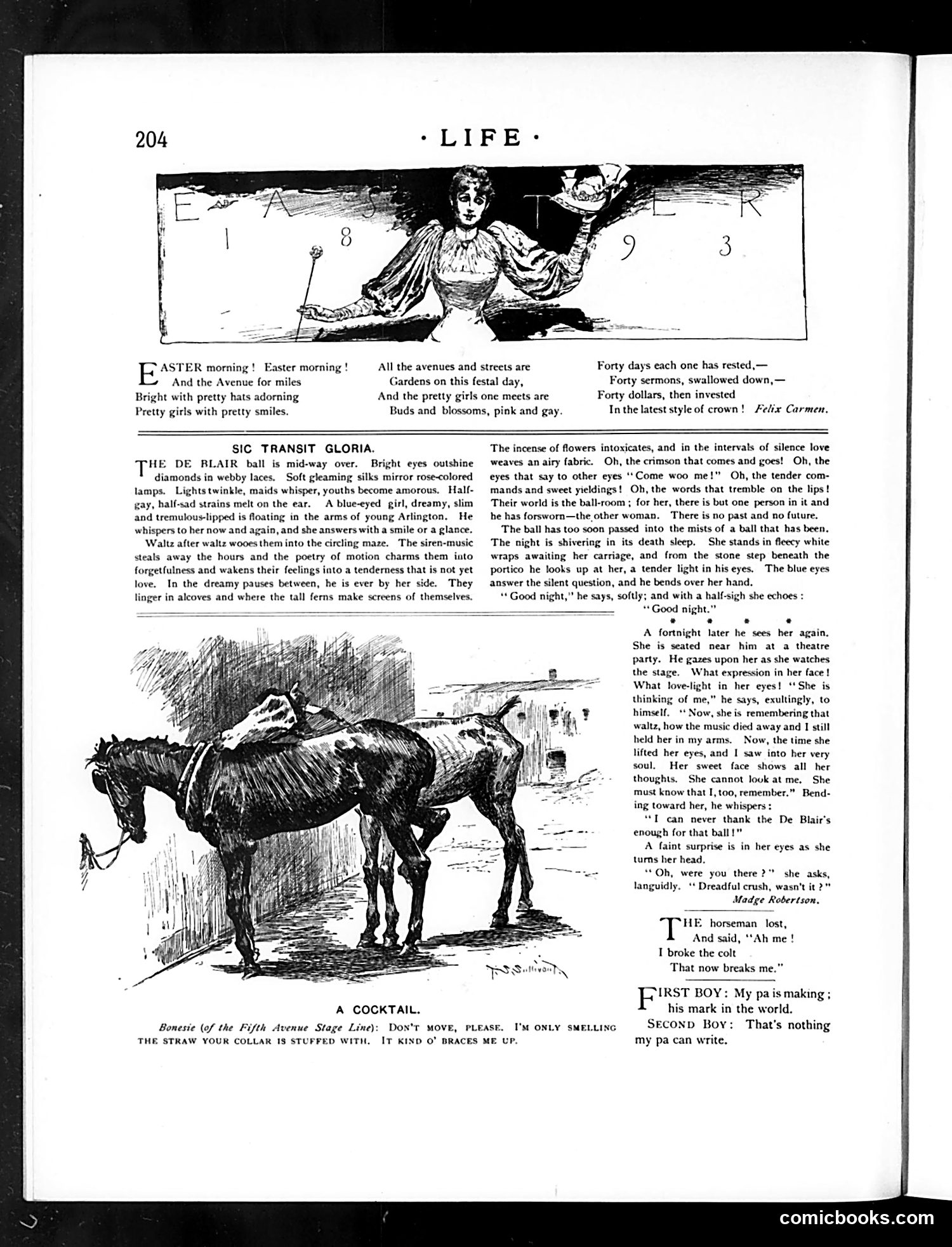
This page contains Easter-themed poetry and satirical content typical of Life's humor magazine format. **"Easter Morning"** is a sentimental poem celebrating the holiday and spring renewal, contrasting with the magazine's typical satirical tone. **"Sic Transit Gloria"** is a darker piece about a young woman at a debutante ball, exploring themes of fleeting youth, romance, and disillusionment—suggesting the emptiness behind high society's glamorous facade. **"A Cocktail"** is a cartoon showing a disheveled horse, captioned with a joke about a woman's perfume being so strong it's affecting the animal. This is typical period humor mocking women's excessive use of cosmetics and fragrances. The brief jokes at bottom mock fathers' writing abilities and a child's broken horse, representing everyday domestic humor.
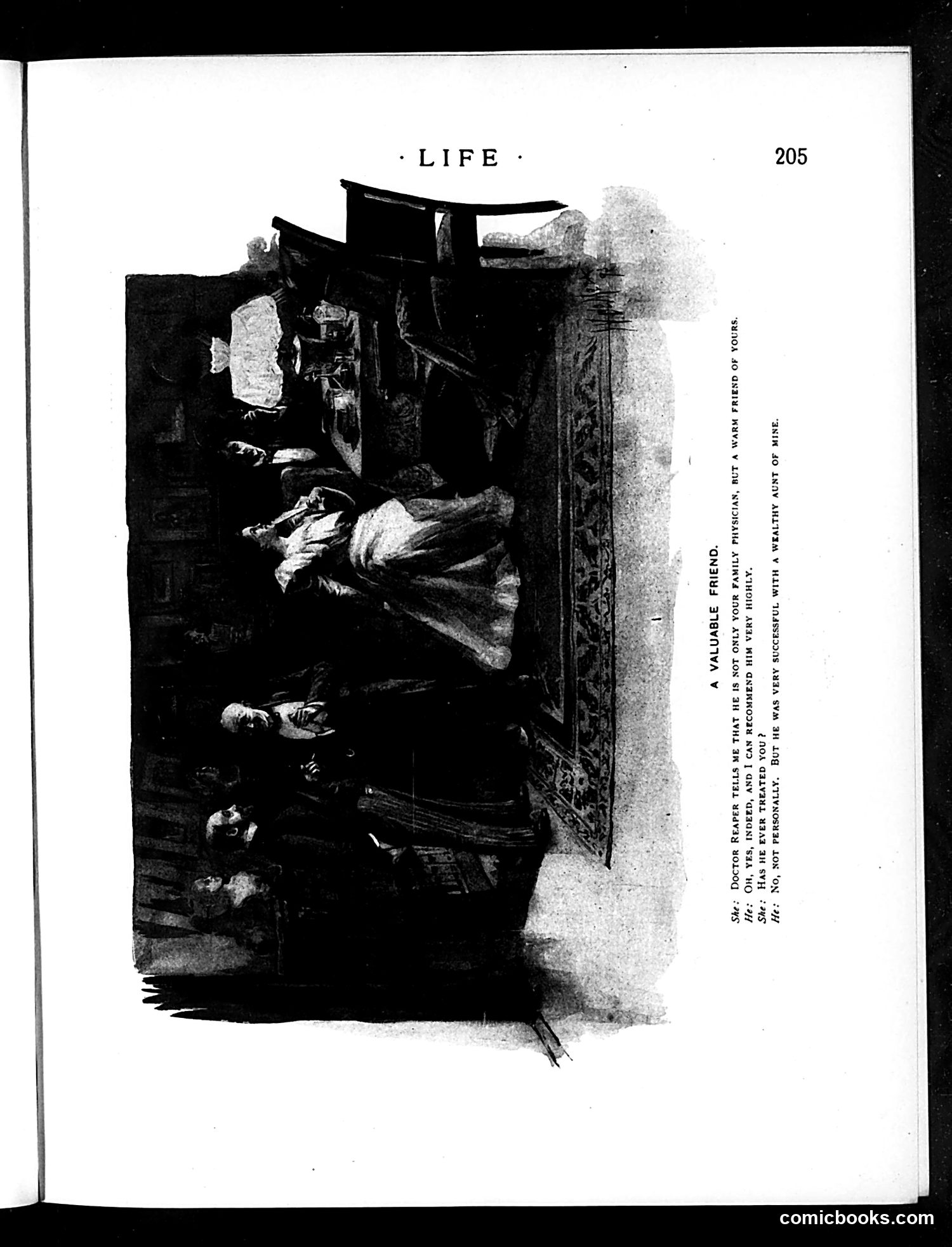
This appears to be a satirical illustration titled "A Valuable Friend" from Life magazine (page 205). The image shows a man reclining or lounging in what appears to be an interior domestic space, rendered in dark, sketchy style typical of late 19th or early 20th-century political cartoons. The caption references "Doctor Happy" and mentions physical ailments or medical conditions, suggesting this is satirizing either a questionable medical practitioner or commenting on attitudes toward health and medicine of the era. The figure's relaxed posture and the domestic setting suggest commentary on leisure, idleness, or perhaps the relationship between doctors and their wealthy patients. Without clearer text visibility or additional context, the specific satirical target remains somewhat unclear.
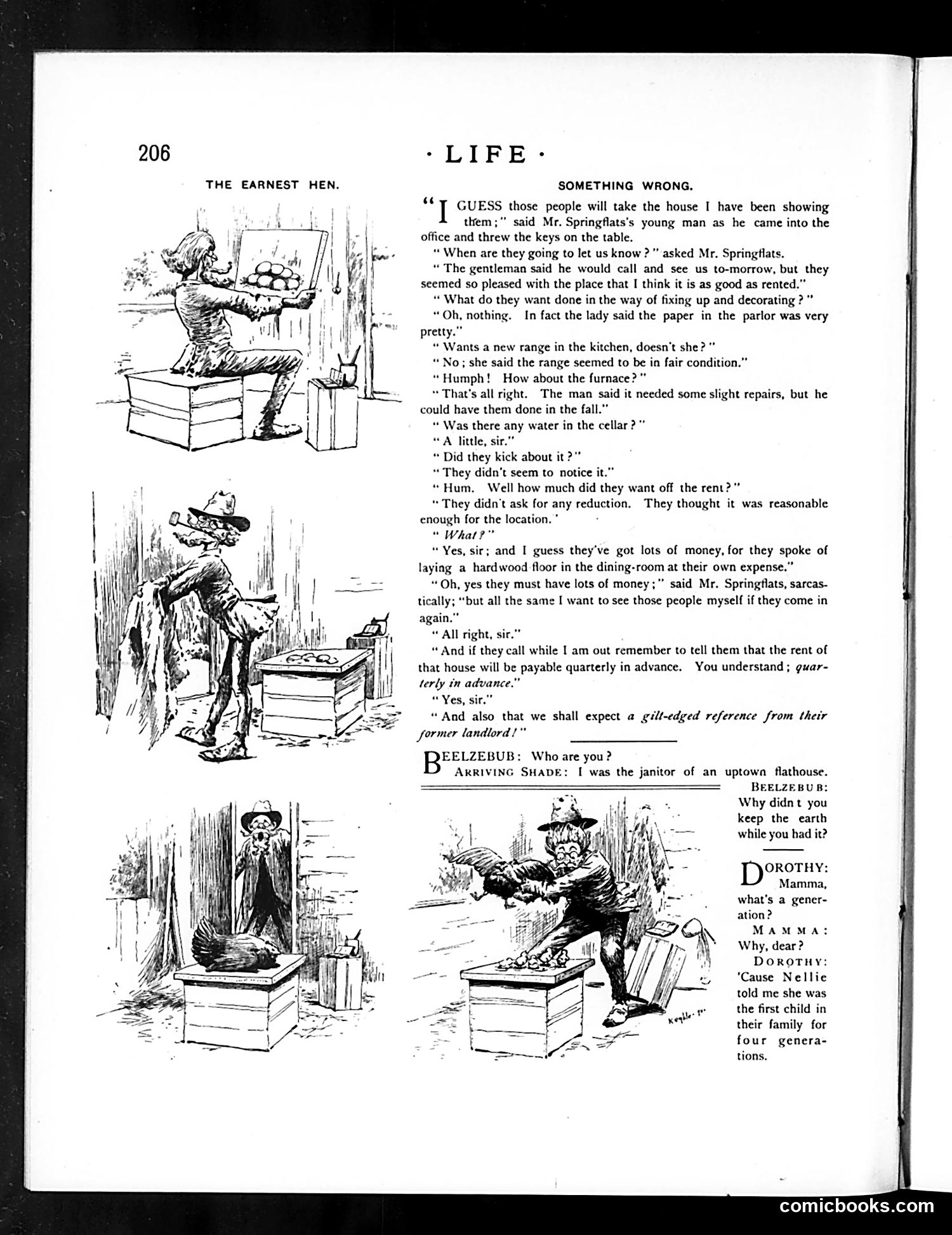
**Main Cartoon: "Something Wrong"** This satirical dialogue mocks a landlord's suspicious nature. Mr. Springflats, a property manager, grows increasingly paranoid upon learning prospective tenants found his rental acceptable without complaint—they didn't demand repairs, didn't negotiate rent, and didn't complain about water in the cellar. His suspicion intensifies when they offer to pay for improvements themselves, revealing his assumption: tenants with *actual money* wouldn't accept reasonable terms, so these must be unreliable. The joke critiques landlord greed and distrust of honest renters. **Secondary Cartoons: "The Earnest Hen"** Shows a hen sitting on eggs—a visual pun about patience and productivity. **Bottom Panel: Afterlife Dialogue** Beelzebub questions a janitor's ghost about why he didn't "keep the earth"—a dark joke suggesting the janitor wasted his life. The Dorothy segment is a separate joke about generational terminology. **Context**: Early 20th-century satirical humor targeting landlord exploitation and tenant relations in urban America.
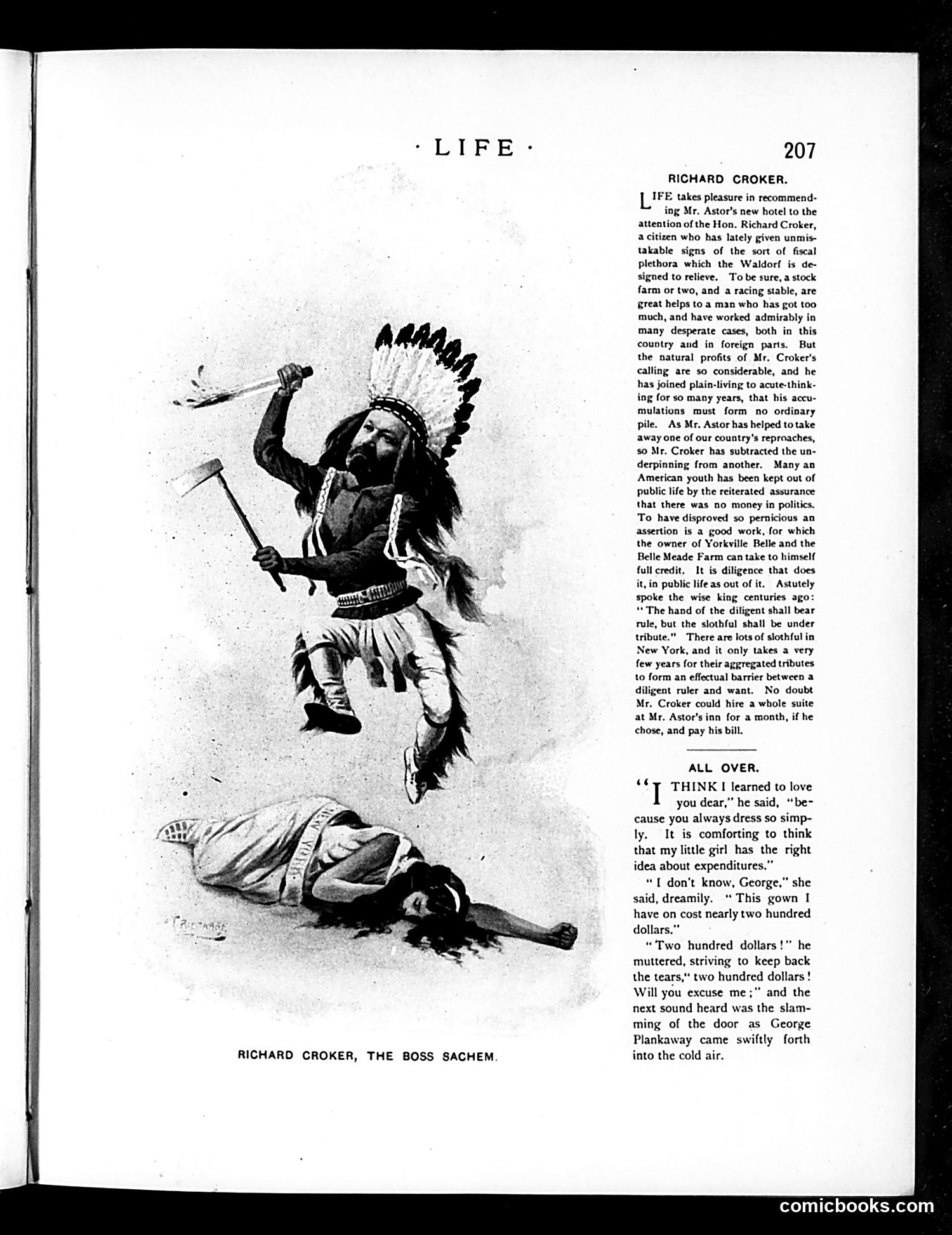
This page satirizes **Richard Croker**, the powerful Democratic boss of Tammany Hall in New York City during the Gilded Age. The cartoon depicts him as a Native American "sachem" (chief), playing on the Tammany Hall organization's use of Native American imagery. The text mockingly "congratulates" Croker on becoming wealthy through politics—sarcastically suggesting he's proved there IS money in political office, contrary to the claim that public service doesn't pay. Life uses ironic praise to expose the corruption and graft that allowed machine politicians like Croker to accumulate fortunes. References to his "stock farm" and "racing stable" (Yorkville Belle, Belle Meade Farm) highlight his luxurious lifestyle funded by political power. The second story, "All Over," is unrelated domestic humor about a husband's shock at his wife's $200 dress.
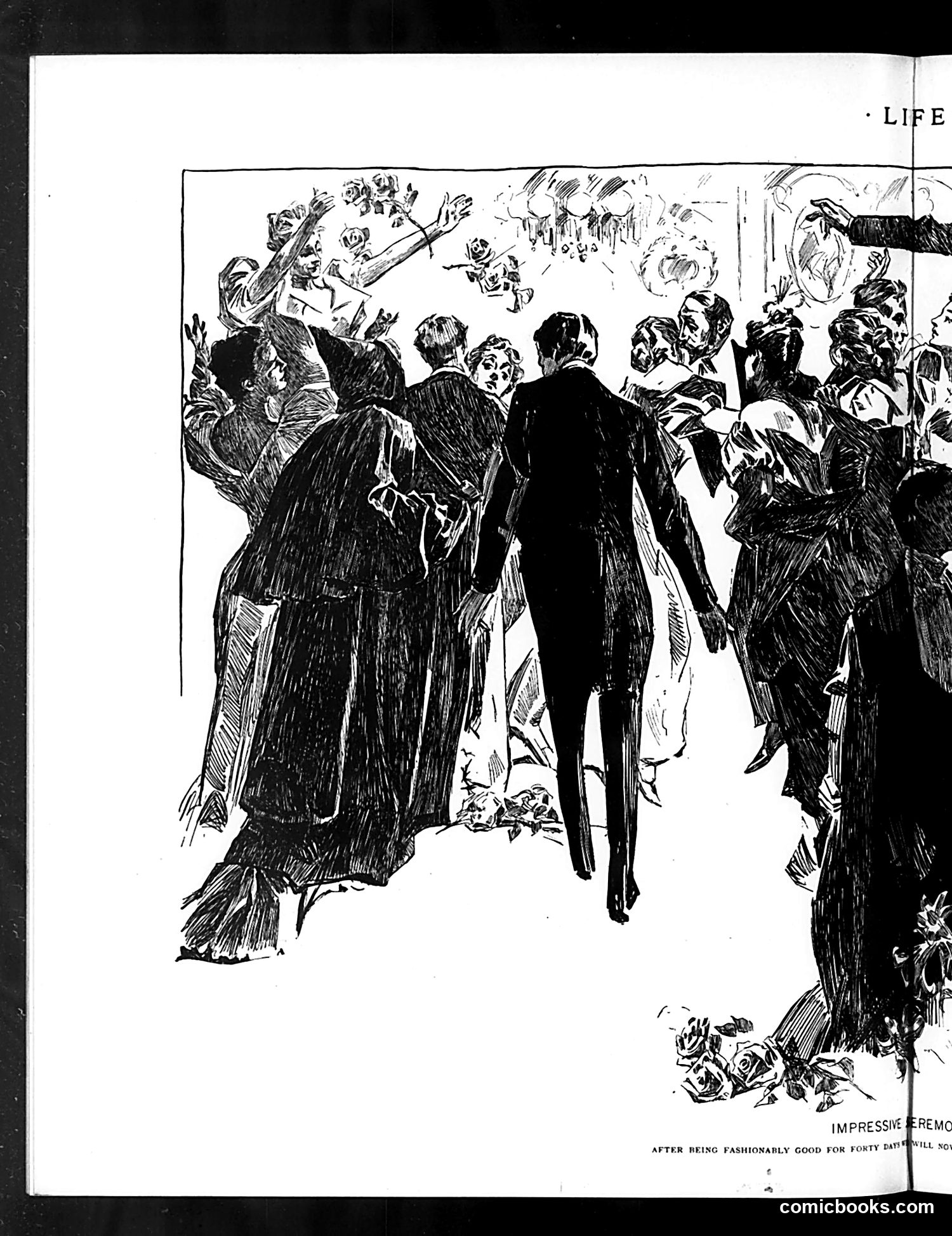
This is a black-and-white sketch showing a formal social gathering—likely an upper-class event or reception. A well-dressed man in a dark suit stands centrally, surrounded by fashionably-dressed women in elaborate clothing and feathered hats typical of early 20th-century high society. The caption reads "AFTER BEING FASHIONABLY GOOD FOR FORTY DAYS," suggesting satire about temporary moral reformation or social propriety. The sketch appears to mock the superficiality of high-society gatherings or the performative nature of fashionable respectability—wealthy people maintaining appearances of propriety while gathering at social events. The OCR text is largely corrupted and unreadable, making it difficult to identify specific referenced figures. Without clearer text or additional context, the precise satirical target remains unclear, though the general commentary appears to critique aristocratic pretense and fashionable morality.
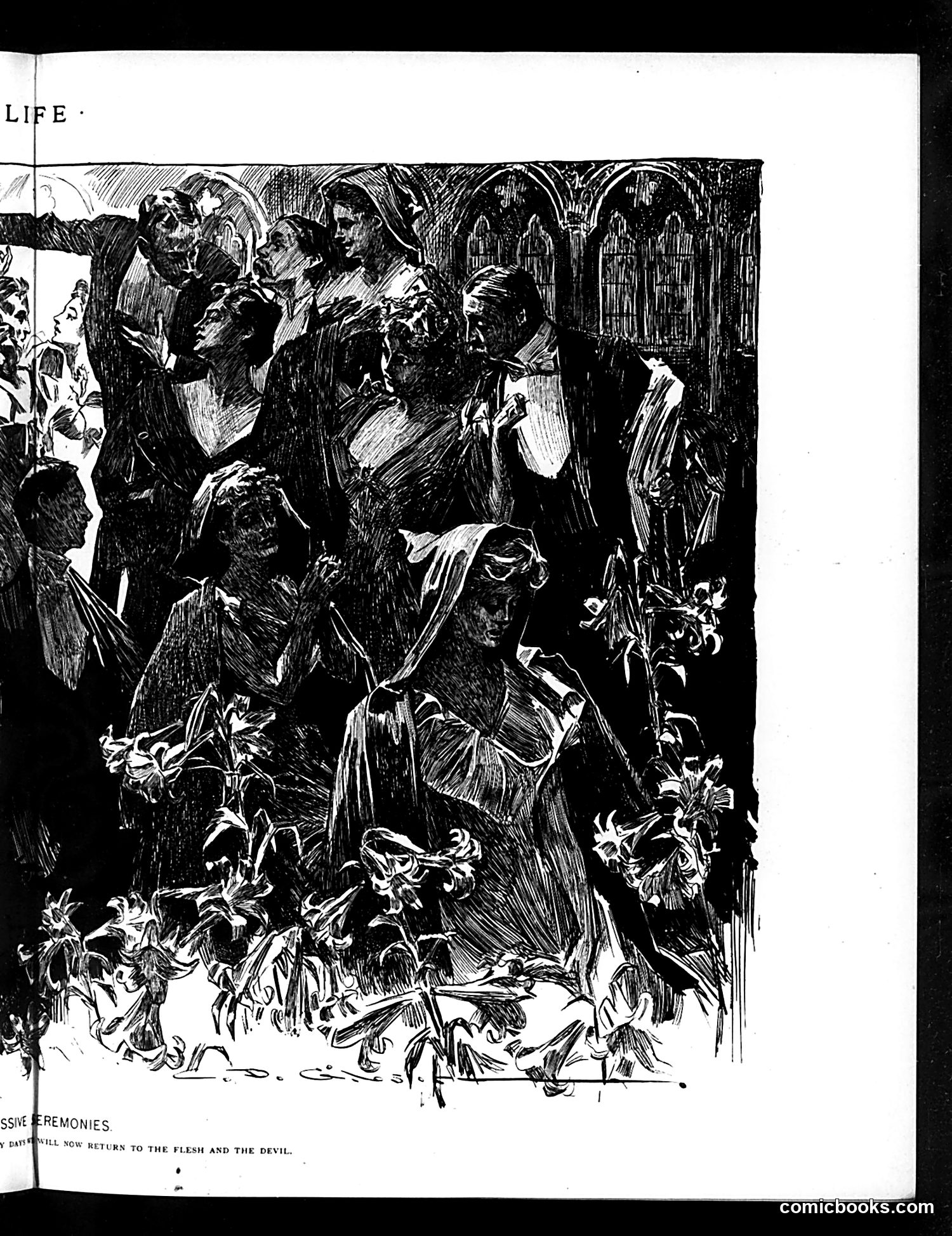
This appears to be a satirical illustration from *Life* magazine showing a church interior scene with multiple figures in formal attire gathered around flowering plants. The caption fragment references "ceremonies" and mentions something "returning to the flesh and the devil." The drawing style uses heavy cross-hatching typical of early 20th-century satirical illustration. The Gothic church architecture in the background and the formal dress suggest this satirizes religious hypocrisy or the contrast between church propriety and worldly behavior. However, the OCR text is severely fragmented and incomplete. Without the full caption or clearer context about the specific date and event being satirized, I cannot definitively identify which historical moment or public figures this targets. The exact satirical point remains unclear from the available information.
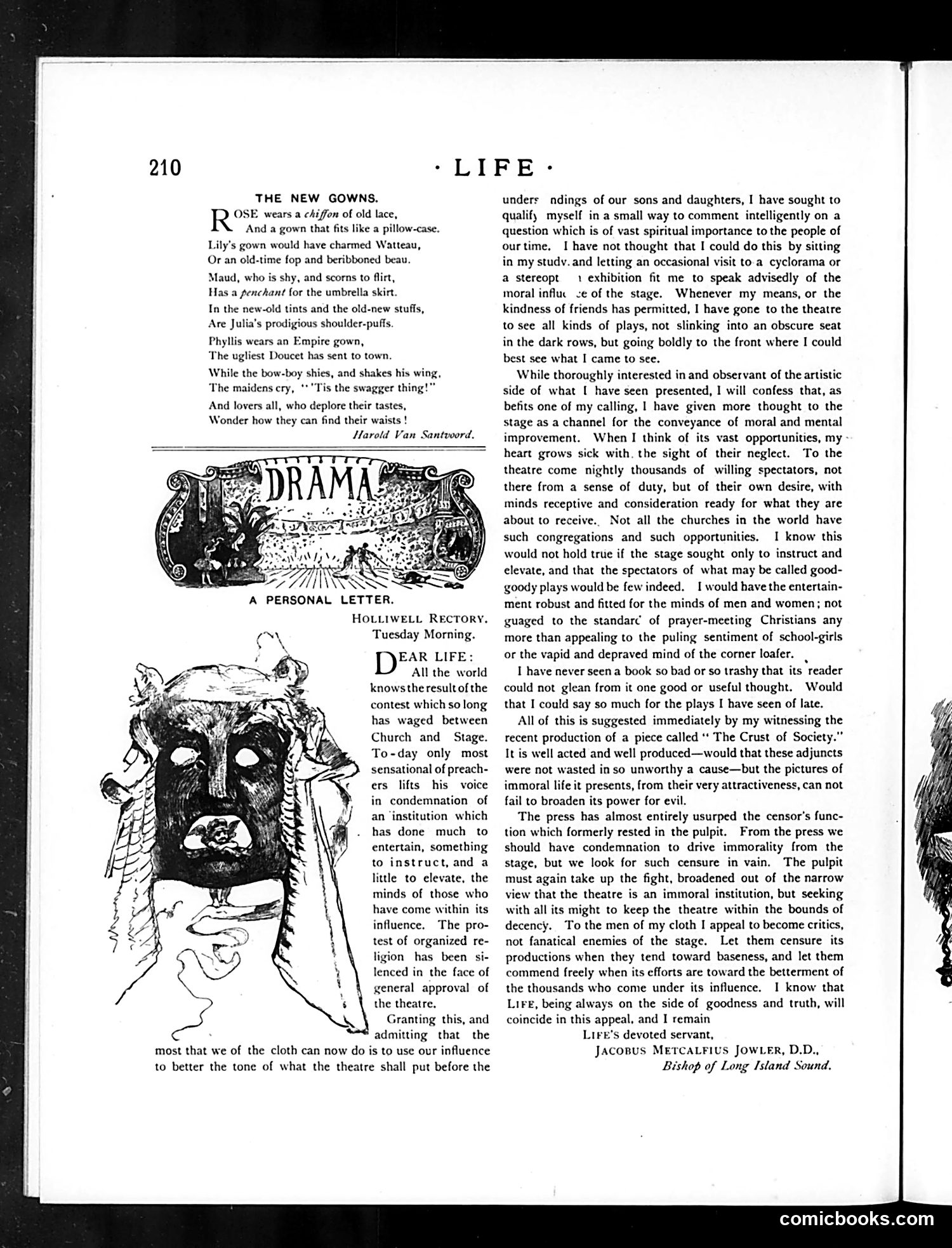
This *Life* magazine page contains two distinct pieces: **"The New Gowns"** (top) is light satirical verse mocking women's fashionable clothing of the era. It humorously catalogs absurd new styles—pillow-case gowns, umbrella skirts, exaggerated shoulder puffs—and ends with the joke that women can't even locate their own waists in these ridiculous getups. The crude illustration shows a grotesquely misshapen female figure, emphasizing the satire. **"A Personal Letter"** (main text) is a clergy member's earnest defense of theatre against religious opposition. The Bishop of Long Island argues the Church has lost its battle against stage entertainment, so religious leaders should instead attend plays to influence their moral content. He critiques both preachy "good-goody plays" and immoral productions like "The Crust of Society," advocating for robust, entertaining drama with subtle moral instruction. The letter represents the early-1900s debate over theatre's cultural and spiritual value.
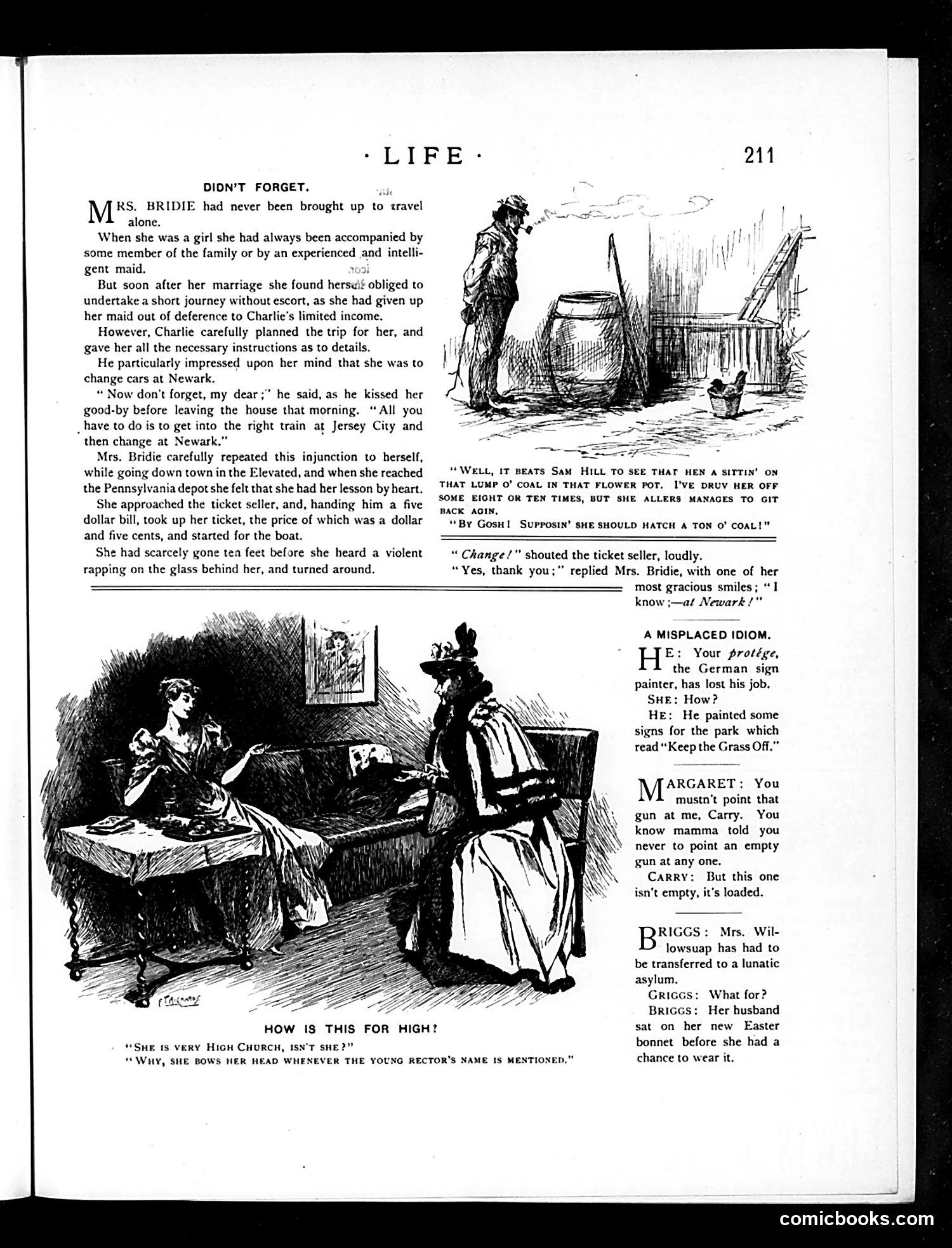
This page contains three separate humorous anecdotes typical of *Life* magazine's satirical style: **"Didn't Forget"** depicts Mrs. Bridie's confusion during her first solo train journey. Her husband Charlie instructed her to "change at Newark," but she misunderstands—when the ticket seller shouts "Change!" (meaning her fare money), she replies thinking he's reminding her about Newark. The joke mocks both her inexperience traveling alone and her literal interpretation of instructions. **"How Is This for High?"** satirizes religious pretension through wordplay: a woman is "High Church" not due to theological conviction but because she bows whenever the rector's name is mentioned—a physical gesture misinterpreted as pious devotion. **"A Misplaced Idiom"** jokes about a German immigrant sign painter's linguistic confusion. He paints "Keep the Grass Off" instead of "Keep Off the Grass"—a malapropism that results in job loss. All three sketches target common domestic scenarios and human foolishness rather than political issues.
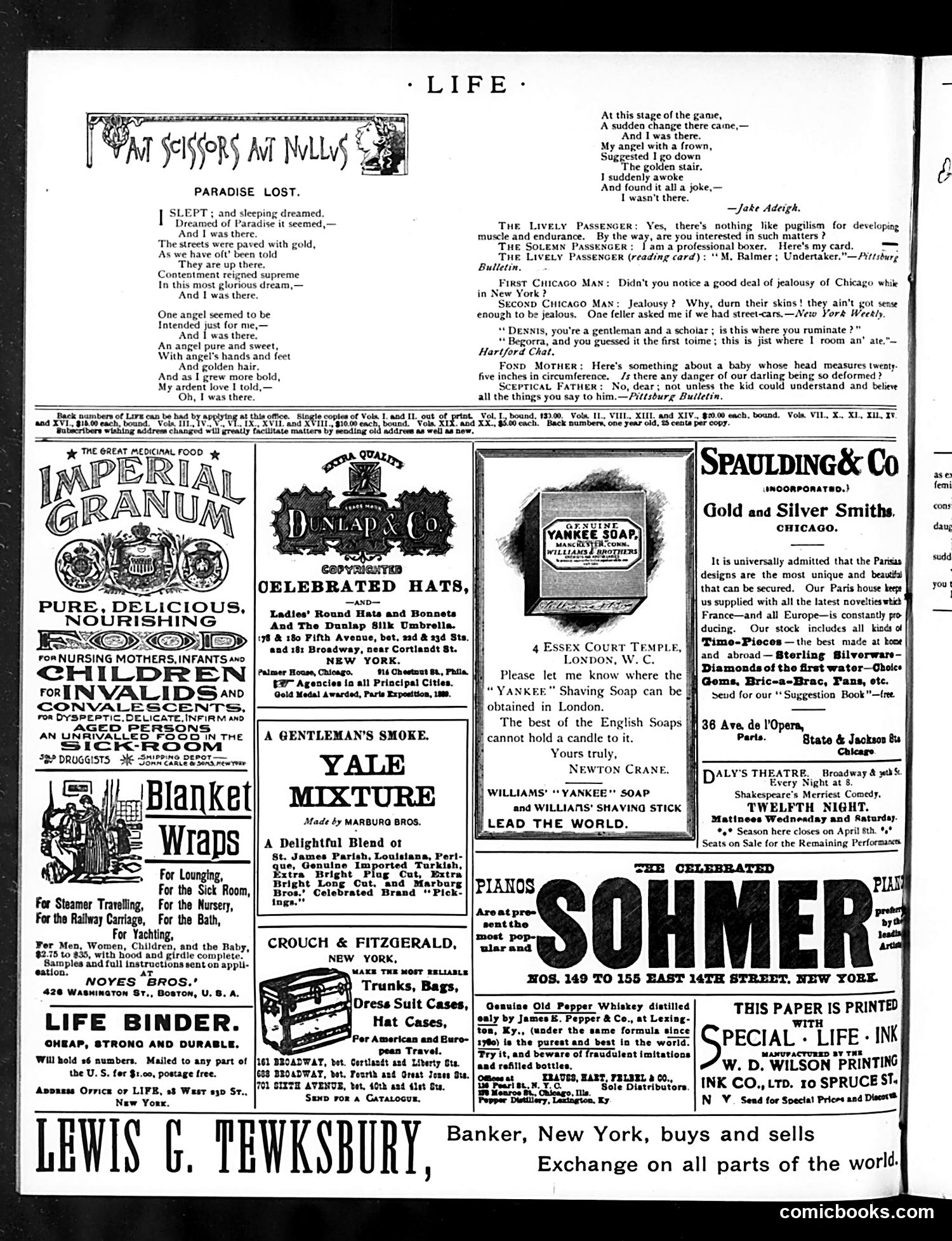
This page is primarily **advertisements and light humor pieces**, not political satire. The content includes: **Main Elements:** 1. **"Paradise Lost" poem** — A sentimental dream narrative about an angel that turns out to be a cruel joke; reflects Victorian sentimentality. 2. **Brief comedic dialogues** — Mostly gentle humor about Chicago visitors in New York (playing on regional rivalry), a boxer's card, and a father's skepticism about baby-health claims. 3. **Extensive advertising** — The bulk of the page features ads for tobacco (Yale Mixture), hats (Dunlap), blanket wraps, trunks, pianos (Sohmer), and soaps — typical of Life's revenue model. **Historical Context:** This appears to be late 19th-century Life (note Paris Exposition 1889 reference), when the magazine mixed literary content with commercial advertising. The humor is mild domestic comedy rather than sharp political commentary—reflecting Life's evolution toward mainstream entertainment magazine status.
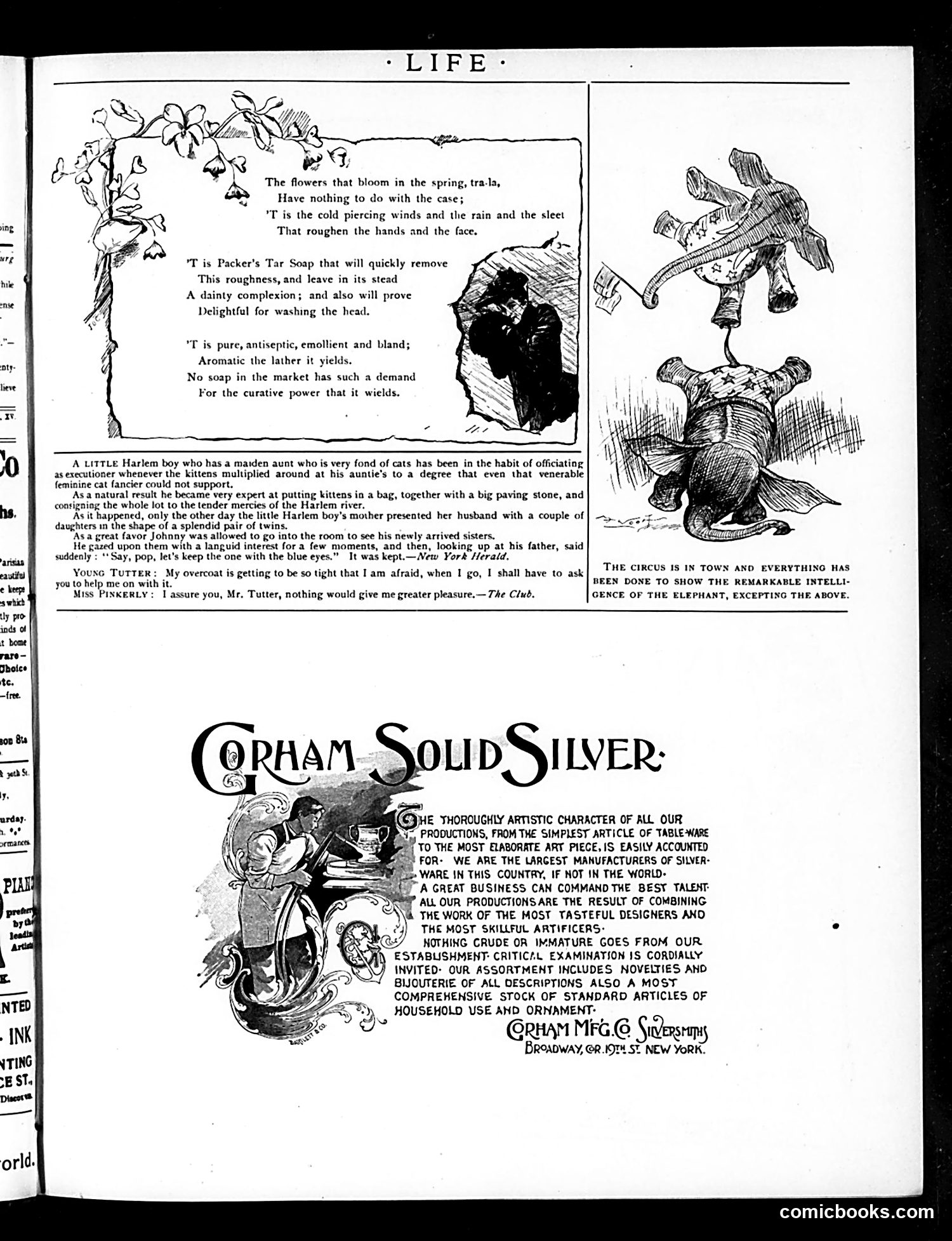
This page contains **advertising and light humor** rather than political satire. The top advertisement uses poetry to promote **Packer's Tar Soap**, claiming it removes roughness from hands and face caused by cold weather—a common pitch for 19th-century patent medicines. Below are three brief comedic anecdotes: 1. A story about a Harlem boy accustomed to drowning kittens who, upon seeing newborn twins, asks his father if they can "keep the one with the blue eyes"—dark humor implying he'd dispose of the other. 2. A joke about a tight overcoat where Young Tutter fears needing help removing it. 3. A circus caption joke: everything displays the elephant's intelligence "excepting the above" (the image shows the elephant appearing dim-witted). The page concludes with a full advertisement for **Gorham Manufacturing Company's silverware**, emphasizing their artistic designs and skilled craftmanship. The content reflects turn-of-the-century American publishing: mix of advertisements and mild, often crude humor.
This is a **product advertisement**, not satire or political commentary. It promotes Scott's Emulsion, a cod liver oil supplement marketed to parents of weak or underweight children. The decorative border features cherubic infants, emphasizing the product's appeal to families concerned about child health. The text uses physician endorsement—a common marketing tactic of the era—to establish medical credibility. By calling cod liver oil "almost as palatable as milk," advertisers addressed a real concern: the notoriously unpleasant taste of the supplement. The $1 price and "Sold by all Druggists" indicate this was a mass-market patent medicine. Such supplements were genuinely popular in the late 19th/early 20th century, before modern pediatric nutrition standards. For modern readers, this reflects an era when nutritional deficiencies were common and commercial remedies filled perceived medical gaps—some legitimately helpful, many dubious.
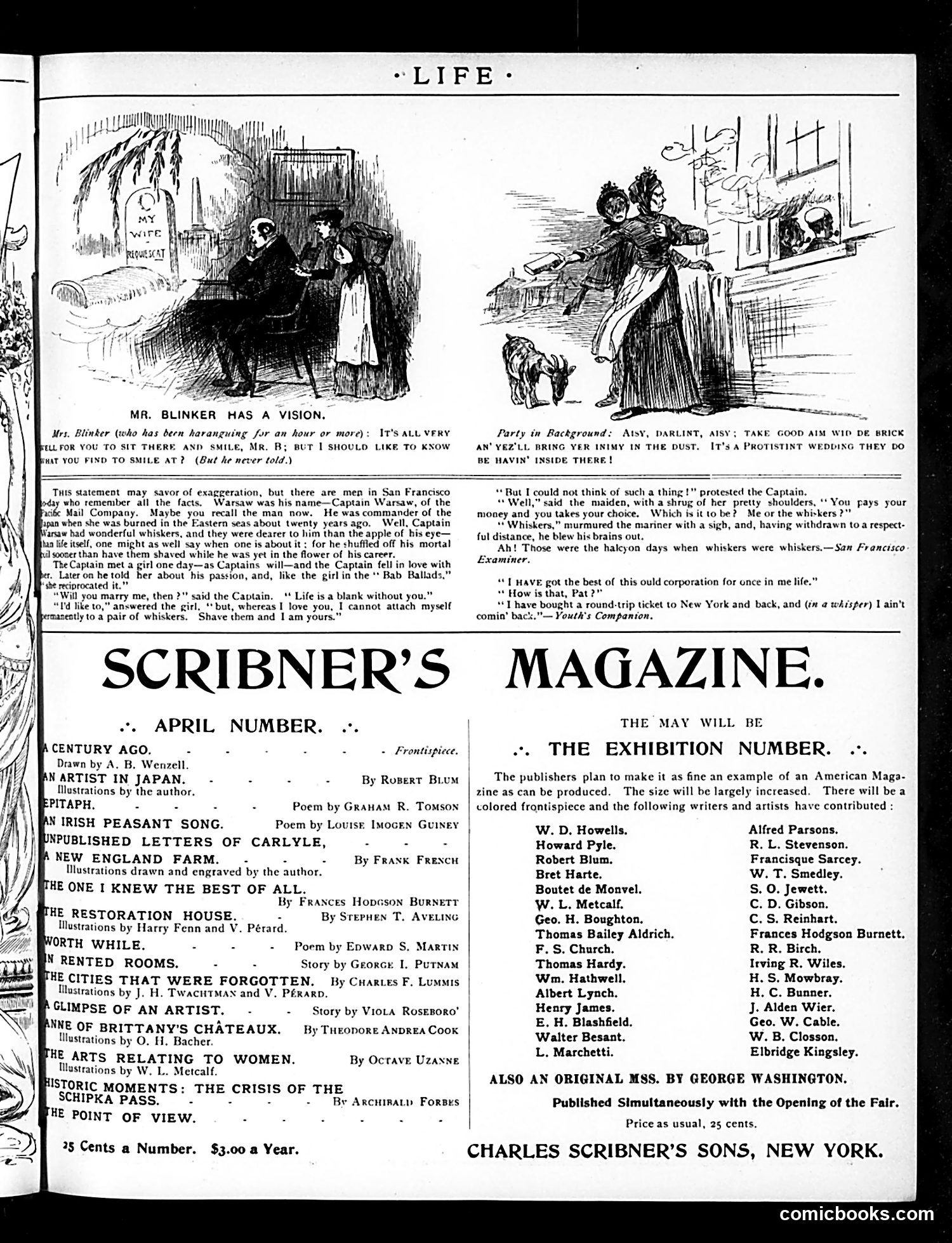
This is primarily an **advertising/contents page** for Scribner's Magazine (April issue), but features two humorous cartoons illustrating social commentary. **"Mr. Blinker Has a Vision"** shows a henpecked husband enduring his wife's nagging while daydreaming (cartoons at right). The accompanying text tells a tall tale about Captain Warsaw, a San Francisco ship commander so devoted to his impressive whiskers that when a woman demands he shave them to marry her, he **chooses the whiskers and shoots himself**—presented as nostalgic for an era when men prioritized masculine vanity over romance. The satire mocks both **excessive facial hair obsession** (common in the era) and **male stubbornness**, while using the exaggerated anecdote to poke fun at outdated notions of masculinity. A secondary joke appears below: an Irish immigrant brags about outsmarting a corporation by buying a round-trip ticket to New York with no intention of returning—a small act of working-class rebellion presented as cleverness. The page is mostly a **table of contents** announcing Scribner's upcoming exhibition issue.
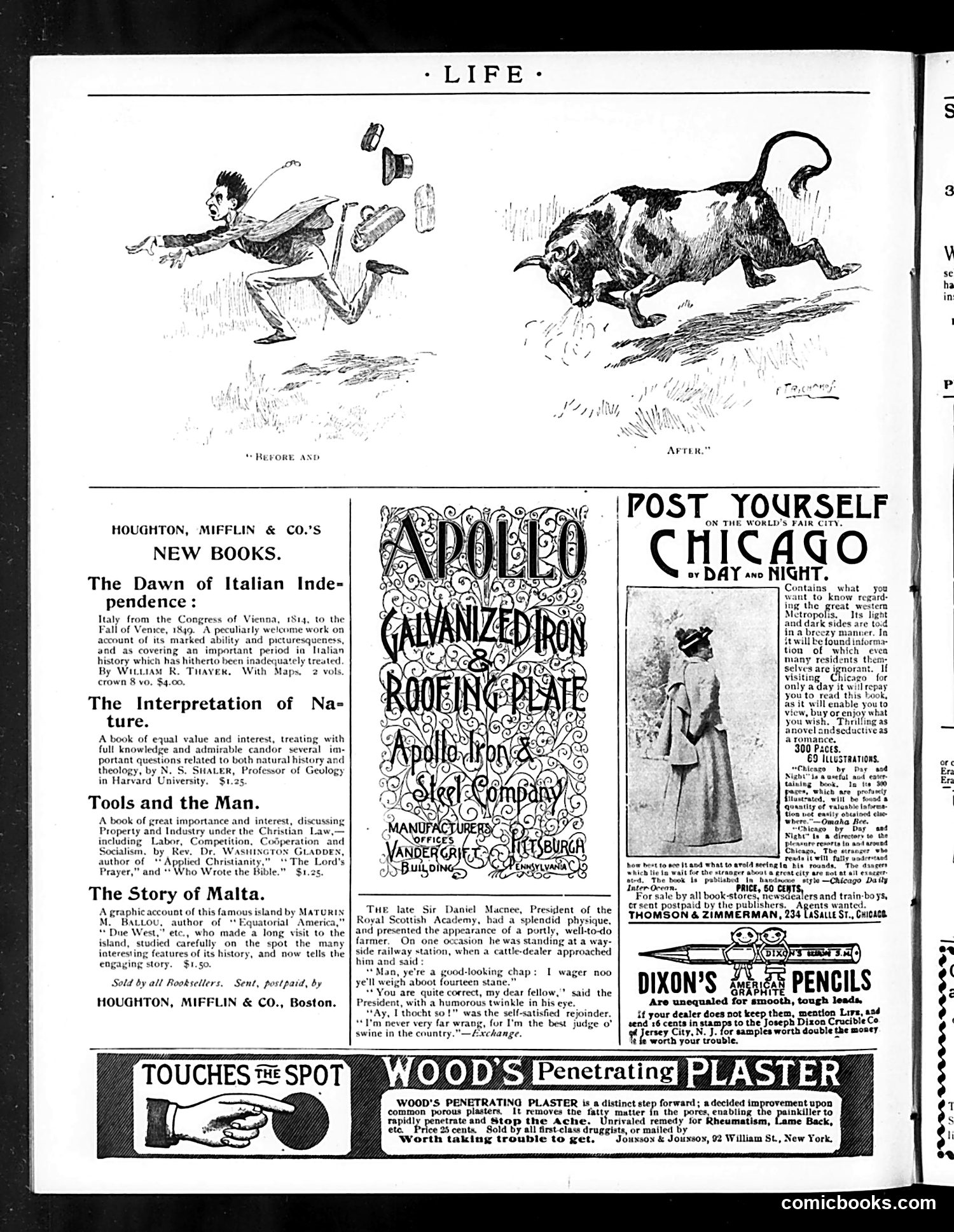
The top cartoon titled "Before and After" depicts a humorous transformation: a well-dressed man is shown fleeing in panic from a charging bull, with his belongings scattered in the air. The "after" shows him standing calmly while the bull walks away peacefully. This is a classic slapstick joke playing on the common saying that bulls are enraged by red cloth. The satire suggests that the man's panicked flight was unnecessary—the bull wasn't actually dangerous, just as the fearful reputation of bulls may be exaggerated. The humor relies on physical comedy and the contrast between the man's wild panic and the bull's actual indifference. The rest of the page consists of book advertisements, publisher notices, and product advertisements typical of period magazine content—nothing particularly satirical or requiring historical context beyond recognizing it as standard turn-of-century advertising.
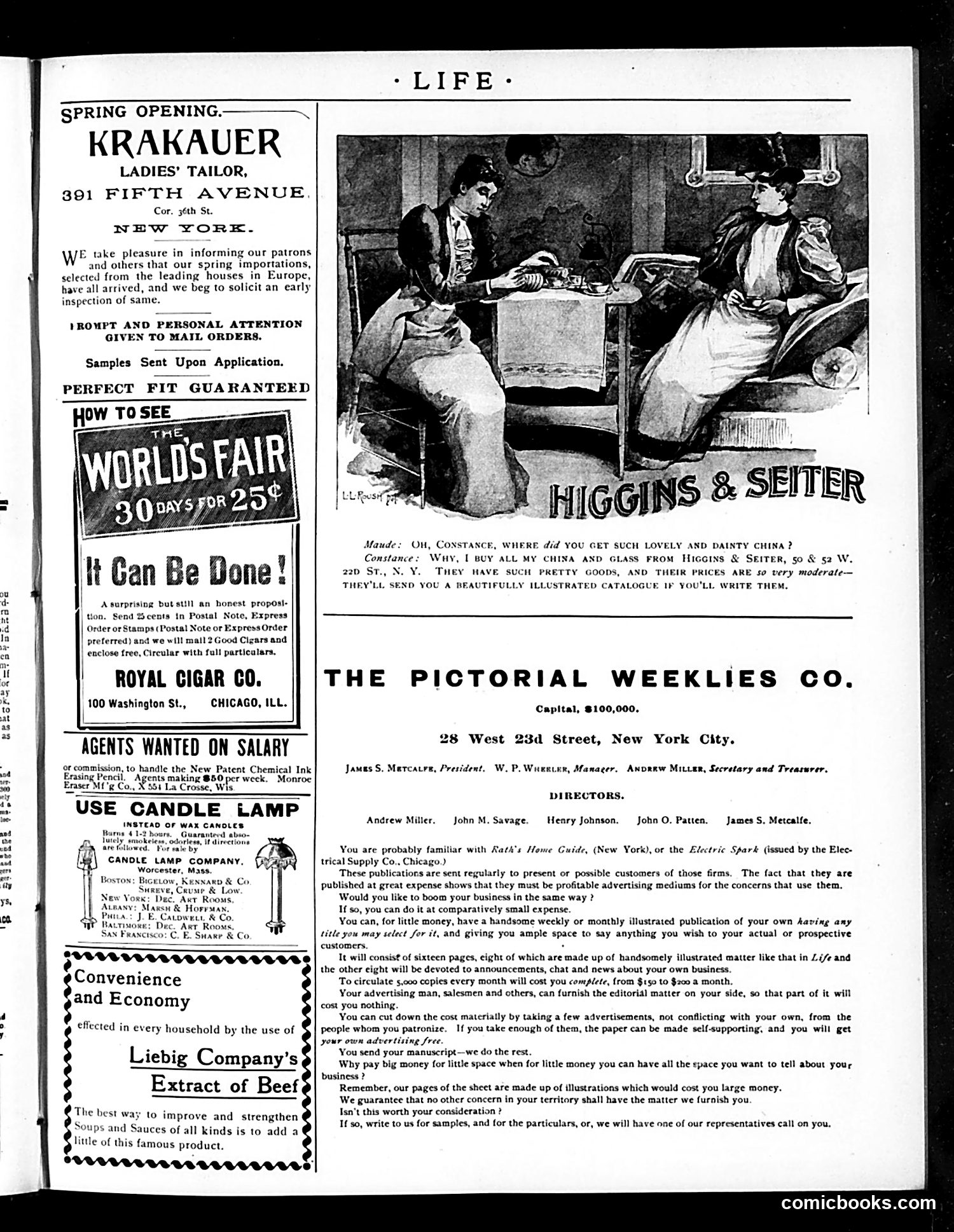
This page is primarily **advertisements**, not political satire. The dominant visual is a commercial illustration for **Higgins & Seiter** (a china/glassware retailer), showing two well-dressed women in conversation about fine dishware—a straightforward sales pitch to affluent customers. The illustration presents idealized "society" women (Maude and Constance) discussing luxury goods, reflecting early 1900s consumer culture and the aspirational advertising typical of *Life* magazine. The dialogue directly promotes the retailer's products and catalogue. The page contains no political cartoon or satire—just period advertising for ladies' tailoring, cigars, home goods, and publishing services. The content reflects the magazine's business model: entertainment mixed with lucrative advertisements targeting wealthy readers interested in fashion, home furnishings, and consumer goods.
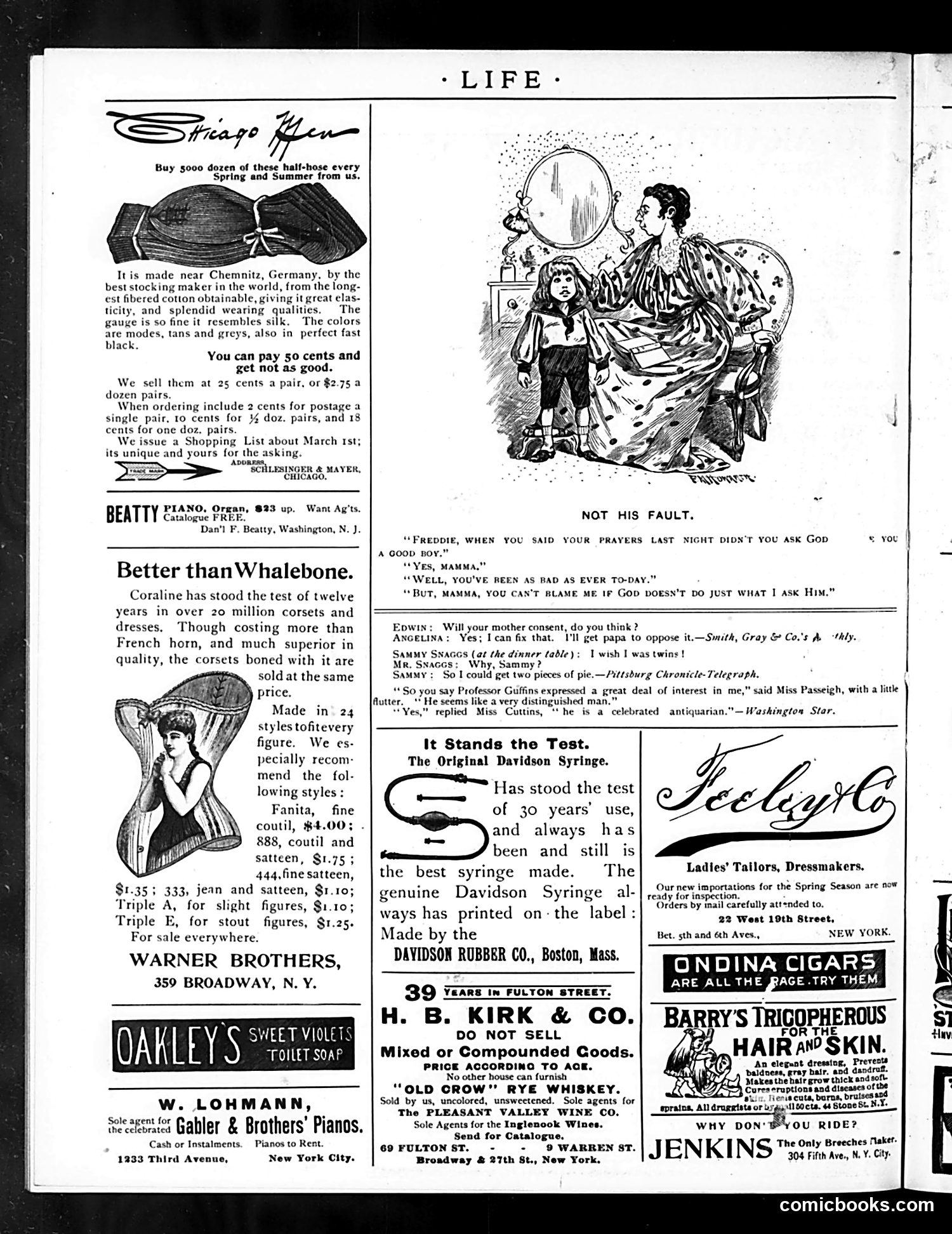
This cartoon satirizes childhood reasoning and parental discipline. A mother scolds her son Freddie for misbehaving, despite his prayers the night before. The boy's reply—that God should be blamed for not answering his request to be good—uses childish logic to deflect responsibility. The joke targets both the child's absurd reasoning (asking God to make him behave, then blaming God for the outcome) and implicitly critiques overly literal religious instruction given to children. The cartoon suggests the gap between what children are taught about prayer's power and how they actually understand cause-and-effect morality. The page also contains various period advertisements (corsets, pianos, cigars, etc.) typical of *Life* magazine's revenue model. The other small comic snippets visible employ similar domestic humor involving children and family situations.
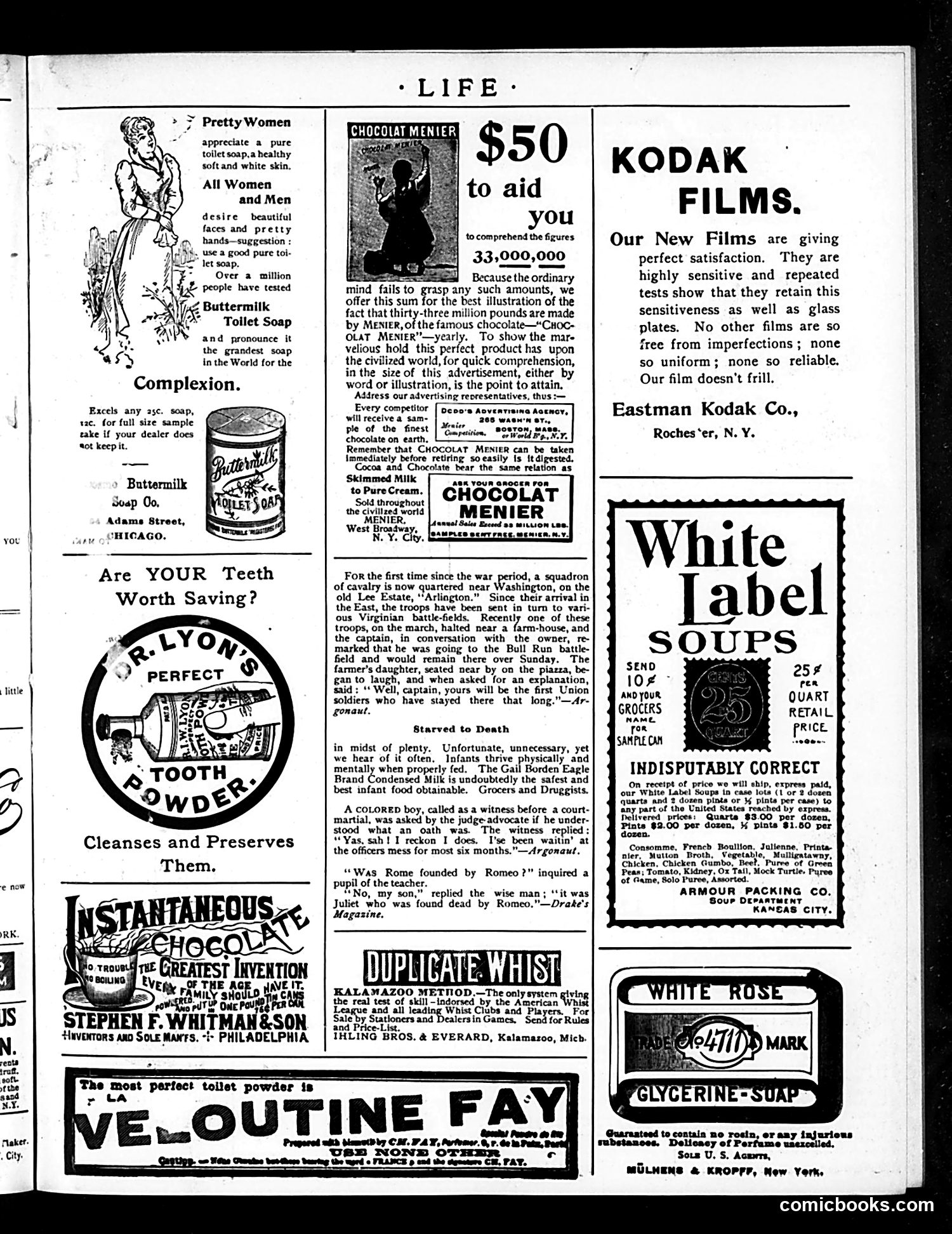
This is primarily an **advertising page** from Life magazine, with minimal editorial content. The small cartoon/joke pieces embedded among ads include: **"Arlington" anecdote**: A cavalry officer staying at a Virginia farm mentions he'll camp at Bull Run battlefield over Sunday. The farmer's daughter laughs, explaining Union soldiers have never "stayed there that long"—a joke referencing the Union Army's repeated failures and retreats during Civil War Virginia battles. **"Court-Martial" joke**: A Black witness testifies he understands oaths because he's been "waitin' at the officers mess for most six months"—satirizing either military racial dynamics or the absurdity of military bureaucracy. **"Rome" riddle**: A student asks if Rome was founded by Romeo; the teacher corrects him that Juliet was "found dead by Romeo"—wordplay on founding/found. These are light, non-political humor pieces typical of Life's satirical style. The page is dominated by patent medicines, soaps, and commercial products, reflecting early 20th-century magazine economics.
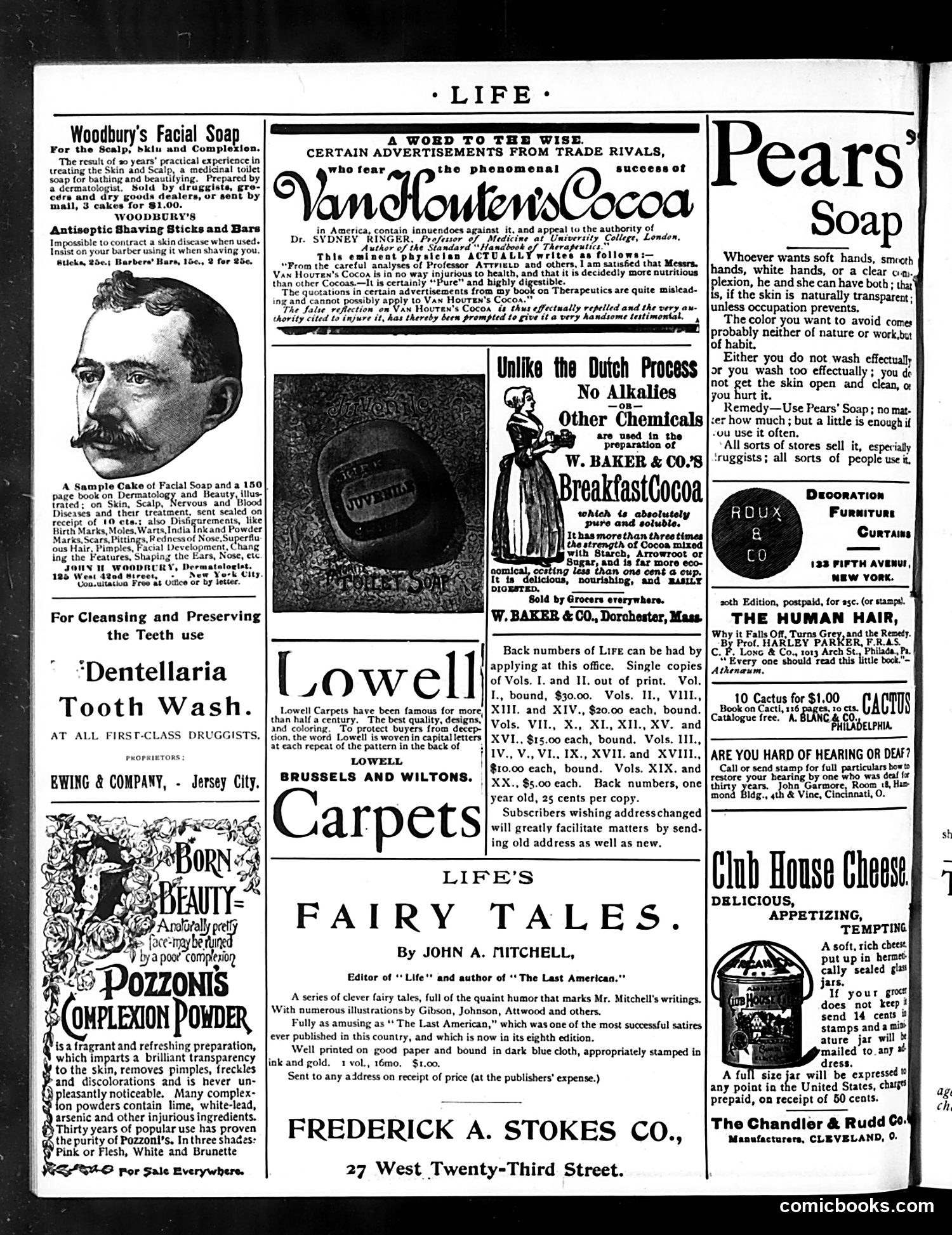
This page is primarily **advertisements** rather than satire or cartoons. However, the "Word to the Wise" section at the top is notable: it's a **competitive attack and defense** regarding cocoa brands. Rival cocoa manufacturers were making negative claims about Van Houten's Cocoa, so Life published a rebuttal featuring an endorsement from Professor Sydney Ringer of University College London, certifying Van Houten's cocoa as "pure," "highly digestible," and more nutritious than competitors. The irony Life highlights is that the rivals' own cited authority (Ringer's medical handbook) actually *vindicated* Van Houten when read carefully. The page is essentially calling out false or misleading advertising through selective quotation—a common marketing tactic then as now.
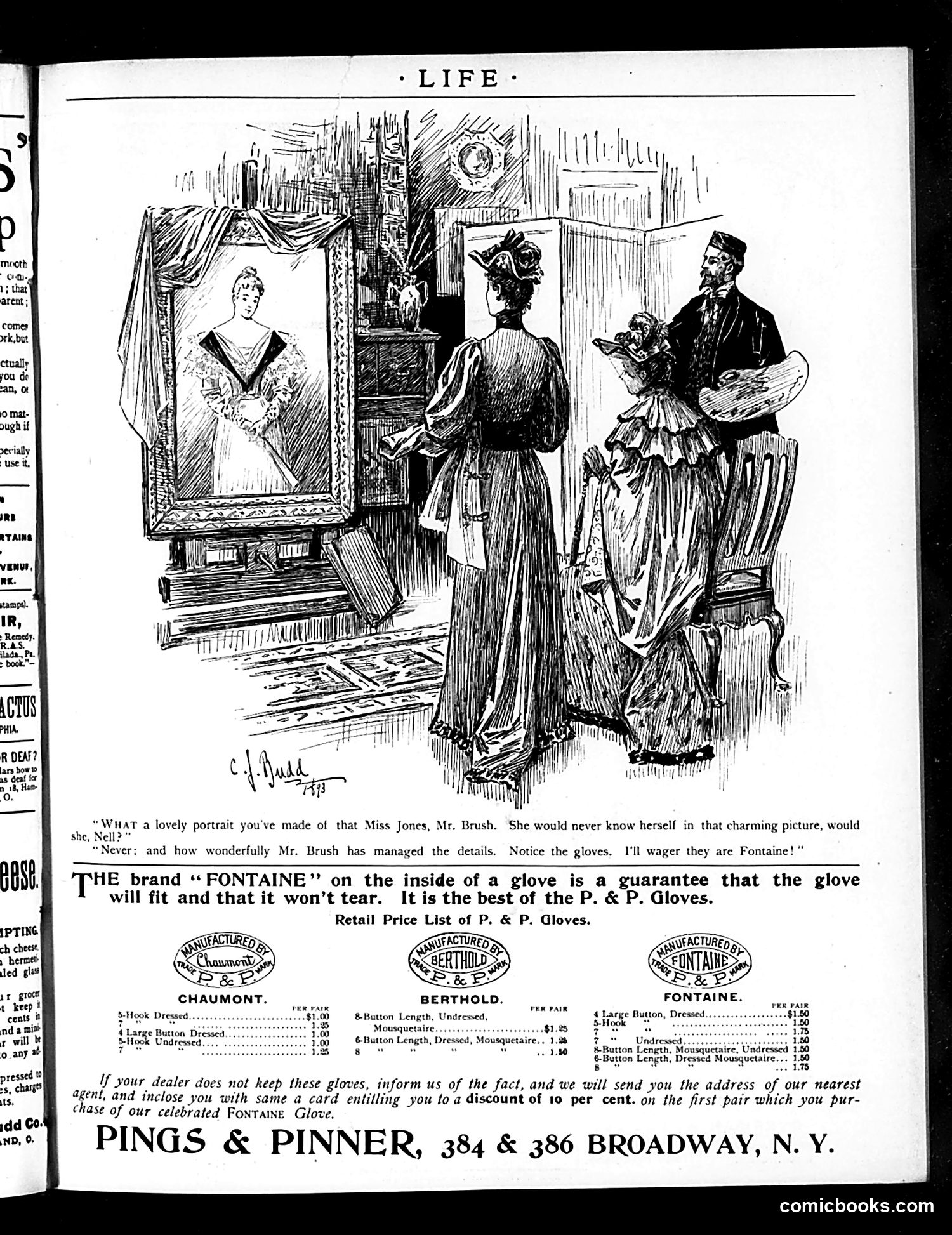
This page is primarily a **commercial advertisement** for P. & P. Gloves, specifically their "Fontaine" brand. The illustration depicts a humorous domestic scene: two women admiring a portrait of "Miss Jones" painted by "Mr. Brush." One woman compliments the artist's attention to detail, particularly noting the gloves in the portrait, confidently predicting they are Fontaine brand. The joke is a gentle, tongue-in-cheek endorsement: the gloves are so well-made and flattering that even in a portrait, their quality is unmistakable. The accompanying text emphasizes that Fontaine gloves fit properly and won't tear—presented as a guarantee of quality. The page lists various glove styles (Chaumont, Berthold, Fontaine) with prices and button lengths. At the bottom, Pings & Pinner (the manufacturer) offers dealers and customers information and a 10% discount incentive. This is early 20th-century consumer advertising using light humor to sell women's gloves.
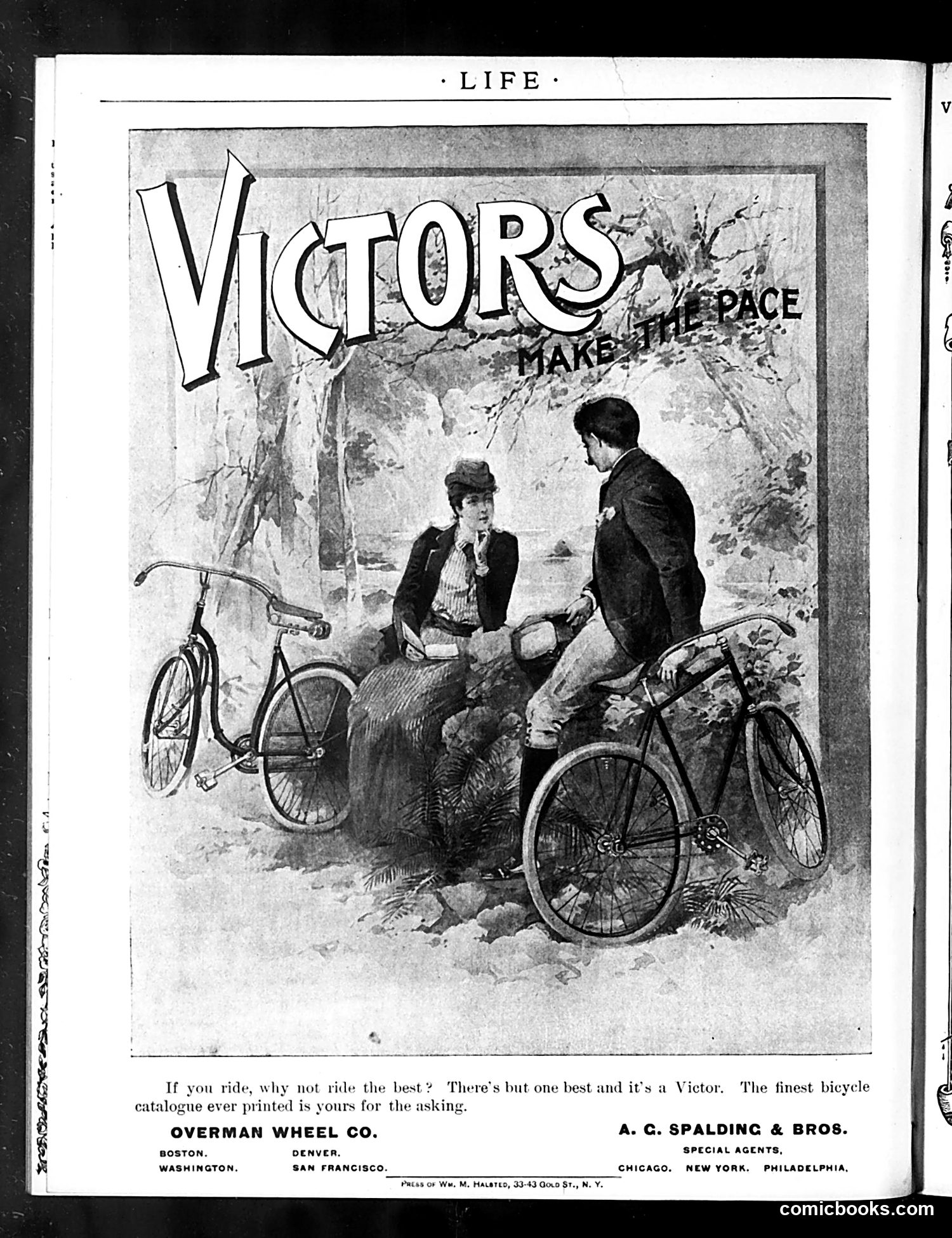
This is primarily a **bicycle advertisement**, not political satire. It's a Victor bicycle ad from the Overman Wheel Co., appearing in *Life* magazine. The image shows two well-dressed people with bicycles by a scenic lakeside, representing leisure and romance—common advertising imagery of the bicycle-craze era (roughly 1890s-early 1900s). The tagline "If you ride, why not ride the best?" is straightforward product promotion. The only mild "satire" is *Life*'s typical light humor in framing this as aspirational lifestyle marketing. There are no political figures, caricatures, or social commentary visible—just a vintage advertisement using attractive imagery and the appeal of quality and status to sell bicycles during their golden age as consumer goods.