
Life, 1893-03-30 · page 16 of 28
Life — March 30, 1893 — page 16: what you’re looking at
What you’re looking at
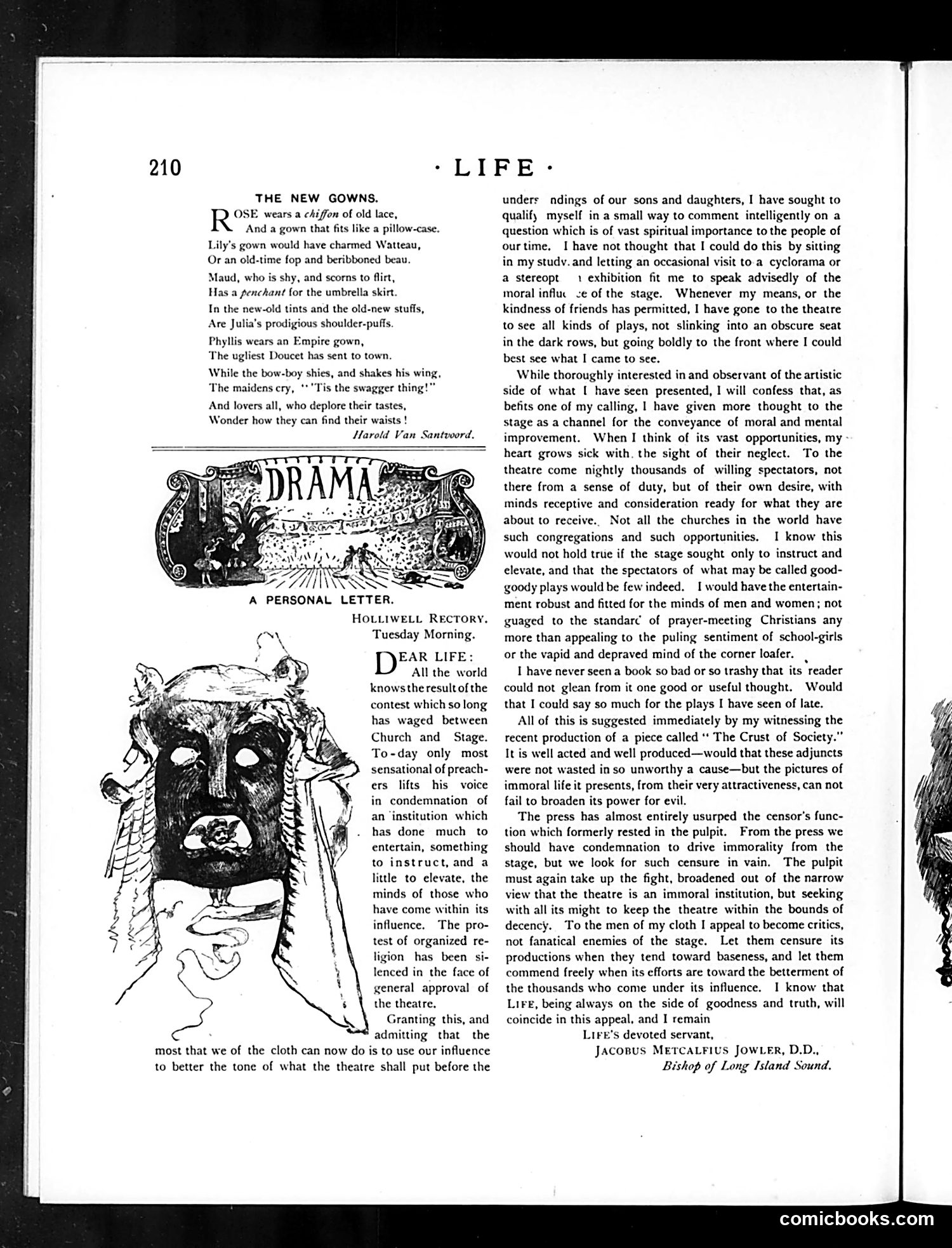
This *Life* magazine page contains two distinct pieces: **"The New Gowns"** (top) is light satirical verse mocking women's fashionable clothing of the era. It humorously catalogs absurd new styles—pillow-case gowns, umbrella skirts, exaggerated shoulder puffs—and ends with the joke that women can't even locate their own waists in these ridiculous getups. The crude illustration shows a grotesquely misshapen female figure, emphasizing the satire. **"A Personal Letter"** (main text) is a clergy member's earnest defense of theatre against religious opposition. The Bishop of Long Island argues the Church has lost its battle against stage entertainment, so religious leaders should instead attend plays to influence their moral content. He critiques both preachy "good-goody plays" and immoral productions like "The Crust of Society," advocating for robust, entertaining drama with subtle moral instruction. The letter represents the early-1900s debate over theatre's cultural and spiritual value.
📄 Transcribed text from this page (OCR, searchable)
Machine-transcribed from the original scan — historical spelling and the odd misread are preserved.
* LIFE: THE NEW GOWNS. OSE wears a chiffon of old lace, And a gown that fits like a pillow-case. Lily's gown would have charmed Watteau, Or an old-time fop and beribboned beau. Maud, who is shy, and scorns to flirt, Has a penchant for the umbrella skirt. In the new-old tints and the old-new stuffs, Are Julia's prodigious shoulder-pufts. Phyllis wears an Empire gown, ‘The ugliest Doucet has sent to town. While the bow-boy shies, and shakes his wing, ‘The maidens cry, ** Tis the swagger thing!” And lovers all, who deplore their tastes, Wonder how they can find their waists ! Harold Van Santvoord. SUA 4 hadstobelp Sop 4, SoO7TN 77H \ ELS A PERSONAL LETTER. HOLLIWELL RECTORY, Tuesday Morning. EAR LIFE: All the world knows the result of the contest which so long has waged between Church and Stage. To-day only most sensational of preach- ers lifts his voice in condemnation of an ‘institution which has done much to entertain, something to instruct, and a little to elevate, the minds of those who have come within its influence. The pro- test of organized re- ligion has been si- lenced in the face of general approval of the theatre, Granting this, and admitting that the most that we of the cloth can now do is to use our influence to better the tone of what the theatre shall put before the ~~ oN unders ndings of our sons and daughters, I have sought to qualify myself in a small way to comment intelligently on a question which is of vast spiritual importance to the people of ourtime. I have not thought that I could do this by sitting in my studv. and letting an occasional visit to.a cyclorama or a stereopt 1 exhibition fit me to speak advisedly of the moral influe ce of the stage. Whenever my means, or the kindness of friends has permitted, I have gone to the theatre to see all kinds of plays, not slinking into an obscure seat in the dark rows, but going boldly to the front where I could best see what I came to see. While thoroughly interested in and observant of the artistic side of what [ have seen presented, | will confess that, as befits one of my calling, | have given more thought to the stage as a channel for the conveyance of moral and mental improvement. When I think of its vast opportunities, my heart grows sick with. the sight of their neglect. To the theatre come nightly thousands of willing spectators, not there from a sense of duty, but of their own desire, with minds receptive and consideration ready for what they are about to receive. Not all the churches in the world have such congregations and such opportunities. I know this would not hold true if the stage sought only to instruct and elevate, and that the spectators of what may be called good- goody plays would be few indeed. I would have the entertain- ment robust and fitted for the minds of men and women; not guaged to the standarc of prayer-meeting Christians any more than appealing to the puling sentiment of school-girls or the vapid and depraved mind of the corner loafer. I have never seen a book so bad or so trashy that its reader could not glean from it one good or useful thought. Would that I could say so much for the plays I have seen of late. All of this is suggested immediately by my witnessing the recent production of a piece called ‘‘ The Crust of Society.” It is well acted and well produced—would that these adjuncts were not wasted in so unworthy a cause—but the pictures of immoral life it presents, from their very attractiveness, can not fail to broaden its power for evil. The press has almost entirely usurped the censor's func- tion which formerly rested in the pulpit. From the press we should have condemnation to drive immorality from the stage, but we look for such censure in vain. The pulpit must again take up the fight, broadened out of the narrow view that the theatre is an immoral institution, but seeking with all its might to keep the theatre within the bounds of decency. To the men of my cloth I appeal to become critics, not fanatical enemies of the stage. Let them censure its productions when they tend toward baseness, and let them commend freely when its efforts are toward the betterment of the thousands who come under its influence. I know that Lire, being always on the side of goodness and truth, will coincide in this appeal, and I remain Lire’s devoted servant, Jacopus METCALFIUS JOWLER, D.D., Bishop of Long Island Sound. comicbooks.com