
Life, 1893-03-30 · page 6 of 28
Life — March 30, 1893 — page 6: what you’re looking at
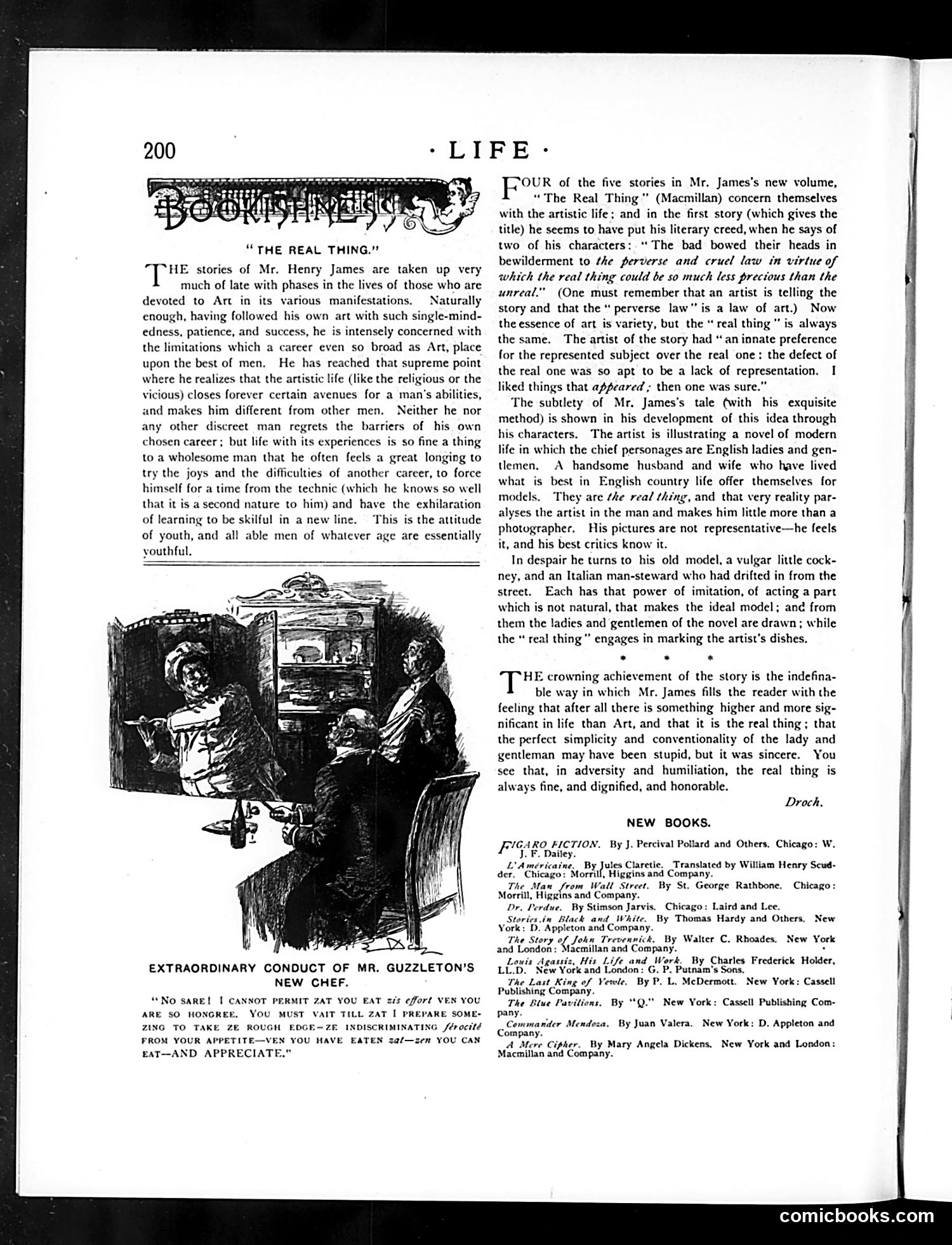
A restored page from Life, 1893-03-30. Page through the whole issue in the reader above.
📄 Transcribed text from this page (OCR, searchable)
Machine-transcribed from the original scan — historical spelling and the odd misread are preserved.
“THE REAL THING.” HE stories of Mr. Henry James are taken up very much of late with phases in the lives of those who are devoted to Art in its various manifestations. Naturally enough, having followed his own art with such single-mind- edness, patience, and success, he is intensely concerned with the limitations which a career even so broad as Art, place upon the best of men. He has reached that supreme point where he realizes that the artistic life (like the religious or the vicious) closes forever certain avenues for a man’s abilities, and makes him different from other men, Neither he nor any other discreet man regrets the barriers of his own chosen career; but life with its experiences is so fine a thing to a wholesome man that he often feels a great longing to try the joys and the difficulties of another career, to force himself for a time from the technic (which he knows so well that it is a second nature to him) and have the exhilaration of learning to be skilful in a new line. This is the attitude of youth, and all able men of whatever age are essentially youthful. EXTRAORDINARY CONDUCT OF MR. GUZZLETON’S NEW CHEF. I CANNOT PERMIT ZAT YOU EAT s/s effort VEN You ARE SO HONGREE, YOU MUST VAIT TILL ZAT I PREPARE SOME- ZING TO TAKE ZE ROUGH EOGE-ZE INDISCRIMINATING /érocété FROM YOUR APPETITE—VEN YOU HAVE EATEN saf—sen YOU CAN EAT—AND APPRECIATE, | “No sarel ‘OUR of the five stories in Mr. James’s new volume, “The Real Thing" (Macmillan) concern themselves with the artistic life; and in the first story (which gives the title) he seems to have put his literary creed, when he says of two of his characters: “The bad bowed their heads in bewilderment to the perverse and cruel law in virtue of which the real thing could be so much less precious than the unreal.” (One must remember that an artist is telling the story and that the “ perverse law a law of art.) Now the essence of art is variety, but the “ real thing " is always the same. The artist of the story had “ an innate preference for the represented subject over the real one: the defect of the real one was so apt to be a lack of representation. I liked things that appeared ; then one was sure.” The subtlety of Mr. James's tale (with his exquisite method) is shown in his development of this idea through his characters. The artist is illustrating a novel of modern life in which the chief personages are English ladies and gen- tlemen. A handsome husband and wife who have lived what is best in English country life offer themselves for models, They are the read thing, and that very reality par- alyses the artist in the man and makes him little more than a photographer. His pictures are not representative—he feels it, and his best critics know it. In despair he turns to his old model, a vulgar little cock- ney, and an Italian man-steward who had drifted in from the street, Each has that power of imitation, of acting a part which is not natural, that makes the ideal model; and from them the ladies and gentlemen of the novel are drawn; while the “ real thing” engages in marking the artist's dishes. . . * HE crowning achievement of the story is the indefina- ble way in which Mr. James fills the reader with the feeling that after all there is something higher and more sig- nificant in life than Art, and that it is the real thing; that the perfect simplicity and conventionality of the lady and gentleman may have been stupid, but it was sincere. You see that, in adversity and humiliation, the real thing is always fine, and dignified, and honorable. Droch. NEW BOOKS. FIGARO FICTION. By J. Percival Pollard and Others, Chicago: W. J. F. Dailey. LiAmericaing By Jules Claretic, Translated by William Henry Scud- Higgins and Company. By St. George Rathbone. der.” Chicago: Mornil The Man from Wall Street. Morrill, Higgins and Company. Dr. Perdue. By Stimson Jarvis, Chicago: Laird and Lee. Stories.in Black and White. By Thomas Hardy and Others, Yor ‘Appleton and Company. ¢ Story of John Trevennick, By Walter C, Rhoades. New York and London: Macmillan and Compan ° Louis Agassiz, His Life and Werk. By Charles Frederick Holder, LL.D. New York and London: G. P. Putnam's Sons. The Last King of Yewle. By P. L. McDermott. Publishing Company. The Blue Pavilions. pany. Commander Mendoza, Compan: A Mere Cipher. By Mary Angela Dickens, New York and London: Macmillan and Company. Chicago : New New York: Cassell By “Q." New York: Cassell Publishing Com- By Juan Valera. New York: D. Appleton and comicbooks.com