
Life, 1893-03-30 · page 4 of 28
Life — March 30, 1893 — page 4: what you’re looking at
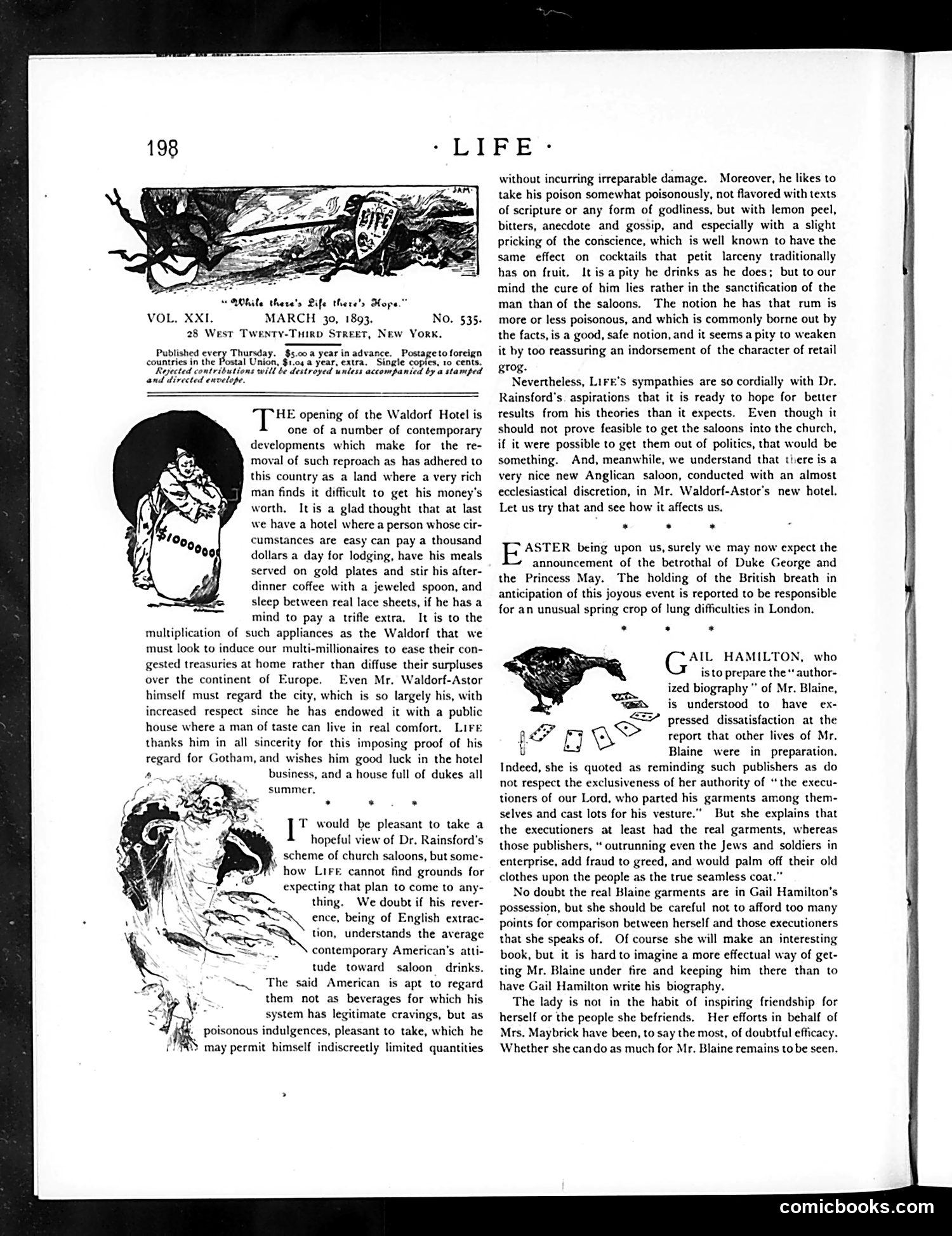
What you’re looking at
This page contains editorial commentary rather than political cartoons. The main illustration shows a wealthy man laden with jewelry and ornaments—representing the nouveau riche opening the Waldorf Hotel, a luxury establishment for millionaires. The satire mocks the ease with which wealthy Americans can accumulate excessive luxury. Below, a sketch appears to illustrate Dr. Rainsford's proposal for church saloons—establishments serving alcohol within religious settings. Life expresses skepticism about this scheme, doubting it would succeed in converting saloon-goers while questioning whether churches should operate such ventures. The page also discusses Gail Hamilton's biography of Mr. Blaine and debates about its accuracy and the executors' handling of his estate papers.
📄 Transcribed text from this page (OCR, searchable)
Machine-transcribed from the original scan — historical spelling and the odd misread are preserved.
LIFE “While there's Life there's Hope.” VOL, XXI. MARCH 30, 1893. No. 535. 28 West Twenty-Tuirp STREET, New York. Published every Thursday. $s.coa year in advance. | Postage to foreign countries in the Postal Union, $1.04 a year, extra. Single copies, 10 cents. Rejected contributions will be destroyed untess accompanied by a stamped and directed envelope. HE opening of the Waldorf Hotel is one of a number of contemporary developments which make for the re- moval of such reproach as has adhered to this country as a land where a very rich man finds it difficult to get his money's worth, Itis a glad thought that at last we have a hotel where a person whose cir- cumstances are easy can pay a thousand dollars a day for lodging, have his meals served on gold plates and stir his after- dinner coffee with a jeweled spoon, and sleep between real lace sheets, if he has a mind to pay a trifle extra. It is to the multiplication of such appliances as the Waldorf that we must look to induce our multi-millionaires to ease their con- gested treasuries at home rather than diffuse their surpluses over the continent of Europe. Even Mr. Waldorf-Astor himself must regard the city, which is so largely his, with increased respect since he has endowed it with a public house where a man of taste can live in real comfort. LIFE thanks him in all sincerity for this imposing proof of his regard for Gotham, and wishes him good luck in the hotel business, and a house full of dukes all summer. . . * I" would be pleasant to take a hopeful view of Dr. Rainsford's scheme of church saloons, but some- how LiFe cannot find grounds for expecting that plan to come to any- thing. We doubt if his rever- a SA. ence, being of English extrac- Vi Tx SN tion, understands the average contemporary American's atti } tude toward saloon drinks. The said American is apt to regard them not as beverages for which his system has legitimate cravings, but as poisonous indulgences, pleasant to take, which he FR may permit himself indiscreetly limited quantities without incurring irreparable damage. Moreover, he likes to take his poison somewhat poisonously, not flavored with texts of scripture or any form of godliness, but with lemon peel, bitters, anecdote and gossip, and especially with a slight pricking of the conscience, which is well known to have the same effect on cocktails that petit larceny traditionally has on fruit. It is a pity he drinks as he does; but to our mind the cure of him lies rather in the sanctification of the man than of the saloons. The notion he has that rum is more or less poisonous, and which is commonly borne out by the facts, is a good, safe notion, and it seems a pity to weaken it by too reassuring an indorsement of the character of retail grog. Nevertheless, L1FE’S sympathies are so cordially with Dr. Rainsford's. aspirations that it is ready to hope for better results from his theories than it expects. Even though it should not prove feasible to get the saloons into the church, if it were possible to get them out of politics, that would be something. And, meanwhile, we understand that there is a very nice new Anglican saloon, conducted with an almost ecclesiastical discretion, in Mr. Waldorf-Astor’s new hotel. Let us try that and see how it affects us. pe ASTER being upon us, surely we may now expect the announcement of the betrothal of Duke George and the Princess May. The holding of the British breath in anticipation of this joyous event is reported to be responsible for an unusual spring crop of lung difficulties in London. . . * GAL HAMILTON, who isto prepare the** author- ized biography" of Mr. Blaine, is understood to have ex- pressed dissatisfaction at the eee 502" report that other lives of Mr. u Blaine were in preparation, Indeed, ae is quoted as reminding such publishers as do not respect the exclusiveness of her authority of “the execu- tioners of our Lord, who parted his garments among them- selves and cast lots for his vesture.”” But she explains that the executioners at least had the real garments, whereas those publishers, “ outrunning even the Jews and soldiers in enterprise, add fraud to greed, and would palm off their old clothes upon the people as the true seamless coat.” No doubt the real Blaine garments are in Gail Hamilton's possession, but she should be careful not to afford too many points for comparison between herself and those executioners that she speaks of. Of course she will make an interesting book, but it is hard to imagine a more effectual way of get- ting Mr. Blaine under fire and keeping him there than to have Gail Hamilton write his biography. The lady is not in the habit of inspiring friendship for herself or the people she befriends. Her efforts in behalf of Mrs. Maybrick have been, to say the most, of doubtful efficacy. Whether she cando as much for Mr. Blaine remains to be seen. comicbooks.com