
A complete issue · 16 pages · 1893
Life — March 9, 1893
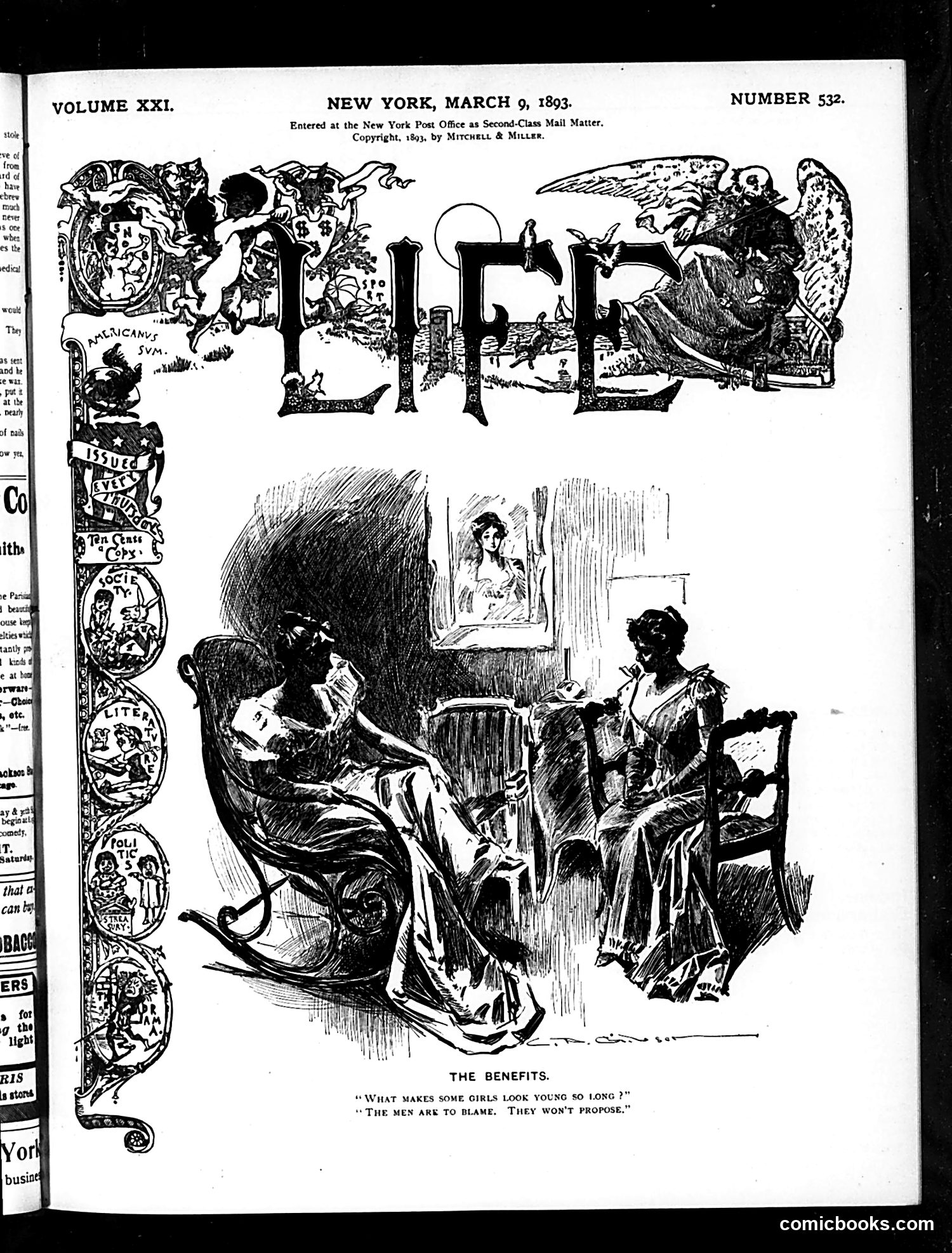
This page from *Life* magazine contains a satirical illustration titled "The Benefits." The cartoon depicts two women in conversation—one reclining and one seated—with dialogue reading: "What makes some girls look so young so long?" / "The men are to blame. They won't propose." The satire targets Victorian-era marriage customs and gender expectations. The joke suggests that unmarried women retain their youthful appearance longer because they avoid the physical and emotional toll of marriage. This reflects period anxieties about matrimony's effects on women's health and appearance, while simultaneously critiquing men's reluctance to marry. The ornate decorative border on the left is typical of *Life*'s design aesthetic from this era.
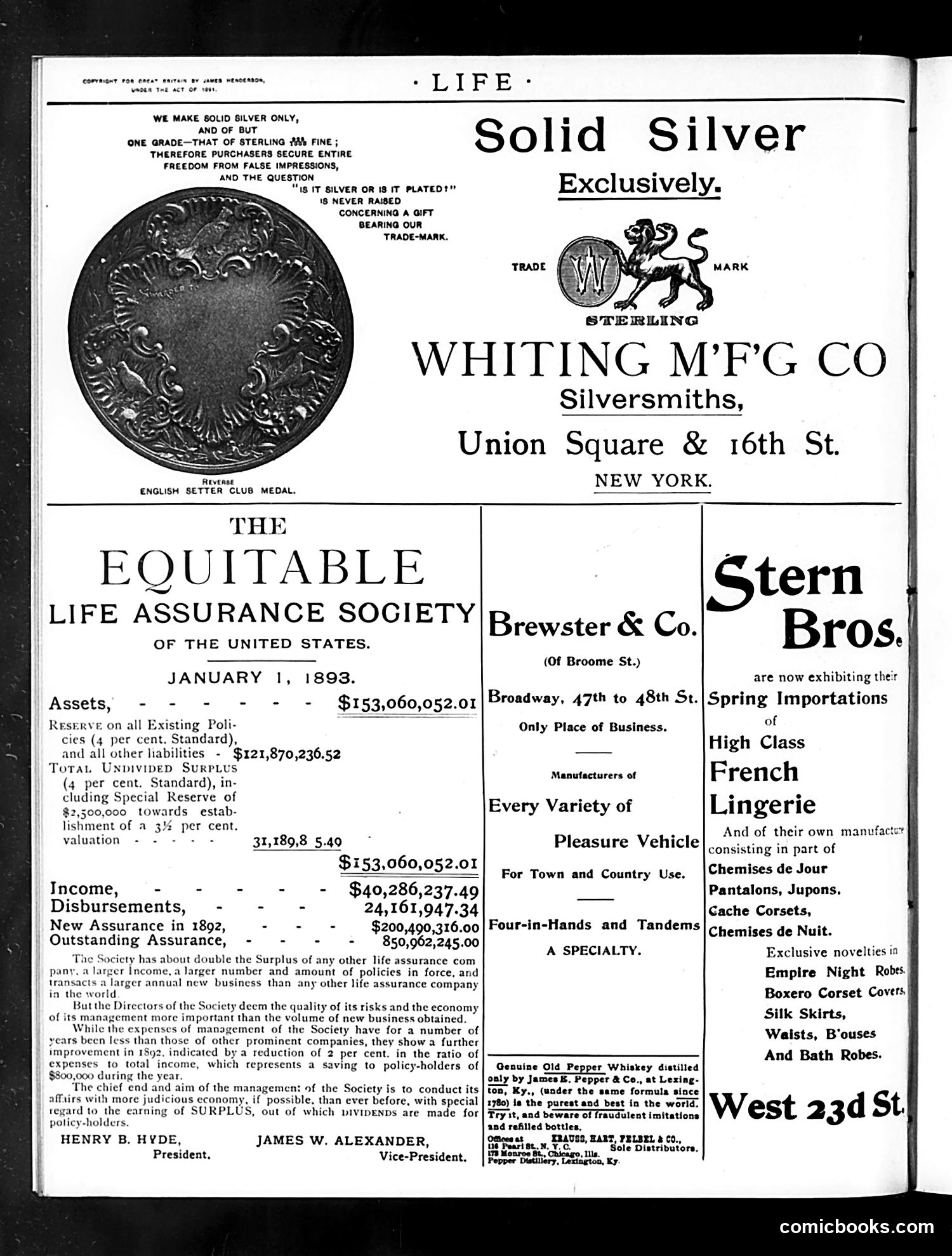
This page is primarily **advertising**, not satirical content. The advertisements include: 1. **Whiting Mfg Co** (silversmiths) - emphasizing solid sterling silver goods, with an ornate medallion image 2. **Equitable Life Assurance Society** - financial statement from January 1, 1893 3. **Brewster & Co** - manufacturers of pleasure vehicles (carriages) 4. **Stern Bros** - advertising French lingerie and corsets There is no political cartoon visible on this page. The decorative medallion is merely a product image for the silversmith company. The page represents typical late-19th-century *Life* magazine advertising—luxury goods targeted at wealthy readers—rather than satirical commentary.
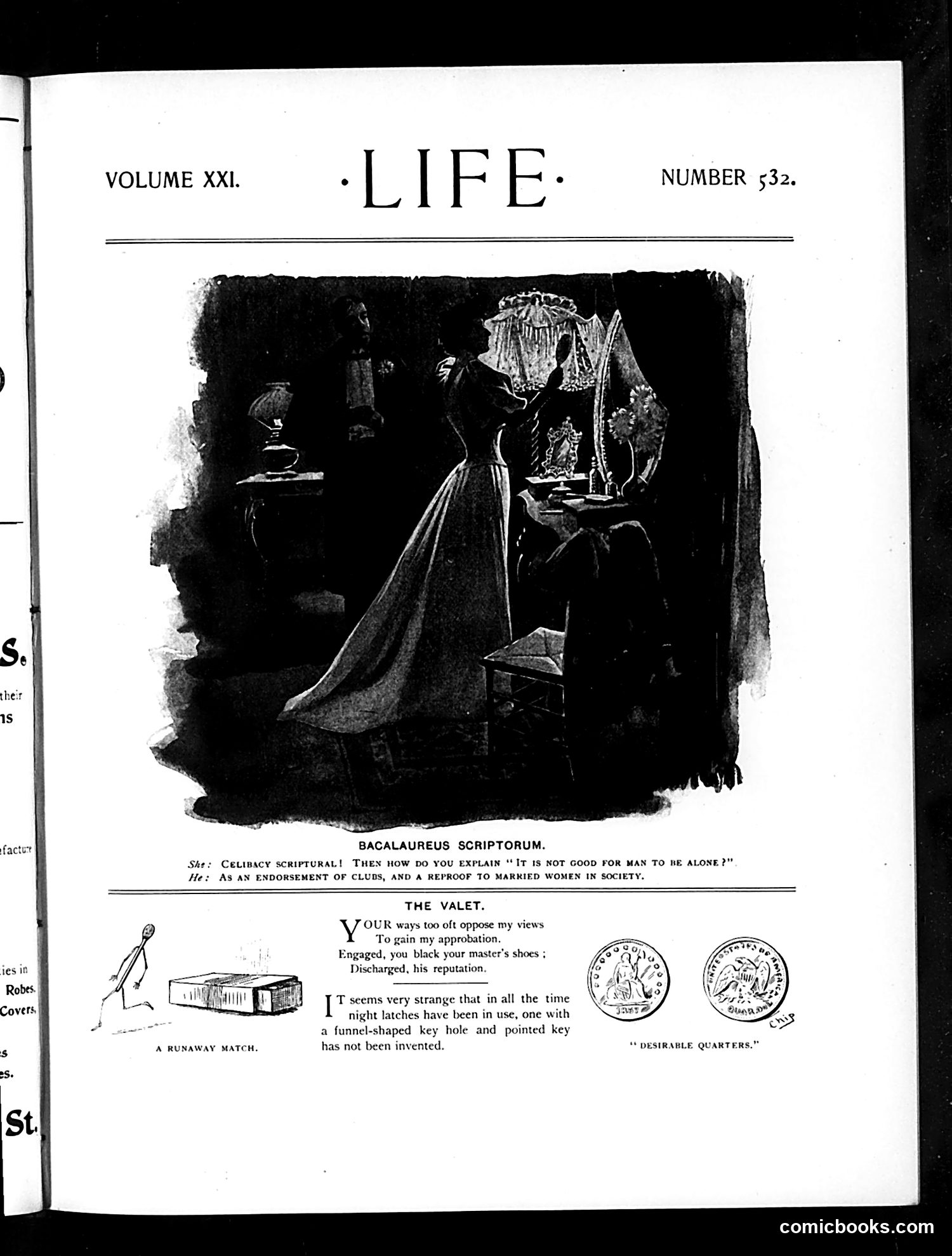
**Main Illustration:** A dramatic scene depicting a woman in classical dress confronting figures in what appears to be a formal interior. The Latin title translates to "Bachelor of Letters/Writings." **The Satire:** The caption quotes a character explaining "It is not good for man to be alone," which he endorses as support from "clubs, and a reproof to married women in society." This appears to satirizing arguments used by men's clubs to justify their exclusivity—claiming bachelor societies are morally necessary while simultaneously critiquing women's social roles. **"The Valet" Section:** Contains witty observations about servants blackening masters' shoes and damaging reputations, plus a comment about an unpatented night-latch design. The page mixes social commentary on gender, marriage, and class hierarchies typical of early 20th-century American satire.
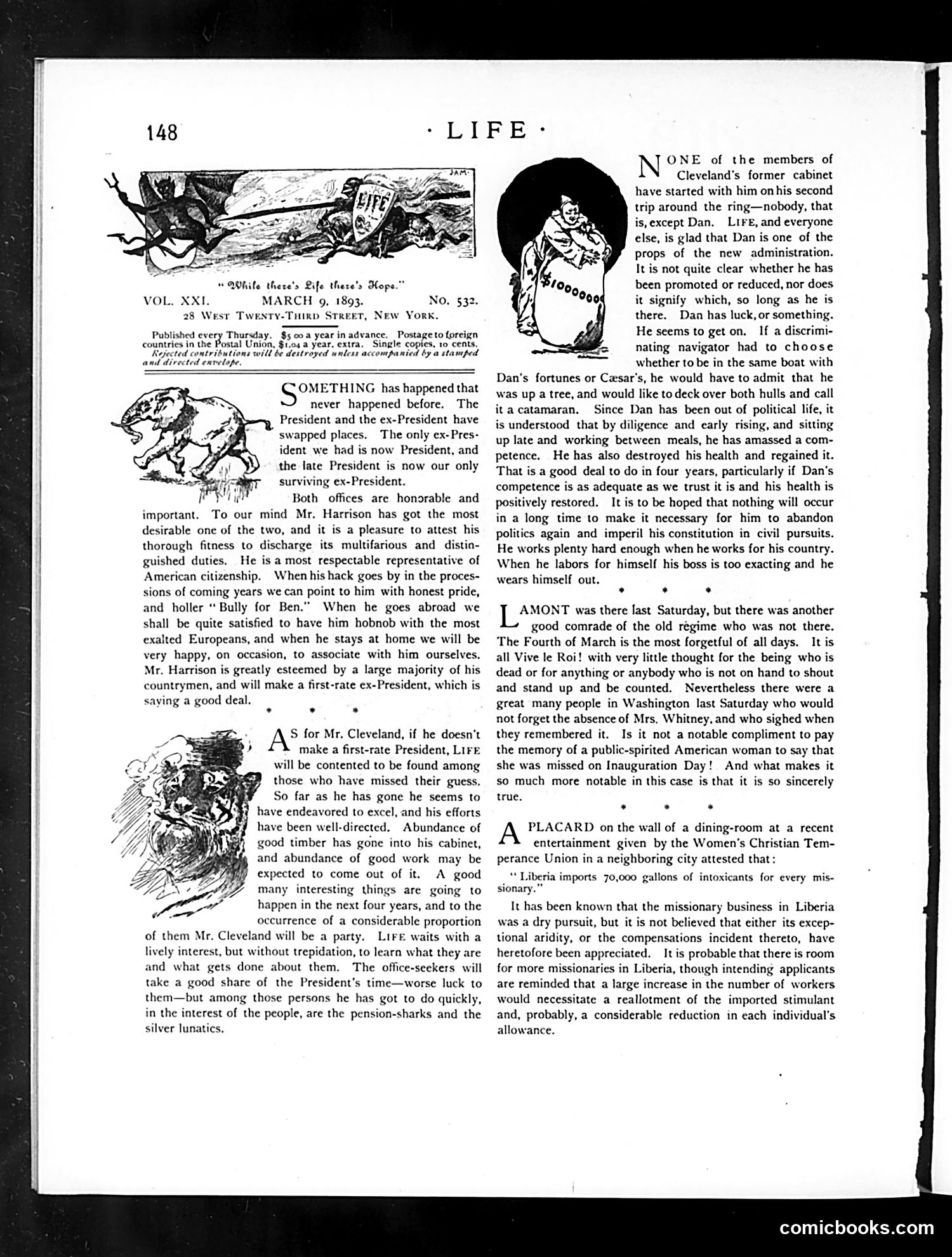
This page satirizes the transition between President Cleveland and President Harrison's administrations. The text discusses how both men are now "surviving ex-Presidents"—an unusual situation at the time. The cartoons mock the political establishment's jockeying for position and favor. One sketch appears to show a dog (likely representing a political operative or office-seeker) sniffing around, suggesting the scramble for patronage appointments under the new administration. The commentary suggests Cleveland was well-regarded, but the page takes aim at office-seekers and political operatives ("pension-sharks and silver lunatics") who will pressure Harrison for positions and favors. The satire centers on the self-serving nature of politics and the burden placed on incoming administrations by those seeking government posts and influence.
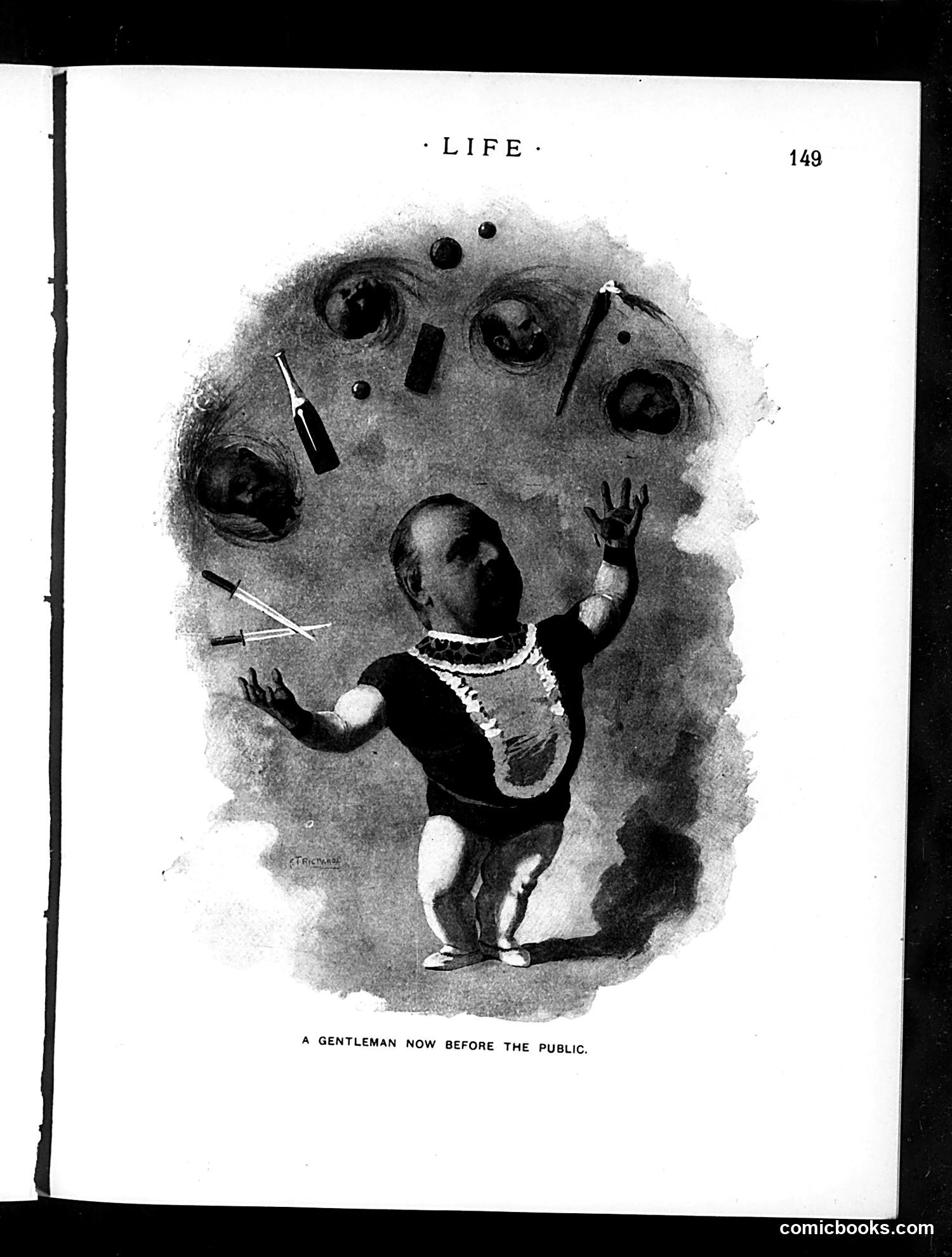
This satirical cartoon titled "A Gentleman Now Before the Public" depicts a small man juggling various objects while facing an enormous, featureless head—likely representing public opinion or scrutiny. The objects being juggled appear to include bottles, tools, and other implements, suggesting the figure is attempting to maintain multiple public personas or interests simultaneously. The satire critiques how public figures must perform and balance competing demands when exposed to public attention. The vast, looming head represents the all-seeing public eye, while the small man's frantic juggling act illustrates the precarious performance required of anyone seeking public acceptance or approval. The cartoon suggests the exhausting, inauthentic nature of public life during this era.
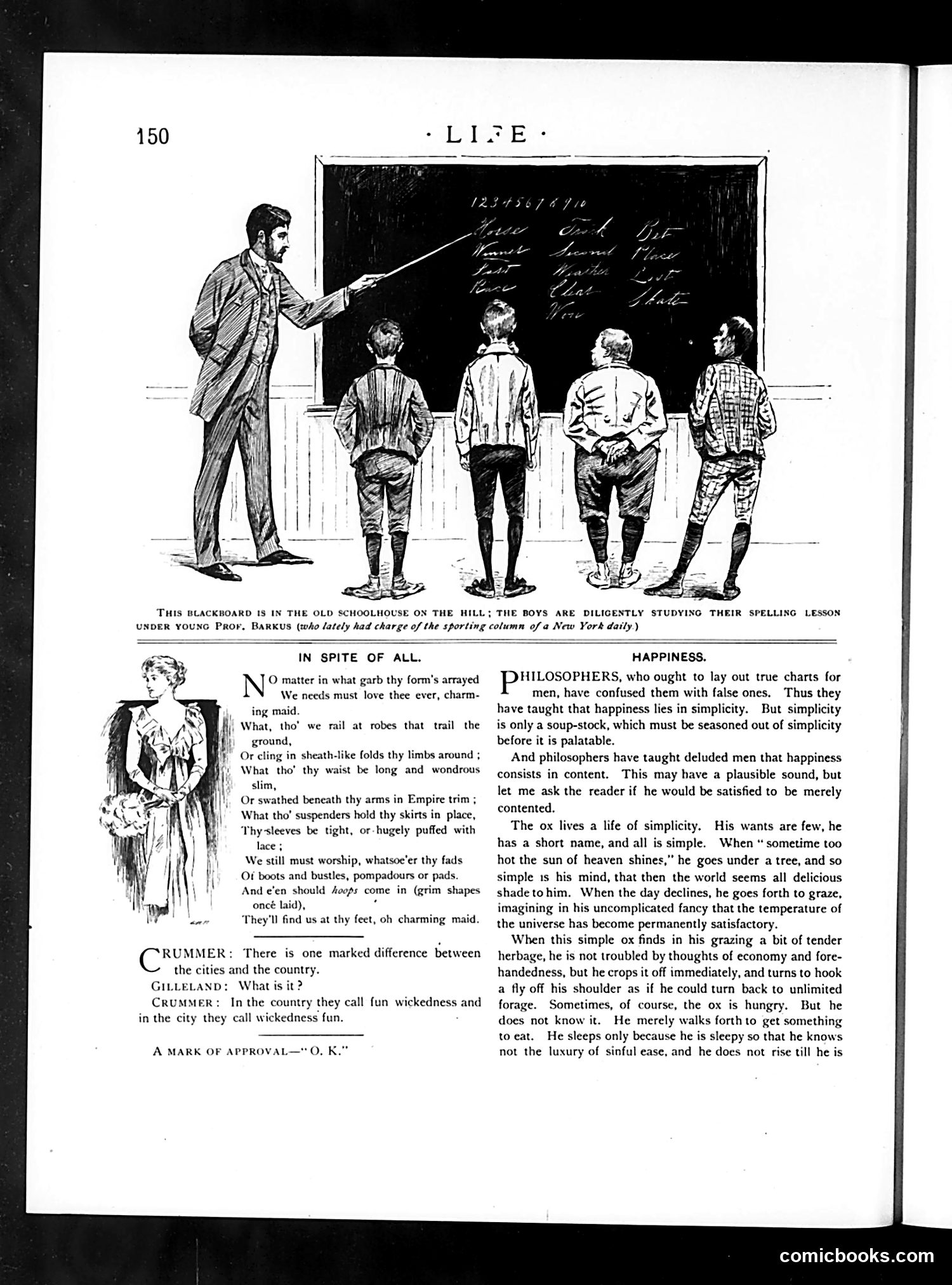
**The Main Cartoon**: Shows a schoolteacher pointing at a blackboard while four boys study a spelling lesson in an old schoolhouse. The caption notes this depicts "diligent studying" under "young Prof. Harkus" at the old schoolhouse on the hill. **"In Spite of All" Section**: A satirical poem mocks elaborate Victorian women's fashion, listing ridiculous garments and accessories women wear despite discomfort. **"Happiness" Essay**: A philosophical piece argues that true happiness comes from simplicity and contentment—living modestly without worrying about economy or luxury. The essay contrasts the simple life (few wants, basic needs) with unnecessary complexity. **The Crummer/Gilliland Dialogue**: A brief exchange joking that cities contain "wickedness" while country areas contain merely "fun wickedness." The page blends educational satire with period philosophy on fashion, rural life, and contentment.
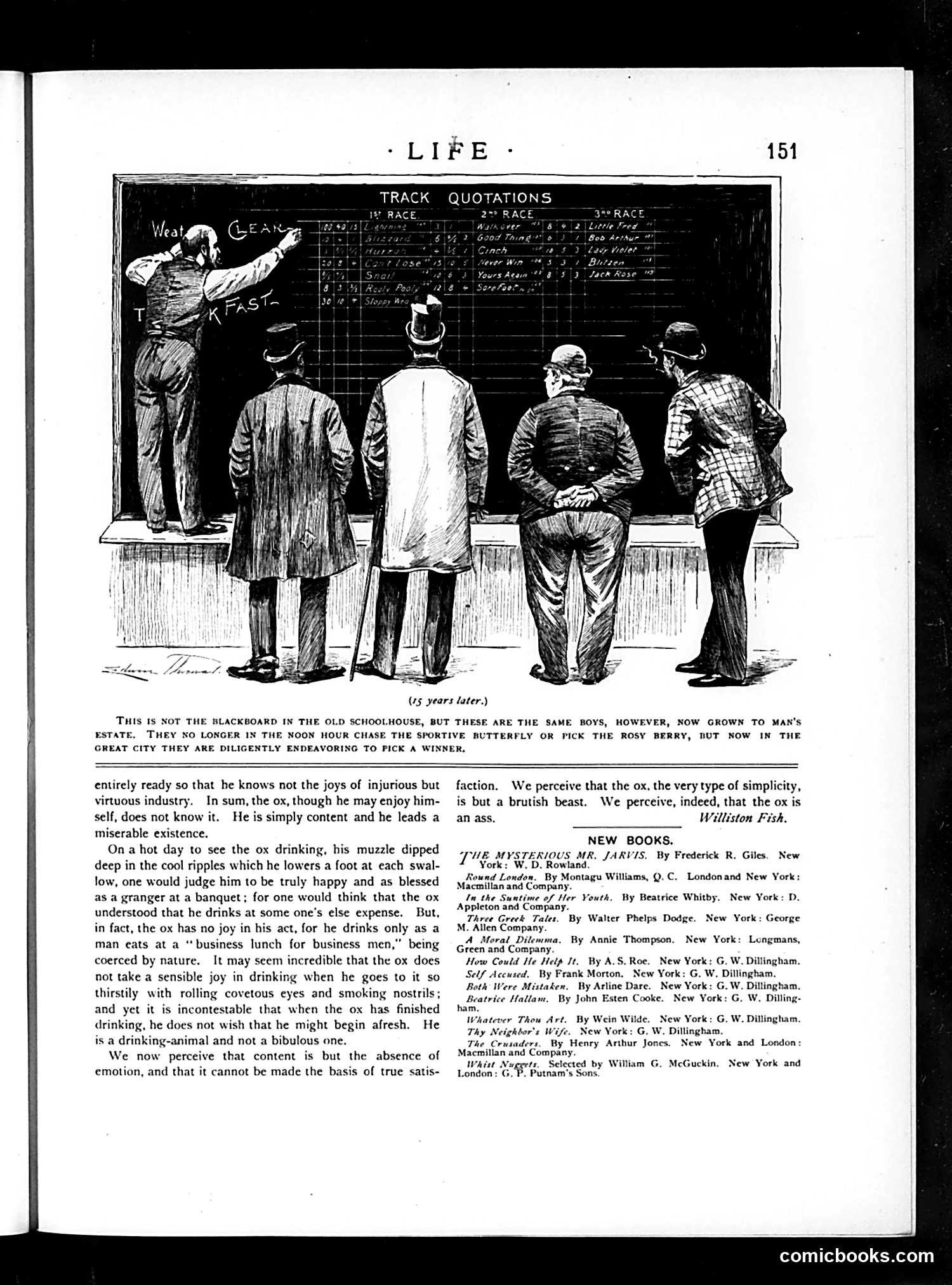
This cartoon satirizes **horse racing betting culture** in early 20th-century America. The illustration shows five men in suits and hats gathered at what appears to be a betting board ("Track Quotations") displaying race odds. The caption explains the joke: these are the same schoolboys from years past who once chased butterflies and picked berries during recess. Now, as grown men in the city, they're engaged in the "serious business" of picking horse-race winners instead—a pointed commentary on how childhood innocence transforms into adult gambling habits. The satire suggests that men simply substitute one form of leisure pursuit for another as they mature, with betting replacing innocent outdoor play. It's a gentle critique of how gambling had become normalized recreation among urban adult males.
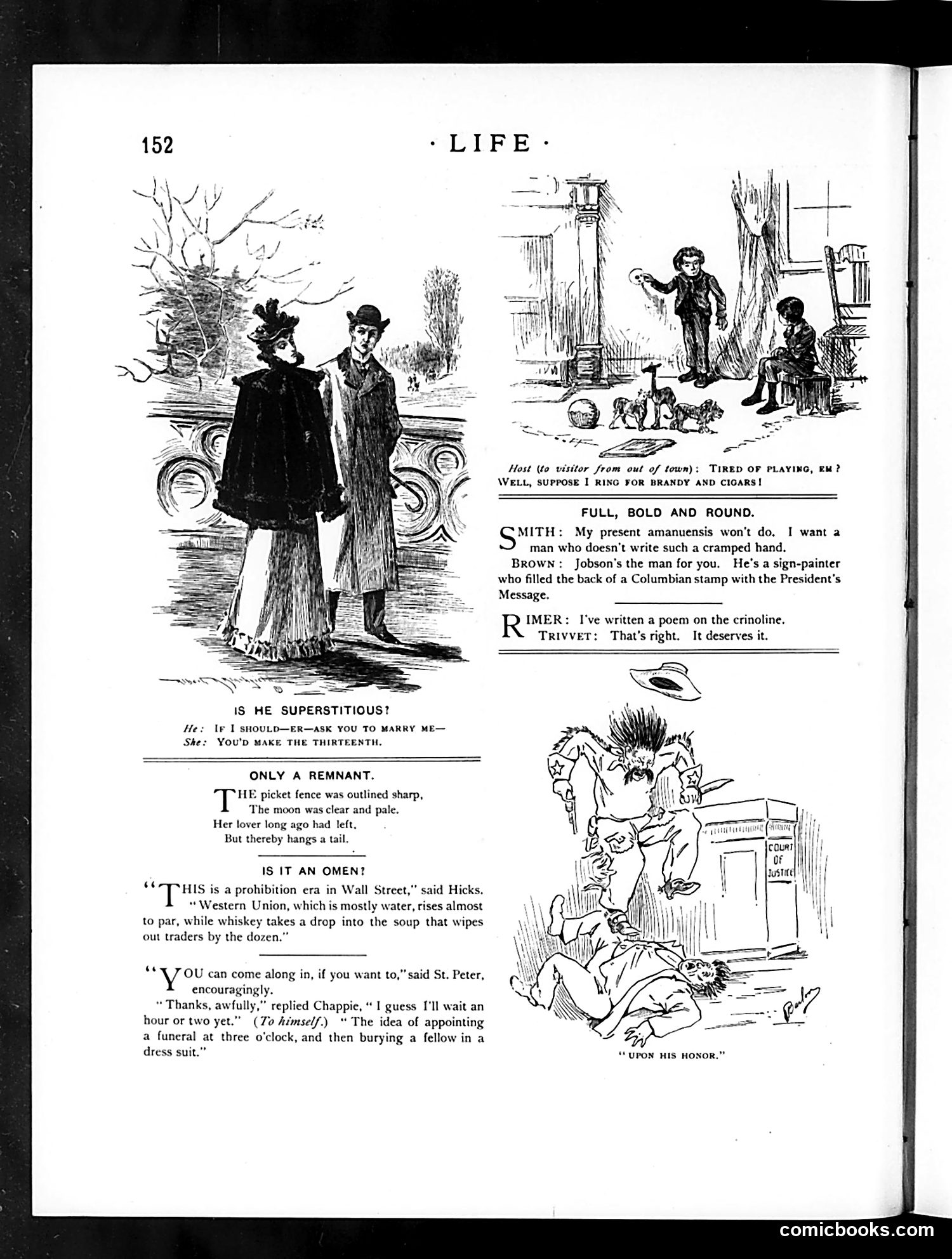
This page contains several humorous sketches with brief comedic dialogues: 1. **"Is He Superstitious?"** - A man proposes marriage on the 13th, which the woman rejects as unlucky. 2. **"Only a Remnant"** - A poetic meditation on a picket fence and moon, ending with "But thereby hangs a tail"—wordplay on the phrase "thereby hangs a tale." 3. **"Full, Bold and Round"** - A dialogue about finding a suitable writer; Brown recommends Jobson, a sign-painter who decorated a Columbian stamp. 4. **"Is It an Omen?"** - Hicks makes a joke about Prohibition-era water (Western Union) versus whiskey in soup. 5. **"Upon His Honor"** - A cartoon showing St. Peter and Chappie discussing funeral appointments. The sketches represent typical early 20th-century American humor targeting social conventions and contemporary references like Prohibition.
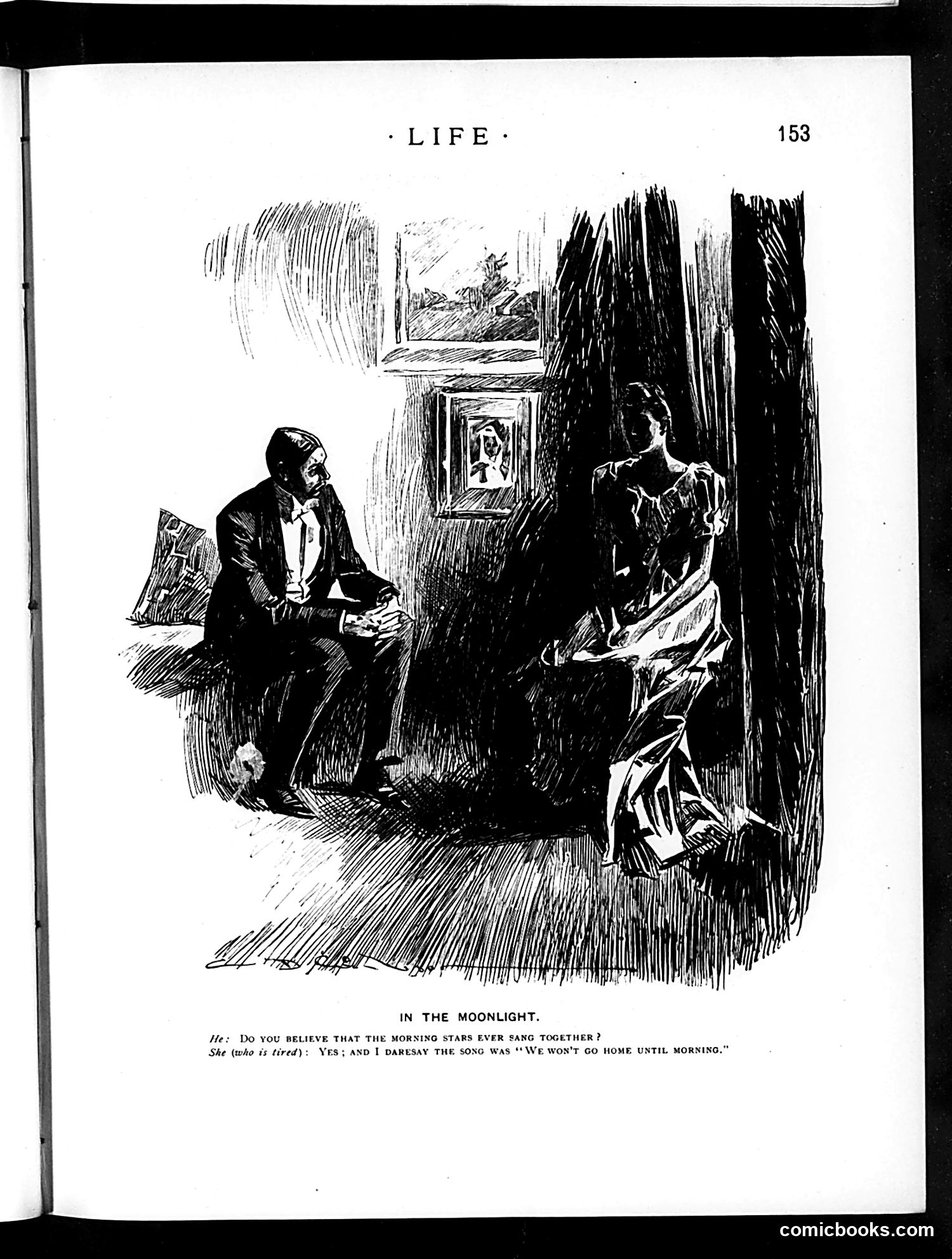
This is a romantic cartoon showing a couple in an intimate late-night setting. The man, dressed formally in a suit, sits beside a woman in what appears to be a bedroom or private room with curtains and a small framed picture on the wall. The humor relies on a playful contradiction: he asks if she believes "the morning stars ever sang together," while she responds that she and he "dareday the song was 'We won't go home until morning.'" The joke satirizes romantic idealization versus practical reality—he quotes poetic, heavenly sentiment while she references a drinking song suggesting they'll stay up all night. It's gentle satire on the gap between romantic rhetoric and actual behavior in courtship situations.
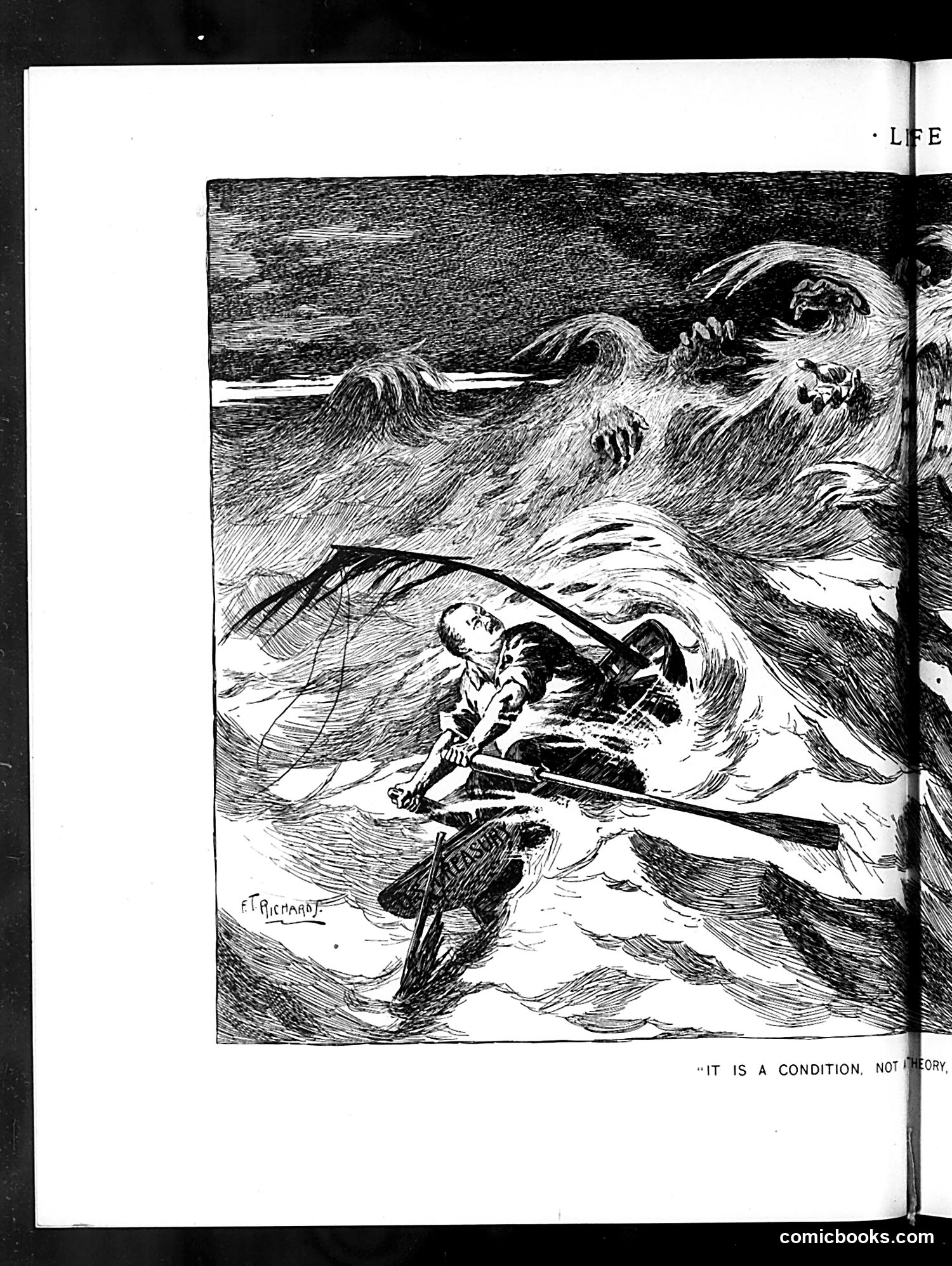
This is a dramatic engraving by F.F. Richard showing a figure struggling against powerful waves in turbulent waters. The figure appears to be clinging to an oar or pole while being overwhelmed by the sea. The caption reads: "IT IS A CONDITION, NOT A THEORY." This is political satire, likely critiquing someone's position on a major issue of the day. The drowning figure represents someone whose political stance or policy is failing catastrophically in practice—the "condition" of reality contradicts their "theory." Without the specific historical context, I cannot identify which political figure or issue is referenced, but the message is clear: whatever this person advocates for is proving disastrous when implemented, and no amount of theoretical argument matters when facing harsh practical reality.
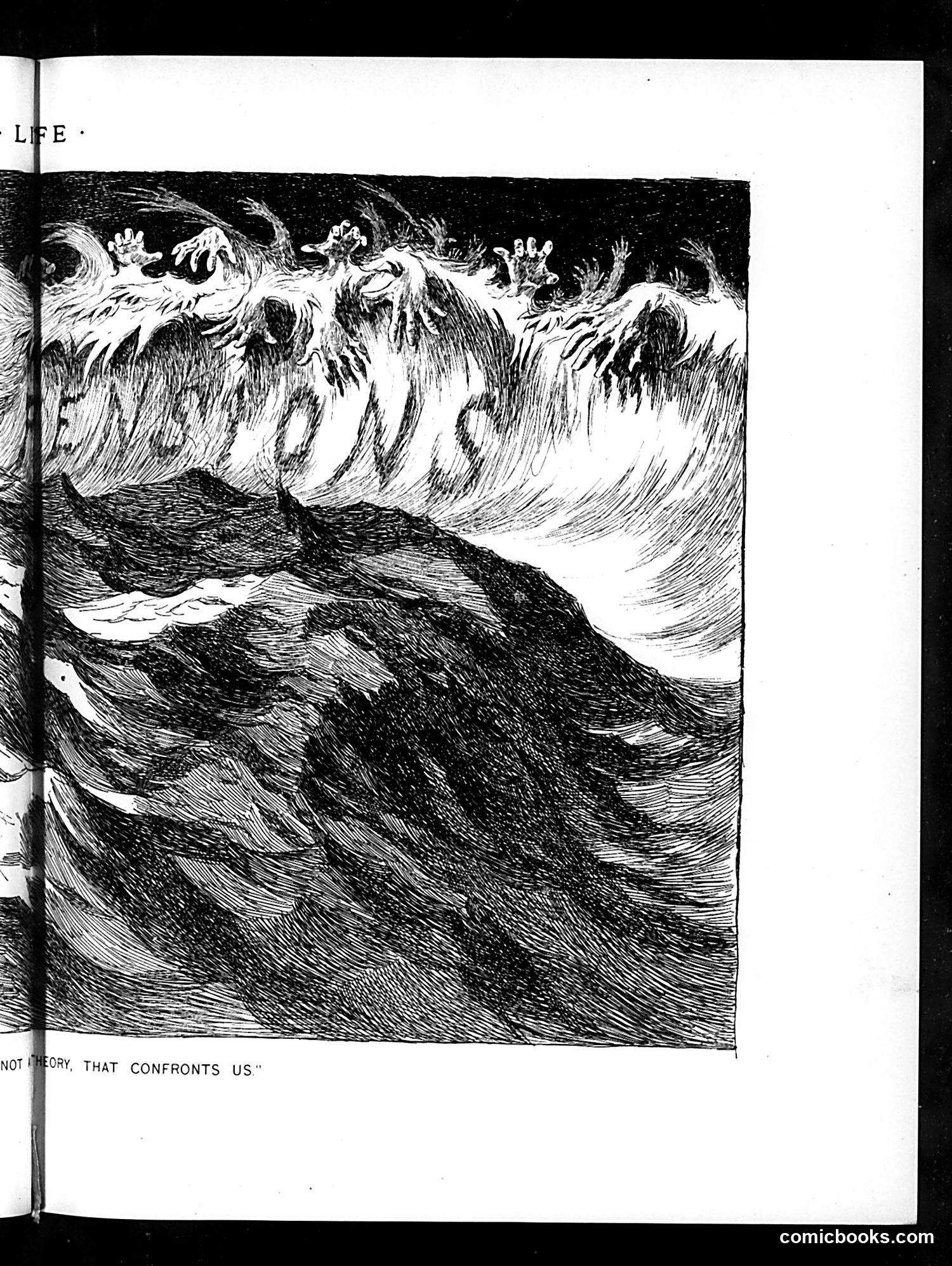
This etching depicts a dramatic seascape with turbulent waves and what appears to be humanoid figures emerging from or struggling within the water. The visible text fragment reads "NOT THEORY, THAT CONFRONTS US," suggesting a commentary on practical, immediate challenges rather than abstract philosophy. The style and composition evoke chaos and struggle, likely representing a contemporary crisis or threat facing society. The figures' distressed poses and the violent wave action suggest danger or upheaval. Without additional context or visible captions identifying specific political figures or events, the exact subject remains unclear—though the overall tone indicates serious social or political commentary typical of *Life* magazine's satirical approach during its heyday as a vehicle for social criticism.
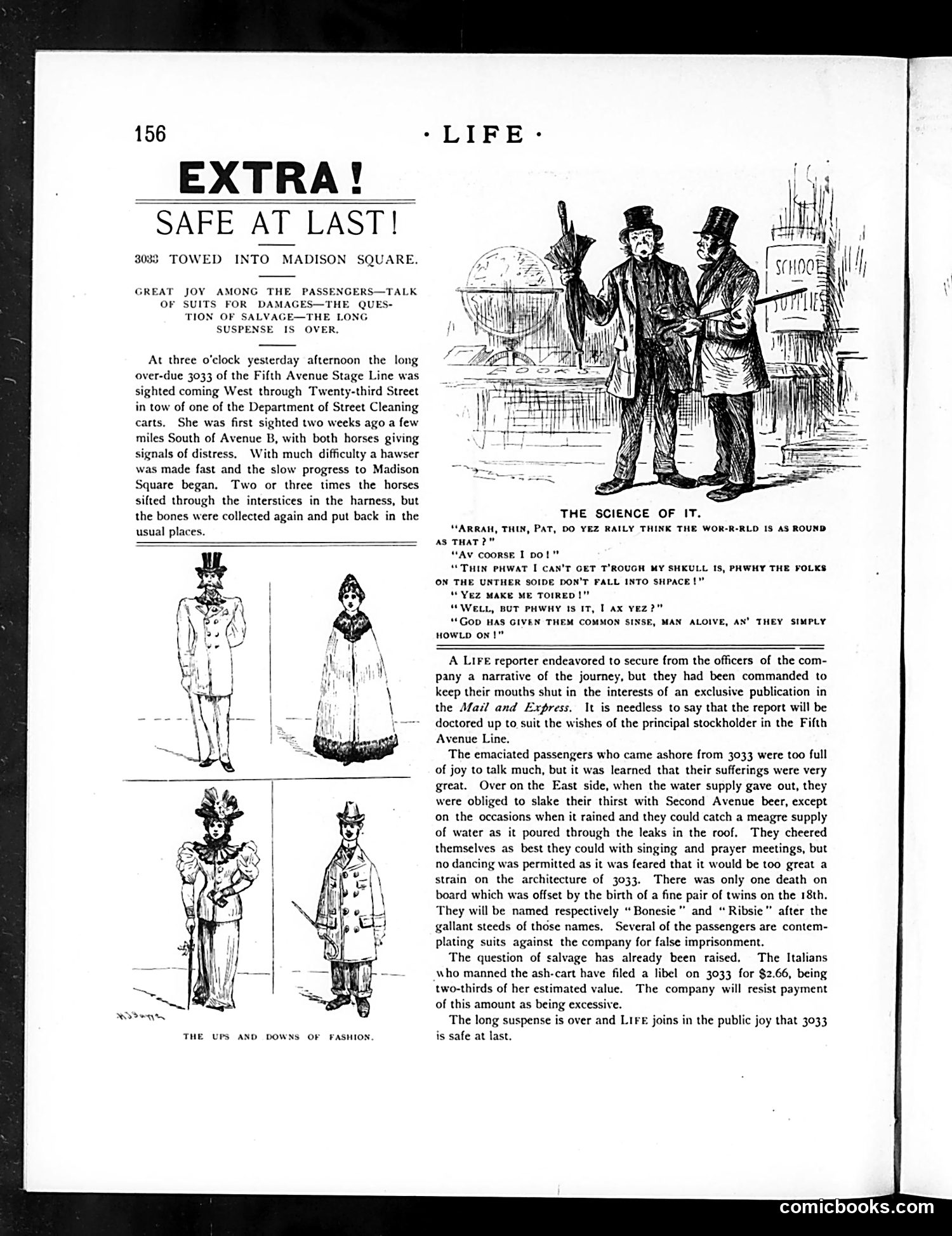
This *Life* article satirizes a real or plausible incident: a Fifth Avenue Stage Line omnibus (streetcar #3033) that went missing for two weeks before being towed to Madison Square by a Department of Street Cleaning cart—pulled by horses so malnourished their bones protruded through their harnesses. The satire targets multiple subjects: the incompetence of the transit company, the sensationalism of competing newspapers (the *Mail and Express*), and corporate indifference to passenger suffering. Passengers endured two weeks without adequate water, drinking "Second Avenue beer" instead, yet the company apparently forbade dancing to avoid damaging the vehicle's structure. The lower cartoon about the flat earth uses Irish-dialect working-class characters to mock popular scientific confusion—a separate humor piece on the page. The fashion sketches appear incidental. The joke: *Life* celebrates the omnibus's "safe" arrival while highlighting the company's negligence, the absurd salvage disputes, and broader institutional failures in Gilded Age New York.
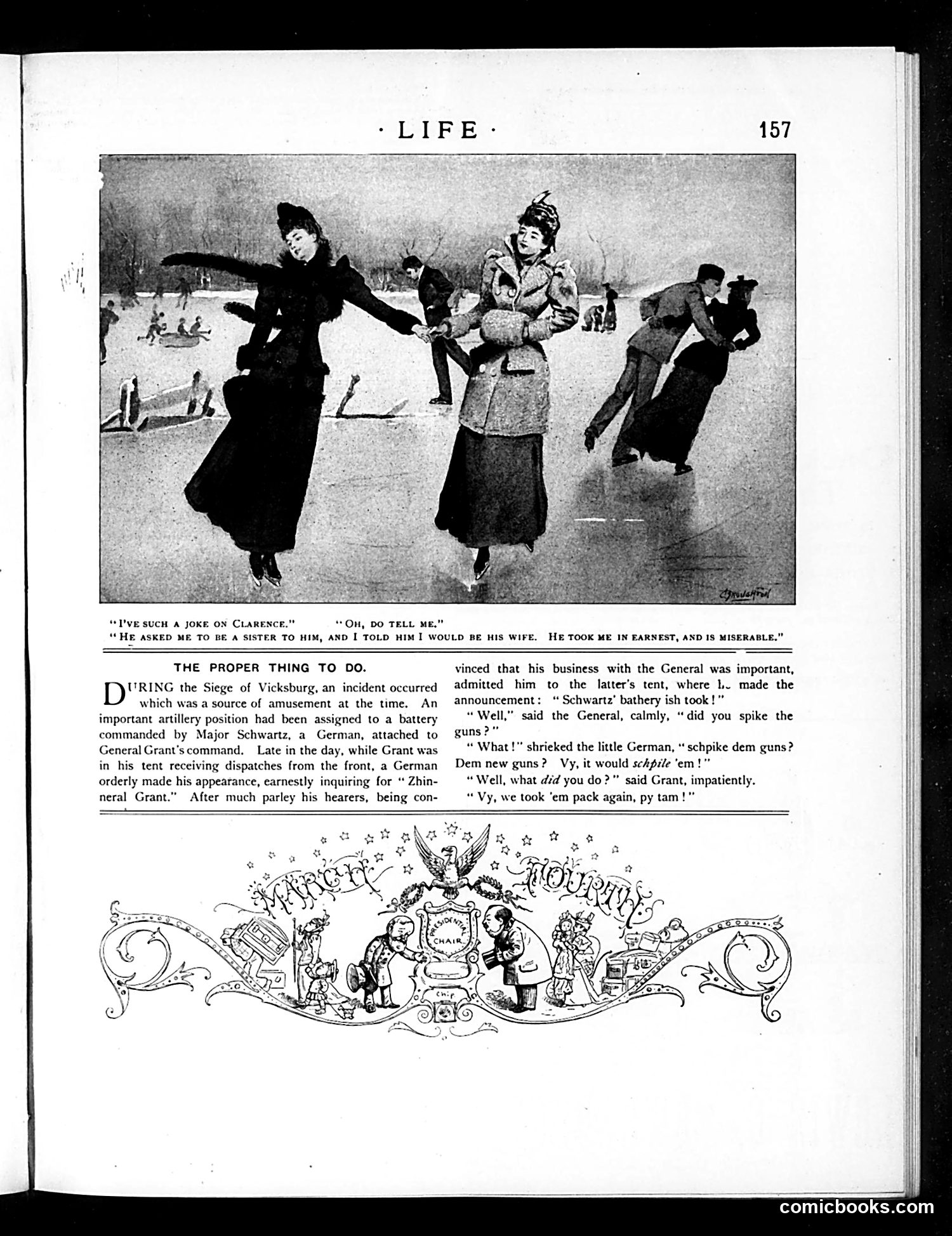
This *Life* magazine page contains two distinct pieces: **Top photograph:** A humorous social scene showing people ice skating. The caption presents a dated romantic joke: a woman told a man she'd be a "sister" to him (implying platonic friendship), but he took her literally and proposed marriage, now being miserable about it. **Main story:** "The Proper Thing to Do" recounts an anecdote from the American Civil War's Siege of Vicksburg. A German-accented artillery officer (Major Schwartz) urgently reports to General Grant that his battery has been captured. When Grant calmly asks if he "spiked the guns" (disabled them so enemies couldn't use them), Schwartz responds with mock horror that he didn't—instead, he says they retrieved the guns and brought them back. The humor relies on the German accent dialect writing and the absurdity of the officer's priorities, suggesting he protected the equipment rather than following proper military protocol. Both pieces are light social satire typical of the era.
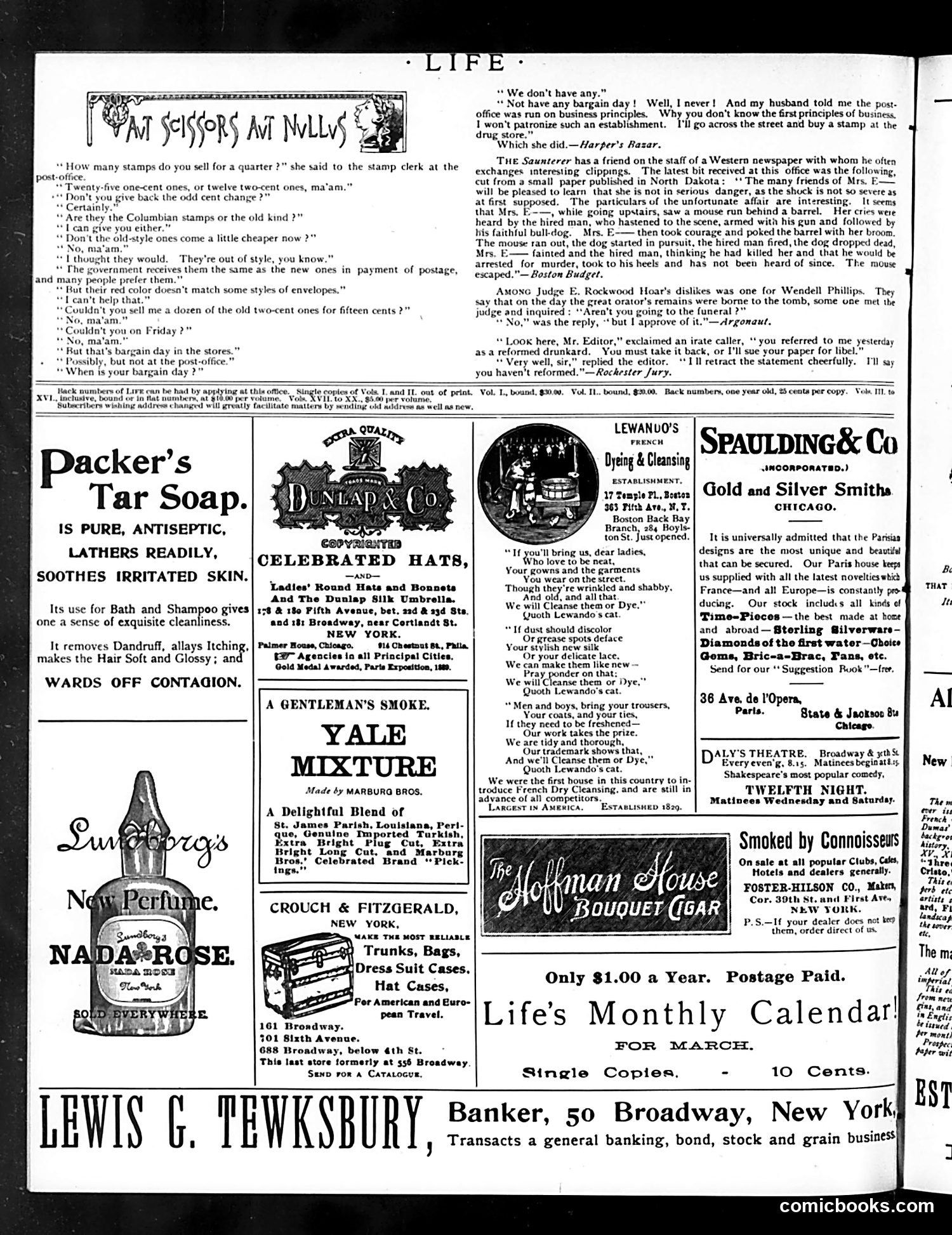
This page is primarily **advertisements and humor anecdotes**, not political cartoons. The main content consists of short jokes and amusing stories: **"At Scissors at Nulls"** features dialogue between a postal clerk and an exasperated female customer demanding bargain pricing on stamps. The satire mocks both her unrealistic expectations (the post office isn't a discount retailer) and her threat to shop elsewhere—ultimately undermining her own complaint by buying stamps at a drug store anyway. It's gentle social humor about consumer absurdity. Other anecdotes include a North Dakota newspaper's darkly comedic tale of a mouse-hunting mishap ending in tragedy, and a joke about Judge E. Rockwood Hoar's dislike for abolitionist Wendell Phillips. The page is dominated by period advertisements for tar soap, hats, tobacco, perfume, and banking services—typical of Life magazine's revenue model. **No identifiable political figures or campaigns are referenced.**
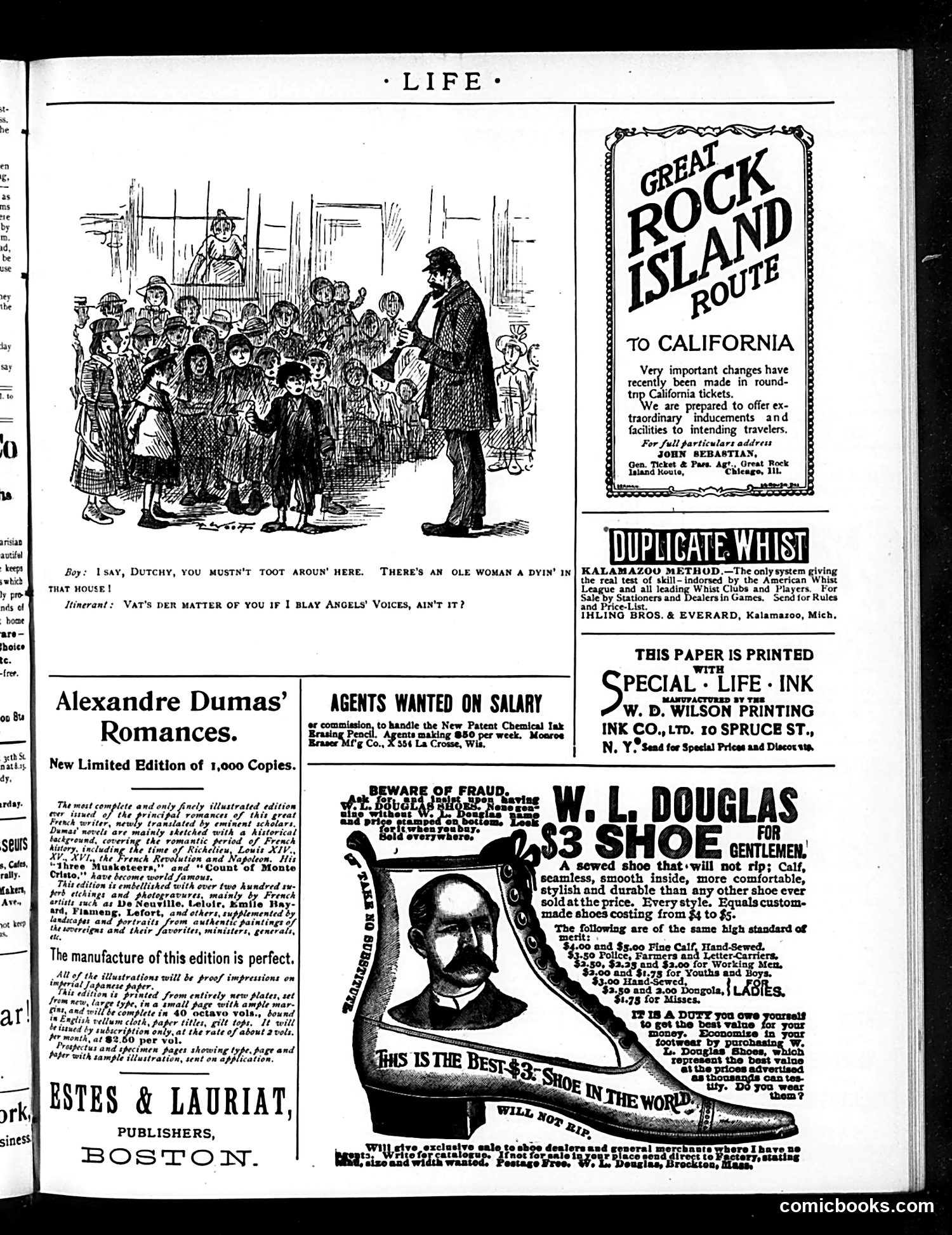
This page is primarily **advertising and editorial content**, not a political cartoon requiring historical context. The main illustrated element is a **sketch of a street scene** showing a tall man (labeled "Itinerant") with a German accent ("Dutchy," "Vat's der matter") playing a musical instrument near a house where a woman is dying. A boy tells him to stop, saying there's a dying woman inside. The itinerant responds that playing "Angels' Voices" shouldn't matter. This appears to be a **gentle ethnic humor piece** playing on German immigrant stereotypes—the thick accent and obliviousness to social propriety. The joke relies on the character's insensitivity: he doesn't understand why his musical performance is inappropriate given someone's death nearby. The rest of the page consists of period advertisements for books (Alexandre Dumas romances), railroad tickets to California, shoes (W.L. Douglas brand), printing ink, and card game instruction—typical late 19th/early 20th-century magazine filler.
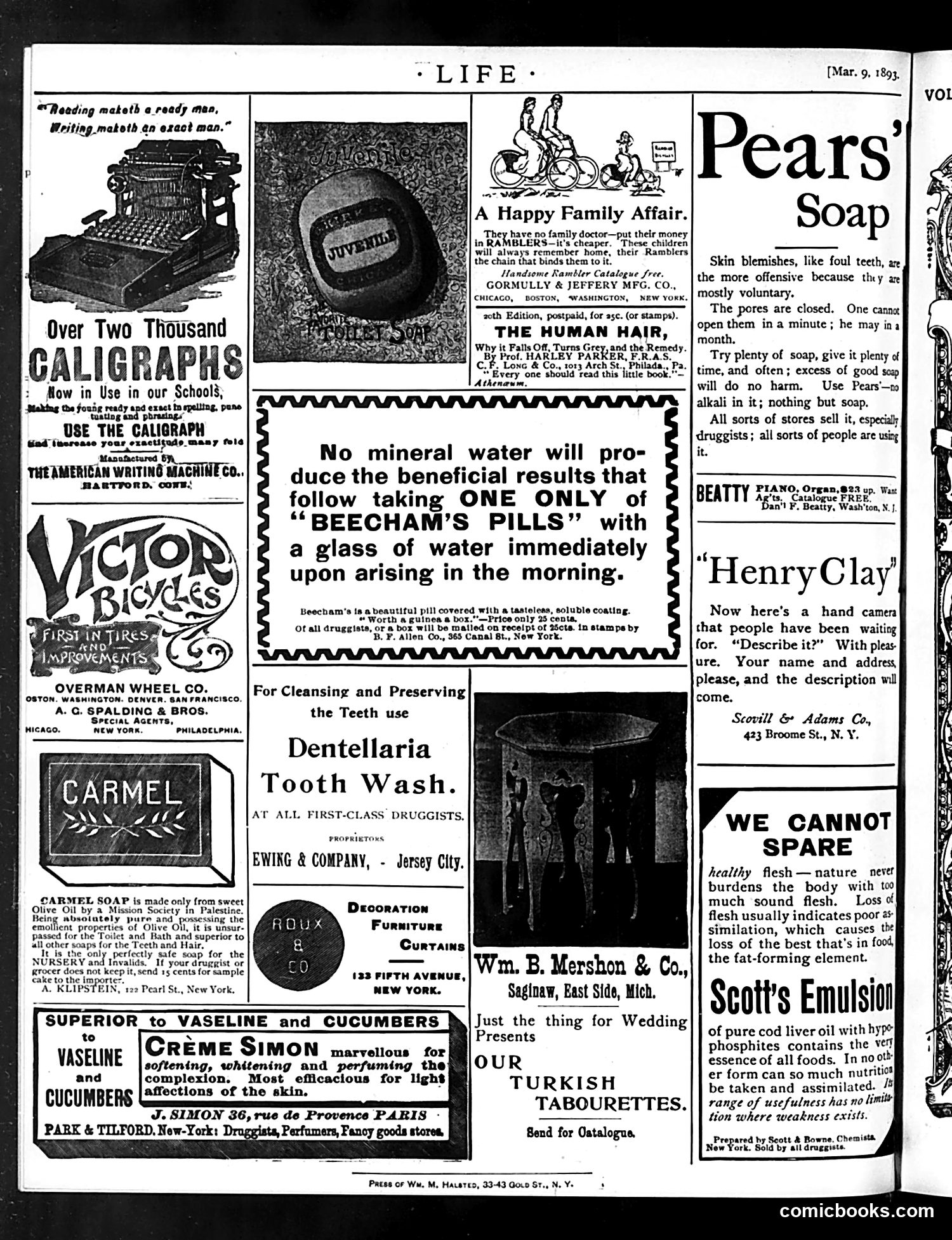
This is primarily an **advertising page** rather than a satirical cartoon page. It contains numerous commercial advertisements typical of the 1890s, including: - **Bicycles and wheeled vehicles** (Rambler bicycles, Victor bicycles, Overman Wheel Co.) — reflecting the cycling craze of the era - **Patent medicines** (Beecham's Pills, Scott's Emulsion) — common in this period before FDA regulation - **Personal care products** (Pears' Soap, Dentellaria Tooth Wash, Carmel Soap, Creme Simon) — emphasizing whitening and skin beautification - **Furniture and home goods** (Turkish tabourettes, decoration curtains) The only text with potential satirical intent appears in the **Rambler bicycle ad**, which jokingly suggests bicycles are cheaper than family doctors and create family bonds. The **Pears' Soap ad** makes a mild social observation that "skin blemishes...are mostly voluntary," implying poor hygiene. Overall, this reflects 1890s consumer culture and advertising practices rather than political satire.