
Life, 1893-03-09 · page 7 of 16
Life — March 9, 1893 — page 7: what you’re looking at
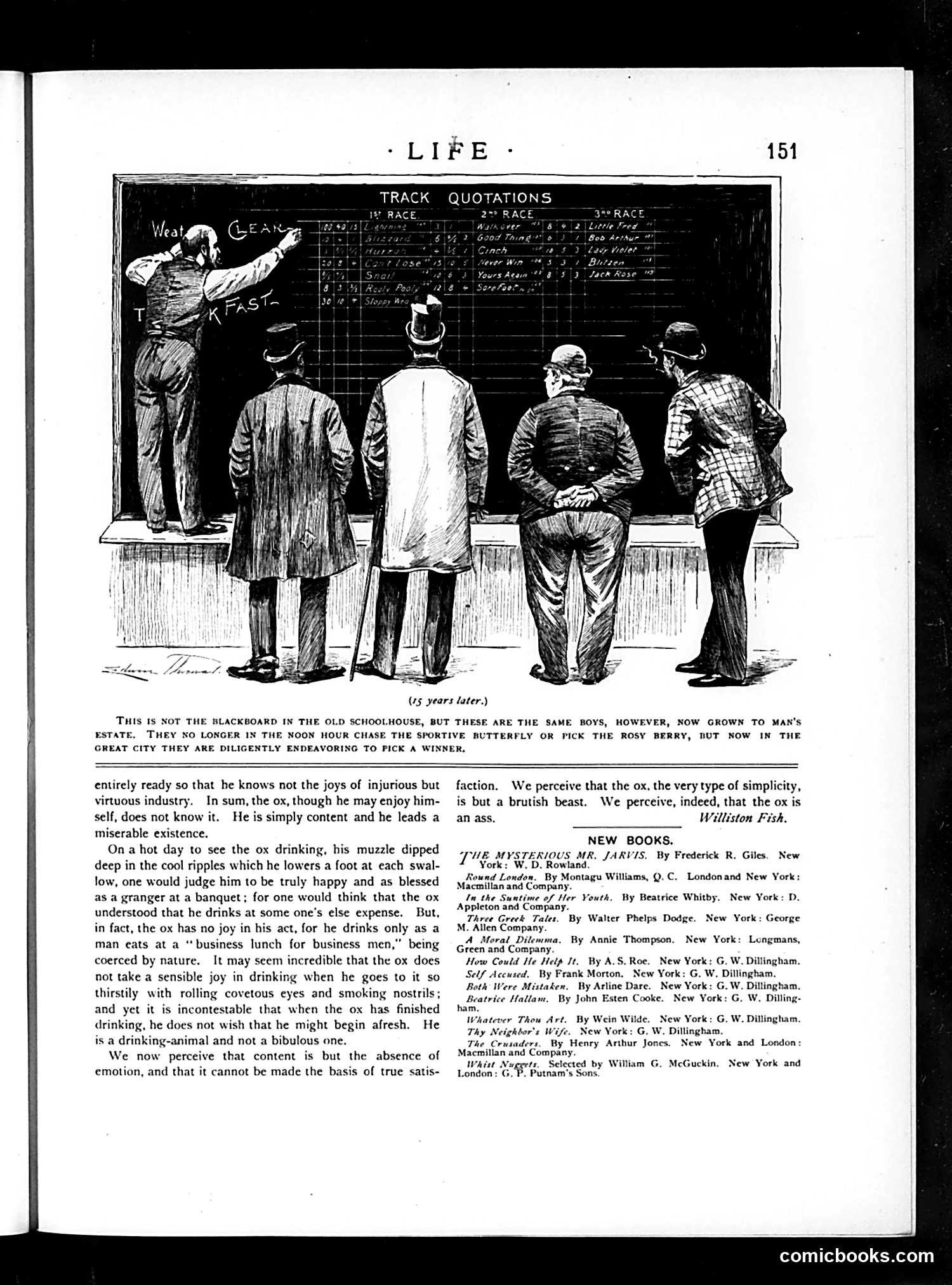
What you’re looking at
This cartoon satirizes **horse racing betting culture** in early 20th-century America. The illustration shows five men in suits and hats gathered at what appears to be a betting board ("Track Quotations") displaying race odds. The caption explains the joke: these are the same schoolboys from years past who once chased butterflies and picked berries during recess. Now, as grown men in the city, they're engaged in the "serious business" of picking horse-race winners instead—a pointed commentary on how childhood innocence transforms into adult gambling habits. The satire suggests that men simply substitute one form of leisure pursuit for another as they mature, with betting replacing innocent outdoor play. It's a gentle critique of how gambling had become normalized recreation among urban adult males.
📄 Transcribed text from this page (OCR, searchable)
Machine-transcribed from the original scan — historical spelling and the odd misread are preserved.
Buteen Jack Rose” fae: (15 years later.) THIS IS NOT THE BLACKBOARD IN THE OLD SCHOOLHOUSE, BUT THESE ARE THE SAME BOYS, HOWEVER, NOW GROWN TO MAN'S ESTATE, ‘THEY NO LONGER IN THE NOON HOUR CHASE THE SPORTIVE BUTTERFLY OR PICK THE ROSY BERRY, BUT NOW IN THE GREAT CITY THEY ARE DILIGENTLY ENDEAVORING TO PICK A WINNER, entirely ready so that he knows not the joys of injurious but virtuous industry. In sum, the ox, though he may enjoy him- self, does not know it. He is simply content and he leads a miserable existence. On a hot day to see the ox drinking, his muzzle dipped deep in the cool ripples which he lowers a foot at each swal- low, one would judge him to be truly happy and as blessed as a granger at a banquet; for one would think that the ox understood that he drinks at some one’s else expense. But, in fact, the ox has no joy in his act, for he drinks only as a man eats at a ‘business lunch for business men,” being coerced by nature. It may seem incredible that the ox does not take a sensible joy in drinking when he goes to it so thirstily with rolling covetous eyes and smoking nostrils; and yet it is incontestable that when the ox has finished drinking, he does not wish that he might begin afresh. He is a drinking-animal and not a bibulous one. We now perceive that content is but the absence of emotion, and that it cannot be made the basis of true satis- faction. We perceive that the ox, the very type of simplic’ is but a brutish beast. We perceive, indeed, that the ox is an ass. Williston Fish. NEW BOOKS. TUE MYSTERIOUS MR. JARVIS. York: W. D, Rowland. Round London, By Montagu Williams, Q.C. Londonand New York: Macmillan and Company. In the Suntime of Her Youth. Appleton and Company. Three Greek Tales. M. Allen Company. A Moral Dilemma, Green and Company. How Could He Help It, By A.S. Roe. New York: G. W. Dillingham, Self Accused, By Frank Morton, New York: G. W. Dillingham. Both Were Mistaken. By Arline Dare. New York: G.W. Dillingham, Beatrice Hallam, By John Esten Cooke. New York: G. W. Dilling- ham, Whatever Thou Art, By Wein Wilde. New York: G. W. Dillingham, Thy Neighbor's Wife, New York: G, W. Dillingham, The Crusaders. By Henry Arthur Jones. New York and London: Macmillan and Company. Whist Nuggets, Selected by William G. . B, Putnam's Sons. By Frederick R. Giles. New By Beatrice Whitby. New York: D. By Walter Phelps Dodge. New York: George By Annie Thompson. New York: Longmans, McGuckin, New York and comicbooks.com