
Life, 1893-03-09 · page 6 of 16
Life — March 9, 1893 — page 6: what you’re looking at
What you’re looking at
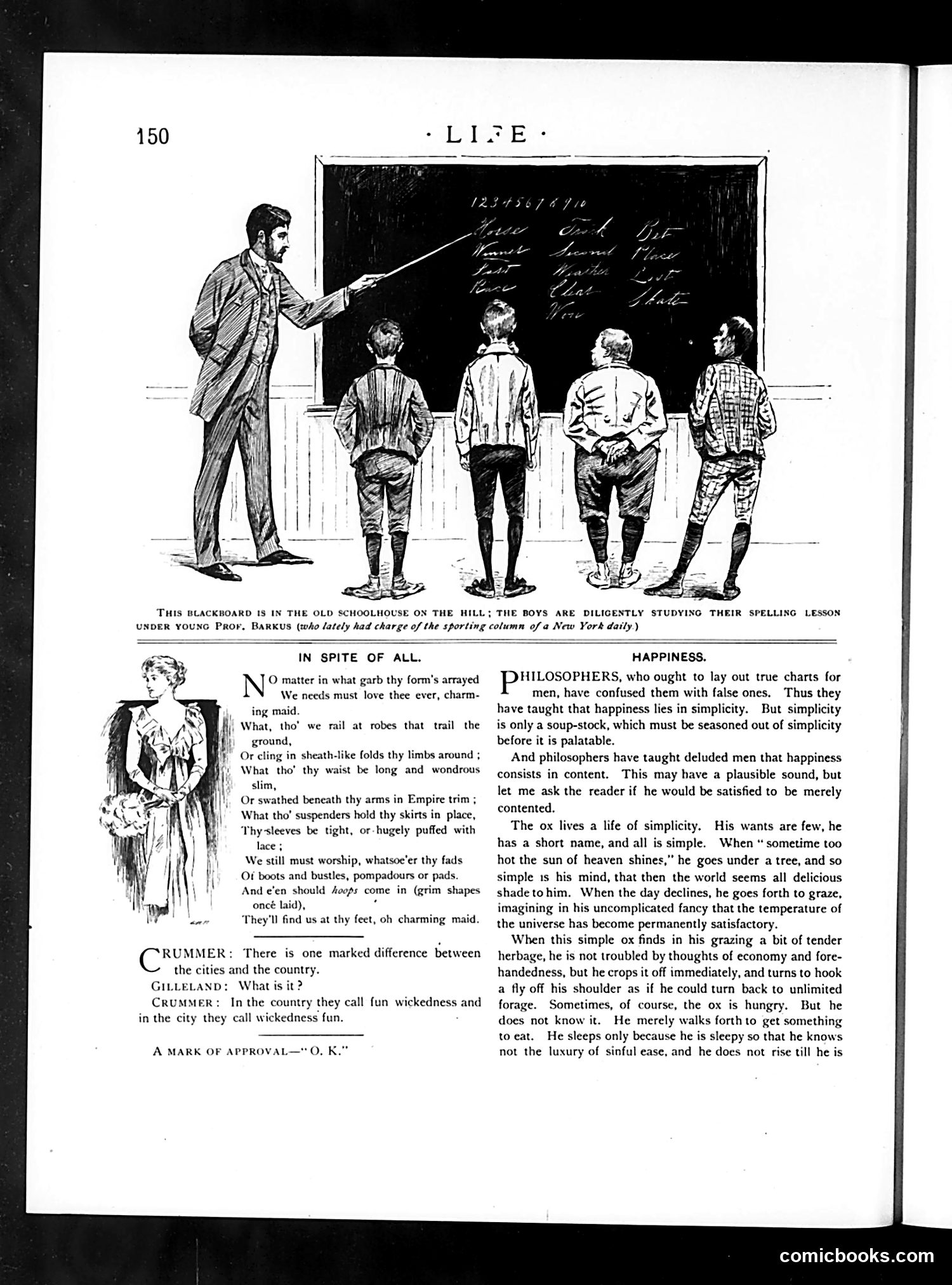
**The Main Cartoon**: Shows a schoolteacher pointing at a blackboard while four boys study a spelling lesson in an old schoolhouse. The caption notes this depicts "diligent studying" under "young Prof. Harkus" at the old schoolhouse on the hill. **"In Spite of All" Section**: A satirical poem mocks elaborate Victorian women's fashion, listing ridiculous garments and accessories women wear despite discomfort. **"Happiness" Essay**: A philosophical piece argues that true happiness comes from simplicity and contentment—living modestly without worrying about economy or luxury. The essay contrasts the simple life (few wants, basic needs) with unnecessary complexity. **The Crummer/Gilliland Dialogue**: A brief exchange joking that cities contain "wickedness" while country areas contain merely "fun wickedness." The page blends educational satire with period philosophy on fashion, rural life, and contentment.
📄 Transcribed text from this page (OCR, searchable)
Machine-transcribed from the original scan — historical spelling and the odd misread are preserved.
THIS BLACKBOARD IS IN THE OLD SCHOOLHOUSE ON THE HILL; THE BOYS ARE DILIGENTLY STUDYING THEIR SPELLING LESSON UNDER YOUNG PROF. BARKUS (who lately had charge of the sporting column of a New York daily) IN SPITE OF ALL. O matter in what garb thy form's arrayed We needs must love thee ever, charm- ing maid. What, tho’ we rail at robes that trail the ground, Or cling in sheath-like folds thy limbs around ; What tho’ thy waist be long and wondrous slim, Or swathed beneath thy arms in Empire trim ; What tho’ suspenders hold thy skirts in place, ‘Thy-sleeves be tight, or-hugely puffed with lace ; We still must worship, whatsoe'er thy fads Of boots and bustles, pompadours or pads. And e’en should oops come in (grim shapes oncé laid), * ‘They'll find us at thy feet, oh charming maid. RUMMER: There is one marked difference between the cities and the country. GILLELAND: What is it? CRUMMER: Inthe country they call fun wickedness and in the city they call wickedness fun. A MARK OF APPROVAL—" O, K.” HAPPINESS. HILOSOPHERS, who ought to lay out true charts for men, have confused them with false ones. Thus they have taught that happiness lies in simplicity. But simplicity is only a soup-stock, which must be seasoned out of simplicity before it is palatable. And philosophers have taught deluded men that happiness consists in content. This may have a plausible sound, but let me ask the reader if he would be satisfied to be merely contented. The ox lives a life of simplicity. His wants are few, he has a short name, and all is simple. When “ sometime too hot the sun of heaven shines,” he goes under a tree, and so simple 1s his mind, that then the world seems all delicious shadetohim. When the day declines, he goes forth to graze, imagining in his uncomplicated fancy that the temperature of the universe has become permanently satisfactory. When this simple ox finds in his grazing a bit of tender herbage, he is not troubled by thoughts of economy and fore- handedness, but he crops it off immediately, and turns to hook a fly off his shoulder as if he could turn back to unlimited forage. Sometimes, of course, the ox is hungry. But he does not know it. He merely walks forth to get something to eat. He sleeps only because he is sleepy so that he knows not the luxury of sinful ease, and he does not rise till he is comicbooks.com