
A complete issue · 16 pages · 1893
Life — February 23, 1893
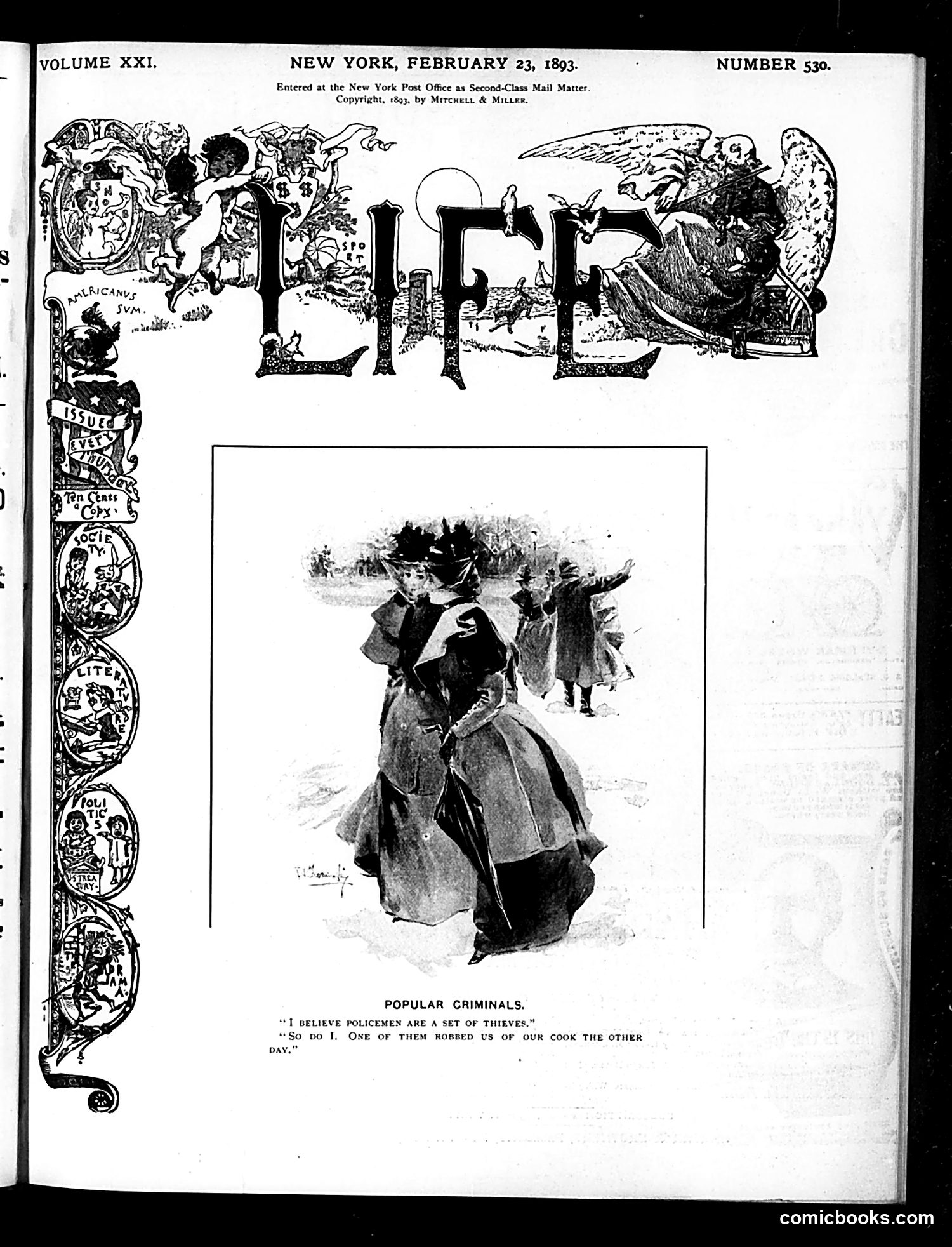
This page features a section titled "POPULAR CRIMINALS" with a sketch of a woman in winter clothing and the caption: "I believe policemen are a set of thieves. So do I. One of them robbed us of our cook the other day." The satire appears to target public distrust of police corruption in 1890s New York. The joke plays on two meanings of "robbed"—stealing valuables versus taking away a domestic servant, likely through arrest or coercion. The woman's complaint conflates serious criminal suspicion of police with the domestic inconvenience of losing household help, mocking both the speaker's trivial concern and the broader contemporary perception that police were themselves criminals or thieves. It's social commentary on urban anxieties and class relations of the Gilded Age.
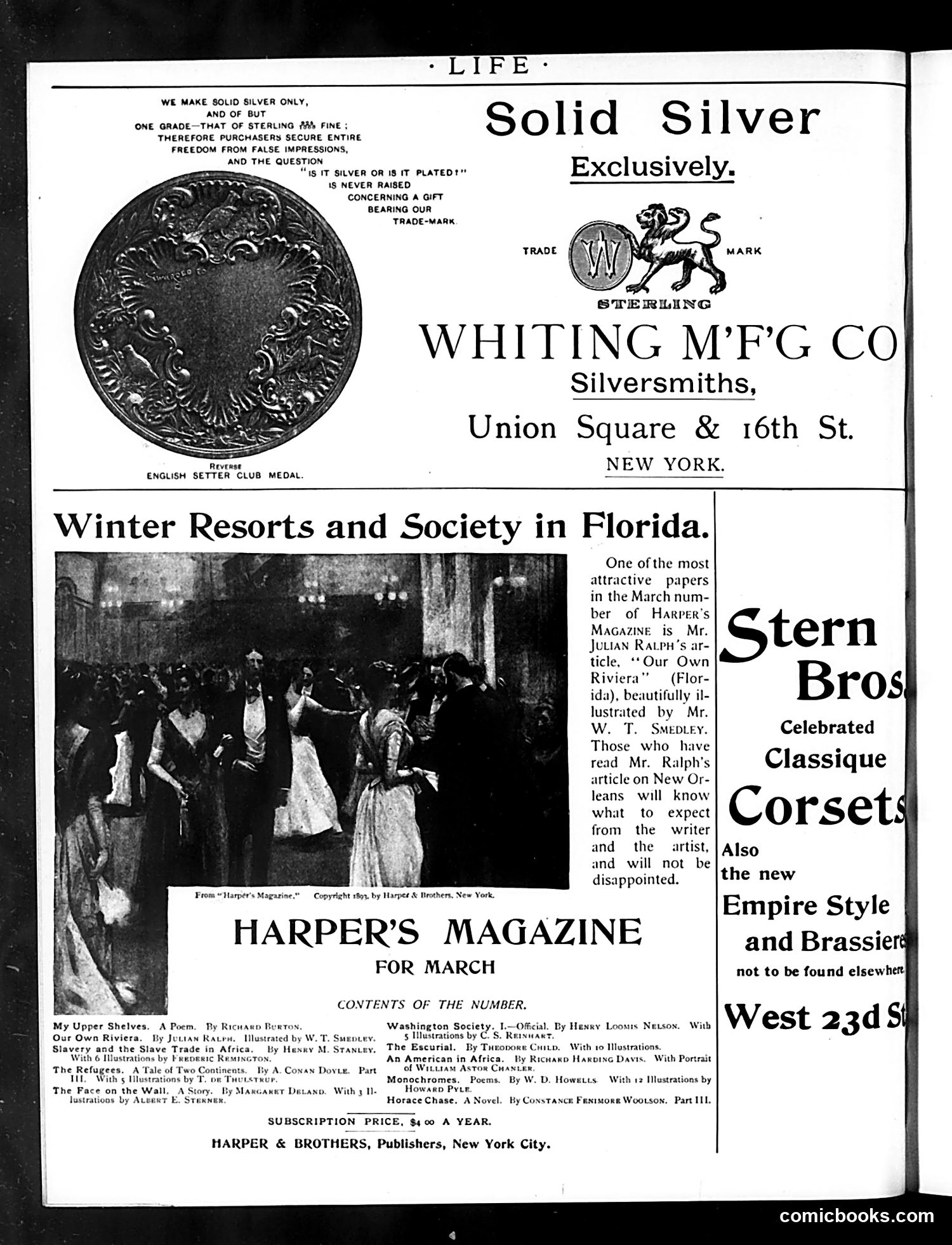
This page is primarily **advertising and magazine promotion**, not political satire. The top half features an advertisement for Whiting Manufacturing Company's solid silver flatware and serving pieces, emphasizing their sterling silver quality with an ornate medal image. The company's location is given as Union Square & 16th Street, New York. The lower half promotes Harper's Magazine's March issue, featuring a photograph of an elegant winter social gathering in Florida. The contents list includes fiction and poetry pieces. On the right, Stern Bros. advertises their "Classique Corsets" and Empire Style brassieres. **No political cartoon or satirical content is present on this page.** It represents typical early 20th-century magazine advertising and editorial promotion.
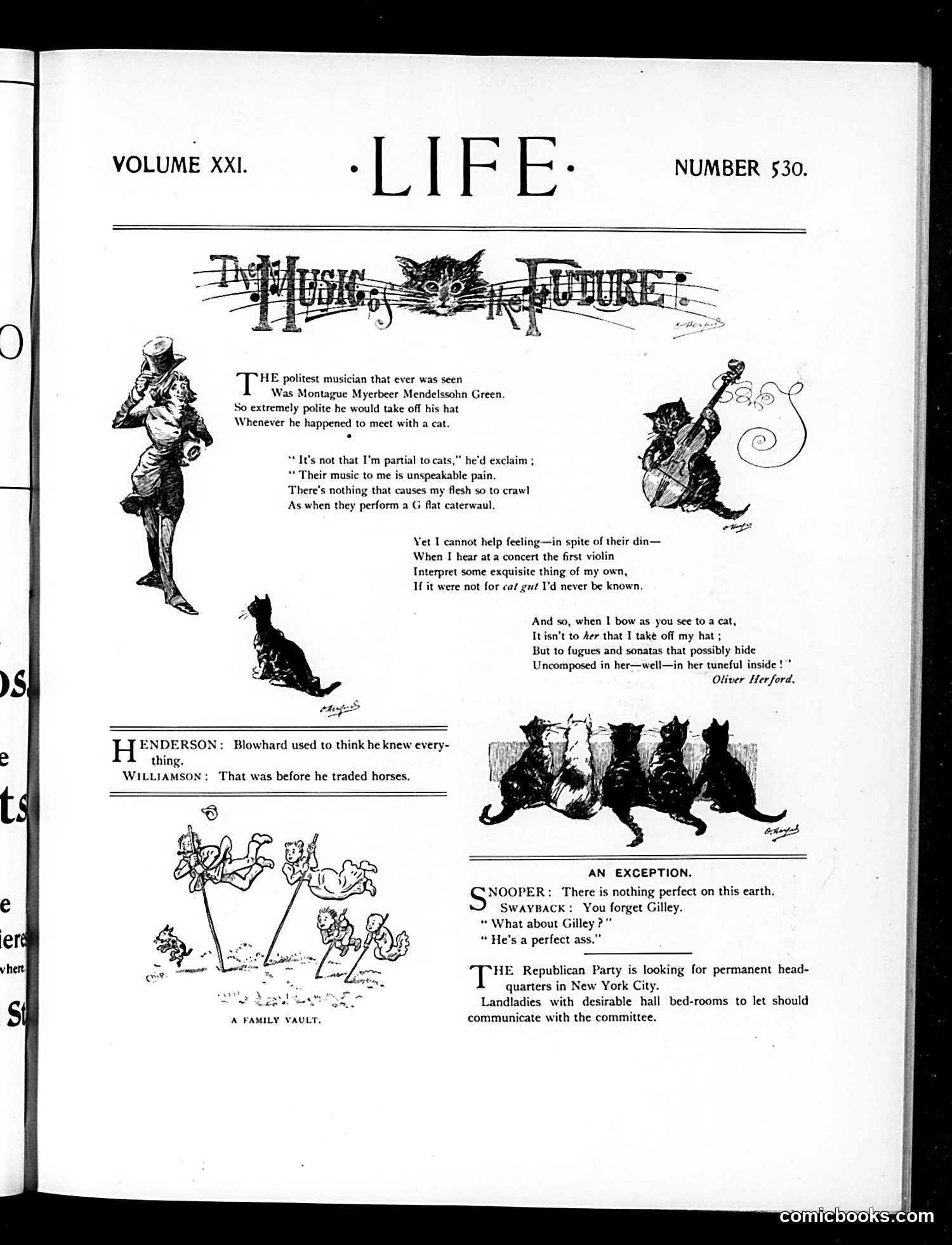
This page features "A Musical Lecture" satirizing a fastidious classical musician, Montague Myerbeer Mendelsohn Green, who claims cats' music causes him physical pain—yet he admits he removes his hat respectfully when encountering felines. The joke critiques this contradiction: he finds their concerts unbearable but treats them with deference. The accompanying illustrations show anthropomorphized cats performing music (violin, cello) alongside the musician's conflicted behavior. Below are unrelated brief items: a Henderson/Williamson joke about horse trading, a "Family Vault" cartoon showing acrobatic figures, and a notice about the Republican Party seeking New York City headquarters. The satire targets pretentious musical snobbery and hypocritical politeness.
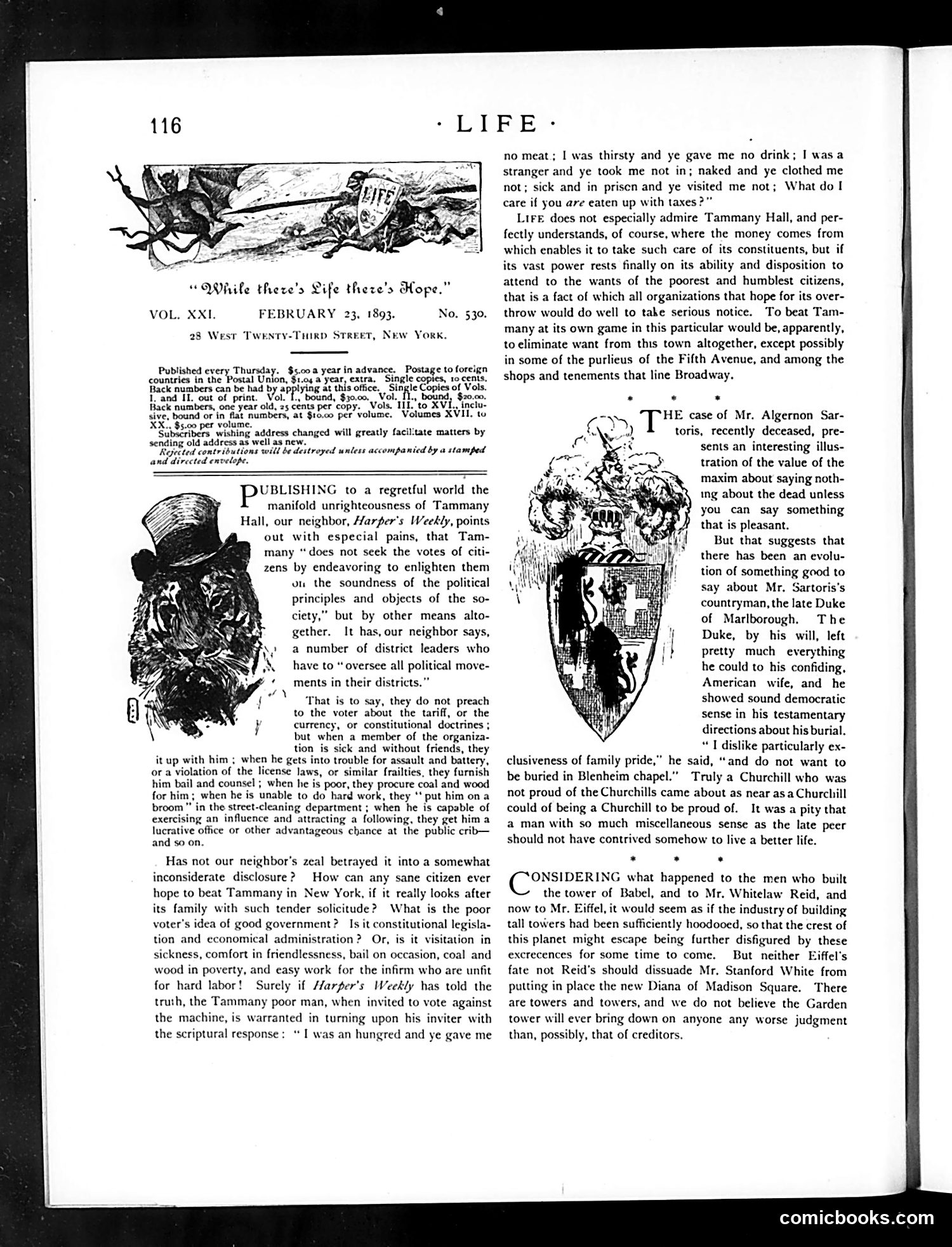
The page critiques **Tammany Hall**, New York's powerful Democratic political machine, which controlled the city through patronage and allegedly neglected poor constituents. The editorial sarcastically notes that Tammany claims to enlighten citizens "on the soundness of the political principles" while actually operating through backroom deals and favors to district leaders. The accompanying **caricatures** (specific identities unclear from image alone) appear to represent Tammany operatives. The text argues the organization cynically supports politicians in exchange for influence, then "puts him on a shelf" when he's no longer useful—depicting the ruthless, transactional nature of machine politics. The piece references **Algernon Sartoris**, a recently deceased figure, to contrast honest conduct with Tammany's moral failures. The satire exposes how patronage systems prioritized corrupt loyalty over genuine public service.
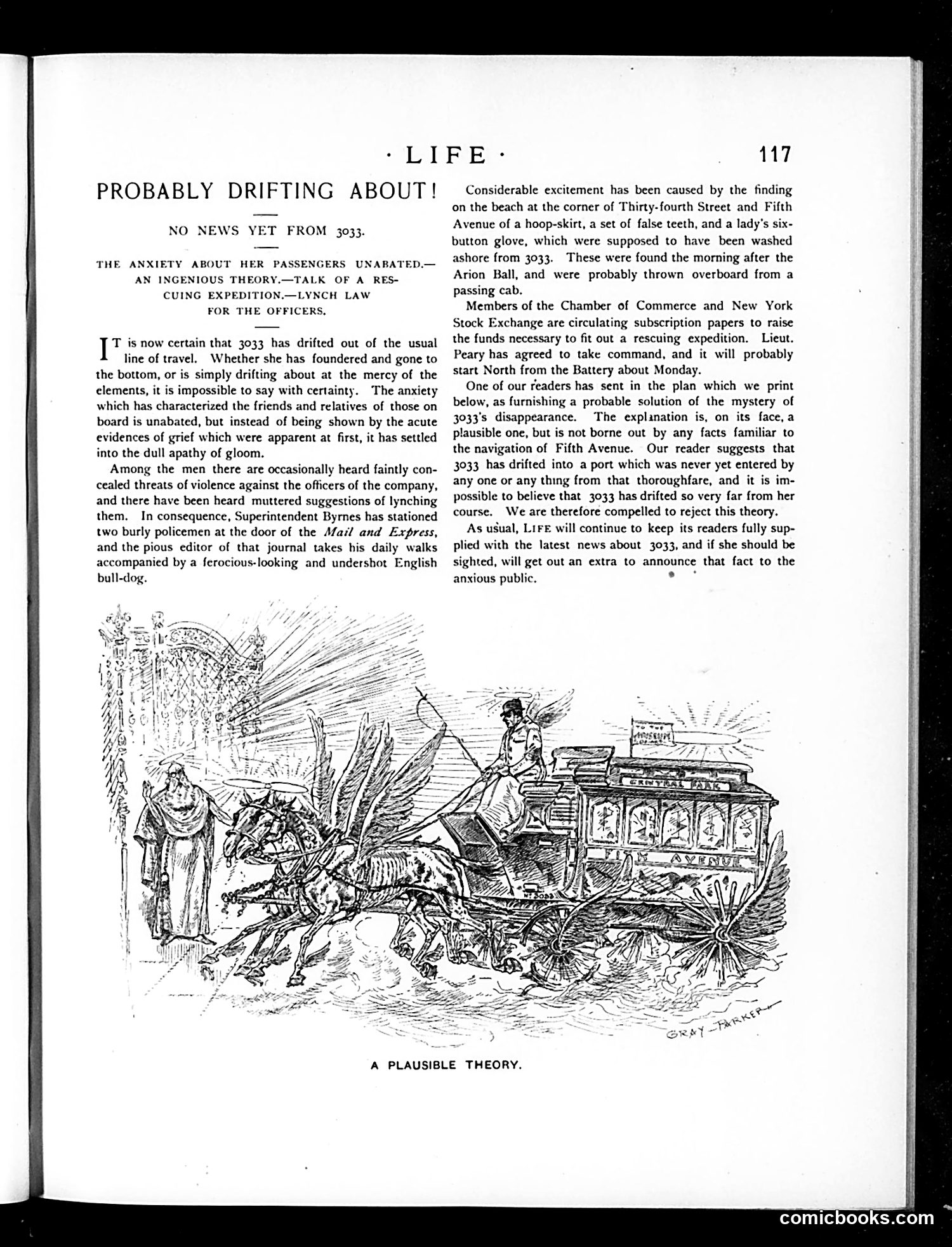
This cartoon satirizes the mysterious disappearance of the SS *3033* (a ship). The text describes anxiety about the ship's passengers and crew, noting that finding items washed ashore suggests the vessel either sank or drifted away. The cartoon illustrates a humorous "plausible theory": rather than sinking or drifting, the ship has somehow driven onto land as if it were a horse-drawn carriage. A driver controls the vessel like a wagon, surrounded by desert vegetation and cacti, while a figure observes from the left. The satire mocks the desperate speculation surrounding the ship's fate—suggesting that the public's increasingly absurd explanations rival this ridiculous image of a steamship functioning as a desert stagecoach. It's comedy born from genuine maritime anxiety.
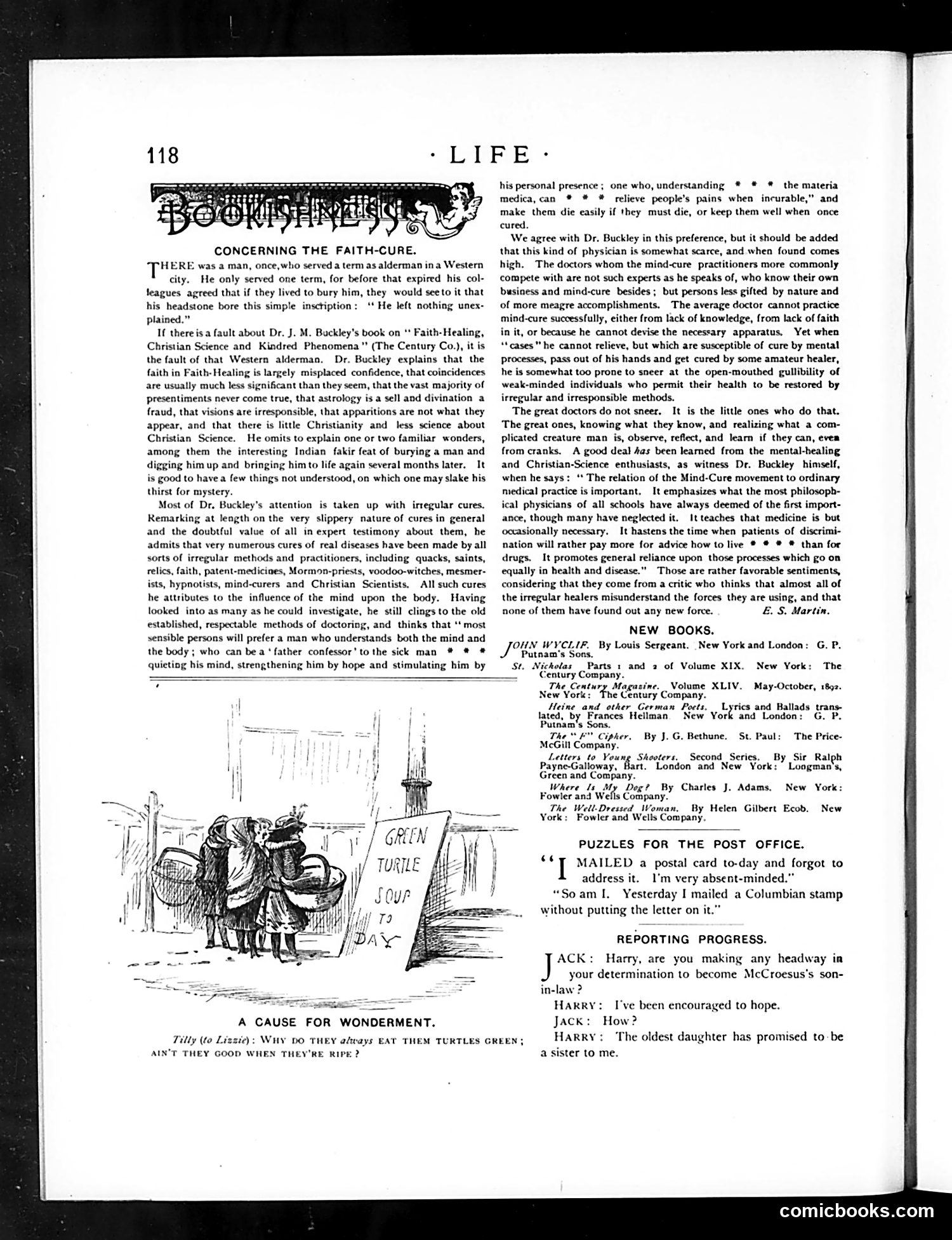
The main cartoon titled "A Cause for Wonderment" depicts a figure eating green turtle soup, with a caption asking: "Why do they always eat them turtles green; ain't they good when they're ripe?" This is a humorous joke about ignorance—likely mocking working-class or immigrant dialects and their misunderstanding of food preparation. The "green" in "green turtle soup" refers to a specific culinary preparation (using green sea turtles), not the ripeness of the ingredient. The satire ridicules the speaker's confusion about cooking terminology. The page also contains a lengthy article on faith-healing and Christian Science, discussing Dr. Buckley's views on mind-cure and medical practice, followed by a "New Books" section and brief comedic exchanges titled "Puzzles for the Post Office" and "Reporting Progress."
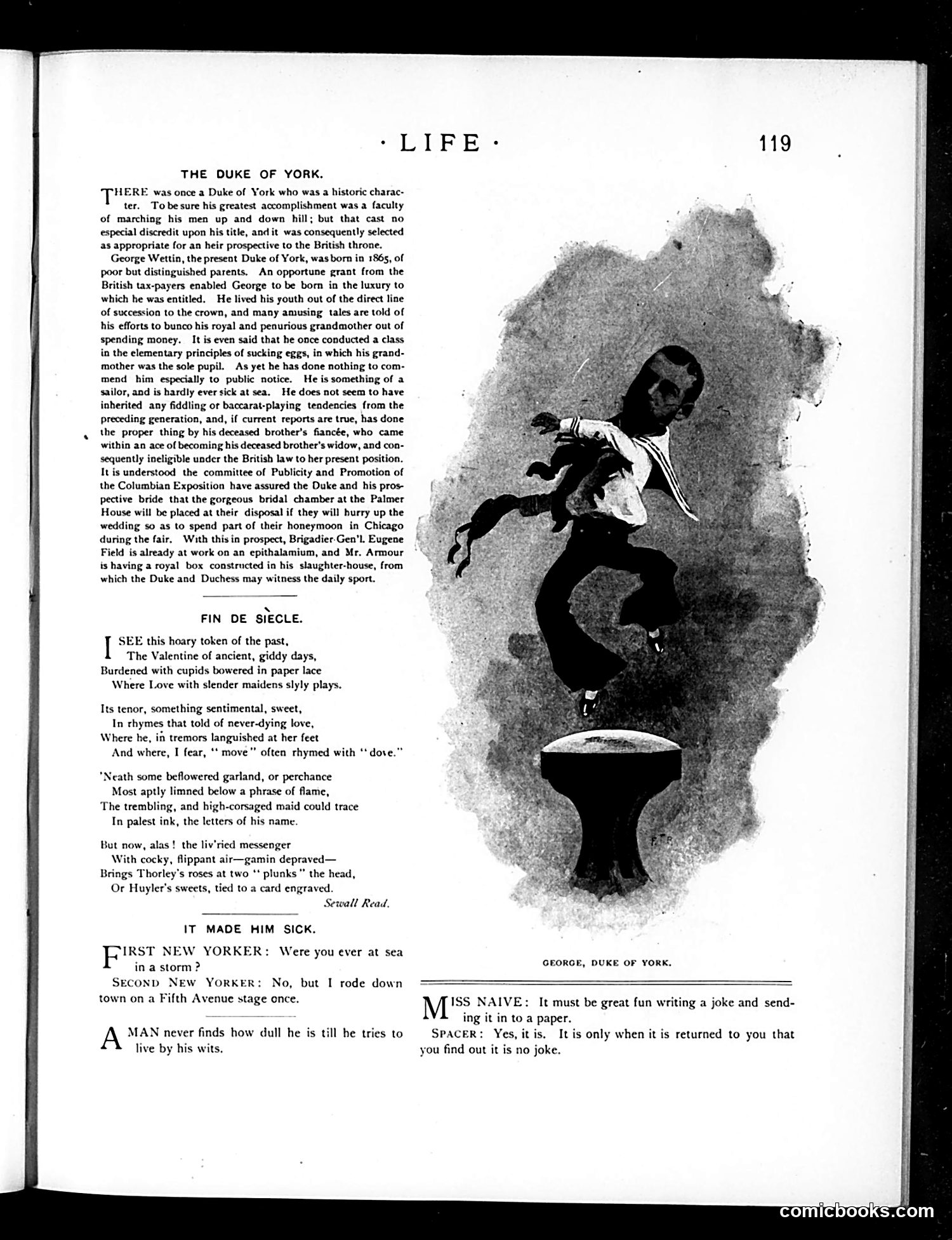
The main article "The Duke of York" discusses George Westin, the Duke of York (born 1865), describing his relatively undistinguished background and accomplishments. The text notes he's primarily known for marching skills and mentions plans for his wedding at the Columbian Exposition in Chicago, with arrangements for a bridal chamber and royal box for witnessing daily sport. The portrait illustration shows a formally dressed gentleman in period attire. Below are three separate short humorous pieces: "Fin de Siècle" (a sentimental poem about old love letters), "It Made Him Sick" (a brief dialogue joke), and "Miss Naive" (a quip about returning jokes to newspapers). These represent typical Life magazine content: society commentary mixed with light verse and short comedic exchanges.
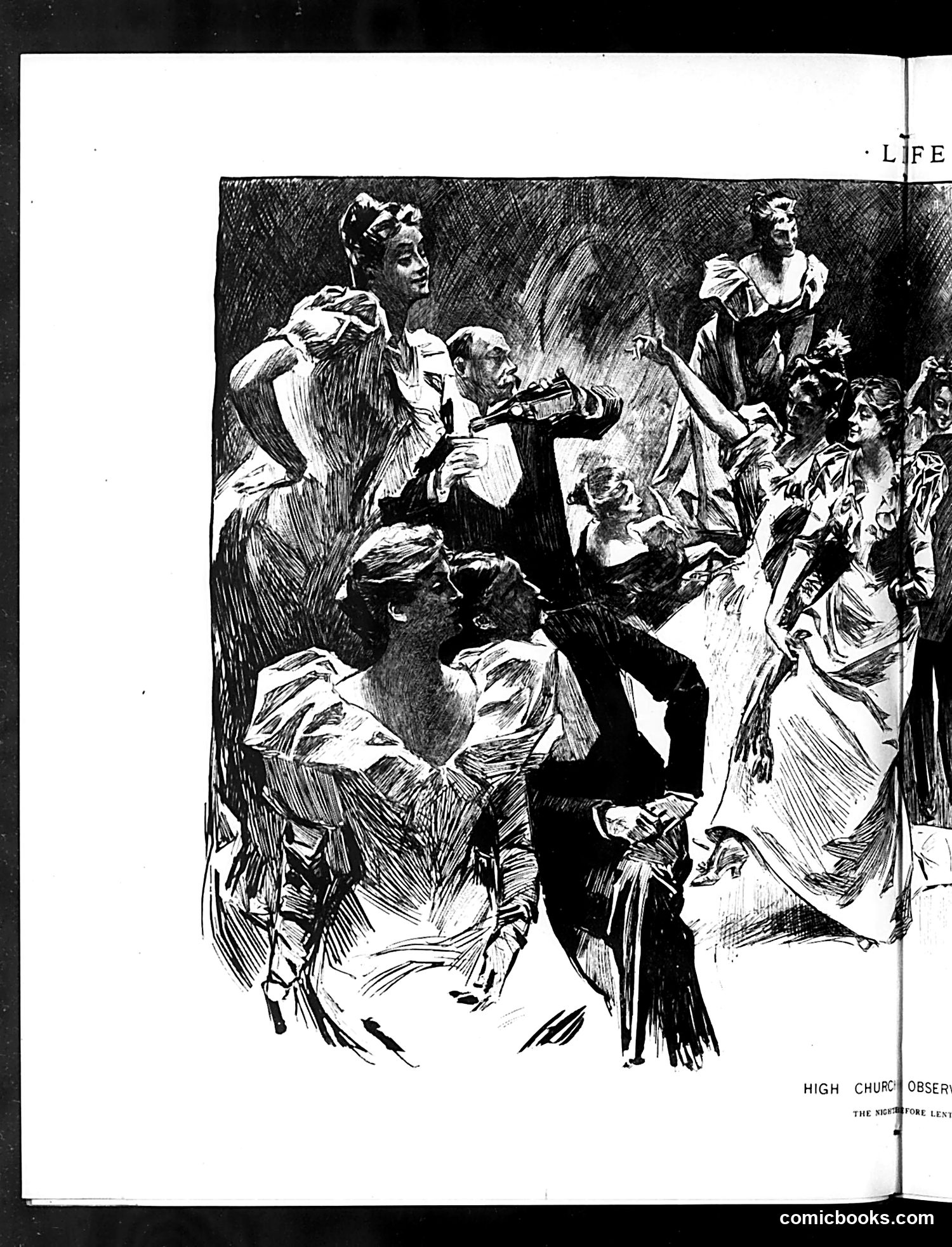
This satirical illustration depicts a formal religious or high-society gathering, likely mocking "High Church" (Anglican/Catholic) observance during Lent. The central figure appears to be a military or ecclesiastical authority addressing a crowd of well-dressed society women and attendees. The sketch's emphasis on elaborate clothing, formal postures, and the gathering's theatrical nature suggests satire aimed at the ostentatious performance of religious observance among the wealthy elite. The title references "nightstore lent," which appears to be a play on words—possibly mocking how commercial establishments ("nightstore") undermine or trivialize the spiritual sacrifice supposedly central to Lenten observance. The cartoon likely critiques the hypocrisy of society's wealthy performing religious piety while maintaining their material indulgences.
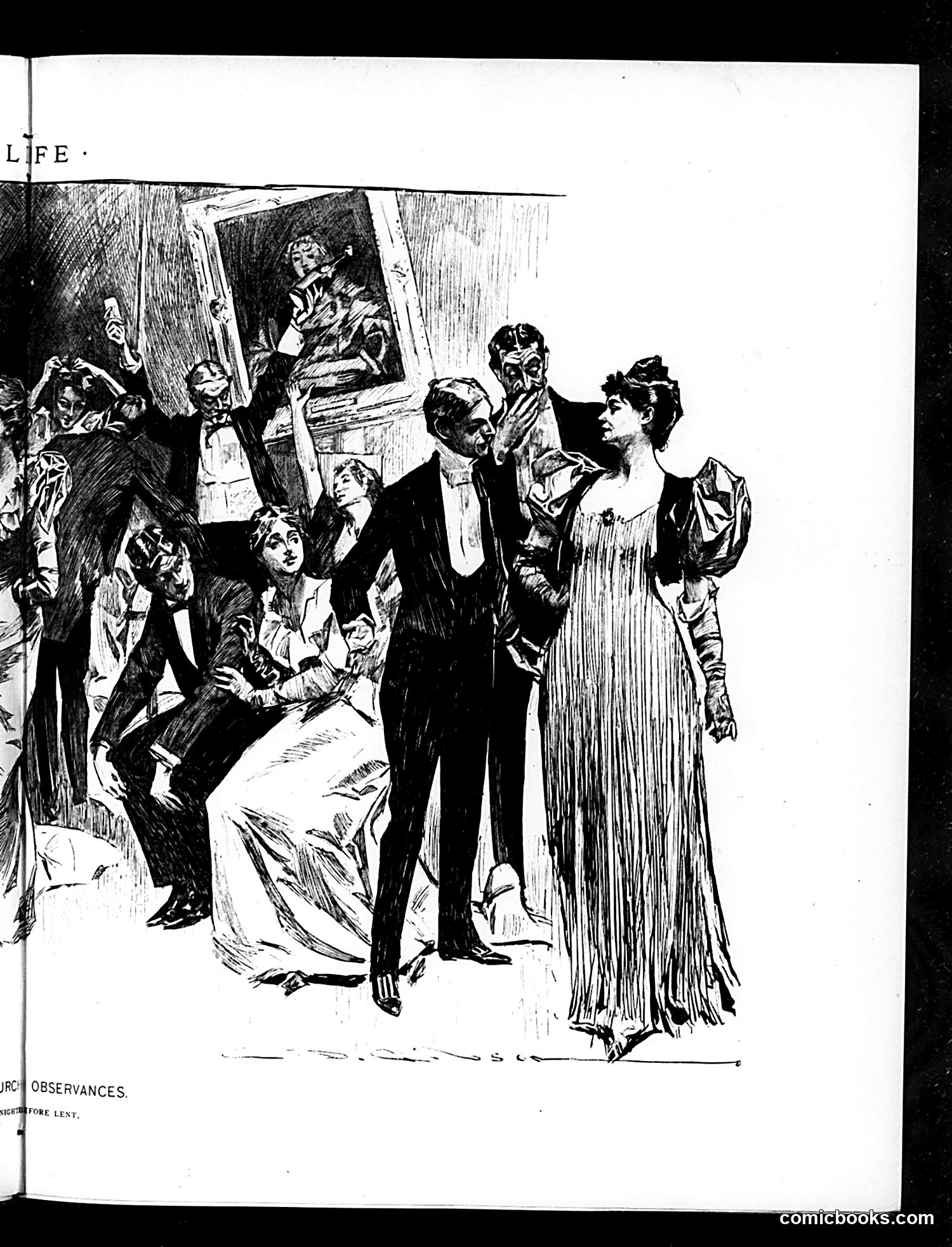
This page from *Life* magazine shows a social scene titled "OBSERVANCES" (partially visible at bottom). The sketch depicts what appears to be an art gallery or salon viewing, with well-dressed figures examining a painting on the wall. A man in formal attire stands centrally, gesturing toward the artwork, while a woman in an elegant flowing gown stands prominently to the right. Various other society figures surround them. The satire likely mocks upper-class art appreciation and social pretension—the gathering's affected poses and formal dress suggest mockery of how wealthy patrons publicly display cultural refinement. The specific artwork being viewed is unclear, but the scene captures *Life* magazine's characteristic satirizing of Gilded Age society manners and affectations.
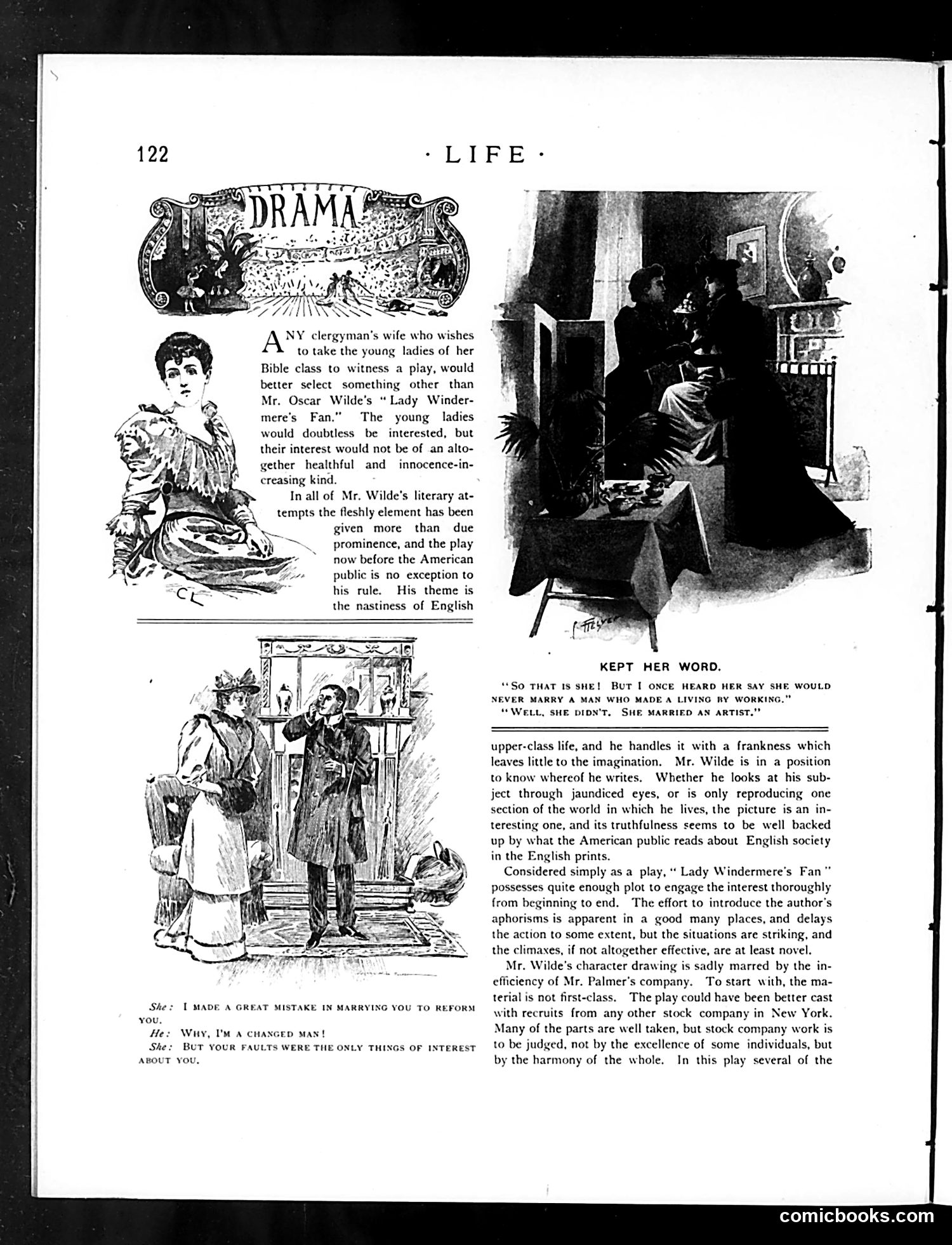
This page reviews Oscar Wilde's play "Lady Windermere's Fan," performed in America. The article critiques the work for its focus on upper-class English society and "fleshly element," noting concerns that a clergyman's wife might hesitate recommending it to young ladies in her Bible class. The dialogue snippet ("She: I made a great mistake in marrying you to reform you") satirizes marital dynamics in Wilde's social comedy. The accompanying illustrations depict scenes from the play showing Victorian-era characters in drawing rooms. The critic acknowledges the play has enough plot interest but finds Mr. Palmer's theatrical company's performance somewhat lacking, though notes the ensemble work compensates for weaker individual performances.
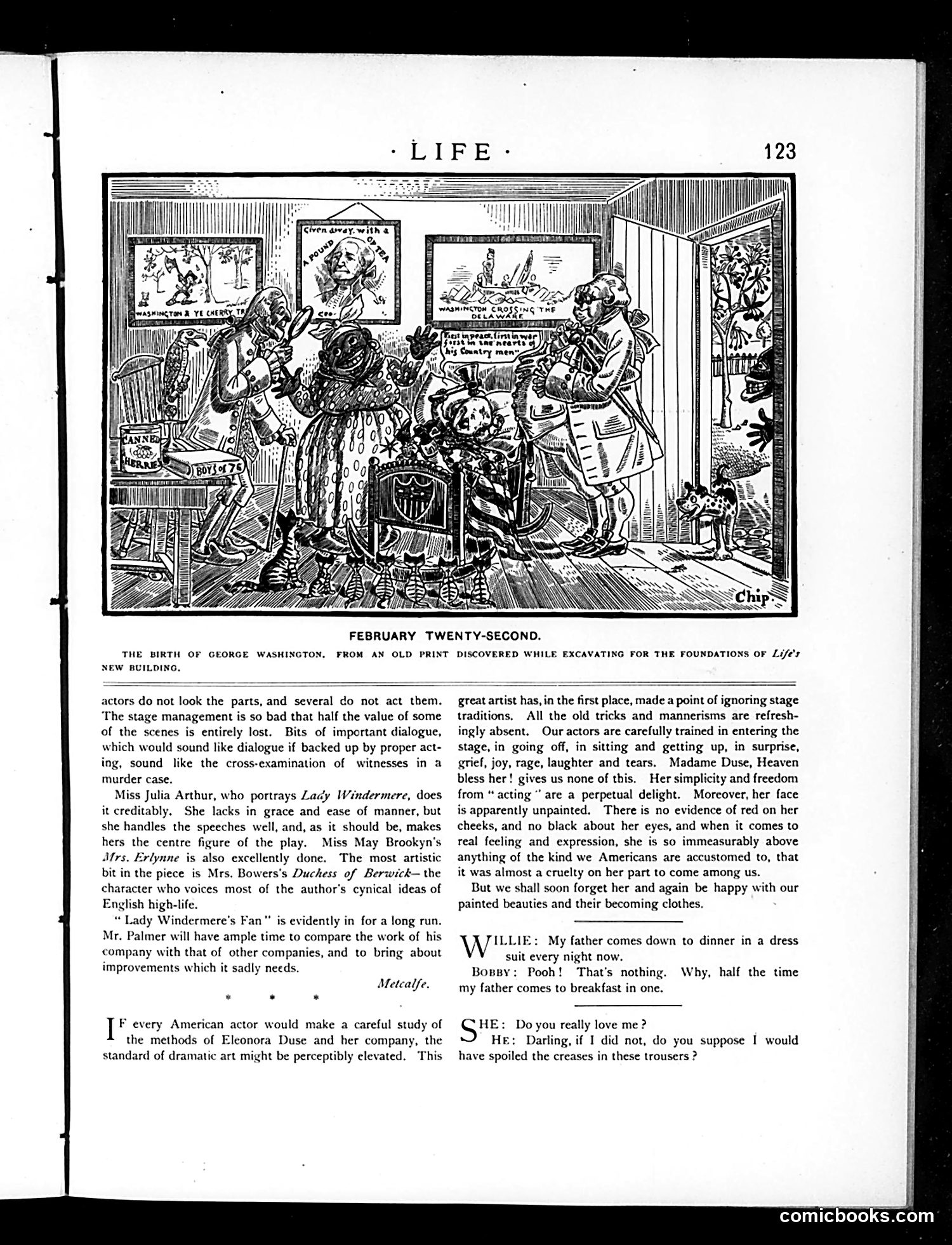
This page from *Life* magazine features a satirical cartoon about theatrical performances, specifically critiquing American actors' lack of training and stage presence compared to professionals like Eleonora Duse (an acclaimed Italian actress referenced in the text). The main cartoon depicts a chaotic theatrical scene where actors appear wooden and unconvincing—the satire's target. The text criticizes actors who "do not look the parts" and "do not act them," arguing that American theater lacks the refined technique of European standards. The dialogue snippets at bottom mock superficial conversation and bourgeois domesticity—presumably representing the shallow material in contemporary American plays. The overall message: American theater needs to professionalize and study serious dramatic techniques rather than rely on amateur performers and trivial scripts.
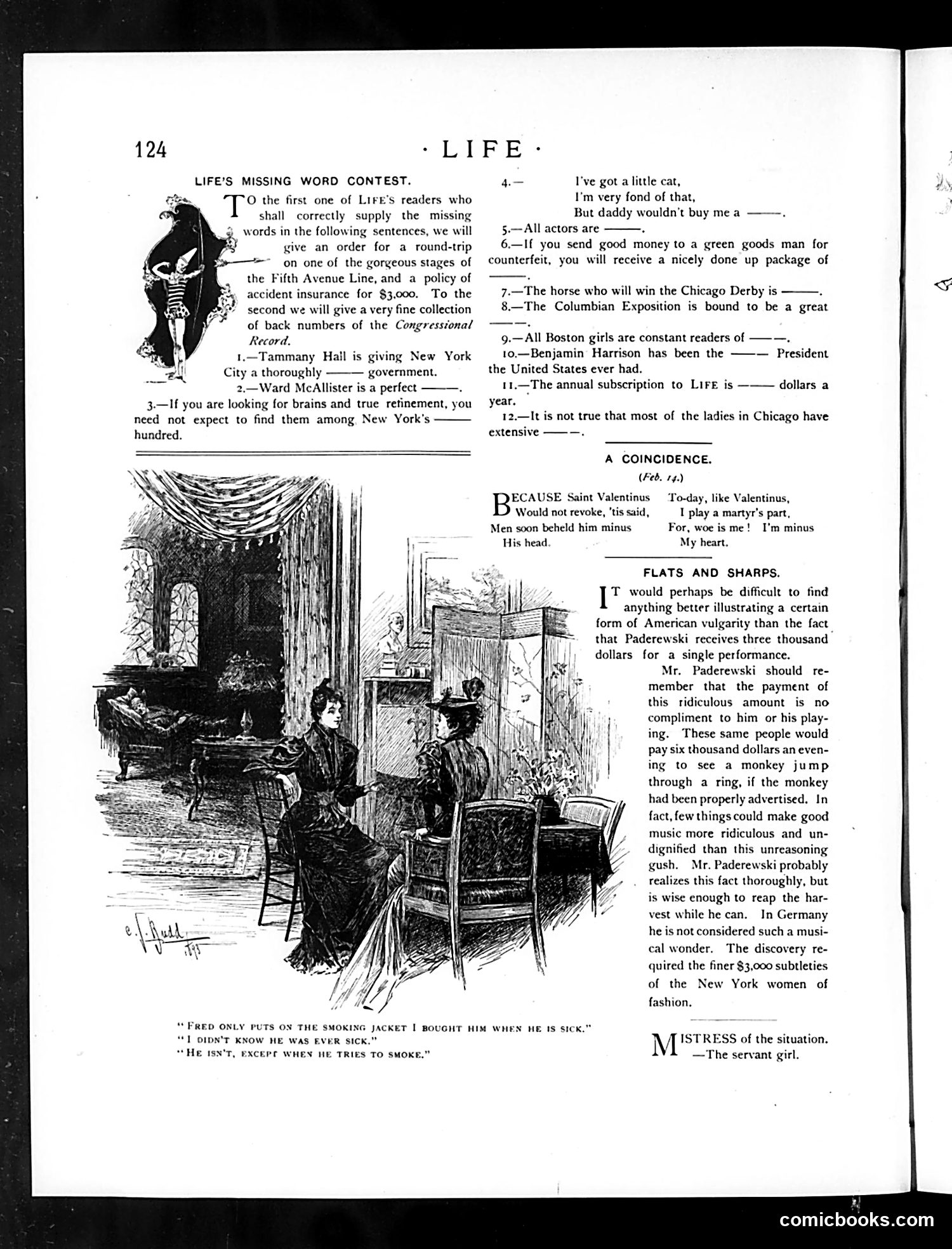
This page contains **Life's Missing Word Contest**, a fill-in-the-blank game offering prizes to readers. The satire targets prominent figures and institutions of the era: **Key References:** - **Tammany Hall**: The corrupt New York Democratic machine (joke: "thoroughly _____ government") - **Ward McAllister**: A famous New York socialite and arbiter of high society - **Benjamin Harrison**: U.S. President at the time - **Paderewski**: The famous Polish pianist receiving $3,000 per performance—criticized as exorbitant **The Satire's Point:** The "Flats and Sharps" section mocks American vulgarity and celebrity worship. Paderewski's astronomical fees reveal not sophisticated taste but mob mentality—the same public would pay equally to see a monkey perform. The implicit critique: Americans equate fame with quality and blindly follow herd enthusiasm rather than genuine aesthetic judgment. The cartoon below depicts an interior scene with dialogue mocking pretense around smoking habits, though the specific reference remains unclear.
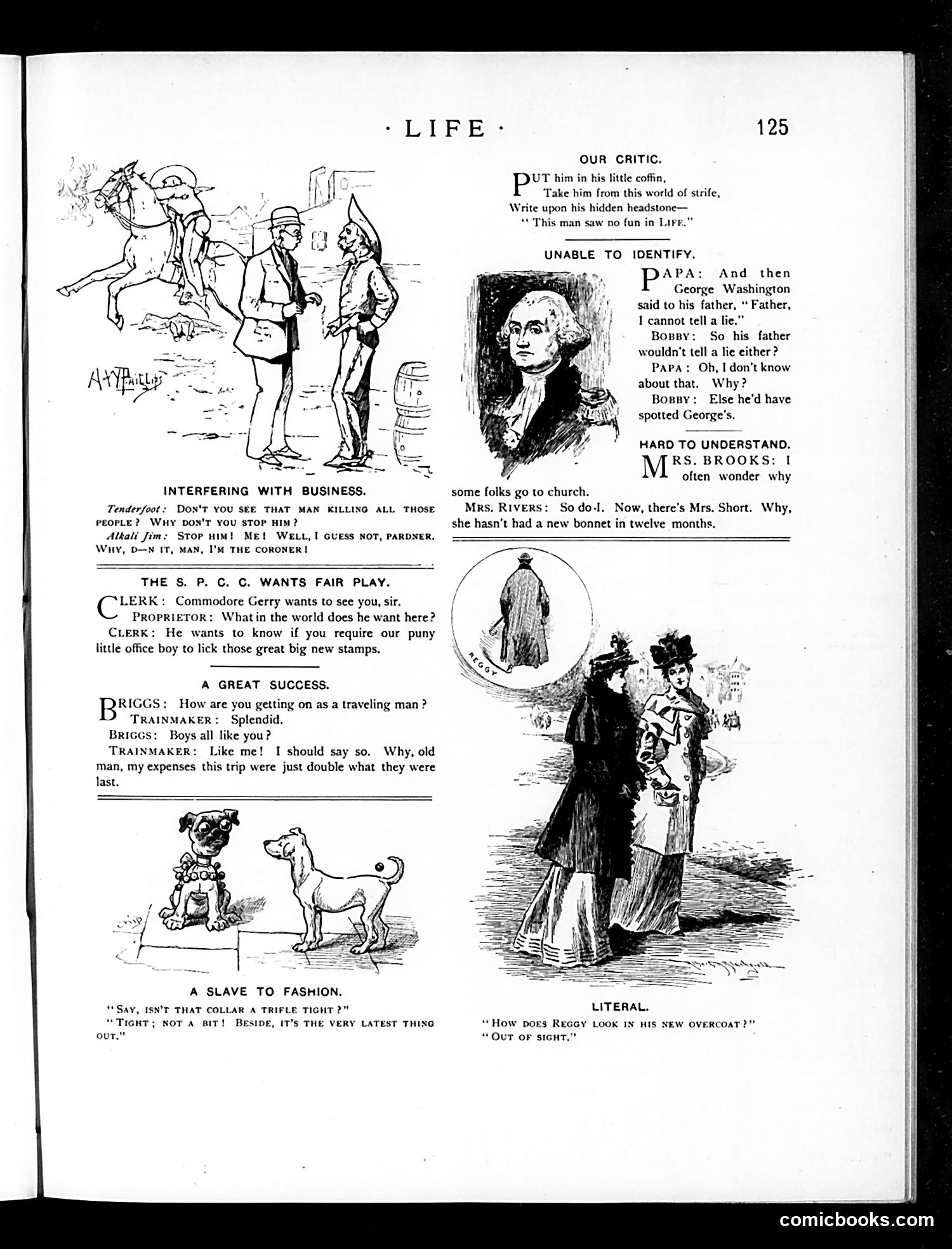
This page contains multiple short comedic sketches typical of *Life* magazine's satirical format: **"Our Critic"** mocks someone so joyless they deserve a tombstone reading "This man saw no fun in Life"—a pun on the magazine's title. **"Unable to Identify"** plays on the famous (apocryphal) story of young George Washington confessing to cutting down his father's cherry tree. A child questions the logic: if the father wouldn't lie, how did he fail to notice young George's obvious dishonesty? **"The S.P.C.C. Wants Fair Play"** references the Society for Prevention of Cruelty to Children, satirizing concern for office boy welfare by suggesting the organization worries whether a young employee must lick large stamps—absurdist humor about labor conditions. **"A Slave to Fashion"** mocks fashion conformity: a man wears an uncomfortably tight collar because it's the "latest thing." **"Literal"** punts on the phrase "out of sight" (meaning "excellent"), with someone taking it literally to mean invisible. These represent typical *Life* humor: wordplay, social observation, and gentle mockery of contemporary manners and follies.
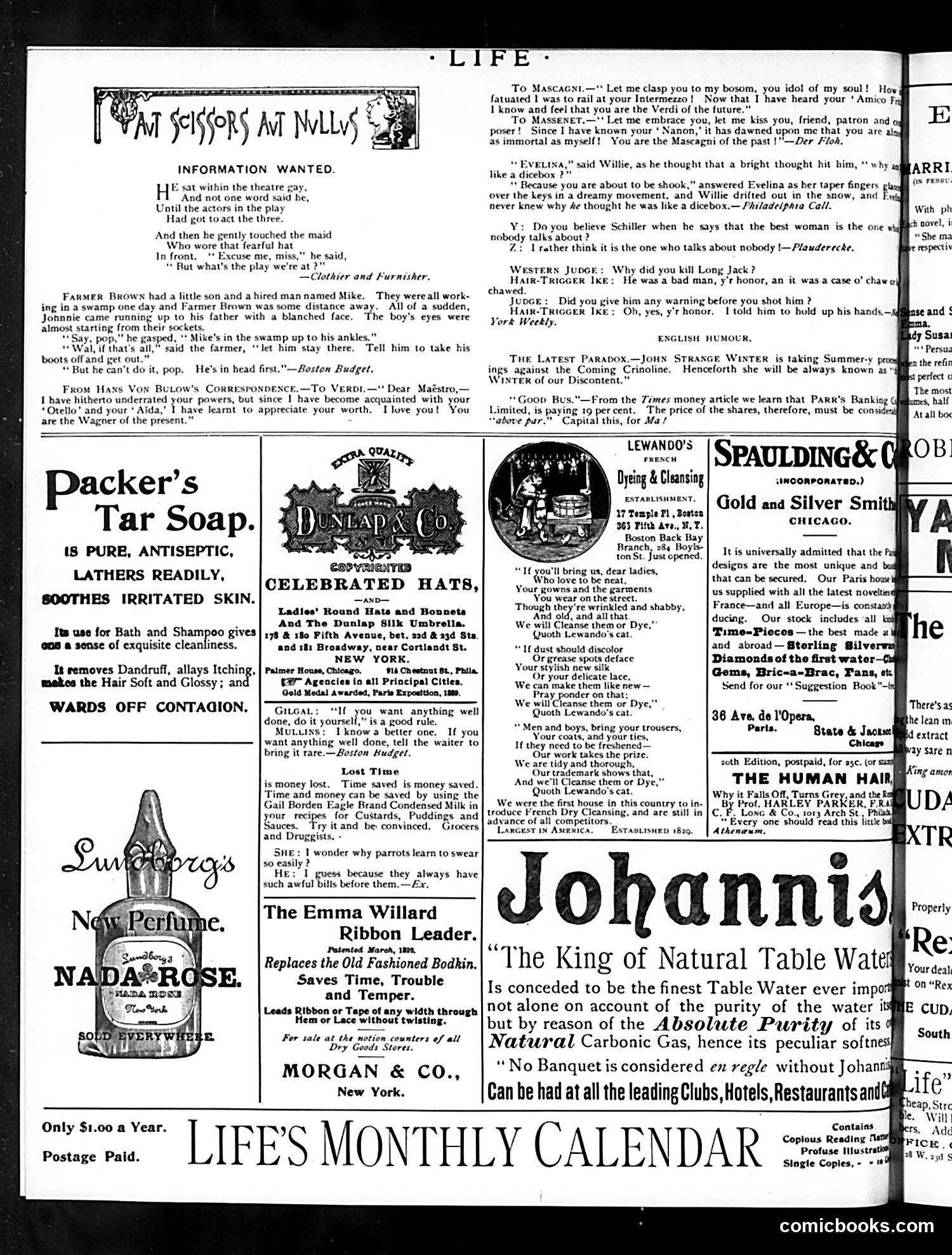
This page contains several brief humorous sketches typical of late 19th-century American satire: **Main Cartoons:** - A theater-goer asking a woman in front to remove her large hat—mocking the era's excessively wide bonnets that obstructed views - A farmer's son stuck headfirst in a swamp, playing on rural comedic mishaps - A "Western Judge" scene satirizing frontier justice and rough dialect ("y'r honor," "chawed") **Literary Satire:** The "Hans von Bülow's Correspondence" section mocks operatic fandom and inflated praise. Von Bülow (a real 19th-century conductor) sends absurdly contradictory flattery to composers Verdi, Mascagni, and Massenet, calling each "the Wagner of [his era]"—ridiculous since they're contemporaries. This satirizes the hyperbolic fan letters composers received. **Other Jokes:** Brief quips about women pianists, crinoline fashions, and banking practices fill the remaining space, typical of Life's miscellaneous humor format. The page is primarily advertising (Packer's Tar Soap, Spaulding & Co.), reflecting how magazines subsidized content.
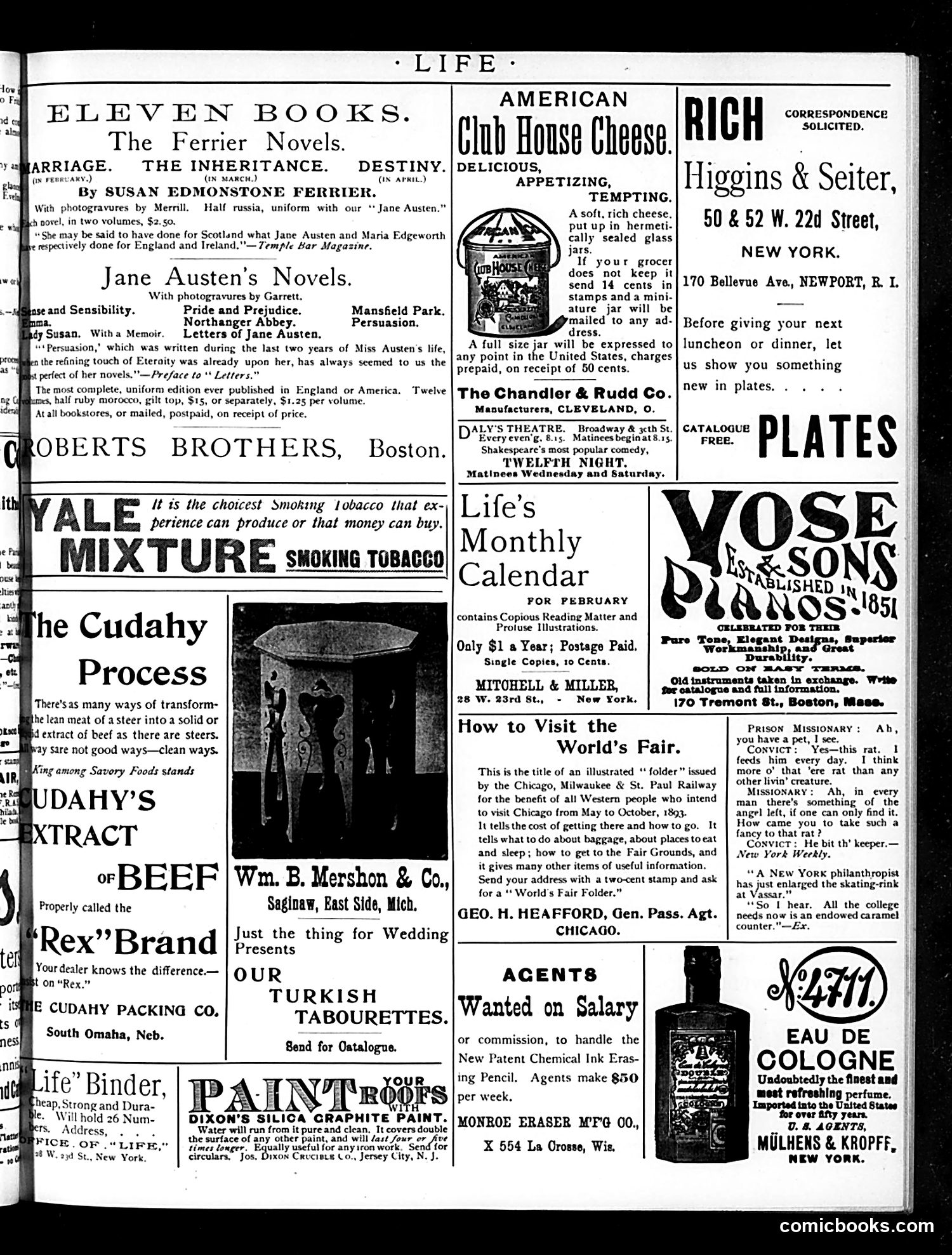
This page is **primarily advertising**, not satirical content. It's from Life magazine's advertising section, likely from early 1893 (based on the World's Columbian Exposition reference). The advertisements showcase typical late-Victorian consumer goods: Jane Austen novels, smoking tobacco (Yale Mixture), beef extract (Cudahy's Rex Brand), Turkish furniture, paint products, cheese, cologne, and fine china. The only quasi-editorial content is "Life's Monthly Calendar" promoting the February issue and a small "Prison Missionary" dialogue—likely a humorous filler anecdote rather than satire. **Context for modern readers:** This reflects the Gilded Age marketplace—when magazines relied heavily on advertising revenue and juxtaposed highbrow literary offerings (Jane Austen) alongside commercial products targeting middle and upper-class consumers. The ads emphasize quality, propriety, and social refinement typical of the period's aspirational consumer culture.
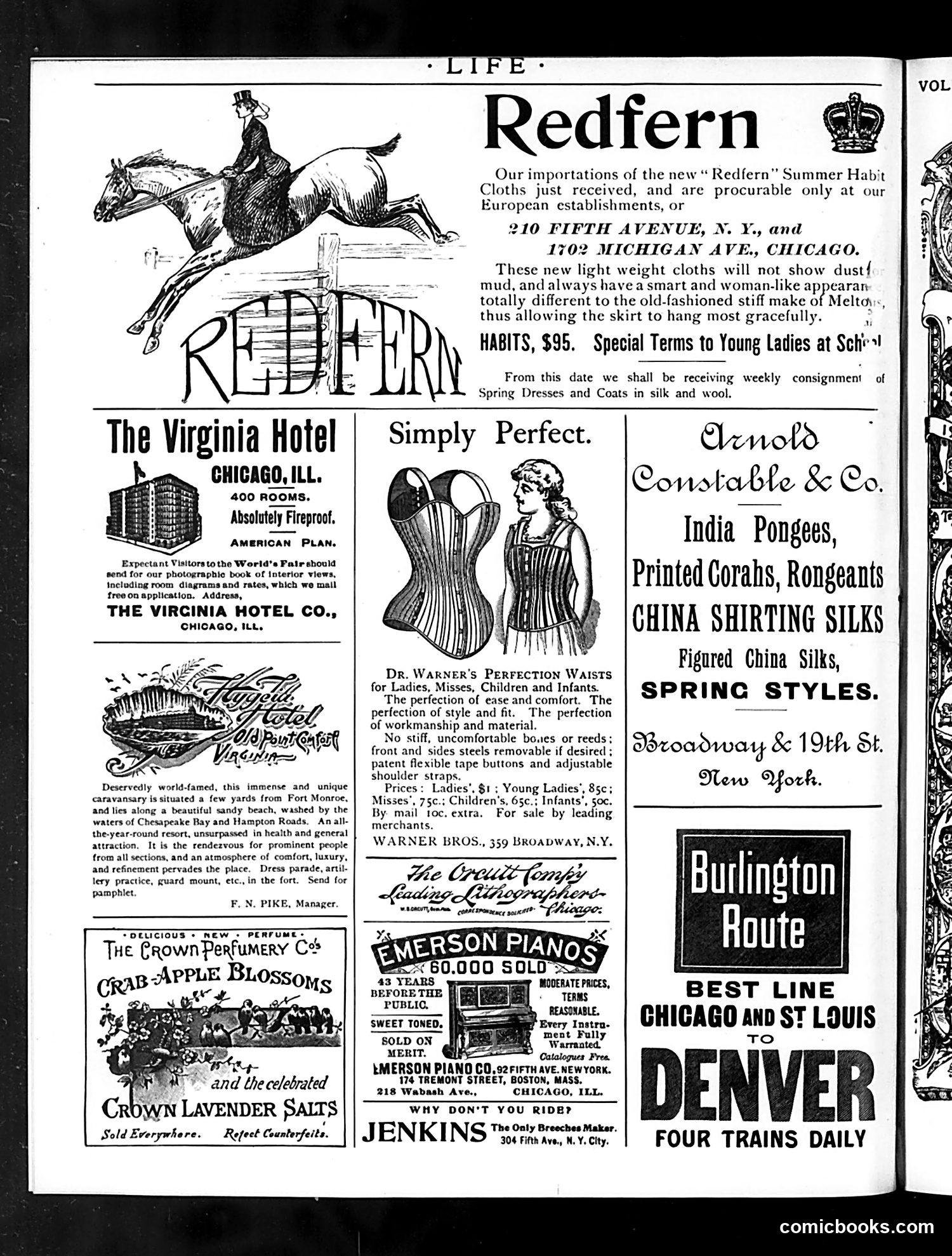
This is primarily an **advertising page** from Life magazine, not a satirical cartoon page. It contains approximately a dozen advertisements for luxury goods and services aimed at affluent American consumers, likely from the 1890s-early 1900s era. The page features ads for: - **Redfern** riding habit clothes (top) — fashionable equestrian wear for women - **The Virginia Hotel** — a resort destination - **Dr. Warner's Perfection Waists** — corsetry emphasizing comfort without rigid boning - **Emerson Pianos** — musical instruments - **Arnold Constable & Co.** — fine fabrics from Asia - **Burlington Route** — railroad service to Denver The only illustration with narrative content is a **sketch of a woman riding sidesaddle** at the top, advertising Redfern clothes. This depicts the fashionable sport of women's horseback riding during this era. This reflects the magazine's function as a commercial vehicle for marketing high-end products to wealthy urban readers.