
Life, 1893-02-23 · page 11 of 16
Life — February 23, 1893 — page 11: what you’re looking at
What you’re looking at
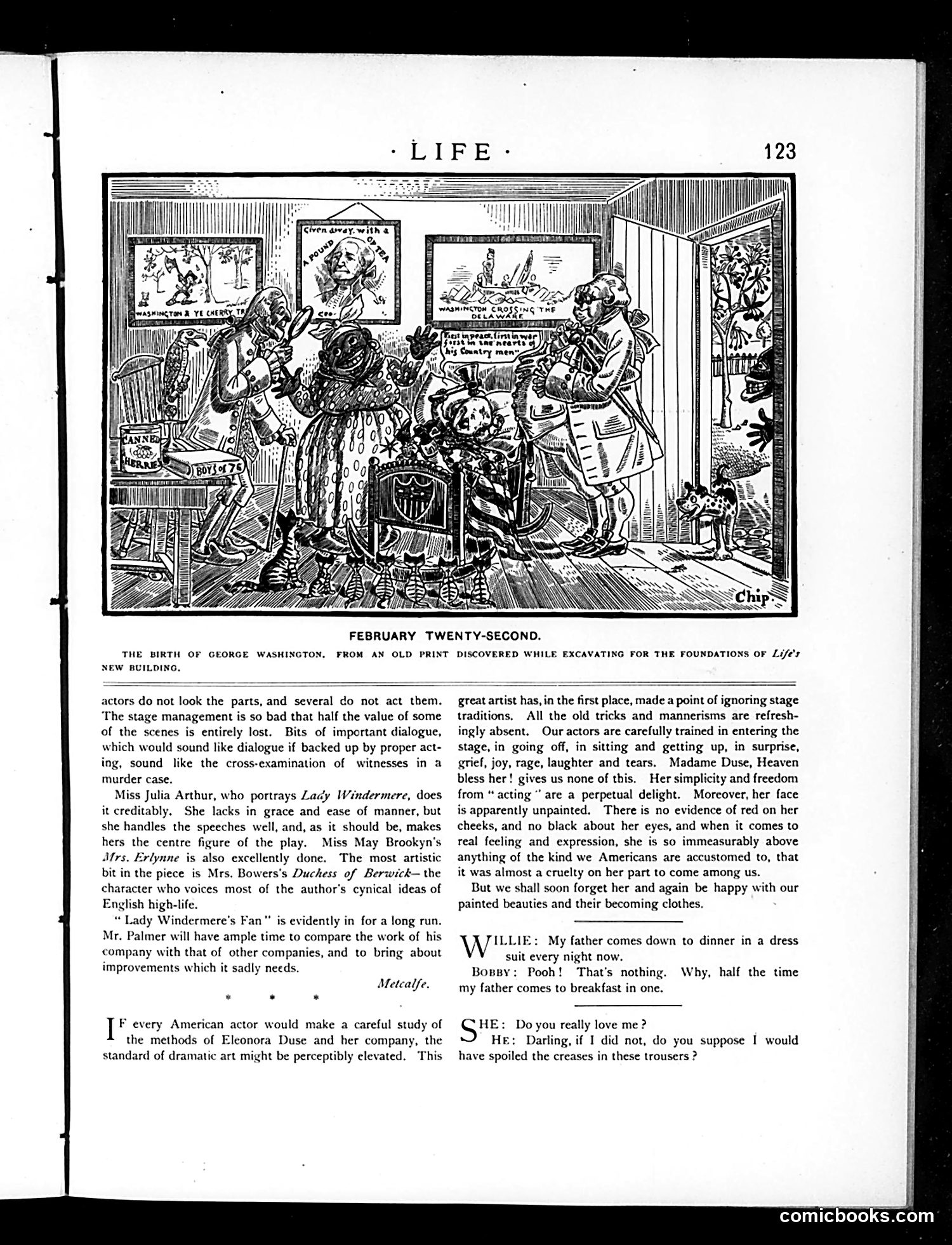
This page from *Life* magazine features a satirical cartoon about theatrical performances, specifically critiquing American actors' lack of training and stage presence compared to professionals like Eleonora Duse (an acclaimed Italian actress referenced in the text). The main cartoon depicts a chaotic theatrical scene where actors appear wooden and unconvincing—the satire's target. The text criticizes actors who "do not look the parts" and "do not act them," arguing that American theater lacks the refined technique of European standards. The dialogue snippets at bottom mock superficial conversation and bourgeois domesticity—presumably representing the shallow material in contemporary American plays. The overall message: American theater needs to professionalize and study serious dramatic techniques rather than rely on amateur performers and trivial scripts.
📄 Transcribed text from this page (OCR, searchable)
Machine-transcribed from the original scan — historical spelling and the odd misread are preserved.
Le Let ka TL Tt i Mn eZ ms SN SS s SS Ss FEBRUARY TWENTY-SECOND. THE BIRTH OF GEORGE WASHINGTON, NEW BUILDING, FROM AN OLD PRINT DISCOVERED WHILE EXCAVATING FOR THE FOUNDATIONS OF Life's actors do not look the parts, and several do not act them. The stage management is so bad that half the value of some of the scenes is entirely lost. Bits of important dialogue, which would sound like dialogue if backed up by proper act- ing, sound like the cross-examination of witnesses in a murder case. Miss Julia Arthur, who portrays Lady Windermere, does it creditably, She lacks in grace and ease of manner, but she handles the speeches well, and, as it should be, makes hers the centre figure of the play. Miss May Brookyn’s rs. Erlynne is also excellently done. The most artistic bit in the piece is Mrs. Bowers’s Duchess of Berwick—the character who voices most of the author's cynical ideas of English high-life. * Lady Windermere's Fan” is evidently in for a long run. Mr. Palmer will have ample time to compare the work of his company with that of other companies, and to bring about improvements which it sadly needs. Metcalfe, * * * [fv American actor would make a careful study of the methods of Eleonora Duse and her company, the standard of dramatic art might be perceptibly elevated. This great artist has, in the first pie: made a point of ignoring stage traditions, All the old tricks and mannerisms are refresh- ingly absent. Our actors are carefully trained in entering the stage, in going off, in sitting and getting up, in surprise, grief, joy, rage, laughter and tears. Madame Duse, Heaven bless her! gives us none of this. Her simplicity and freedom from “ acting are a perpetual delight. Moreover, her face is apparently unpainted. There is no evidence of red on her cheeks, and no black about her eyes, and when it comes to real feeling and expression, she is so immeasurably above anything of the kind we Americans are accustomed to, that it was almost a cruelty on her part to come among us. But we shall soon forget her and again be happy with our painted beauties and their becoming clothes. ILLIE: My father comes down to dinner in a dress suit every night now. Bossy: Pooh! That's nothing. my father comes to breakfast in one. Why, half the time HE: Do you really love me ? HE: Darling, if I did not, do you suppose I would have spoiled the creases in these trousers ? comicbooks.com