
Life, 1893-02-23 · page 4 of 16
Life — February 23, 1893 — page 4: what you’re looking at
What you’re looking at
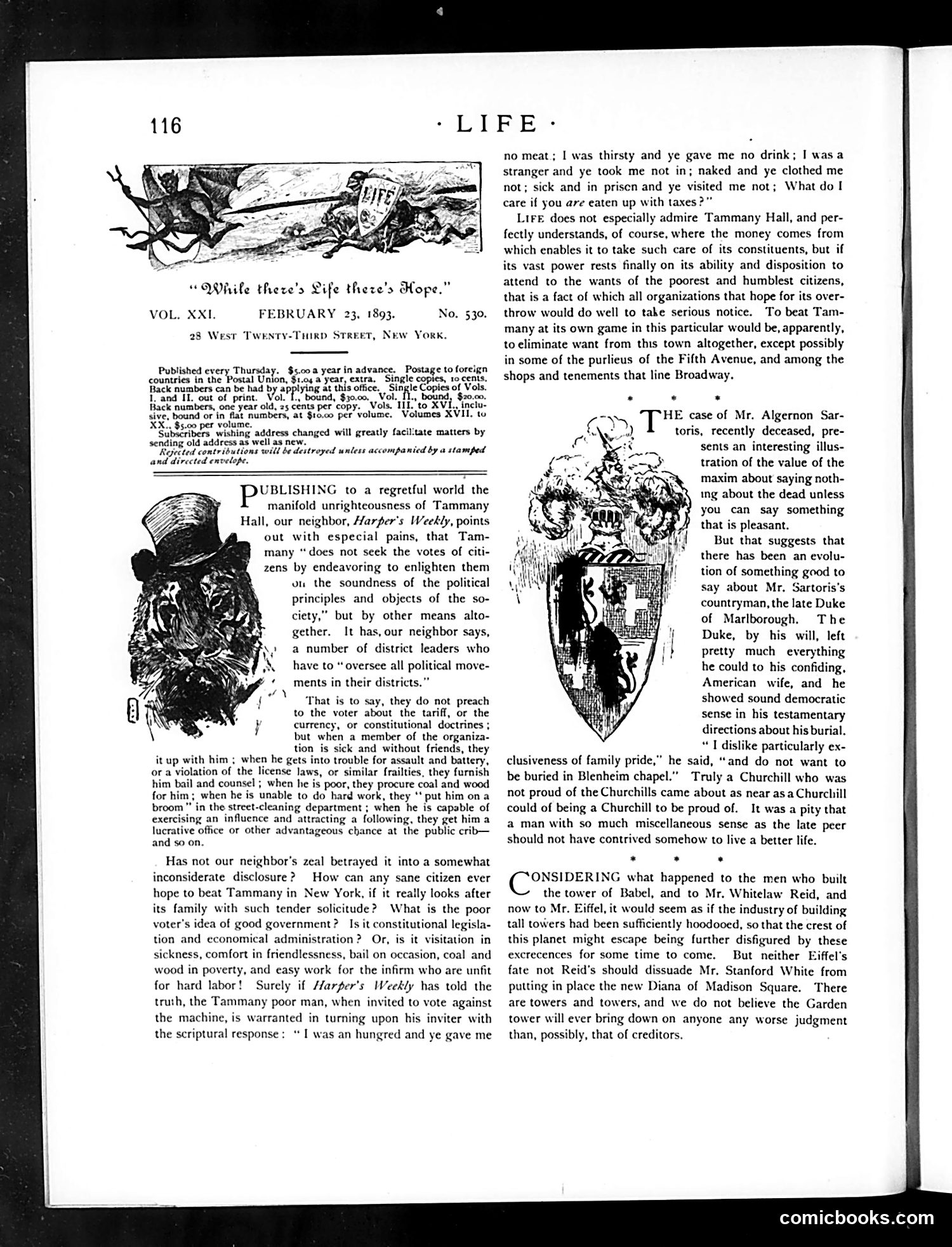
The page critiques **Tammany Hall**, New York's powerful Democratic political machine, which controlled the city through patronage and allegedly neglected poor constituents. The editorial sarcastically notes that Tammany claims to enlighten citizens "on the soundness of the political principles" while actually operating through backroom deals and favors to district leaders. The accompanying **caricatures** (specific identities unclear from image alone) appear to represent Tammany operatives. The text argues the organization cynically supports politicians in exchange for influence, then "puts him on a shelf" when he's no longer useful—depicting the ruthless, transactional nature of machine politics. The piece references **Algernon Sartoris**, a recently deceased figure, to contrast honest conduct with Tammany's moral failures. The satire exposes how patronage systems prioritized corrupt loyalty over genuine public service.
📄 Transcribed text from this page (OCR, searchable)
Machine-transcribed from the original scan — historical spelling and the odd misread are preserved.
- LIFE: “While there’s Life there’s Hope.” VOL. XXI. FEBRUARY 23, 1893. 28 West Twenty-Tiirp Street, N No, 530. w York. Published every Thursday. $5.00 year in advance. Postage to foreign countries in the Postal Union, $1.04 a year, extra, Single copies, 10 cen! Back numbers can be had by applying at thi Vol. f., bound, s office, | Single Copies of Vo I. and IT. out of print. $30.00, Vol. Tl., bound, $20.00. Hack numbers, one year old, 25 cents per copy. Vols. III.'to XVI., inclu- sive, bound or in flat numbers, at $10.00 per volume. Volumes XVII. to XX.. $5.00 per volume. ; Subscribers. wishing address changed will greatly facilitate matters by sending old address as well as new. ; Rejected contributions will be destroyed untess accompanied by a stamped and directed envelope. UBLISHING to a regretful world the manifold unrightcousness of Tammany Hall, our neighbor, Harper's Weekly, points out with especial pains, that Tam- many “does not seek the votes of citi- zens by endeavoring to enlighten them vu the soundness of the political principles and objects of the so- ciety,” but by other means alto- gether. It has, our neighbor says, a number of district leaders who have to “ oversee all political move- ments in their districts.” That is to say, they do not preach to the voter about the tariff, or the currency, or constitutional doctrines ; but when a member of the organiza- tion is sick and without friends, they it up with him ; when he gets into trouble for assault and battery, or a violation of the license laws, or similar frailties, they furnish him bail and counsel ; when he is poor, they procure coal and wood for him; when he is unable to do hard work, they ‘' put him ona broom” in the street-cleaning department ; when he is capable of exercising an influence and attracting a following, they get him a lucrative office or other advantageous chance at the public crib— and so on, Has not our neighbor's zeal betrayed it into a somewhat inconsiderate disclosure? How can any sane citizen ever hope to beat Tammany in New York, if it really looks after its family with such tender solicitude? What is the poor voter's idea of good government? Is it constitutional legisla- tion and economical administration ? Or, is it visitation in sickness, comfort in friendlessness, bail on occasion, coal and wood in poverty, and easy work for the infirm who are unfit for hard labor! Surely if Harper's Weekly has told the truth, the Tammany poor man, when invited to vote against the machine, is warranted in turning upon his inviter with the scriptural response: “ I was an hungred and ye gave me no meat; I was thirsty and ye gave me no drink; I wasa stranger and ye took me not in; naked and ye clothed me not; sick and in prisen and ye visited me not; What do I care if you are eaten up with taxes?” LIFE does not especially admire Tammany Hall, and per- fectly understands, of course, where the money comes from which enables it to take such care of its constituents, but if its vast power rests finally on its ability and disposition to attend to the wants of the poorest and humblest citizens, that is a fact of which all organizations that hope for its over- throw would do well to take serious notice. To beat Tam- many at its own game in this particular would be, apparently, to eliminate want from this town altogether, except possibly in some of the purlieus of the Fifth Avenue, and among the shops and tenements that line Broadway. * * * -\ HE case of Mr. Algernon Sar- Rp T toris, recently deceased, pre- sents an interesting illus- tration of the value of the maxim about saying noth- ing about the dead unless you can say something that is pleasant. But that suggests that there has been an evolu- tion of something good to say about Mr. Sartoris’s countryman, the late Duke of Marlborough, The Duke, by his will, left pretty much everything he could to his confiding, American wife, and he showed sound democratic sense in his testamentary directions about his burial. “T dislike particularly ex- clusiveness of family pride,” he said, “and do not want to be buried in Blenheim chapel.” Truly a Churchill who was not proud of the Churchills came about as near asa Churchill could of being a Churchill to be proud of. It was a pity that a man with so much miscellaneous sense as the late peer should not have contrived somehow to live a better life. * . . ONSIDERING what happened to the men who built the tower of Babel, and to Mr. Whitelaw Reid, and now to Mr. Eiffel, it would seem as if the industry of building tall towers had been sufficiently hoodooed, so that the crest of this planet might escape being further disfigured by these excrecences for some time to come. But neither Eiffel’s fate not Reid’s should dissuade Mr. Stanford White from putting in place the new Diana of Madison Square. There are towers and towers, and we do not believe the Garden tower will ever bring down on anyone any worse judgment than, possibly, that of creditors, comicbooks.com