
Life, 1893-02-23 · page 6 of 16
Life — February 23, 1893 — page 6: what you’re looking at
What you’re looking at
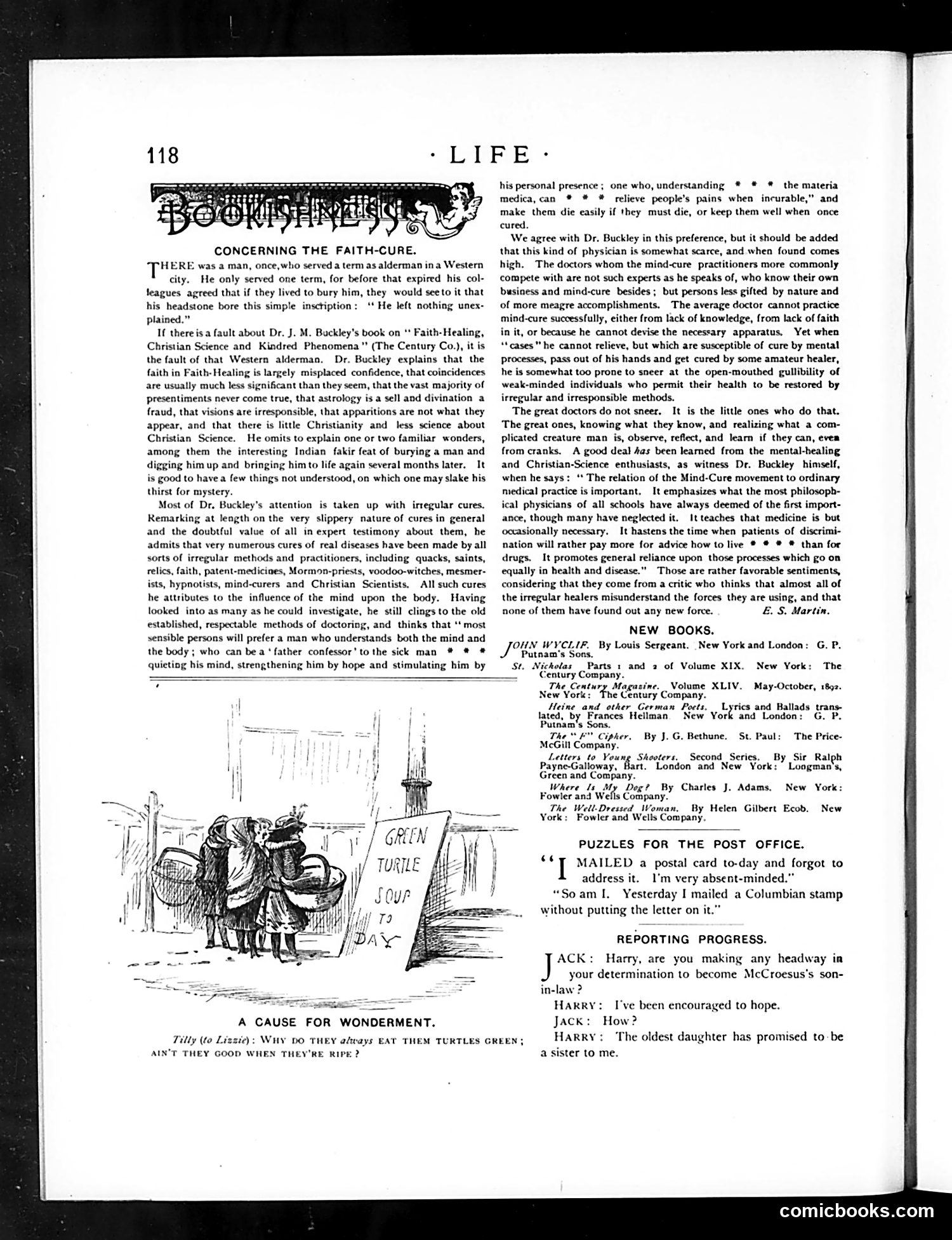
The main cartoon titled "A Cause for Wonderment" depicts a figure eating green turtle soup, with a caption asking: "Why do they always eat them turtles green; ain't they good when they're ripe?" This is a humorous joke about ignorance—likely mocking working-class or immigrant dialects and their misunderstanding of food preparation. The "green" in "green turtle soup" refers to a specific culinary preparation (using green sea turtles), not the ripeness of the ingredient. The satire ridicules the speaker's confusion about cooking terminology. The page also contains a lengthy article on faith-healing and Christian Science, discussing Dr. Buckley's views on mind-cure and medical practice, followed by a "New Books" section and brief comedic exchanges titled "Puzzles for the Post Office" and "Reporting Progress."
📄 Transcribed text from this page (OCR, searchable)
Machine-transcribed from the original scan — historical spelling and the odd misread are preserved.
- LIFE: CONCERNING THE FAITH-CURE. “THERE was a man, once,who served term as alderman ina Western city, He only served one term, for before that expired his col- feagues agreed that if they lived to bury him, they would seeto it that his headstone bore this simple insctiption: ‘ He left nothing unex- plained.” If there isa fault about Dr. J. M. Buckley’s book on ** Faith-Healing Christian Science and Kindred Phenomena" (The Century Co.), it is the fault of that Western alderman. Dr. Buckley explains that the faith in Faith-Healing is largely misplaced confidence, that coincidences are usually much less significant than they seem, that the vast majority of presentiments never come true, that astrology is a sell and divination a fraud, that visions are irresponsible, that apparitions are not what they appear, and that there is little Christianity and less science about Christian Science. He omits to explain one or two familiar wonders, among them the interesting Indian fakir feat of burying a man and digging him up and bringing himto life again several months later. It is good to havea few things not understood, on which one may slake his thirst for mystery. Most of Dr, Buckley's attention is taken up with irregular cures. Remarking at length on the very slippery nature of cures in general and the doubtful value of all in expert testimony about them, he admits that very numerous cures of real diseases have been made by all sorts of irregular methods and practitioners, including quacks, saints, relics, faith, patent-medicines, Mormon-priests, voodoo-witches, mesmer- ists, hypnotists, mind-curers and Christian Scientists, All such cures Having looked into as many as he could investigate, he still clings to the old established, respectable methods of doctoring, and thinks that * most sensible persons will prefer a man who understands both the mind and the body ; who can bea ‘father confessor’ to the sick man # # # quieting his mind, strengthening him by hope and stimulating him by he attributes to the influence of the mind upon the body. his personal presence ; one who, understanding * ® ® the materia medica, can * * # relieve people's pains when incurable,” and make them die easily if they must die, or keep them well when once cured. We agree with Dr. Buckley in this preference, but it should be added that this kind of physician is somewhat scarce, and when found comes high, The doctors whom the mind-cure practitioners more commonly compete with are not such experts as he speaks of, who know their own business and mind-cure besides ; but persons less gifted by nature and of more meagre accomplishments. The average doctor cannot practice mind-cure successfully, either from lack of knowledge, from lack of faith in it, or because he cannot devise the necessary apparatus, Yet when “*cases" he cannot relieve, but which are susceptible of cure by mental Processes, pass out of his hands and get cured by some amateur healer, he is somewhat too prone to sneer at the open-mouthed gullibility of weak-minded individuals who permit their health to be restored by irregular and irresponsible methods. The great doctors do not sneer, It is the little ones who do that. The great ones, knowing what they know, and realizing what a com- plicated creature man is, observe, reflect, and learn if they can, eves from cranks. A good deal Aas been learned from the mental-healing and Christian-Science enthusiasts, as witness Dr. Buckley himself, when he says: ‘* The relation of the Mind-Cure movement to ordinary medical practice is important, It emphasizes what the most philosopb- ical physicians of all schools have always deemed of the first import- ance, though many have neglected it, It teaches that medicine is but occasionally necessary. It hastens the time when patients of discrimi- nation will rather pay more for advice how to live ® # ® ® than for drugs, It promotes general reliance upon those processes which go on equally in health and disease." Those are rather favorable sentiments, considering that they come from a critic who thinks that almost all of the irregular healers misunderstand the forces they are using, and that none of them have found out any new force. &. S. Martin. NEW BOOKS. OHN WYCLIF. By Louis Sergeant. New York and London: G. P. Putnam's Sons. St, Nickolas Parts 1 and a of Volume XIX. New York: The A CAUSE FOR WONDERMENT. ie): WHY DO THEY afteays EAT THEM TURTLES GREEN ; AIN'T THEY GOOD WHEN THEY'RE RIPE? ‘Century Company. The Century Magazine. Volume XLIV. May-October, 1892. New York: The Century Company. Heine and other German Poets, lated, by Frances Hellman Putnam's Sons, The “ F" Cipher, McGill Company. Letters to Young Shooters. Payne-Galloway, Bart. Green and Company. Where Is My Deg? By Charles J. Adams, Fowler and Wells Company. The Well-Dressed Woman, By Helen Gilbert Ecob. New York: Fowler and Wells Company. Lyrics and Ballads trans- New York and London: G. P. By J. G. Bethune. St. Paul: The Price- Second Series. By Sir Ralph London and New York: Loogman's, New York: PUZZLES FOR THE POST OFFICE. “T MAILED a postal card to-day and forgot to address it. I'm very absent-minded.” SoamI. Yesterday I mailed a Columbian stamp without putting the letter on it. REPORTING PROGRESS. ACK: Harry, are you making any headway in your determination to become McCroesus’s son- in-law ? HARRY: Jack: How? HARRY: The oldest daughter has promised to-be a sister to me. I've been encouraged to hope. comicbooks.com