
A complete issue · 16 pages · 1893
Life — February 16, 1893
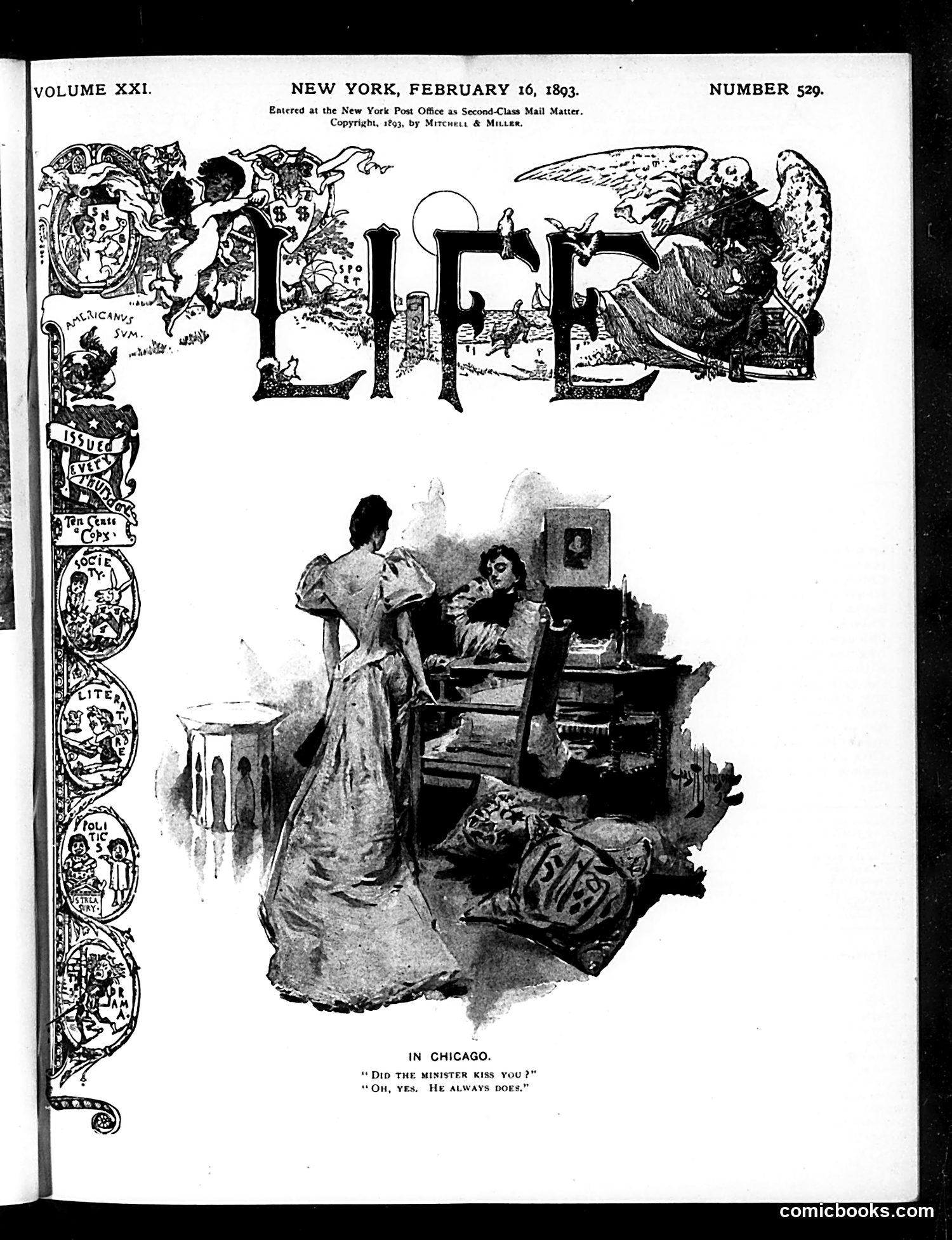
This page features a satirical illustration titled "In Chicago" with the caption: "Did the Minister Kiss You?" / "Oh, Yes. He always does." The cartoon depicts a woman at a piano speaking with a man (likely a minister, based on context). The joke appears to be social satire about clerical behavior—specifically, the impropriety of a minister kissing a woman during a private lesson or visit. The woman's casual, accepting response ("He always does") suggests this is normalized or expected behavior, making the satire critique the hypocrisy of religious figures who violate their supposed moral standards. The ornate decorative border on the left is typical of Life magazine's design. This reflects late-19th-century anxieties about authority figures' moral conduct.
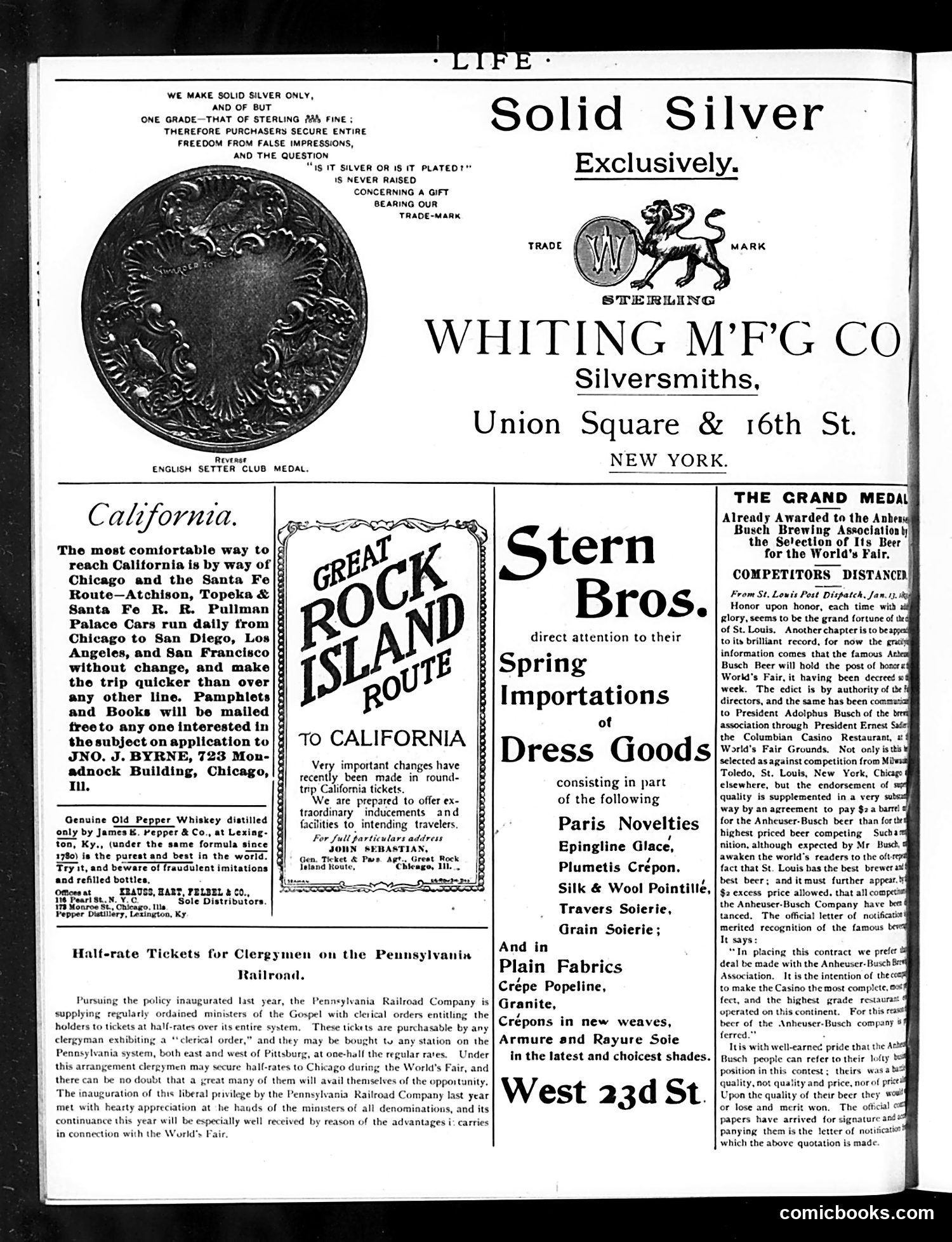
This page is **primarily advertising** rather than editorial satire. The main content includes: 1. **Whiting MFG Co.** advertisement emphasizing "Solid Silver Exclusively" with their sterling trademark, located in New York. 2. **Stern Bros.** advertisement for spring dress goods imports from Paris, including novelties and fabrics. 3. **Travel advertisement** for the Great Rock Island Route to California via Chicago and Santa Fe. 4. **Pennsylvania Railroad clergy discount** notice offering half-rate tickets to clergymen. The only image is a decorative **English Setter Club Medal** (ornamental silver piece), which is illustrative rather than satirical. There are no political cartoons or satirical commentary on this page—it's a commercial publication page typical of *Life* magazine's mixed advertising and editorial format during this era.
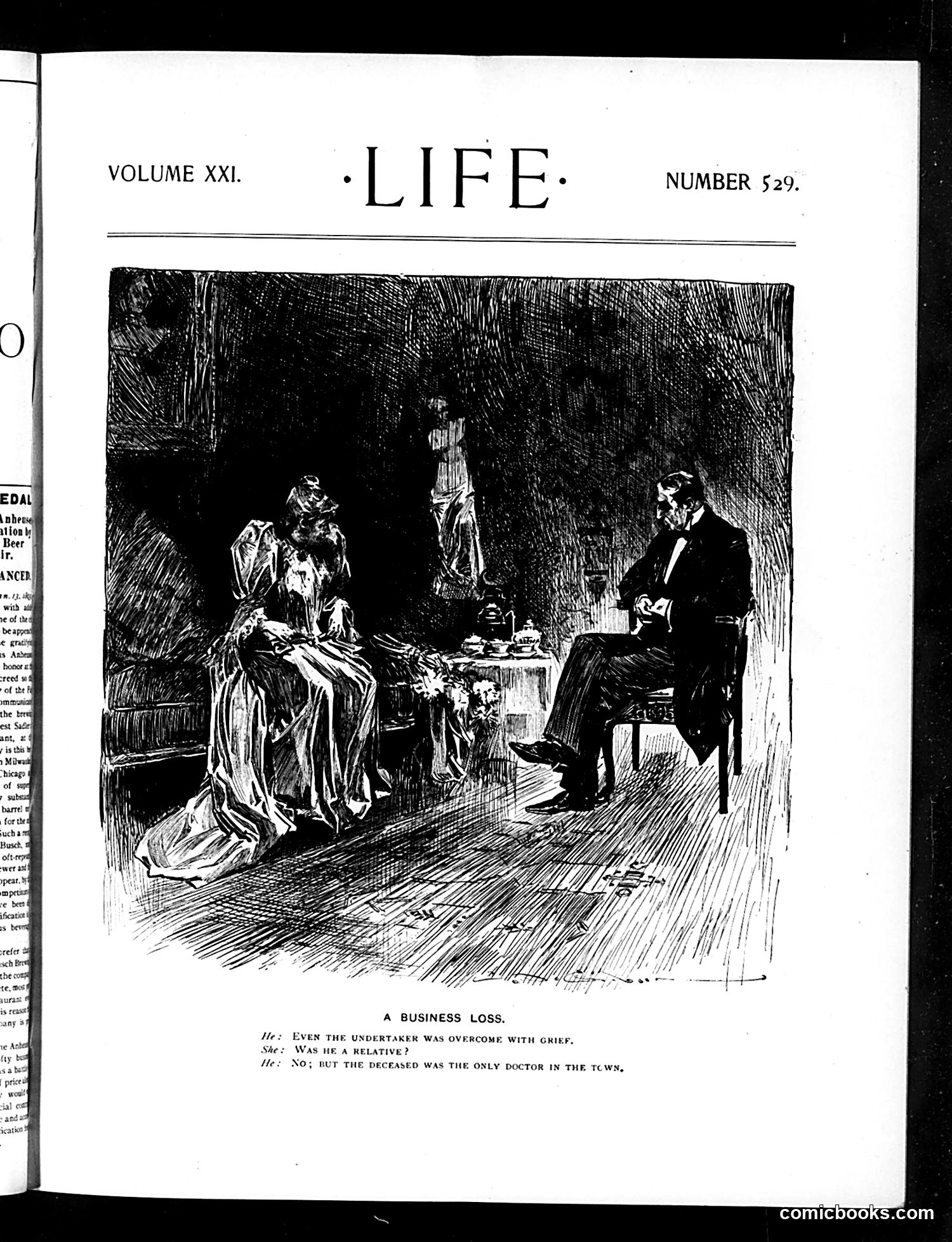
This is a dark humor cartoon about an undertaker's financial loss. The scene shows a grieving woman in elaborate mourning dress meeting with an undertaker (seated right) in his parlor. The joke's dialogue reveals the satire: The undertaker is overcome with grief—not for the deceased, but because "the deceased was the only doctor in the town." The humor exploits the tension between genuine mourning and economic self-interest. The undertaker would normally profit from deaths (his business depends on them), but this particular death is financially catastrophic because the town's only physician has died. The cartoon satirizes how professional interests can paradoxically conflict with one another, and mocks the undertaker's mercenary priorities surfacing even during a supposedly solemn moment.
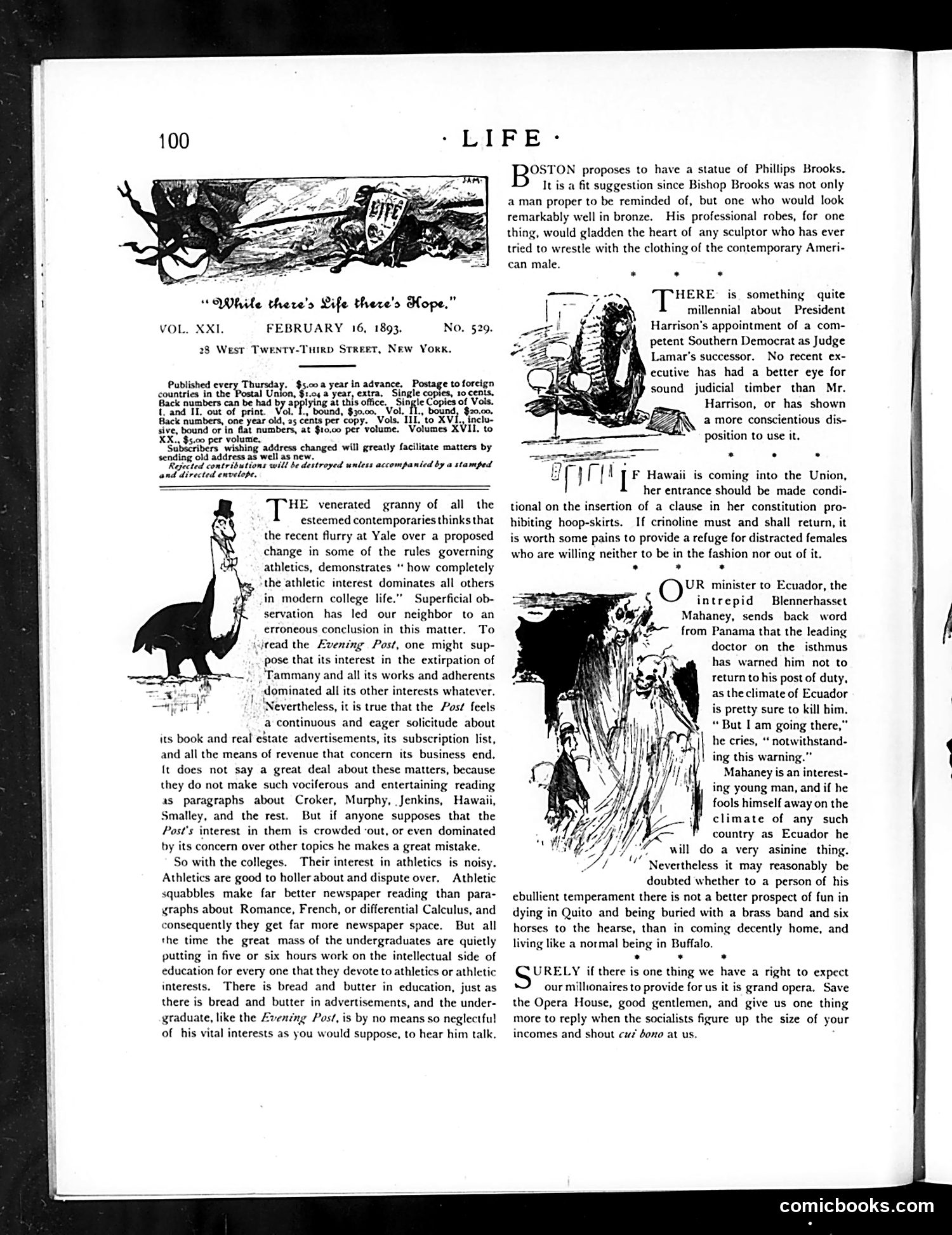
This page contains three satirical commentaries on contemporary issues: 1. **Yale Athletics Debate**: The text critiques the *Evening Post*'s concerns about Yale's athletic dominance overshadowing academics. The author defends athletics as legitimate college interest, arguing the *Post* neglects its own commercial interests while criticizing others. 2. **Phillips Brooks Statue**: Boston proposes commemorating Bishop Phillips Brooks, described as an admirable public figure worthy of remembrance. 3. **Hawaiian Statehood & Ecuador Minister**: Brief items mock Hawaii's conditional entry into the Union (regarding "hoop-skirts") and criticize Minister Mahaney's decision to remain in Ecuador despite health warnings—calling it foolish stubbornness. The page uses light satire and social commentary typical of 1890s Life magazine's format.
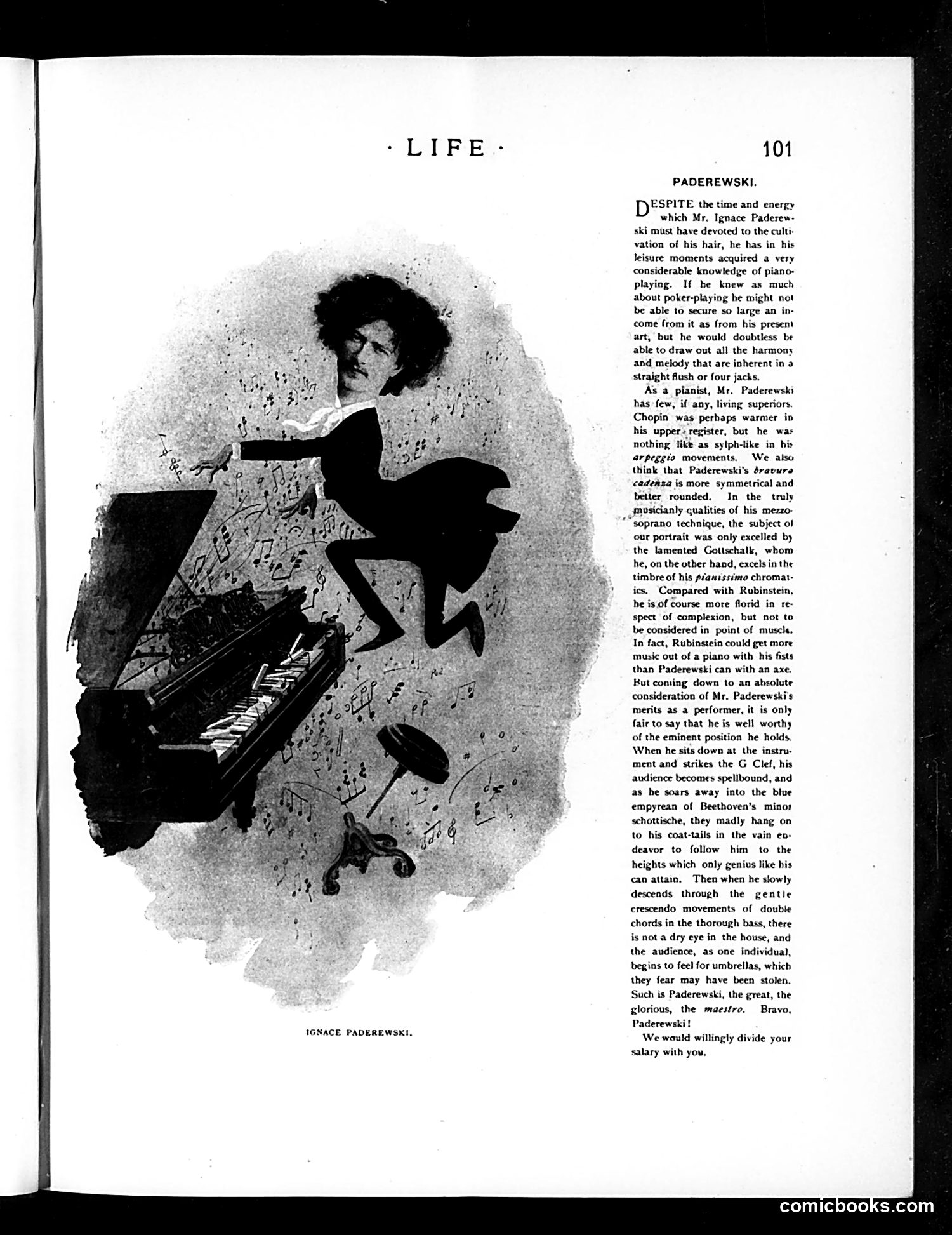
This page features a caricature and profile of **Ignacy Jan Paderewski**, the famous Polish pianist and statesman. The text praises his extraordinary musical talents, particularly his piano virtuosity and emotional power as a performer. The satire targets his lesser-known side: the article notes that despite his immense musical gifts, Paderewski was "nothing like as exhibitive in his upper register" and that his technical abilities, while exceptional, don't quite match those of competitors like Rubinstein. The concluding joke—"We would willingly divide your salary with you"—satirizes the vast financial success Paderewski achieved through concert performances, suggesting his earnings were so substantial that even his admirers would accept a share of them. The illustration shows Paderewski at the piano in a dramatic, romanticized pose typical of early 1900s caricature style.
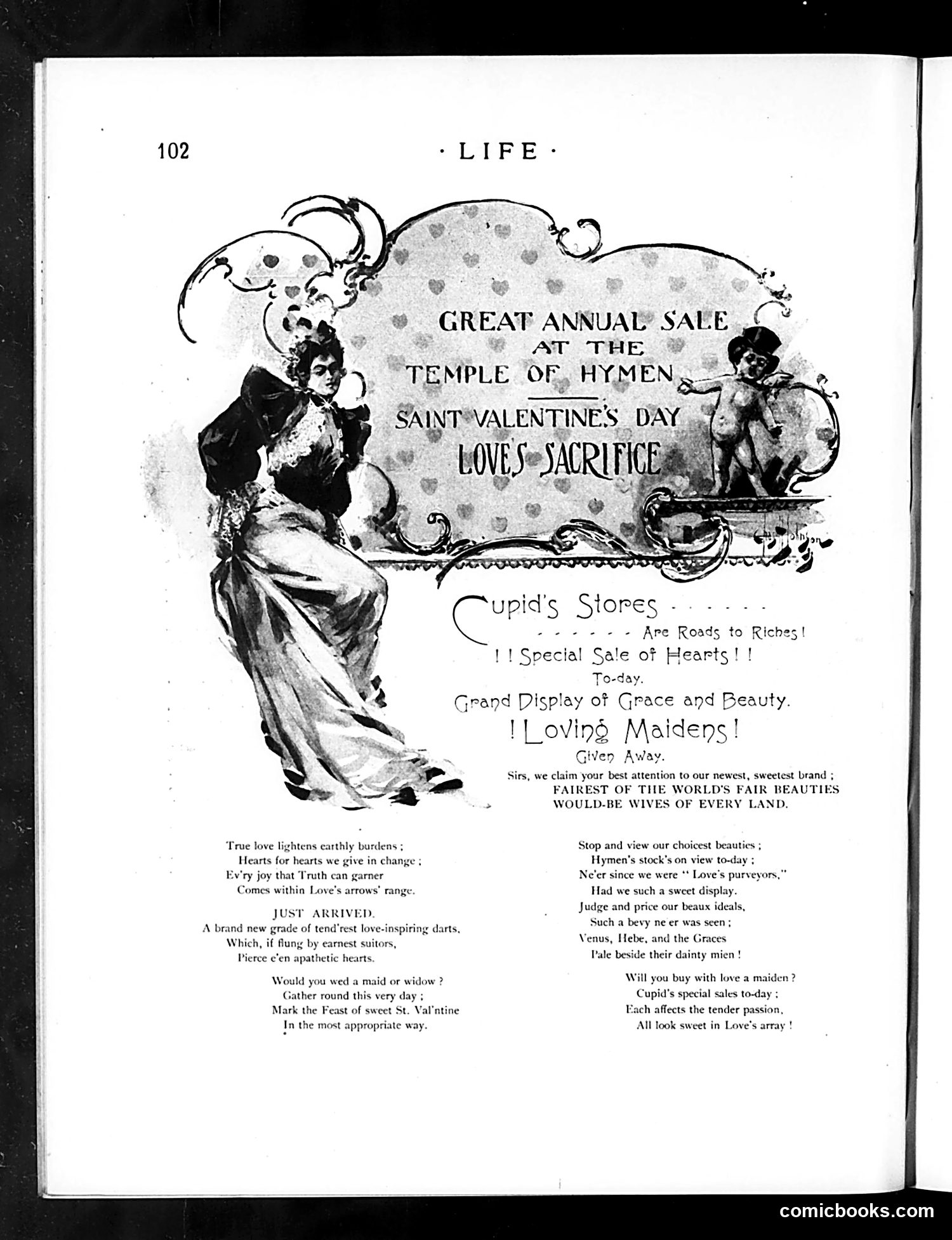
This page is primarily a **satirical advertisement** rather than a political cartoon. It advertises "Cupid's Stores," a fictional Valentine's Day marketplace offering "love maidens" for sale at the "Temple of Hymen" (marriage). The satire mocks commercialization of romance and marriage by presenting love as a commodity. The accompanying verses mock both romantic idealism ("True love lightens earthly burdens") and the transactional nature of courtship, asking "Would you wed a maid or widow?" and suggesting one should "buy with love a maiden." The illustration shows a fashionable woman in period dress alongside a cherub, emphasizing the commercialized aesthetics of romantic love. The overall joke targets how capitalist society commodifies even intimate human relationships and emotions, particularly marriage for men seeking wives.
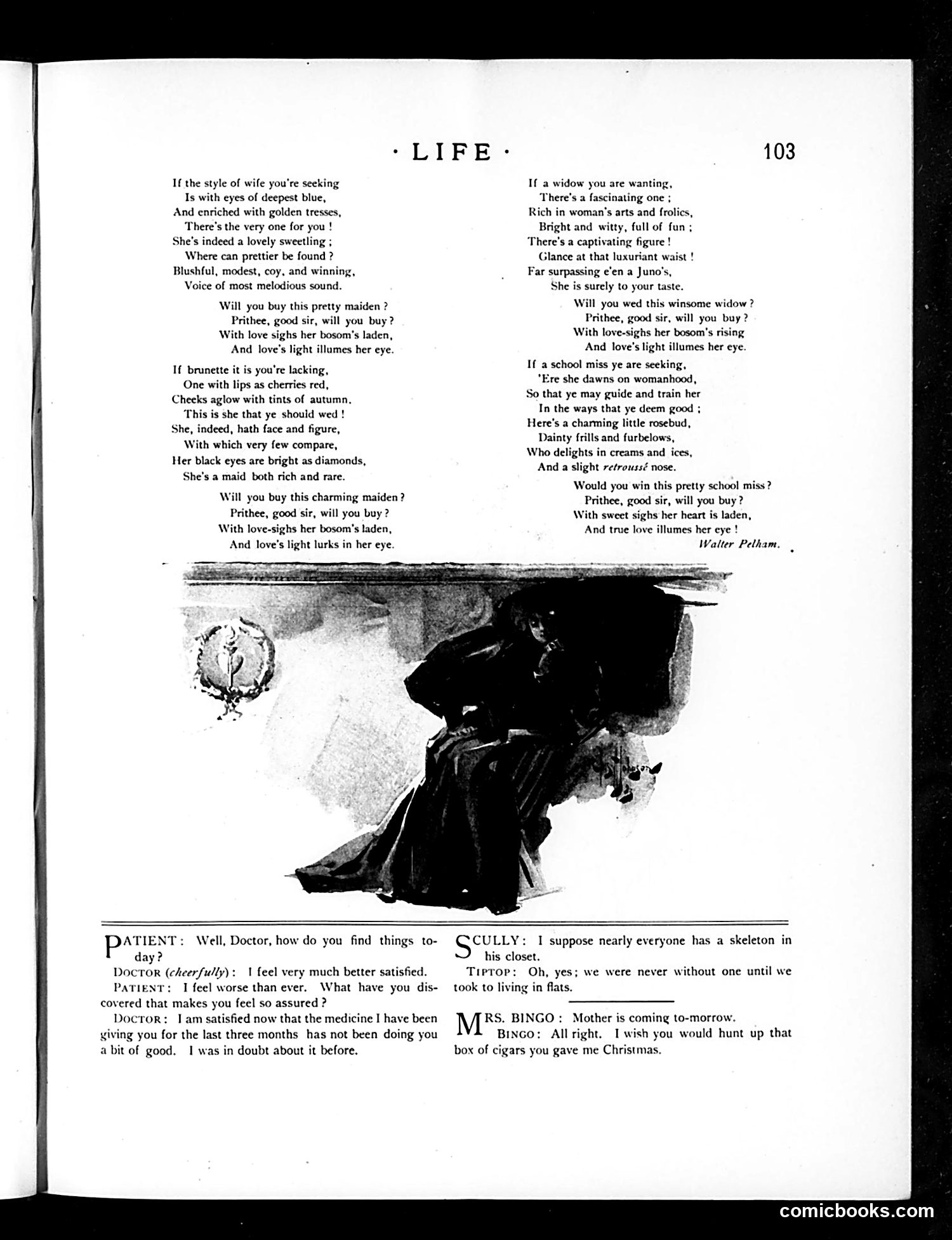
This page contains two distinct elements: **Upper section:** A poem by Walter Pelham titled "Life" presenting humorous descriptions of various marriageable women—brunettes, widows, school girls—each with stereotypical attributes. The verses mockingly ask "Will you buy?" as if cataloging commodities. This satirizes the marriage market and male attitudes toward women as purchasable goods, common satirical fodder for early 20th-century humor magazines. **Lower section:** Three brief comic dialogues—between a patient and doctor, two characters named Scully and Tiptoe discussing skeletons in closets, and Mrs. Bingo and Bingo about cigars. These appear to be standalone joke vignettes with accompanying illustration, typical filler content for period humor magazines. The illustration depicts a silhouetted figure in profile, likely complementing the marriage-market theme above.
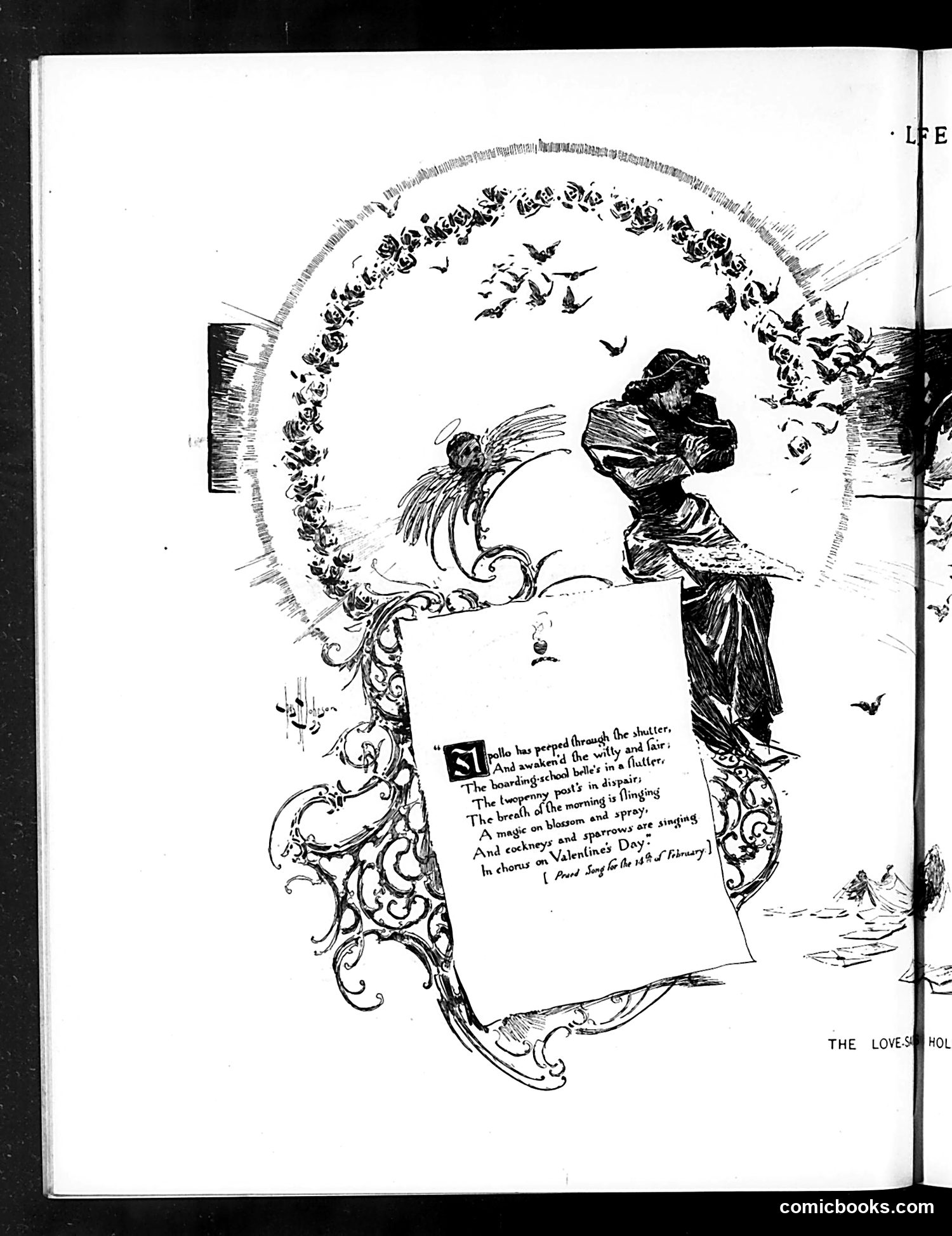
This page from *Life* magazine features a romantic illustration centered on a poetic quotation about spring and love. The image shows two figures—a winged cupid or cherub on the left and an elegantly dressed woman on the right—arranged around a decorative oval frame containing the verse. The text reads as a "Poet's Song for the 14th of February," suggesting this is Valentine's Day-themed content. The quoted lines praise spring's arrival, with references to "the shutter," "the silly and fair," and romantic imagery of "blossom and spray," "cockneys and sparrows are singing." This appears to be decorative rather than satirical—a sentimental, aesthetic piece celebrating Valentine's Day and springtime romance typical of early 20th-century *Life* magazine's lighter content.
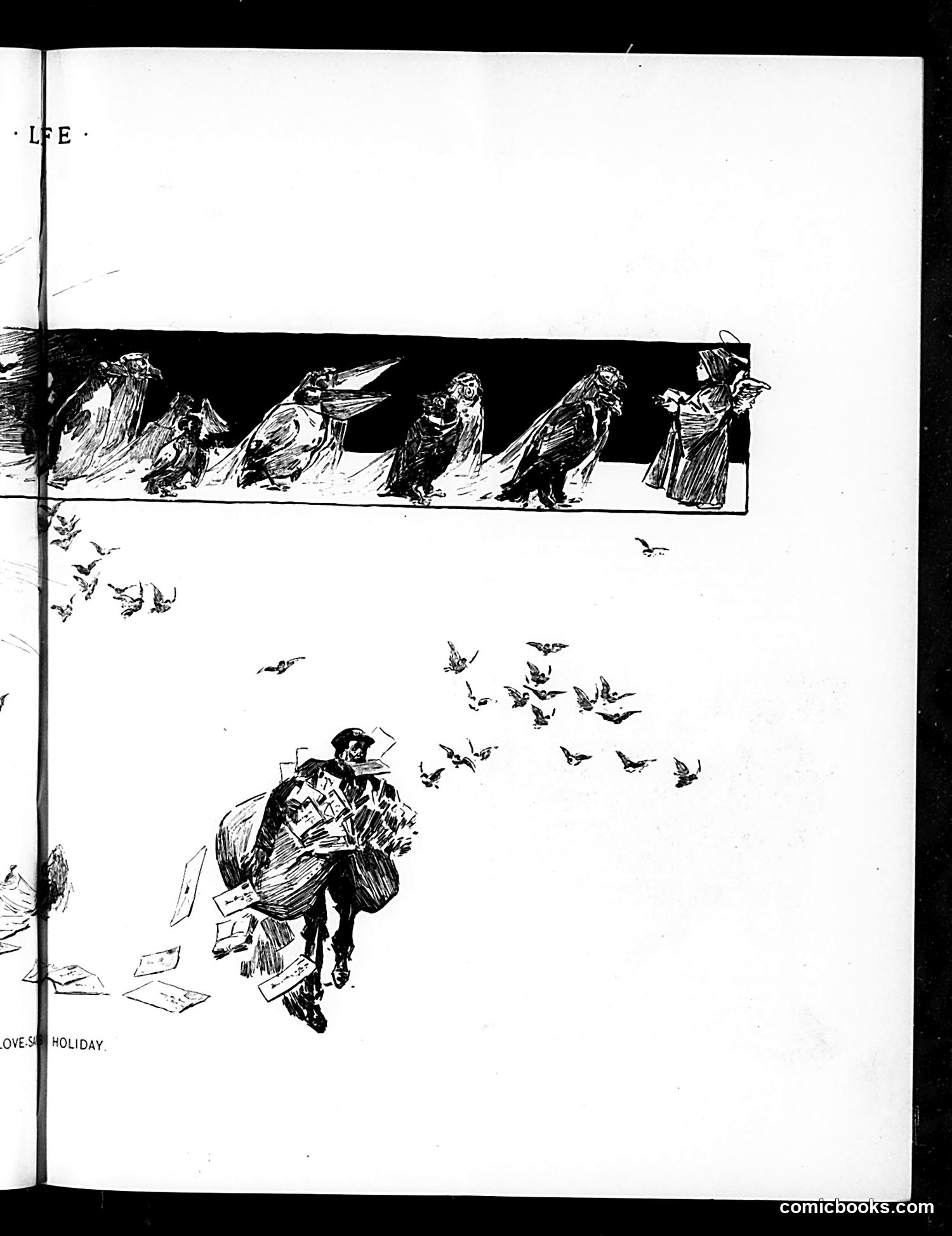
This page from *Life* magazine contains two satirical illustrations. The top panel shows five figures in a procession or line, rendered in stark black and white. The bottom illustration depicts a disheveled figure surrounded by scattered papers and pursued by birds in flight. Without clearer text identifying the specific figures or date, I cannot definitively name the individuals caricatured or pinpoint the exact political event being satirized. However, the imagery suggests commentary on governmental or institutional corruption—the scattered papers and fleeing birds in the lower cartoon imply someone evading consequences or responsibility. The formal procession above may represent officials or authority figures. The specific satirical point remains unclear without additional context or legible caption text.
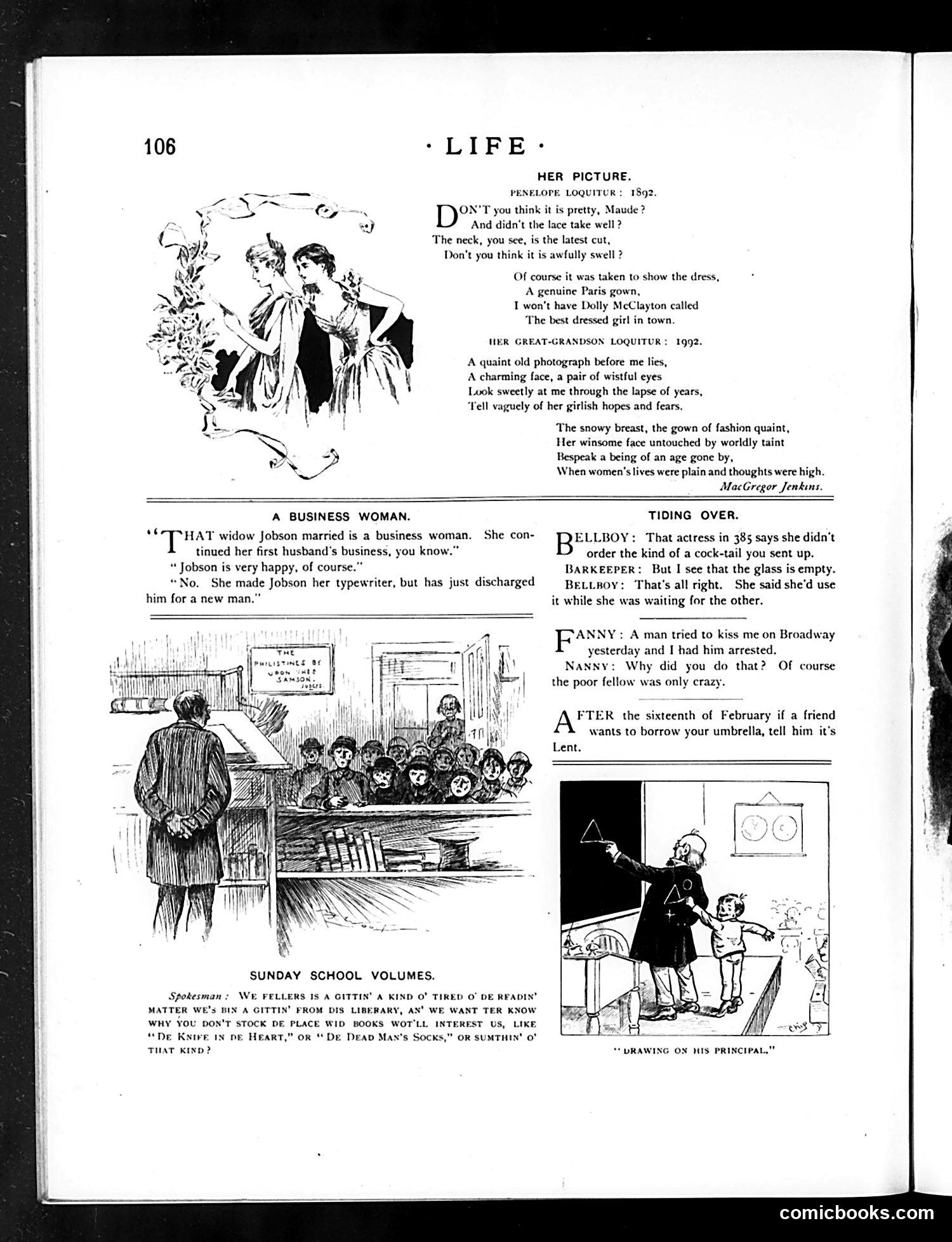
This page contains several unrelated satirical vignettes typical of Life's format: **"Her Picture"** (1892): Dialogue about a fashionable Paris dress, satirizing women's obsession with high fashion and appearances. **"A Business Woman"**: Brief joke about widow Johnson who fired her typewriter operator husband to hire a new man—satire on early female business owners and workplace gender dynamics. **"Sunday School Volumes"**: Librarian complaints about patrons requesting sensational books like "The Knife is the Heart" instead of wholesome Sunday school material—mocking both lowbrow reading tastes and moralistic library gatekeeping. **"Tiding Over"** and other brief quips mock everyday absurdities: empty glasses, street harassment, umbrella borrowing, and a child's drawing lesson. The humor relies on Victorian-era social observations about class, gender roles, and propriety.
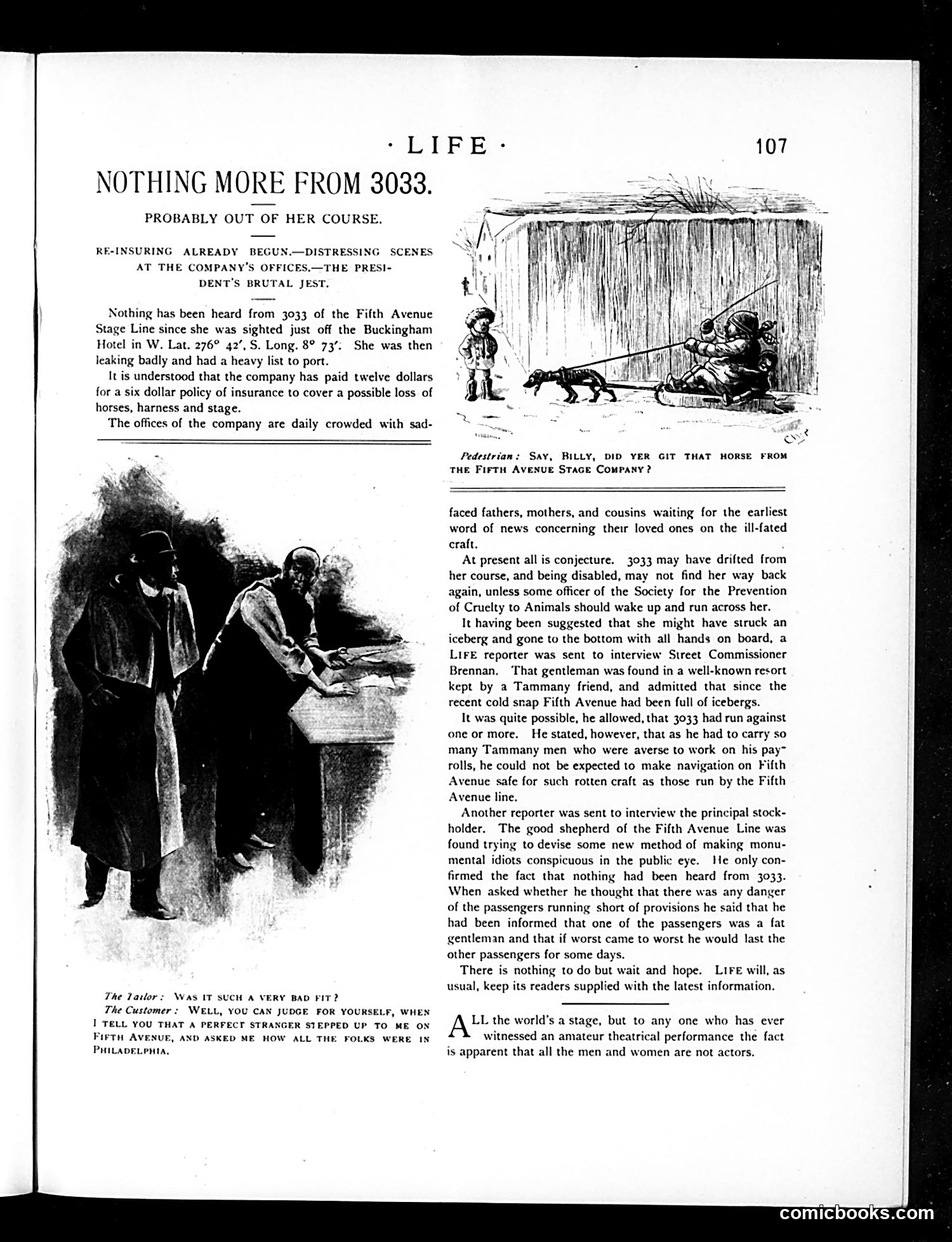
This page satirizes the disappearance of stagecoach 3033 from the Fifth Avenue Stage Line in New York City. The text indicates the coach vanished near the Buckingham Hotel, with passengers and cargo lost. The company paid $12 for insurance on a $6 policy, suggesting financial desperation. The cartoon dialogue mocks the absurdity: a tailor questions a customer about how "a perfect stranger stepped up to me on Fifth Avenue, and asked me how all the folks were in Philadelphia"—implying the missing coach created such a bizarre, nonsensical situation that even random interactions became surreal. The illustrations depict bewildered city dwellers discussing the incident. The satire targets the stage company's incompetence and the public's shocked reaction to this mysterious urban incident.
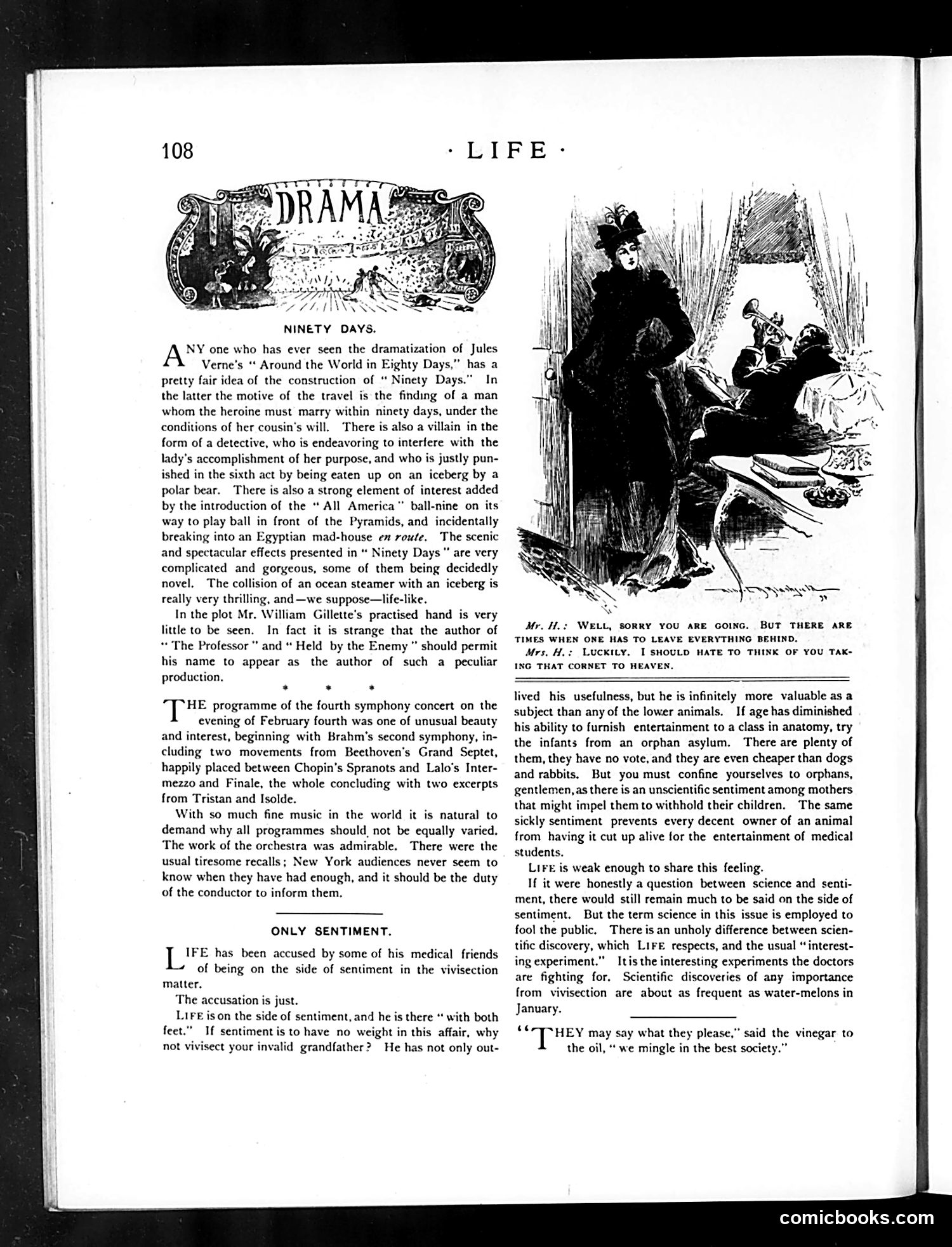
This page contains theater and music criticism along with social commentary on vivisection (animal experimentation). **"Ninety Days" Theater Review**: Life critiques a stage play loosely based on Jules Verne's *Around the World in Eighty Days*. The reviewer mocks the plot's melodramatic elements—a heroine racing to marry within 90 days, a villainous detective, and absurdly, a polar bear eating the villain on an iceberg. Life notes that despite William Gillette's reputation as a playwright (*The Professor*, *Held by the Enemy*), this production lacks his usual skill. **The Vivisection Debate**: Life defends sentiment against medical vivisection, arguing that if age alone justified experimentation, elderly people would logically qualify. The piece satirizes doctors' "interesting experiments" versus genuine scientific discovery, accusing the medical establishment of using "science" as cover for cruel entertainment. **Illustration**: Shows a domestic scene of a woman departing, with a husband expressing relief she's taking her cornet—a humorous jab at amateur musicianship.
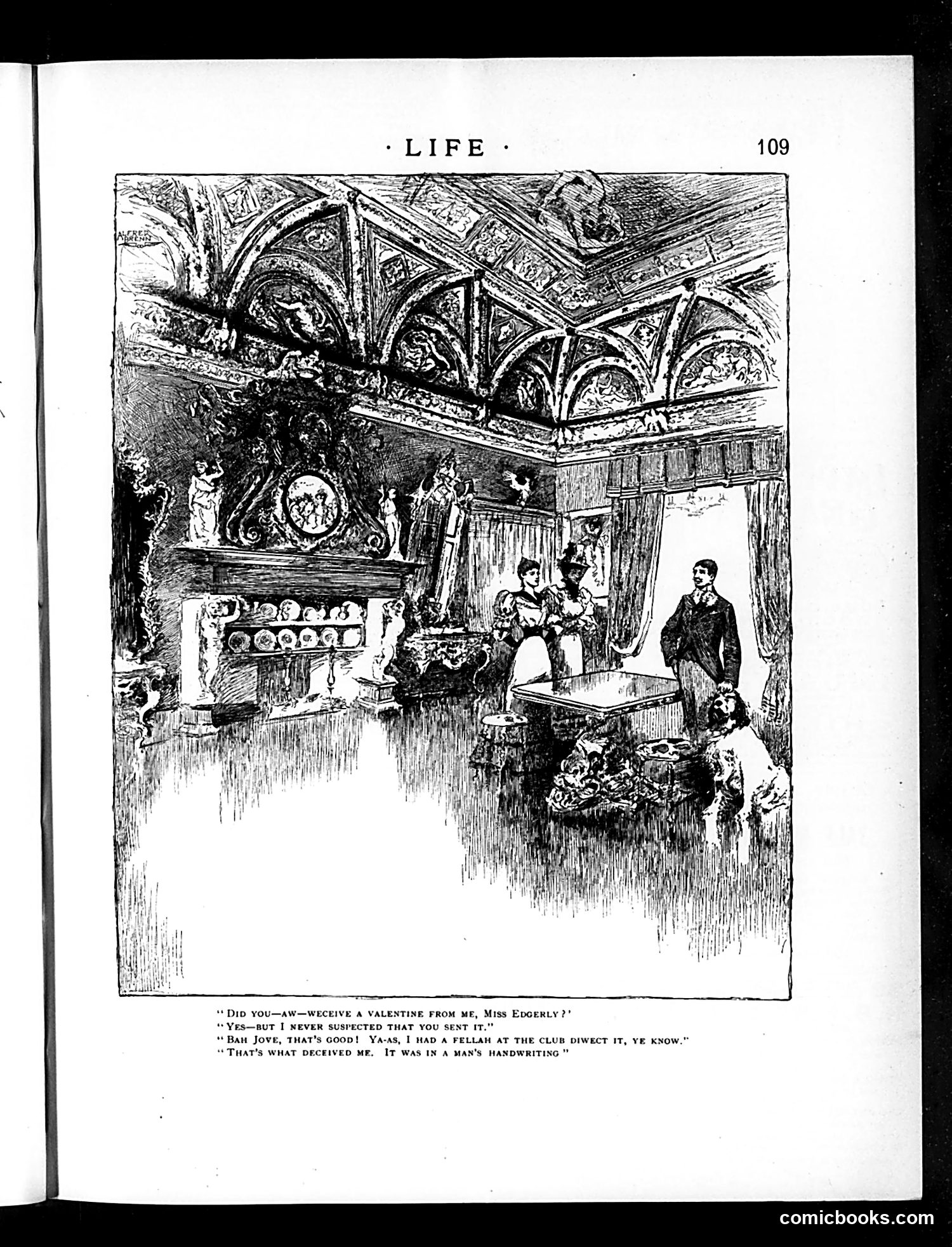
This single-panel cartoon satirizes Victorian courtship conventions and masculine vanity. A well-dressed man attempts to romantically impress Miss Edgerly by sending her a Valentine, but hires another man (likely a servant or club associate) to deliver it, hoping to appear charmingly indirect or mysterious. The joke's punchline: Miss Edgerly immediately suspects deception because the handwriting is masculine—revealing the man's scheme. The satire targets upper-class male pretense and the elaborate social games surrounding romance in this era. The ornate interior setting emphasizes the wealthy, leisured context where such frivolous romantic posturing occurs. The cartoon mocks both the man's transparent attempt at sophistication and the period's rigid gender expectations around courtship.
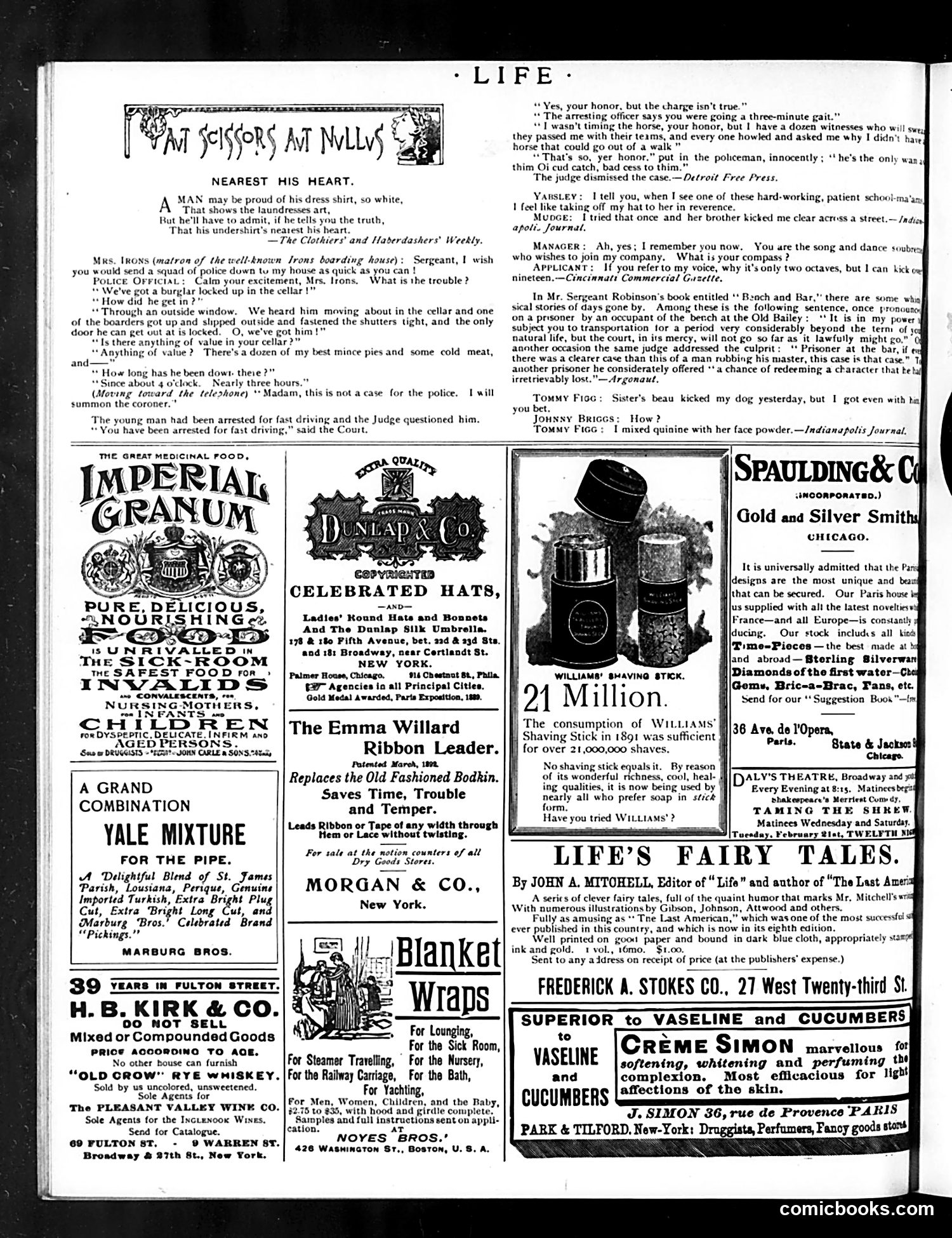
This page from *Life* magazine contains several humorous short pieces typical of late 19th-century American satire: **"Nearest His Heart"** presents a domestic comedy where Mrs. Irons traps a burglar in her cellar. The humor lies in the policeman's suggestion to "summon the coroner"—implying the burglar will starve to death from Mrs. Irons's notoriously bad cooking (her "mince pies" being infamous). **The speeding case** satirizes a farmer's defense: he claims witnesses can attest his horse couldn't go faster than a walk, making the officer's arrest absurd. The Irish policeman's agreement ("bad cess to thim") ironically confirms the farmer's innocence while mocking the officer's poor judgment. **Other brief jokes** mock schoolteachers, performers, and include a revenge punchline about face powder and quinine. The page is primarily **advertisements** for period products: Imperial Granum (food supplement), tobacco, whiskey, and various patent medicines and personal goods. The satire reflects common themes: incompetent authority figures, domestic/marital humor, and practical jokes.
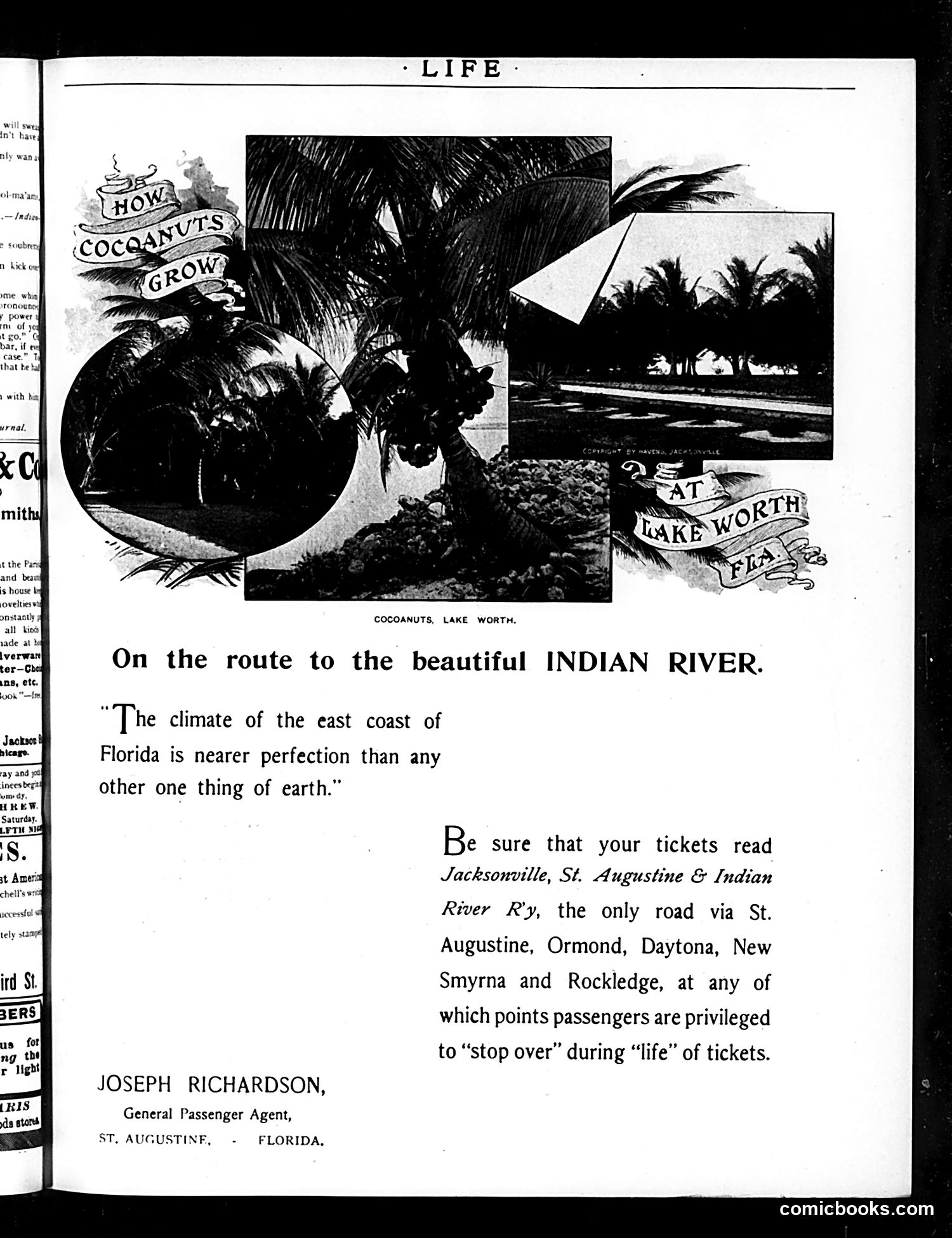
This is primarily a **travel advertisement**, not satire. It promotes the Jacksonville, St. Augustine & Indian River Railway to Florida's east coast, specifically the Indian River region. The page features photographs of coconut palms at Lake Worth and a scenic landscape, paired with decorative banners reading "How Coconuts Grow" and "At Lake Worth, Florida." These images showcase the exotic, tropical appeal of the destination to potential travelers. The advertisement quotes hyperbolic praise ("nearer perfection than any other one thing of earth") to market Florida's climate. The term "life of tickets" (meaning ticket validity period) is a standard railroad phrase, not a joke. Joseph Richardson, the General Passenger Agent, promotes the railway as the preferred route, highlighting multiple stop-over points along the line. This is straightforward commercial promotion typical of early 20th-century American travel advertising, capitalizing on growing interest in Florida tourism.
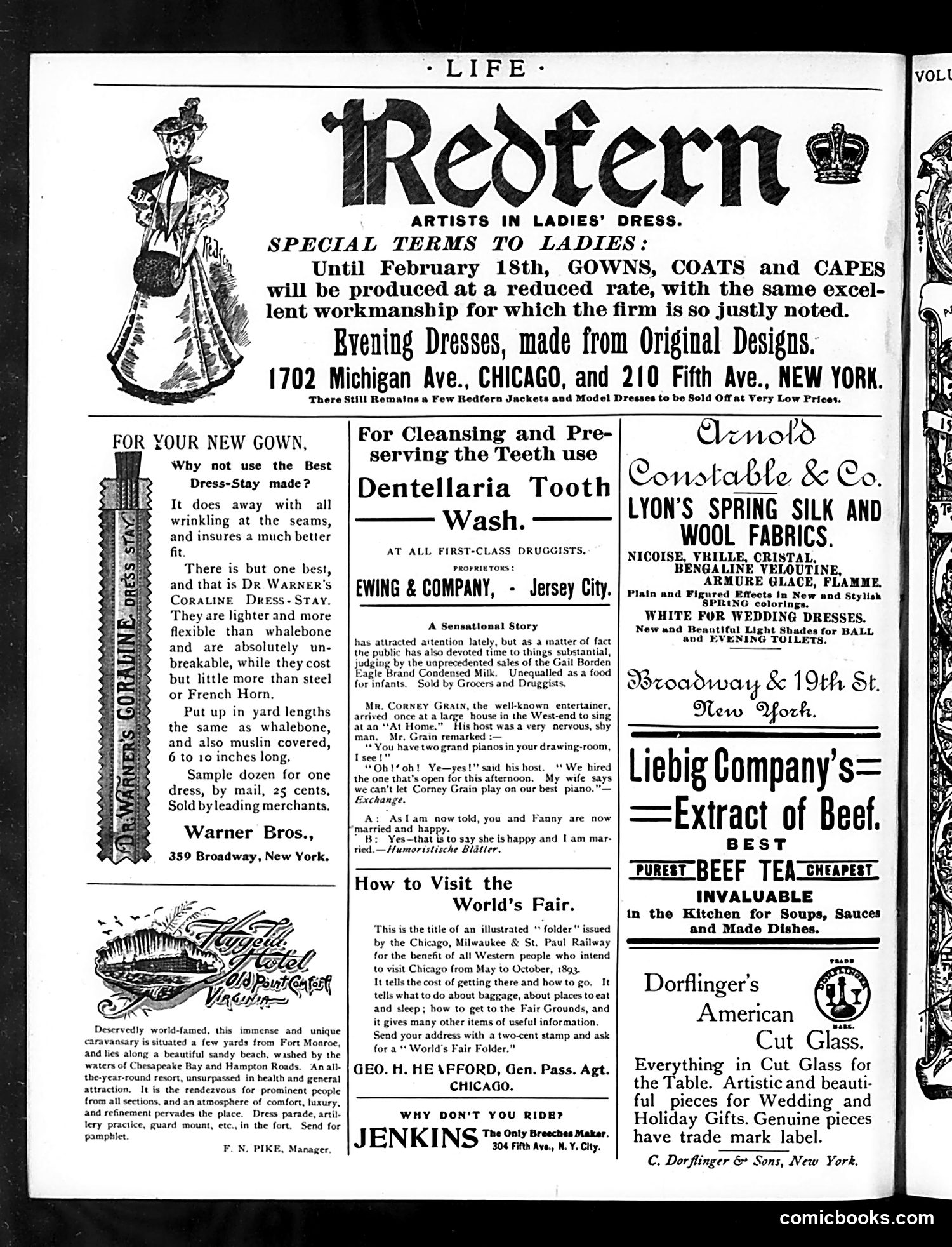
This page is **primarily advertising**, not editorial content or political satire. It's from Life's commercial section, dated around 1893 (references the World's Fair in Chicago, May-October 1893). The ads target affluent readers, particularly women interested in fashion: Redfern offers discounted gowns and coats; Warner Bros. sells corset stays; Arnold Constable advertises spring silks and wedding dress fabrics. Other ads promote dental products, beef extract, cut glass, and a railway to the World's Fair. There's one brief humorous anecdote about entertainer Corney Grain—a nervous host won't let him play their "best piano"—but this is light social comedy, not political satire. The single small illustration shows a fashionably dressed woman in 1890s attire, reflecting the page's focus on women's fashion and consumer goods rather than commentary or satire.