
Life, 1893-02-16 · page 4 of 16
Life — February 16, 1893 — page 4: what you’re looking at
What you’re looking at
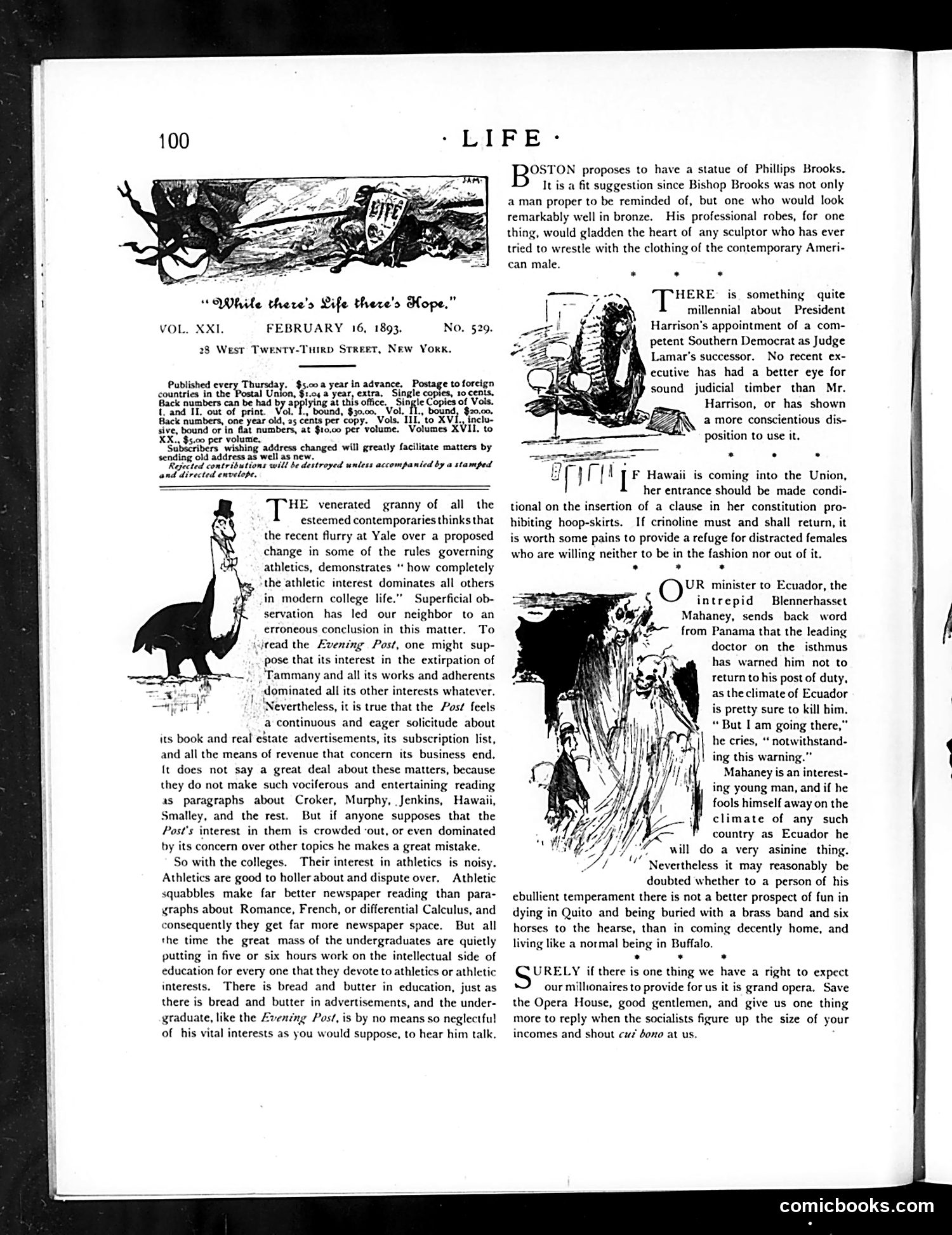
This page contains three satirical commentaries on contemporary issues: 1. **Yale Athletics Debate**: The text critiques the *Evening Post*'s concerns about Yale's athletic dominance overshadowing academics. The author defends athletics as legitimate college interest, arguing the *Post* neglects its own commercial interests while criticizing others. 2. **Phillips Brooks Statue**: Boston proposes commemorating Bishop Phillips Brooks, described as an admirable public figure worthy of remembrance. 3. **Hawaiian Statehood & Ecuador Minister**: Brief items mock Hawaii's conditional entry into the Union (regarding "hoop-skirts") and criticize Minister Mahaney's decision to remain in Ecuador despite health warnings—calling it foolish stubbornness. The page uses light satire and social commentary typical of 1890s Life magazine's format.
📄 Transcribed text from this page (OCR, searchable)
Machine-transcribed from the original scan — historical spelling and the odd misread are preserved.
> LIFE: “While there's Life there's Hope.” VOL. XXI. FEBRUARY 16, 1893. 28 West Twe: No. 529. ~Tuirp STREET, New York. Published every Thursday. $5.co a year in advance. Postage to foreign countries in the y Union, $1.04 a year, extra, Single coy ro cents, Back aumbers can be had by applying at this office, Single Copics of Vols. {. and IT, out of print. Vol. L., bound, $30.00. Vol. T1., bound, $20.00. Back numbers, one year old, 25 cents per ‘copy. Vols. III. to XVI, inclu- sive, bound or in flat numbers, at $to.co per volume, Volumes XVII. to XX., $5.00 per volume. as Subscribers wishing address changed will greatly facilitate matters by sending old address as well as new. Rejected contributions will be destroyed unless accompanied by a stamped and directed envelope, HE venerated granny of all the esteemed contemporaries thinks that the recent flurry at Yale over a proposed change in some of the rules governing athletics, demonstrates “ how completely the athletic interest dominates all others in modern college life.” Superficial ob- servation has led our neighbor to an erroneous conclusion in this matter. To wjread the Evening Post, one might sup- ‘pose that its interest in the extirpation of , Tammany and all its works and adherents dominated all its other interests whatever. ‘Nevertheless, it is true that the Post feels a continuous and eager solicitude about its book and real eState advertisements, its subscription list, and all the means of revenue that concern its business end. {t does not say a great deal about these matters, because they do not make such vociferous and entertaining reading as paragraphs about Croker, Murphy, Jenkins, Hawaii, Smalley, and the rest. But if anyone supposes that the Post's interest in them is crowded ‘out, or even dominated by its concern over other topics he makes a great mistake. So with the colleges. Their interest in athletics is noisy. Athletics are good to holler about and dispute over. Athletic squabbles make far better newspaper reading than para- graphs about Romance, French, or differential Calculus, and consequently they get far more newspaper space. But all the time the great mass of the undergraduates are quietly putting in five or six hours work on the intellectual side of education for every one that they devote to athletics or athletic interests. There is bread and butter in education, just as there is bread and butter in advertisements, and the under- graduate, like the Evening Post, is by no means so neglectful of his vital interests as you would suppose, to hear him talk. OSTON proposes to have a statue of Phillips Brooks. It is a fit suggestion since Bishop Brooks was not only a man proper to be reminded of, but one who would look remarkably well in bronze. His professional robes, for one thing, would gladden the heart of any sculptor who has ever tried to wrestle with the clothing of the contemporary Ameri- can male. . . HERE is something quite millennial about President Harrison's appointment of a com- petent Southern Democrat as Judge Lamar’s successor. No recent ex- fp ccutive has had a better eye for ip sound judicial timber than Mr. 4 Harrison, or has shown a more conscientious dis- position to use it. —— 8 fF Wh [ F Hawai is coming into the Union, her entrance should be made condi- tional on the insertion of a clause in her constitution pro- hibiting hoop-skirts. If crinoline must and shall return, it is worth some pains to provide a refuge for distracted females who are willing neither to be in the fashion nor out of it. . , . UR minister to Ecuador, the intrepid Blennerhasset Mahaney, sends back word from Panama that the leading doctor on the isthmus has warned him not to return to his post of duty, as the climate of Ecuador is pretty sure to kill him. “ But I am going there,” he cries, “ notwithstand- ing this warning.” Mahaney is an interest- ing young man, and if he fools himself away on the climate of any such country as Ecuador he % will do a very asinine thing. Nevertheless it may reasonably be doubted whether to a person of his ebullient temperament there is not a better prospect of fun in dying in Quito and being buried with a brass band and six horses to the hearse, than in coming decently home, and living like a normal being in Buffalo. . . . URELY if there is one thing we have a right to expect our millionaires to provide for us it is grand opera. Save the Opera House, good gentlemen, and give us one thing more to reply when the socialists figure up the size of your incomes and shout cw? dono at us. comicbooks.com