
Life, 1893-02-16 · page 12 of 16
Life — February 16, 1893 — page 12: what you’re looking at
What you’re looking at
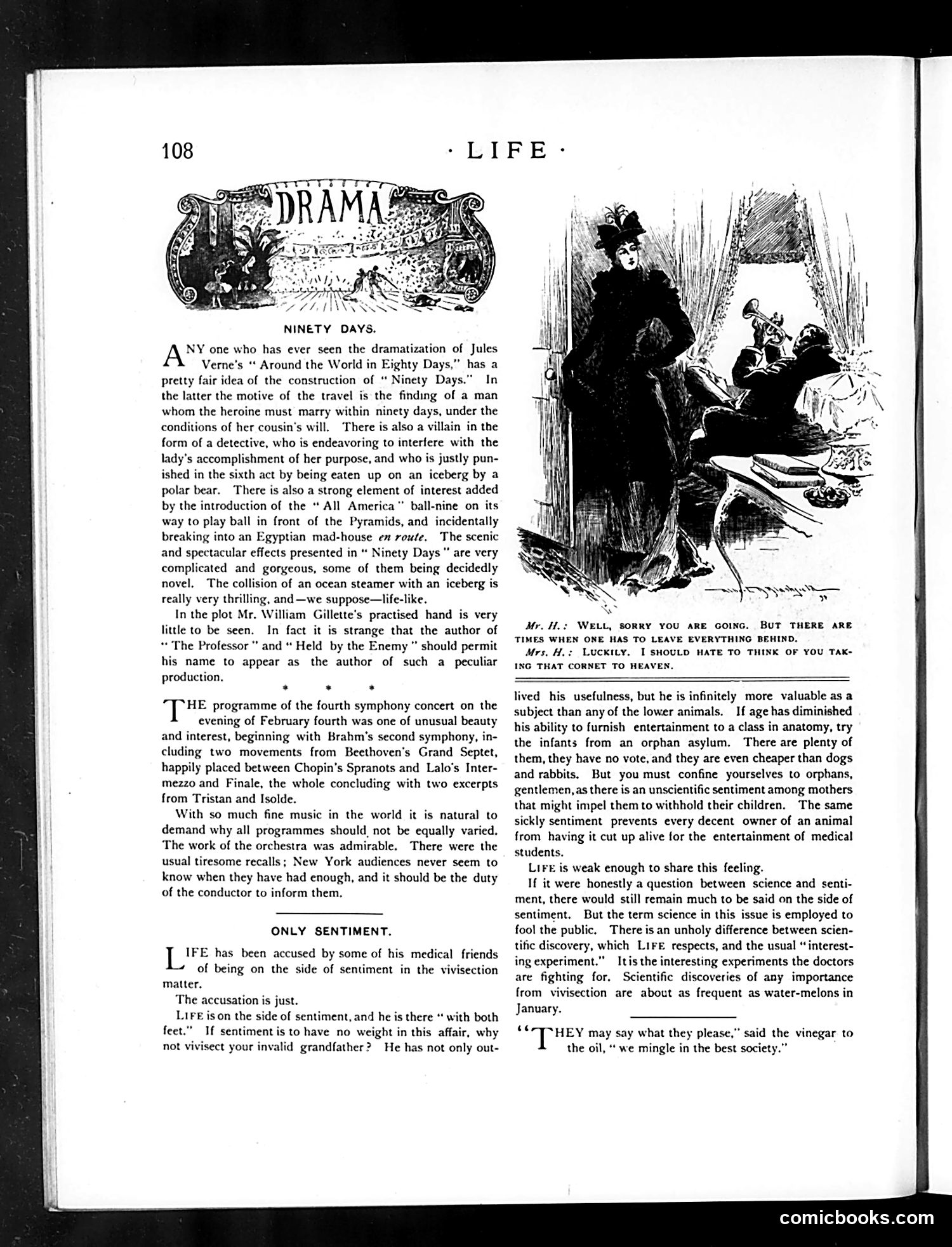
This page contains theater and music criticism along with social commentary on vivisection (animal experimentation). **"Ninety Days" Theater Review**: Life critiques a stage play loosely based on Jules Verne's *Around the World in Eighty Days*. The reviewer mocks the plot's melodramatic elements—a heroine racing to marry within 90 days, a villainous detective, and absurdly, a polar bear eating the villain on an iceberg. Life notes that despite William Gillette's reputation as a playwright (*The Professor*, *Held by the Enemy*), this production lacks his usual skill. **The Vivisection Debate**: Life defends sentiment against medical vivisection, arguing that if age alone justified experimentation, elderly people would logically qualify. The piece satirizes doctors' "interesting experiments" versus genuine scientific discovery, accusing the medical establishment of using "science" as cover for cruel entertainment. **Illustration**: Shows a domestic scene of a woman departing, with a husband expressing relief she's taking her cornet—a humorous jab at amateur musicianship.
📄 Transcribed text from this page (OCR, searchable)
Machine-transcribed from the original scan — historical spelling and the odd misread are preserved.
NINETY DAYS. NY one who has ever seen the dramatization of Jules Verne’s ‘* Around the World in Eighty Days,” has a pretty fair idea of the construction of “ Ninety Days.” In the latter the motive of the travel is the finding of a man whom the heroine must marry within ninety days, under the conditions of her cousin's will. There is also a villain in the form of a detective, who is endeavoring to interfere with the lady's accomplishment of her purpose, and who is justly pun- ished in the sixth act by being eaten up on an iceberg by a polar bear. There is also a strong element of interest added by the introduction of the “ All America” ball-nine on its way to play ball in front of the Pyramids, and incidentally breaking into an Egyptian mad-house en route. The scenic and spectacular effects presented in “ Ninety Days" are very complicated and gorgeous, some of them being decidedly novel. The collision of an ocean steamer with an iceberg is really very thrilling, and—we suppose—life-like. In the plot Mr. William Gillette's practised hand is very little to be seen. In fact it is strange that the author of “ The Professor" and “ Held by the Enemy" should permit his name to appear as the author of such a_ peculiar production. . . . ‘T programme of the fourth symphony concert on the evening of February fourth was one of unusual beauty and interest, beginning with Brahm’s second symphony, in- cluding two movements from Beethoven's Grand Septet, happily placed between Chopin's Spranots and Lalo’s Inter- mezzo and Finale, the whole concluding with two excerpts from Tristan and Isolde. With so much fine music in the world it is natural to demand why all programmes should, not be equally varied. The work of the orchestra was admirable. There were the usual tiresome recalls; New York audiences never seem to know when they have had enough, and it should be the duty of the conductor to inform them. ONLY SENTIMENT. IFE has been accused by some of his medical friends of being on the side of sentiment in the vivisection matter, The accusation is just. LIFE ison the side of sentiment, and he is there “ with both feet.” If sentiment is to have no weight in this affair, why not vivisect your invalid grandfather? He has not only out- Mr. Ho: WELL, SORRY YOU ARE GOING, BUT THERE ARE TIMES WHEN ONE HAS TO LEAVE EVERYTHING BEHIND. Mrs. H.: LUCKIty, I SHOULD MATE TO THINK OF YOU TAK- ING THAT CORNET TO HEAVEN, lived his usefulness, but he is infinitely more valuable as a subject than any of the lower animals. If age has diminished his ability to furnish entertainment to a class in anatomy, try the infants from an orphan asylum. There are plenty of them, they have no vote, and they are even cheaper than dogs and rabbits. But you must confine yourselves to orphans, gentlemen, as there is an unscientific sentiment among mothers that might impel them to withhold their children. The same sickly sentiment prevents every decent owner of an animal from having it cut up alive for the entertainment of medical students. Lire is weak enough to share this feeling. If it were honestly a question between science and senti- ment, there would still remain much to be said on the side of sentiment. But the term science in this issue is employed to fool the public. There is an unholy difference between scien- tific discovery, which LIFE respects, and the usual “interest- ing experiment.” It is the interesting experiments the doctors are fighting for. Scientific discoveries of any importance from vivisection are about as frequent as water-melons in January. S¢HEY may say what they please,” said the vinegar to the oil, “* we mingle in the best society.” comicbooks.com