
A complete issue · 18 pages · 1892
Life — February 18, 1892
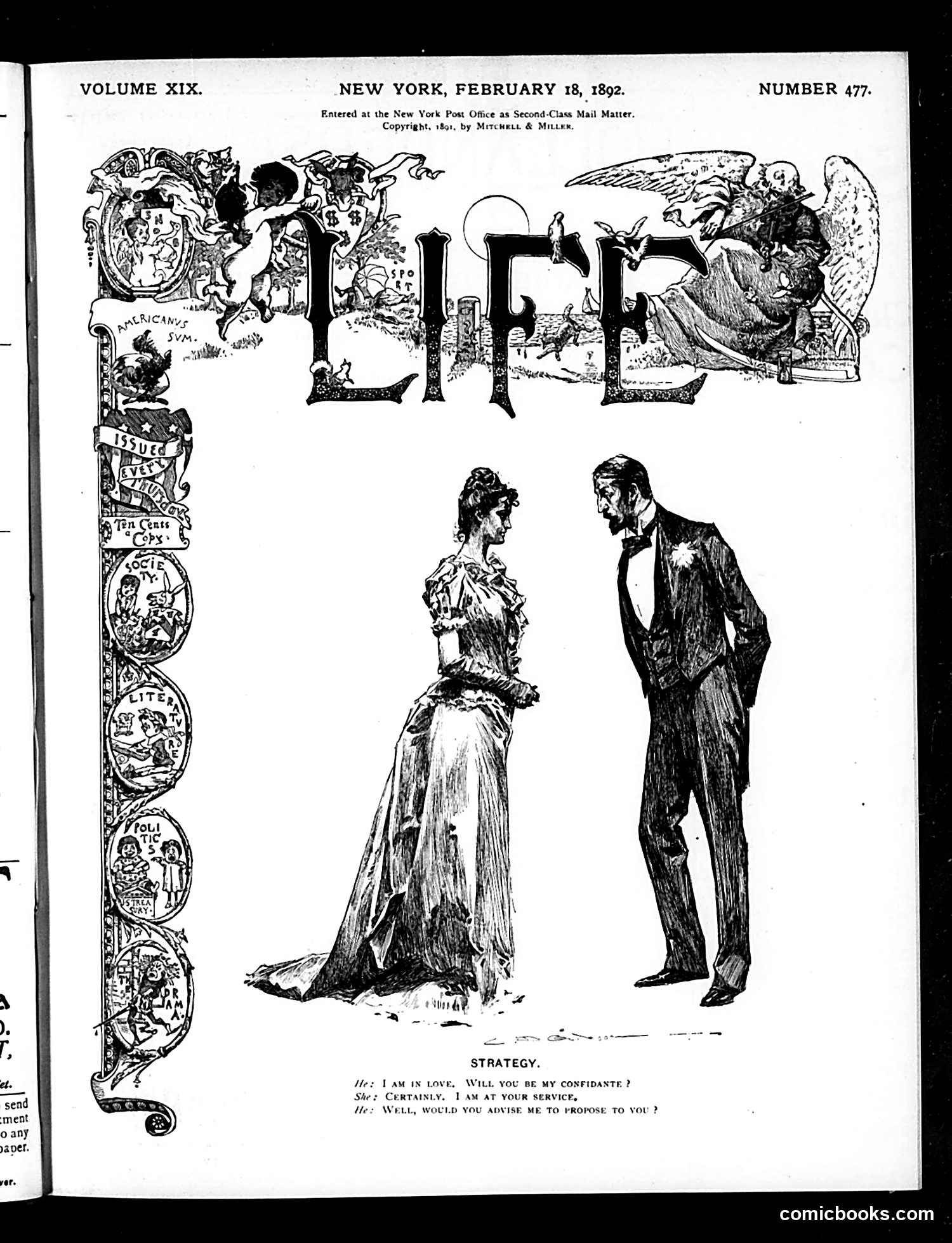
This satirical cartoon depicts a romantic scene titled "Strategy." A well-dressed man proposes to a woman in an elegant gown, with the dialogue revealing the joke: **He:** "I am in love. Will you be my confidante?" **She:** "Certainly. I am at your service." **He:** "Well, would you advise me to propose to you?" The satire mocks Victorian courtship conventions, particularly the indirect, strategic approach men used in romantic matters. Rather than a direct proposal, the man seeks the woman's "advice" about proposing to her—a clever rhetorical strategy to avoid outright rejection while still achieving his goal. The humor lies in how transparent this manipulation is, and how it reflects the artificial social conventions surrounding marriage proposals in the Gilded Age.
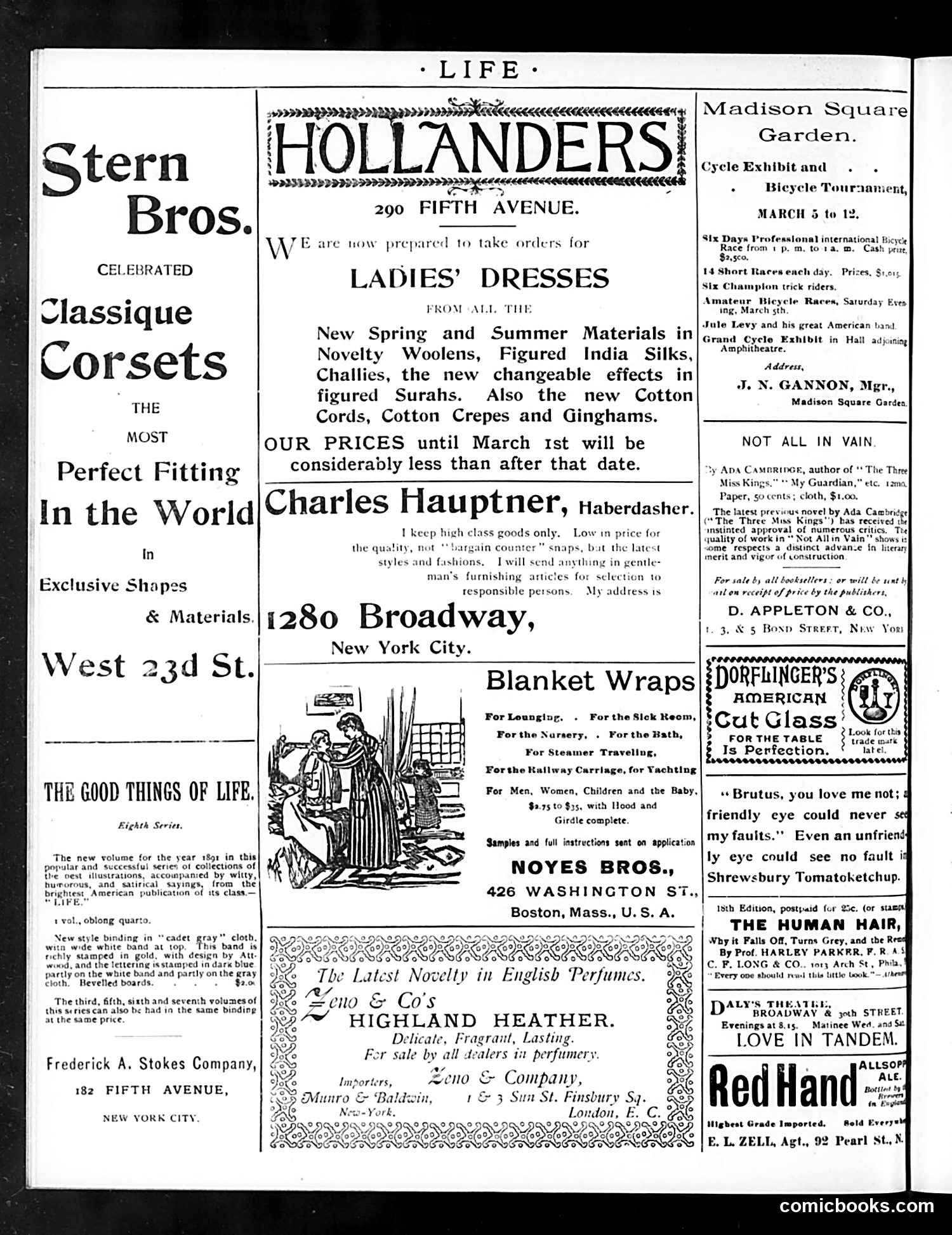
This page is primarily **advertising content** rather than satirical commentary. It features multiple advertisements for consumer goods typical of the late 19th/early 20th century: corsets (Stern Bros.), ladies' dresses (Hollanders), blanket wraps (Noyes Bros.), perfume (Eno & Co.), and other merchandise. The only non-advertising content is a small illustrated section titled "THE GOOD THINGS OF LIFE" by Frederick A. Stokes Company, promoting a new book volume with witty, humorous engravings. The illustration itself appears to show a domestic scene, but without clearer detail, its specific satirical intent is unclear. The page reflects Life magazine's business model: mixing light editorial content with paid advertisements for an affluent readership.
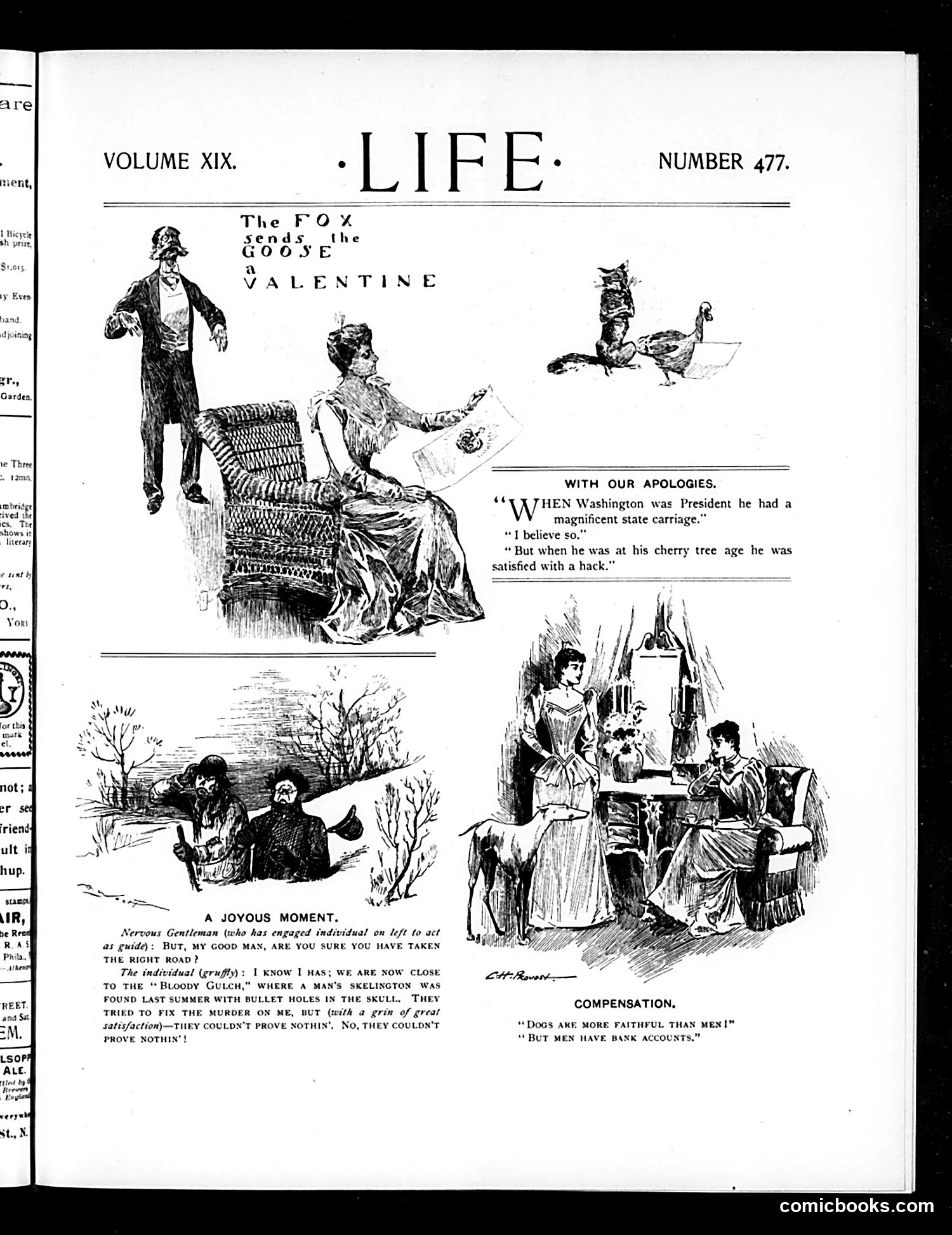
This page contains three comic illustrations with satirical captions: 1. **"The Fox Sends the Goose a Valentine"** — depicts a sophisticated fox presenting a valentine to a woman, likely satirizing deceptive romantic gestures. 2. **"A Joyous Moment"** — shows two men near a body of water discussing a murder investigation at "Bloody Gulch," mocking detective fiction tropes where circumstantial evidence fails to prove guilt. 3. **"Compensation"** — presents a domestic scene with the caption "Dogs are more faithful than men / But men have bank accounts," a commentary on gender relations and material security in marriage. The page's humor relies on contemporary understanding of courtship customs, popular crime narratives, and gender dynamics of the early 20th century.
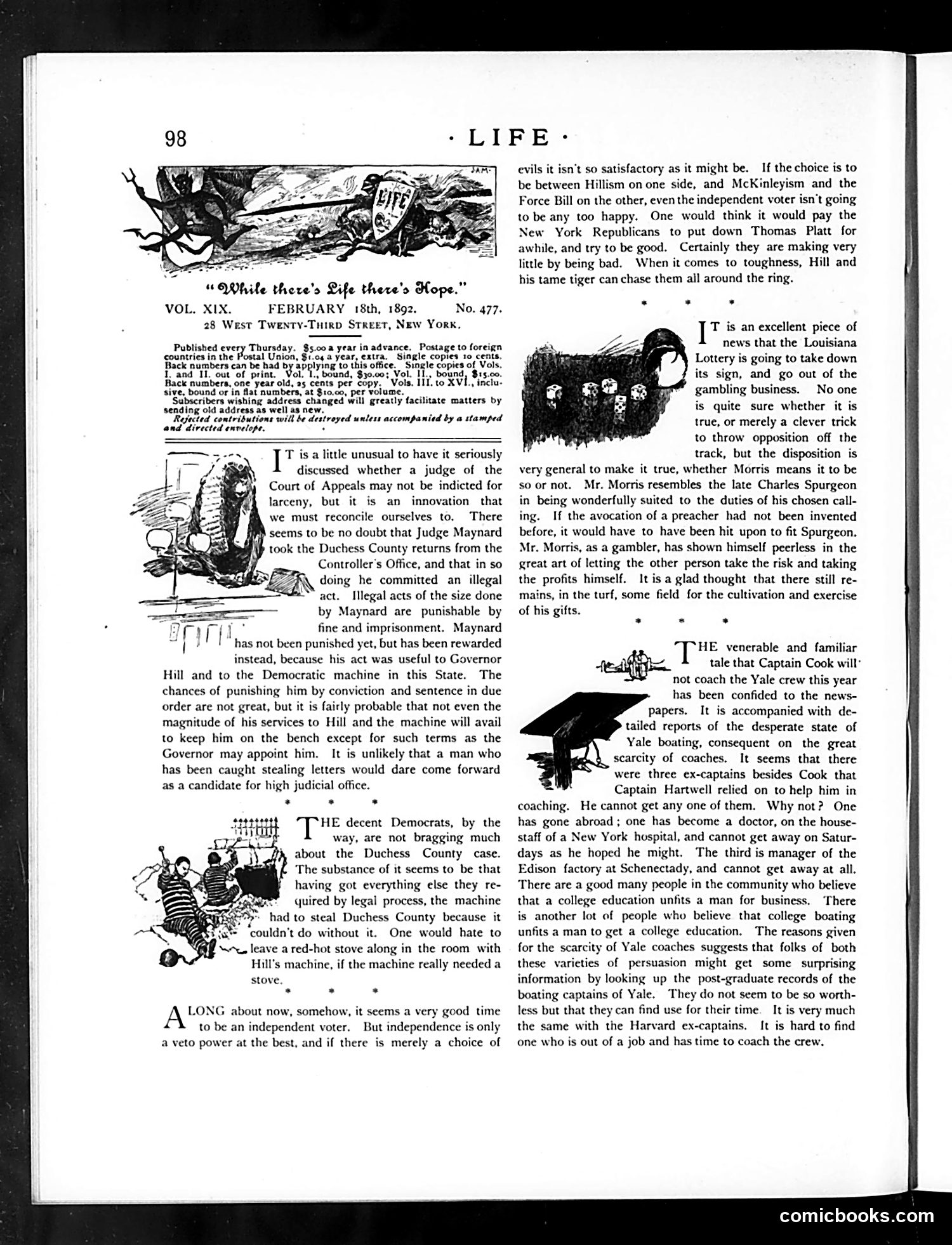
This page contains editorial commentary on contemporary political issues rather than cartoons. The text discusses: 1. **Judge Maynard and the Duchess County case**: A debate about whether a judge may be indicted for larceny, framed as legal innovation. 2. **New York Republican politics**: Commentary on Thomas Platt and McKinleyism versus Hill's faction, suggesting internal Republican division over political power. 3. **The Louisiana Lottery**: Reported closure of the gambling operation, with skepticism about whether it's genuine or a political maneuver. 4. **Yale rowing**: A discussion of coach Captain Cook's unavailability and the difficulty finding qualified replacements. The cartoons appear to be decorative illustrations accompanying these political and social commentary pieces rather than standalone satirical images with specific identifiable targets.
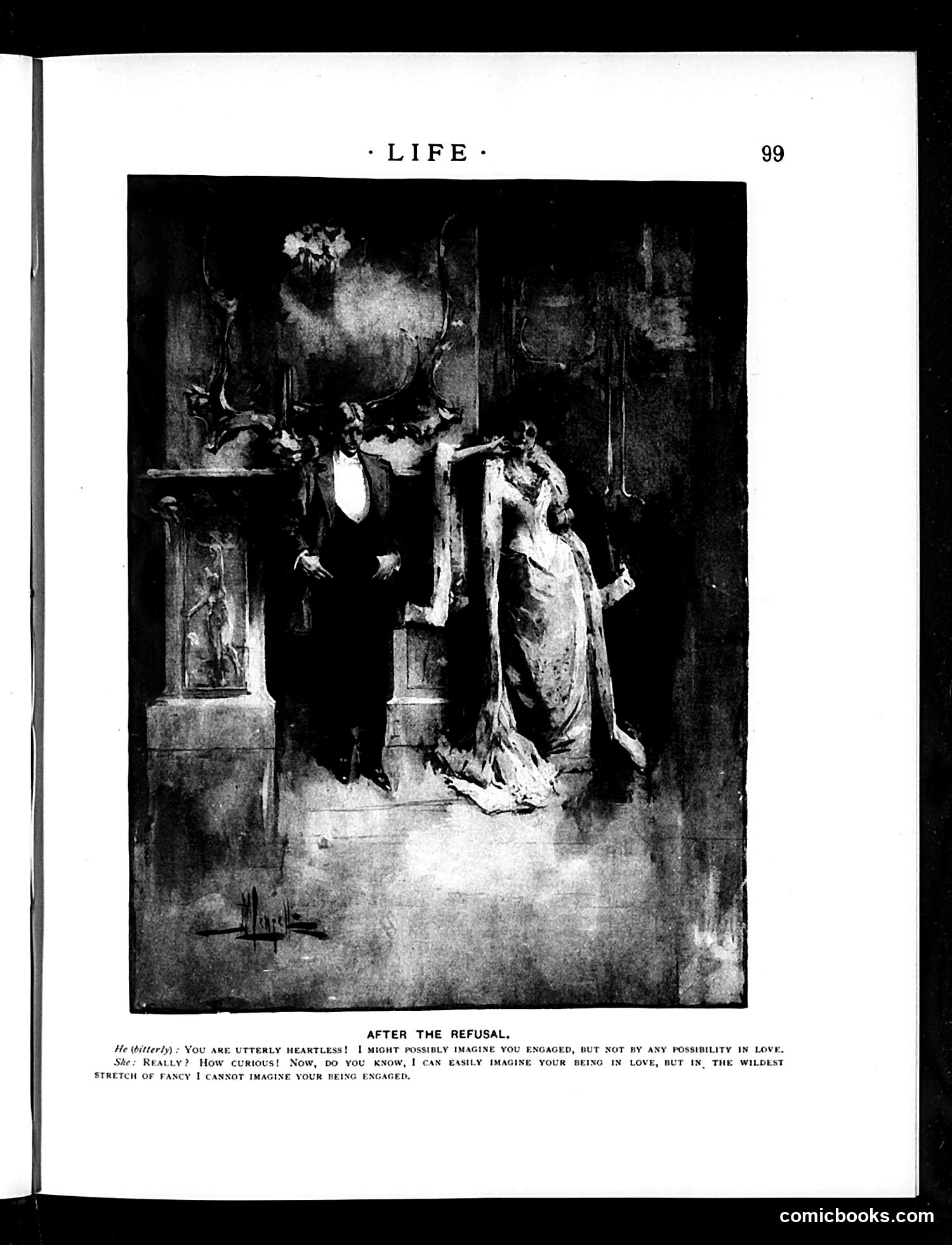
This appears to be a dramatic theatrical or narrative illustration depicting a romantic rejection scene. The caption identifies it as "After the Refusal," showing a woman in an elaborate dress rejecting a man's marriage proposal. The dialogue reveals the satire: the man claims he cannot imagine the woman being in love, only "engaged"—suggesting she's incapable of genuine romantic feeling and is merely pursuing marriage as a social transaction or status achievement. The woman's response dismisses his logic as absurd fancy. The illustration satirizes upper-class courtship conventions and the gap between romantic ideals and mercenary marriage practices of the era. The woman's elaborate costume and the formal interior setting emphasize the social performance of Victorian/Edwardian courtship rather than authentic emotion.
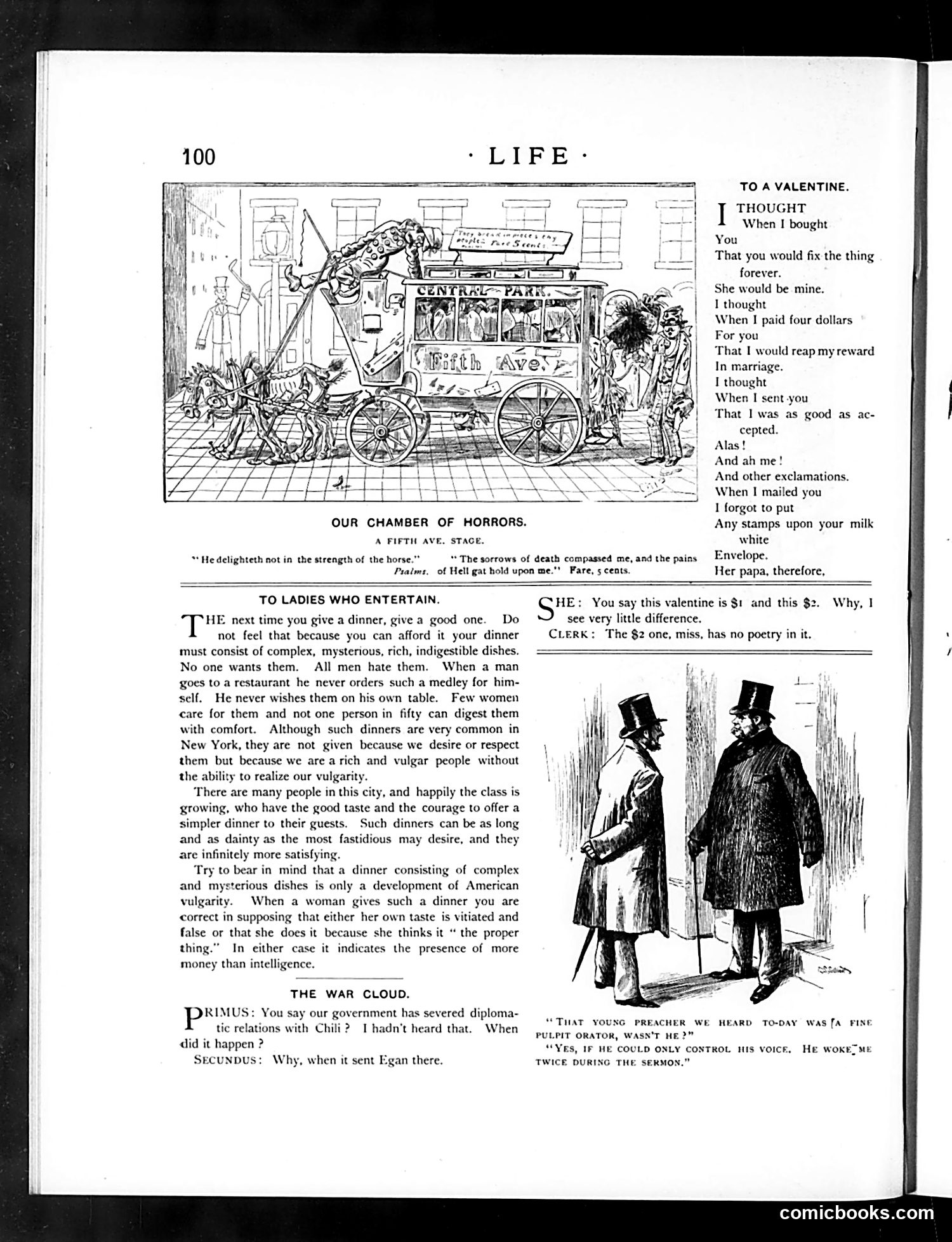
**Main Cartoon - "Our Chamber of Horrors":** This depicts a chaotic Fifth Avenue street scene with an overturned horse-drawn cart labeled "Central Park" and pedestrians in disarray. The caption quotes Psalms about sorrows and death, suggesting satirical commentary on urban transportation accidents or street chaos in New York City during the era of horse-drawn carriages. **"To a Valentine" & "To Ladies Who Entertain":** These are satirical pieces about romantic disappointment and dinner etiquette. The valentine poem mocks a failed courtship, while the prose section critiques ostentatious, overly-complex dinner parties among wealthy Americans, arguing that simpler meals demonstrate better taste than pretentious "vulgar" displays. **"The War Cloud":** A brief dialogue between Primus and Secundus referencing severed U.S.-Chilean diplomatic relations, likely referencing a specific historical incident.
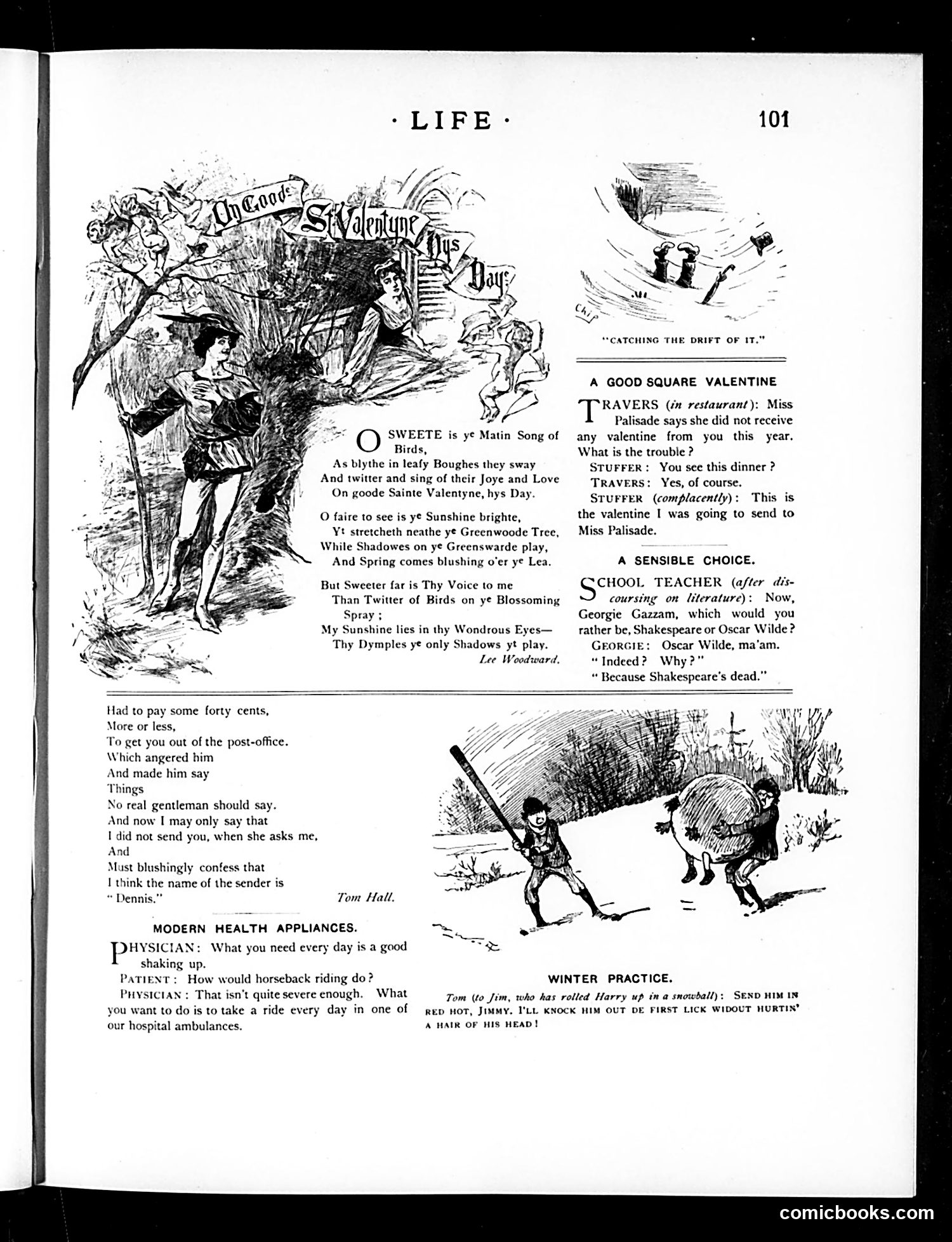
This page contains several humorous sketches and dialogue pieces typical of early 20th-century satirical humor: **"An Good Square Valentine"** depicts a restaurant conversation where a man admits he forgot to send his dinner companion a Valentine's card—he was planning to send one to someone else (Miss Palisade) instead. The humor relies on the awkwardness of this admission. **"A Sensible Choice"** jokes about a student choosing Oscar Wilde over Shakespeare because "Shakespeare's dead"—absurdist humor playing on the student's flawed logic. **"Modern Health Appliances"** satirizes medical fads by suggesting horseback riding in ambulances as treatment. The sketches labeled "Catching the Drift of It" and "Winter Practice" appear to be visual gags about seasonal activities, though details are unclear from the image quality.
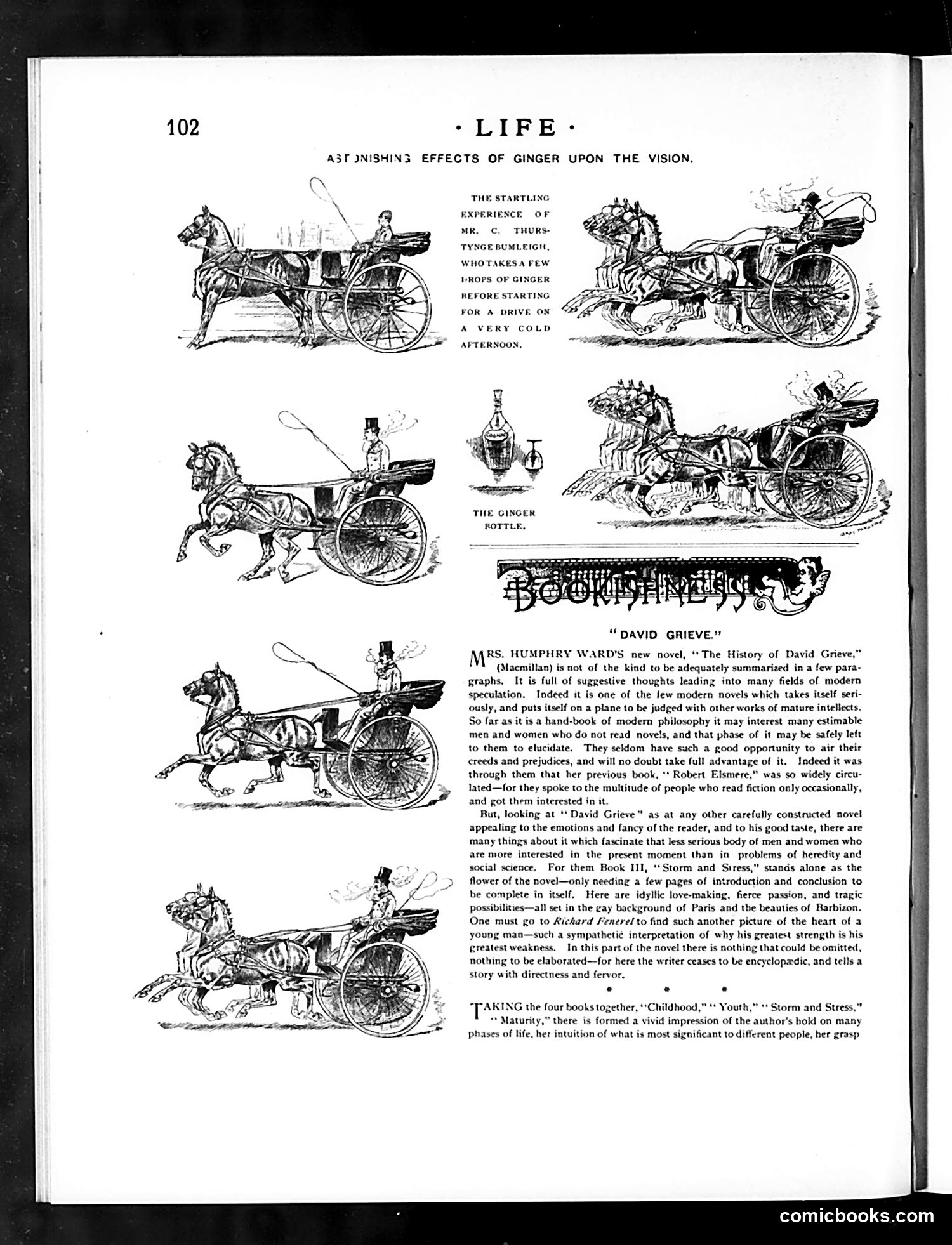
This is a humorous comic sequence showing a horse-drawn carriage with a gentleman passenger becoming increasingly animated across four panels. The caption indicates Mr. C. Thurstonge Rumleigh takes ginger drops before a cold-weather drive, and the illustrations depict his growing excitement and energetic behavior—the horse and carriage appear more vigorous and animated in each successive panel. The joke relies on the Victorian-era belief that ginger was a stimulant or tonic with invigorating properties. The satire mocks both the exaggerated medicinal claims of ginger tonics and the enthusiastic testimonials common in period advertisements. The visual progression humorously suggests the ginger makes the passenger hyperactive rather than merely warming him on a cold afternoon.
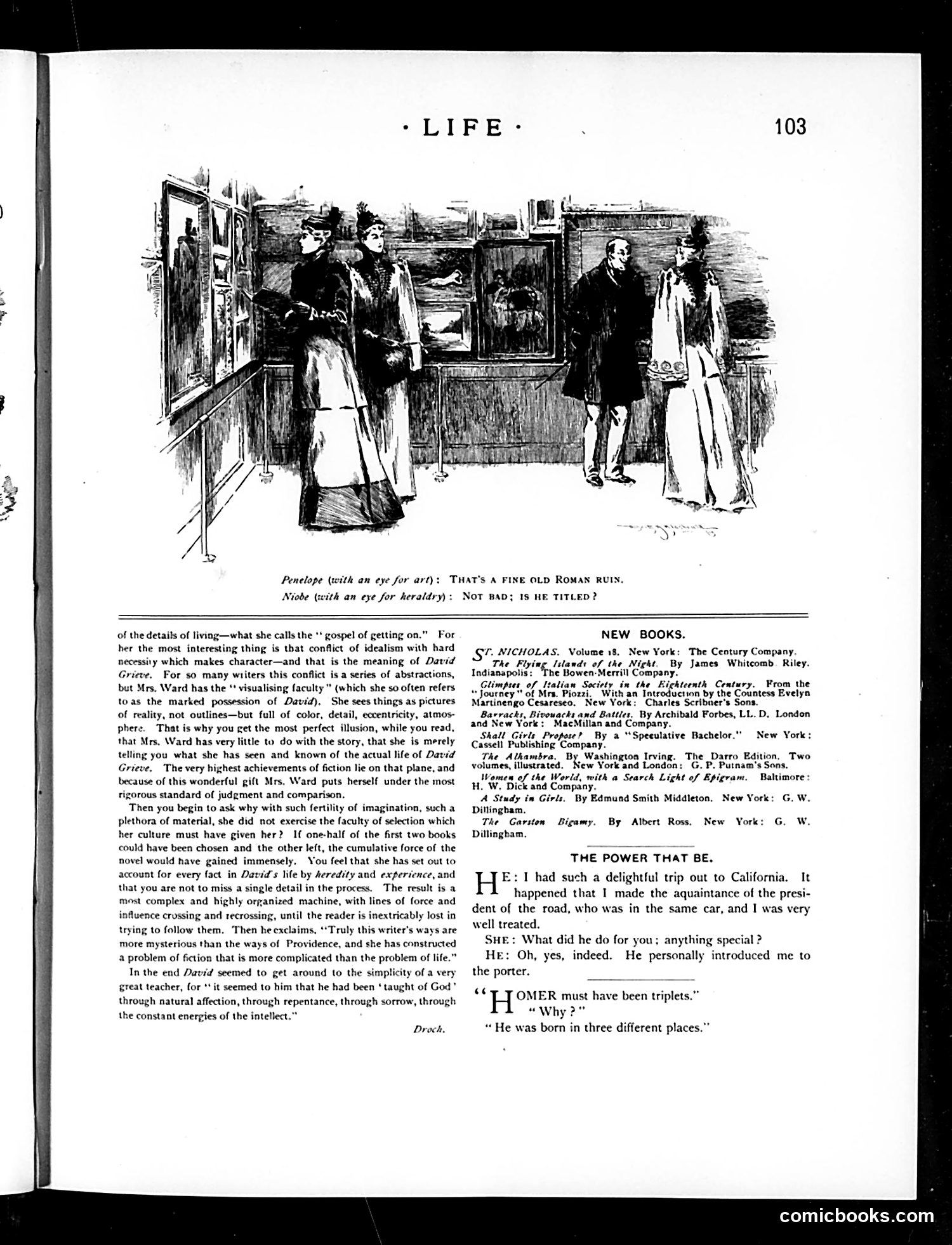
This page contains a sketch depicting what appears to be an art gallery or museum scene, with several well-dressed visitors examining framed artworks on walls. The caption reads: "Penelope (with an eye for art): 'THAT'S A FINE OLD ROMAN RUIN.' Niobe (with an eye for heraldry): 'NOT BAD; IS HE TITLED?'" The satire mocks two types of female gallery visitors: one who appreciates art's aesthetic or historical value, and another who judges artwork (or people) primarily by social status and aristocratic titles. "Niobe" appears to be referring to one of the male visitors as if he were an artwork to be evaluated, revealing the shallow social-climbing priorities of certain wealthy women. The humor lies in this confusion of artistic appreciation with status-seeking.
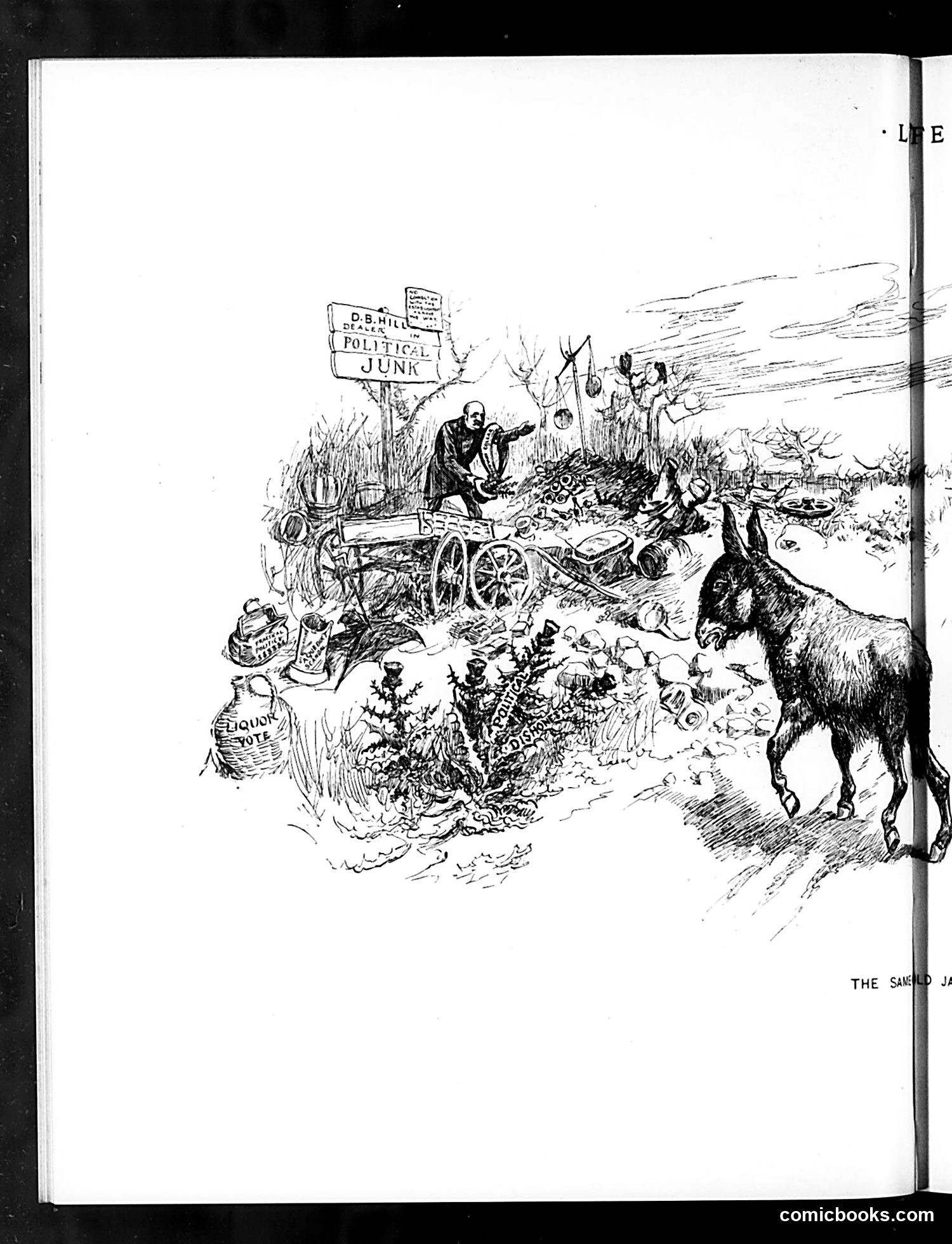
This political cartoon satirizes D.B. Hill's management of political affairs as worthless "junk." The central figure (likely a politician or party leader) stands amid a literal junkyard of discarded political materials—broken wheels, debris, and refuse—suggesting his administration has produced nothing of value. Key symbolic elements include: - A sign reading "D.B. HILL'S POLITICAL JUNK" - A liquor bottle labeled "LIQUOR VOTE," referencing prohibition-era politics - A goat scavenging the debris, implying even animals won't touch this "junk" - Scattered waste representing failed policies or broken promises The cartoon mocks Hill's political record as entirely useless and corrupt, reducing his governance to literal garbage. The exact historical context requires knowing when Hill held office, but the message is clear: his political legacy amounts to nothing.
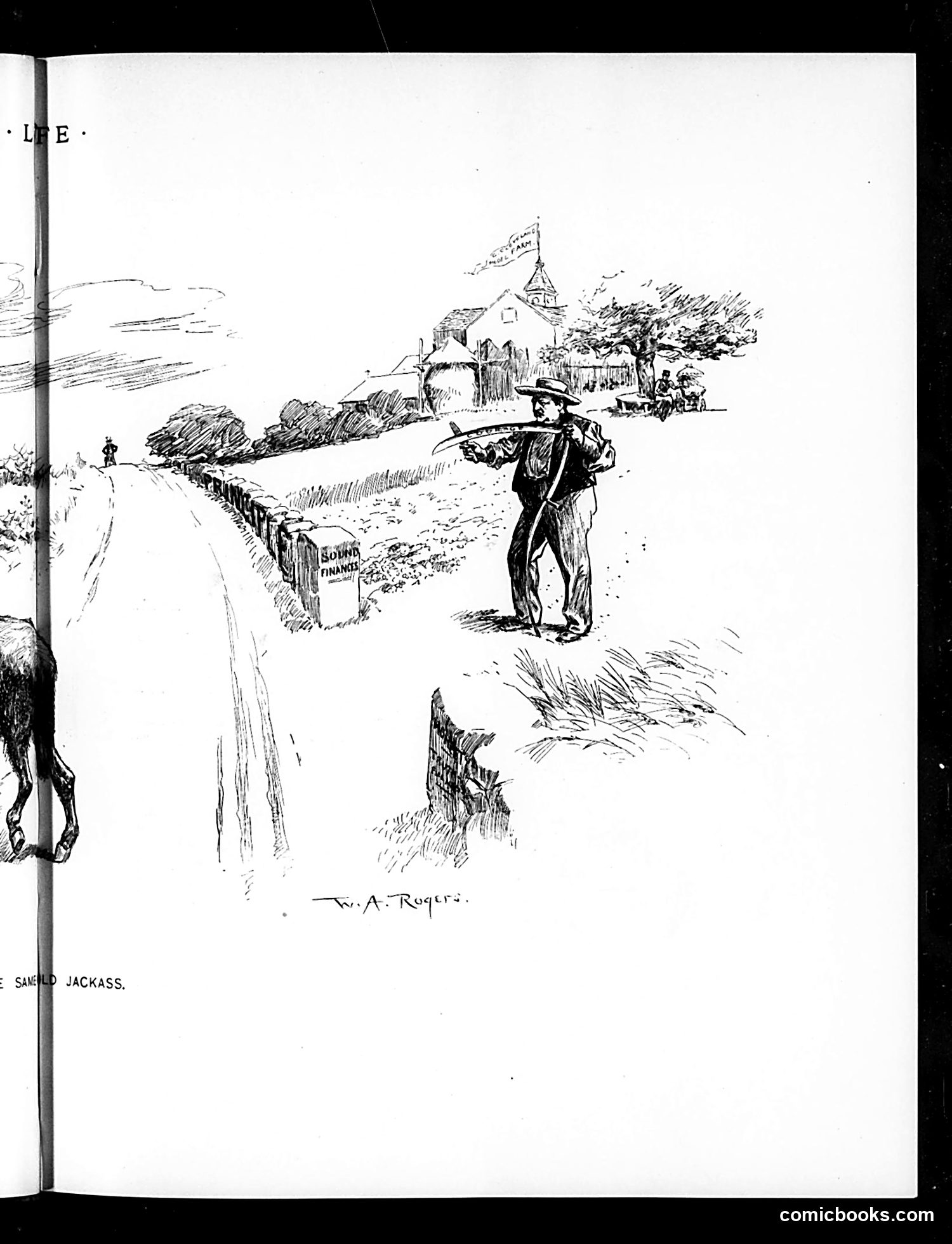
This political cartoon depicts a man in formal attire standing beside a fence labeled "SACRED FINANCES." He carries a long pole or staff, appearing to manage or control something. In the background sits a rural church or meetinghouse with village scenery. The title "The Sacred Jackass" suggests satire about financial management being treated as untouchable dogma. The figure appears to represent a political or economic authority figure who treats finances as a religious matter beyond criticism or reform. The donkey/jackass reference implies either stubbornness or foolishness regarding fiscal policy. Without the publication date, the specific financial crisis referenced remains unclear, though this likely comments on late 19th or early 20th-century American economic policy debates.
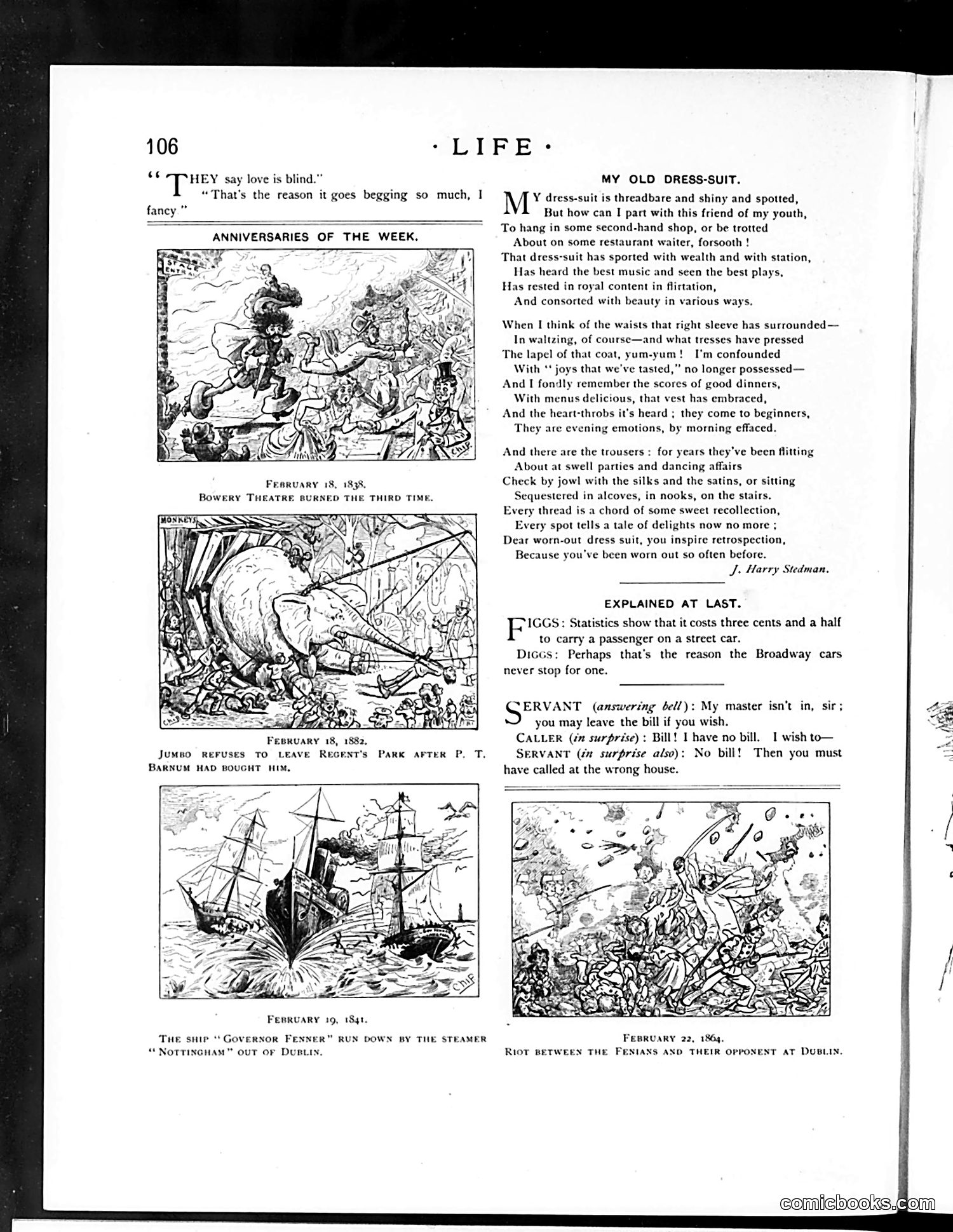
This page from Life contains historical "Anniversaries of the Week" commemorating significant events from past Februaries: the 1838 Bowery Theatre fire, Jumbo the elephant (famously exhibited by P.T. Barnum) refusing to leave in 1882, and two maritime/Irish incidents from 1841 and 1864. The main feature is a sentimental poem "My Old Dress-Suit" by J. Harry Stedman, nostalgically personifying a worn formal jacket as a repository of youthful memories—romantic encounters, fine dinners, and social events. The humor section "Explained at Last" contains brief satirical jokes about streetcar economics and a servant's confusion about an unexpected visitor with "no bill"—implying visitors typically come as creditors. The wood-engraved illustrations depict the historical events in period style. Overall, the page mixes nostalgia, gentle humor, and historical documentation typical of Life's late-nineteenth-century satirical approach.
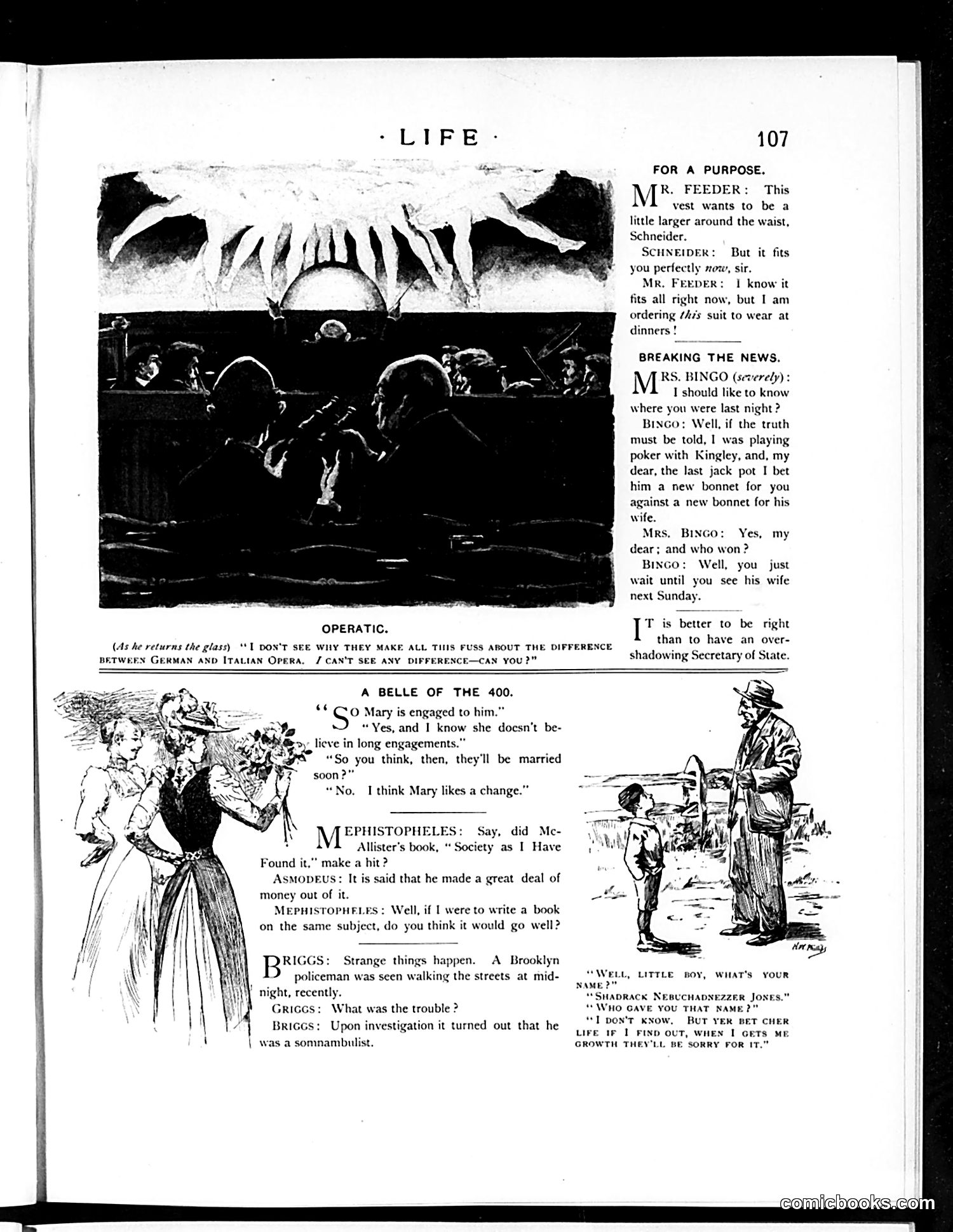
This page contains four unrelated humorous sketches typical of early 20th-century American satire: **"Operatic"**: A man returning a glass claims he sees no difference between German and Italian opera—mocking audiences who pretend to sophisticated taste they don't possess. **"For a Purpose"**: A customer orders a suit deliberately larger at the waist than needed, claiming it's for dinner wear. The tailor notes it already fits perfectly, satirizing men's vanity about appearing slimmer in public. **"Breaking the News"**: A husband admits losing a poker bet involving bonnets for his wife and his friend's wife. His smug response suggests the friend's wife is attractive, implying marital complications—humor based on gentlemen's gambling and jealousy. **"A Belle of the 400"**: Society women discuss a wealthy peer's engagement, suggesting the woman won't marry him because she prefers variety—mocking upper-class attitudes toward romance and commitment. The final sketch shows a boy with an absurdly pretentious name, joking he'll seek revenge on whoever named him once grown—humor based on ridiculous nomenclature and childhood resentment.
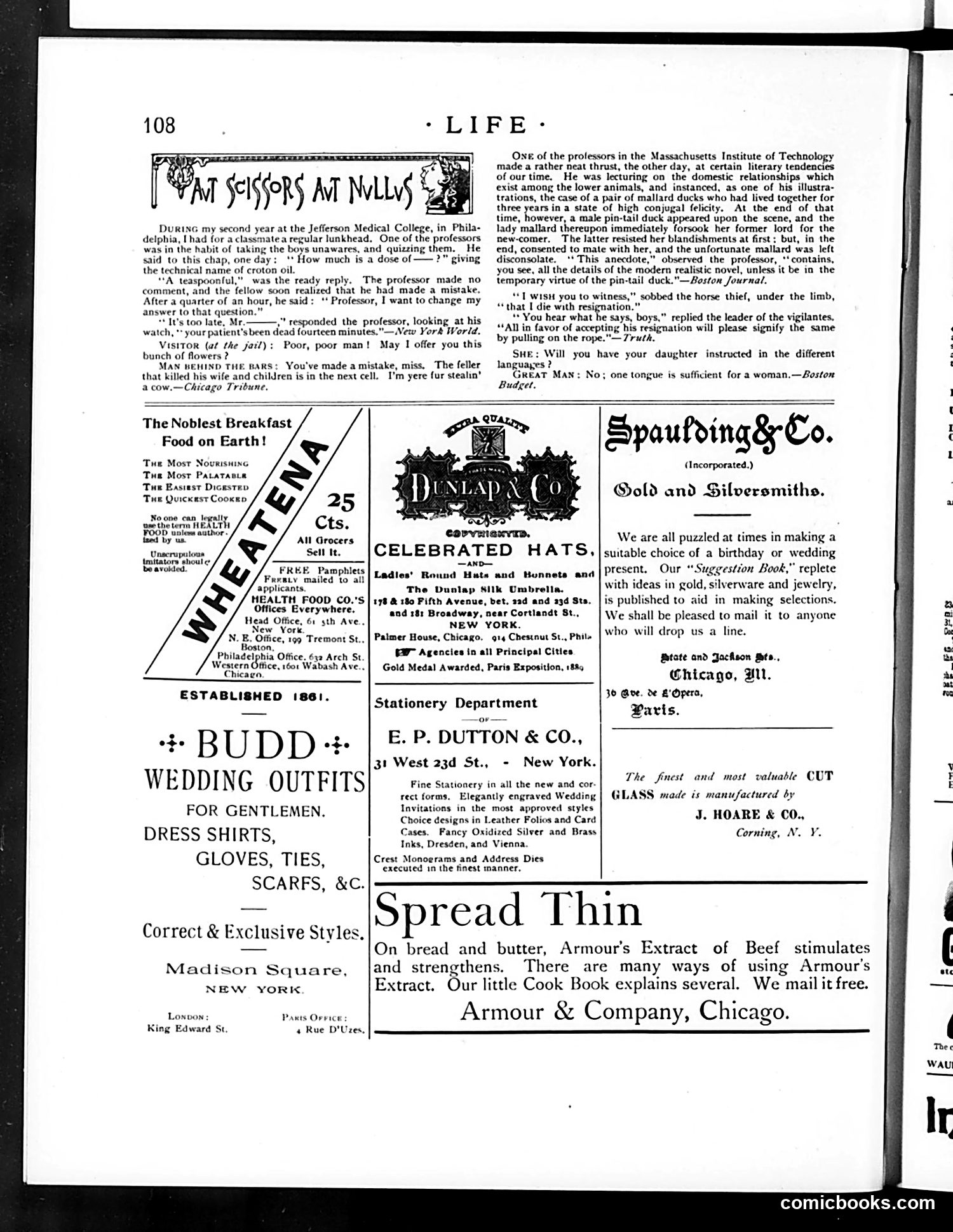
This page contains four brief humorous anecdotes satirizing American life and institutions: 1. **Medical School Hubris**: A student gives a dangerously wrong dosage answer; the professor's quip—"your patient's been dead fourteen minutes"—mocks medical education's stakes and the professor's sardonic wit. 2. **Mistaken Charity**: A visitor offers flowers to a jailed man, assuming he's a murderer, but he's merely a cattle thief. The joke ridicules society's assumptions about criminality. 3. **Literary Criticism**: An MIT professor uses mallard ducks abandoning their mate as a metaphor for modern realistic novels' focus on infidelity and seduction—a critique of contemporary literature's preoccupation with moral transgression. 4. **Gender Satire**: A man dismisses teaching his daughter multiple languages, claiming one tongue suffices for women—mocking male chauvinism. The page is predominantly advertisements (breakfast cereal, clothing, stationery). The anecdotes use educated professionals and everyday scenarios to mock contemporary social pretensions, poor judgment, and gender attitudes.
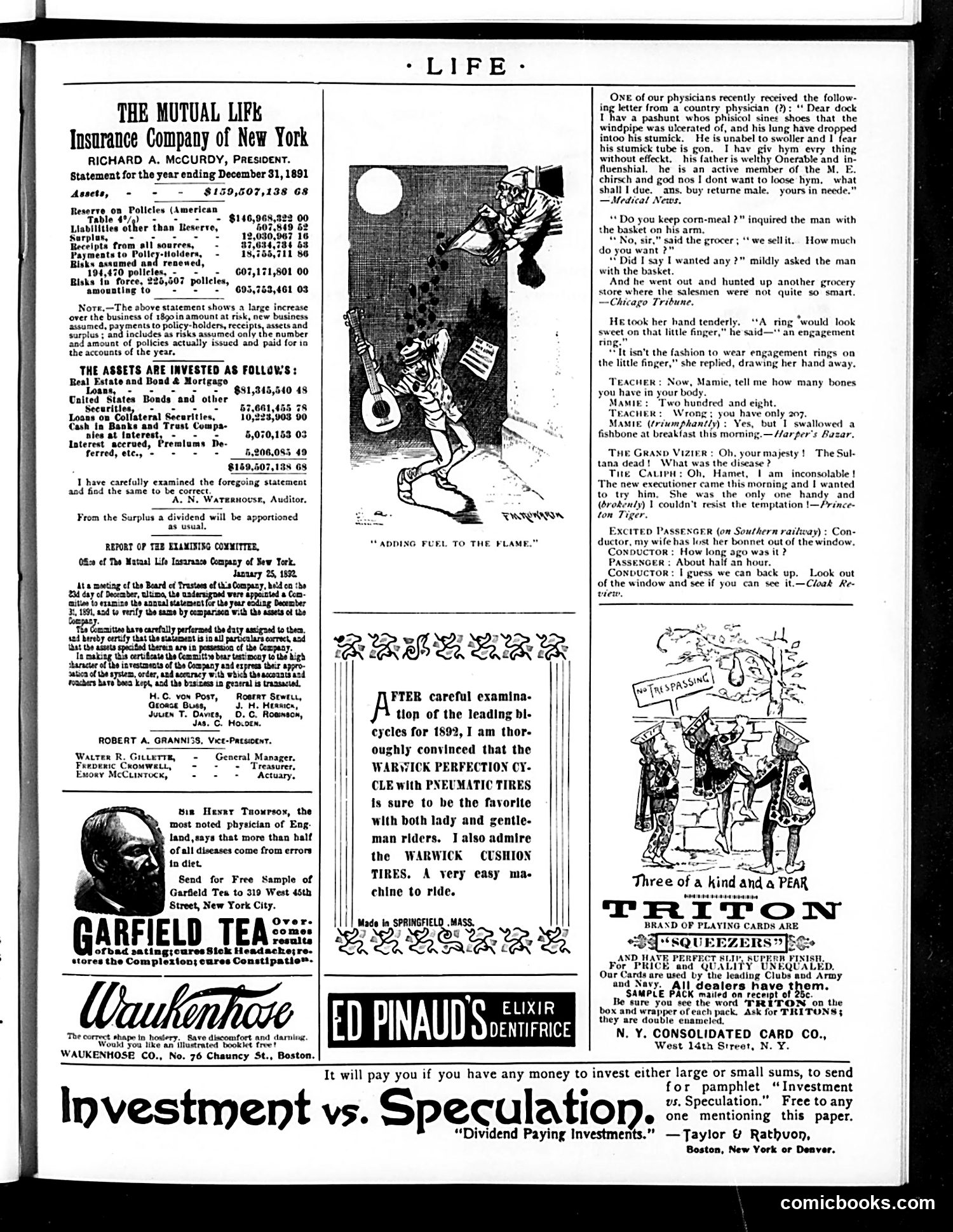
This page features a satirical cartoon depicting a doctor and grocer in conversation. The title "Adding Fuel to the Flame" refers to the absurd medical advice being exchanged. The cartoon illustrates a darkly humorous anecdote: a rural physician writes to a colleague describing a patient with a ruptured windpipe whose lung has collapsed into his stomach. The consulting doctor's response is to suggest the patient buy corn-meal from the grocer—a completely useless remedy that would only worsen the patient's condition, hence "adding fuel to the flame." The satire targets medical incompetence and the desperation of doctors lacking modern knowledge or treatment options. The misspelled, phonetic dialect of the letter amplifies the comedy, suggesting rural ignorance. This reflects 1890s anxieties about quackery and the need for professional medical standards, while mocking both the patients and practitioners of folk medicine.
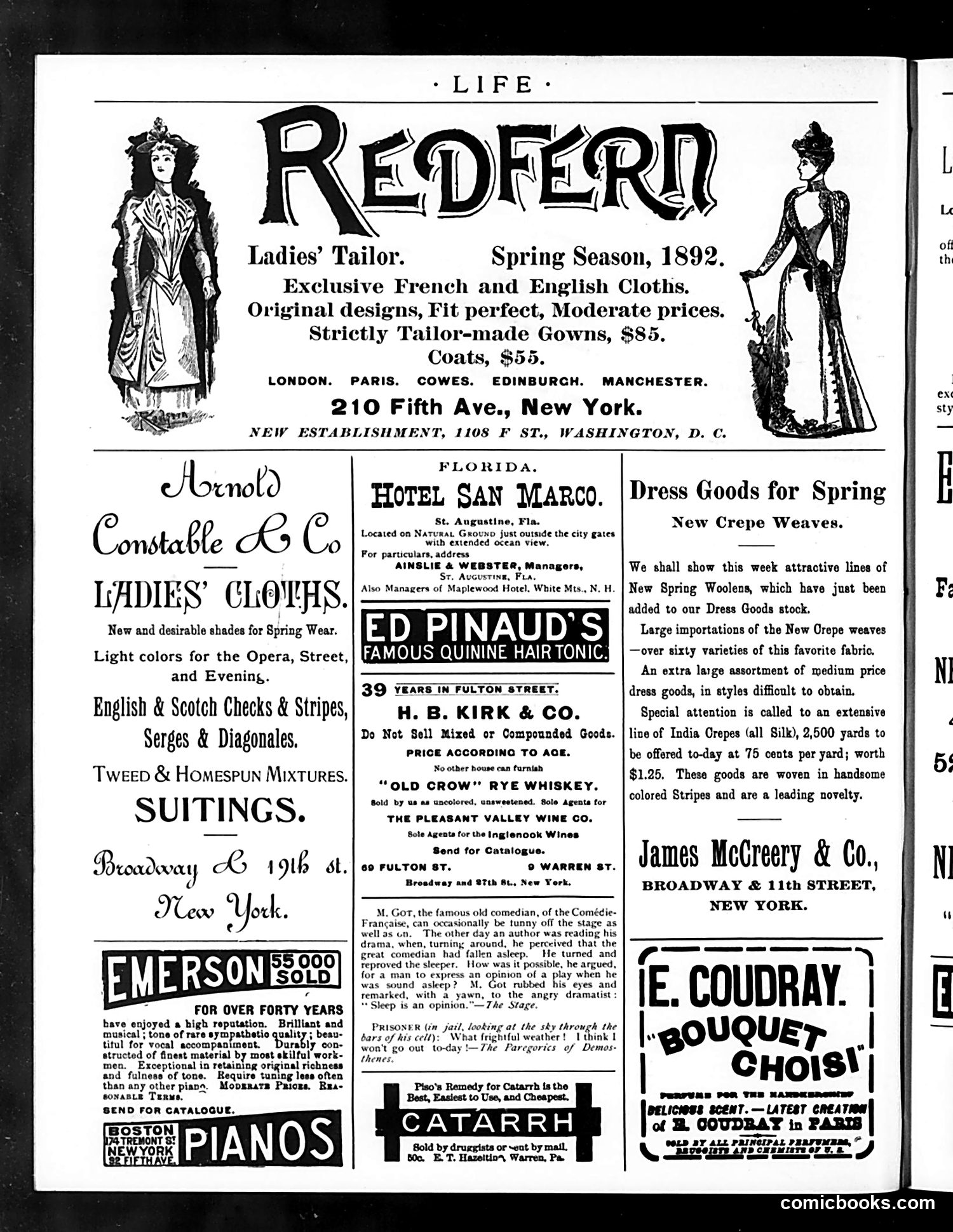
This is primarily an **advertising page** from Life magazine's Spring 1892 issue, not a satirical cartoon page. The content consists almost entirely of commercial advertisements for clothing, pianos, whiskey, hair tonic, and perfume—typical of magazine filler from this era. The only satirical content appears to be two brief **humorous anecdotes** (not cartoons): 1. A joke about M. Got, a famous French comedian who fell asleep during an author's reading of his play. When criticized, Got responds that "Sleep is an opinion"—a witty deflection of the accusation. 2. A brief joke about a prisoner looking at bad weather through jail bars, deciding not to go out—absurdist humor playing on the prisoner's lack of freedom. These are lightweight comedic pieces with no apparent political significance. The page primarily reflects 1890s consumer culture and advertising practices rather than satire or social commentary.
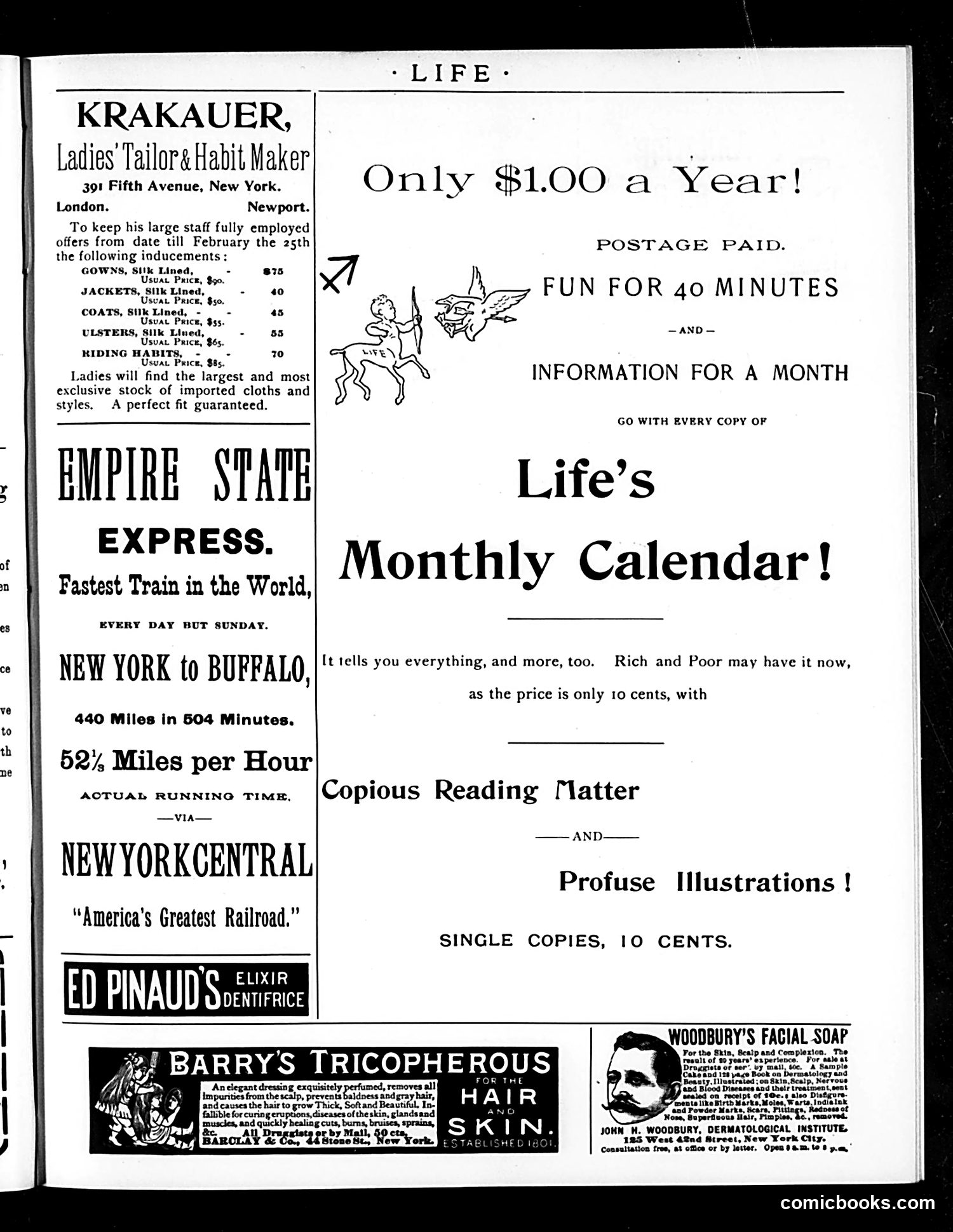
This is primarily an **advertising page** with minimal editorial content. The small winged cherub figures in the upper right are decorative elements promoting *Life's* monthly calendar subscription ($1.00/year, 10 cents per single copy). The page contains period advertisements for: - **Krakauer** (a ladies' tailor in New York/Newport offering silk-lined garments) - **Empire State Express** (the NYC Central Railroad, promoting speed: 440 miles in 604 minutes) - **Barry's Tricopherous** and **Ed Pinaud's** (hair/grooming products) - **Woodbury's Facial Soap** (featuring a mustachioed man endorsing dermatological treatment) **For modern readers:** This reflects early-1900s consumer culture—luxury imported fabrics, railroad competition emphasizing speed, and medicinal beauty products marketed with pseudo-scientific claims and male celebrity endorsements. The "fun for 40 minutes" promise reflects how magazines positioned themselves as affordable entertainment for aspiring middle-class readers.
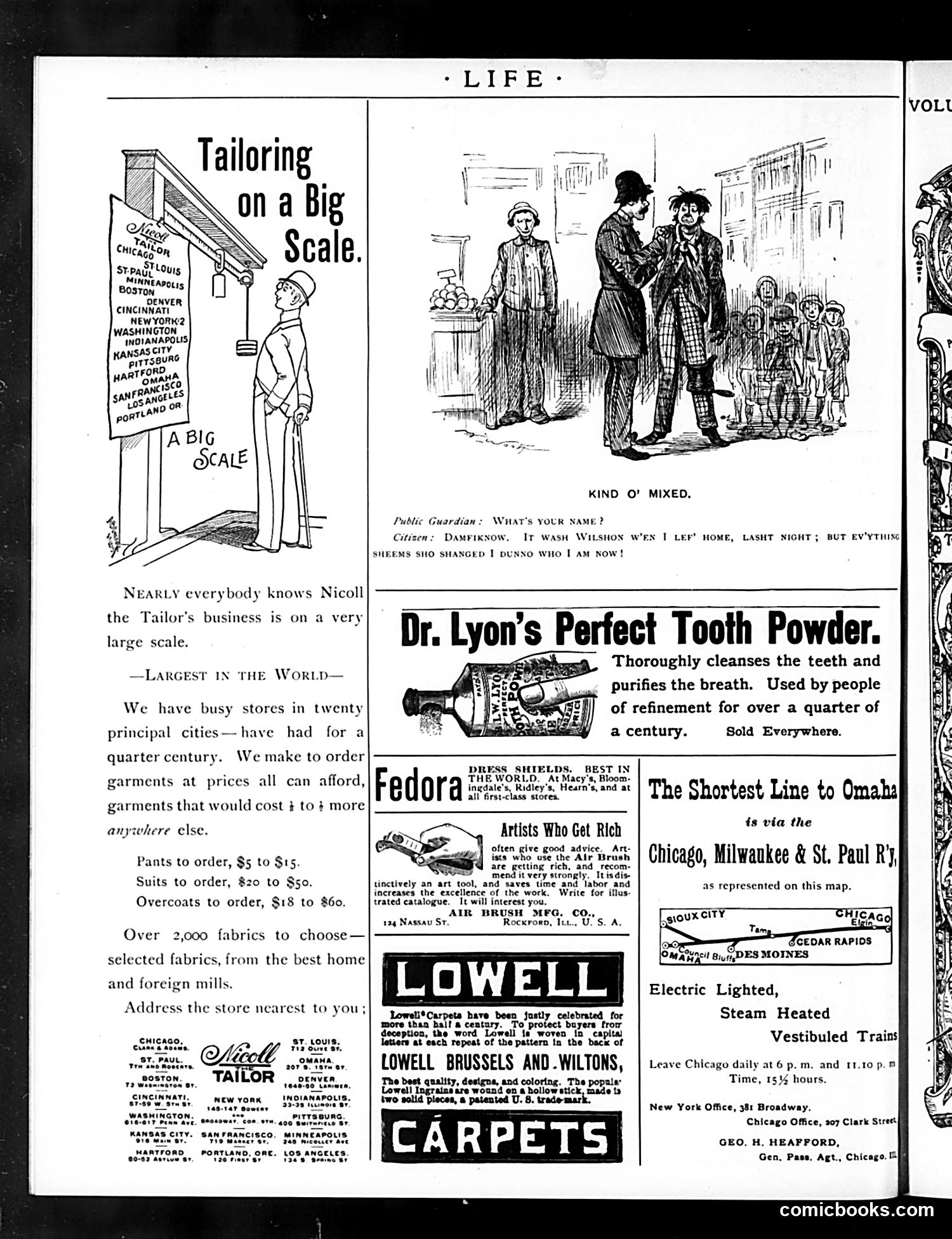
This page consists primarily of **period advertisements** rather than editorial content, but includes one small satirical cartoon titled "Kind o' Mixed." The cartoon depicts a **public guardian questioning a confused immigrant child**. The child, speaking in heavy dialect, explains that his name was "Wilkinson" before leaving home, but "everything sheems sho shanged" since arriving that he no longer knows who he is. **The satire targets:** The disorientation and identity loss experienced by immigrants in America—a common early-20th-century theme in *Life* magazine's satirical commentary. The dialect and the child's bewilderment suggest how radically America transformed newcomers, sometimes leaving them culturally unmoored. The surrounding ads (tailoring, tooth powder, carpets, rail travel) reflect the magazine's commercial nature and contemporary consumer culture.