
Life, 1892-02-18 · page 4 of 18
Life — February 18, 1892 — page 4: what you’re looking at
What you’re looking at
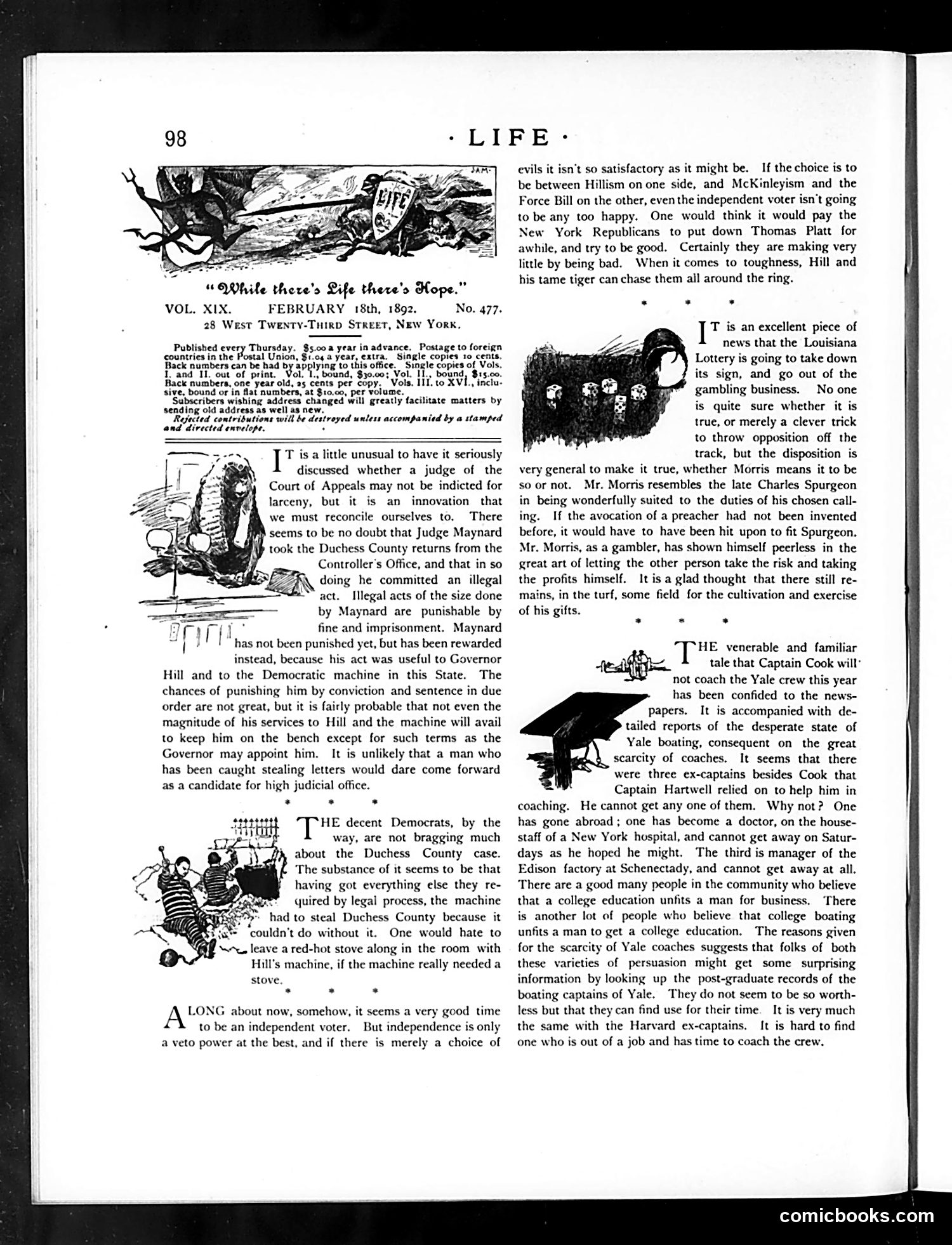
This page contains editorial commentary on contemporary political issues rather than cartoons. The text discusses: 1. **Judge Maynard and the Duchess County case**: A debate about whether a judge may be indicted for larceny, framed as legal innovation. 2. **New York Republican politics**: Commentary on Thomas Platt and McKinleyism versus Hill's faction, suggesting internal Republican division over political power. 3. **The Louisiana Lottery**: Reported closure of the gambling operation, with skepticism about whether it's genuine or a political maneuver. 4. **Yale rowing**: A discussion of coach Captain Cook's unavailability and the difficulty finding qualified replacements. The cartoons appear to be decorative illustrations accompanying these political and social commentary pieces rather than standalone satirical images with specific identifiable targets.
📄 Transcribed text from this page (OCR, searchable)
Machine-transcribed from the original scan — historical spelling and the odd misread are preserved.
LIFE “OMhile there's Life there's Hope.” VOL. XIX. FEBRUARY 18th, 1892. No. 477. 28 West Twenty-Tuirp STREET, NEW York. Published every Thursday. $5.00 year in advance. Postage to foreign countries in the Postal Union, $1.04 a year, extra. Single copies 10 cents. Back numbers can be had by appiying to this office, Single copies of Vols. 1, and Il, out of print. bound, $30.00; bound Back numbers, one year old, 25 cents per copy: | Vols Ii. toXVvl., sive, bound of in flat numbers, at $10.00, per volu Scbscribers wishing address changed’ will greatly facilitate matters by sending old address as well as new. Rejucted contributions will be destreyed unless accompanied by a stamped and directed envelope. $15.00. inclu: T is a little unusual to have it seriously discussed whether a judge of the Court of Appeals may not be indicted for larceny, but it is an innovation that we must reconcile ourselves to. There seems to be no doubt that Judge Maynard took the Duchess County returns from the Controller's Office, and that in so ey \ doing he committed an illegal “S" act. Illegal acts of the size done by Maynard are punishable by fine and imprisonment. Maynard has not been punished yet, but has been rewarded instead, because his act was useful to Governor Hill and to the Democratic machine in this State. The chances of punishing him by conviction and sentence in due order are not great, but it is fairly probable that not even the magnitude of his services to Hill and the machine will avail to keep him on the bench except for such terms as the Governor may appoint him. It is unlikely that a man who has been caught stealing letters would dare come forward as a candidate for high judicial office. . . HE decent Democrats, by the way, are not bragging much about the Duchess County case. ‘The substance of it seems to be that having got everything else they re- quired by legal process, the machine rar “had to steal Duchess County because it tS ‘couldn't do without it. a would hate) to Hill's iiachines if the machine really needed a stove. . . . LONG about now, somehow, it seems a very good time to be an independent voter. But independence is only a veto power at the best, and if there is merely a choice of evils it isn’t so satisfactory as it might be. If the choice is to be between Hillism on one side, and McKinleyism and the Force Bill on the other, even the independent voter isn’t going to be any too happy. One would think it would pay the New York Republicans to put down Thomas Platt for awhile, and try to be good. Certainly they are making very little by being bad. When it comes to toughness, Hill and his tame tiger can chase them ail around the ring. T is an excellent piece of news that the Louisiana Lottery is going to take down its sign, and go out of the gambling business. No one is quite sure whether it is true, or merely a clever trick to throw opposition off the track, but the disposition is very general to make it true, whether Morris means it to be so or not. Mr. Morris resembles the late Charles Spurgeon in being wonderfully suited to the duties of his chosen call- ing. If the avocation of a preacher had not been invented before, it would have to have been hit upon to fit Spurgeon. Mr. Morris, as a gambler, has shown himself peerless in the great art of letting the other person take the risk and taking the profits himself. It is a glad thought that there still re- mains, in the turf, some field for the cultivation and exercise of his gifts. . . * HE venerable and familiar teat tale that Captain Cook will not coach the Yale crew this year has been confided to the news- papers. It is accompanied with de- tailed reports of the desperate state of Yale boating, consequent on the great scarcity of coaches. It seems that there were three ex-captains besides Cook that Captain Hartwell relied on to help him in coaching. He cannot get any one of them. Why not? One has gone abroad; one has become a doctor, on the house- staff of a New York hospital, and cannot get away on Satur- days as he hoped he might. The third is manager of the Edison factory at Schenectady, and cannot get away at all. There are a good many people in the community who believe that a college education unfits a man for business. There is another lot of people who believe that college boating unfits a man to get a college education. The reasons given for the scarcity of Yale coaches suggests that folks of both these varieties of persuasion might get some surprising information by looking up the post-graduate records of the boating captains of Yale. They do not seem to be so worth- less but that they can find use for their time. It is very much the same with the Harvard ex-captains. It is hard to find one who is out of a job and has time to coach the crew. comicbooks.com