
Life, 1892-02-18 · page 8 of 18
Life — February 18, 1892 — page 8: what you’re looking at
What you’re looking at
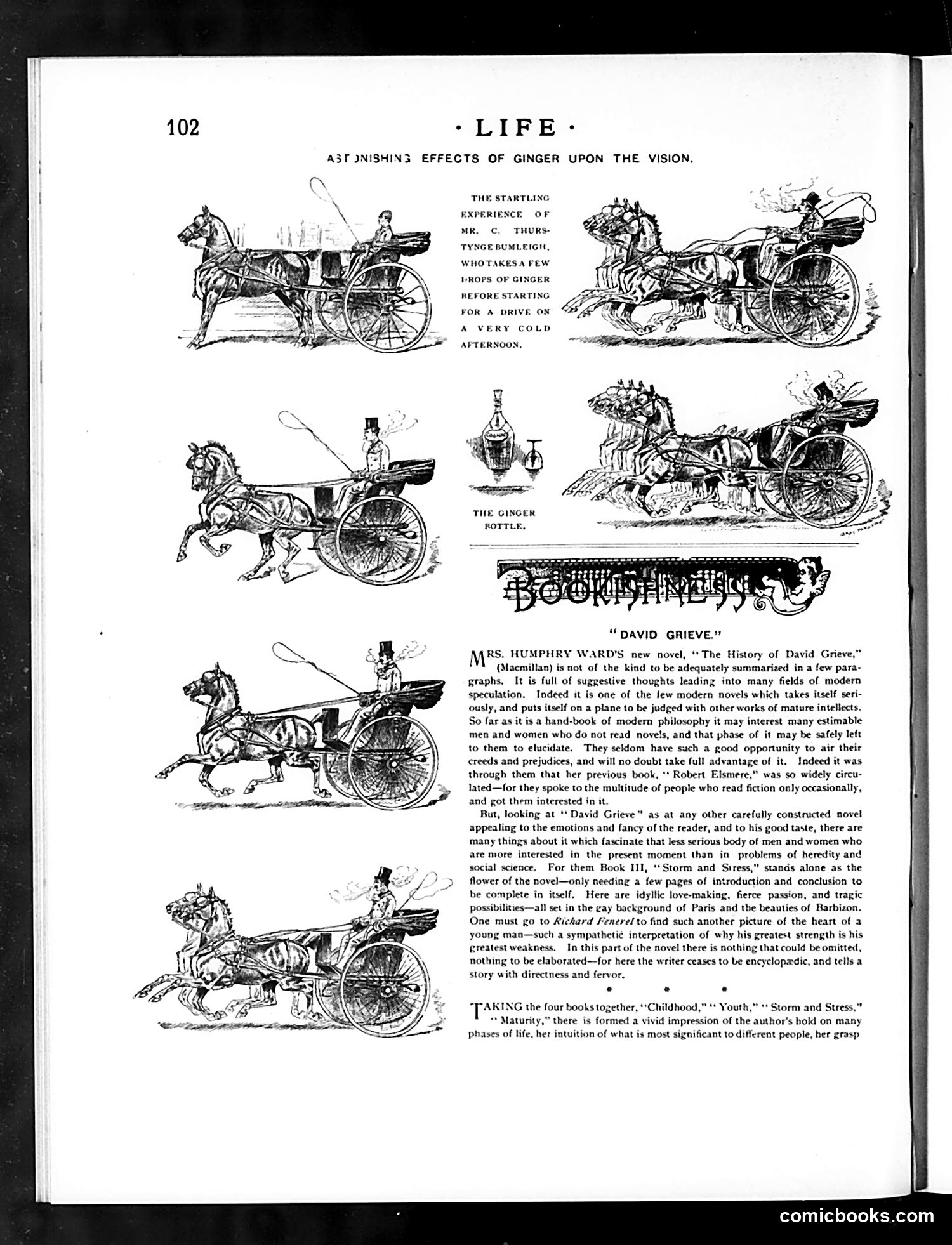
This is a humorous comic sequence showing a horse-drawn carriage with a gentleman passenger becoming increasingly animated across four panels. The caption indicates Mr. C. Thurstonge Rumleigh takes ginger drops before a cold-weather drive, and the illustrations depict his growing excitement and energetic behavior—the horse and carriage appear more vigorous and animated in each successive panel. The joke relies on the Victorian-era belief that ginger was a stimulant or tonic with invigorating properties. The satire mocks both the exaggerated medicinal claims of ginger tonics and the enthusiastic testimonials common in period advertisements. The visual progression humorously suggests the ginger makes the passenger hyperactive rather than merely warming him on a cold afternoon.
📄 Transcribed text from this page (OCR, searchable)
Machine-transcribed from the original scan — historical spelling and the odd misread are preserved.
> LIFE: A3T NISHINS EFFECTS OF GINGER UPON THE VISION, THE STARTLING EXPERIENCE OF MR, C, THURS TYNGE BUMLEIGN, WHOTAKESA FEW UROPS OF GINGER REFORE START! FOR A DRIVE ON A VERY COLD AFTERNOON, “DAVID GRIEVE.” N RS. HUMPHRY WARD'S new novel, ‘* The History of David Grieve,” (Macmillan) is not of the kind to be adequately summarized in a few para- graphs. It is full of suggestive thoughts leading into many fields of modern speculation, Indeed it is one of the few modern novels which takes itself seri- ously, and puts itself on a plane to be judged with other works of mature intellects. So far as it isa hand-book of modem philosophy it may interest many estimable men and women who do not read novels, and that phase of it may be safely left to them to elucidate. They seldom have such a good opportunity to air their creeds and prejudices, and will no doubt take full advantage of it. Indeed it was through them that her previous book, '* Robert Elsmere,” was so widely circu- lated—for they spoke to the multitude of people who read fiction only occasionally, and got them interested in it. But, looking at ‘* David Grieve as at any other carefully constructed novel appealing to the emotions and fancy of the reader, and to his good taste, there are many things about it which fascinate that less serious body of men and women who are more interested in the present moment than in problems of heredity and social science, For them Book III, ‘Storm and Stress," stands alone as the flower of the novel—only needing a few pages of introduction and conclusion to be complete in itself, Here are idyllic love-making, fierce passion, and tragic possibilitres—all set in the gay background of Paris and the beauties of Barbizon. One must go to Richard Fenerel to find such another picture of the heart of a young man—such a sympathetié interpretation of why his greatest strength is his greatest weakness. In this part of the novel there is nothing that could be omitted, nothing to be elaborated—for here the writer ceases to be encyclopxdic, and tells a story with directness and fervor. ° * « AKING the four books together, Childhood,” ** Youth," ** Storm and Stress," ‘Seiisiagiagtaeimanisia > g ; “ Maturity," there is formed a vivid impression of the author’s hold on many —_— 2 phases of life, her intuition of what is most significant to different people, her grasp comicbooks.com