
Life, 1892-02-18 · page 9 of 18
Life — February 18, 1892 — page 9: what you’re looking at
What you’re looking at
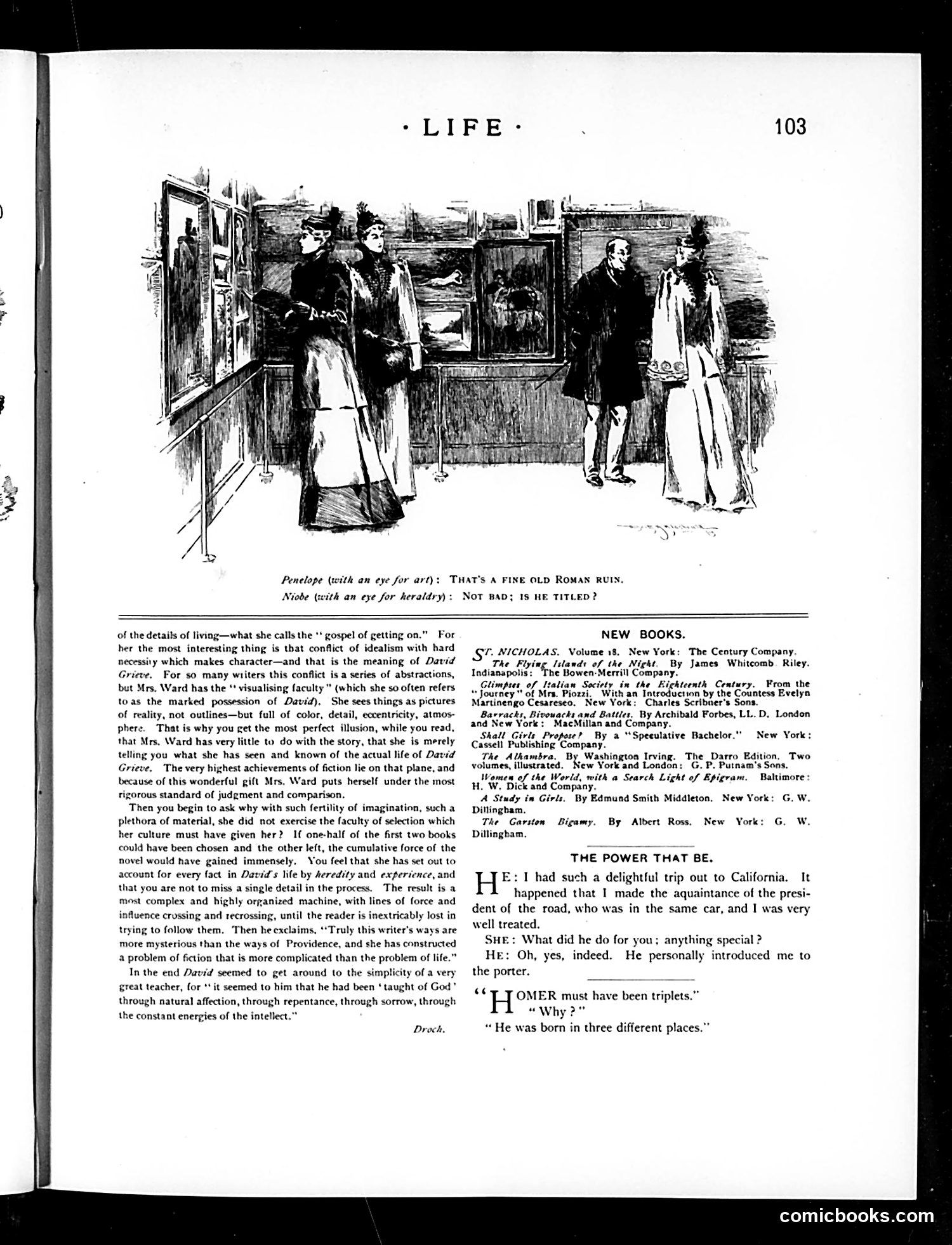
This page contains a sketch depicting what appears to be an art gallery or museum scene, with several well-dressed visitors examining framed artworks on walls. The caption reads: "Penelope (with an eye for art): 'THAT'S A FINE OLD ROMAN RUIN.' Niobe (with an eye for heraldry): 'NOT BAD; IS HE TITLED?'" The satire mocks two types of female gallery visitors: one who appreciates art's aesthetic or historical value, and another who judges artwork (or people) primarily by social status and aristocratic titles. "Niobe" appears to be referring to one of the male visitors as if he were an artwork to be evaluated, revealing the shallow social-climbing priorities of certain wealthy women. The humor lies in this confusion of artistic appreciation with status-seeking.
📄 Transcribed text from this page (OCR, searchable)
Machine-transcribed from the original scan — historical spelling and the odd misread are preserved.
Penelope (with an eye for art): THAT'S A FINE OLD ROMAN RUIN. Niobe (with an exe for heraldry): Not BAD; 18 HE TITLED? of the details of living—what she calls the ** gospel of getting on.” For her the most interesting thing is that conflict of idealism with hard necessity which makes character—and that is the meaning of David Grieve. For so many writers this conflict is a series of abstractions, but Mrs. Ward has the “* visualising faculty " (which she so often refers toas the marked possession of David). She sees things as pictures of reality, not outlines—but full of color, detail, eccentricity, atmos- phere. That is why you get the most perfect illusion, while you read, that Mrs, Ward has very little to do with the story, that she is merely telling you what she has seen and known of the actual life of David Grieve, The very highest achievements of fiction lie on that plane, and because of this wonderful gift Mrs, Ward puts herself under the most rigorous standard of judgment and comparison. Then you begin to ask why with such fertility of imagination, such a plethora of material, she did not exercise the faculty of selection which her culture must have given her? If one-half of the first two books could have been chosen and the other left, the cumulative force of the novel would have gained immensely. Vou feel that she has set out to account for every fact in David's life by heredity and experience, and that you are not to miss a single detail in the process. The result is a most complex and highly organized machine, with lines of force and influence crossing and tecrossing, until the reader is inextricably lost in trying to follow them. ‘Then he exclaims, ‘Truly this writer’s ways are more mysterious than the ways of Providence, and she has constructed a problem of fiction that is more complicated than the problem of life.” In the end David seemed to get around to the simplicity of a very great teacher, for “it seemed to him that he had been ‘taught of God’ through natural affection, through repentance, through sorrow, through the constant energies of the intellect.” Droch. NEW BOOKS. SU_NICHOLAS. Volume 18, New York: The Century Company. The Flying Island: of the Night. By James Whitcomb. Riley. Indianapolis: “The Bowen-Merrill Company. Glimpres, of Italian Society in the Eighteenth Century. From the Journey" of Mrs, Piozzi. With an Introduction by the Countess Evelyn. Martinengo Cesareseo. New York: Charles Scribner's Sons. Barracks, Bivouacks and Battles. By Archibald Forbes, LL.D. London and New York: MacMillan and Company. Shall Girls Propose? By a “Speeulative Bachelor.” Cassell Publishing Company. The Athambra, By Washington Irving. The Darro Edition. Two volumes, illustrated. New Yorkand London: G. P. Putnam's Sons, Women of the World, with a Search Light of Epigram. H, W, Dick and Company. A Study in Girls, By Edmund Smith Middleton. Dillingham. The Garston Dillingham, New York : Baltimore : New York: G. W. Biga' By Albert Ross. New York: G. W. THE POWER THAT BE. ] | E: I had such a delightful trip out to California. It happened that I made the aquaintance of the presi- dent of the road, who was in the same car, and I was very well treated. SHE: What did he do for you; anything special ? HE: Oh, yes, indeed. He personally introduced me to the porter. “cs OMER must have been triplets.” “Why?” “ He was born in three different places.” comicbooks.com