
A complete issue · 16 pages · 1892
Life — January 28, 1892
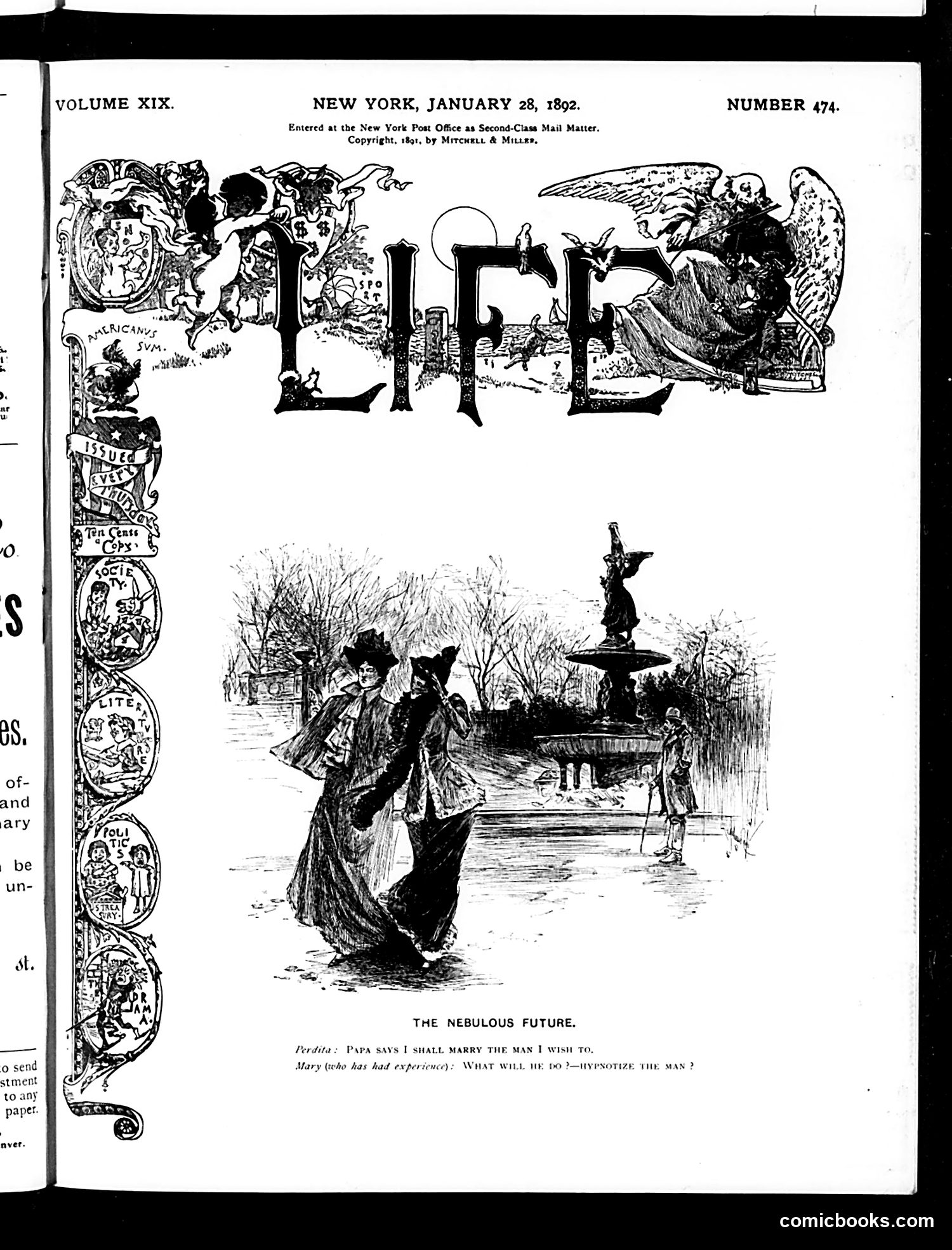
This cartoon satirizes fortune-telling and female ambition. A woman consults what appears to be a fortune teller or spiritualist (common in 1890s popular culture) near a fountain in a public park. The caption reads: "Fedida: Papa says I shall marry the man I wish to. Mary (who has had experience): What will he do?—Hypnotize the man?" The joke mocks the gap between romantic idealism and practical reality. The reference to "hypnotize" suggests contemporary skepticism about spiritualism and mesmerism—popular but dubious practices of the era. The satire implies that modern women who believe they can marry whomever they wish are naive; the man would need supernatural influence to agree. It reflects period anxieties about changing gender relations and women's increasing independence.
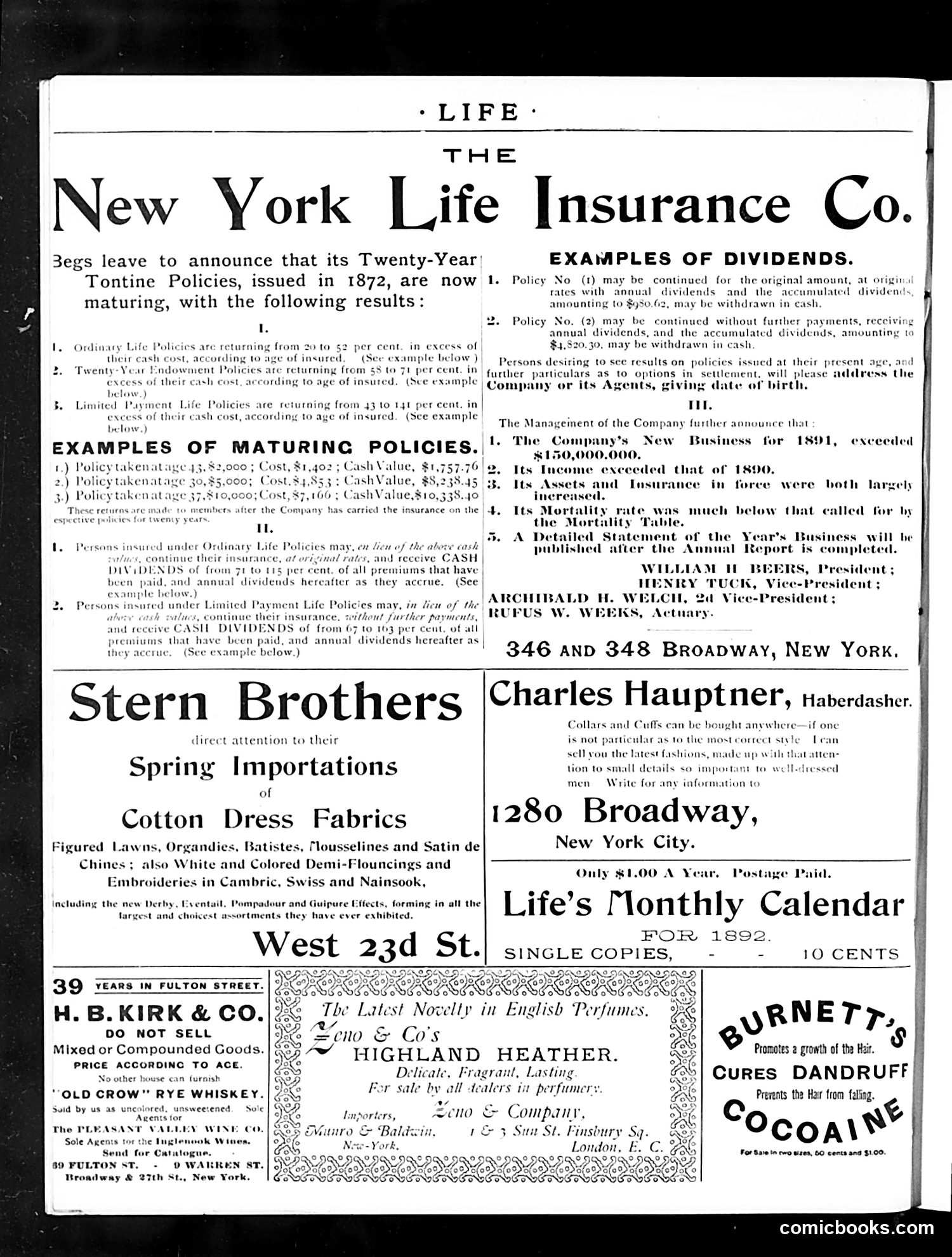
This page is **primarily advertising**, not satirical content. It consists of commercial announcements from 1892 for: - **New York Life Insurance Co.** (top) announcing dividend returns on maturing twenty-year policies - **Stern Brothers** (cotton dress fabrics) - **H.B. Kirk & Co.** (whiskey and wine) - **Charles Hauptner** (haberdashery) - **Life's Monthly Calendar** subscription ($1.00/year) - Smaller ads for English perfume, and notably **Burnett's Cocaine** for treating dandruff and hair loss The cocaine ad is historically notable—cocaine was legal and marketed for medical purposes in the 1890s before regulation. There is no political satire visible on this page; it represents straightforward commercial advertising typical of period magazines.
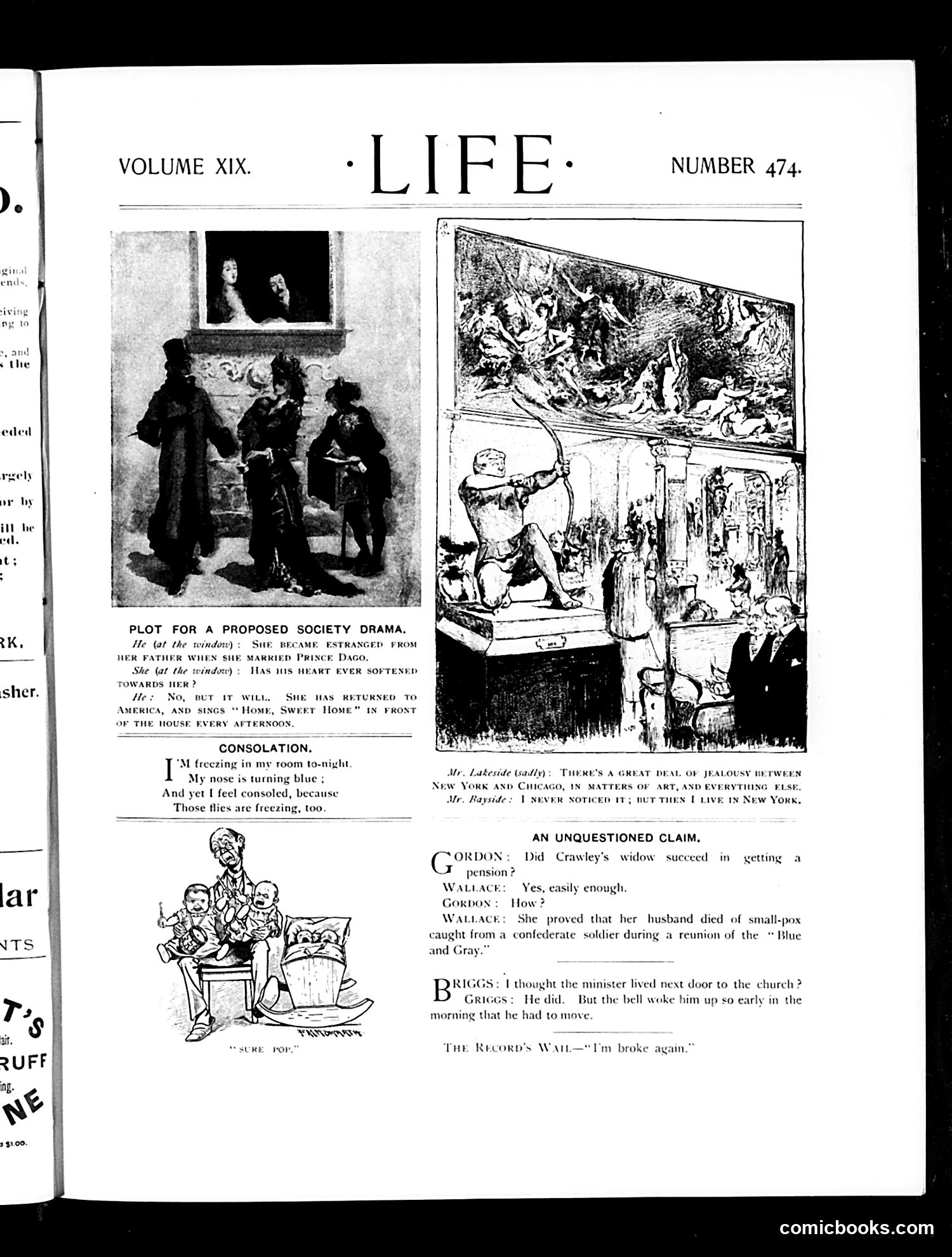
This page contains three distinct pieces of satirical humor: 1. **"Plot for a Proposed Society Drama"** (top left): A sketch depicting a domestic scandal—a woman estranged from her husband after he married another woman, with his "heart ever softened towards her." The satire targets melodramatic theatrical conventions popular in contemporary society dramas. 2. **"An Unquestionioned Claim"** (center dialogue): A brief comic exchange about a widow's pension, revealing how bureaucratic systems could be exploited through dubious proof (claiming a Confederate soldier husband died of smallpox during a reunion). 3. **"Sue Pop"** (bottom): An illustration of a woman surrounded by children, captioned with domestic humor about managing a large family. The overall page satirizes middle-class social pretenses and domestic complications of the era.
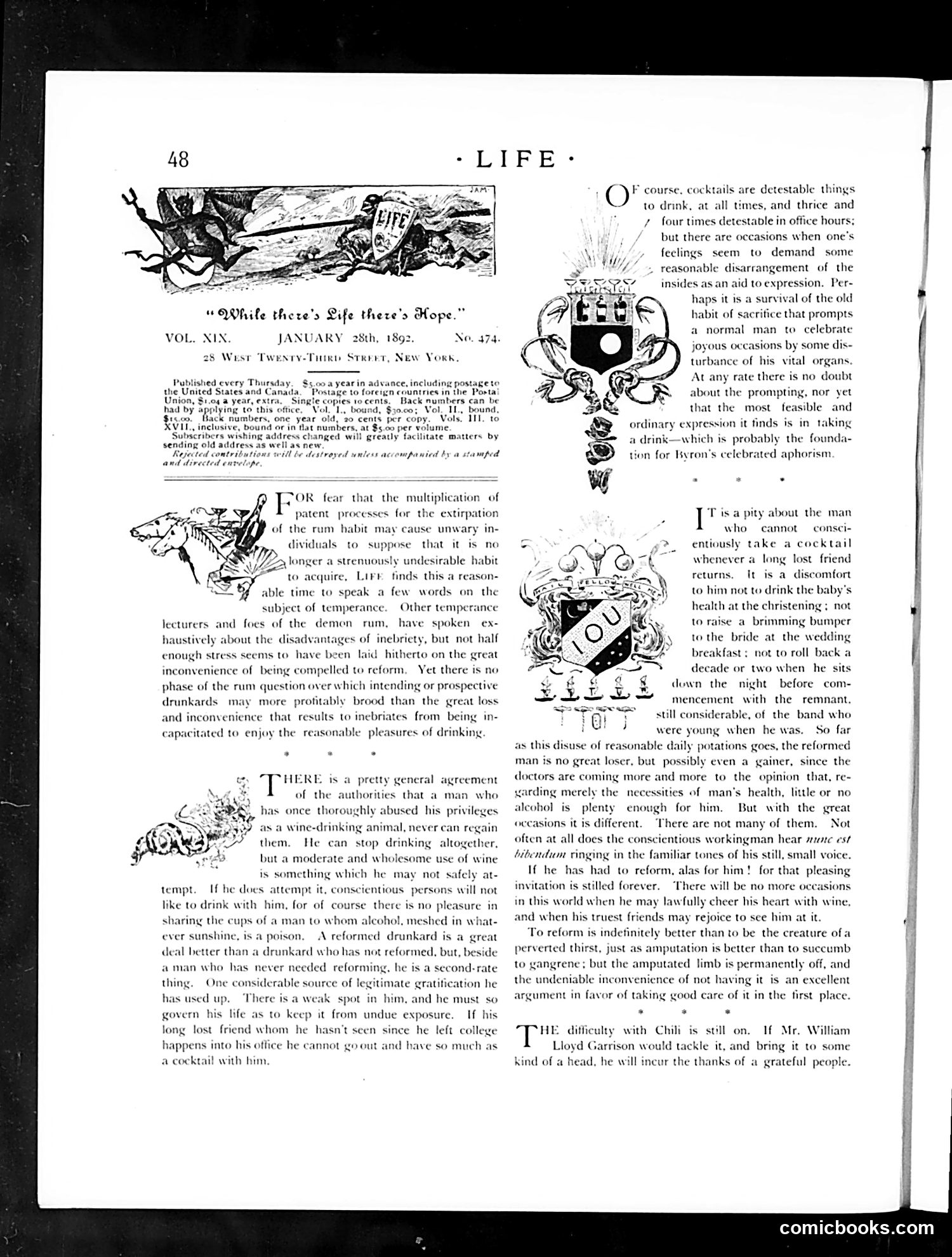
This page discusses alcohol reform and temperance through satirical commentary. The text debates whether heavy drinkers can genuinely reform or should abstain entirely. The author argues that moderate drinking is acceptable for most people, but those with demonstrated alcohol abuse problems face an impossible choice: either quit completely or remain addicts. The decorative emblems/crests with "LIFE" branding serve as page ornaments rather than depicting specific political figures. The satire targets temperance advocates' absolutism while acknowledging alcohol's genuine dangers. The final reference to "Chill" and "Mr. William Lloyd Garrison" appears to reference historical temperance reformers, though the specific context is unclear from this excerpt alone. The piece essentially mocks rigid prohibition sentiment while admitting alcohol abuse is real.
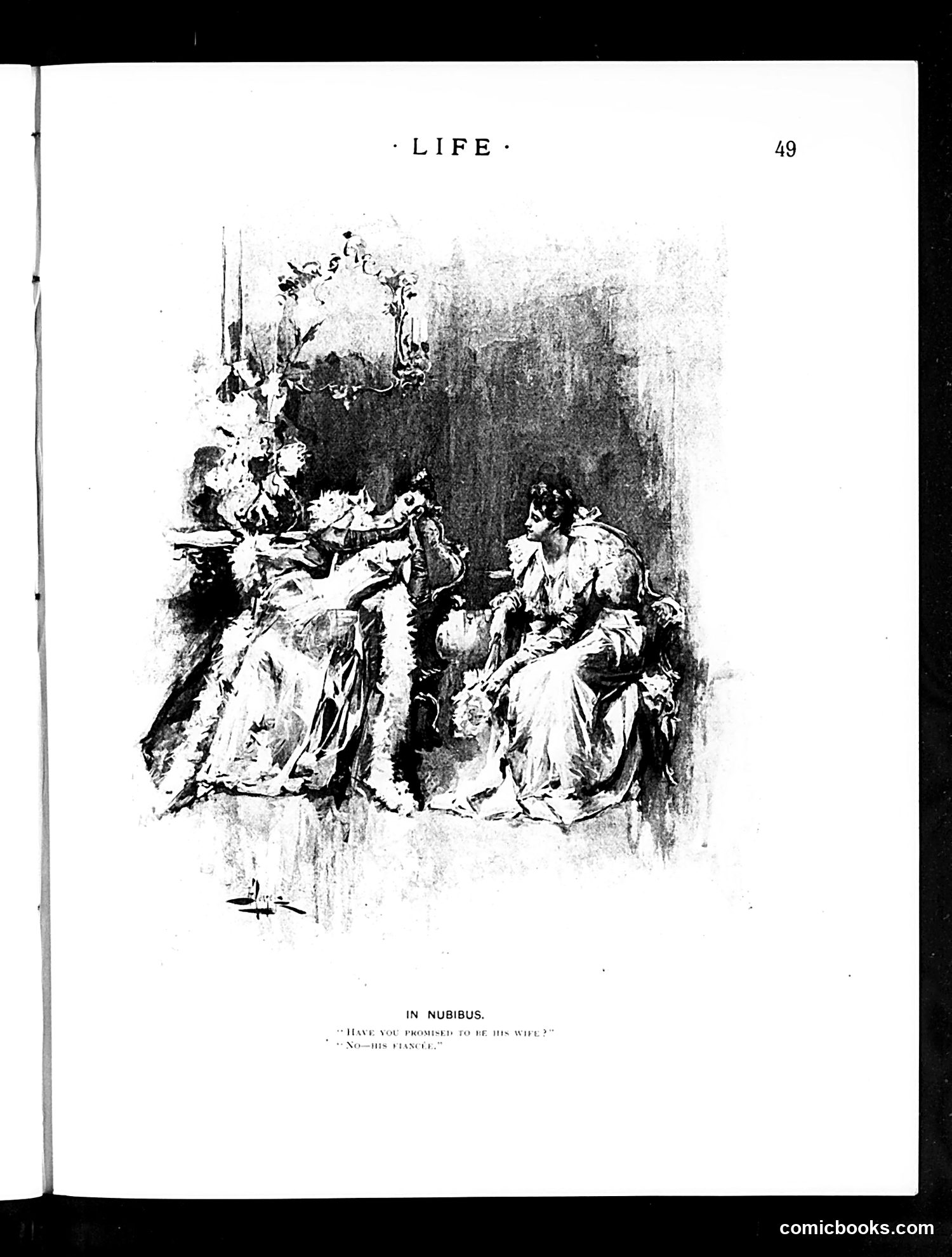
This page from *Life* magazine (page 49) features a sketch titled "IN NUBIBUS" with the caption: "Have you promised to be his wife?" / "No—his fiancée." The cartoon depicts what appears to be four elegantly dressed women in an interior setting, engaged in conversation. The satire plays on the distinction between being a "wife" versus a "fiancée"—mocking the social pretensions or linguistic games around marriage status and engagement among upper-class women of the era. The title "In Nubibus" (Latin for "in the clouds") suggests these women are living in an ethereal, detached world of social niceties and semantic distinctions, disconnected from practical reality. The humor targets the affected language and artificial social conventions governing courtship and marriage among the wealthy.
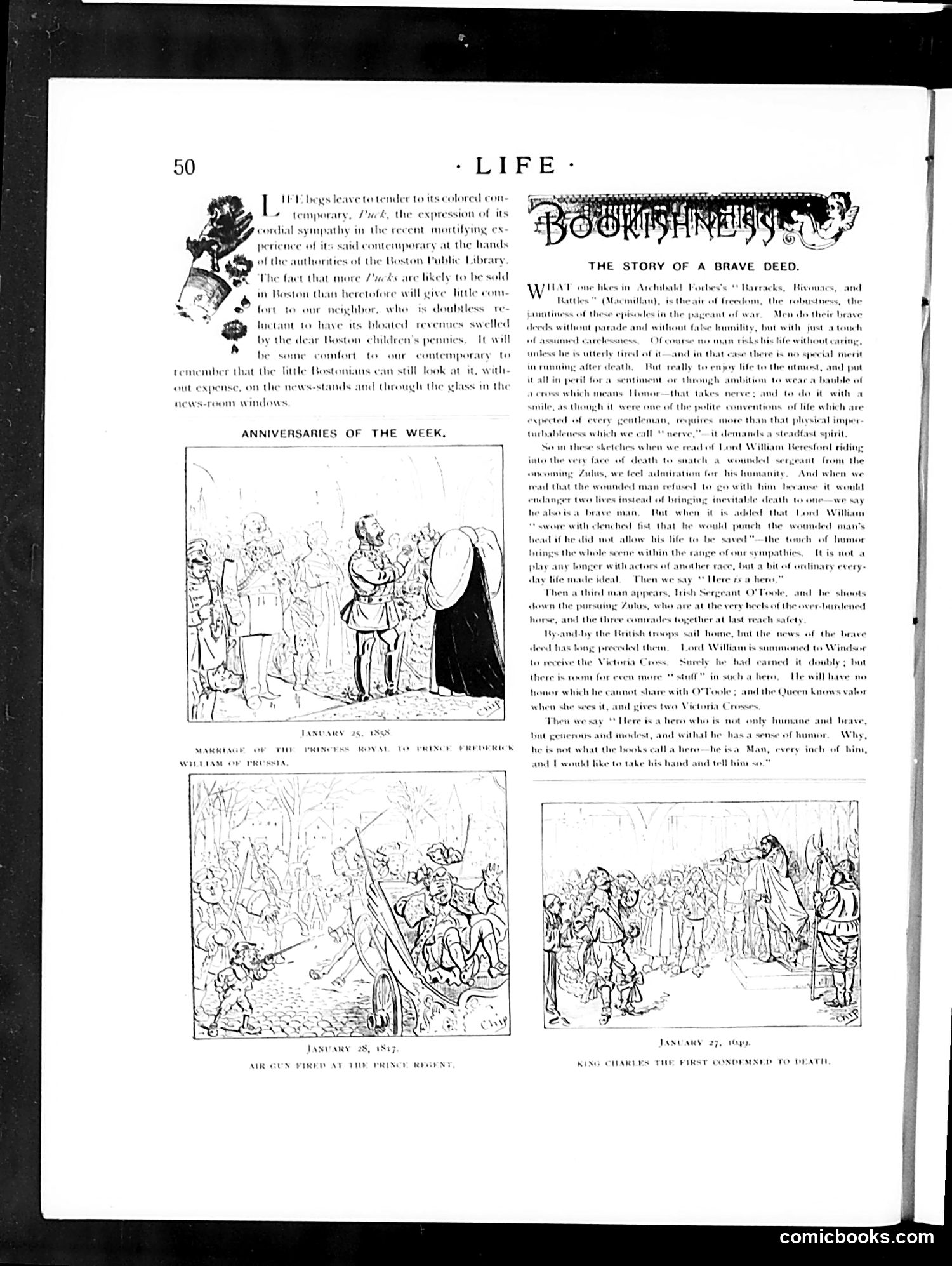
This page contains two sections: **"Anniversaries of the Week"** features historical illustrations commemorating events from specific dates, including the January 25, 1858 marriage of Princess Royal to Prince Frederick of Prussia, and January 28, 1817's "Argus' First at the Prince Regent," plus January 27, 1649's "King Charles the First Condemned to Death." **"Book Shelf" article** discusses Archibald Forbes's book about military bravery, examining whether soldiers like "Lord William Beresford" exhibit genuine courage when facing death. The text argues true bravery requires more than physical imperviousness—it demands moral character and willingness to sacrifice. The illustrations are historical engravings rather than contemporary satire, serving an educational/commemorative function typical of Life magazine's content during this period.
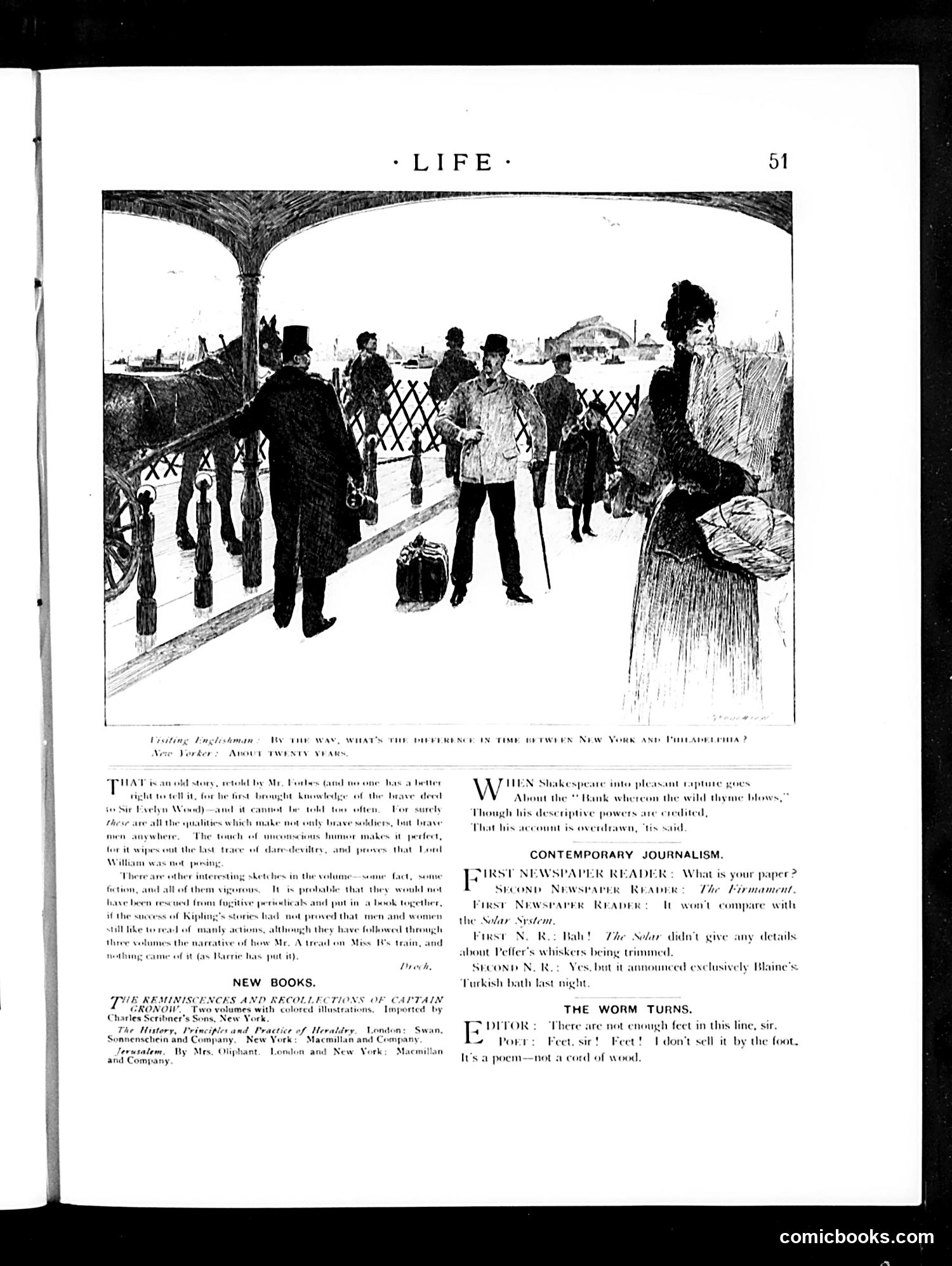
The illustration depicts a scene at what appears to be a train platform or dock, with well-dressed Victorian-era figures. The caption references "the difference in time between New York and Philadelphia" about twenty years prior. The cartoon satirizes contemporary travel and communication. A gentleman appears to be conducting some kind of transaction or conversation—likely poking fun at the practical inconveniences or absurdities of coordinating activities across cities separated by significant travel time. The surrounding text includes literary references (Shakespeare), book reviews under "NEW BOOKS," and humorous dialogue sections titled "CONTEMPORARY JOURNALISM" and "THE WORM TURNS"—typical of Life's satirical format mixing visual and textual humor about social customs and current affairs.
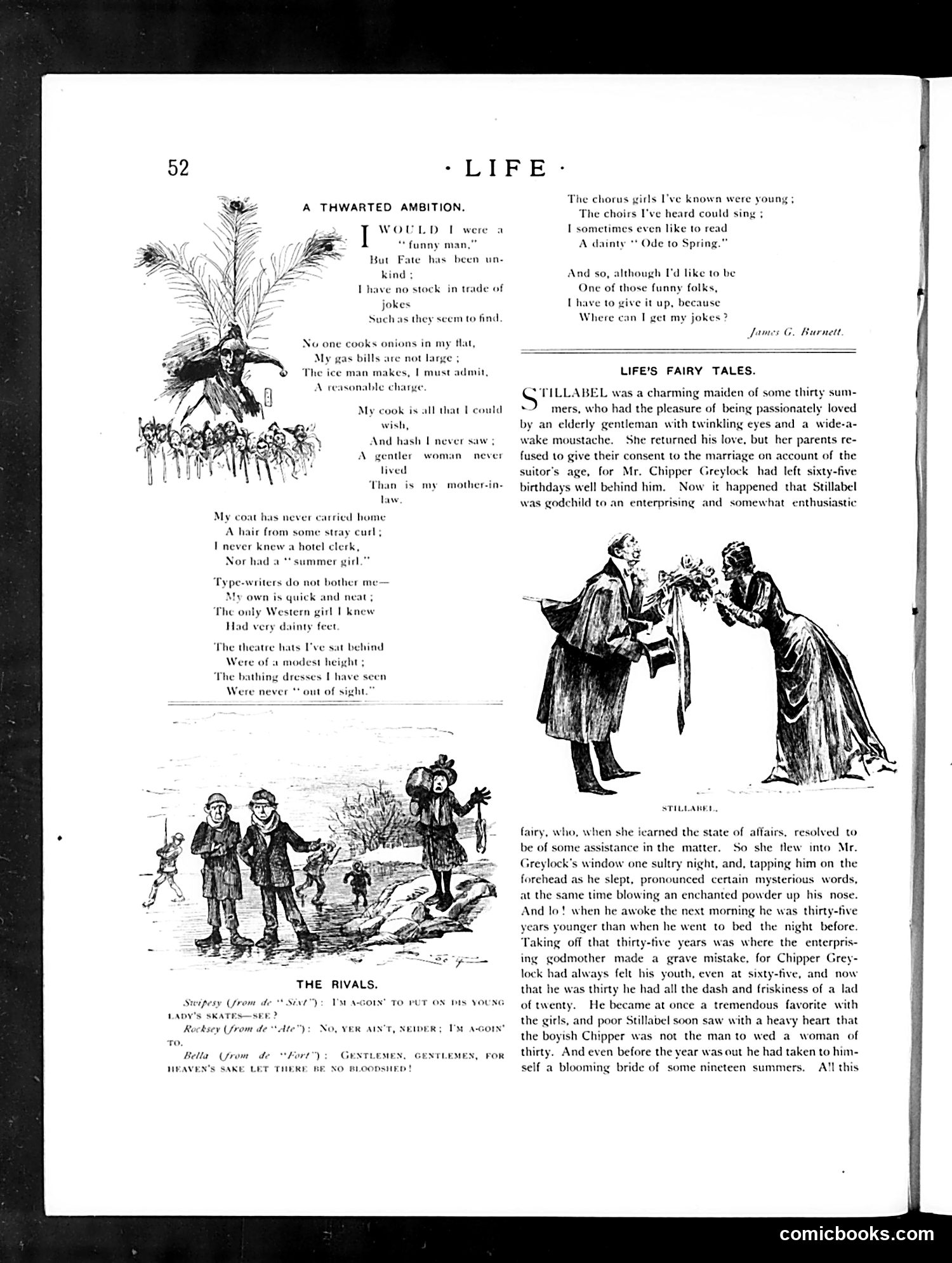
This page contains two separate pieces: **"A Thwarted Ambition"** (left): A poem by James G. Burnett expressing frustration at failed aspirations to be a "funny man." The speaker laments that Fate has been unkind and he lacks the qualities needed for humor—he can't cook, his typewriter is slow, he's never known a hotel clerk, and he's unfamiliar with theater or fashionable society. The accompanying illustration shows a dejected figure amid domestic chaos, emphasizing his ordinariness. **"Life's Fairy Tales"** (right): A humorous story about Stillabel, a thirty-something maiden courted by an elderly gentleman. Through magical intervention (enchanted powder), she becomes thirty-five years younger overnight, becoming irresistibly attractive to young men—particularly the wealthy Chipper Greylock. Both pieces satirize Victorian courtship conventions and gender expectations about age, appearance, and marriageability.
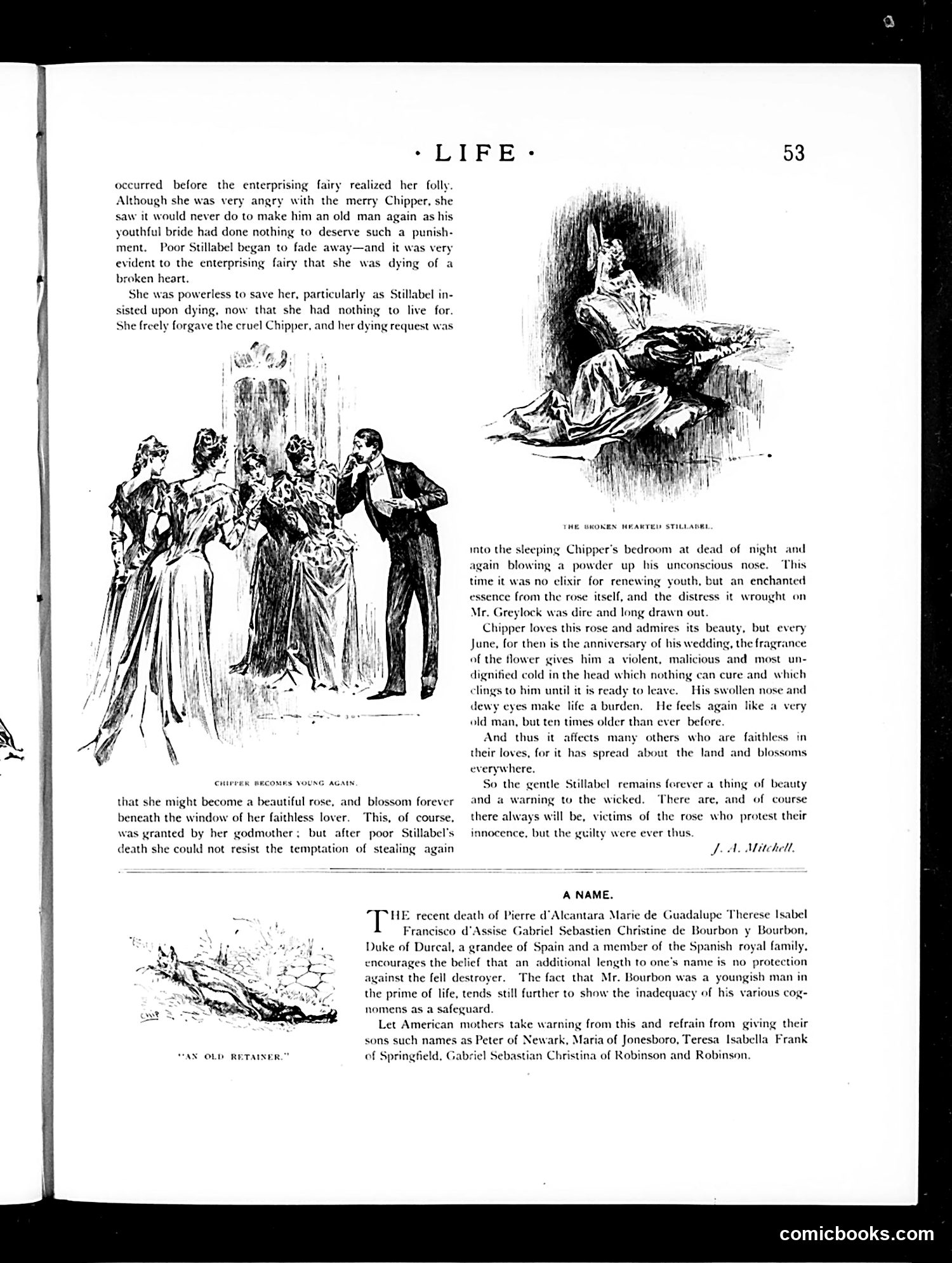
This page contains two fictional stories with accompanying illustrations: **"Chipper Becomes Young Again"** (top): A fairy tale about a magical rose that rejuvenates an aging man named Chipper, though it causes his wife Stillabel to die of heartbreak. The moral warns against infidelity and vanity. **"A Name"** (bottom): A brief piece discussing the recent death of Pierre d'Alcántara (a Spanish nobleman with an extremely long formal name), arguing that lengthy names provide "protection against the fell destroyer" (death). It humorously advises American mothers against giving their sons similarly elaborate names like "Peter of Newark" or "Gabriel Sebastian Christina of Robinson." Both are lighthearted moral tales typical of Life's satirical fiction—the first a cautionary romance, the second gentle mockery of aristocratic naming conventions.
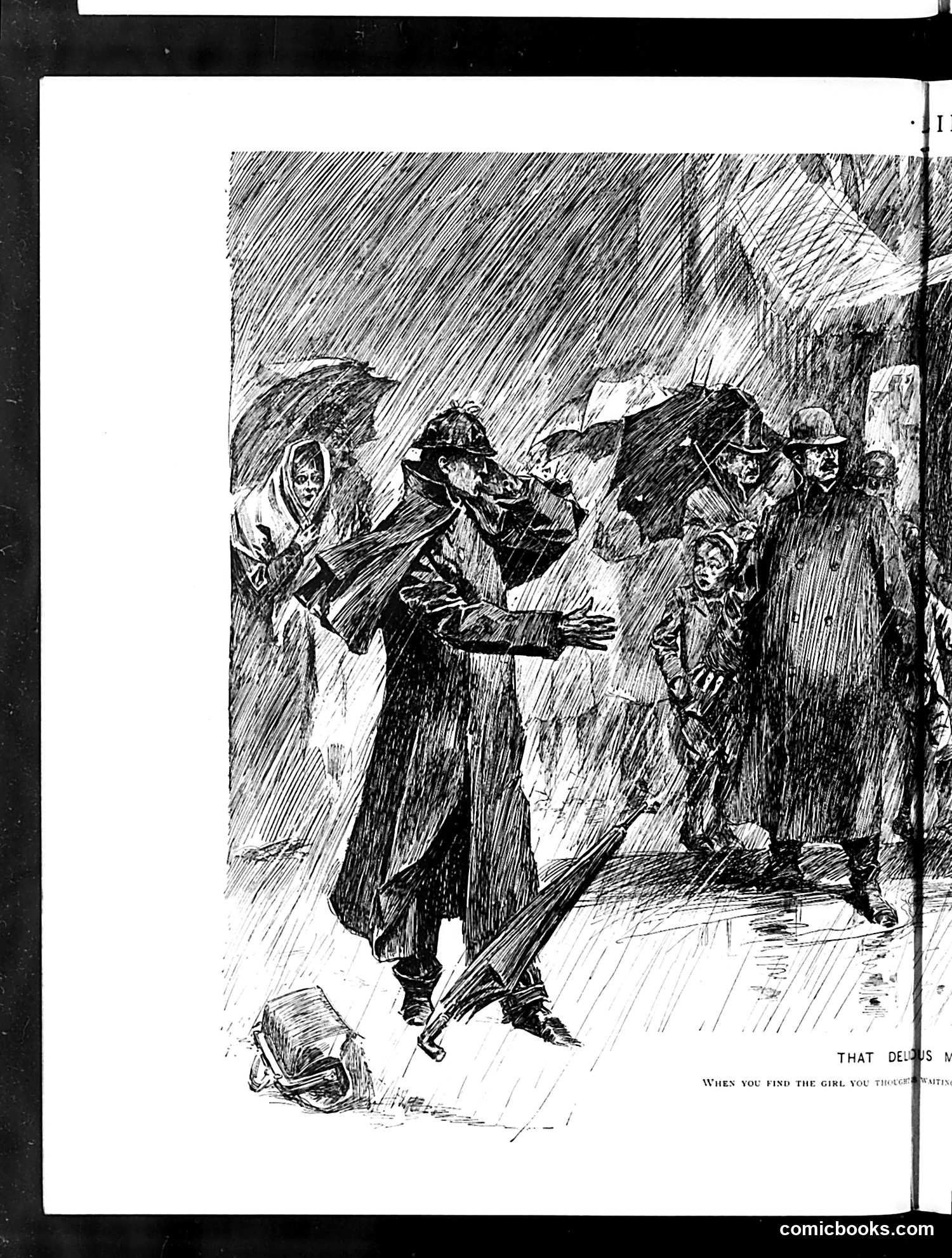
This is a pen-and-ink illustration showing a rainy street scene with a well-dressed man in a top hat and overcoat gesturing dramatically toward a group of poorly-dressed figures huddled in the rain. The caption reads "THAT DELOUS M[...]" and "WHEN YOU FIND THE GIRL YOU THOU[GHT WAITIN[G...]" The cartoon appears to satirize class contrast and romantic disillusionment. The gentleman's animated gesture suggests he's confronting or reacting to the shabby appearance of people he encounters—likely commenting on the gap between romantic idealization and harsh social reality. The incomplete caption suggests he's discovered that the girl he imagined waiting for him is actually part of the impoverished underclass. This reflects early 20th-century Life magazine's satirical commentary on wealth disparities and class-based romantic expectations.
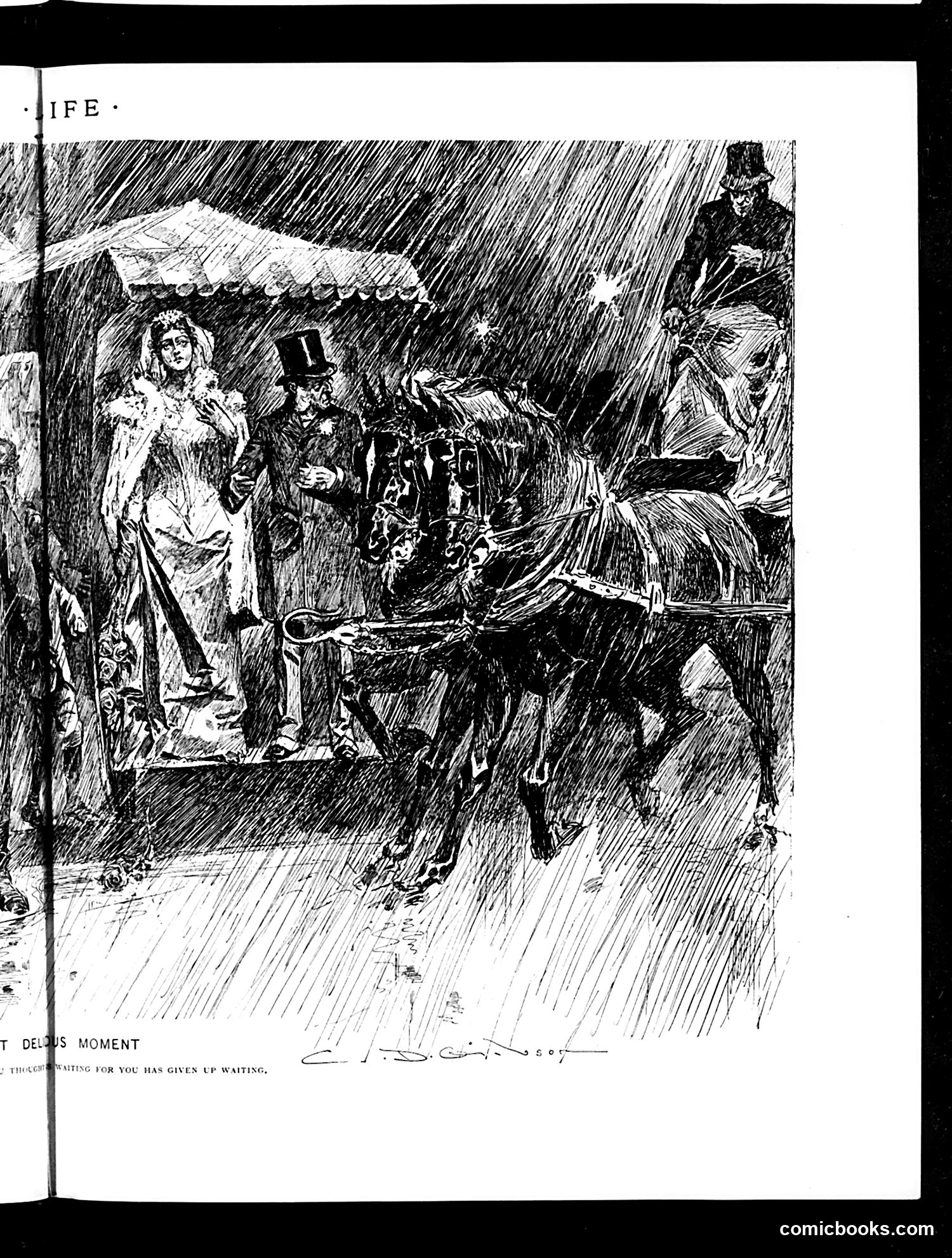
This sketch depicts a rainy street scene with a wealthy couple in a carriage. The caption reads "I THOUGHT WAITING FOR YOU HAS GIVEN UP WAITING" (likely OCR error for "I thought [someone] waiting for you has given up waiting"). The satire appears to concern courtship or romantic etiquette—specifically the social awkwardness when one party abandons their vigil. A fashionably dressed woman under an awning and a man in a top hat observe an elegant carriage departing in heavy rain, while another figure stands in the downpour. The "delicious moment" likely refers to the uncomfortable social comedy of romantic rejection or a suitor's frustration when a woman ceases waiting. It satirizes Victorian-era dating conventions and romantic expectations, though without clearer context, the specific situation remains somewhat unclear.
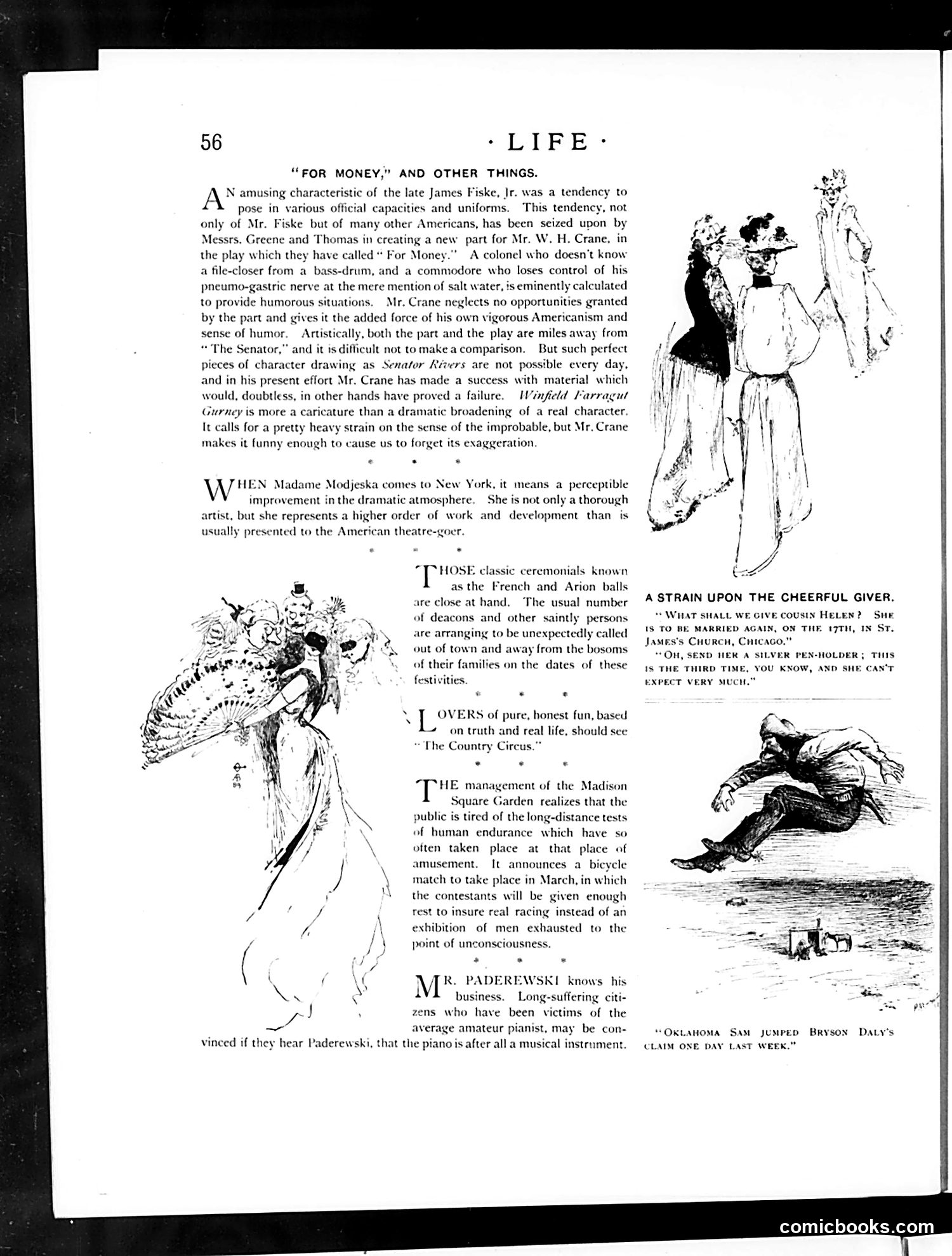
This satirical page from *Life* magazine (circa 1890s) contains theater and social criticism: **Theater Reviews:** The text discusses W. H. Crane's new play "For Money," which satirizes Americans' tendency to pose in official uniforms and capacities—referencing the late Jay Gould (James Fiske, Jr.). The play features absurd characters like a colonel ignorant of military matters and a commodore who panics at salt water. **Social Commentary:** - A joke about French and Arion balls mocks deacons and respectable men who conveniently arrange to be "out of town" during these events, suggesting moral hypocrisy. - The sketch "A Strain Upon the Cheerful Giver" satirizes repeat gift-giving burdens when someone marries multiple times—Cousin Helen's third wedding requires yet another silver pen-holder gift. - References to Madison Square Garden's bicycle endurance tests and pianist Paderewski add cultural context of the era's entertainment trends. The illustrations show period fashion and social types typical of genteel American society.
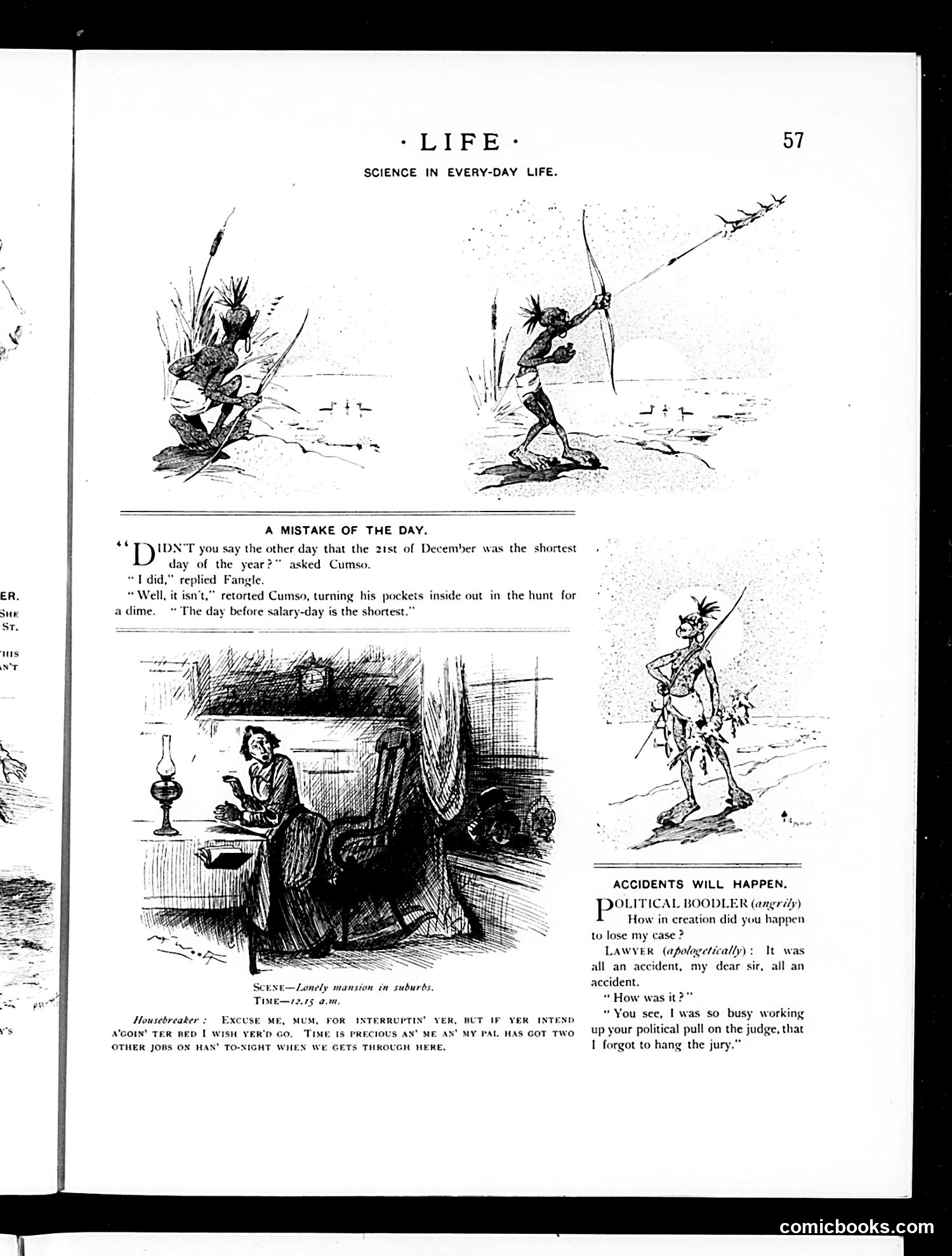
This page contains three satirical pieces mocking everyday folly and corruption: **"A Mistake of the Day"**: Two characters debate whether December 21st is the year's shortest day. The joke hinges on working-class perspective—one character argues the day *before* payday feels shortest because workers are broke, undermining scientific fact with economic reality. **"Accidents Will Happen"**: A corrupt politician scolds his lawyer for losing a case. The lawyer admits he was "so busy working up your political pull on the judge, that I forgot to hang the jury." This exposes judicial corruption: the lawyer was manipulating the judge through political connections rather than presenting the case, and forgot to bribe jurors—treating jury tampering as routine procedure. **"Scene—Lonely Mansion in Suburbs"**: A burglar politely interrupts a homebreaker, explaining they both have multiple jobs lined up that night and time is "precious." This darkly satirizes working-class desperation—even criminals are overworked. The page satirizes how corruption, poverty, and systemic failures pervade ordinary life.
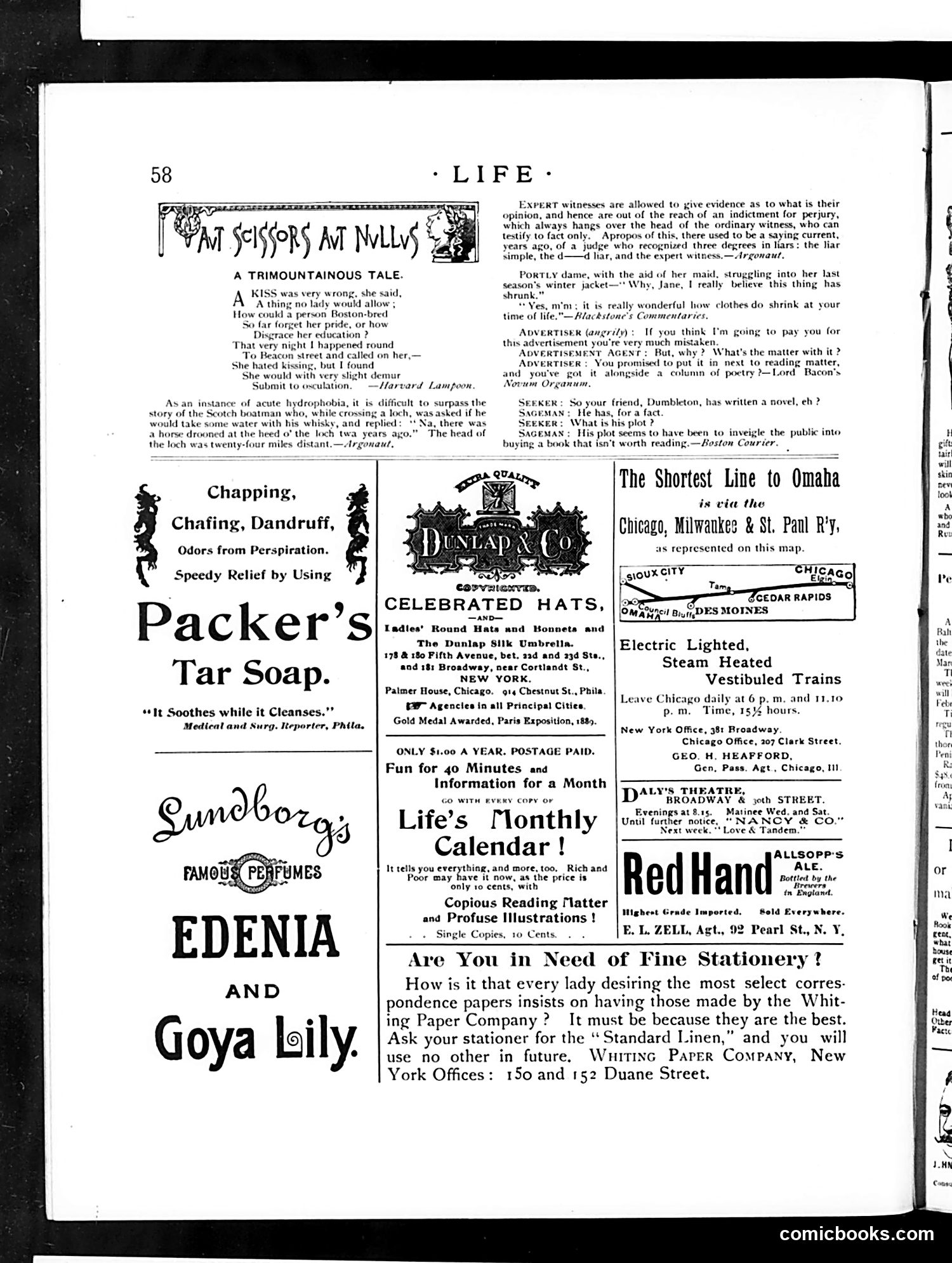
This page is primarily **advertisements interspersed with humorous short pieces**, typical of Life's format during this era. The cartoon/joke content includes: **"A Trimountainous Tale"**: A satirical piece mocking Boston propriety—a supposedly proper Boston lady claims to abhor kissing as unladylike, yet readily accepts "osculation" (kissing) when a suitor visits. The humor targets hypocrisy and pretentious morality. **Anecdotes about dishonesty**: Pieces mock expert witnesses (who can legally give opinions rather than facts, creating perjury loopholes), a Scotch boatman's refusal of water due to a horse corpse in a loch, and an advertiser angry his ad ran next to poetry instead of "reading matter." The page is otherwise dominated by **period advertisements** for Packer's Tar Soap, Dunlap hats, Lundborg perfumes, Life's Monthly Calendar, railroad travel to Omaha, theatrical notices, and stationery companies—all reflecting late 19th-century consumer culture. **Overall**: A satirical magazine page mixing light social mockery with commercial content.
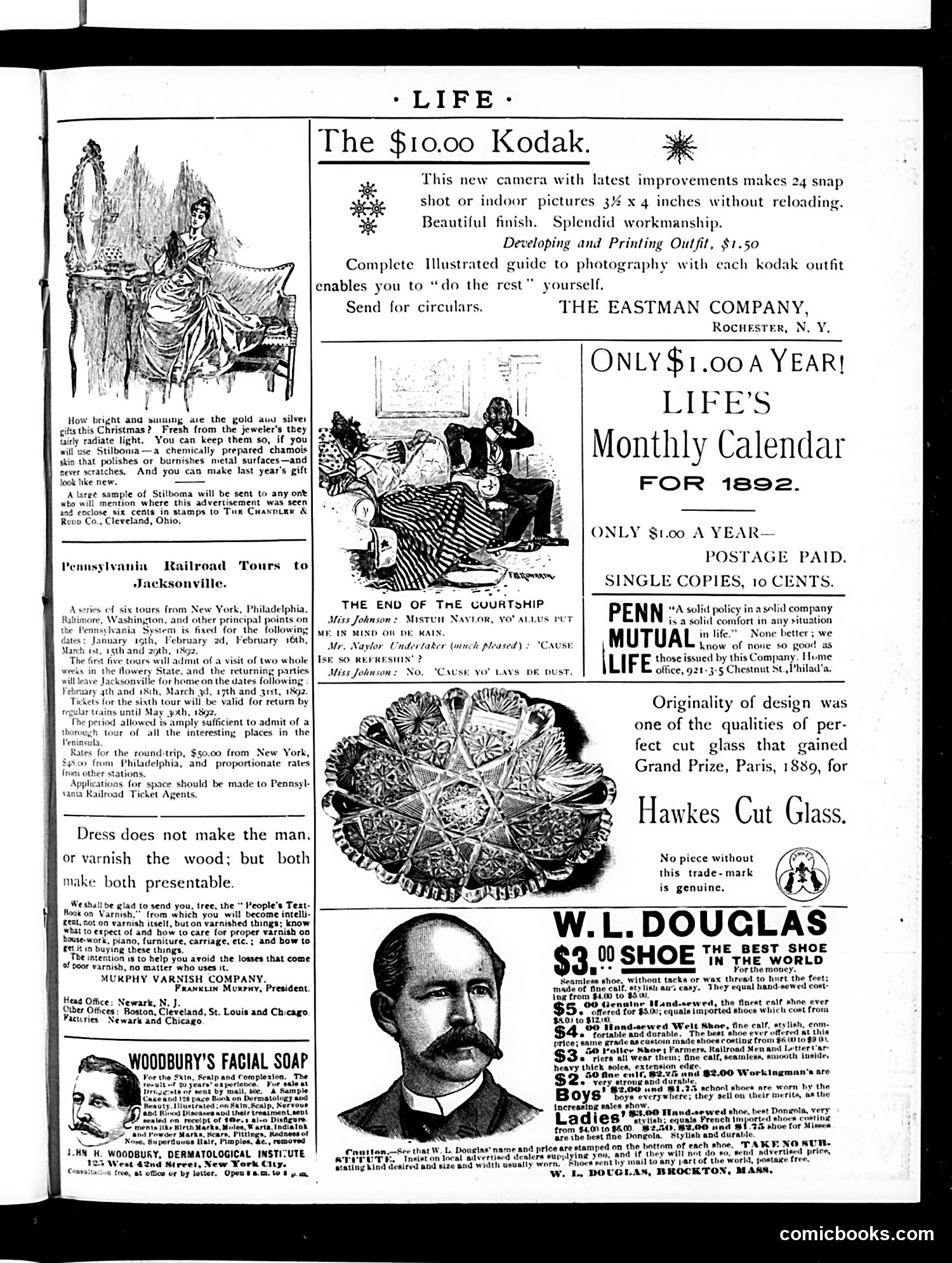
This is primarily an **advertising page** from Life magazine (1892), with one small cartoon labeled "The End of the Courtship." ## The Cartoon The modest illustration depicts a domestic scene with three figures. The text identifies them as Miss Johnson, Mr. Naylor (an undertaker), and another character. The humor appears to rest on a double meaning: Miss Johnson responds to questions about "laying dust" with "No, 'cause it lays de dust"—likely a crude dialect joke playing on the undertaker's profession (dealing with the dead) and dust/dirt references. The cartoon's title suggests the couple's romantic relationship is ending, presumably because the woman finds something objectionable about the man. ## Context The page is dominated by **consumer advertisements** for 1892: Kodak cameras ($10), Eastman Company, Life's Monthly Calendar subscription, Hawkes Cut Glass, W.L. Douglas shoes ($3), Stilboma metal polish, Pennsylvania Railroad tours, and various other products. These ads reveal what middle-class Americans purchased and valued during the Gilded Age. The cartoon itself is minor—Life primarily functioned as a vehicle for advertising rather than satirical commentary on this particular page.
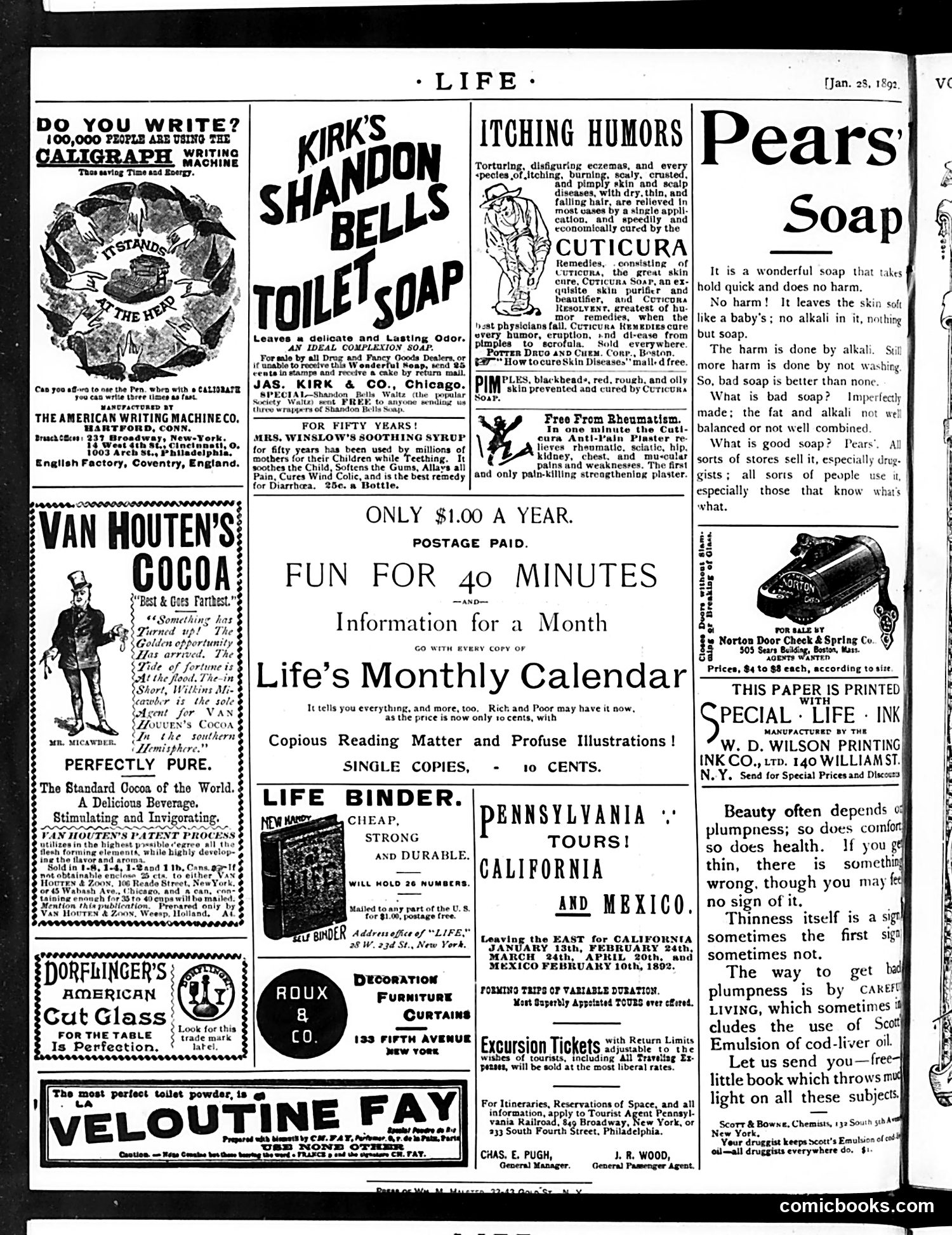
This is primarily an **advertising page** with minimal editorial content. The page showcases patent medicines and consumer products typical of the 1890s, reflecting the era's unregulated pharmaceutical marketing. Notable advertisements include: - **Mrs. Winslow's Soothing Syrup**: marketed for fifty years as a teething remedy for infants (now known to contain dangerous substances) - **Cuticura remedies**: promoted for skin conditions and "humors" (reflecting outdated medical theory) - **Van Houten's Cocoa**: positioned as "perfectly pure" and featuring a Dickens reference (Micawber) - **Kirk's Shandon Bells Toilet Soap** and **Pears' Soap**: luxury soap brands - **Veloutine**: a cosmetic powder marketed as the "most perfect toilet powder" The page also advertises **Life's Monthly Calendar** ($1/year) and travel tours to California and Mexico. **Modern context**: These ads reveal how 1890s consumers trusted unproven remedies, relied on brand prestige over safety regulation, and how marketing exploited parental anxieties about child health.