
A complete issue · 15 pages · 1891
Life — November 12, 1891
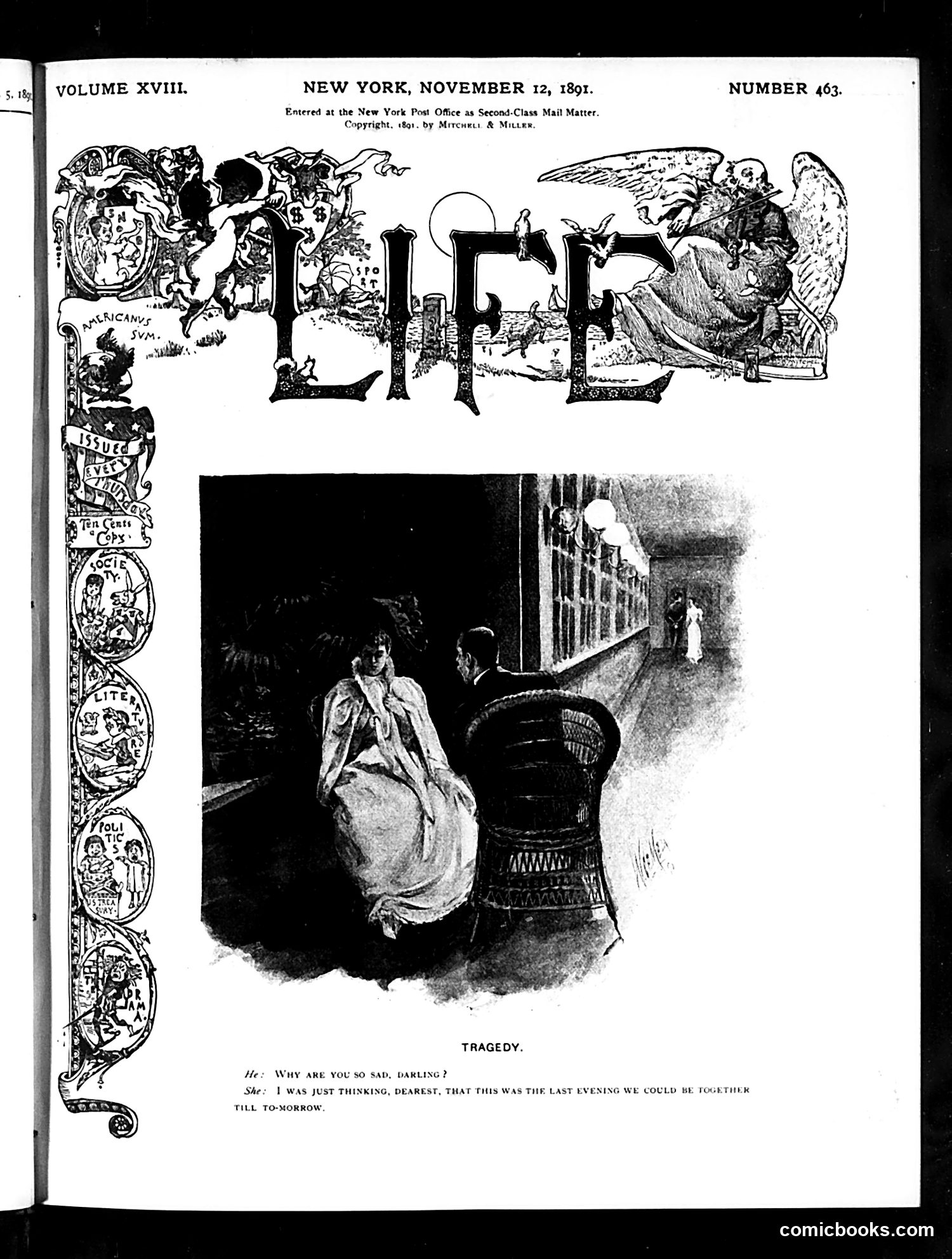
This page features a sketch titled "Tragedy" depicting an intimate domestic scene. A woman in a light dress sits beside a man in a wicker chair, in what appears to be a dimly lit interior. The dialogue reveals the poignant moment: she expresses sadness because she realizes this is their last evening together before tomorrow's separation. The sketch satirizes sentimental melodrama common in 1890s popular culture—the exaggerated emotional display of romantic parting. The ornate decorative border and elaborate "LIFE" header reflect the magazine's sophisticated design aesthetic. Without additional context about specific political figures or contemporary events referenced in the imagery, the primary humor appears directed at the overwrought sentimentality of period romance narratives rather than specific current affairs.
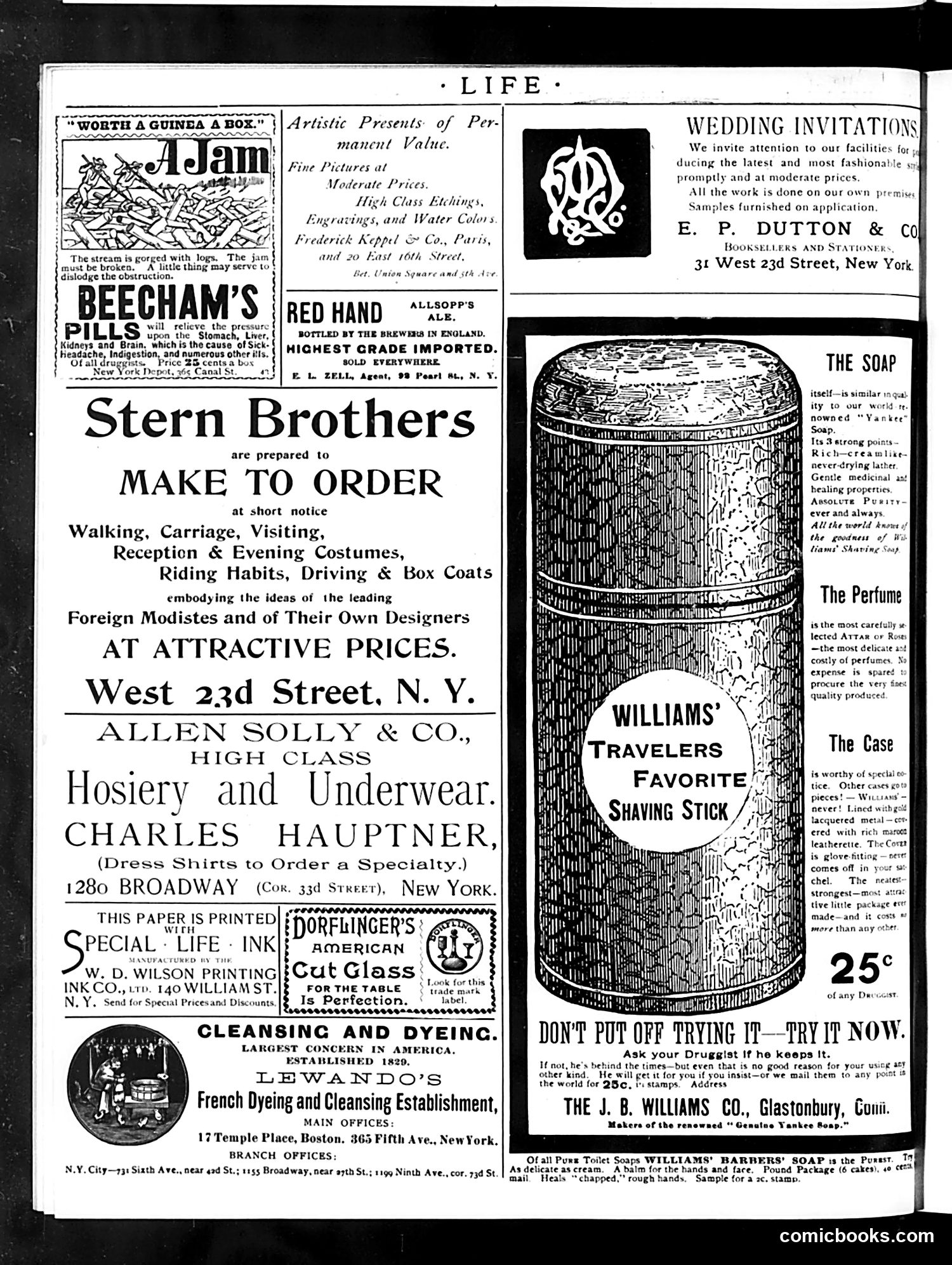
This page is **primarily advertising**, not satirical content. It contains commercial advertisements for various products and services typical of early 20th-century America: - **Beecham's Pills** (patent medicine for kidney/brain ailments) - **Stern Brothers** (custom clothing) - **Allen Solly & Co.** (hosiery and underwear) - **Dorfflinger's Cut Glass** (tableware) - **Lewando's** (French dry cleaning service) - **Williams' Travelers Favorite Shaving Stick** (prominently featured with large product illustration) - **E.P. Dutton & Co.** (wedding invitations) There are no political cartoons or satirical commentary visible. The page demonstrates how *Life* magazine, while known for satire, also relied heavily on paid advertisements to fund publication. The ads reflect consumer goods and services marketed to middle and upper-class readers of that era.
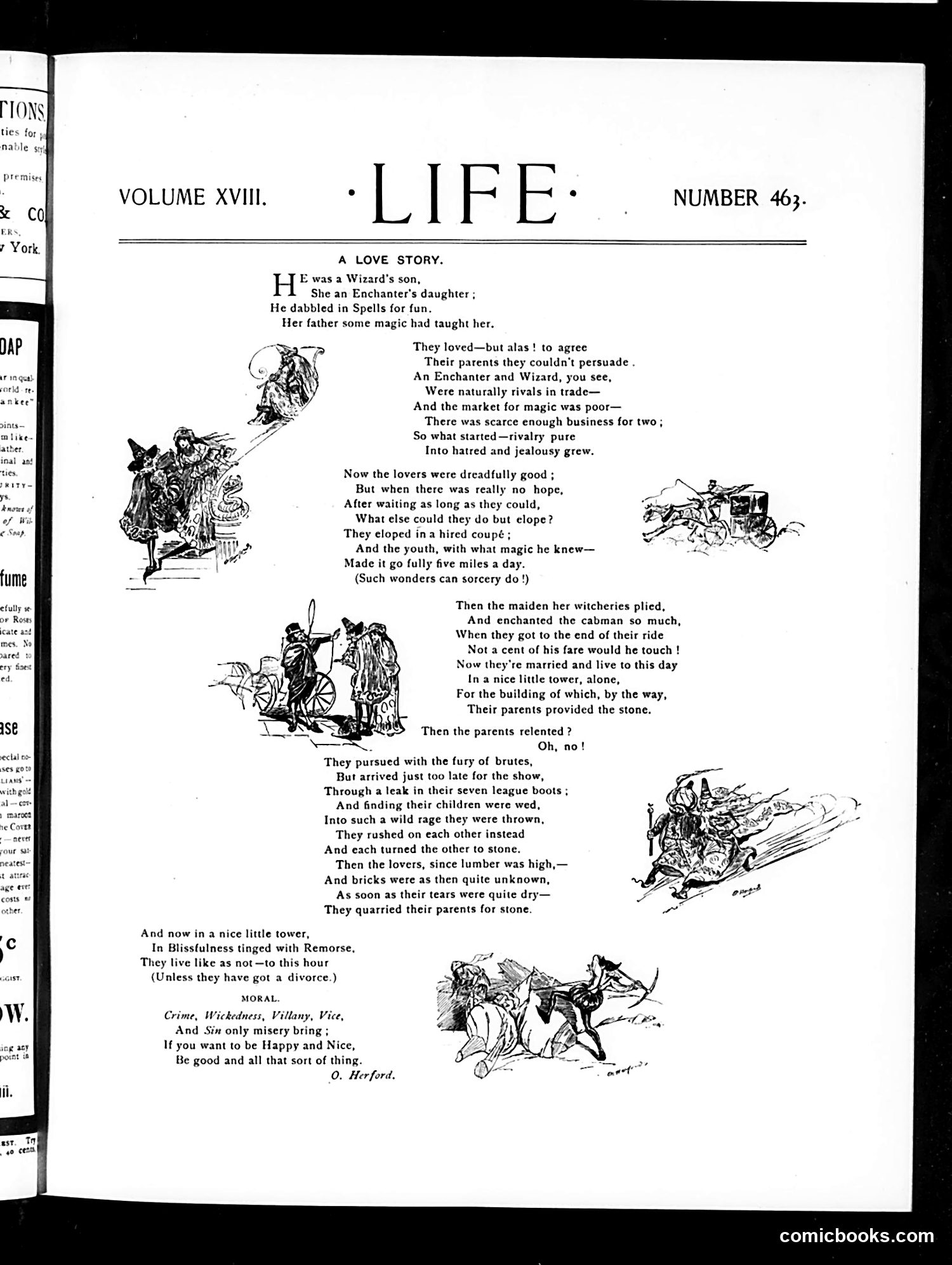
This is a humorous poem illustrated with whimsical sketches about a romance between a Wizard's son and an Enchanter's daughter. The satire isn't political but rather social—it mocks professional rivalry and class conflict. The joke: their parents are magical trade competitors ("An Enchanter and Wizard, you see, / Were naturally rivals in trade"). When the young couple elopes, the parents pursue them in magical fury, eventually turning both lovers to stone in their rage. The moral at the end—advising against "Crime, Wickedness, Villany, Vice"—is delivered ironically, as the parents' destructive behavior contradicts such virtuous advice. This is lighthearted fantasy satire rather than political commentary, typical of *Life* magazine's entertainment content.
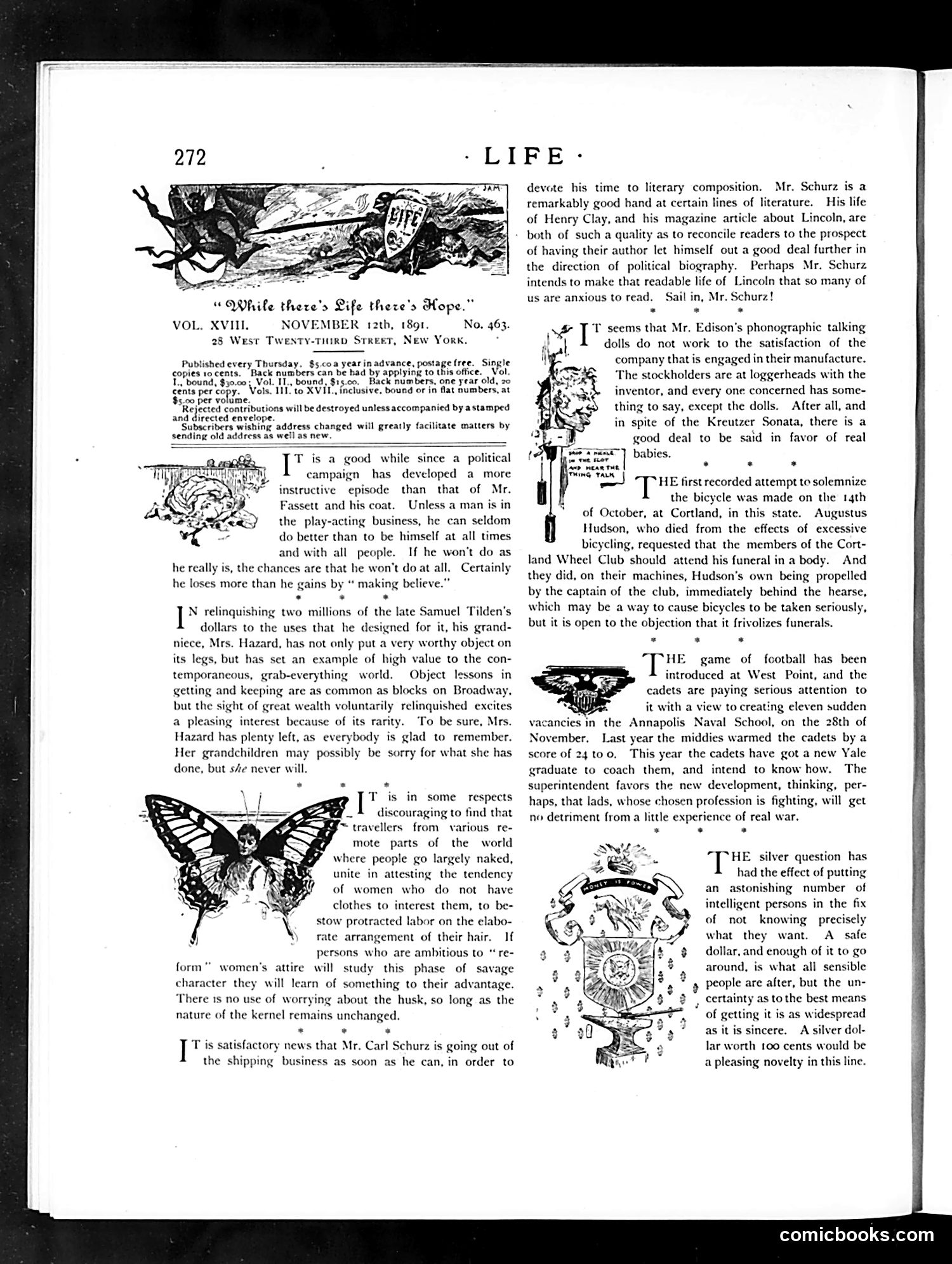
This page contains multiple brief satirical commentary items rather than a single unified cartoon. The visible illustrations include a butterfly and what appears to be a dead or sleeping figure labeled "While there's Life there's Hope," likely a general memento mori joke about mortality. The text discusses: - **Edison's phonographic dolls**: Stockholders and the inventor are dissatisfied with the talking dolls' commercial performance - **Political campaigns**: Commentary on Mr. Fassett's campaign style - **Samuel Tilden's estate**: His grandniece Mrs. Hazard donating his wealth to charity - **Bicycling at West Point**: A cadet's funeral procession on bicycles - **Football at West Point**: Introduction of the sport; cadets receiving coaching from Yale graduates - **The silver question**: Monetary policy debate affecting "intelligent persons" The page reflects 1880s-era American concerns: new technology, wealth philanthropy, and political/economic debates.
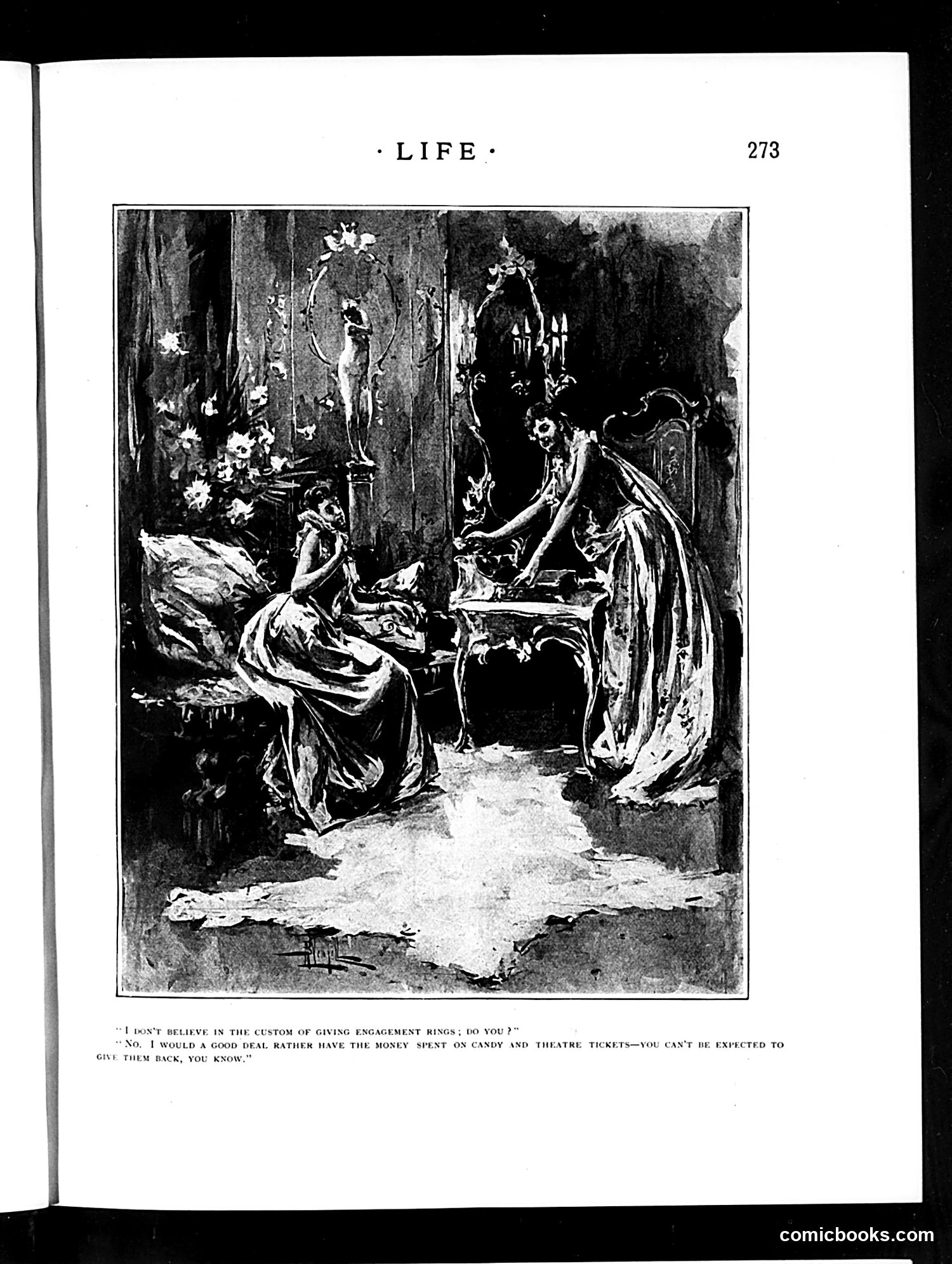
This illustration satirizes attitudes toward engagement rings and marriage customs among the wealthy. The scene depicts two elegantly dressed women in an ornate interior, with one seated at a vanity or desk. The dialogue mocks the practicality of modern women: one woman dismisses engagement ring tradition, saying she'd prefer money spent on "candy and theatre tickets" instead—luxuries she cannot reclaim if the engagement breaks. The satire targets both outdated romantic customs and the economic realities facing women of means, who would rather enjoy immediate pleasures than symbolic jewelry they might lose. This reflects early 20th-century debates about marriage, consumerism, and changing women's expectations regarding courtship and material goods.
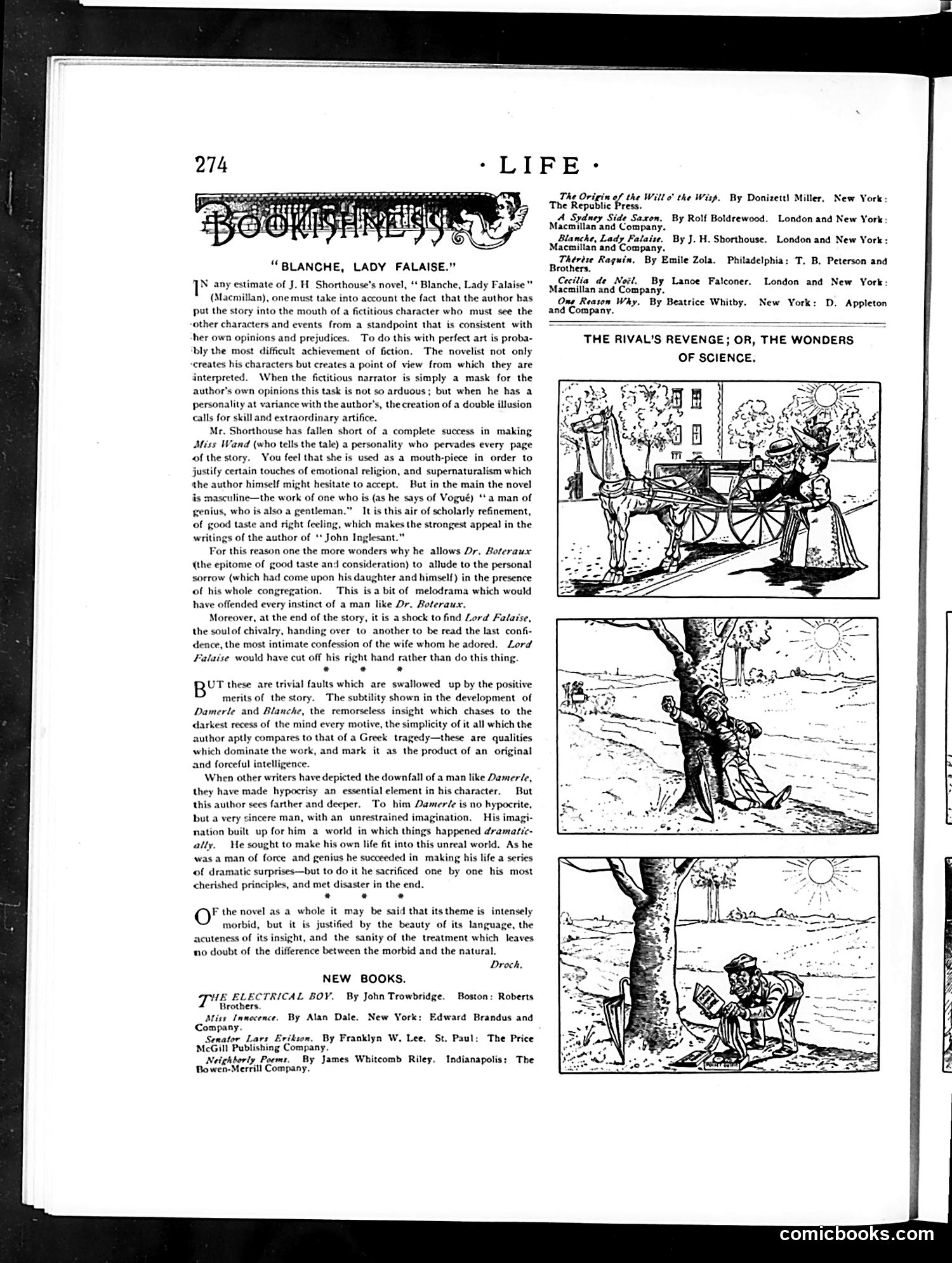
This page features a book review of J.H. Shorthouses' novel "Blanche, Lady Falaise" and includes three illustrations for what appears to be a serialized story titled "The Rival's Revenge; Or, The Wonders of Science." The three wood-cut style illustrations depict dramatic scenes: a figure apparently conducting some kind of scientific experiment or apparatus in a garden setting, another scene showing figures in an outdoor landscape, and a third showing what appears to be a confrontation or action scene near water. Without additional context identifying the story's plot, characters, or publication details, the specific satirical meaning remains unclear. The illustrations suggest this is likely a melodramatic scientific romance or revenge narrative typical of late-19th-century popular fiction.
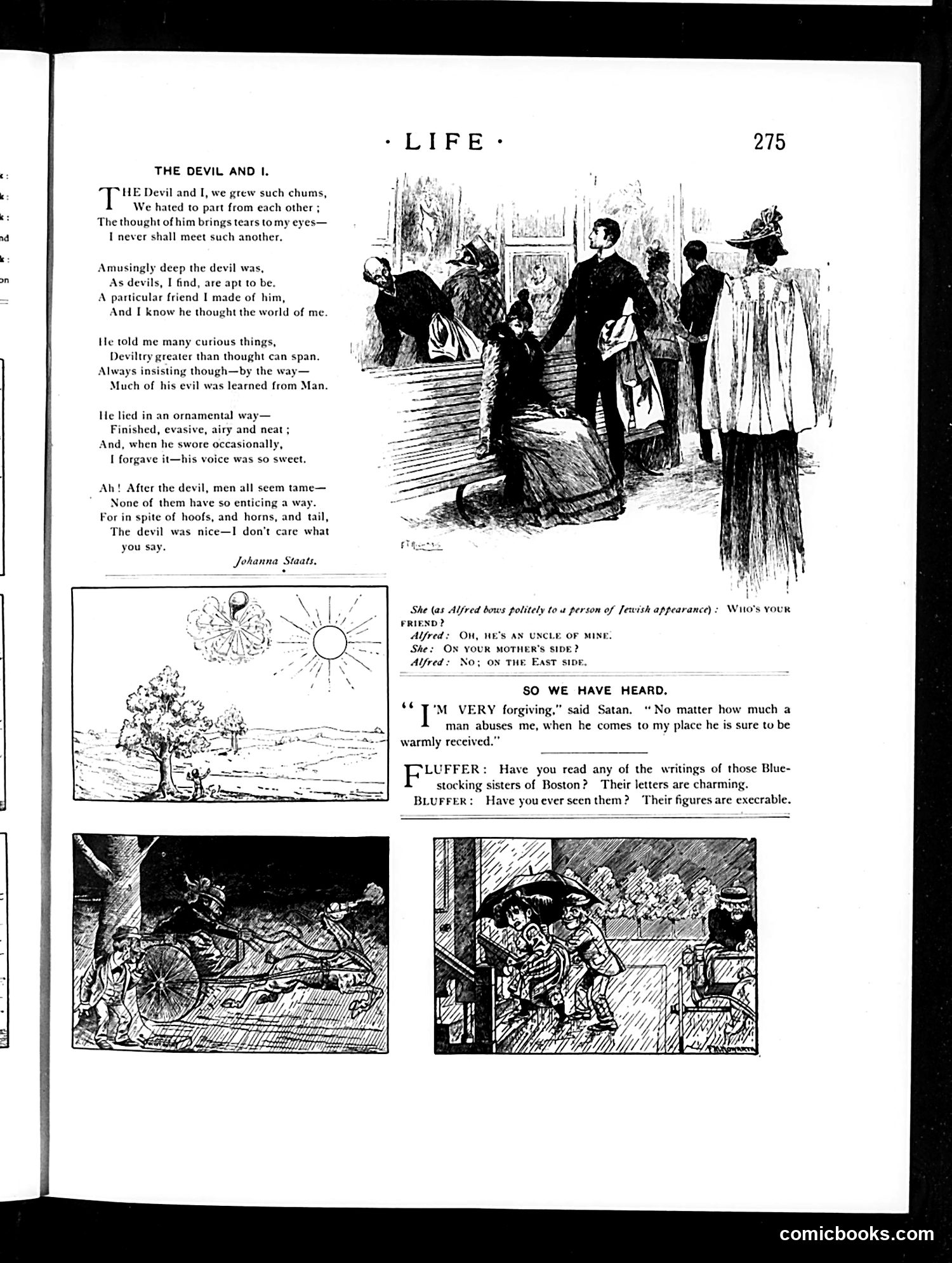
This page contains a poem titled "The Devil and I" by Johanna Staats, which presents a first-person reflection on a relationship with "the devil"—likely a metaphorical critique of a charismatic but morally compromised man. The accompanying illustrations appear to depict social or domestic scenes with period clothing (appearing to be late 19th or early 20th century). The lower section includes a dialogue labeled "So We Have Heard," featuring satirical commentary on Satan's supposed forgiveness toward sinners, followed by a conversation between characters named "Fluffer" and "Bluffer" mocking Boston's literary circles, specifically referencing "Blue-stocking sisters"—educated or intellectual women, often satirized in period humor. The cartoons illustrate demonic or chaotic scenes, reinforcing the satirical tone about moral corruption and social pretension.
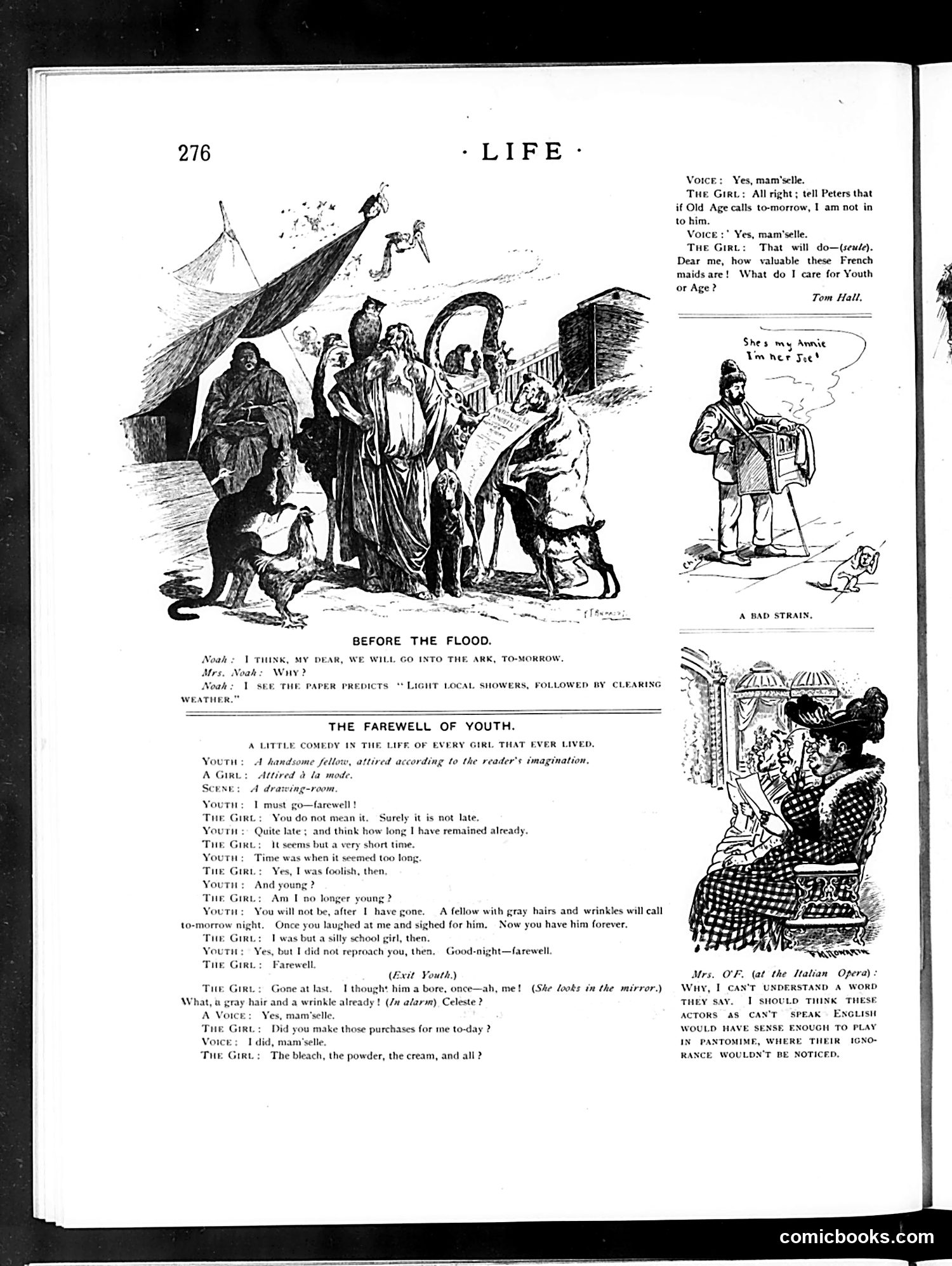
This page contains several satirical sketches and dialogues typical of Life's humor format: **"Before the Flood"** depicts Noah preparing his ark while figures debate weather predictions—satirizing contemporary uncertainty about forecasts. **"The Farewell of Youth"** is a sentimental dialogue between a young man and girl parting ways, with the girl noting he'll "have a fellow with gray hairs and wrinkles" by tomorrow. It mocks romantic melodrama and the passage of time. **"A Bad Strain"** shows a street vendor hawking newspapers, likely commenting on sensationalism. **The Italian Opera critique** (bottom right) expresses frustration that foreign actors perform without understanding English dialogue, criticizing pantomime performances where "ignorance wouldn't be noticed." The page reflects Life's typical blend of social commentary, romantic satire, and cultural criticism through illustrated vignettes.
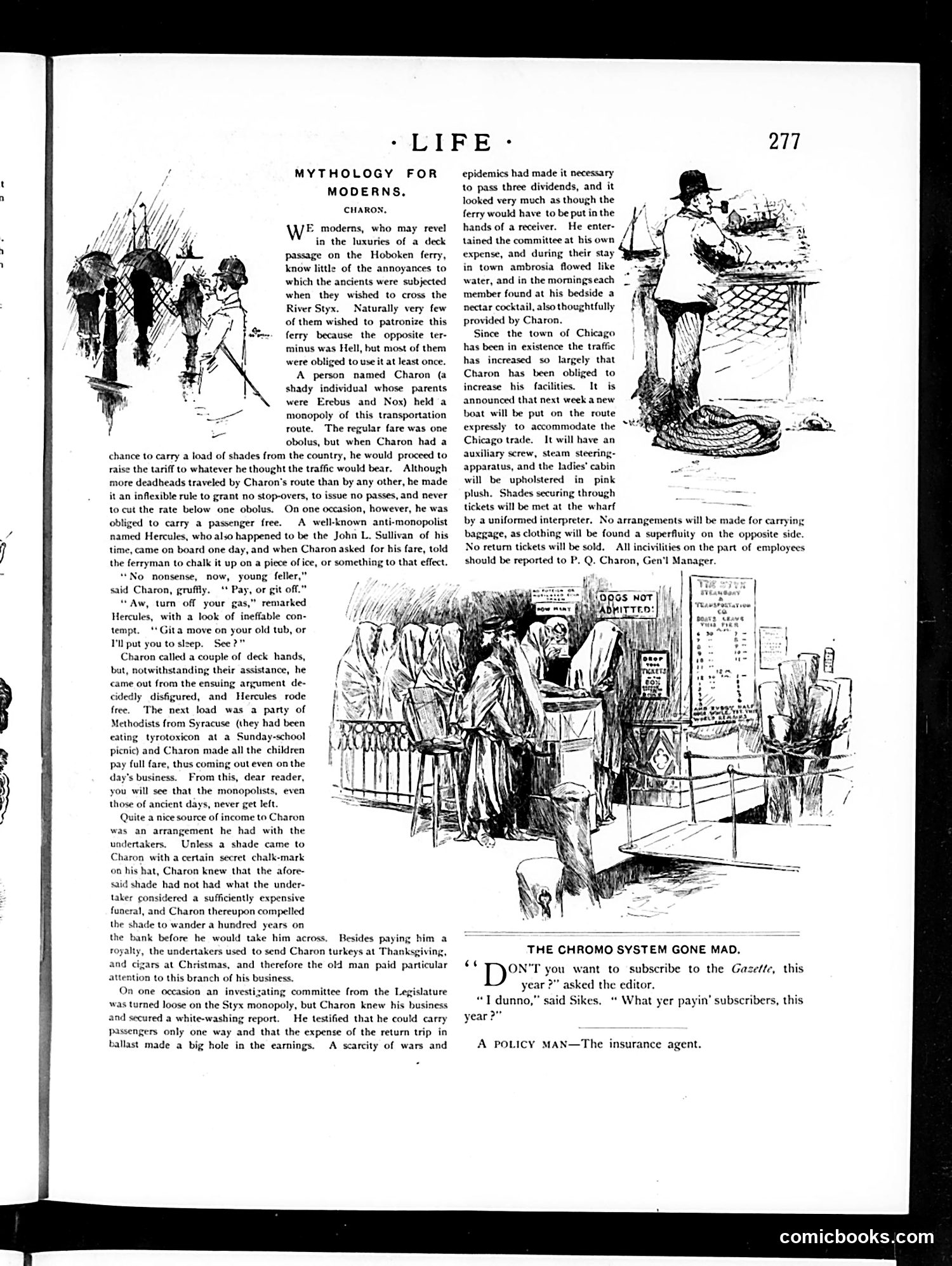
This satire humorously updates the Greek mythological ferryman Charon (who transported souls across the River Styx) as a modern New Jersey ferry operator on the Hoboken line. The piece jokes that Charon operates like a typical monopolistic businessman—charging high fares, refusing to issue passes, and ruthlessly maximizing profit from passengers with no alternatives. The humor lies in applying classical mythology to contemporary American capitalism and transportation monopolies. A subplot mocks a Legislative committee's failed attempt to regulate Charon through a white-washing report, suggesting bureaucratic corruption. The bottom cartoon titled "The Chromo System Gone Mad" appears to reference magazine subscription sales practices, likely satirizing aggressive sales tactics of the era.
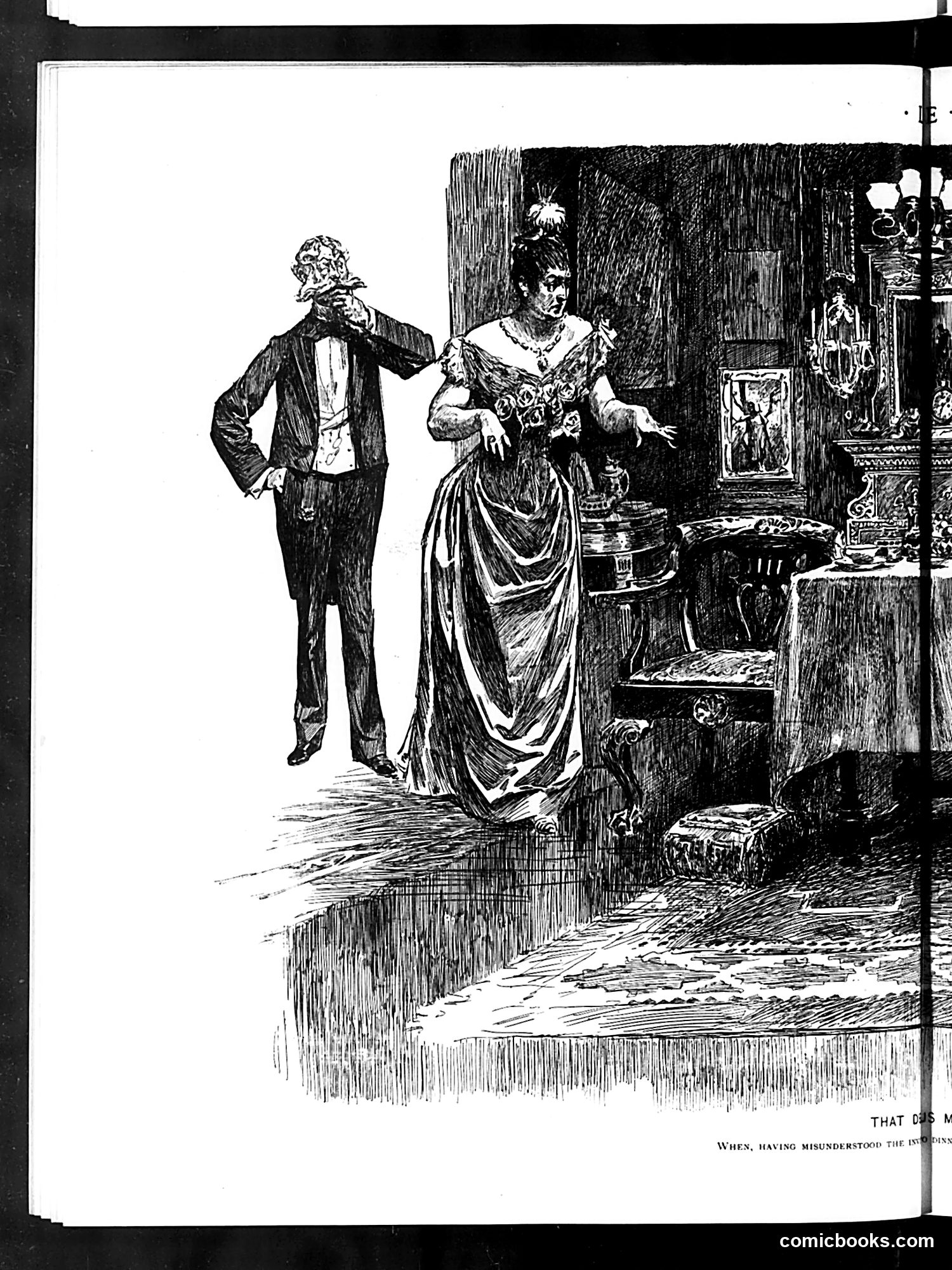
This appears to be a Victorian-era social satire illustration from *Life* magazine. The image shows an elegant interior scene with a well-dressed man in formal attire observing a woman in an elaborate ball gown being attended to. The partially visible caption reads: "WHEN, HAVING MISUNDERSTOOD THE INSTRUCTIONS..." The joke likely satirizes social miscommunication or misunderstanding between upper-class figures—possibly commenting on romantic misadventure, social pretension, or domestic confusion. The detailed rendering of luxurious furnishings and fashionable dress suggests this mocks the affectations of wealthy society. Without the complete caption, the specific target of the satire remains unclear, though the setup implies humorous consequences resulting from misinterpreted directions or expectations in polite society.
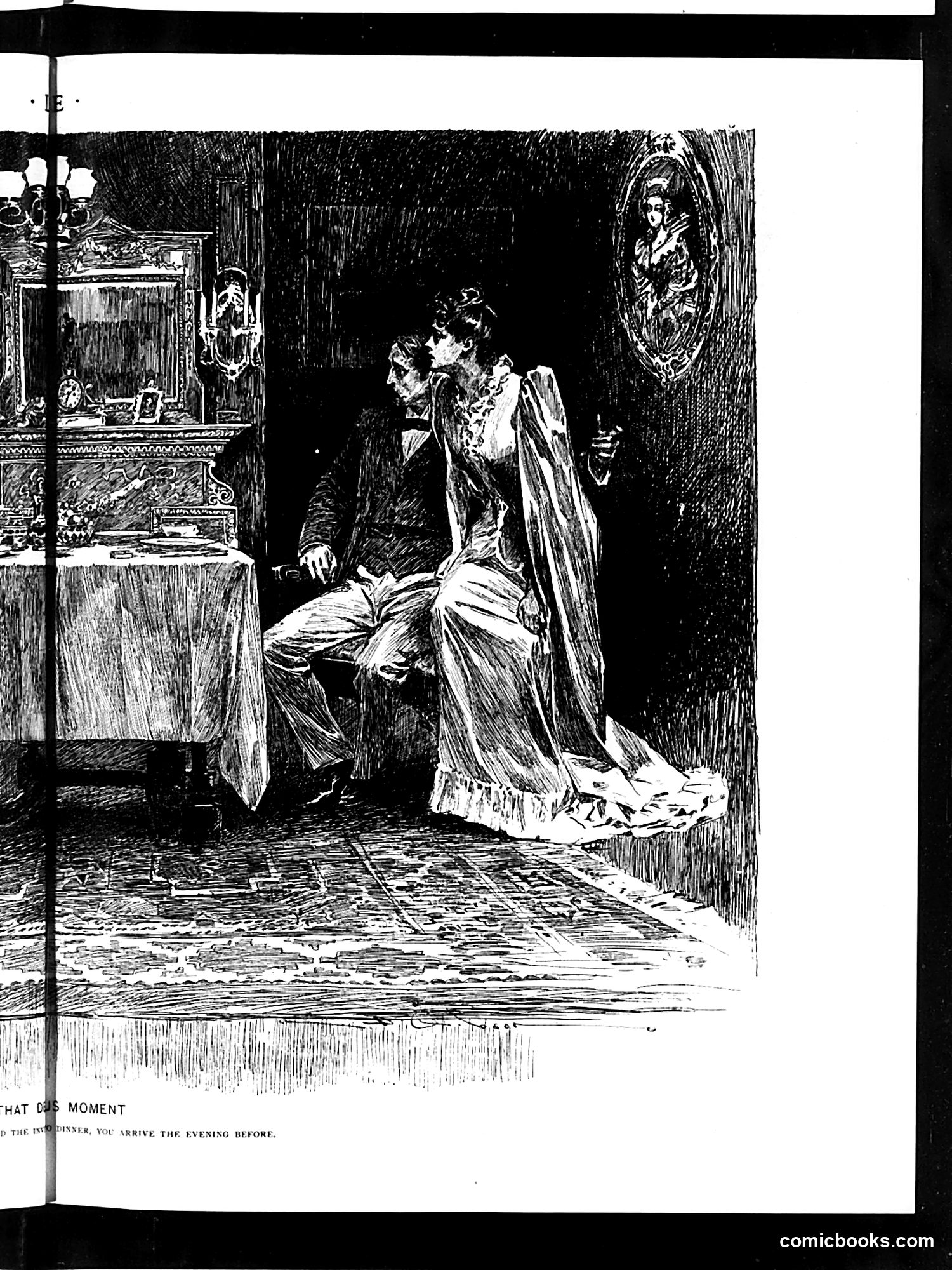
This is a sketch illustrating a romantic or dramatic scene between two elegantly dressed figures in what appears to be a wealthy interior. The man wears dark formal attire while the woman reclines in an elaborate gown with flowing drapery. The setting includes ornate furniture and a portrait on the wall. The visible caption fragment reads "...THAT ONE MOMENT" and references "...D THE INSTANT YOU ARRIVE THE EVENING BEFORE," suggesting this depicts a pivotal romantic or theatrical moment from a narrative. Without the complete text or publication date visible, the specific satirical point remains unclear. However, the style suggests this is likely illustrating a romantic scene meant to comment on upper-class courtship rituals or theatrical melodrama—common subjects for *Life* magazine's satirical treatment of wealthy society.
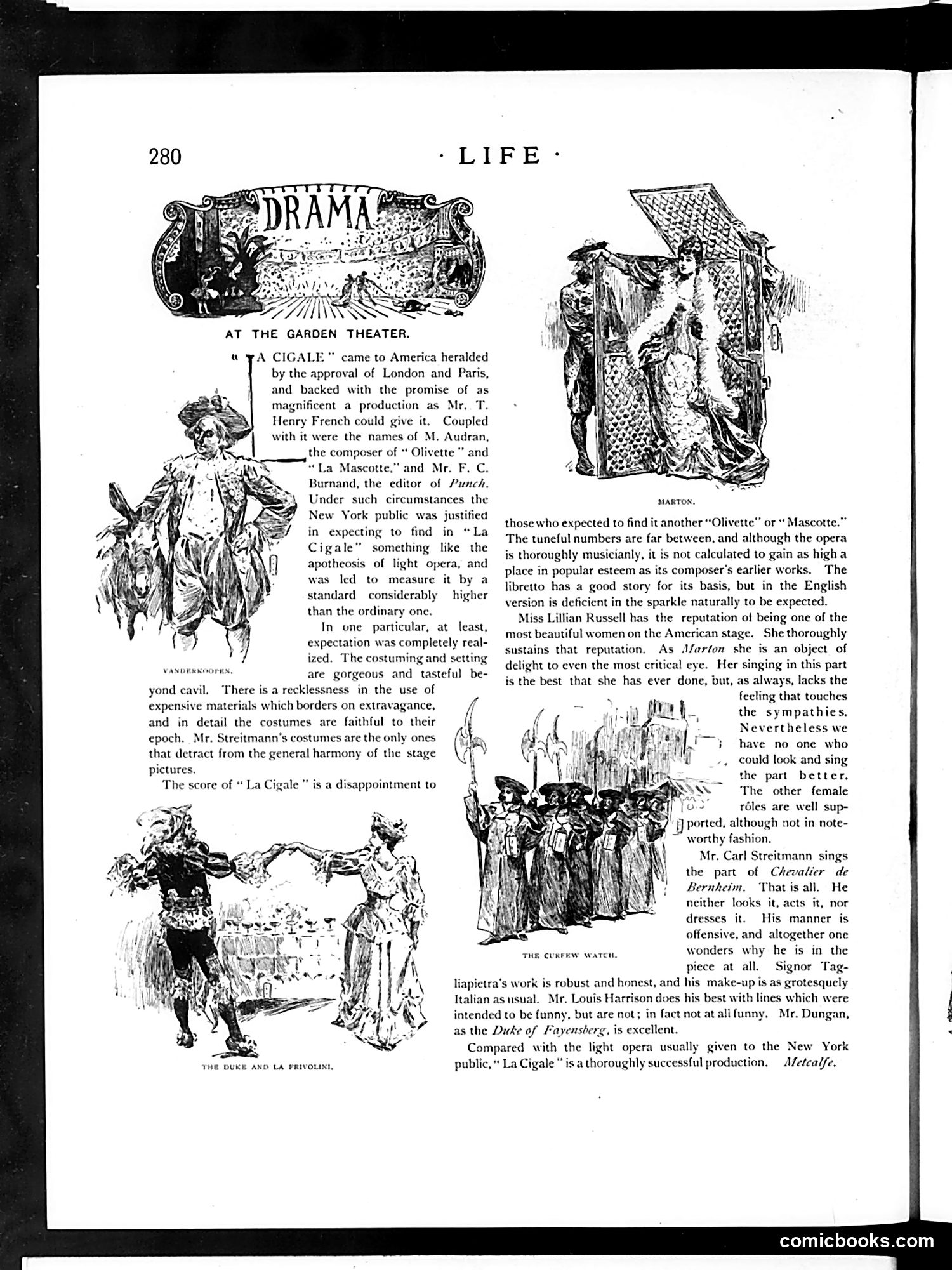
This is a theater review of the opera *La Cigale*, which premiered at New York's Garden Theater with considerable fanfare—backed by prominent European composers and the editor of *Punch* magazine. The accompanying illustrations show scenes from the production. The critic praises the costumes and settings as "gorgeous and tasteful," highlighting their expensive attention to historical detail. However, the musical score disappoints—the tuneful numbers are sparse, and it doesn't match the composer's earlier successes like *Olivette*. The review gives mixed marks to the cast: Miss Lillian Russell, playing Marton, earns praise for her beauty and performance, though the critic notes she lacks emotional depth. Carl Streitmann, playing the Chevalier, receives harsh criticism—appearing miscast, poorly dressed, and offensive in manner. Other performers receive qualified approval. Overall, despite these flaws, the production is deemed "thoroughly successful" compared to typical New York light opera offerings.
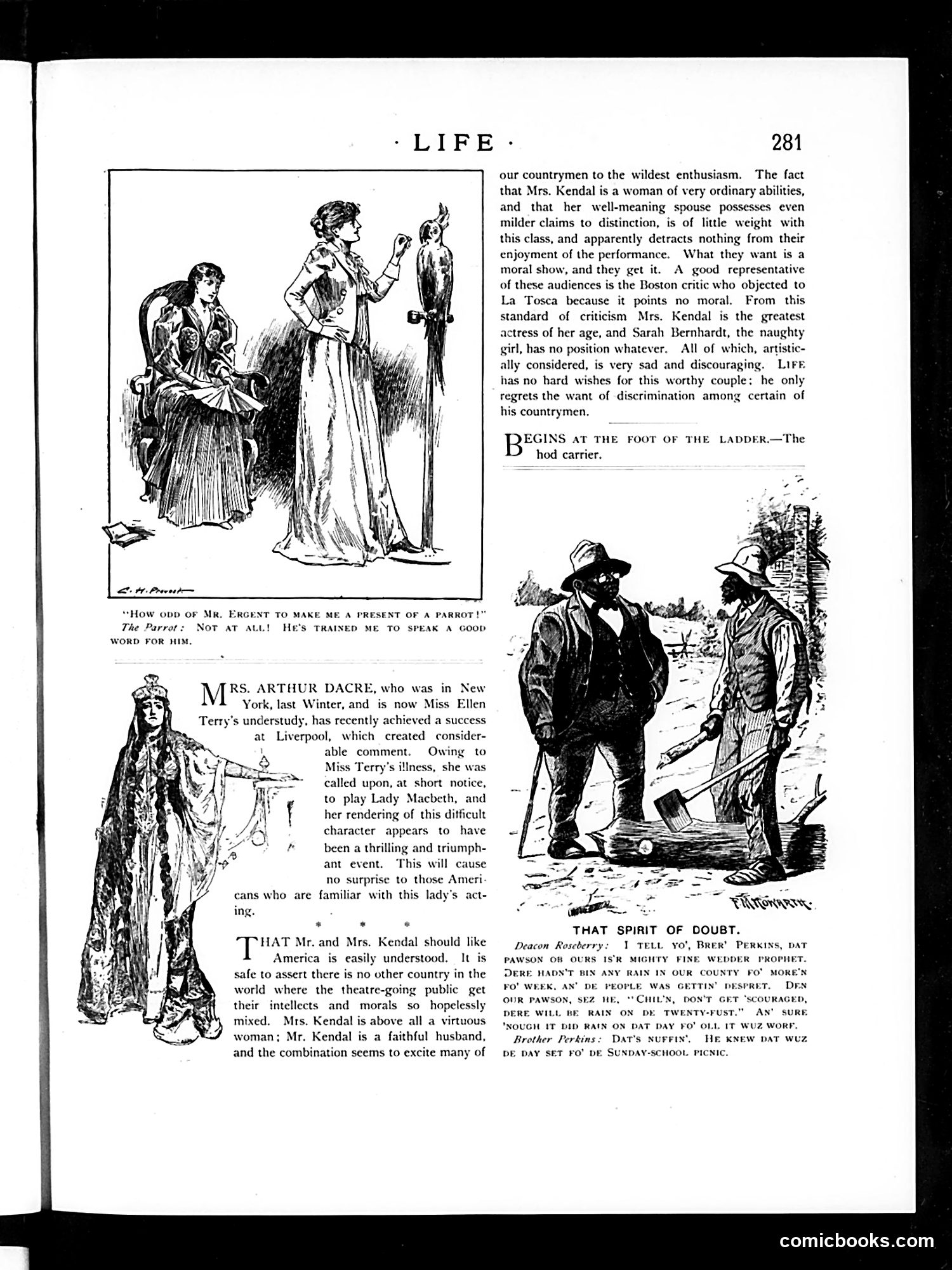
This page contains social commentary on American theatrical tastes and entertainment culture, circa late 19th century. **Upper cartoon**: Depicts a woman presenting a parrot to another woman, with the caption suggesting the parrot has been "trained" to speak well. This satirizes superficial gift-giving and pretense among the wealthy. **Main article**: Critiques American audiences' obsession with moral virtue in performers. The text attacks the popularity of Mr. and Mrs. Kendal—described as "ordinary" talents whose appeal rests entirely on their reputation for marital fidelity and moral respectability, not artistic merit. Life contrasts this with Sarah Bernhardt's superior talent but lower status due to her "naughty" personal life. The piece mocks Boston critics who rejected *La Tosca* for lacking moral instruction, arguing Americans confuse entertainment with moral instruction. **Lower cartoon**: Depicts African American characters (in period dialect) discussing a pastor's successful weather prediction—which succeeds only because he coincidentally chose the date of the church picnic, when rain would naturally cancel it. Satirizes false prophets and superstitious thinking.
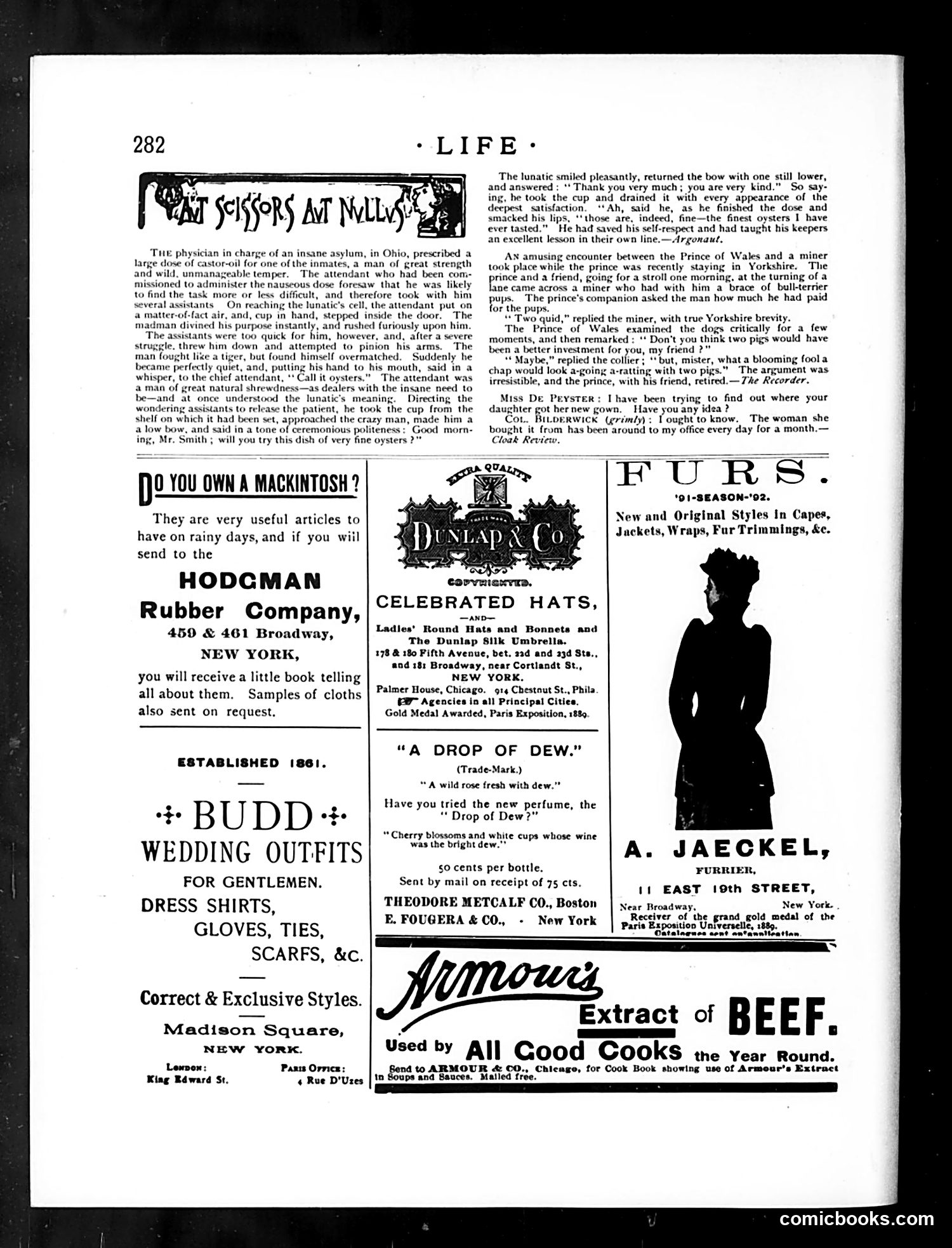
The main cartoon story titled "Clever Scissors at Millville" depicts an asylum attendant administering castor oil to a violent patient by cleverly reframing it as "oysters." When the patient requests it be called oysters, the attendant complies—by using respectful language and polite ceremony rather than force—the patient cooperates willingly. The satire comments on Victorian institutional psychology: dignity and psychological manipulation work better than brute force with patients. Below are two other humorous anecdotes: one about the Prince of Wales's witty exchange with a Yorkshire miner about bull-terrier pups, and a brief social comedy about a woman repeatedly visiting a man's office demanding payment for a dress. The rest of the page consists entirely of period advertisements for mackintoshes, formal wear, hats, perfume, and beef extract—typical late-Victorian commercial notices rather than editorial content.

I can see this is a page from Life magazine, but the image is almost entirely black or blank, making it impossible to discern any cartoon content, text, figures, or satirical commentary. The only clearly visible element is "comicbooks.com" at the bottom right corner and what appears to be a white edge on the left side of the page. Without being able to see the actual cartoon(s) or read the OCR'd text clearly, I cannot identify any figures, political references, or explain the satire intended. The page may be a scan quality issue, or this may be a blank/title page from the publication. I cannot responsibly speculate about content I cannot see.