
Life, 1891-11-12 · page 12 of 15
Life — November 12, 1891 — page 12: what you’re looking at
What you’re looking at
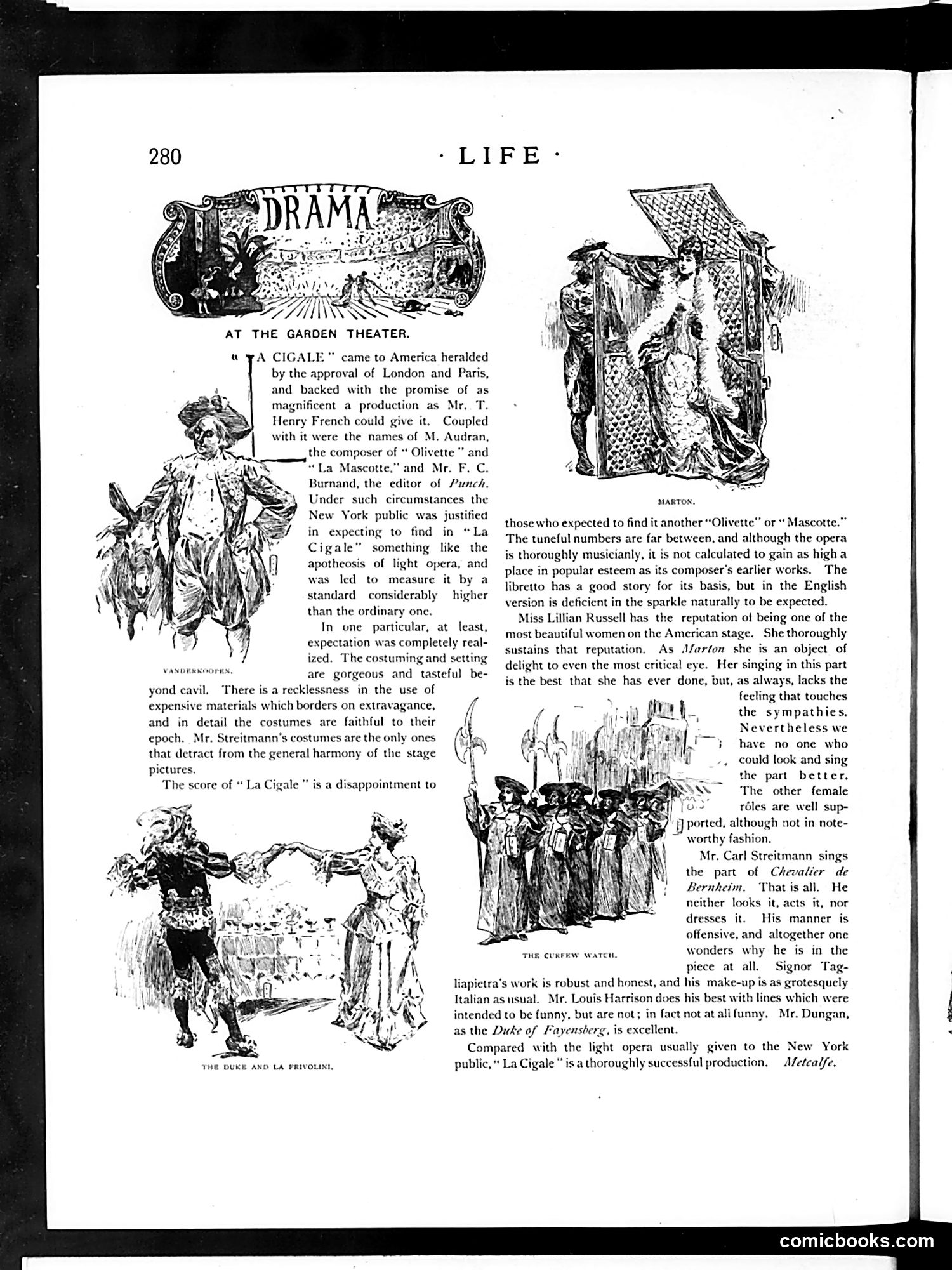
This is a theater review of the opera *La Cigale*, which premiered at New York's Garden Theater with considerable fanfare—backed by prominent European composers and the editor of *Punch* magazine. The accompanying illustrations show scenes from the production. The critic praises the costumes and settings as "gorgeous and tasteful," highlighting their expensive attention to historical detail. However, the musical score disappoints—the tuneful numbers are sparse, and it doesn't match the composer's earlier successes like *Olivette*. The review gives mixed marks to the cast: Miss Lillian Russell, playing Marton, earns praise for her beauty and performance, though the critic notes she lacks emotional depth. Carl Streitmann, playing the Chevalier, receives harsh criticism—appearing miscast, poorly dressed, and offensive in manner. Other performers receive qualified approval. Overall, despite these flaws, the production is deemed "thoroughly successful" compared to typical New York light opera offerings.
📄 Transcribed text from this page (OCR, searchable)
Machine-transcribed from the original scan — historical spelling and the odd misread are preserved.
AT THE GARDEN THEATER. A CIGAL came to America heralded by the approval of London and Paris, and backed with the promise of as magnificent a production as Mr. T. Henry French could give it. Coupled with it were the names of M. Audran, the composer of ** Olivette " and “La Mascotte,” and Mr. F. C. Burnand, the editor of Punch. Under such circumstances the New York public was justified in expecting to find in “La Cigale” something like the apotheosis of light opera, and was led to measure it by a higher standard considerably than the ordina In one particular, at least, expectation was completely real- ized. The costuming and setting are gorgeous and tasteful be- yond cavil. ‘There is a recklessness in the use of expensive materials which borders on extravagance, and in detail the costumes are faithful to their epoch. Mr. Streitmann’s costumes are the only ones that detract from the general harmony of the stage y one. VANDRXXOOPEN, pictures. The score of * La Cigale ” is a disappointment to liapietra’s wor Italian as usua intended to be funny, as the Duke of Fa MARTON. those who expected to find it another “Olivette” or “* Mascotte.” The tuneful numbers are far between, and although the opera is thoroughly musicianly, it is not calculated to gain as high a place in popular esteem as its composer's earlier works. The libretto has a good story for its basis, but in the English version is deficient in the sparkle naturally to be expected. Miss Lillian Russell has the reputation of being one of the most beautiful women on the American stage. She thoroughly sustains that reputation, As J/arfon she is an object of delight to even the most critical eye. Her singing in this part is the best that she has ever done, but, as always, lacks the feeling that touches the sympathies. Nevertheless we have no one who could look and sing the part better, hes The other female SRM) (02° roles are well sup- RS |{] ported, although not in note- f b worthy fashion. Mr. Carl Streitmann sings the part of Chevalier de Bernheim. Thatis all. He neither looks it, acts it, nor dresses it. His manner is offensive, and altogether one wonders why he is in the piece at all. Signor Tag- is robust and honest, and his make-up is as grotesquely Mr. Louis Harrison does his best with lines which were ut are not; in fact not atalifunny. Mr. Dungan, asberg, is excellent. THE CURFEW WATCH. Compared with the light opera usually given to the New York THE DUKE AND LA PRIVOLINI, public, * La Cigale” is a thoroughly suce ssful production. Afetcalfe. comicbooks.com