
Life, 1891-11-12 · page 4 of 15
Life — November 12, 1891 — page 4: what you’re looking at
What you’re looking at
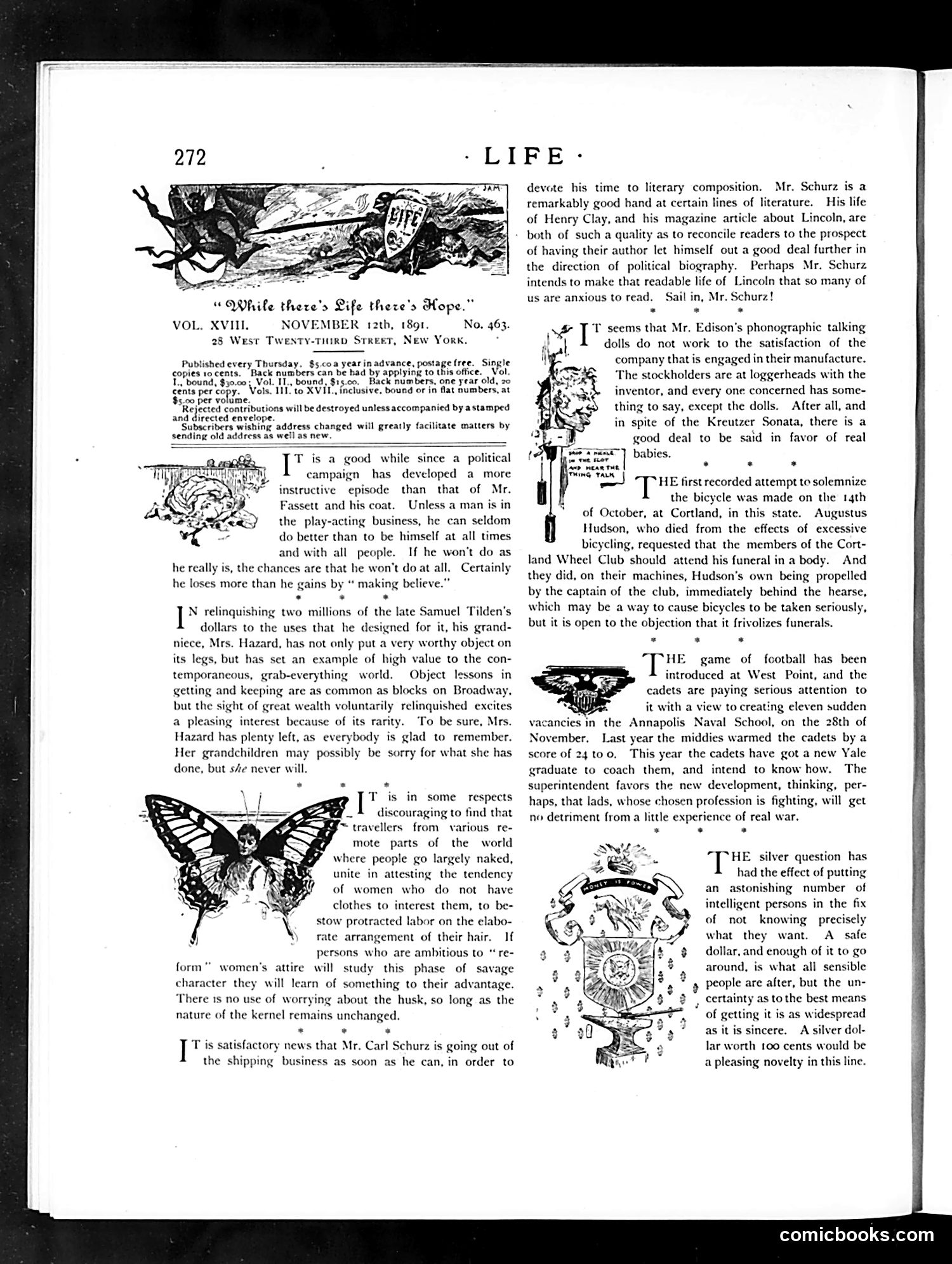
This page contains multiple brief satirical commentary items rather than a single unified cartoon. The visible illustrations include a butterfly and what appears to be a dead or sleeping figure labeled "While there's Life there's Hope," likely a general memento mori joke about mortality. The text discusses: - **Edison's phonographic dolls**: Stockholders and the inventor are dissatisfied with the talking dolls' commercial performance - **Political campaigns**: Commentary on Mr. Fassett's campaign style - **Samuel Tilden's estate**: His grandniece Mrs. Hazard donating his wealth to charity - **Bicycling at West Point**: A cadet's funeral procession on bicycles - **Football at West Point**: Introduction of the sport; cadets receiving coaching from Yale graduates - **The silver question**: Monetary policy debate affecting "intelligent persons" The page reflects 1880s-era American concerns: new technology, wealth philanthropy, and political/economic debates.
📄 Transcribed text from this page (OCR, searchable)
Machine-transcribed from the original scan — historical spelling and the odd misread are preserved.
- LIFE: “While there's Life there's Hope.” XVIII. NOVEMBER 12th, 1891. No, 463. 28 West Twenty-THirp Srreet, New York. Published every Thursday. $5.coa year in advance, postage free. Single copies 1o cents. Back numbers can be had by applying to this office. Vol. 1, bound, $30.00; Vol. IT., bound, $15.00. Back numbers, one year old, cents per copy. Vols, HI. to XV clusive, bound or in flat number $5.00 per volume. Rejected contributions will be destroyed unless accompanied by astamped and directed envelope. Subscribers wishing address changed will greatly facilitate matters by sending old address as well as new. a good while since a political has developed a more than that of Mr. campaign instructive episode Fassett and his coat. Unless a man is in the play-acting business, he can seldom do better than to be himself at all times and with all people. If he won't do as he really is, the chances are that he won't do at all. Certainly he loses more than he gains by “ making believe.” l* relinquishing two millions of the late Samuel Tilden’s dollars to the uses that he designed for it, his grand- niece, Mrs. Hazard, has not only put a very worthy object on its legs, but has set an example of high value to the con- temporancous, grab-everything world. Object lessons in getting and keeping are as common as blocks on Broadway, but the sight of great wealth voluntarily relinquished excites a pleasing interest because of its rarity. To be sure, Mrs. Hazard has plenty left, as everybody is glad to remember. Her grandchildren may possibly be sorry for what she has done, but s#e never will. * * [* is in some respects os discouraging to find that ™ travellers from various re- mote parts of the world where people go largely naked, unite in attesting the tendency of women who do not have clothes to interest them, to be- stow protracted labor on the elabo- rate arrangement of their hair. If persons who are ambitious to “ re- form" women’s attire will study this phase of savage character they will learn of something to their advantage. There 1s no use of worrying about the husk, so long as the nature of the kernel remains unchanged. I" atisfactory news that Mr. Carl Schurz is going out of the shipping business as soon as he can, in order to devote his time to literary composition. Mr. Schurz is a remarkably good hand at certain lines of literature. His life of Henry Clay, and his magazine article about Lincoln, are both of such a quality as to reconcile readers to the prospect of having their author let himself out a good deal further in the direction of political biography. Perhaps Mr. Schurz intends to make that readable life of Lincoln that so many of us are anxious to read. Sail in, Mr. Schurz! . * . dolls do not work to the satisfaction of the company that is engaged in their manufacture. The stockholders are at loggerheads with the inventor, and every one concerned has some- thing to say, except the dolls. After all, and in spite of the Kreutzer Sonata, there is a good deal to be said in favor of real ] babies. pengerres a") HE first recorded attempt to solemnize the bicycle was made on the 14th of October, at Cortland, in this state. Augustus Hudson, who died from the effects of excessive bicycling, requested that the members of the Cort- land Wheel Club should attend his funeral in a body. And they did, on their machines, Hudson's own being propelled by the captain of the club, immediately behind the hearse, which may be a way to cause bicycles to be taken seriously, but it is open to the objection that it frivolizes funerals. * . * *T°HE game of football has been introduced at West Point, and the cadets are paying serious attention to 3 it with a view to creating eleven sudden ncies in the Annapolis Naval School, on the 28th of November. Last year the middies warmed the cadets by a score of 24 to 0, This year the cadets have got a new graduate to coach them, and intend to know how. superintendent favors the new development, thinking, per- haps, that lads, whose chosen profession is fighting, will get no detriment from a little experience of real war. * . * i I" seems that Mr. Edison's phonographic talking te S& “THE silver question has 7 SS had the effect of putting an astonishing number of intelligent persons in the fix of not knowing precisely what they want. A safe dollar, and enough of it to go around, is what all sensible people are after, but the un- certainty as tothe best means of getting it is as widespread as it is sincere. A silver dol- lar worth 100 cents would be a pleasing novelty in this line. comicbooks.com