
Life, 1891-11-12 · page 6 of 15
Life — November 12, 1891 — page 6: what you’re looking at
What you’re looking at
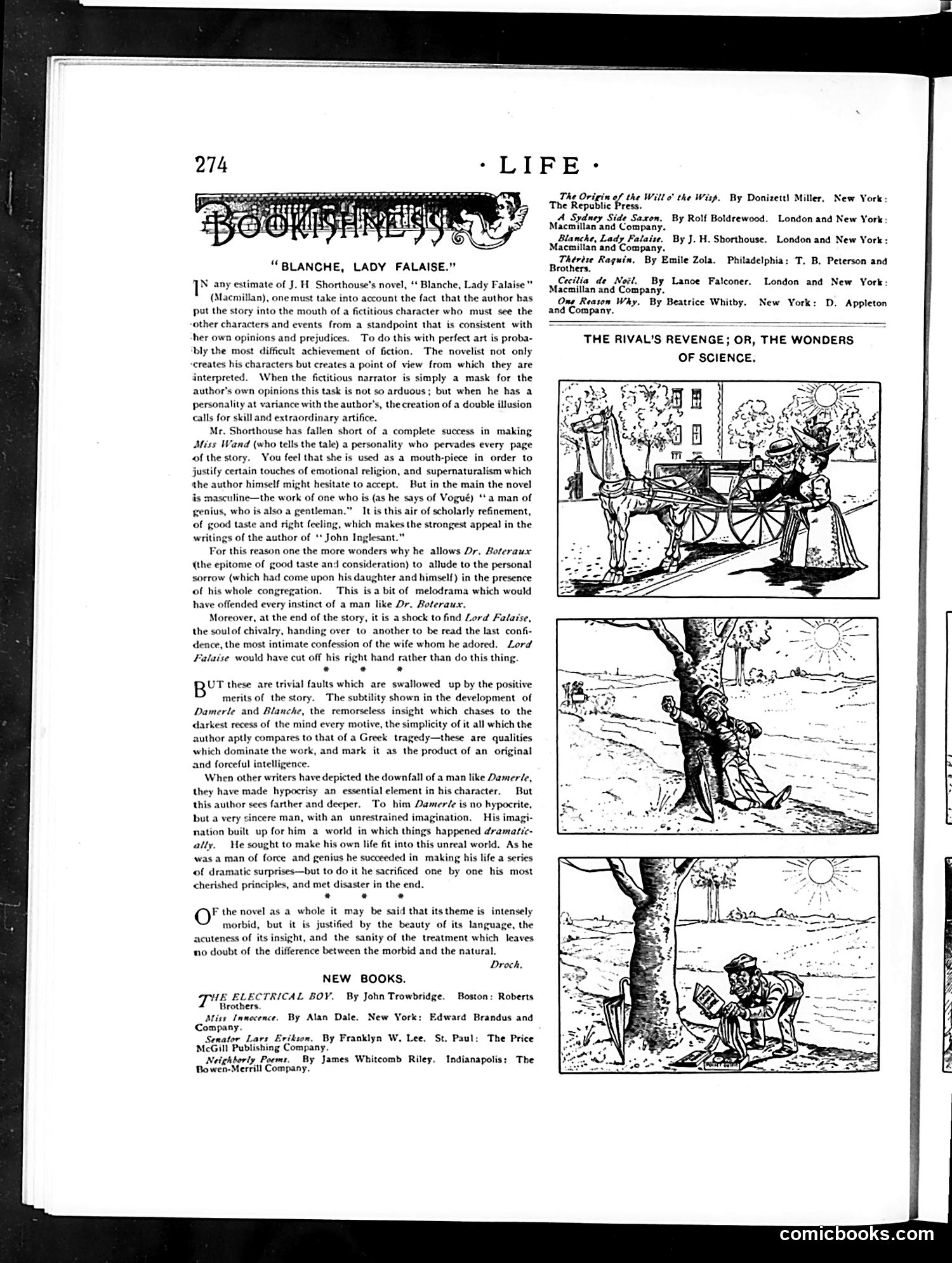
This page features a book review of J.H. Shorthouses' novel "Blanche, Lady Falaise" and includes three illustrations for what appears to be a serialized story titled "The Rival's Revenge; Or, The Wonders of Science." The three wood-cut style illustrations depict dramatic scenes: a figure apparently conducting some kind of scientific experiment or apparatus in a garden setting, another scene showing figures in an outdoor landscape, and a third showing what appears to be a confrontation or action scene near water. Without additional context identifying the story's plot, characters, or publication details, the specific satirical meaning remains unclear. The illustrations suggest this is likely a melodramatic scientific romance or revenge narrative typical of late-19th-century popular fiction.
📄 Transcribed text from this page (OCR, searchable)
Machine-transcribed from the original scan — historical spelling and the odd misread are preserved.
“BLANCHE, LADY FALAISE.” JS any estimate of J. H_ Shorthouse’s novel, ‘* Blanche, Lady Falaise (Macmillan), one must take into account the fact that the author has put the story into the mouth of a fictitious character who must see the other characters and events from a standpoint that is consistent with her own opinions and prejudices. To do this with perfect art is proba- bly the most difficult achievement of fiction. The novelist not only creates his characters but creates a point of view from which they are interpreted. When the fictitious narrator is simply a mask for the author's own opinions this task is not so arduous; but when he has a personality at variance with the author's, the creation of a double illusion calls for skill and extraordinary artifice. Mr, Shorthouse has fallen short of a complete success in. making Afiss Wand (who tells the tale) a personality who pervades every page ‘of the story. You feel that she is used as a mouth-piece in order to justify certain touches of emotional religion, and supernaturalism which ‘the author himself might hesitate to accept. But in the main the novel is masculine—the work of one who is (as he says of Vogué) “a man of genius, who is also a gentleman.” It is this air of scholarly refinement, of good taste and right feeling, which makes the strongest appeal in the writings of the author of ** John Inglesant.” For this reason one the more wonders why he allows Dr. Boteraux {the epitome of good taste and consideration) to allude to the personal sorrow (which had come upon his daughter and himself) in the presence of his whole congregation. This isa bit of melodrama which would have offended every instinct of a man like Dr. Boteraux. Moreover, at the end of the story, it is a shock to find Lord Falaise, the soulof chivalry, handing over to another to be read the last confi- dence, the most intimate confession of the wife whom he adored. Lord Falaise would have cat off his right hand rather than do this thing. * * * BUT these are trivial faults which are swallowed up by the positive merits of the story. The subtility shown in the development of Damerle and Blanche, the remorseless insight which chases to the darkest recess of the mind every motive, the simplicity of it all which the author aptly compares to that of a Greek tragedy—these are qualities which dominate the work, and mark it as the product of an original and forceful intelligence. When other writers have depicted the downfall of a man like Damer/e, they have made hypocrisy an essential element in his character. But this author sees farther and deeper. To him Damerte is no hypocrite, but a very sincere man, with an unrestrained imagination. His imagi- nation built up for him a world in which things happened dramatic- ally. He sought to make his own life fit into this unreal world. As he was a man of force and genius he succeeded in making his life a series ‘of dramatic surprises—but to do it he sacrificed one by one his most cherished principles, and met disaster in the end. * . * OF the novel as a whole it may be said that its theme is intensely morbid, but it is justified by the beauty of its language, the acuteness of its insight, and the sanity of the treatment which leaves no doubt of the difference between the morbid and the natural. Droch, NEW BOOKS. HE ELECTRICAL BOY. By John Trowbridge. Brothers. Aliss Innocence. Company. Senator Lars Erikion, By Franklyn W, Lee, McGill Publishing Company. Neighborly Poems. By James Whitcomb Riley. Bowen-Merrill Company. Boston: Roberts By Alan Dale. New York: Edward Brandus and St. Paul: The Price Indianapolis: The The Origin of the Will o' the Wisp. By Donizett! Miller, New York: The Republic Press. A Sydney Side Saxon. By Rolf Boldrewood. London and New York Macmillan and Company. Blanche, Lady Fataise. Macmillan and Company. Thértre Raguin, By Emile Zola. Brothers. Cecitia de Nett, By J. H. Shorthouse. London and New York : Philadelphia: T, B. Peterson and By Lanoe Falconer. London and New York: Macmillan and Company. One Reason Why. By Beatrice Whitby. and Company. New York: D. Appleton THE RIVAL’S REVENGE; OR, THE WONDERS OF SCIENCE. comicbooks.com