
A complete issue · 16 pages · 1891
Life — October 8, 1891
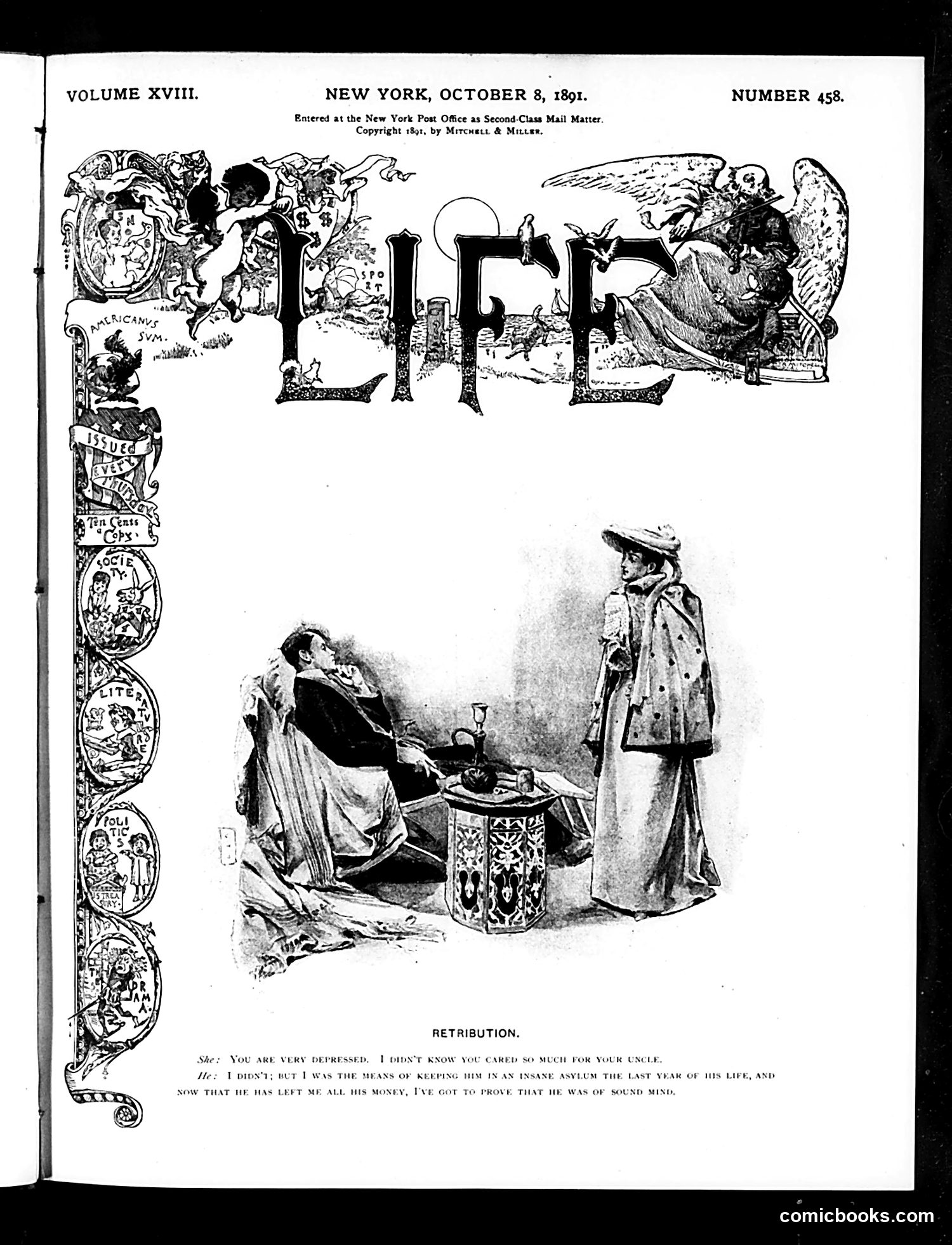
This cartoon depicts a domestic dispute between a man and woman. The woman, standing and wearing a coat and hat, appears angry. The seated man, looking distressed, holds a drink. The dialogue reveals the cartoon's point: The woman says she doesn't care much for the uncle, and the man responds that *he* (the uncle) was responsible for keeping him in an insane asylum for the past year. Now that the uncle has left him all his money, the man claims he must "prove that he was of sound mind." The satire mocks a legal/financial situation where inheriting money paradoxically requires the beneficiary to prove his sanity—the opposite of what one might expect. It's a dark joke about Victorian inheritance law and family conflict over estates and mental competency.
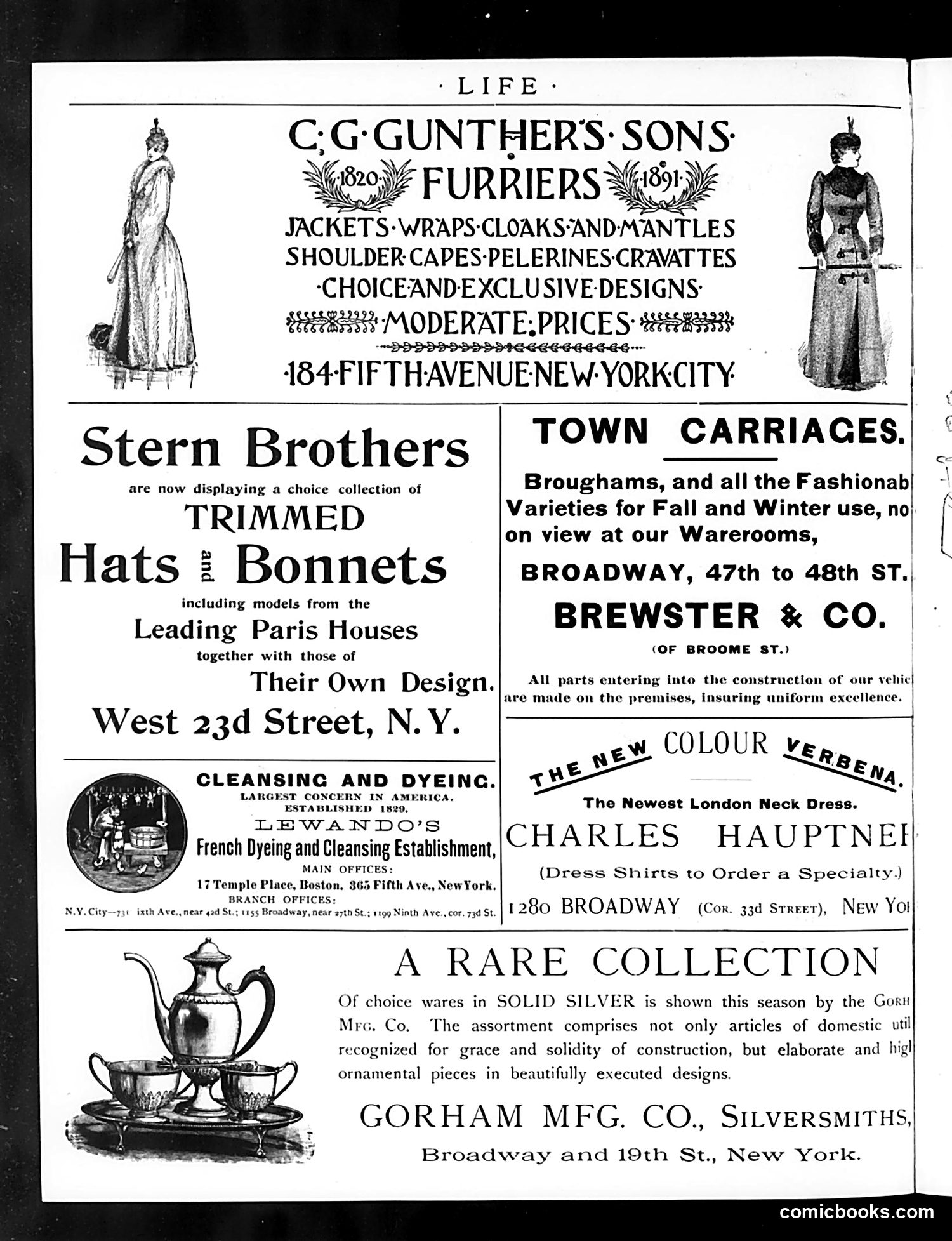
This page is **primarily advertising**, not satire or political commentary. It contains five separate commercial advertisements from what appears to be a late 19th-century issue of *Life* magazine: 1. **C.G. Gunther's Sons** - furrier offering jackets, cloaks, and mantles 2. **Stern Brothers** - hatmaker displaying trimmed hats and bonnets from Paris 3. **Brewster & Co.** - carriage manufacturer on Broadway 4. **Lewando's** - French dyeing and cleaning establishment 5. **Gorham Mfg. Co.** - silversmith displaying solid silver goods The two illustrated figures at top appear to be fashion plates showing women's formal attire of the period, typical advertising imagery for the era. There is no discernible political or social satire on this page—it's a straightforward commercial layout targeting wealthy New York consumers.
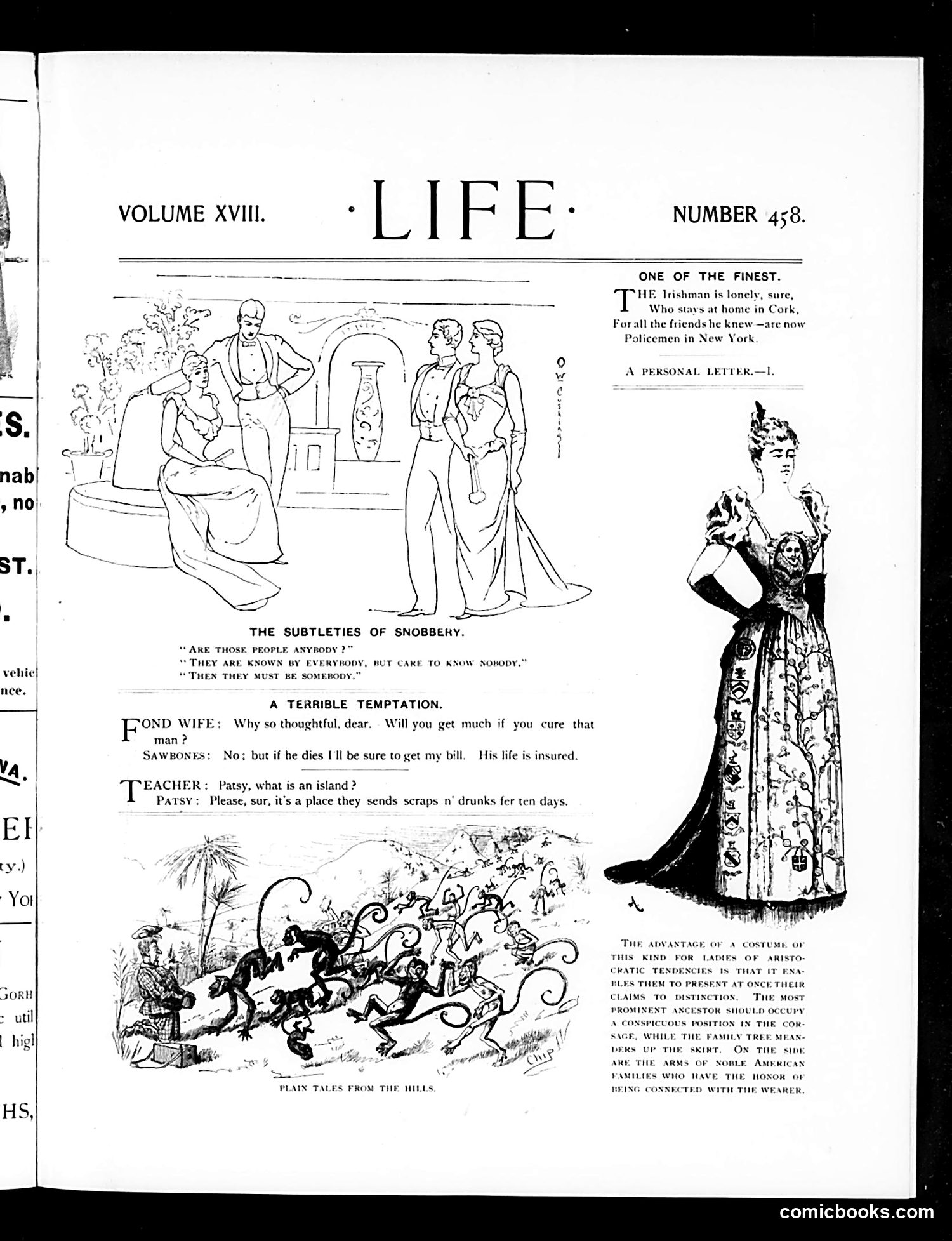
This page from *Life* magazine contains several satirical pieces targeting social pretension and class behavior: **"The Subtleties of Snobbery"** mocks how people strategically claim (or avoid claiming) acquaintance with others to appear distinguished. The joke relies on the logical absurdity of social climbing. **"A Terrible Temptation"** presents a dark humor dialogue about insurance fraud—a sawbones (surgeon) jokes that if a patient dies, he'll collect the insurance payment, treating human life as a financial transaction. **"Plain Tales from the Hills"** appears to be an illustration of monkeys in chaotic behavior—likely commenting on human folly or primitive conduct. The fashion illustration on the right celebrates aristocratic costume heritage, suggesting lineage claims through clothing. Overall, the page satirizes class anxiety, moral corruption, and social pretense in turn-of-the-century America.
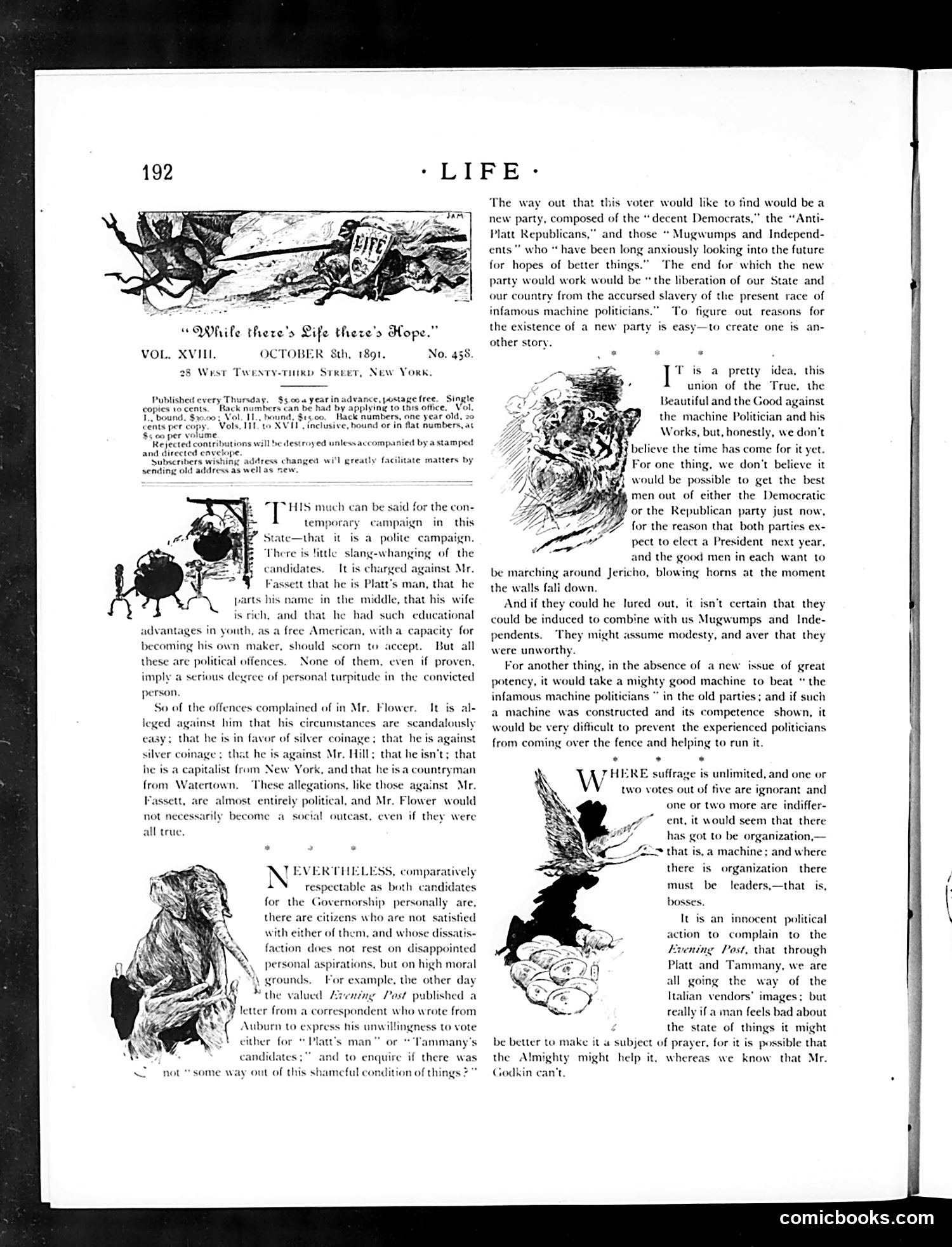
This *Life* magazine page critiques a contemporary gubernatorial campaign, likely in New York state. The text attacks a candidate (possibly William C. Flower based on the discussion) for hypocrisy: he's accused of being a silver-coinage advocate, yet allegedly wealthy and connected to New York capitalists and "Watertown" interests. The cartoons mock political machines and voter manipulation. The editorial suggests that creating a "new party" (possibly referencing Populists or "Mugwumps") to challenge Democrats and Republicans is impractical without strong leadership. The satire emphasizes that effective politics requires organizational machinery and "bosses"—implying that idealistic reform movements cannot compete against entrenched party structures. The piece reflects late-19th-century debates over currency policy, machine politics, and third-party viability.
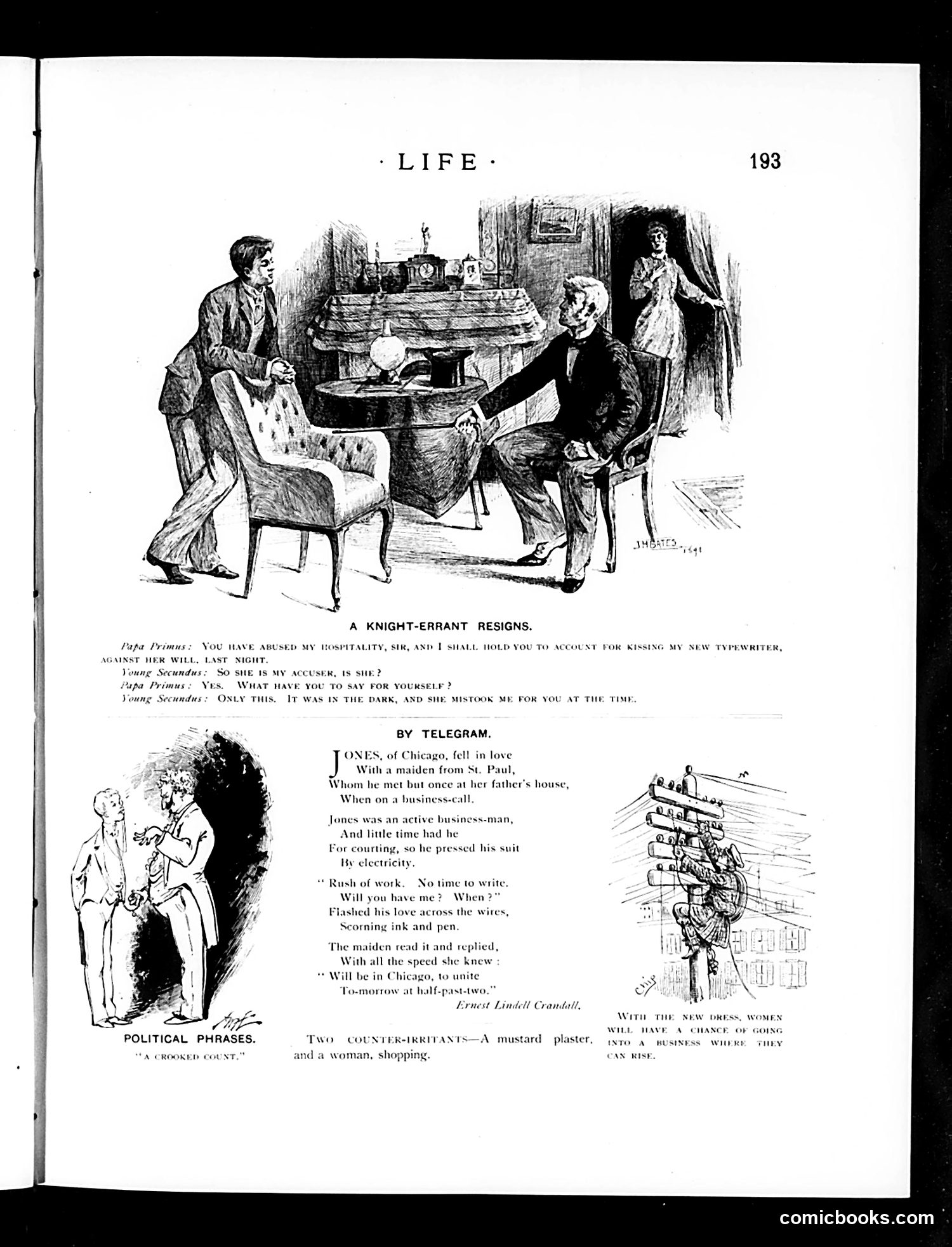
**"A Knight-Errant Resigns"** (top cartoon) depicts a domestic confrontation where a man accuses his host of "abusing my hospitality" and kissing his new typewriter. The woman (the host's daughter, apparently) denies it, claiming darkness caused the confusion. The satire mocks Victorian-era social conventions around courtship and honor—the absurd escalation of a typewriter kiss to a matter requiring accountability reflects period anxieties about technology and propriety. **"By Telegram"** (middle poem by Ernest Lindell Crandall) tells of a businessman's rushed courtship conducted via telegraph due to work pressures, culminating in a hasty marriage proposal. The satire critiques how modern commerce displaces personal relationships. **"Political Phrases"** (bottom left) is labeled "A Broken Coast"—its meaning remains unclear from available context.
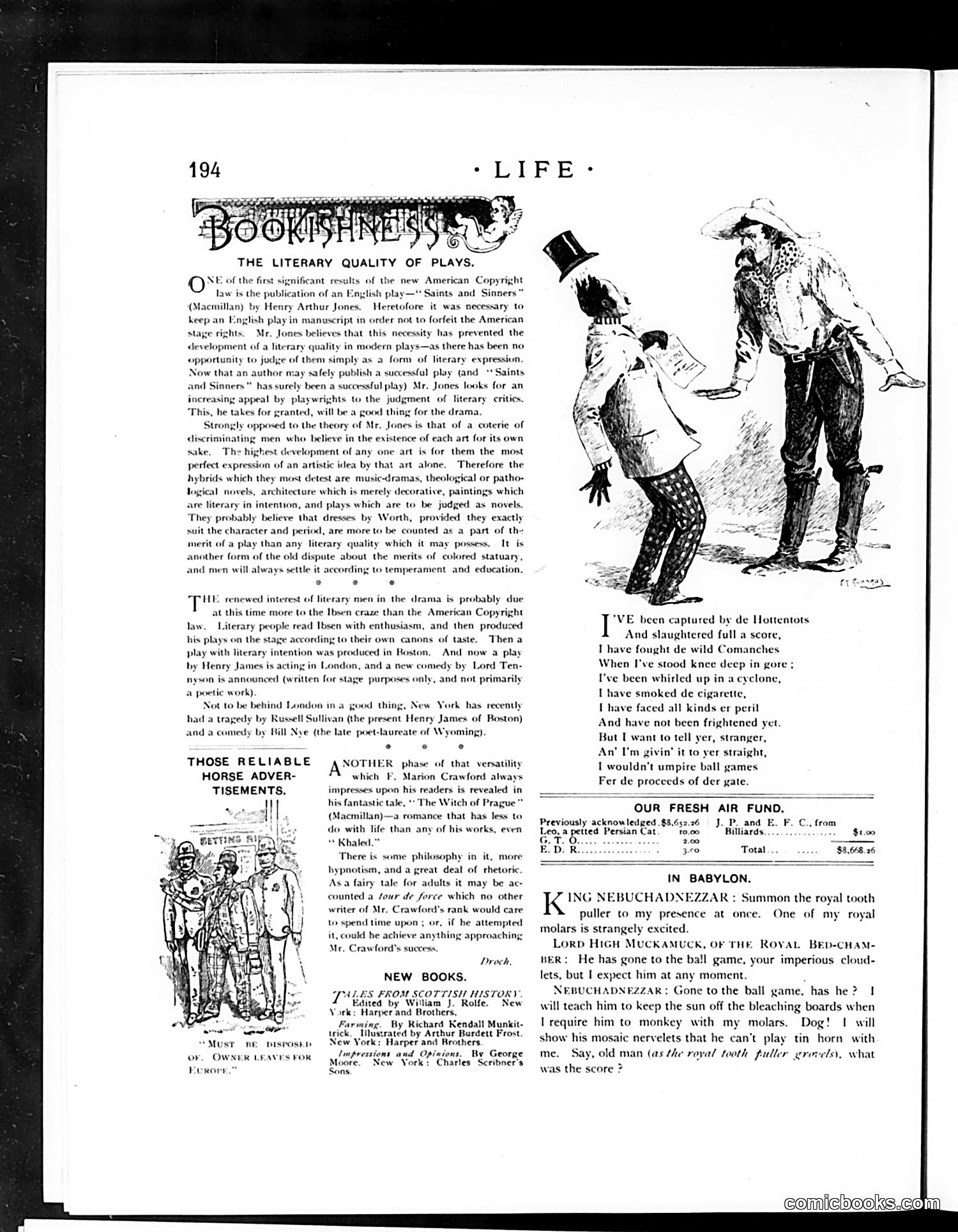
This page discusses the literary quality of modern American plays, particularly responding to critic Henry James's view that plays lack artistic merit compared to novels. The magazine argues plays deserve recognition as legitimate literature. The cartoon titled "Those Reliable Horse Power Tisements" (likely "Advertisements") shows figures in period dress, apparently satirizing theatrical advertising or promotion practices of the era. The accompanying illustration depicts two men in 19th-century attire engaged in what appears to be a comedic confrontation or dialogue, likely illustrating a scene from contemporary theater. The bottom section, "In Babylon," presents dialogue between characters named King Nebuchadnezzar and Lord High Muckamuck, appearing to be humorous theatrical sketch material mocking grandiose historical drama conventions popular at the time.
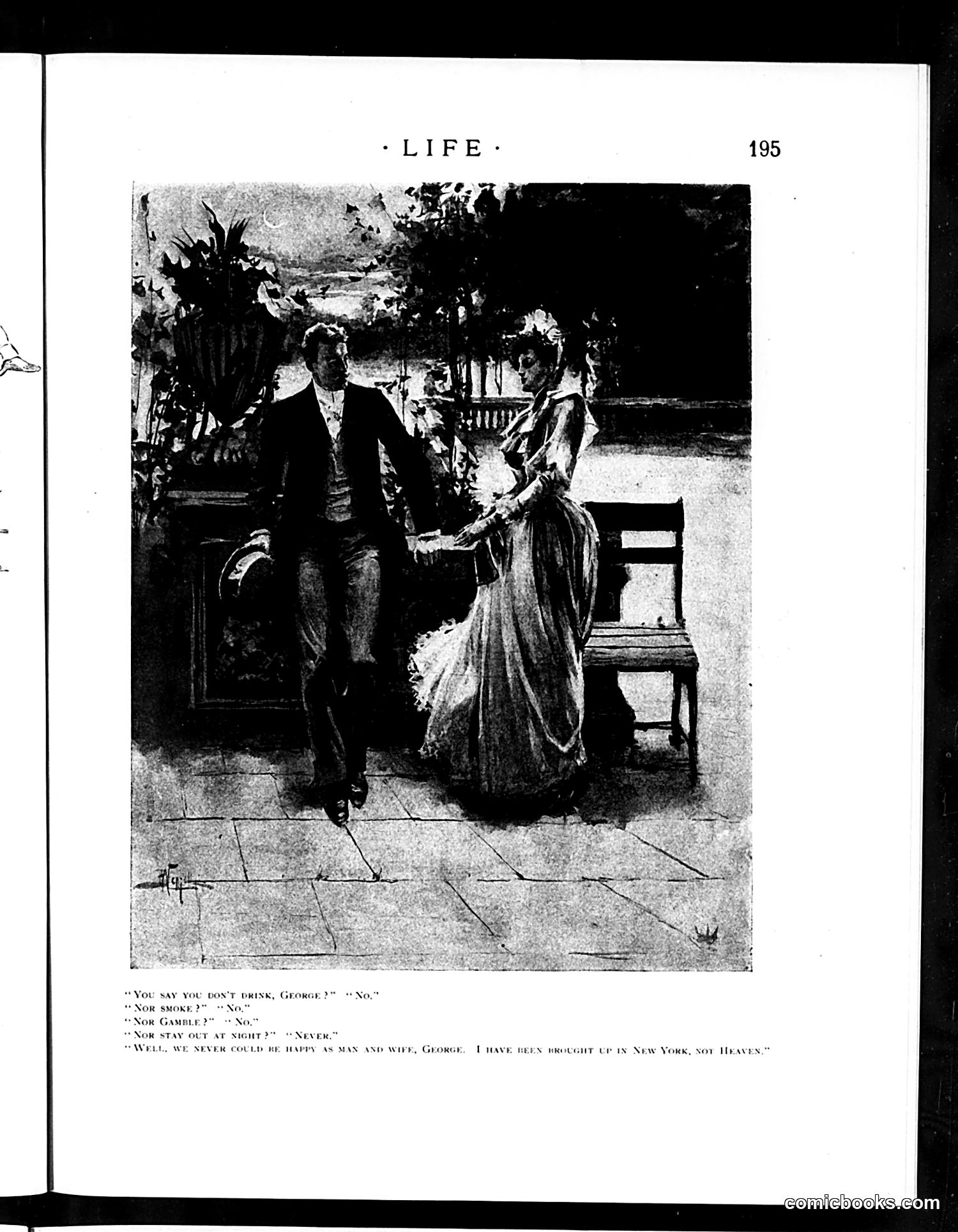
This appears to be a satirical illustration from *Life* magazine depicting a domestic scene. A well-dressed man and an elegantly gowned woman are shown in conversation, with the woman seated. The dialogue presents a humorous contrast between strict moral prohibitions and their ineffectiveness: The man lists various vices he claims to avoid—drinking, smoking, gambling, staying out late—each answered with "No." However, the final line undercuts this virtue: "Well, we never could be happy as man and wife, George. I have been brought up in New York, not Heaven." The satire critiques the artificiality of claimed moral rectitude and suggests that impossibly strict standards make genuine happiness impossible. The implication is that such perfection is unrealistic or hypocritical, particularly regarding urban sophistication versus rural/conservative values. The joke satirizes both prudish moralism and the pretense of living by it.
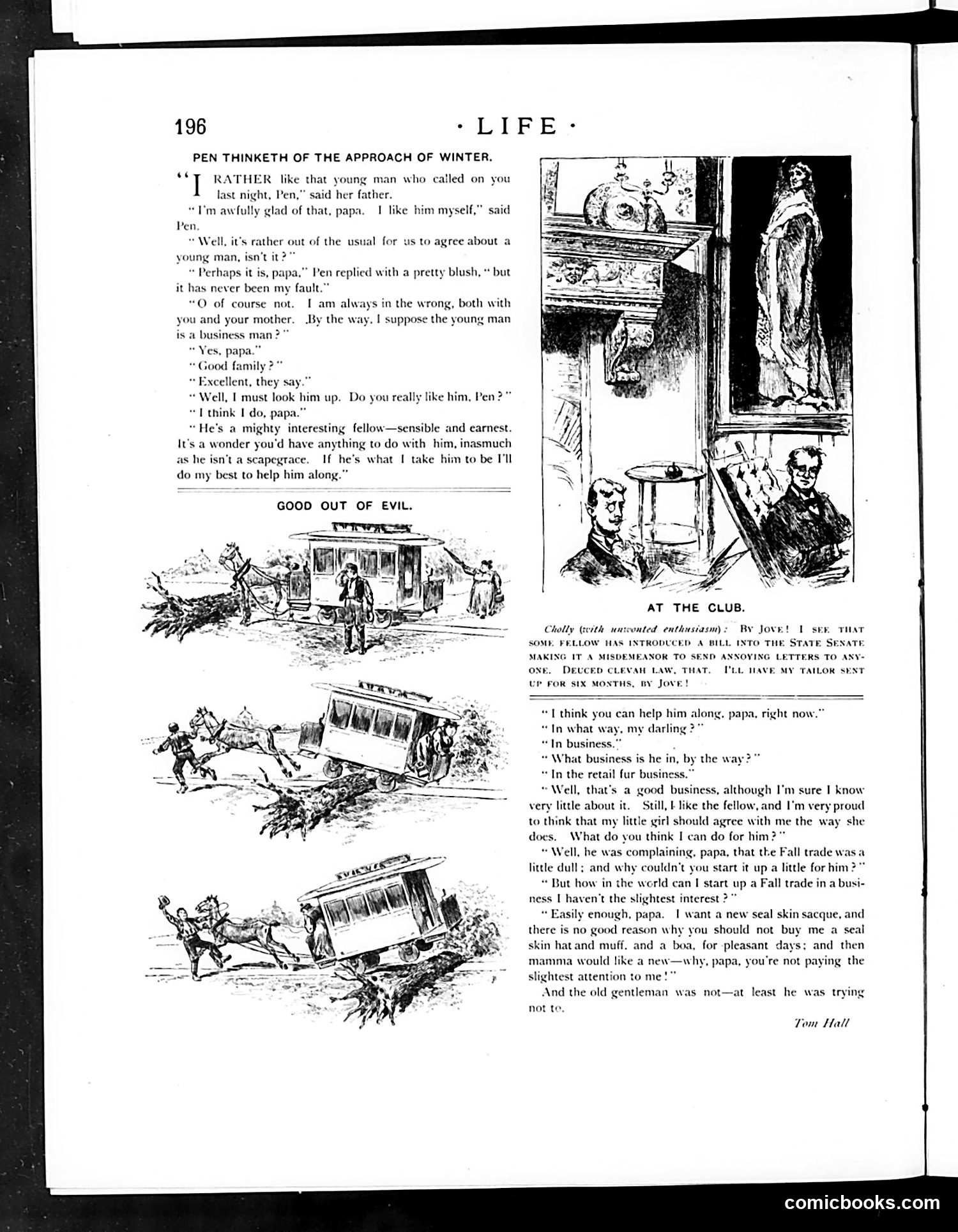
This page contains two separate stories with illustrations. **"Pen Thinketh of the Approach of Winter"** (top) is a dialogue between Pen and her father about a young man's visit. The father questions whether the suitor is suitable, ultimately asking if Pen likes him. Pen responds that he's "sensible and earnest" and she'd help him succeed. **"Good Out of Evil"** (left) shows three sequential cartoon panels of a streetcar accident, depicting horses pulling a trolley that crashes or tips over with increasing severity—apparently depicting the humorous consequences of vehicular mishaps. **"At the Club"** (right) features dialogue about business, specifically the fur retail trade. A character mentions introducing a bill to the state senate to send annoying letters to fur traders, expressing frustration about slow fall business. The page blends domestic romance with commercial satire.
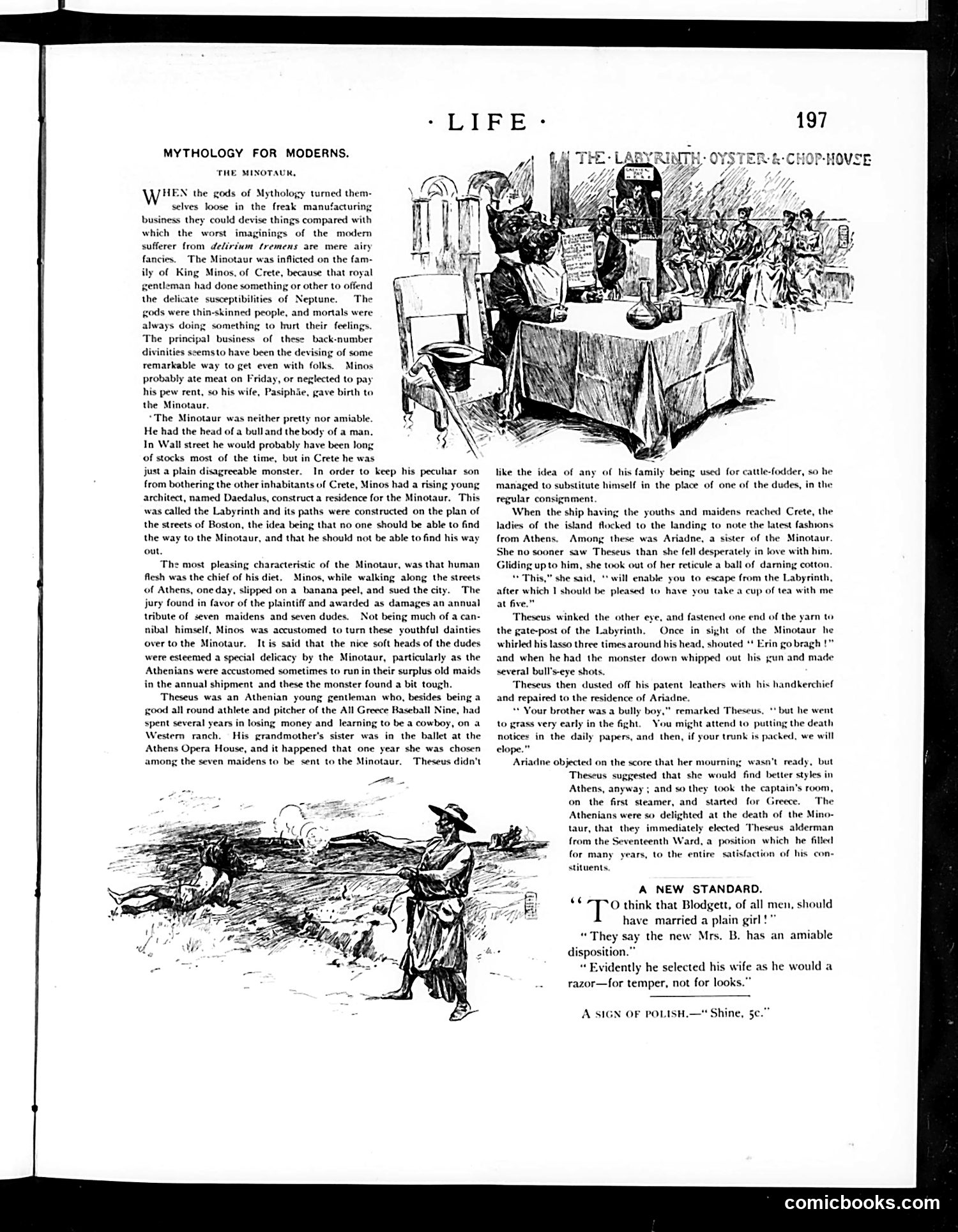
This page presents a satirical retelling of the classical Greek myth of the Minotaur for contemporary readers. The text humorously reimagines the monster as a product of modern industrial capitalism—born from King Minos's schemes to exploit even his own family for financial gain. The accompanying illustration (top right) depicts "The Labyrinth Oyster & Chop House," transforming the mythological maze into a restaurant, likely satirizing how ancient stories are commercialized and trivialized in modern American culture. Below are brief humorous anecdotes labeled "A New Standard" and "A Sign of Polish," offering witty social commentary on contemporary marriage and manners—typical of *Life* magazine's satirical approach to modern American life and pretensions.
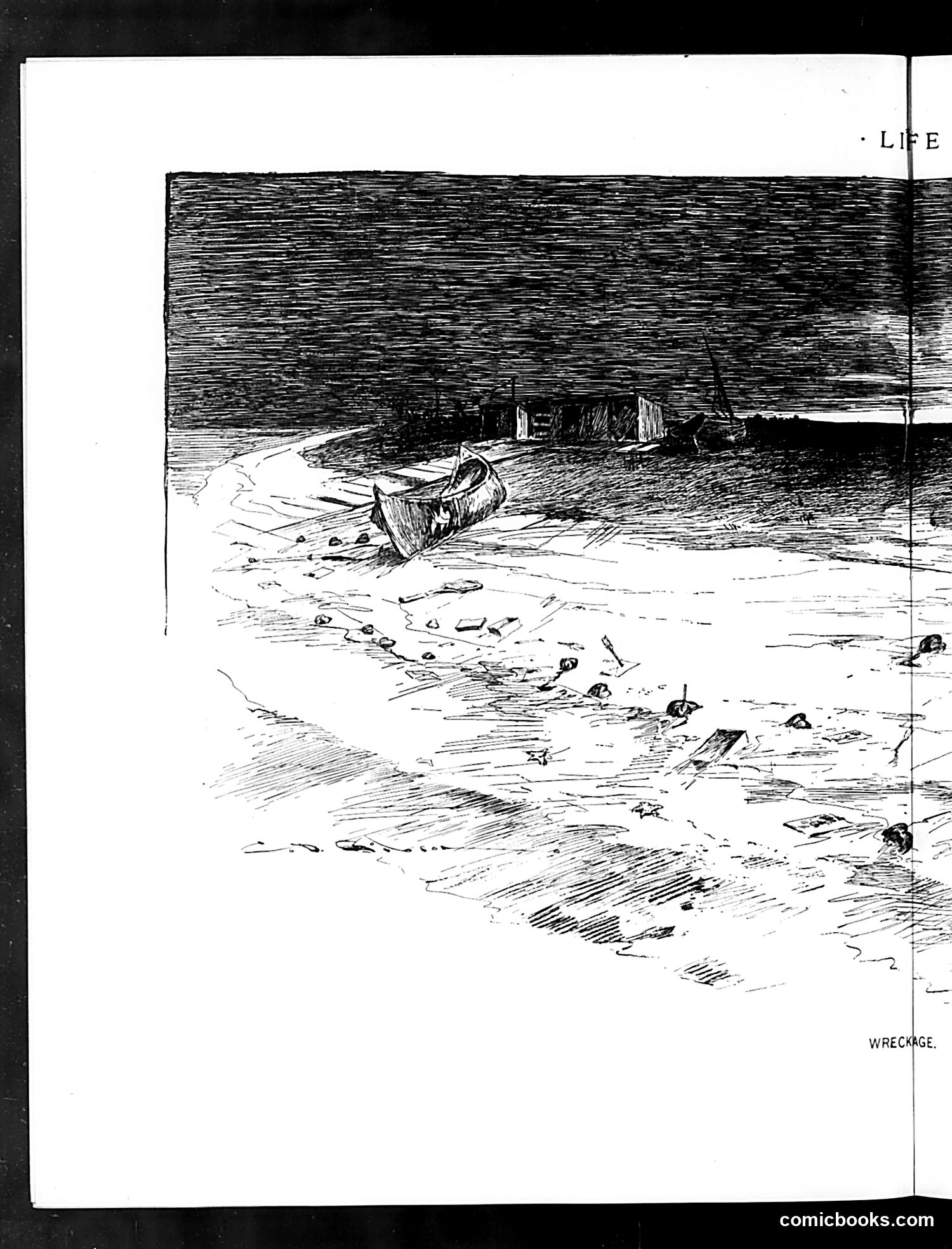
This page from *Life* magazine depicts a beach scene titled "WRECKAGE." The illustration shows a capsized or wrecked boat on a sandy shore, surrounded by scattered debris and what appear to be salvaged items or wreckage scattered across the beach. In the background, there are rough waters and what looks like damaged structures or buildings on the coastline. Without additional context or caption text visible on this page, the specific satirical target is unclear. The image could be commenting on a particular maritime disaster, economic collapse, or social upheaval of the era, but I cannot identify the precise historical event or political reference intended without more information. The stark, expressive line work emphasizes desolation and destruction.
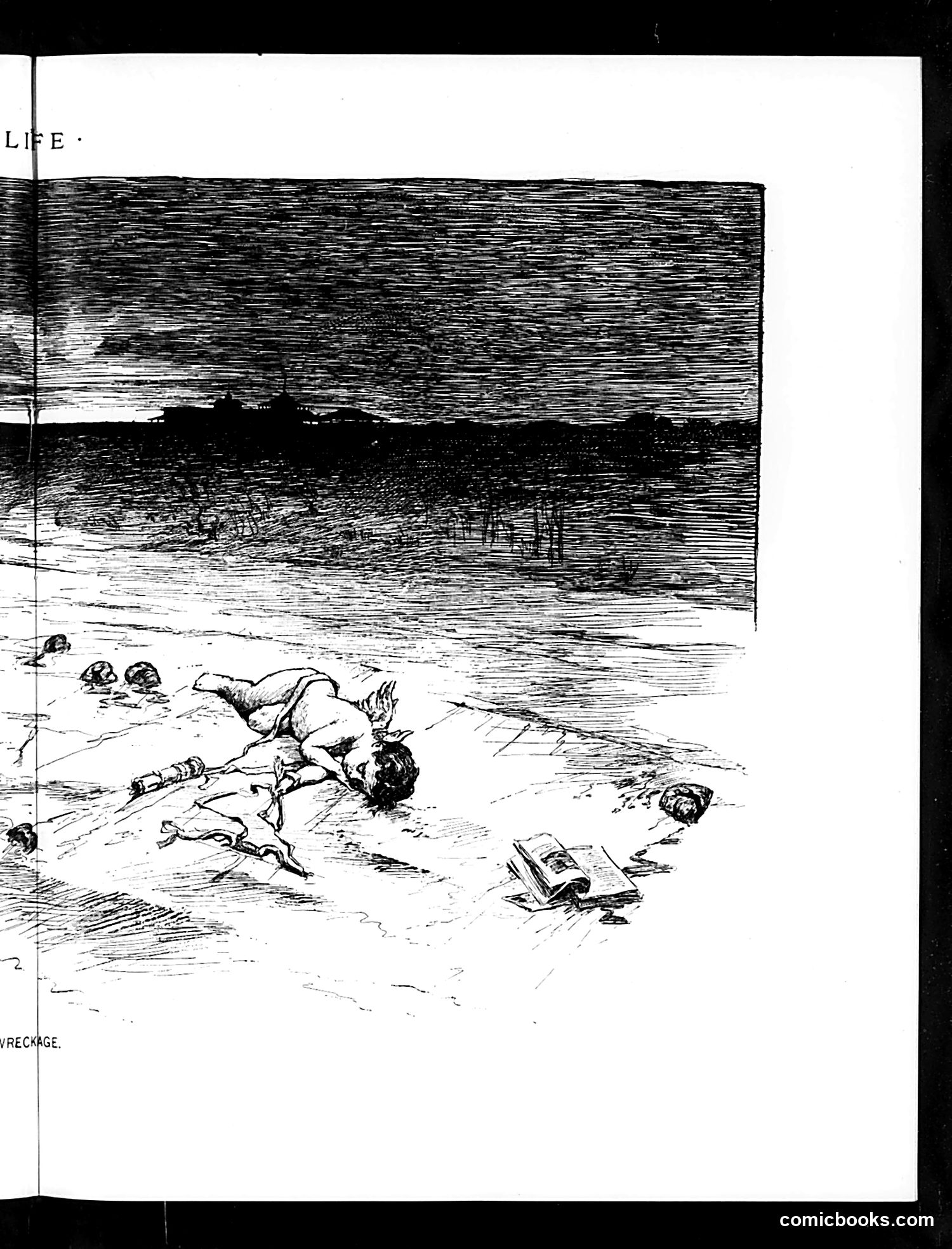
This appears to be a satirical illustration titled "WRECKAGE" from Life magazine, depicting the aftermath of a shipwreck or maritime disaster. The image shows a deceased or unconscious figure lying on a beach, surrounded by debris including what appears to be scattered cargo, wreckage, and personal items washed ashore. The illustration uses dark, dramatic etching-style lines to convey the grim scene. Without additional context from the magazine's date or accompanying text, the specific political or social commentary is unclear. However, given Life's satirical nature, this likely comments on maritime safety, business practices, or social conditions of its era. The word "LIFE" at the top may be ironic commentary on the fatality depicted below.
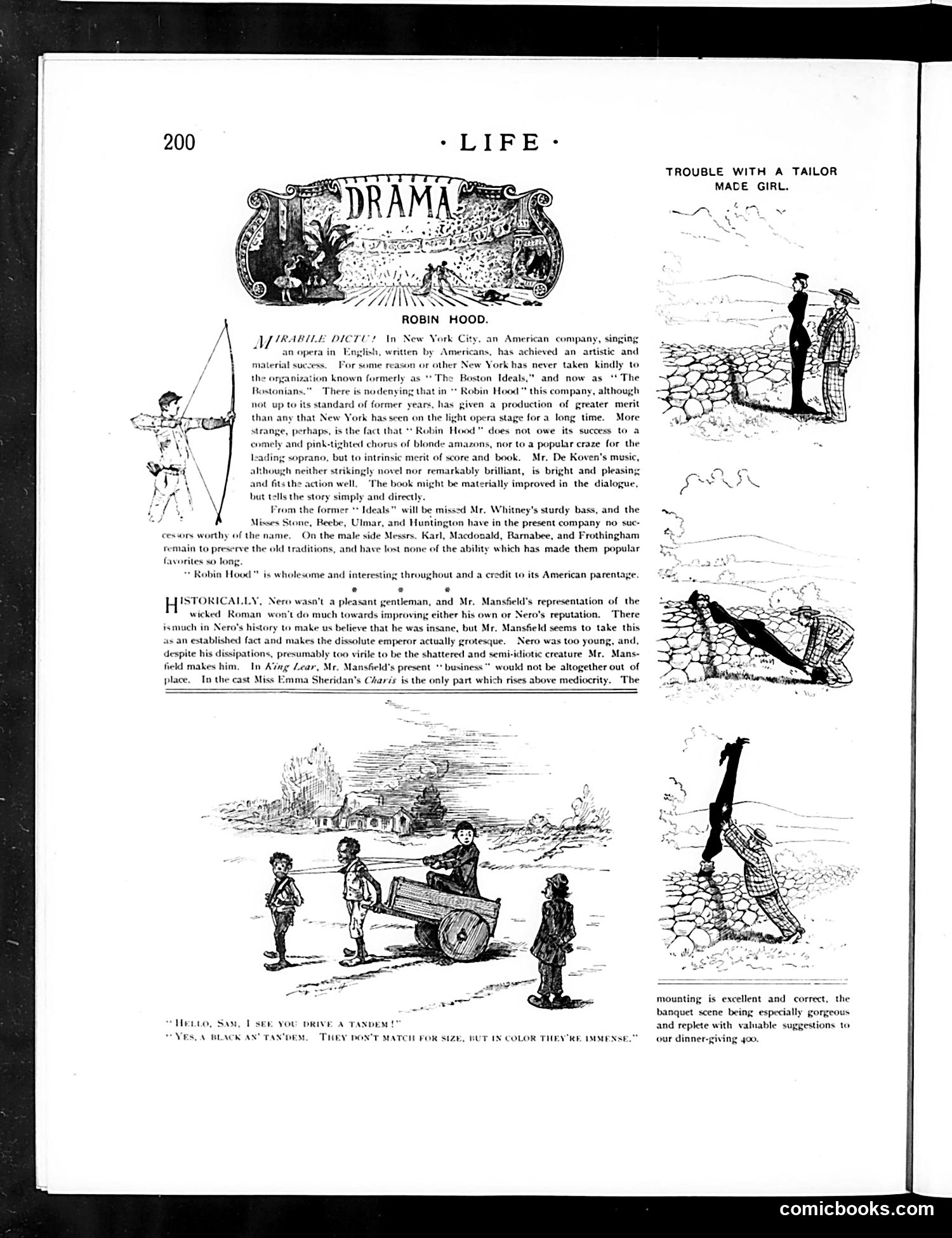
This *Life* magazine page reviews theatrical productions, primarily an American operatic adaptation of "Robin Hood" by the Bostonians company. The text praises the show's success despite New York's historical coldness toward American theatrical companies—unusual because it succeeds through artistic merit rather than spectacle (pretty chorus girls or star power). The page also critiques Richard Mansfield's performance as Nero, arguing he overplays the character's degeneracy in ways historically implausible and theatrically excessive. The cartoon illustrations (a tandem bicycle joke and a tailor scene) are humorous vignettes unrelated to the main reviews. For modern readers: this reflects late 19th-century American cultural anxiety about whether homegrown theater could match European standards, and contemporary debates about theatrical taste—spectacle versus substance, star power versus ensemble quality.
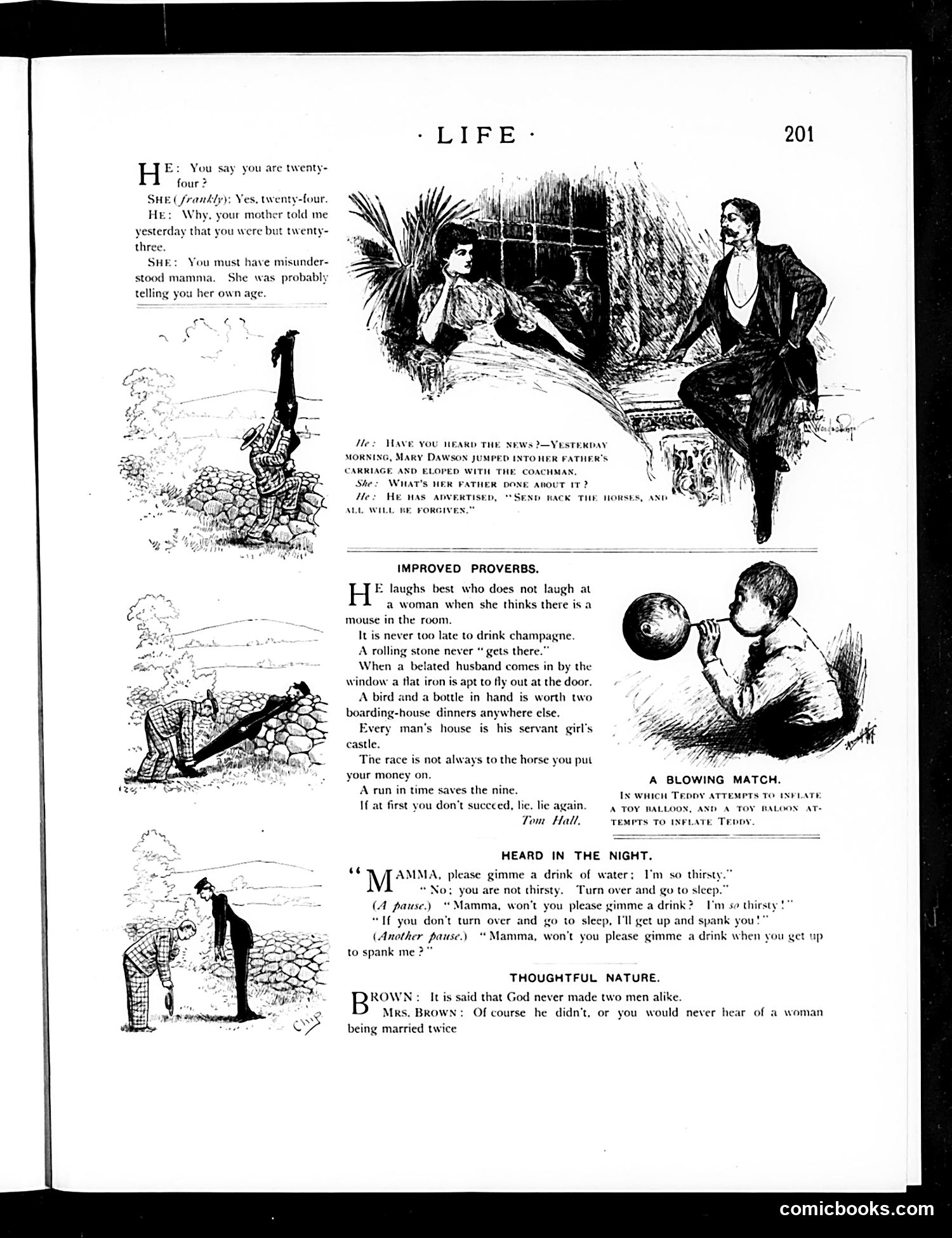
This page contains multiple humor sections typical of early 20th-century satirical magazines: **Top section**: A dialogue joke about a woman's age discrepancy—she claims to be 24, but her mother previously said she was 23. The punchline is that the mother was likely lying about *her own* age, not the daughter's, satirizing women's reluctance to admit their true age. **"Improved Proverbs"**: A collection of humorous twisted sayings mocking domestic life and social conventions—infidelity ("belated husband comes in by the window"), servant girl dynamics, failed investments, and drinking habits. These reflect turn-of-the-century middle-class anxieties. **"Heard in the Night"**: A child repeatedly asking for water while avoiding bedtime, threatening to get spanked so the mother will provide a drink afterward—satirizing childhood manipulation tactics. **"Thoughtful Nature"**: A wife jokes that God *must* have made men different from each other, otherwise women wouldn't remarry (implying husbands are distinguishably flawed). This satirizes marriage dissatisfaction. The sketches and text together constitute genteel domestic satire aimed at a middle-class audience.
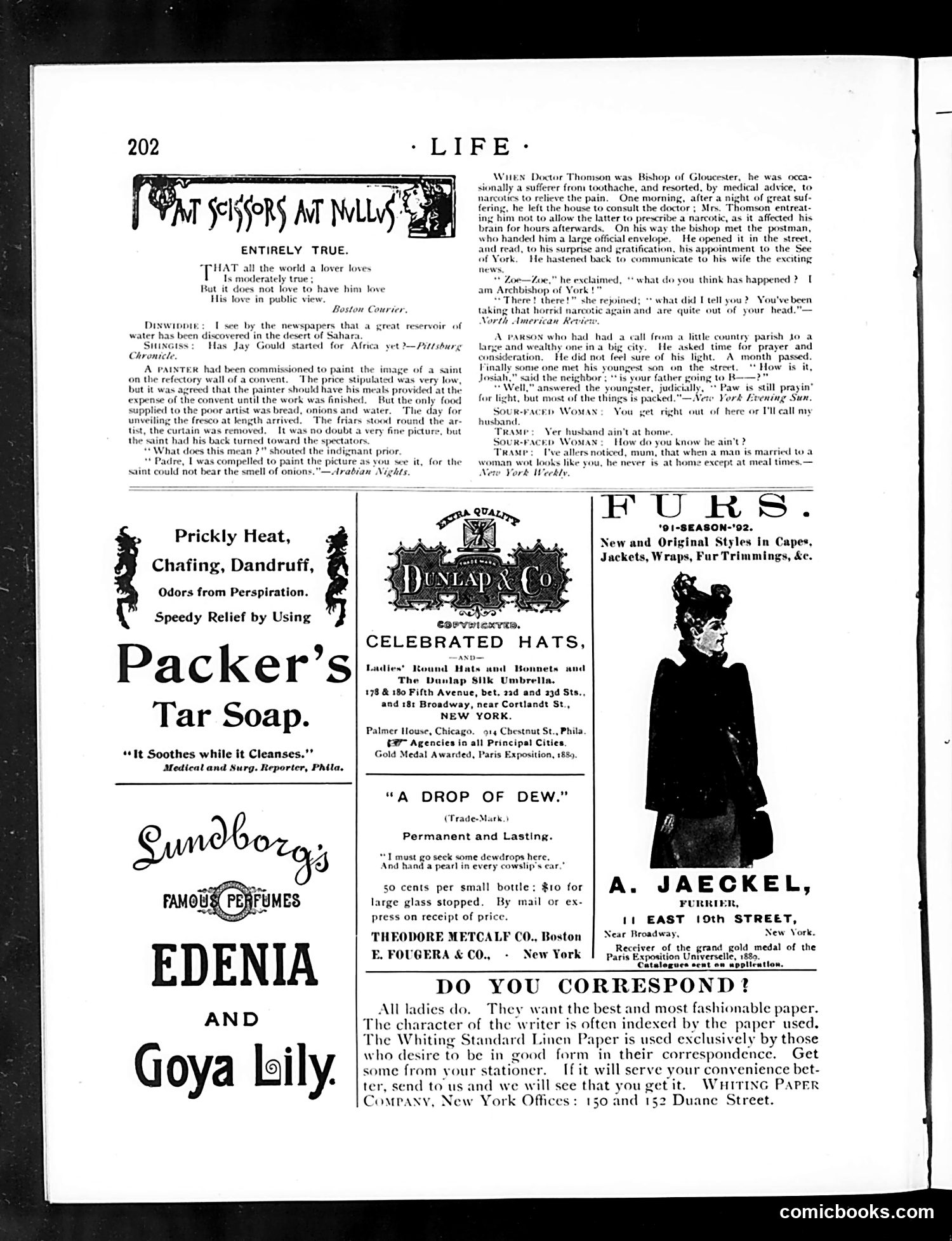
This page is primarily **advertisements and humorous anecdotes** rather than political satire. The content includes: **"Anecdotes at Mills"** section: Four brief humorous stories illustrating ironic situations—a bishop receiving news of his appointment while suffering from narcotic side effects, a painter forced to depict a saint with its back turned due to onion smell, and domestic comedy sketches involving working-class characters. **Advertisements**: Parker's Tar Soap, Lunborg's perfumes, Dunlap hats, "A Drop of Dew" product, and A. Jaeckel furrier services dominate the page. The humor relies on **wordplay and situational irony** rather than political commentary. The anecdotes mock human nature, medical ignorance, and marital dynamics through exaggeration. The page reflects late-19th-century *Life* magazine's blend of light satirical writing and commercial advertising aimed at middle-class readers.
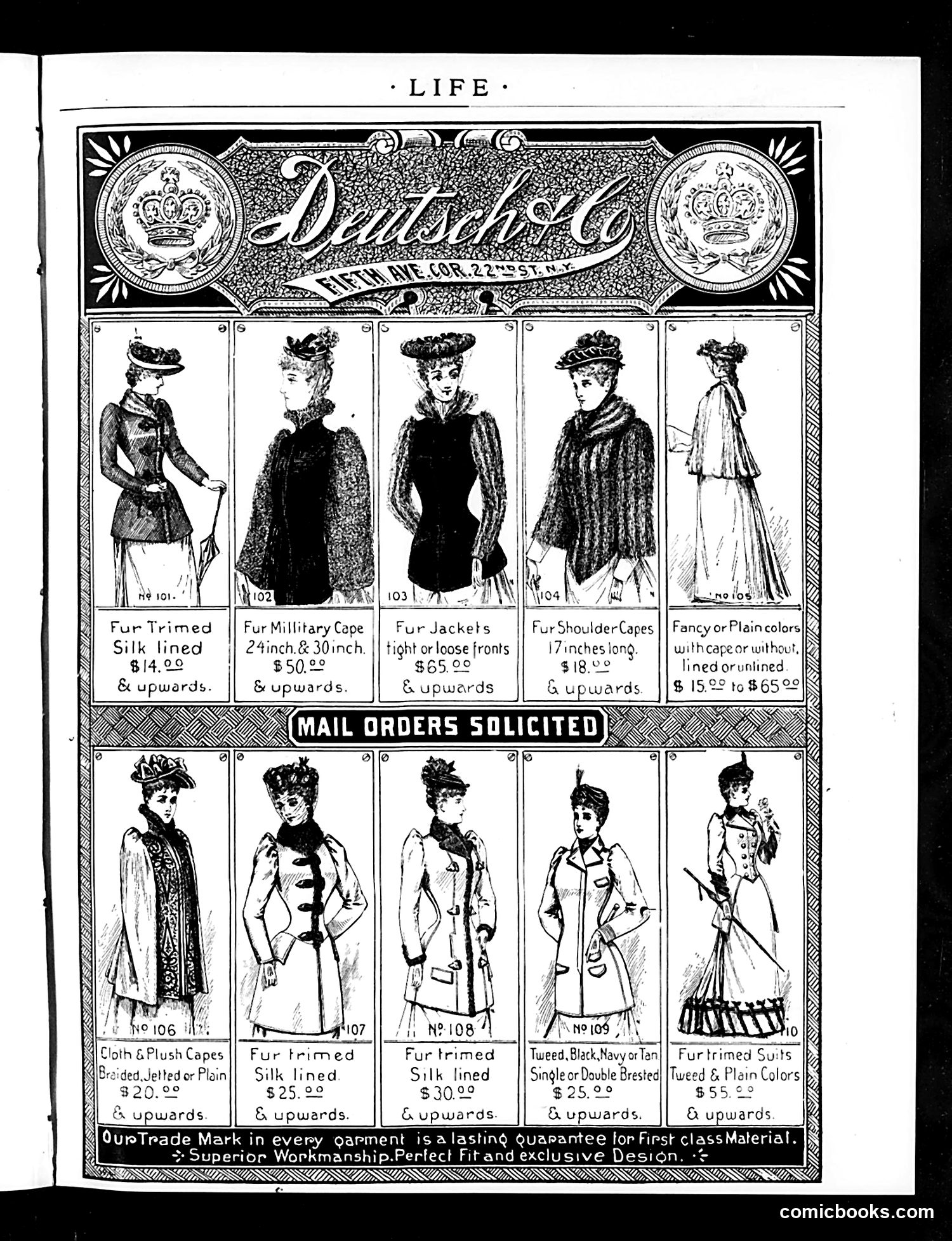
This is not a cartoon but a **mail-order fashion advertisement** from the Deutschco company (a German-American retailer, visible in the ornate header). It showcases ten women's garments from what appears to be the **early 1900s**: fur-trimmed capes, military-style cloaks, jackets, and suits. The page targets middle-to-upper-class women seeking fashionable outerwear. Prices range from $14–$65, substantial sums for the era. Items emphasize luxury materials—silk linings, fur trim, tweed—and tailored construction. The "MAIL ORDERS SOLICITED" banner indicates this reaches catalog customers nationwide. The guarantee at bottom ("Trade Mark in every garment is a lasting Guarantee for First class Material") emphasizes quality and brand reputation—typical of period advertising building consumer confidence in mail purchases. This is primarily **commercial content**, not satire.
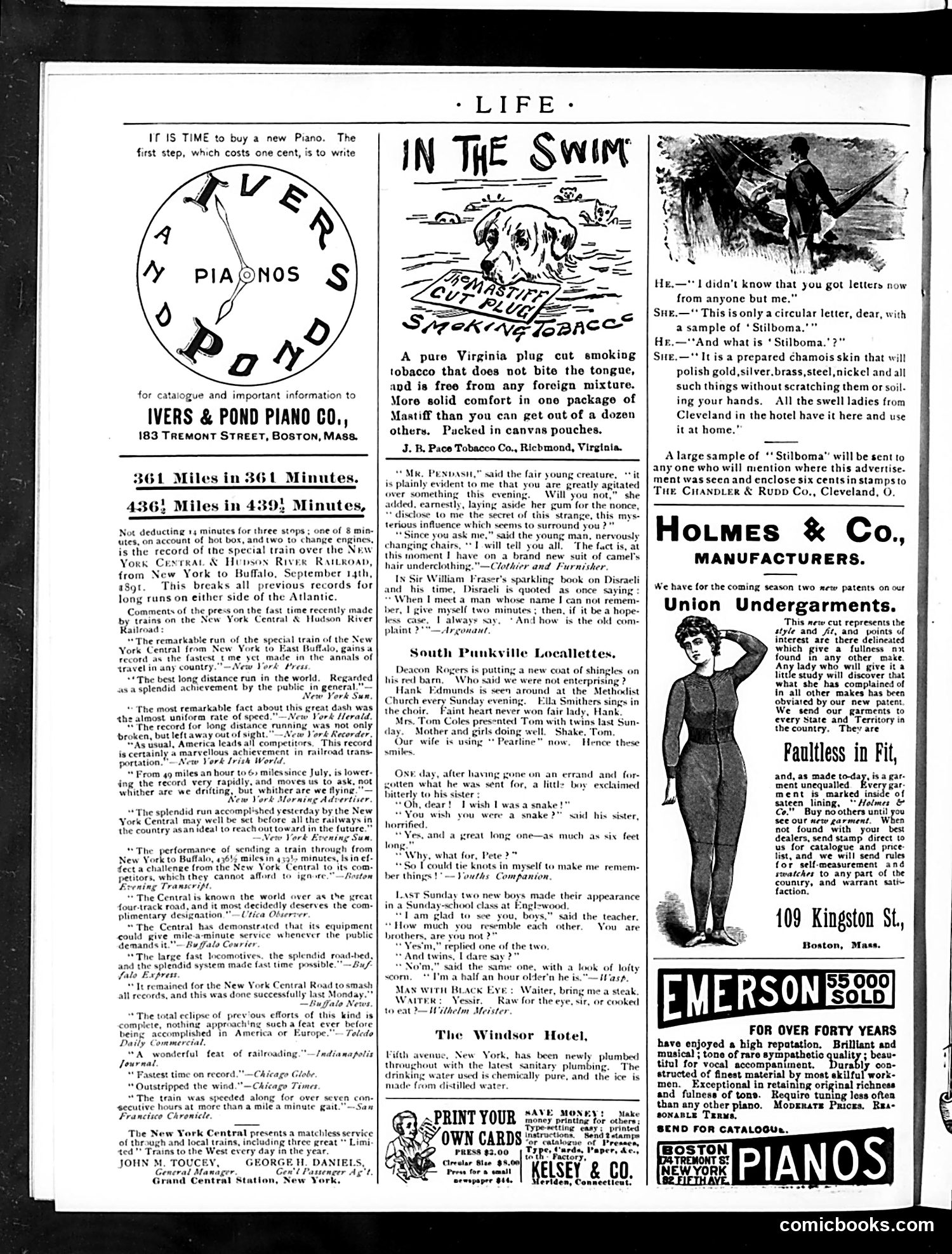
This page is primarily **advertising and promotional content** rather than political satire. The main elements are: **"In the Swim"** cartoon (center-top): A humorous domestic exchange where a husband boasts he receives letters only from his wife, while she mentions receiving a circular letter about "Siliboma"—a prepared chamois skin product for polishing metals. The joke is lightweight domestic banter about mail and consumer products. **Dominant content**: Multiple advertisements and promotional articles for pianos (Ivers & Pond), cigars (Mastiff tobacco), underwear (Holmes & Co.), and other merchandise. The largest section celebrates the New York Central Railroad's speed record: 436+ miles in 439+ minutes (essentially one mile per minute). **Historical context**: This reflects the era's obsession with transportation speed and technological progress. The railroad boasting and extensive press quotes demonstrate how such achievements were celebrated as national accomplishments. The page is typical of *Life* magazine's mixed editorial-advertising format rather than its famous satirical cartooning.