
Life, 1891-10-08 · page 12 of 16
Life — October 8, 1891 — page 12: what you’re looking at
What you’re looking at
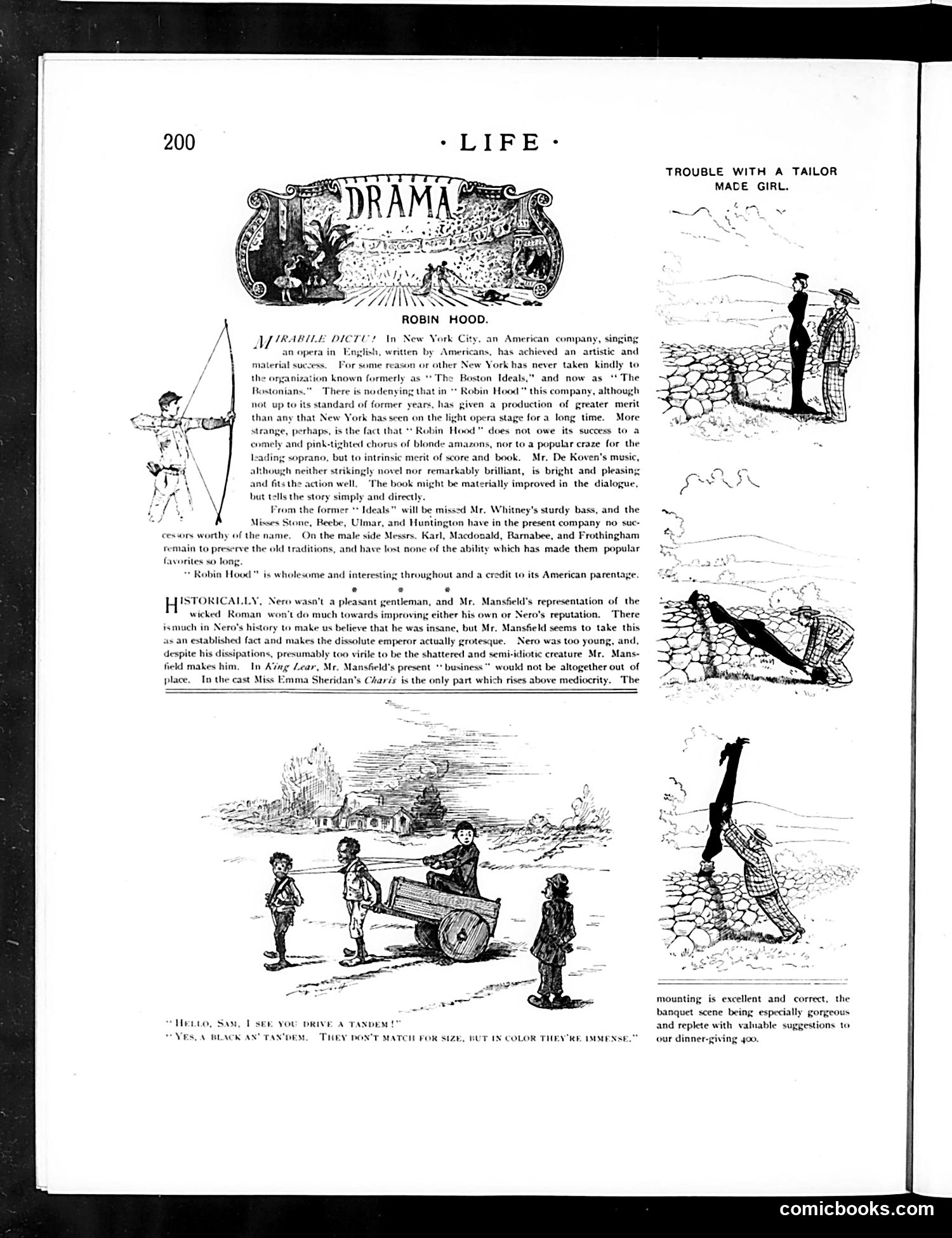
This *Life* magazine page reviews theatrical productions, primarily an American operatic adaptation of "Robin Hood" by the Bostonians company. The text praises the show's success despite New York's historical coldness toward American theatrical companies—unusual because it succeeds through artistic merit rather than spectacle (pretty chorus girls or star power). The page also critiques Richard Mansfield's performance as Nero, arguing he overplays the character's degeneracy in ways historically implausible and theatrically excessive. The cartoon illustrations (a tandem bicycle joke and a tailor scene) are humorous vignettes unrelated to the main reviews. For modern readers: this reflects late 19th-century American cultural anxiety about whether homegrown theater could match European standards, and contemporary debates about theatrical taste—spectacle versus substance, star power versus ensemble quality.
📄 Transcribed text from this page (OCR, searchable)
Machine-transcribed from the original scan — historical spelling and the odd misread are preserved.
ROBIN HOOD. |J/RABILE DICTU! In New ork City, an American company, singing * in. English, written by Americans, has achieved an artistic and material success. For some reason or other New York has never taken kindly to the organization known formerly as ‘The Boston Ideals," and now as ‘* The Rostonians,” There is nodenying that in * Robin Hood ” this company, although not up to its standard of former years, has given a production of greater merit than any that New York hasseen on the light opera stage fora long time. More strange, perhaps, is the fact that“ Robin Hood" does not owe its success to a comely and pink-tighted chorus of blonde amazons, nor to a popular craze for the leading soprano, but to intrinsic merit of se and book. Mr. De Koven's music, akhough neither strikingly novel nor remarkably brilliant, is bright and pleasing and fits the action well, ‘The book might be materially improved in the dialogu but tells the story simply and directly, Ideals" will be missed Mr, Whitney's sturdy bass, and the ar, and Huntington have in the present company no suc- + worthy of the name, On the male side Messrs. Karl, Macdonald, Rarnabee, and Frothingham remain to preserve the old traditions, and have lost none of the ability which has made them popular favorites so long. * Robin Hood” is wholesome and interesting throughout and a credit to its American parentage. * * e ISTORICALLY, Nero wasn't a pleasant gentleman, and Mr, Mansfeld’s representation of the wicked Roman won't do much towards improving either his own or Nero's reputation. ‘There ismuch in Nero's history to make us believe that he was insane, but Mr. Mansfield seems to take this ss. an established fact and makes the dissolute emperor actually grotesque. Nero was too young, and, despite his dissipations, presumably too virile to be the shattered and semi-idiotic creature Mr. Mans- field makes him. In Avng Lear, Mr, Mansfield’s present ** business” would not be altogether out of place. In the cast Miss Emma Sheridan's Charis is the only part which rises above mediocrity. The Heito, Saw, 1 see You DRIVE A TANDEM!" “VESON BLACK AN TANDEM. THEY DON'T MATCH FOR SIZE, HUT IN COLOR THEY'RE IMMENSE.” TROUBLE WITH A TAILOR MACE GIRL. mounting is excellent and correct, th banquet scene being especially gorgeous and replete with valuable suggestions to our dinner-giving 400. comicbooks.com