
Life, 1891-10-08 · page 9 of 16
Life — October 8, 1891 — page 9: what you’re looking at
What you’re looking at
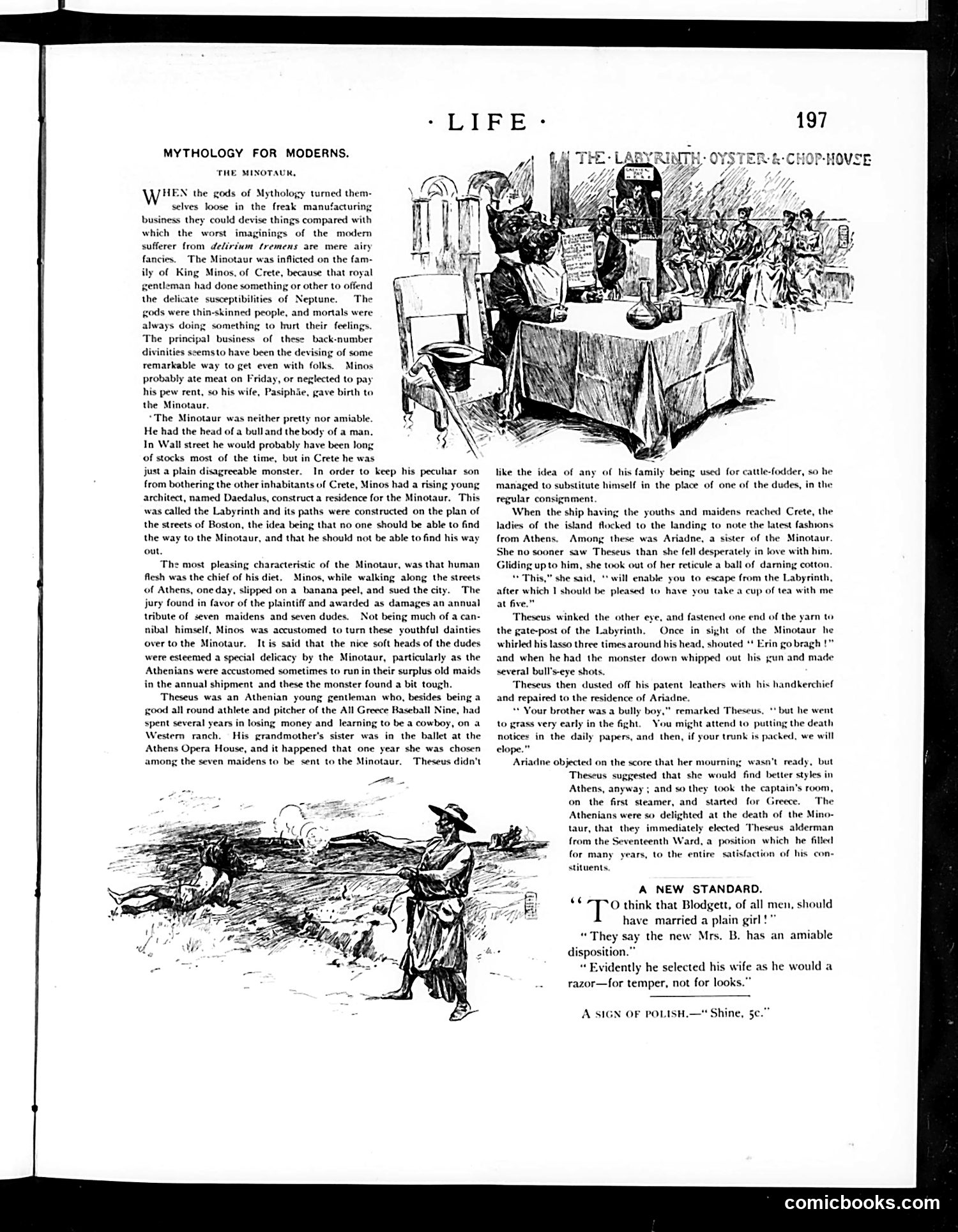
This page presents a satirical retelling of the classical Greek myth of the Minotaur for contemporary readers. The text humorously reimagines the monster as a product of modern industrial capitalism—born from King Minos's schemes to exploit even his own family for financial gain. The accompanying illustration (top right) depicts "The Labyrinth Oyster & Chop House," transforming the mythological maze into a restaurant, likely satirizing how ancient stories are commercialized and trivialized in modern American culture. Below are brief humorous anecdotes labeled "A New Standard" and "A Sign of Polish," offering witty social commentary on contemporary marriage and manners—typical of *Life* magazine's satirical approach to modern American life and pretensions.
📄 Transcribed text from this page (OCR, searchable)
Machine-transcribed from the original scan — historical spelling and the odd misread are preserved.
MYTHOLOGY FOR MODERNS. THE MINOTAUR, WHEN the gods of Mythology tured them- selves loose in the freak manufacturing business they could devise things compared with which the worst imaginings of the modem sufferer from delirium tremens are mere airy fancies. The Minotaur was inflicted on the fam- ily of King Minos, of Crete, because that royal gentleman had done something or other to offend the delicate susceptibilities of Neptune. The gods were thin-skinned people, and mortals were always doing something to hurt their feelings. The principal business of these back-number divinities seemsto have been the devising of some remarkable way to get even with folks. Minos probably ate meat on Friday, or neglected to pay his pew rent, so his wife, Pasiphie, gave birth to the Minotaur. *The Minotaur was neither pretty nor amiable. He had the head of a bull and the body of a man, In Wall street he would probably have been long of stocks most of the time, but in Crete he was just a plain disagreeable monster. In order to keep his peculiar son from bothering the other inhabitants of Crete, Minos had a rising young, architect, named Daedalus, construct a residence for the Minotaur. This was called the Labyrinth and its paths were constructed on the plan of the streets of Boston, the idea being that no one should be able to find the way to the Minotaur, and that he should not be able to find his way out. The most pleasing characteristic of the Minotaur, was that human flesh was the chief of his diet. Minos, while walking along the streets of Athens, one day, slipped on a banana peel, and sued the city. The jury found in favor of the plaintiff and awarded as damages an annual tribute of seven maidens and seven dudes. Not being much of a can- nibal himself, Minos was accustomed to turn these youthful dainties over to the Minotaur. It is said that the nice soft heads of the dudes were esteemed a special delicacy by the Minotaur, particularly as the Athenians were accustomed sometimes to run in their surplus old maids in the annual shipment and these the monster found a bit tough. ‘Theseus was an Athenian young gentleman who, besides being a good all round athlete and pitcher of the All Greece Baseball Nine, had spent several years in losing money and learning to be a cowboy, on a Westem ranch. His grandmother's sister was in the ballet at the Athens Opera House, and it happened that one year she was chosen among the seven maidens to be sent to the Minotaur. Theseus didn’t like the idea of any of his family being used for cattle-fodder, so he managed to substitute himself in the place of one of the dudes, in the regular consignment. When the ship having the youths and maidens reached Crete, the ladies of the istand flocked to the landing to note the latest fashions from Athens. Among these was Ariadne, a sister of the Minotaur. She no sooner saw Theseus than she fell desperately in love with hi Gliding upto him, she took out of her reticule a ball of damning cotton. This,” she said, ‘will enable you to escape from the Labyrinth, after which I should be pleased to have you take a cup of tea with me at five.” ‘Theseus winked the other eye, and fastened one end of the yarn to the gate-post of the Labyrinth, Once in sight of the Minotaur he whirled his lasso three times around his head, shouted ‘ Erin go bragh !" and when he had the monster down whipped out his un and made several bull’seye shots. ‘Theseus then dusted off his patent leathers with his handkerchief and repaired to the residence of Ariadne. * Your brother was a bully boy,” remarked Theseus, ** but he went to grass very early in the fight. You might attend to putting the death notices in the daily papers, and then, if your trunk is packed, we will elope.” Ariadne objected on the score that her mourning wasn't ready, but Theseus suggested that she would find better styles in Athens, anyway ; and so they took the captain's room, on the first steamer, and started for Greece. The Athenians were so delighted at the death of the Mino- taur, that they immediately elected Theseus alderman from the Seventeenth Ward, a position which he filled for many years, to the entire satisfaction of his con- stituents. A NEW STANDARD. $67 0 think that Blodgett, of all men, should have married a plain girl!” “They say the new Mrs. B. has an amiable disposition.” Evidently he selected his wife as he would a razor—for temper, not for looks. A SIGN OF POLISH.— comicbooks.com