
A complete issue · 14 pages · 1891
Life — August 6, 1891
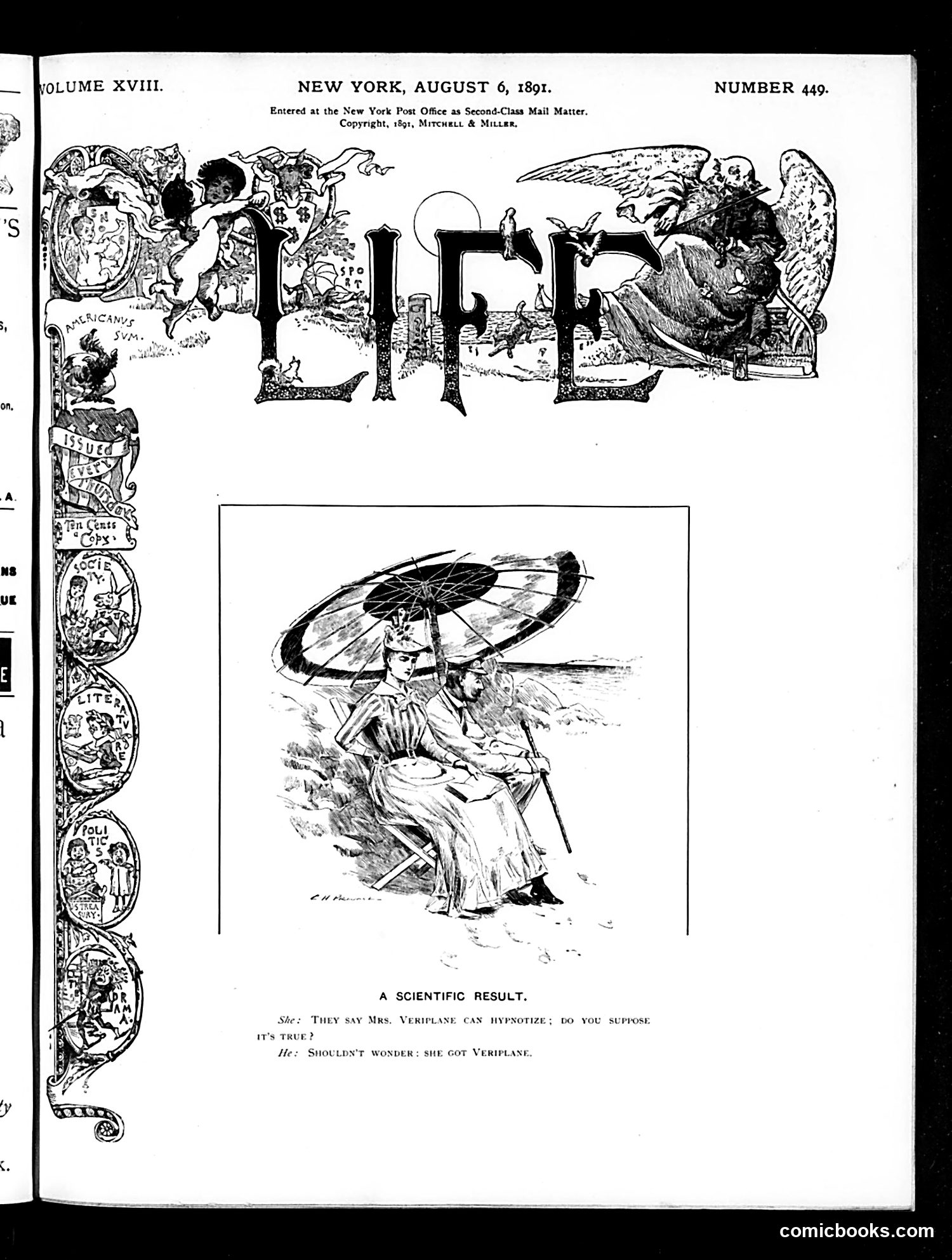
This cartoon satirizes the then-popular phenomenon of mesmerism (hypnotism). The caption presents a mock dialogue: **She:** "They say Mrs. Veriplane can hypnotize; do you suppose it's true?" **He:** "Shouldn't wonder: she got Veriplane." The joke turns on the name "Veriplane"—suggesting he's so thoroughly under her hypnotic influence that she's essentially "very plain" yet he remains mesmerized by her. The cartoon mocks both the pseudoscience of mesmerism (popular in the 1890s) and marital dynamics, suggesting a husband is inexplicably enchanted by an unremarkable wife. The illustration shows a couple sharing an umbrella, depicting the supposed hypnotic state as romantic submission.
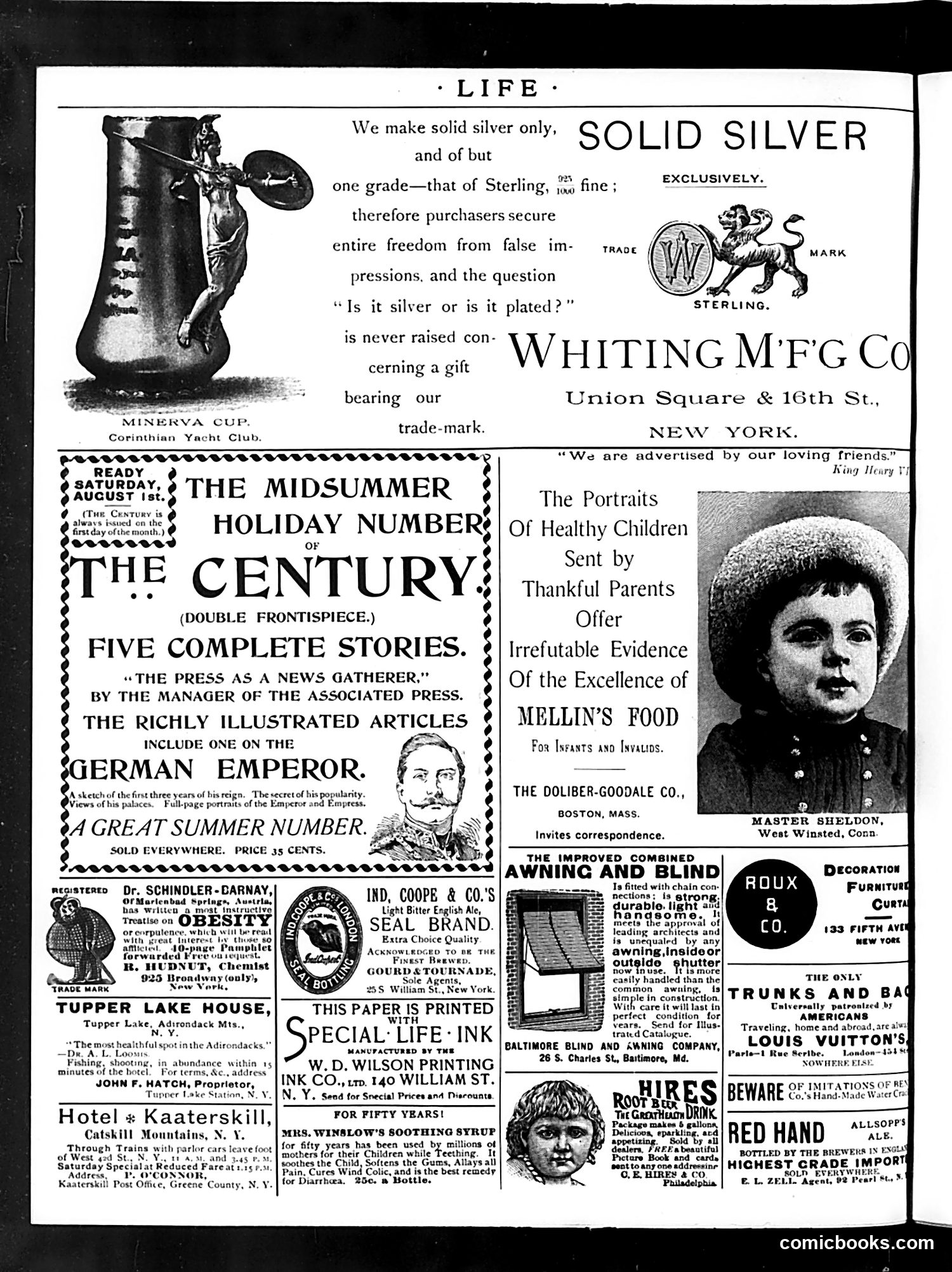
This page is **primarily advertising**, not satire or political commentary. The content includes: **Main advertisements:** - Whiting Manufacturing Co. promoting solid silver goods (Minerva Cup shown) - The Century magazine's midsummer holiday issue - Tupper Lake House hotel - Mellin's Food for infants - Various other period products (awnings, trunks, inks, syrups, ale) **Notable elements:** A portrait labeled "Master Sheldon, West Winsted, Conn" appears as testimonial imagery for Mellin's Food—a common advertising practice using healthy children to endorse infant nutrition products. The "German Emperor" reference in The Century ad likely refers to contemporary coverage of Kaiser Wilhelm II, though specific context isn't clear from this excerpt. Overall, this is a commercial page reflecting turn-of-century American consumer culture rather than political satire.
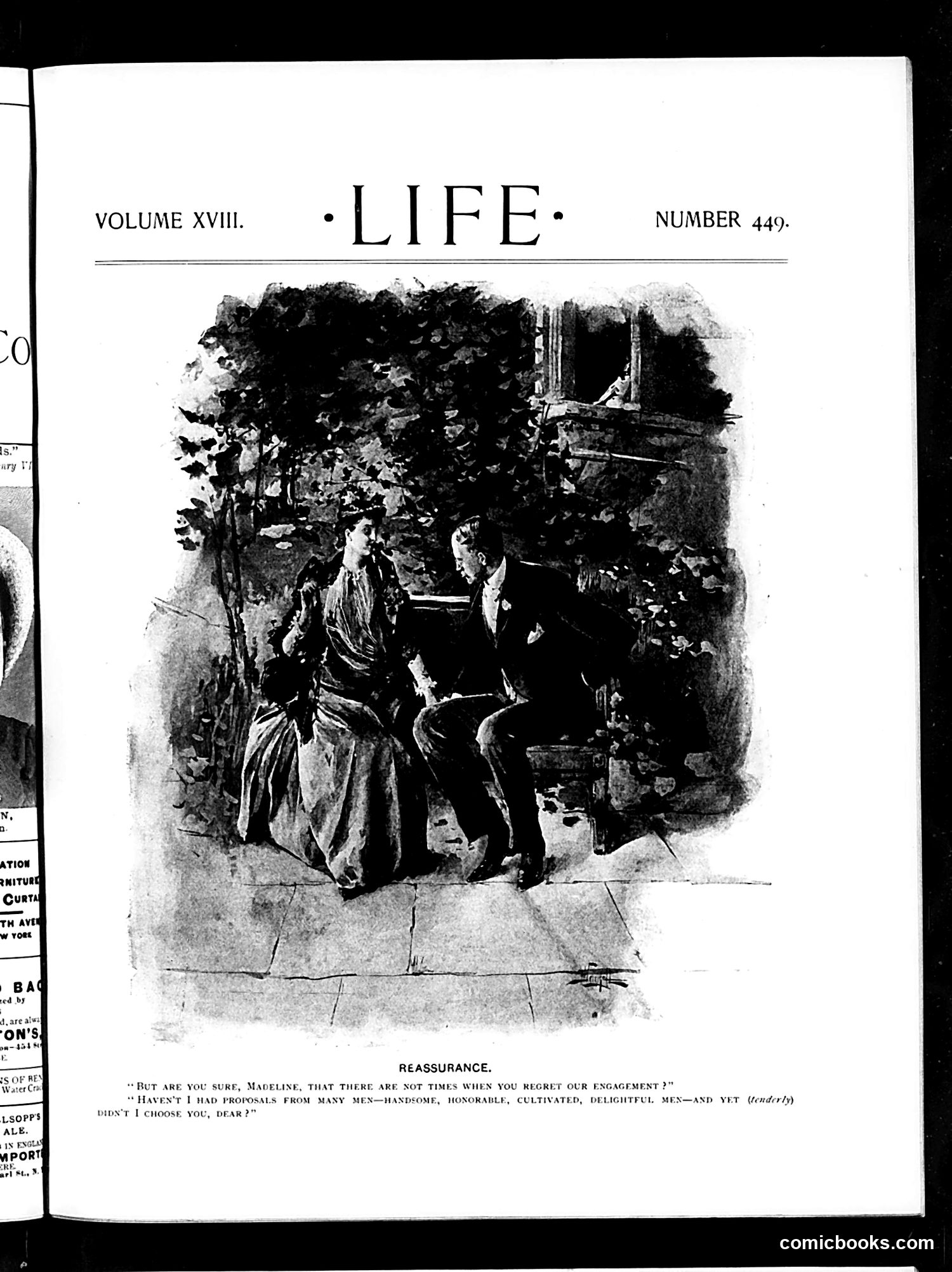
This illustration depicts a romantic scene titled "Reassurance," showing a couple in an intimate garden setting. The dialogue reveals the cartoon's satirical point: a man is reassuring his female companion (Madeline) that despite having received "proposals from many men—handsome, honorable, cultivated, delightful men," he chose her instead. The satire targets male courtship rhetoric of the era. The man's reassurance is backhanded—he's essentially saying "I had better options, but I picked you anyway," which he presents as romantic devotion. The joke mocks how men frame marriage proposals as magnanimous choices rather than mutual commitments, treating women as selected from a marketplace of alternatives rather than as equals in a partnership decision.
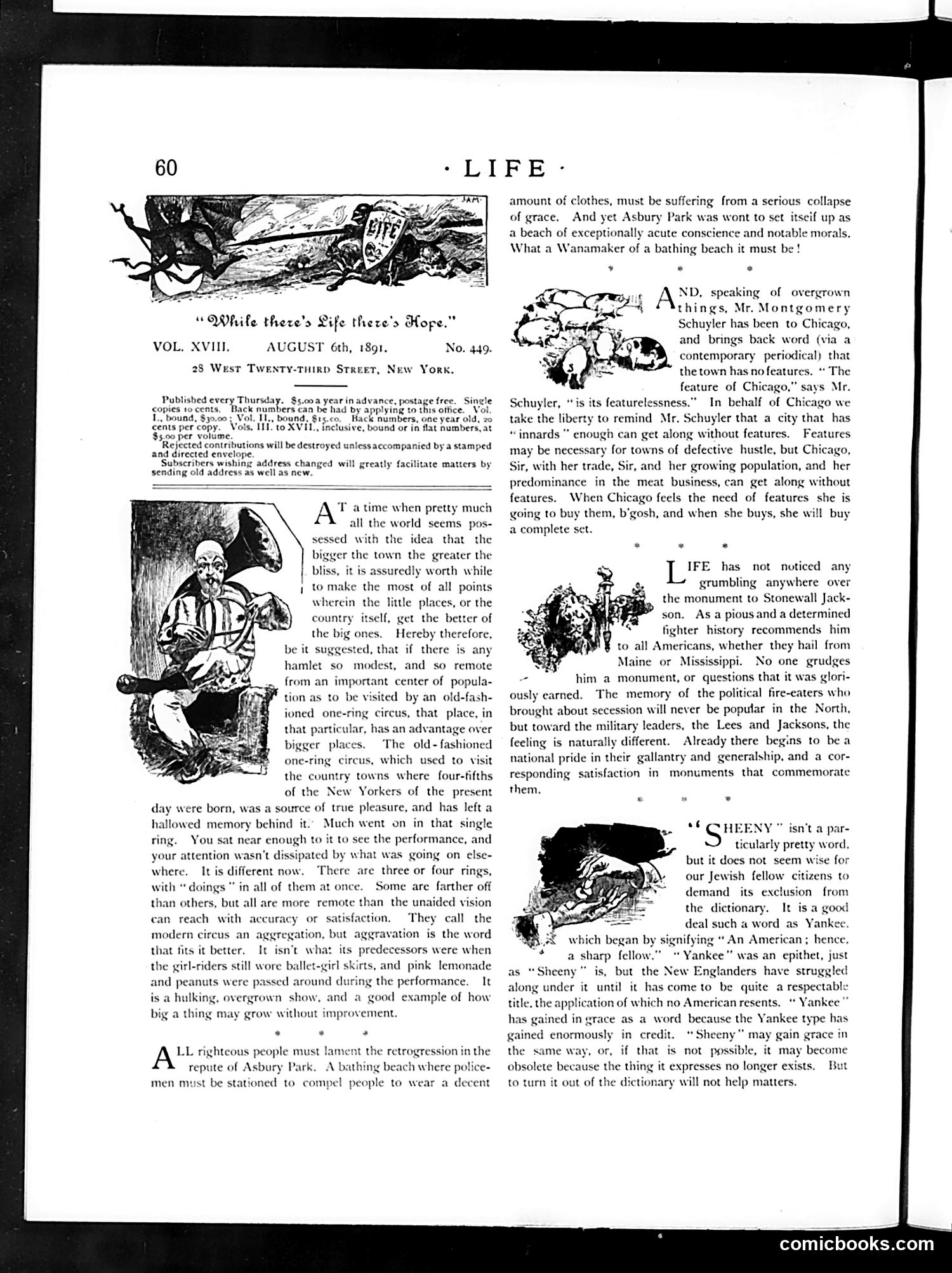
This page contains three satirical pieces addressing contemporary social issues: 1. **Asbury Park Beach Controversy**: The opening criticizes police enforcement of modest bathing attire at Asbury Park, New Jersey. The satire suggests that requiring "decent" clothing at beaches is prudish overreach—the irony being that people must suffer "collapse of grace" by overdressing at a bathing beach. 2. **Chicago's Featurelessness**: A piece mocks Chicago's lack of distinctive character despite its growth and commercial success. The author argues the city needs architectural or cultural "features" to distinguish itself. 3. **"Sheeny" Word Usage**: The final section debates whether the term "sheeny" (a derogatory Yiddish slur for Jewish people) should remain in the dictionary, arguing some obsolete words should be removed rather than preserved.
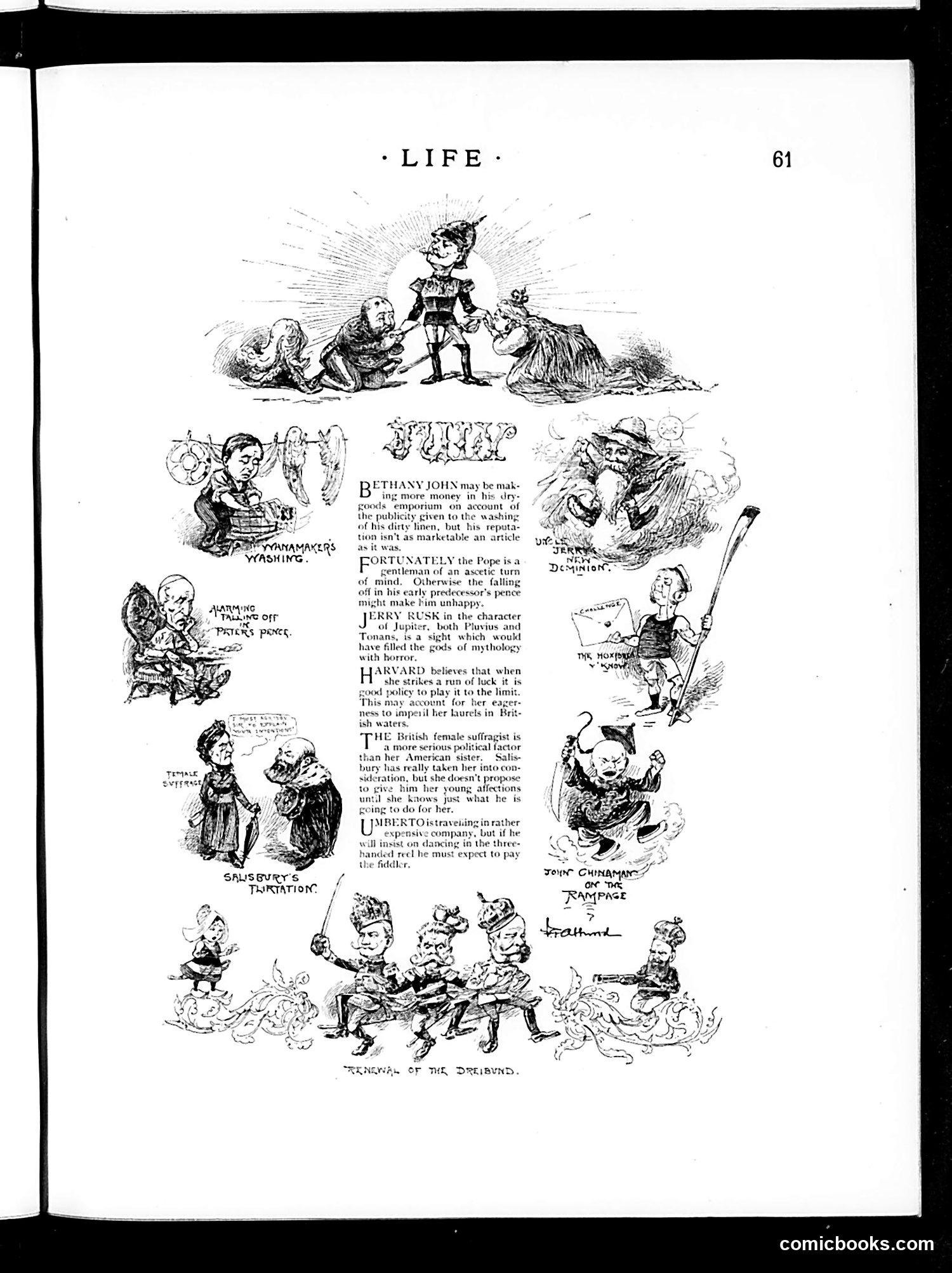
This page contains multiple satirical sketches commenting on contemporary social and political figures, likely from the early 1900s. The central text section uses drop-cap letters to introduce brief commentaries on various topics: - **Bethany John**: Makes money from laundry through questionable practices - **Fortune & the Pope**: References papal authority and ecclesiastical concerns - **Jerry & the Gods**: Appears to joke about classical mythology - **Harriet**: References luck and horse racing - **The British Female Suffragist**: Contrasts British suffragettes with American counterparts, noting political seriousness - **Umberto**: Apparently about expensive entertainment preferences The surrounding illustrations are caricatures depicting these subjects. The bottom scene labeled "Kennel of the Dachshund" shows multiple small figures, likely a visual pun. The overall tone is satirical commentary on contemporary social movements, politics, and public figures.
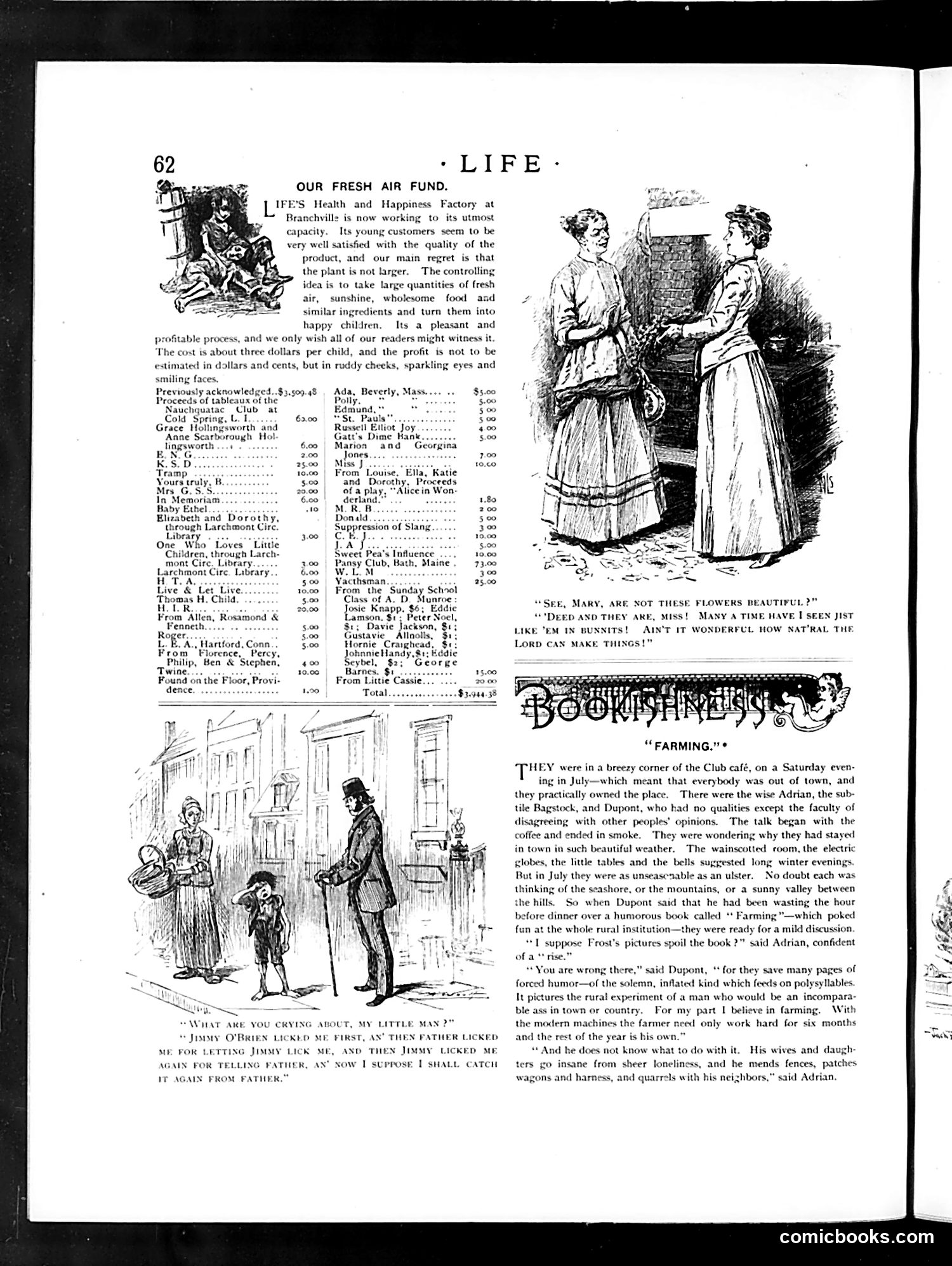
This page contains two distinct elements: **Upper section:** "Our Fresh Air Fund" — a fundraising appeal listing donations to LIFE's charitable initiative providing fresh air, sunshine, and wholesome food to children. The accompanying illustration shows children enjoying outdoor play, emphasizing the program's purpose. **Lower section:** "Farming" — a short story or sketch depicting a conversation between urban characters (Adrian, Dupont, and others) at a Club café. The dialogue humorously contrasts city dwellers' romanticized notions of rural life with Adrian's pragmatic farmer's perspective: farming requires year-round hard work, and rural wives endure isolation, constant labor (mending, cooking, gardening), and livestock management. The satire mocks the urban fantasy of idyllic country living, juxtaposing leisure-class assumptions against agricultural reality.
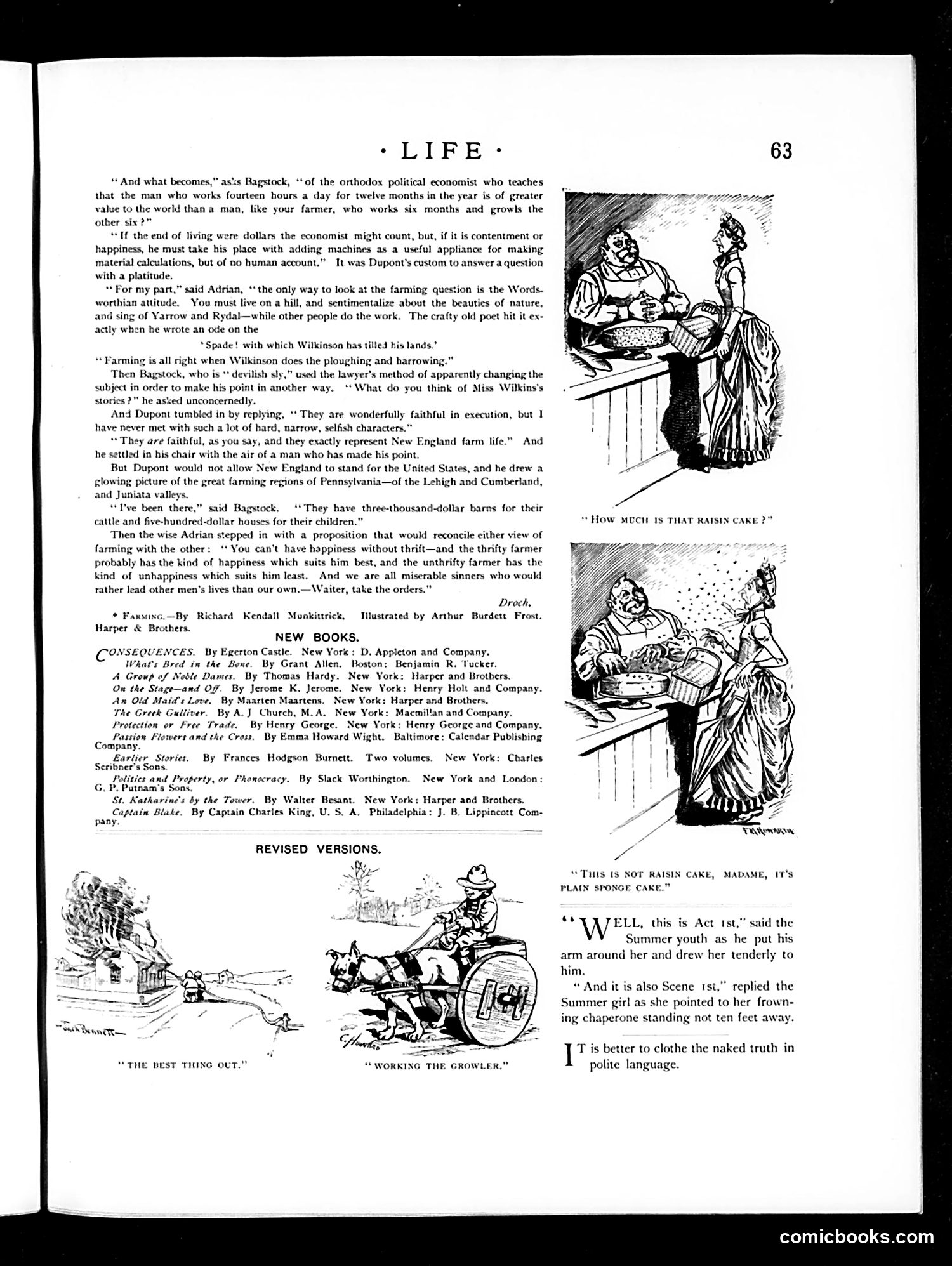
This page satirizes debates about farming and rural economics. The text discusses economists' arguments about agricultural labor—specifically whether farmers working long hours contribute more to society than leisurely wealthy industrialists. The cartoon dialogue mocks gender and class pretensions: a woman asks "How much is that raisin cake?" A Summer youth (appearing to be from a wealthy background) corrects her, saying it's a "sponge cake," and later insists "It is better to clothe the naked truth in polite language"—satirizing upper-class affectation and euphemism. The humor targets both rural simplicity and urban gentility, reflecting early-20th-century tensions between agricultural and industrial economies, and between working-class directness and bourgeois propriety.
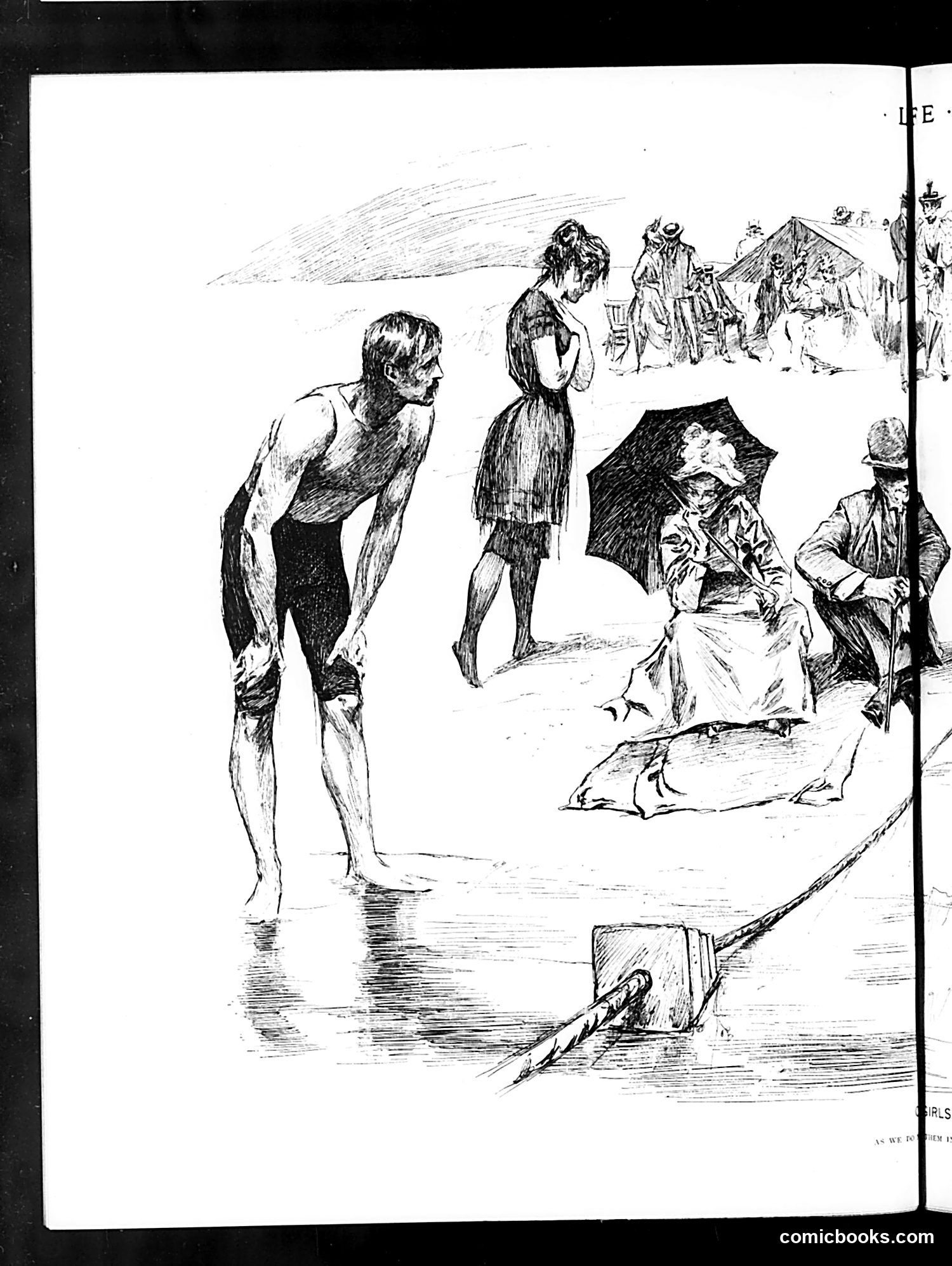
This appears to be a satirical beach scene from Life magazine. The central figure is a thin, hunched man in swimming attire standing in shallow water, drawn in an exaggerated, unflattering style. He's positioned awkwardly before an audience of well-dressed beachgoers, including a woman with an umbrella and several observers in the background. The satire likely targets either a specific public figure or the broader social phenomenon of public bathing and body-consciousness at beaches during the era when Life published such material. The man's grotesque physique and the onlookers' apparent reactions suggest mockery of either vanity, social pretension, or physical inadequacy—common themes in early satirical magazines. Without visible text identifying the figure, the specific target remains unclear.
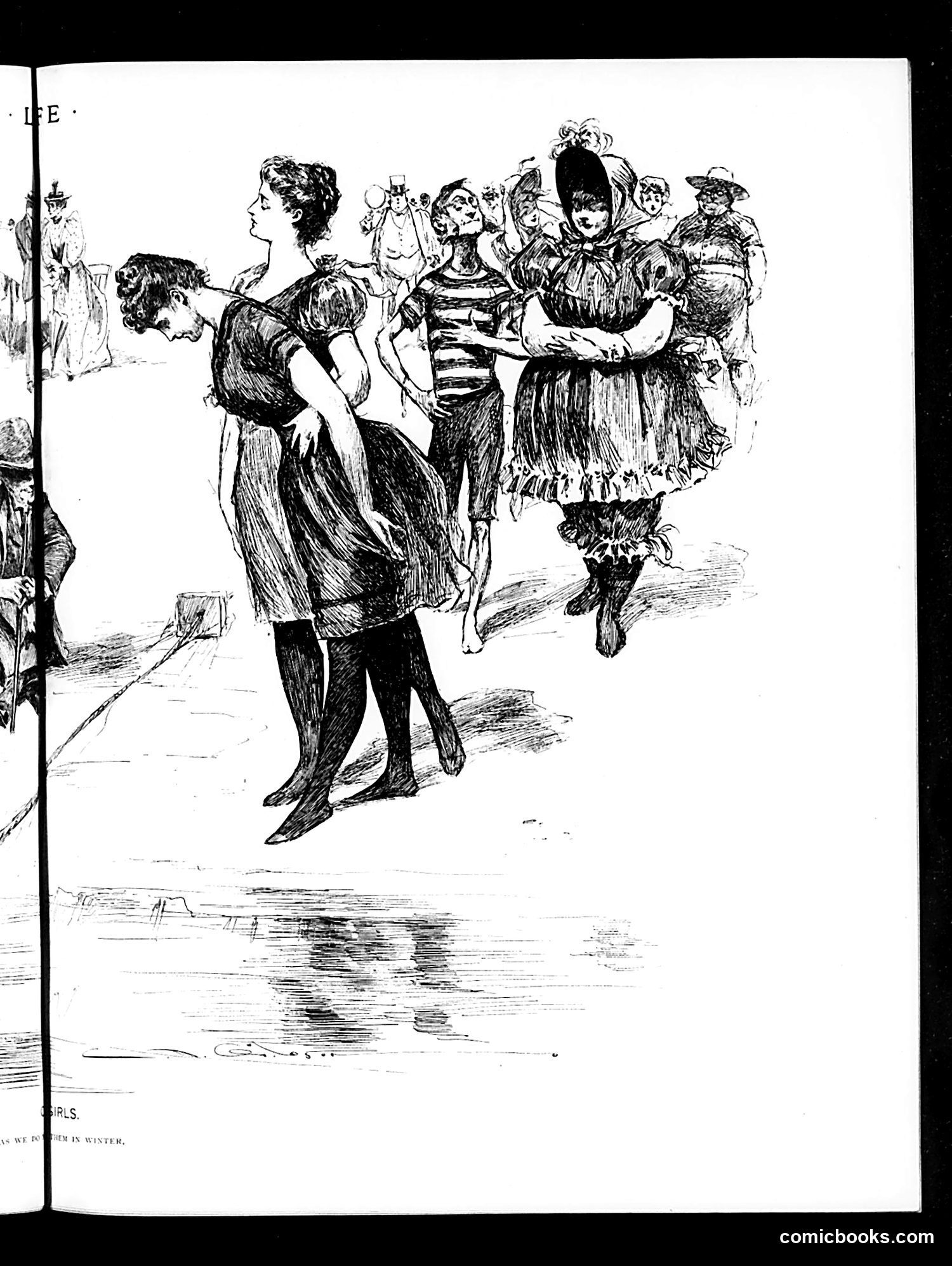
This is a satirical illustration from *Life* magazine depicting a social scene, likely from the late 19th or early 20th century based on the clothing styles and artistic technique. The cartoon shows a woman in dark dress watching a group of elegantly dressed women and men in fashionable attire (including one figure in striped dress and elaborate hats). The composition suggests social observation or commentary on class differences or fashion consciousness. The caption text is partially obscured, though "GIRLS" appears visible at bottom left. Without clearer caption text, the specific satirical point remains unclear—whether this critiques excessive fashion displays, social climbing, or women's behavior in high society. The style of dress and gathering suggests commentary on contemporary social customs or pretension among the wealthy.
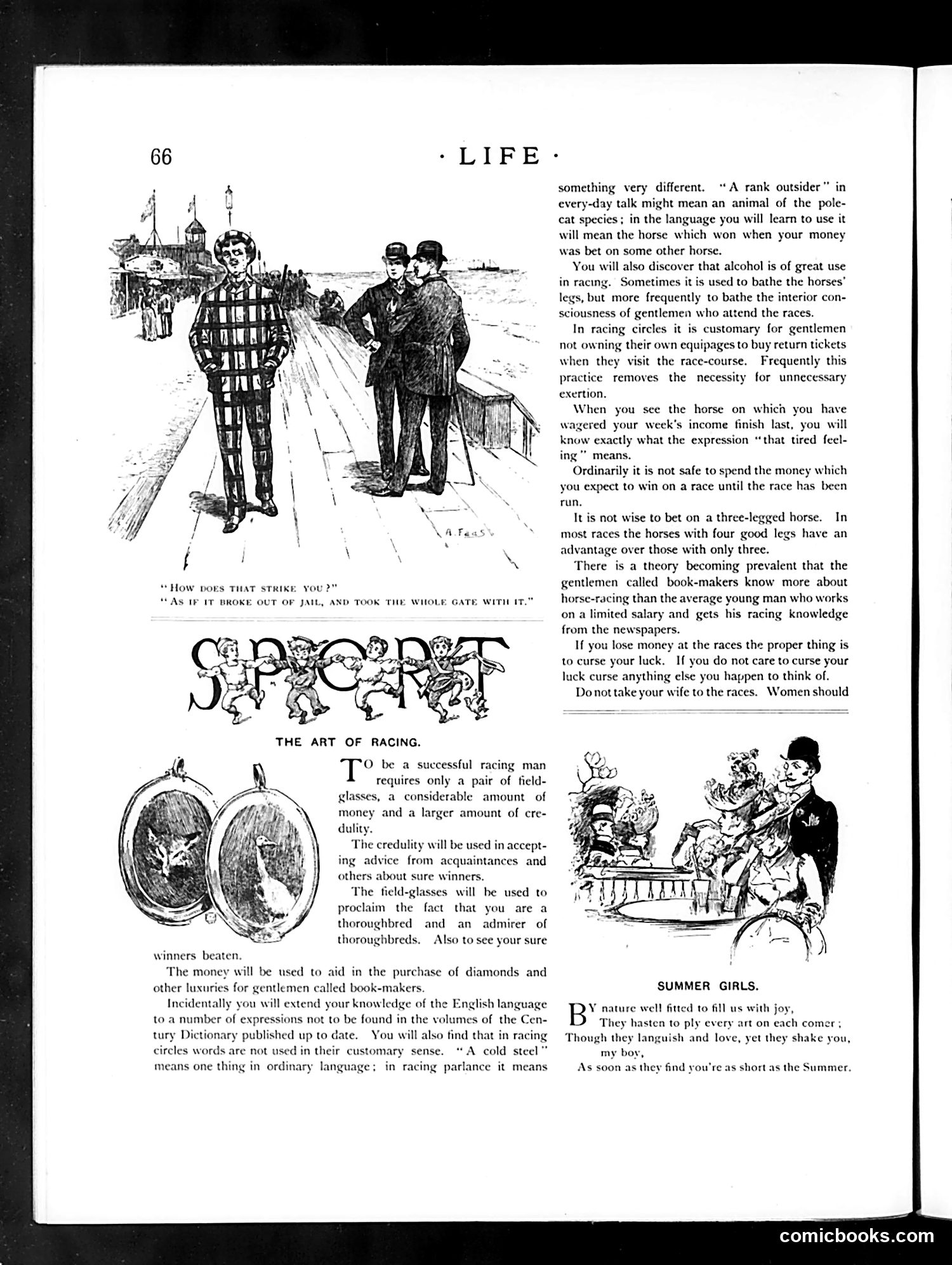
This page satirizes horse-racing culture among wealthy gentlemen. The top illustration shows three men at a racetrack, with the caption "How does that strike you?" implying one man just lost significant money betting on horses. **The satire targets:** - Wealthy men's obsession with horse racing and gambling - The financial recklessness of betting one's weekly income on races - The use of "field glasses" and affected vocabulary to appear sophisticated about racing - Credibility based on claimed insider knowledge rather than actual expertise - The foolishness of taking wives to races (implied disapproval) The text humorously describes racing jargon, warns against betting money you can't afford to lose, and mocks the pretension of amateur racing enthusiasts who lack genuine knowledge but affect expertise through fashion and vocabulary.
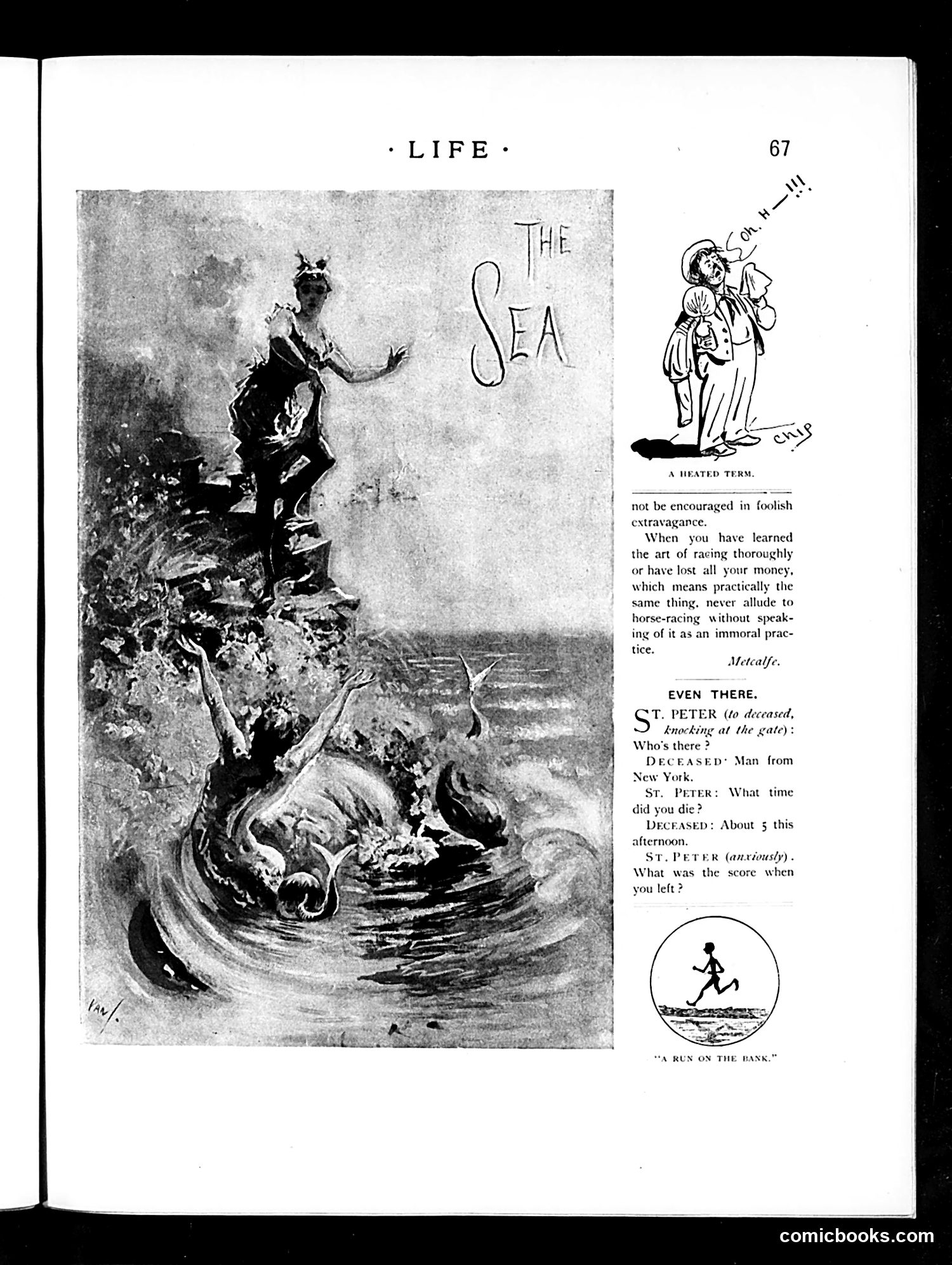
The large illustration titled "THE SEA" depicts a figure (appears to be Neptune or a sea deity) emerging from turbulent ocean waves, gesturing dramatically. This allegorical image likely represents anxieties about maritime or naval matters, though the specific historical reference is unclear without dating context. The text section "EVEN THERE" presents a satirical dialogue between St. Peter and a deceased man from New York, humorously suggesting that even in the afterlife, one cannot escape concerns about horse-racing and gambling losses. The joke mocks American preoccupation with betting and financial speculation. Two smaller cartoons accompany the text: one showing figures discussing improper behavior, another depicting "A RUN ON THE BANK"—a visual pun about financial panic.
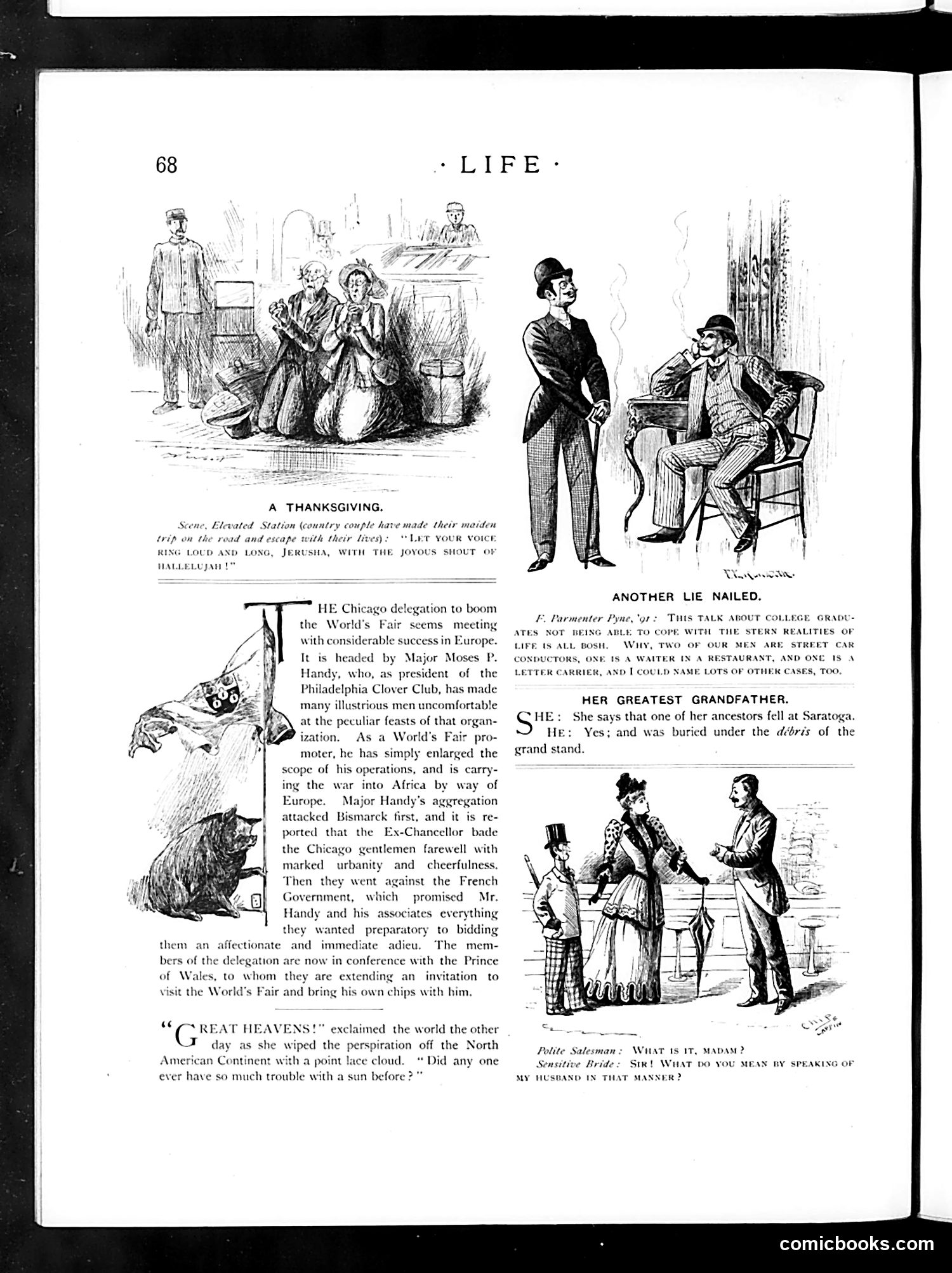
This page contains three satirical cartoons and commentary typical of late-19th-century American humor: **"A Thanksgiving"** depicts rural newcomers to the city experiencing their first elevated train ride—they survive and give thanks, satirizing small-town people's fear of modern technology. **The main article** mocks Moses P. Handy, president of Philadelphia's Clover Club, who's promoting the World's Fair in Europe. The satire targets his aggressive self-promotion, depicting him "carrying war into Africa by way of Europe" through diplomatic visits to Bismarck, the French government, and the Prince of Wales—exaggerating his importance while poking fun at American boosterism. **"Another Lie Nailed"** jokes that college graduates *can* handle real life—they're street car conductors, restaurant waiters, and mail carriers. The satire ironically "proves" their success by listing menial jobs. **"Her Greatest Grandfather"** plays on social pretension: a woman boasts of an ancestor who "fell at Saratoga" (Revolutionary War battle), but he was actually buried under the grandstand—suggesting a far less dignified demise, mocking genealogical snobbery.
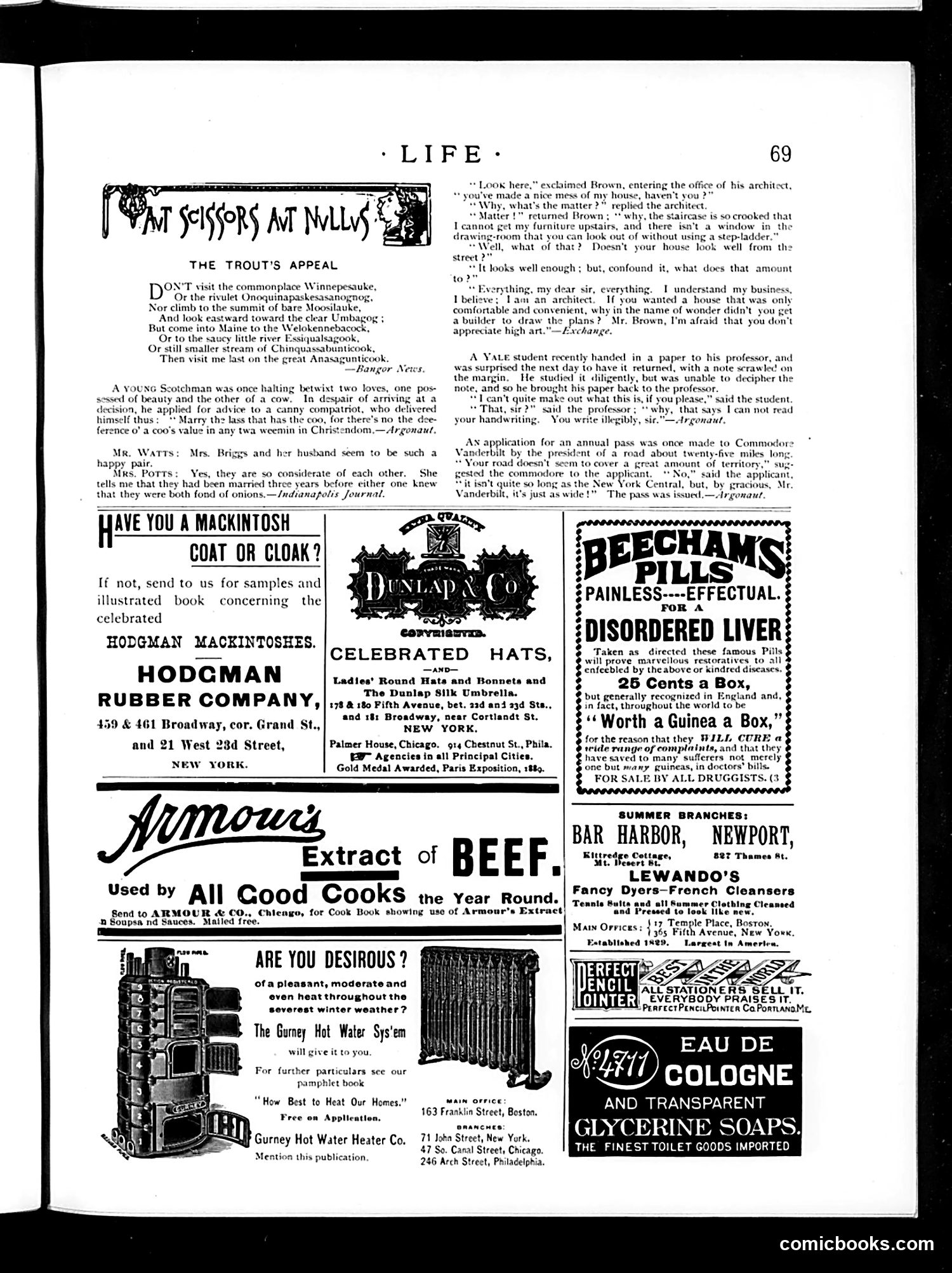
This page is primarily advertisements interspersed with brief comic anecdotes, typical of *Life* magazine's format. **The humor pieces** consist of short, non-illustrated jokes: - A satirical exchange between a homeowner (Brown) and his architect about prioritizing appearance over functionality - A trout urging readers not to visit well-known fishing spots, instead seeking obscure Maine rivers (a nature/tourism joke) - Miscellaneous one-liners about Scottish courtship advice, marital happiness, and an exchange between Commodore Vanderbilt and a railroad company president **The advertisements** promote period products: Hodgman mackintoshes, Dunlap hats, Armour's beef extract, Gurney water heaters, Beecham's Pills (a patent medicine), Lewando's cleaners, and cologne/glycerine soaps. The cartoon/anecdote humor relies on wordplay and social observation rather than visual satire. No specific political figures are identifiable. This page reflects turn-of-century attitudes about genteel taste, business dealings, and consumerism.
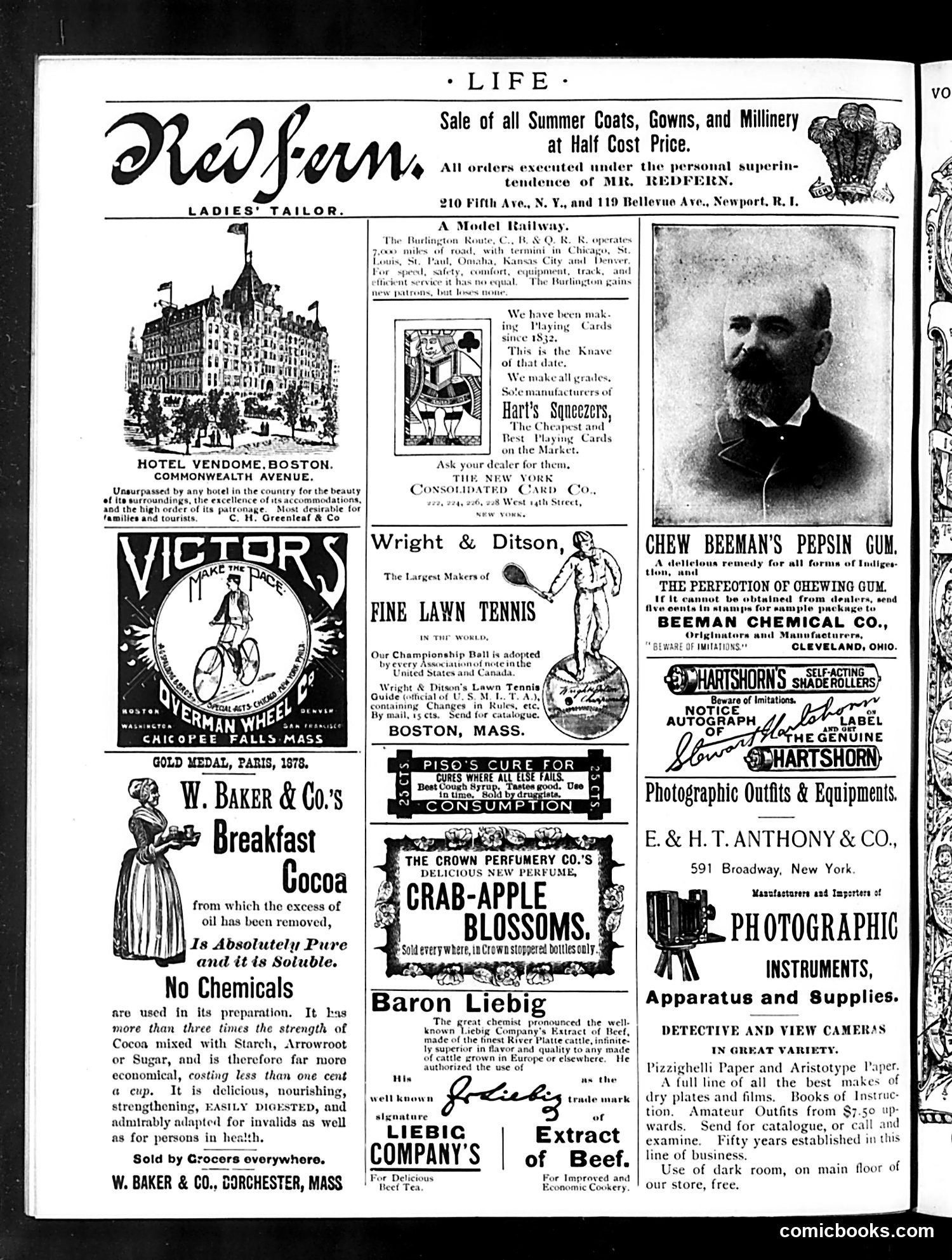
This page is **predominantly advertising**, not satirical content. It represents a typical late-19th-century Life magazine layout mixing commercial endorsements with minimal editorial content. The advertisements showcase products targeting middle- and upper-class consumers: women's tailoring services, hotel accommodations, sporting goods (tennis equipment), patent medicines (Beeman's Pepsin Gum, Piso's Cough Cure), breakfast cocoa, perfume, and photographic equipment. Notable is the **Baron Liebig Extract of Beef** advertisement, featuring what appears to be a bearded man's portrait—likely the historical chemist Justus von Liebig, whose name endorsed a popular beef extract product. This reflects the era's trust in scientific names for commercial legitimacy. The "Model Railway" and playing card references suggest contemporary technological and leisure interests. Overall, the page illustrates how Life functioned as both satirical commentary and a vehicle for advertising to affluent readers, with commercial content often dominating layout space.