
Life, 1891-08-06 · page 4 of 14
Life — August 6, 1891 — page 4: what you’re looking at
What you’re looking at
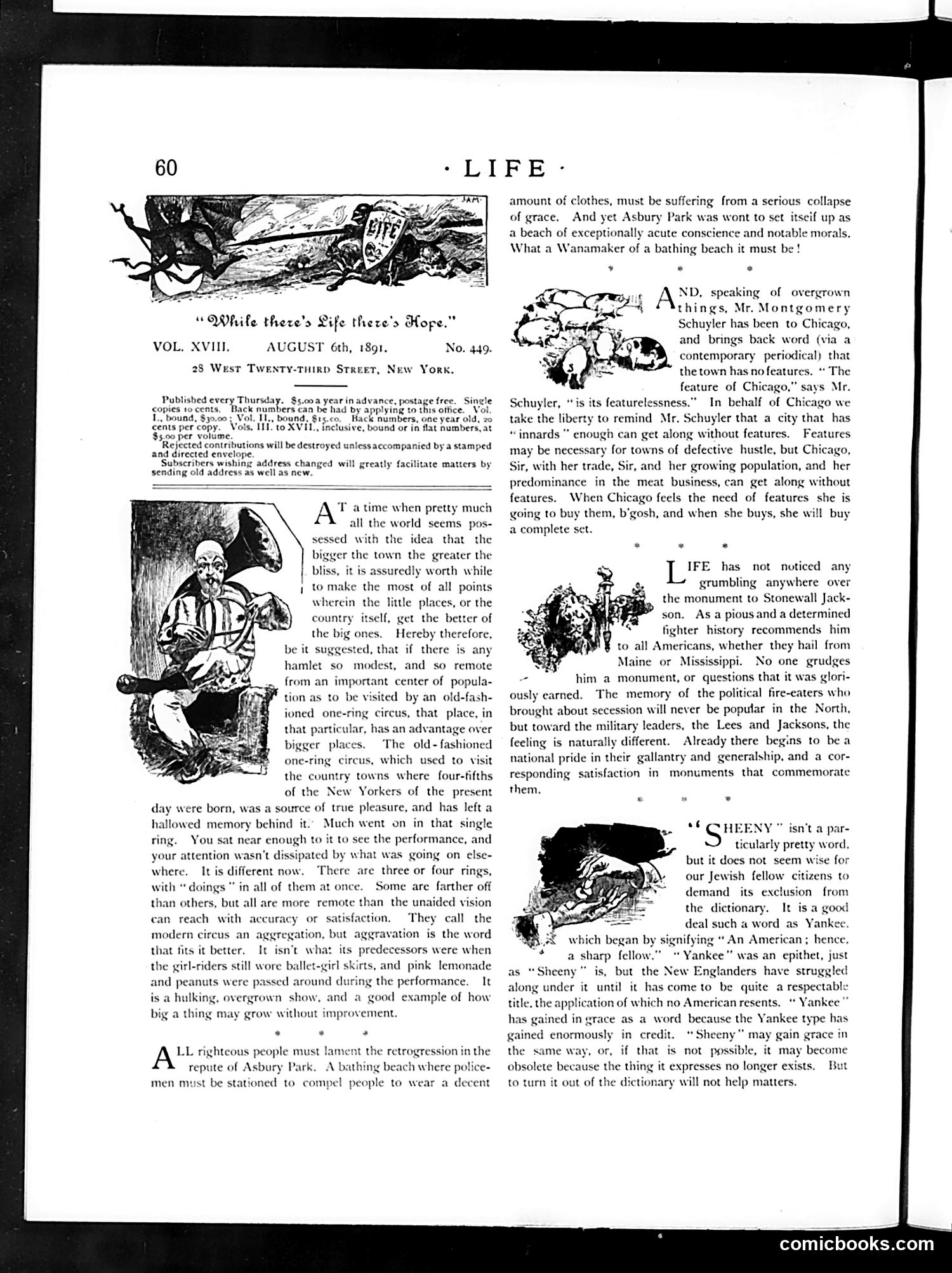
This page contains three satirical pieces addressing contemporary social issues: 1. **Asbury Park Beach Controversy**: The opening criticizes police enforcement of modest bathing attire at Asbury Park, New Jersey. The satire suggests that requiring "decent" clothing at beaches is prudish overreach—the irony being that people must suffer "collapse of grace" by overdressing at a bathing beach. 2. **Chicago's Featurelessness**: A piece mocks Chicago's lack of distinctive character despite its growth and commercial success. The author argues the city needs architectural or cultural "features" to distinguish itself. 3. **"Sheeny" Word Usage**: The final section debates whether the term "sheeny" (a derogatory Yiddish slur for Jewish people) should remain in the dictionary, arguing some obsolete words should be removed rather than preserved.
📄 Transcribed text from this page (OCR, searchable)
Machine-transcribed from the original scan — historical spelling and the odd misread are preserved.
“While there's Life there's Hope.” VOL, XVIII. AUGUST 6th, 1891. No. 449. 28 West Twenty-Tiirp Street, New York. Published every Thursday, $5.00 year in advance, postage free. Sin: copies 10 cents, Back numbers can be had by applying to this office. _ Vol 1., bound, $39.00; Vol. IL., $15.co. Hack numbers, one year old, 20 cents per copy. Vols, III) to XVIL., inclusive, bound or in flat numbers, at $5.00 per volume Rejected contributions will be destroyed unless accompanied bya stamped and directed envelope. Subscribers wishing address changed will greatly facilitate matters by sending old address as well as new. atime when pretty much all the world seems pos- sessed with the idea that the er the town the greater the bliss, it is assuredly worth while to make the most of all points whercin the little places, or the country itself, get the better of the big ones. Hereby therefore, be it sugges d, that if there is any hamlet so modest, and so remote from an important center of popula- tior sited by an old-fash- ioned one-ring circus, that place, in that particular, has an advantage over bigger pla he old-fashioned one-ring circus, which used to visit the country towns where four-fifths of the New Yorkers of the present day were born, was a source of true pleasure, and has left a hallowed memory behind it. Much went on in that single ring. You sat near enough to it to see the performance, and your attention wasn't dissipated by what was going on else- where. It is different now. There are three or four rings, with “ doin; in all of them at once. Some are farther off than others, but all are more remote than the unaided vision can reach with accuracy or satisfaction, They call the modern circus an aggregation, but aggravation is the word that fits it better. It isn’t what its predec Ss were when the girl-riders still wore ballet-girl skirts, and pink lemonade and peanuts were passed around during the performance. It is a hulking, overgrown show, and zood example of how big a thing may grow without improvement. LL righteous people must lament the retrogression in the repute of Asbury Park. A bathing beach where poli men must be stationed to compel people to wear a decent amount of clothes, must be suffering from a serious collapse of grace, And yet Asbury Park was wont to set itseif up as a beach of exceptionally acute conscience and notable morals, What a Wanamaker of a bathing beach it must be! * * ‘D, speaking of overgrown things, Mr. Montgomery Schuyler has been to Chicago, and brings back word (via a contemporary periodical) that the town has no features. “ The feature of Chicago,” says Mr. In behalf of Chicago we take the liberty to remind Mr. Schuyler that a city that has “innards ” enough can get along without features. Features may be necessary for towns of defective hustle, but Chicago, Sir, with her trade, Sir, and her growing population, and her predominance in the meat business, can get along without features. When Chicago feels the need of features she is going to buy them, b’gosh, and when she buys, she will buy a complete set. . IFE has not noticed any grumbling anywhere over the monument to Stonewall Jack- son. As a piousand a determined fighter history recommends him to all Americans, whether they hail from Maine or Mississippi. No one grudges him a monument, or questions that it was glori- ously earned. The memory of the political fire-caters who brought about secession will never be popular in the North, but toward the military leaders, the Lees and Jacksons, the feeling is naturally different. Already there beg national pride in their gallantry and generalship, and a cor- responding satisfaction in monuments that commemorate them. *© CHEENY ” isn’t a par- ticularly pretty word. but it does not seem wise for our Jewish fellow citizens to demand its exclusion from the dictionary. It is a good deal such a word as Yankee, ignifying * An American; hence, harp fellow.” “ Yankee" was an epithet, just as “Sheeny” is, but the New Englanders have struggled along under it until it has come to be quite a respectable title. the application of which no American resents. “ Yankee” has gained in grace as a word because the Yankee type has ined enormously in credit. ‘ Sheeny" may gain grace in the same way, or, if that is not possible, it may become obsolete because the thing it expresses no longer exis But to turn it out of the dictionary will not help matters. comicbooks.co m