
Life, 1891-08-06 · page 7 of 14
Life — August 6, 1891 — page 7: what you’re looking at
What you’re looking at
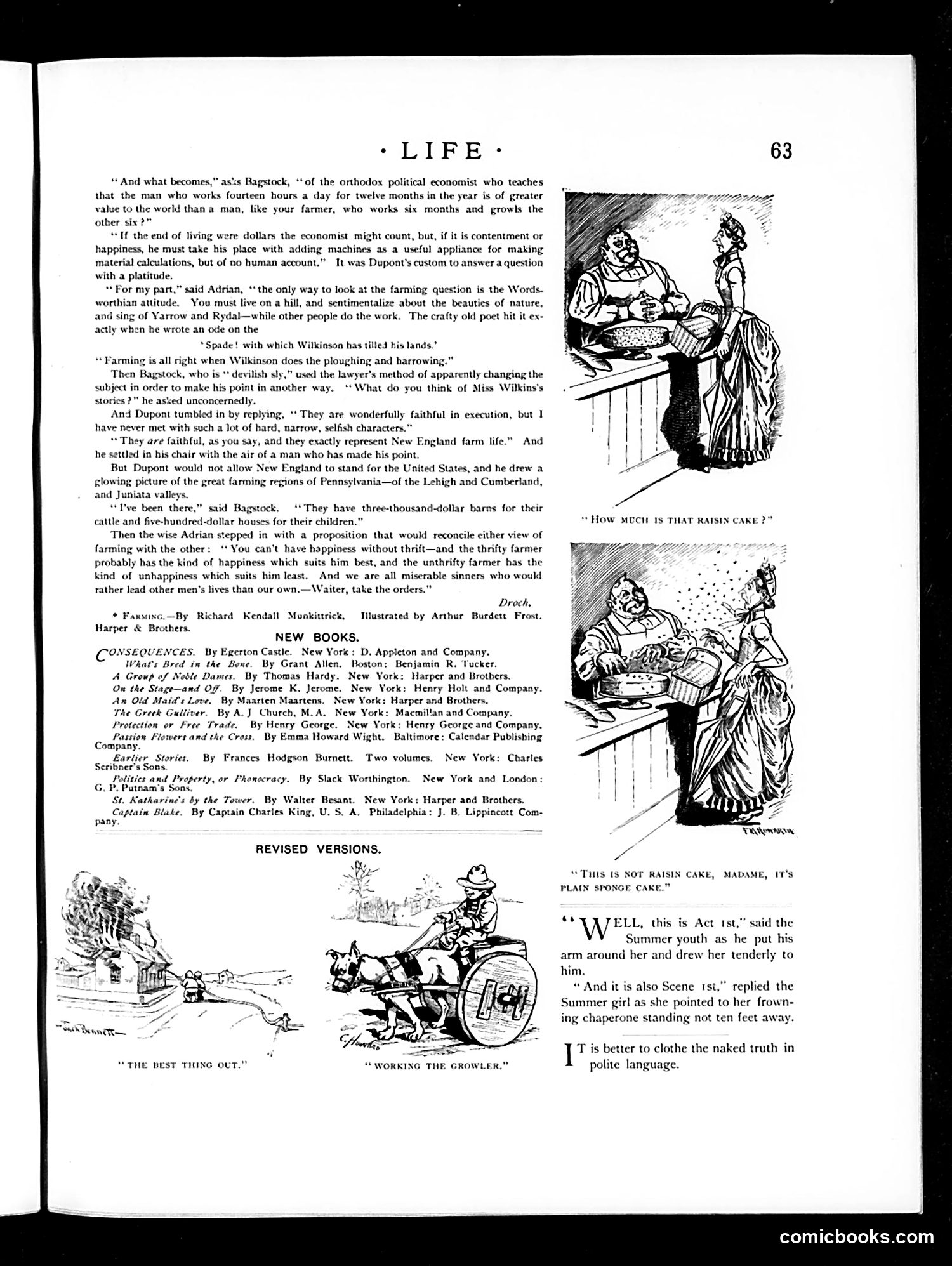
This page satirizes debates about farming and rural economics. The text discusses economists' arguments about agricultural labor—specifically whether farmers working long hours contribute more to society than leisurely wealthy industrialists. The cartoon dialogue mocks gender and class pretensions: a woman asks "How much is that raisin cake?" A Summer youth (appearing to be from a wealthy background) corrects her, saying it's a "sponge cake," and later insists "It is better to clothe the naked truth in polite language"—satirizing upper-class affectation and euphemism. The humor targets both rural simplicity and urban gentility, reflecting early-20th-century tensions between agricultural and industrial economies, and between working-class directness and bourgeois propriety.
📄 Transcribed text from this page (OCR, searchable)
Machine-transcribed from the original scan — historical spelling and the odd misread are preserved.
‘LIFE: 63 “And what becomes,” ass Bagstock, ‘of the orthodox political economist who teaches that the man who works fourteen hours a day for twelve months in the year is of greater value to the world than a man, like your farmer, who works six months and growls the other six?” “If the end of living were dollars the economist might count, but, if it is contentment or happiness, he must take his place with adding machines as a useful appliance for making material calculations, but of no human account.” It was Dupont’s custom to answer a question with a platitude. “For my part,” said Adrian, * the only way to look at the farming question is the Words. worthian attitude. You must live on a hill, and sentimentalize about the beauties of nature, and sing of Yarrow and Rydal—while other people do the work. The crafty old poet hit it ex- actly when he wrote an ode on the “Spade! with which Wilkinson has tilled his lands." “Farming is all right when Wilkinson does the ploughing and harrowing.” Then Bagstock, who is * devilish sly,” used the lawyer's method of apparently changing the subject in order to make his point in another way. ‘* What do you think of Miss Wilkins's stories ?” he asked unconcernedly. And Dupont tumbled in by replying, “ They are wonderfully faithful in execution, but I have never met with such a lot of hard, narrow, selfish charact * They are faithful, as you say, and they exactly represent New England farm life.” And he settled in his chair with the air of a man who has made his point. But Dupont would not allow New England to stand for the United States, and he drew a glowing picture of the great farming regions of Pennsylvania—of the Lebigh and Cumberland, and Juniata valleys. “T've been there,” said Bagstock. ‘They have three-thousand-dollar barns for their cattle and five-hundred-dollar houses for their chikiren. Then the wise Adrian stepped in with a proposition that would reconcile either view of farming with the other: ‘+ You can’t have happiness without thrift—and the thrifty farmer probably has the kind of happiness which suits him best, and the unthrifty farmer has the kind of unhappiness which suits him least. And we are all miserable sinners who would rather lead other men’s lives than our own.—Waiter, take the orders.” Droch. * Faxsinc,—By Richard Kendall Munkittrick, Tllustrated by Arthur Burdett Frost. Harper & Brothers. NEW BOOKS. CoN EQUENCES. By Egerton Castle. New Yor: D. Appleton and Company. What's Bred in the Bone. By Grant Allen, Boston: Benjamin R. Tucker. A Group of Noble Dames. By Thomas Hardy. New York: Harper and Brothers. On the Stage—and Of. By Jerome K. Jerome. New York: Henry Holt and Company. An Old Maid's Love. By Maarten Maartens, New York: Harper and Brothers. The Greek Gulliver. By A.J Church, M.A, New York: Macmil'an and Company. Protection or Free Trade. By Henry George. N : Henry George and Company. Passion Flowers and the Cross. By Emma Howard Wight, Baltimore: Calendar Publishing Company, Earlier Stories. By Frances Hodgson Burnett. Two volumes, New York: Charles pner's Sons. Politics and Property, or Phonocracy, By Slack Worthington. New York and London; P, Putnam's Sons, St. Katharine's by the Tower. By Walter Besant. New York: Harper and Brothers. Captain Blake. By Captain Charles King, U.S. A, Philadelphia: J. B, Lippincott Com- pany. REVISED VERSIONS. ‘THIS IS NOT RAISIN CAKE, MADAME, IT'S PLAIN SPONGE CAKE.” se ZLL, this is Act 1st,” said the Summer youth as he put his arm around her and drew her tenderly to him. “ And it is also Scene tsi,” replied the Summer girl as she pointed to her frown- ing chaperone standing not ten feet away. T is better to clothe the naked truth in “THE BEST THING OUT.” “ WORKING THE GROWLER.” polite language. comicbooks.com