
A complete issue · 15 pages · 1891
Life — May 21, 1891
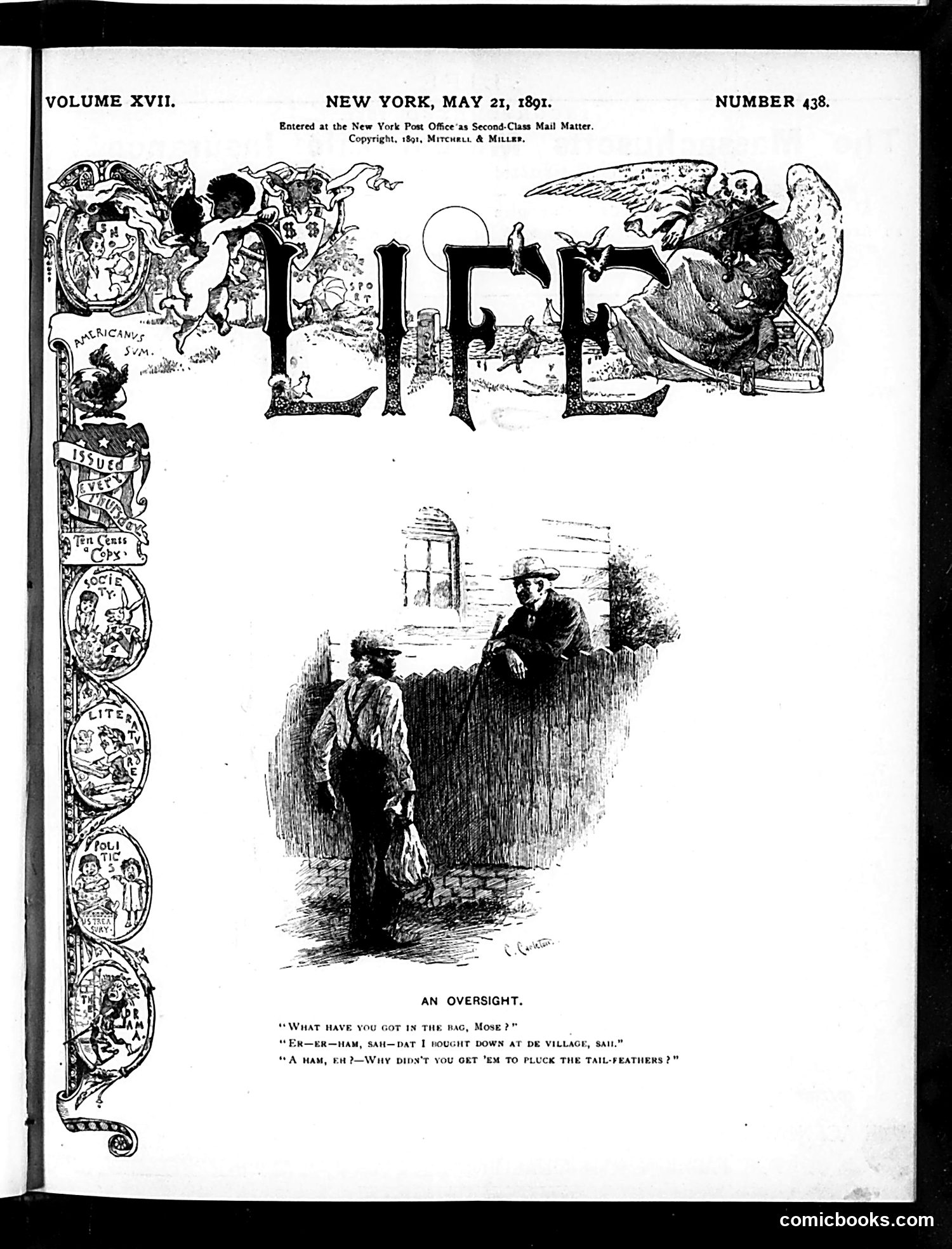
This page contains a single cartoon titled "An Oversight" depicting two men at a fence—one arriving with a bag, the other questioning him. The dialogue reveals a comedic misunderstanding: the first man bought a ham at the village but failed to purchase feathers for the tail, apparently expecting to pluck tail-feathers from the ham itself. The humor is straightforward wordplay: "ham" refers both to the meat and to a poor/exaggerated performer. The joke satirizes either rural simplicity or someone's theatrical pretensions—the "oversight" being the absurd notion that a ham would have tail-feathers to pluck. The ornate left border features Life's characteristic decorative design with small illustrated vignettes, typical of the magazine's 1890s aesthetic.
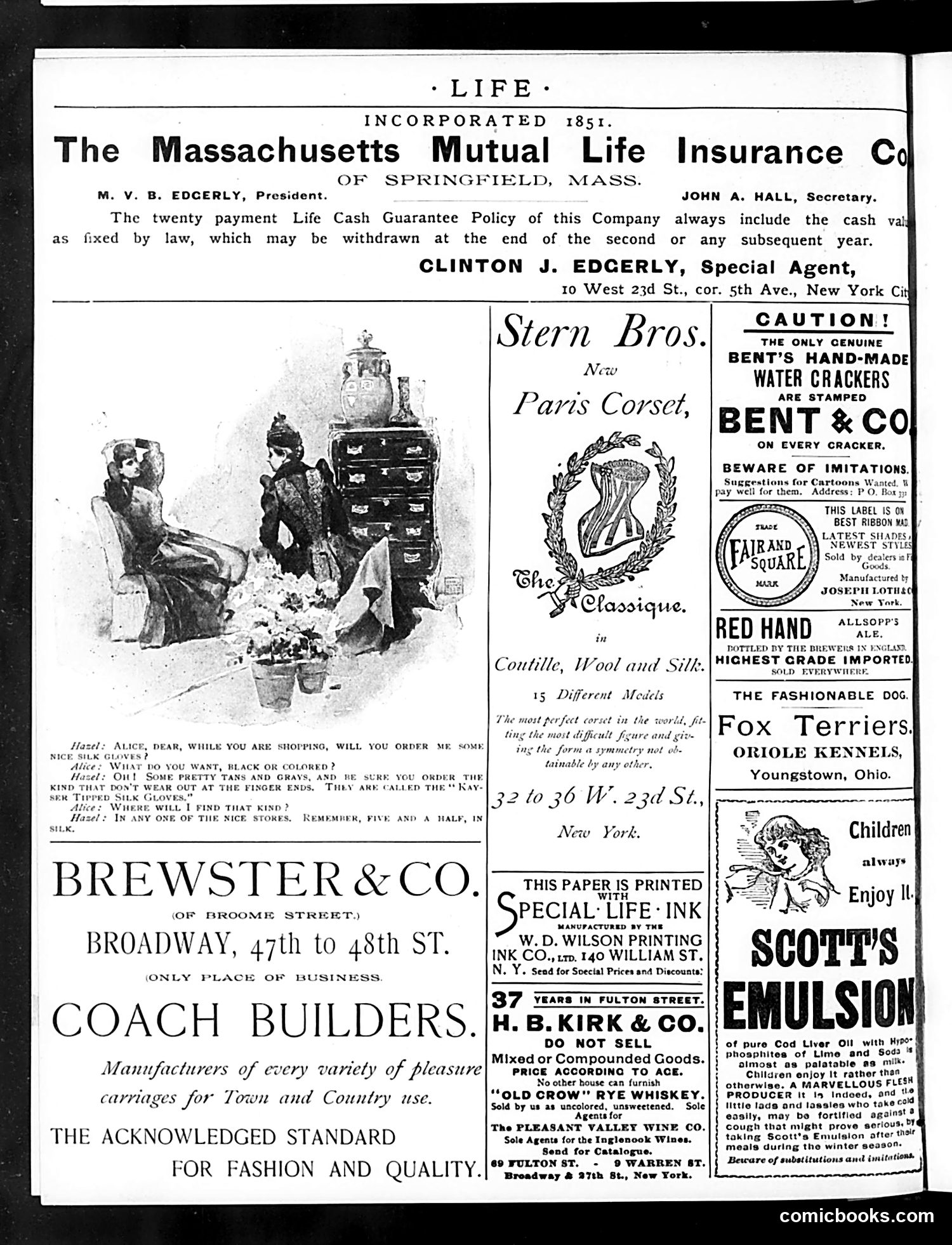
This page is **primarily advertising** with one small satirical cartoon. The main illustration (left side) shows a dialogue between two figures shopping, labeled "Hazel" and "Alice." Alice asks Hazel what silk she wants, and Hazel responds about wanting "nice silk stockings" in black or colored. The joke appears to reference **"K-AVE" brand stockings**, which apparently had a distinctive feature—they "don't wear out at the finger ends," addressing a common wear problem of the era. The cartoon mocks women's hosiery concerns of the early 1900s, when silk stockings were luxury items prone to damage. The satire is gentle, playing on feminine shopping preferences rather than political content. The rest of the page consists of advertisements for corsets, carriages, dog breeds, whiskey, and medicinal emulsions—typical of *Life* magazine's revenue model.
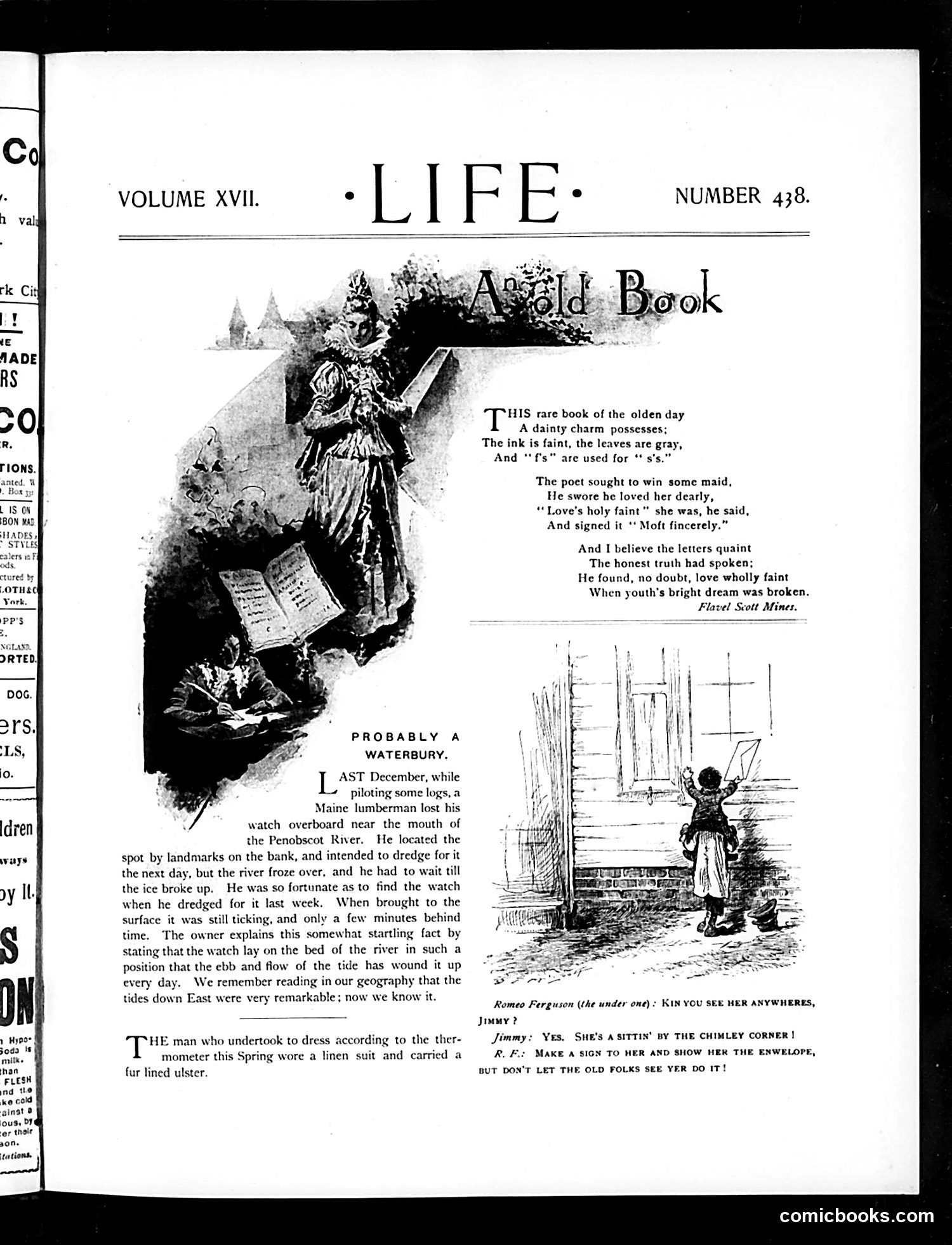
This page features "A Old Book," a nostalgic piece about antiquated documents and customs. The main illustration depicts a period-dressed figure holding an old manuscript, evoking romance with historical handwriting and letters. The two anecdotes below are humorous observations: 1. **"Probably a Waterbury"**: A story about a lumberman losing his watch in a frozen river, then recovering it weeks later still functioning—explained by the watch's waterproof design and the river's tidal action. 2. **The thermometer anecdote**: A brief joke about dressing according to temperature in spring while wearing a fur-lined ulster (overcoat). The satirical tone mocks both obsolete technology and outdated fashion conventions. The dialogue between characters named Jimmy and R.F. suggests gentle mockery of old-fashioned propriety.
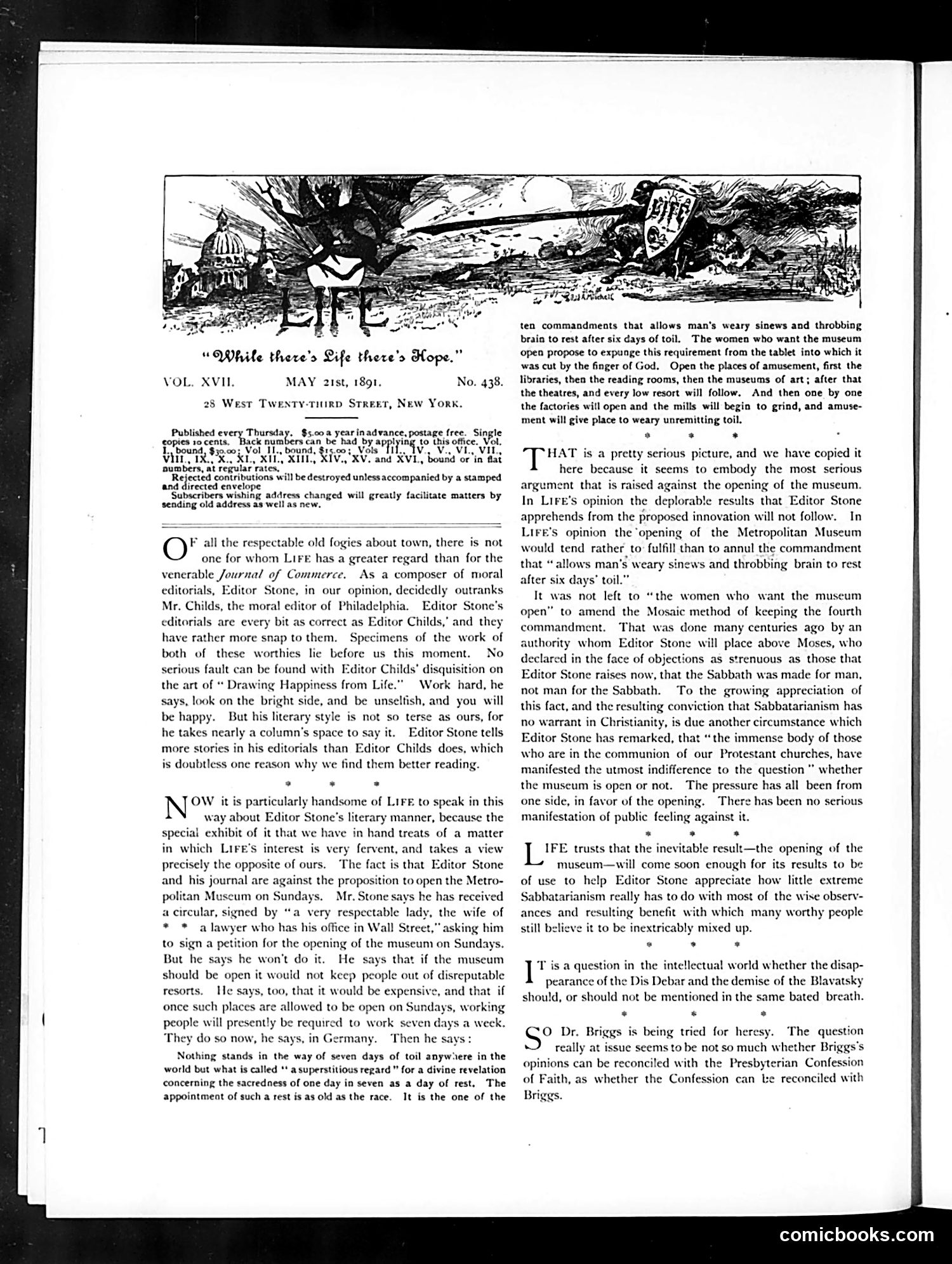
The masthead cartoon depicts a tree growing from an urban landscape with a classical dome (likely representing civic institutions), illustrating the magazine's title: "While there's Life there's Hope." The editorial content addresses a contemporary debate about opening the Metropolitan Museum on Sundays. Editor Stone opposes this, citing religious concerns about Sabbath observance. The text argues that allowing museums to open on Sundays violates the sacred nature of rest—a commandment given to allow workers respite from labor. The piece critiques both those wanting Sunday museum access and religious objections to it, discussing tensions between religious tradition, public welfare, and labor rights that characterized late 19th-century American social debates.
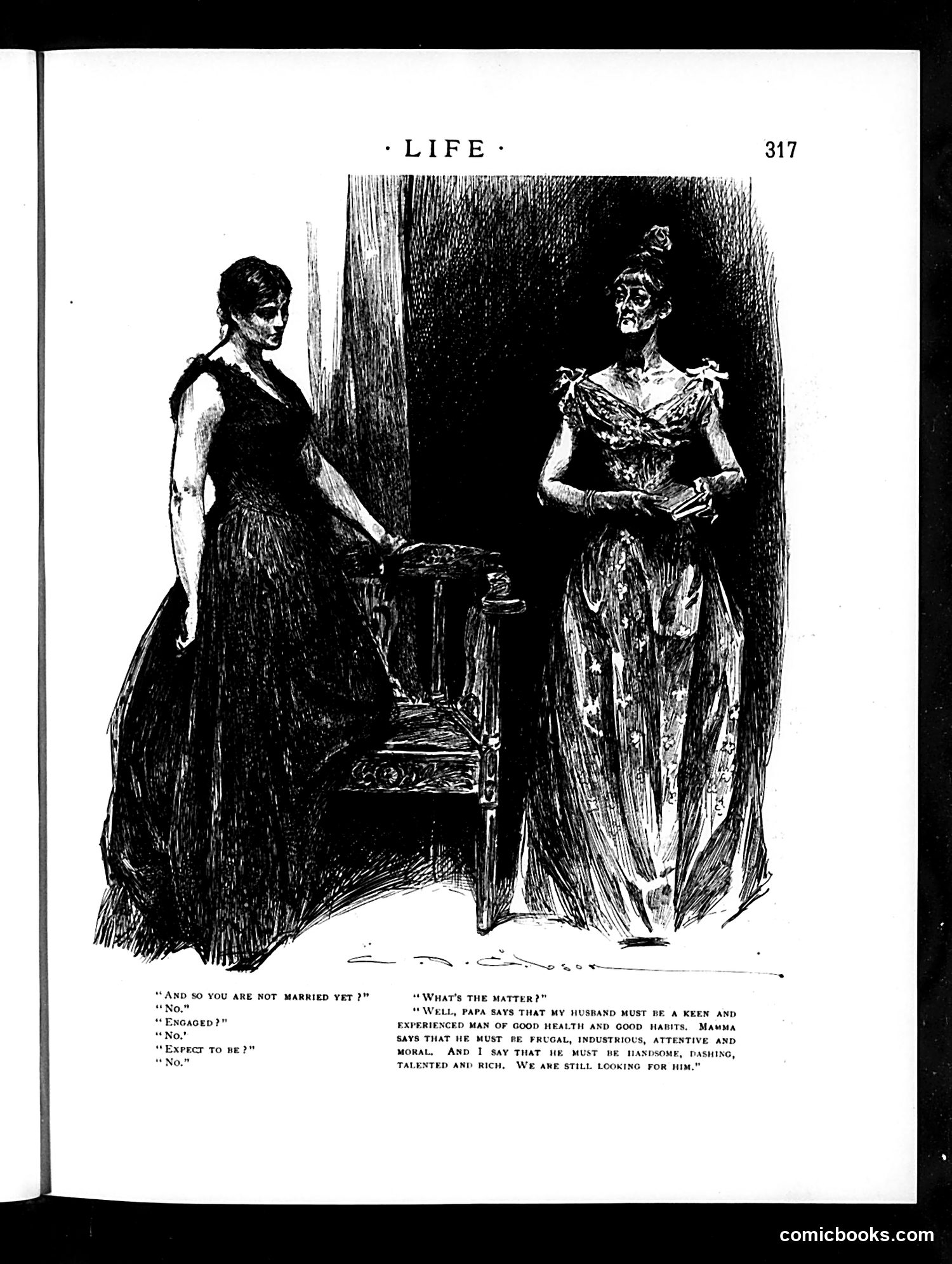
This satirical cartoon depicts two women in conversation. The left figure asks a series of questions about the right figure's marital status, receiving only "No" responses. The right figure then explains her predicament: her father has established exacting criteria for a suitable husband—he must be "keen and experienced," possess "good health and good habits," be "frugal, industrious, attentive and moral," and additionally be "handsome, dashing, talented and rich." The satire targets the impossible standards fathers (and society) placed on potential suitors while girls remained unmarried. The joke critiques how women's marriage prospects were controlled by paternal demands that were simultaneously contradictory and unrealistic—expecting a man to be simultaneously austere ("frugal") and glamorous ("dashing, handsome"). It reflects early-20th-century anxieties about marriage markets and female dependence.
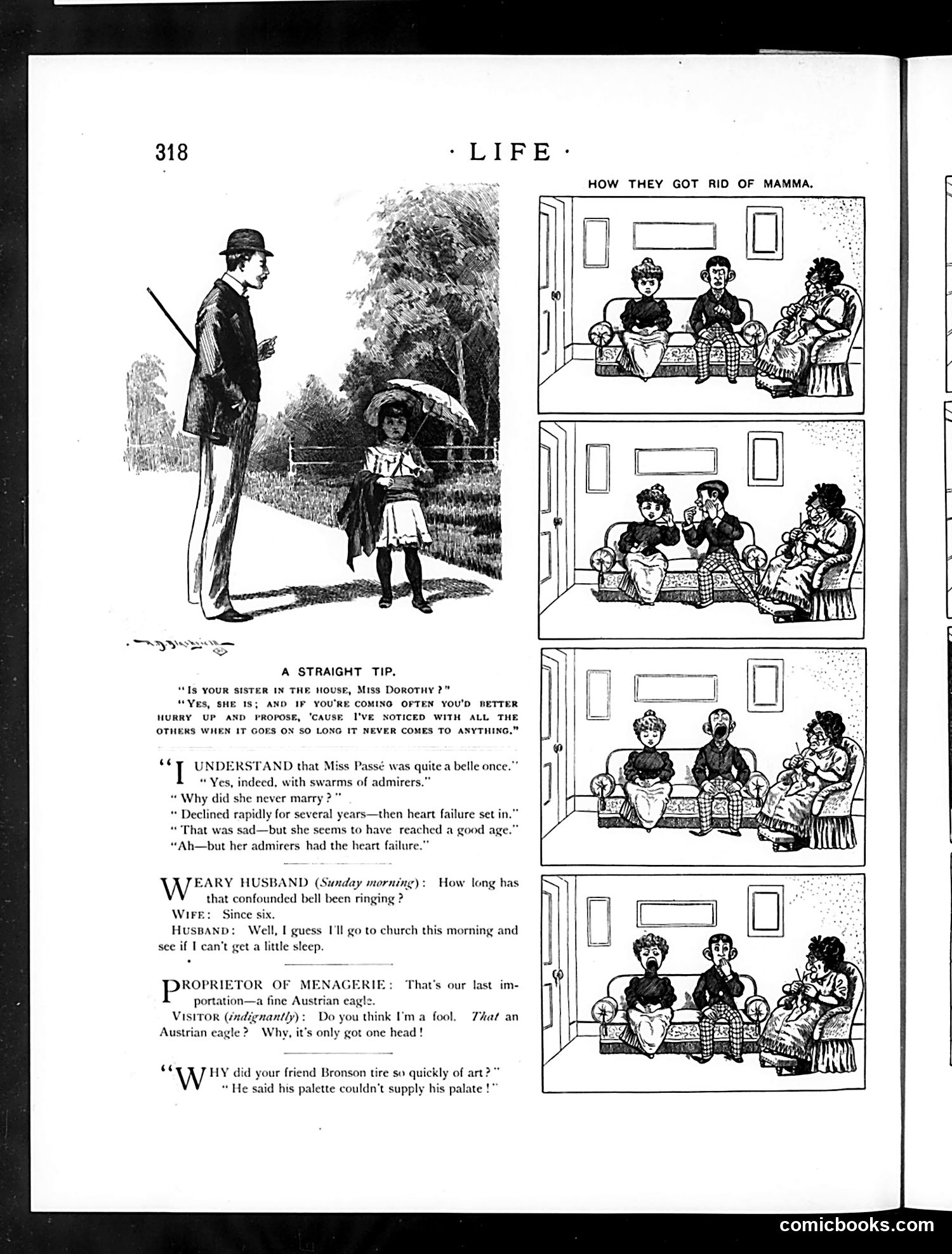
This page contains several unrelated humor items typical of Life's satirical format: **"A Straight Tip"** shows a man advising a young girl about her sister's absence from home, implying the sister is away due to romantic entanglements rather than legitimate reasons—a veiled reference to social scandal. **"How They Got Rid of Mamma"** is a four-panel comic strip showing family members gradually excluding their mother from the living room sofa, with each panel showing her further removed until she's gone—satirizing how families might marginalize elderly relatives. The remaining items ("Weary Husband," "Proprietor of Menagerie," "Why did your friend Bronson tire") are brief joke exchanges about mundane domestic situations and wordplay, typical of the magazine's humor section.
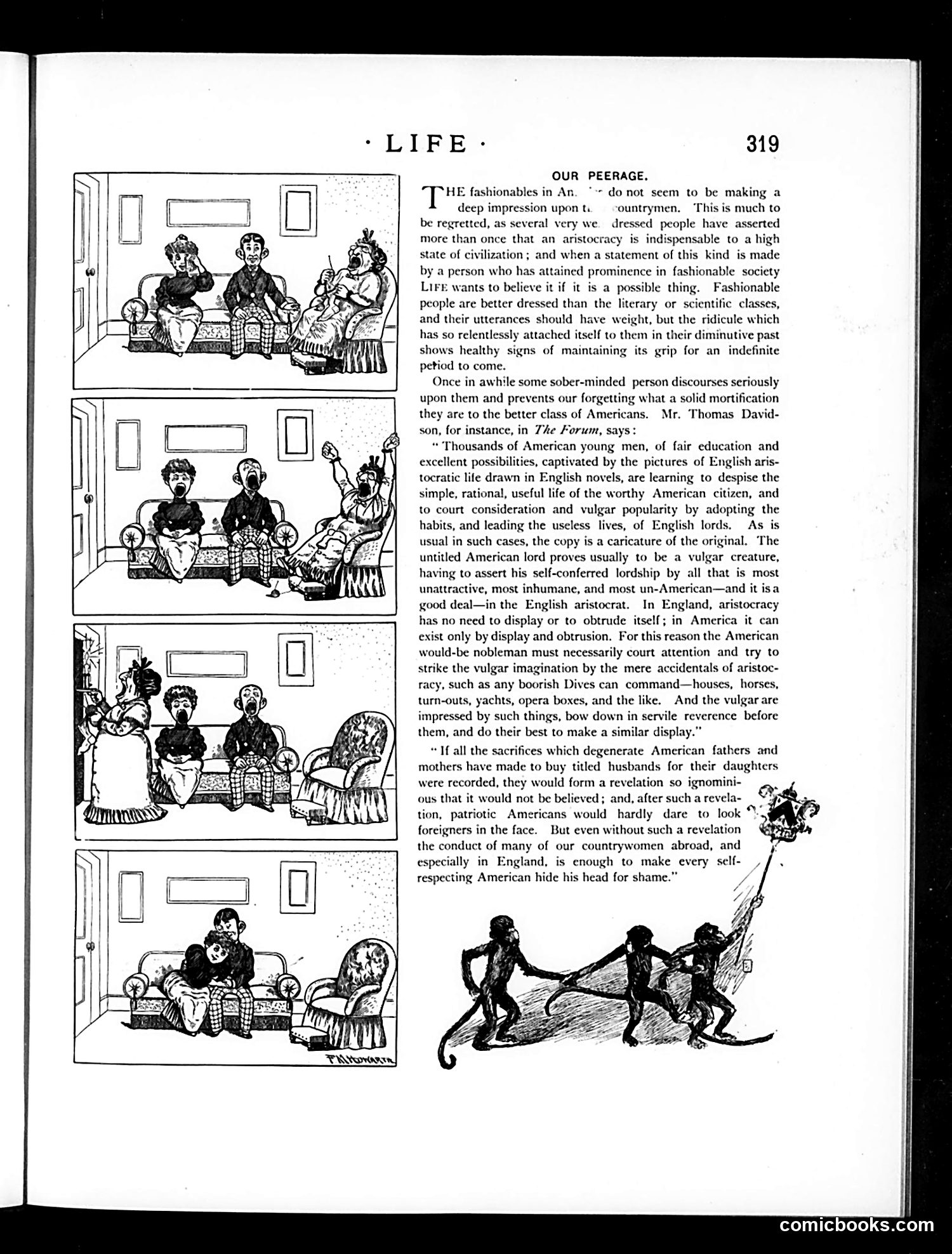
This satirical piece critiques American social climbing through the adoption of British aristocratic customs. The four sequential cartoons show a family's progressive transformation from modest American dress and behavior to increasingly affected "aristocratic" manners and appearance. The accompanying text argues that fashionable Americans imitating English aristocracy are ridiculous and un-American. Life particularly mocks young American men adopting English habits after reading novels, creating vulgar caricatures rather than genuine refinement. The final illustration of caricatured ape-like figures appears to mock this excessive imitation as degenerative—suggesting that abandoning American identity for affected English pretension represents a descent rather than elevation. The satire targets American aspirational class-consciousness and the perceived cultural inferiority many felt toward Britain during this period.
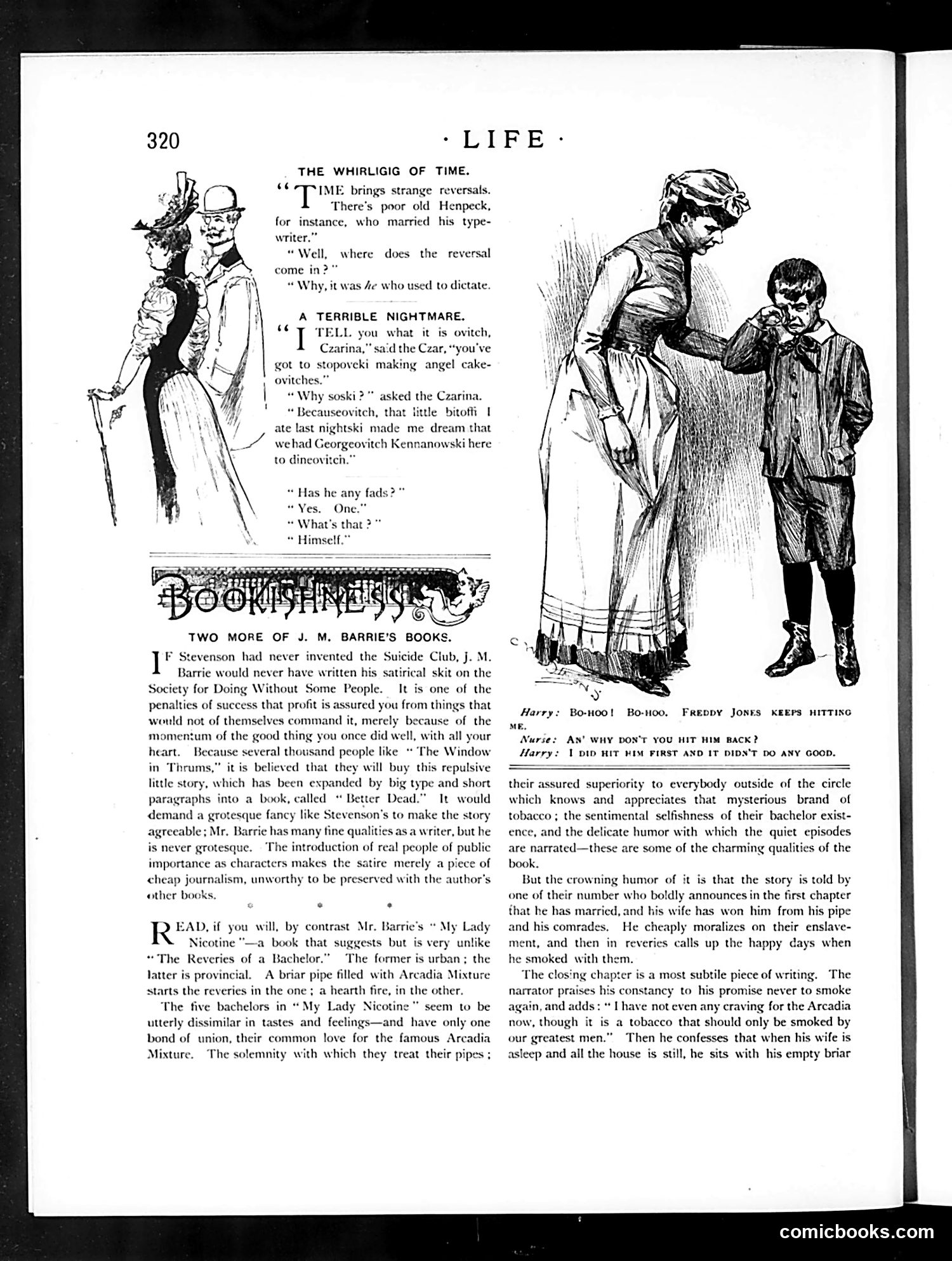
This page from *Life* magazine contains two distinct sections: **Top Section ("The Whirligig of Time")**: A brief satirical dialogue mocking poor old "Henpeck," whose typewriter-wielding wife now dominates him—reversing their traditional marital roles. The joke relies on early 20th-century gender assumptions about who "should" control domestic life. **Main Section ("Two More of J.M. Barrie's Books")**: A literary review of Scottish author J.M. Barrie's works, discussing his satirical novel about a "Society for Doing Without Some People." The critic argues Barrie's sharp social satire works better in short form than expanded into full books. The accompanying illustrations show figures from his stories. **Bottom illustration**: Shows interaction between a woman and boy named "Freddy Jones," with dialogue about hitting—unclear without fuller context. The page targets both gender role reversals and literary pretension of the era.
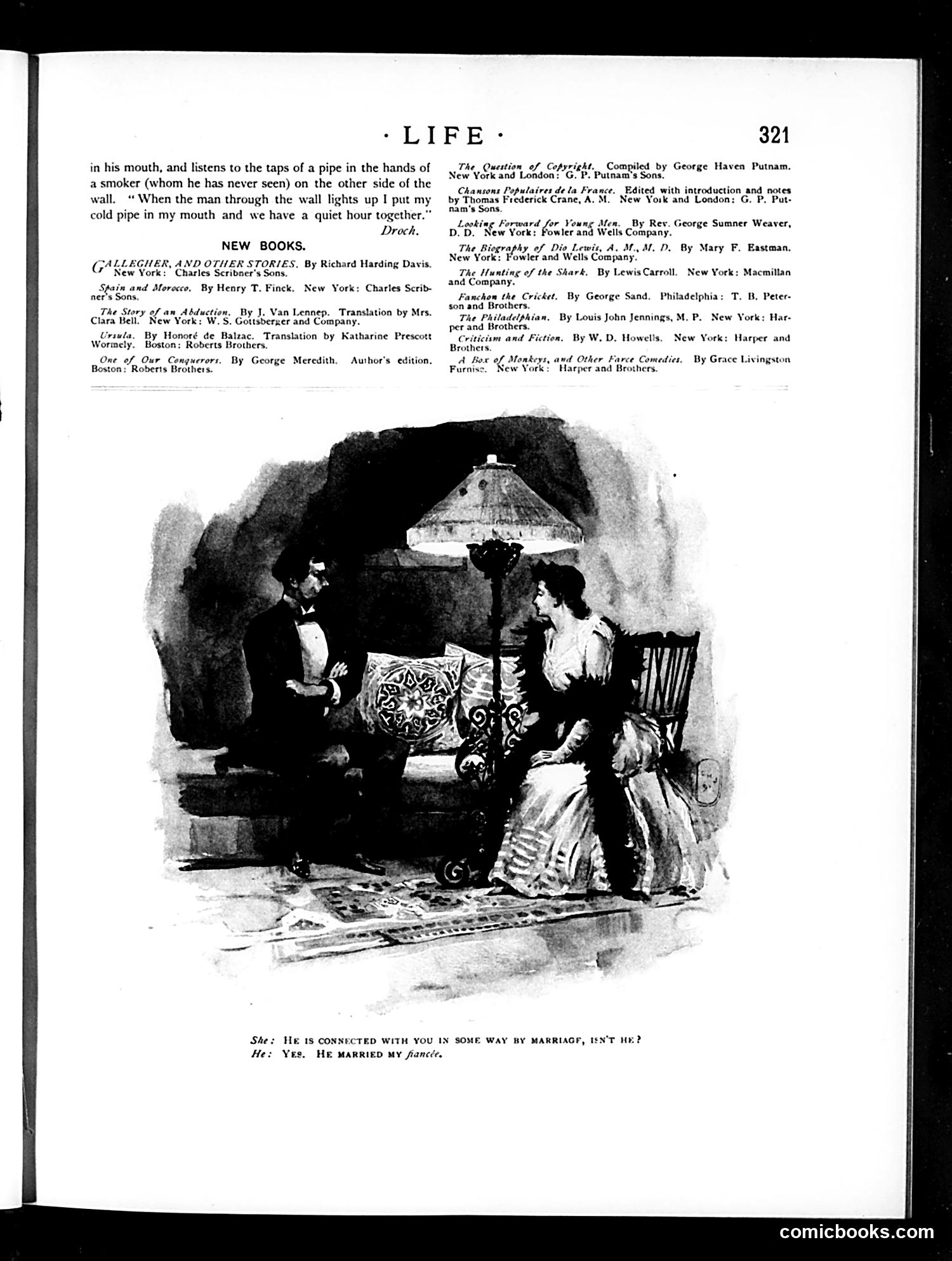
This page contains a book review section titled "NEW BOOKS" listing various literary works, along with a single illustration below. The illustration depicts two figures in formal attire seated at a small table under a lamp in what appears to be an intimate indoor setting. The caption reads: "She: He is connected with you in some way by marriage, isn't he? / He: Yes. He married my [?]." This is a **domestic humor cartoon** playing on the confusion of family relationships and marriage connections—a common satirical theme in early-to-mid 20th century Life magazine. The joke relies on the awkwardness of explaining in-law relationships, suggesting the man's unclear or complicated family ties. No specific political figures or events are referenced; it's simply social satire about ordinary human relationships.
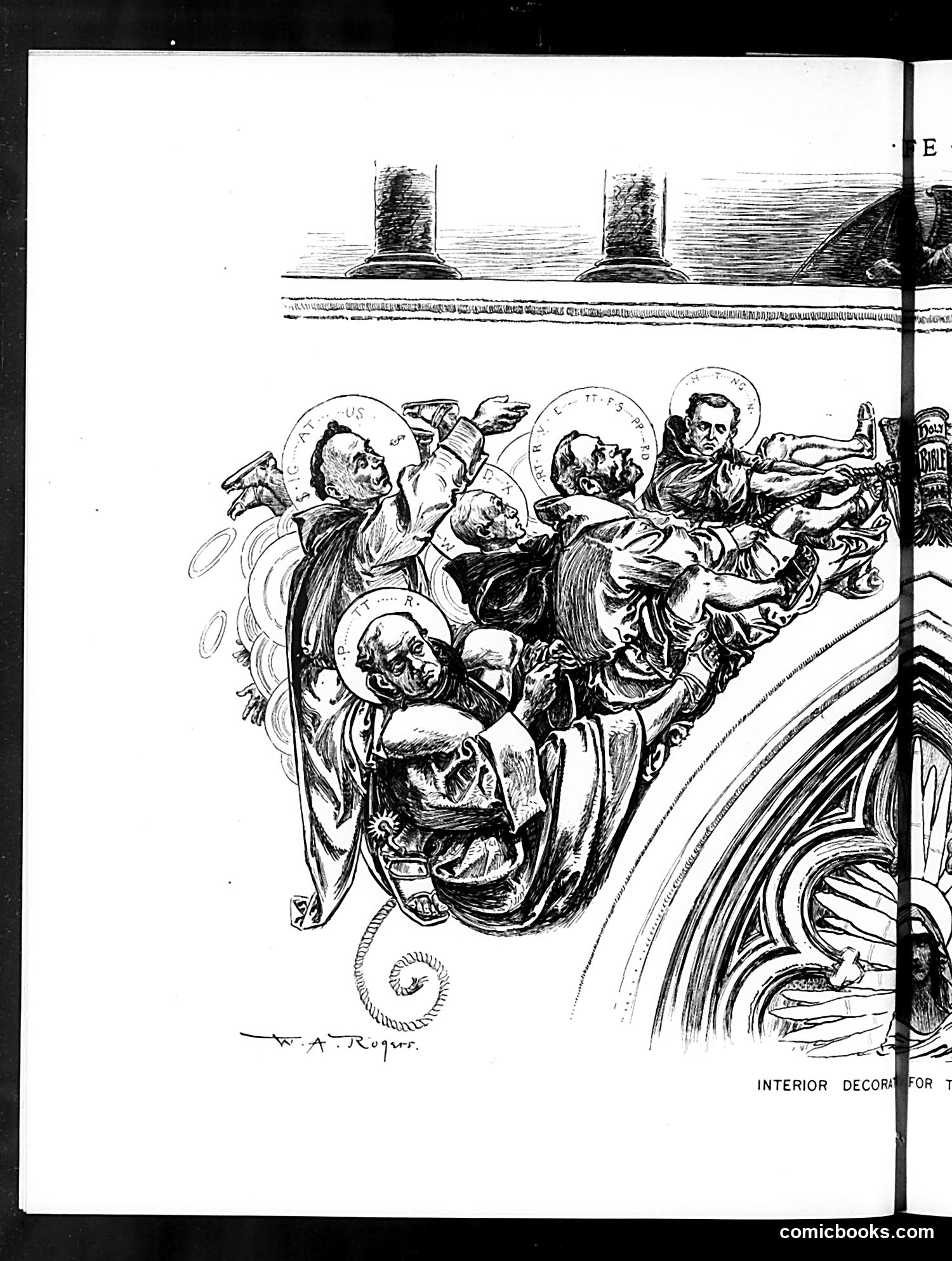
This is a satirical cartoon signed by A. Roeser depicting what appears to be political or social figures crammed inside a large head or vessel, wearing halos (suggesting sainthood or ironic virtue). The circular plates or discs they wear likely represent labels or identities. The cartoon critiques overcrowding or conflicting interests—possibly referring to a government body, political party, or institution packed with competing personalities or agendas. The architectural elements visible on the right suggest an institutional or governmental setting. Without clearer text identifying the specific individuals or clearer date context, the precise political target remains somewhat unclear, though the satire suggests commentary on incompatible egos or interests crammed into one space. The page caption mentions "INTERIOR DECOR FOR T[...]" (text cut off).
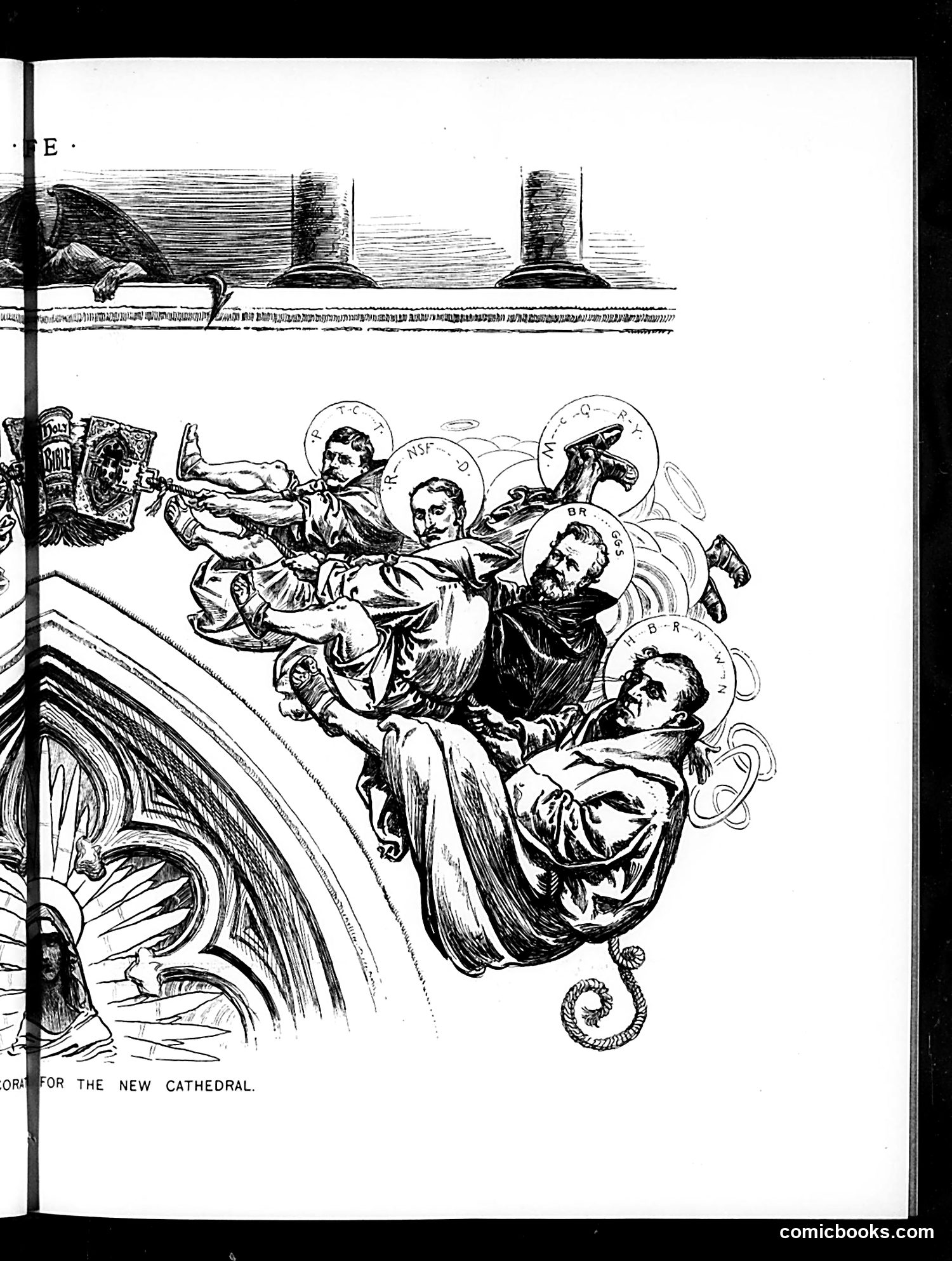
This appears to be a satirical cartoon from Life magazine depicting religious or ecclesiastical figures (indicated by their halos) in clouds, seemingly ascending or floating heavenward. The figures wear robes and have distinct facial features rendered as caricatures. Text at the bottom reads "FOR THE NEW CATHEDRAL," suggesting this references fundraising or construction efforts for a cathedral building project. The satire likely mocks prominent clergy or wealthy donors involved in the cathedral's financing. The halo imagery ironically suggests these figures consider themselves saintly, while the cartoon implies criticism of their actual motivations—possibly regarding money, vanity, or hypocrisy. Without additional context about which cathedral or specific historical moment this references, the precise targets remain unclear, though the satirical intent is evident.
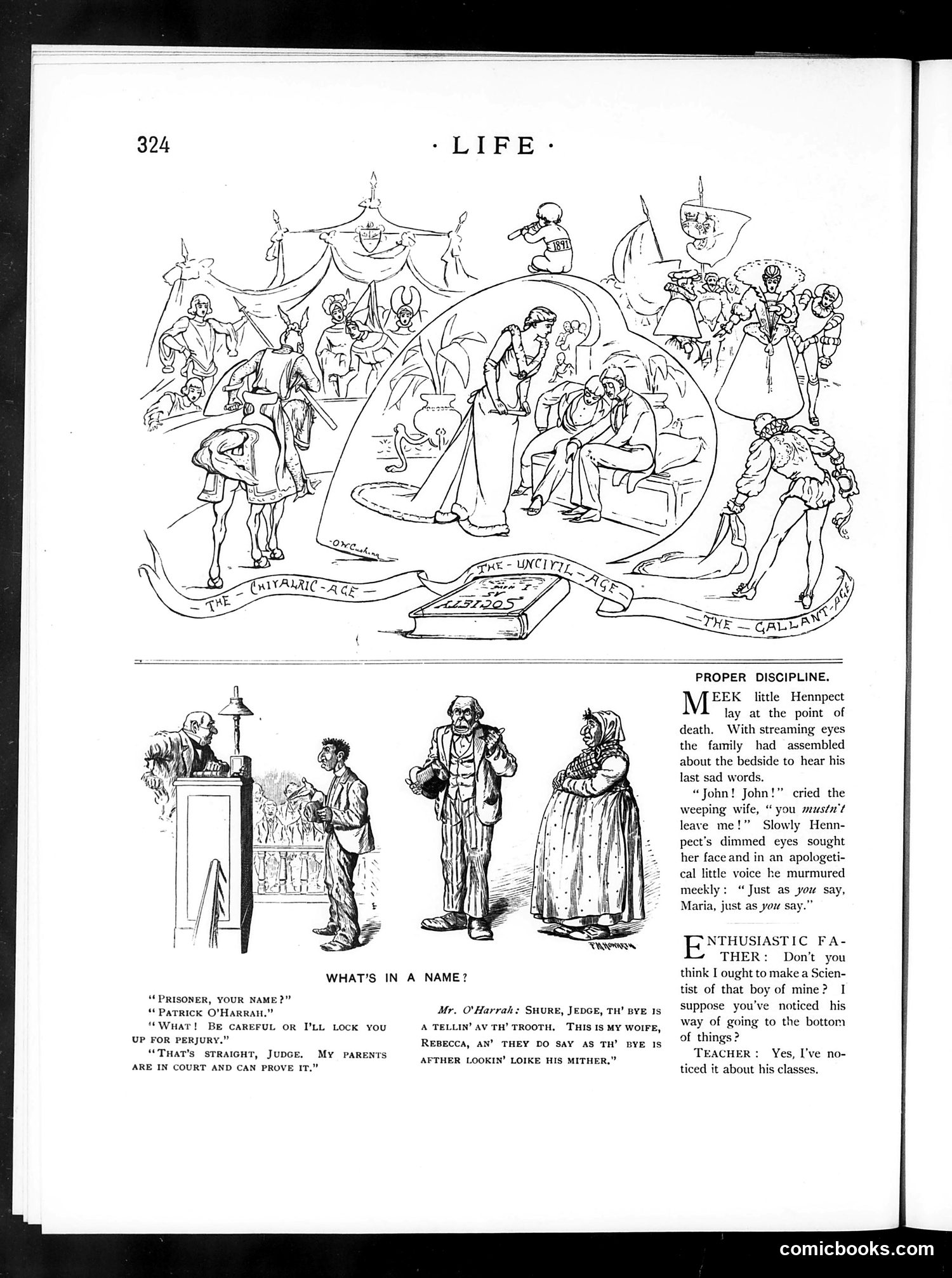
This page contains three satirical vignettes mocking social pretension and hypocrisy: **"Proper Discipline"**: A dying man named Hennpect, even on his deathbed, remains so henpecked by his wife that he cannot assert himself. The joke satirizes weak men who are completely dominated by their wives—his final words are apologetic compliance. **"What's in a Name?"**: An Irish immigrant prisoner named Patrick O'Harrah is warned by a judge not to commit perjury, but insists his parents can prove his identity. The satire targets stereotypes about Irish immigrants and dishonesty in court proceedings. **"Enthusiastic Father"**: A father asks a teacher whether to make his son a scientist, noting the boy "goes to the bottom of things"—apparently meaning he's failing his classes. The humor mocks parents who misinterpret their children's academic struggles as scientific aptitude. The top illustration depicts various historical ages (Chivalric Age, Uncivilized Age, Gallant Age), likely satirizing nostalgia for past eras.
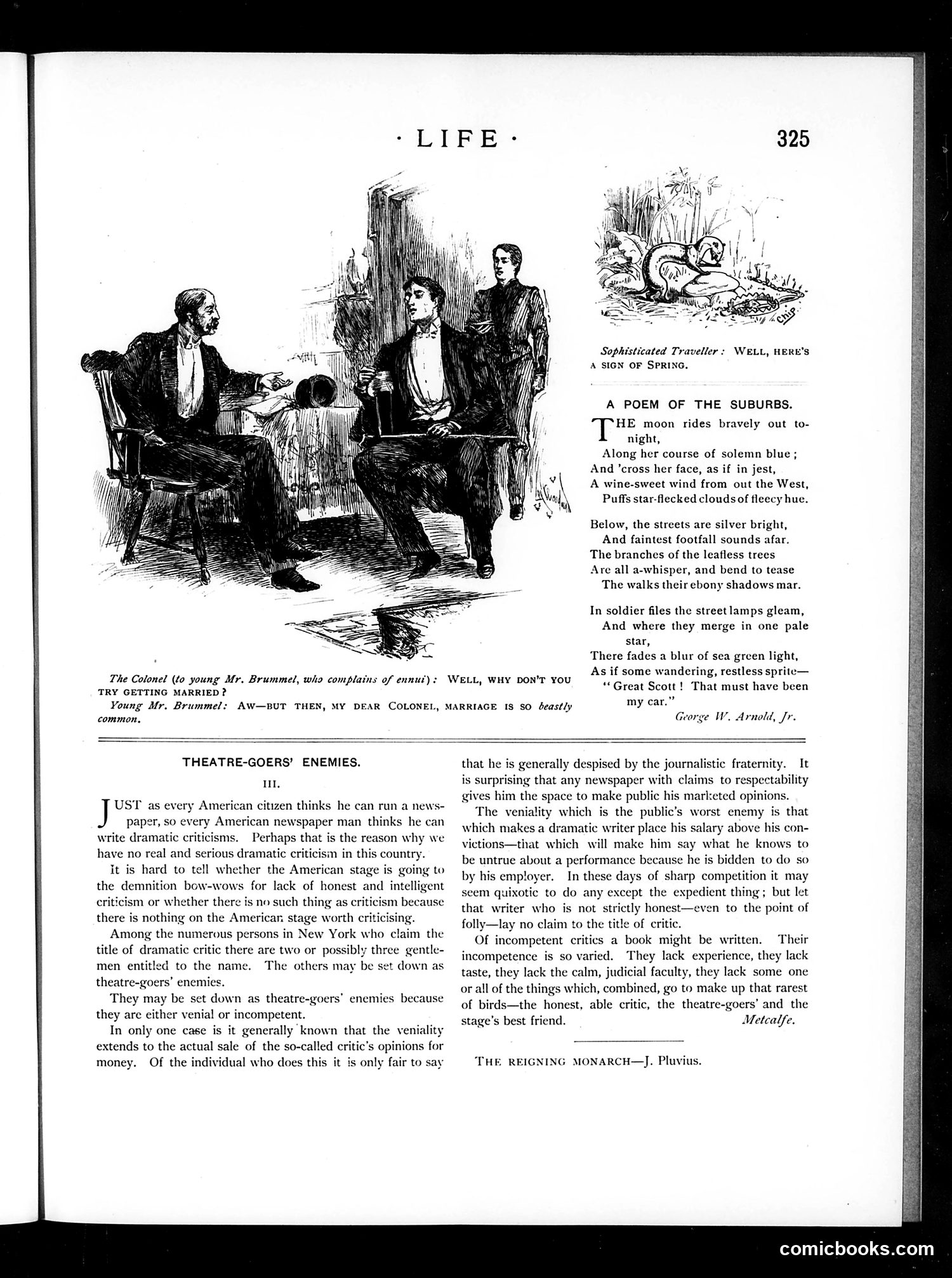
**Top Cartoon**: A Colonel counsels a bored young man (identified as "Mr. Brummel," referencing the famous Regency dandy) to cure his ennui by marrying. Brummel dismisses the idea as "beastly common"—satirizing upper-class pretension and the absurd complaints of wealthy idle men who reject practical solutions because they're beneath their social station. **Middle Section**: A humorous poem mocking suburban sentimentality. It romanticizes moonlit nights and quiet streets, then deflates itself with a punchline: the "wandering sprite" is actually the speaker's car—satirizing how modern intrusions (automobiles) interrupt pastoral reverie. **Main Article**: "Theatre-Goers' Enemies" criticizes New York drama critics. The piece argues most self-proclaimed critics are either dishonest (selling favorable reviews) or incompetent (lacking taste, experience, judgment). It distinguishes between mercenary critics and those who compromise integrity for employer demands, calling both enemies of theatre and audiences.
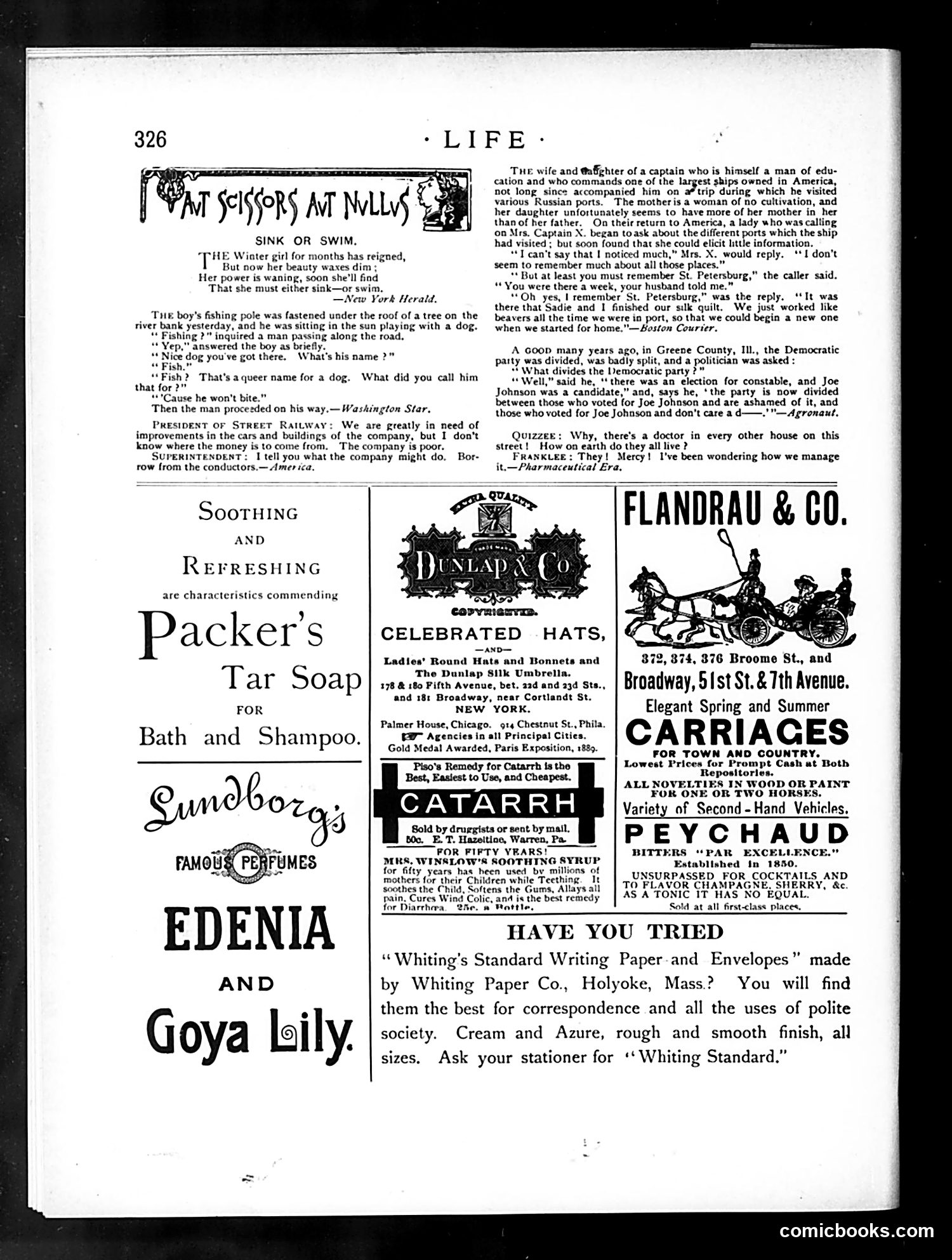
This page is primarily **advertising** with several short humorous anecdotes scattered throughout. The main text includes brief satirical sketches: 1. **"Sink or Swim"**: A seasonal joke about a "Winter girl" losing her power—likely referring to seasonal social dynamics or a specific contemporary figure whose relevance is unclear today. 2. **A fishing story**: A boy with a dog named "Fish" who "won't bite"—a simple pun with no political content. 3. **Street Railway joke**: A superintendent suggests the company borrow money from conductors—satirizing corporate penny-pinching. 4. **Captain's wife anecdote**: Mocks an uneducated woman's lack of cultural awareness during travels to Russian ports, focusing on her needlework rather than sightseeing—a class/education satire. 5. **Greene County politics**: A joke about Democratic Party division over a constable election candidate named Joe Johnson—local Illinois political satire, unclear without historical context. The remainder consists of period advertisements for soaps, hats, carriages, and patent medicines. No identifiable political cartoons appear on this page.

I can see this is a page from Life magazine, but the image is almost entirely black with only a white edge visible on the left side and the "comicbooks.com" watermark at the bottom right. The OCR text provided is minimal and contains only a website reference. I cannot discern any cartoon content, figures, caricatures, text, or satirical elements from this image. The page appears to be either a blank page, severely damaged, improperly scanned, or reproduced at insufficient contrast to read. Without visible content to analyze, I cannot identify political references, satirical points, or historical context for a modern reader. A clearer image would be needed to provide the analysis you've requested.