
Life, 1891-05-21 · page 7 of 15
Life — May 21, 1891 — page 7: what you’re looking at
What you’re looking at
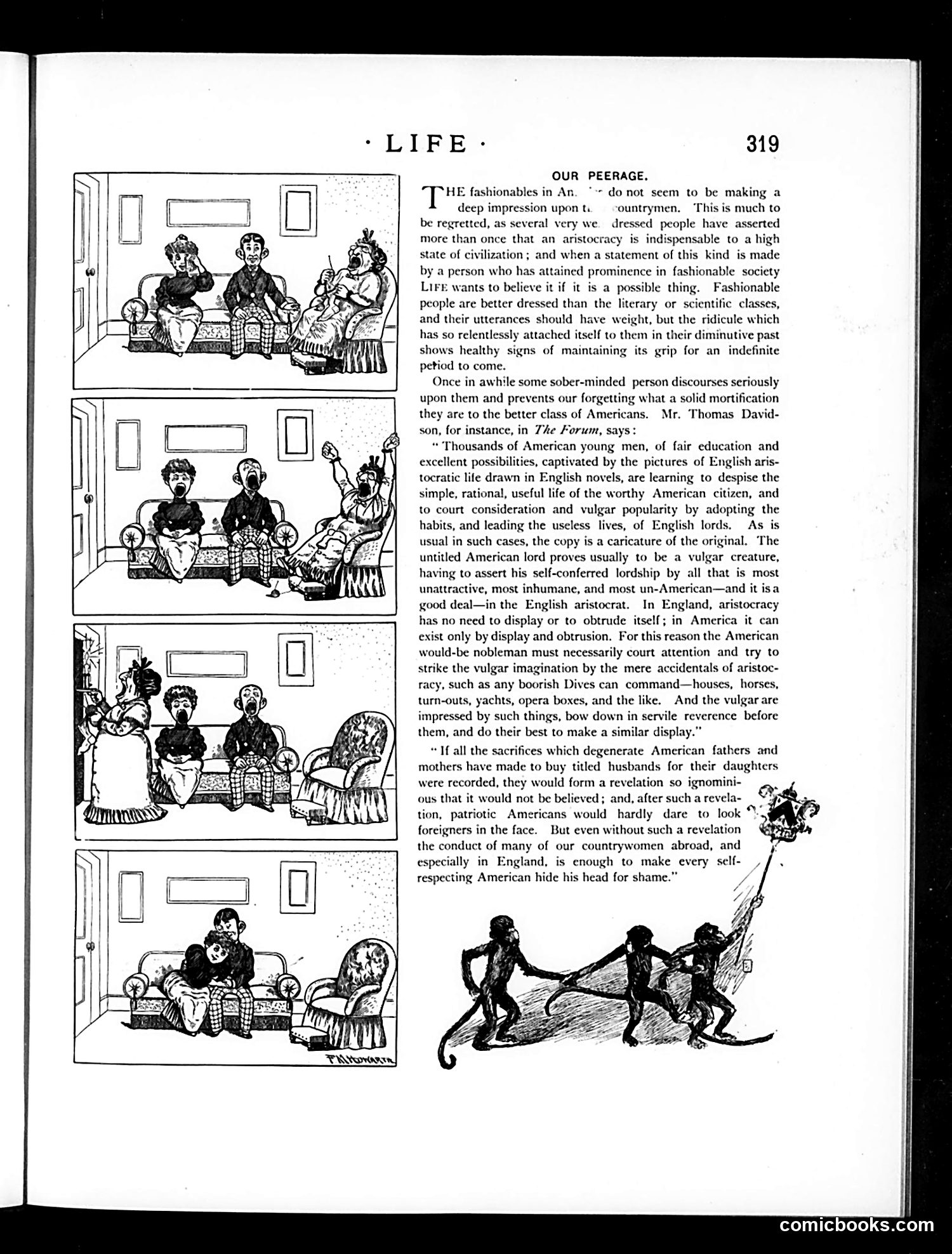
This satirical piece critiques American social climbing through the adoption of British aristocratic customs. The four sequential cartoons show a family's progressive transformation from modest American dress and behavior to increasingly affected "aristocratic" manners and appearance. The accompanying text argues that fashionable Americans imitating English aristocracy are ridiculous and un-American. Life particularly mocks young American men adopting English habits after reading novels, creating vulgar caricatures rather than genuine refinement. The final illustration of caricatured ape-like figures appears to mock this excessive imitation as degenerative—suggesting that abandoning American identity for affected English pretension represents a descent rather than elevation. The satire targets American aspirational class-consciousness and the perceived cultural inferiority many felt toward Britain during this period.
📄 Transcribed text from this page (OCR, searchable)
Machine-transcribed from the original scan — historical spelling and the odd misread are preserved.
‘LIFE: 319 OUR PEERAGE, HE fashionables in An. ** do not seem to be making a deep impression upon t ountrymen, ‘This is much to be regretted, as several very we dressed people have asserted more than once that an aristocracy is indispensable to a high state of civilization ; and when a statement of this kind is made by a person who has attained prominence in fashionable society LiFe wants to believe it if it is a possible thing. Fashionable people are better dressed than the literary or scientific classes, and their utterances should have weight, but the ridicule which has so relentlessly attached itself to them in their diminutive past shows healthy signs of maintaining its grip for an indefinite petiod to come. Once in awhile some sober-minded person discourses seriously upon them and prevents our forgetting what a solid mortification they are to the better class of Americans. Mr. Thomas David- son, for instance, in The Forum, says: Thousands of American young men, of fair education and excellent possibilities, captivated by the pictures of English aris- tocratic life drawn in English novels, are learning to despise the simple, rational, useful life of the worthy American citizen, and to court consideration and vulgar popularity by adopting the habits, and leading the useless lives, of English lords. As is usual in such cases, the copy is a caricature of the original. The untitled American lord proves usually to be a vulgar creature, having to assert his self-conferred lordship by all that is most unattractive, most inhumane, and most un-American—and it isa good deal—in the English aristocrat. In England, aristocracy has no need to display or to obtrude itself; in America it can exist only by display and obtrusion. For this reason the American would-be nobleman must necessarily court attention and try to strike the vulgar imagination by the mere accidentals of aristoc- racy, such as any boorish Dives can command—houses, horses, turn-outs, yachts, opera boxes, and the like. And the vulgar are impressed by such things, bow down in servile reverence before them, and do their best to make a similar display.” * If all the sacrifices which degenerate American fathers and mothers have made to buy titled husbands for their daughters were recorded, they would form a revelation so ignomini- “= ous that it would not be believed ; and, after such a revela- © tion, patriotic Americans would hardly dare to look * foreigners in the face. But even without such a revelation the conduct of many of our countrywomen abroad, and especially in England, is enough to make every self- respecting American hide his head for shame.” p= (assess, comicbooks.com